

Many Maratha heroes have sacrificed their lives to save Hindutva and one of them the eldest son of Chhatrapati Shivaji Maharaj, Shri Chatrapati Sambhaji Maharaj Bhonsale. He was born on May 14 1657 to his mother Soyarabai. After the death of Shivaji Maharaj, on April 3, 1680, Sambhaji established the Hindu Empire and took over.

Sambhaji lost his mother Sai bai at the age of 2. After her death, his paternal grandmother Jijabai looked after him. Initially his stepmother, Soyarabai, also doted on him a lot. Sambhaji was a tiger cub in the true sense. He was extremely handsome and possessed immense bravery. He was a scholar of Sanskrit and eight other languages. In 1666, he was married to Yesu bai, and later the couple had a son – Shahu. On June 6th, 1674 at the time of the coronation of Shivaji Maharaj, he was declared the prince of the Sovereign Maratha Kingdom.
As a prince, Sambhaji proved his bravery and military brilliance on more than one occasion. He led and won his first war at Ramnagar at the age of 16. During 1675-76 he led successful campaigns in Goa and Karnataka.
Chhatrapati Sambhaji Maharaj was a true Dharmaveer, who just like his father Shivaji, did not bow before Aurangzeb although Aurangzeb brutally tortured Sambhaji Maharaj for more than 40 days. Hindus must learn how to sacrifice for Dharma from Sambhaji Maharaj.
A dramatic accession
Chhatrapati Shivaji passed away in April 1680, and for a good nine months Sambhaji was entangled in a bitter accession struggle with his half-brother Rajaram, who was 10 at the time. Soyrabai, Sambhaji’s stepmother and the mother of Rajaram, plotted against to keep him away from the throne. Ultimately though, Sambhaji gained the support of Maratha commander-in-chief Hambirrao Mohite and in January 1681 was officially crowned ruler of the Marathas. Rajaram, Soyrabai, and their associates were put under house arrest.
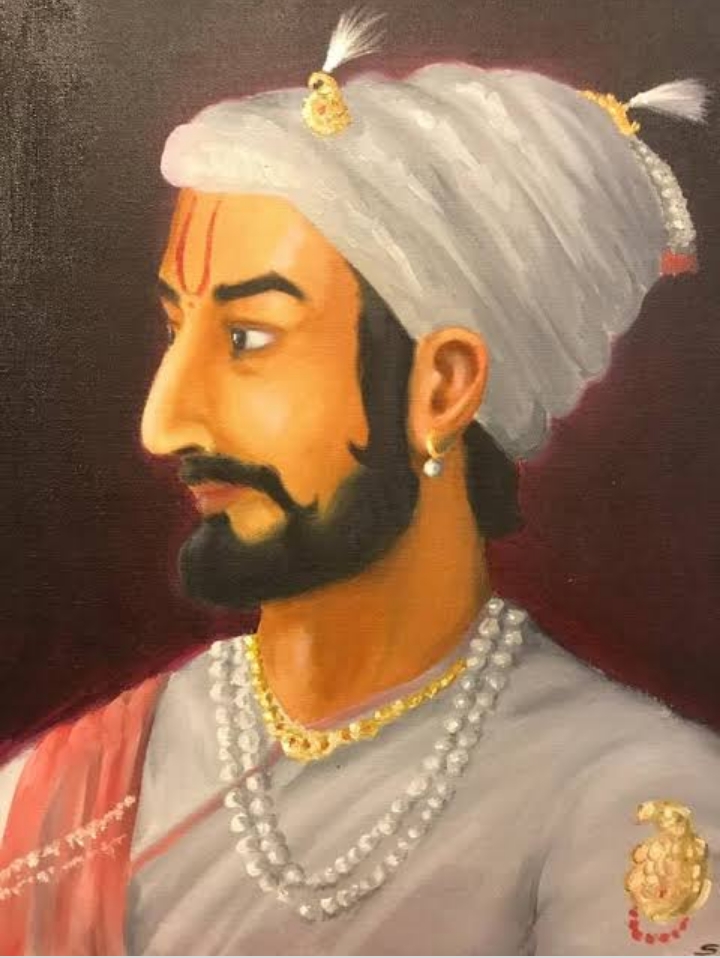
The remarkable things that Sambhaji Maharaj achieved in his short life had far-reaching effects on the whole of India. Every Hindu should be grateful to him for that. He valiantly faced the 8 lakh strong army of Aurangzeb and defeated several Mughal chieftains in the battlefield forcing them to retreat. Because of this, Aurangzeb remained engaged in battles in Maharashtra, thus keeping the rest of India free from Aurangzeb’s tyranny for a long time. This can be considered as the greatest achievement of Sambhaji Maharaj. If Sambhaji Maharaj would have arrived at a settlement with Aurangzeb and accepted his proposal of being a tributary prince, then within the next 2 or 3 years Aurangzeb would have captured North India again. However, because of Sambhaji Maharaj and other Maratha ruler’s (Rajaram and Maharani Tarabai) struggle, Aurangzeb was stuck in battles in South India for 27 years. This helped in the establishment of new Hindu kingdoms in the provinces of Bundelkhand, Punjab and Rajasthan in North India; thus providing safety to the Hindu society there.
Efforts for Reconversion to Hinduism
We all know that Shivaji Maharaj reconverted Netaji Palkar to Hinduism. However, it is important to note that Sambhaji Maharaj had established a separate department in his province for the ‘reconversion ceremony’ of the Hindus who had earlier converted into other religions. There is a story of a Brahmin named ‘Kulkarni’ of Harsul village in the history of Sambhaji Maharaj. Kulkarni had been forcibly converted to Islam by the Mughals. He tried to reconvert into Hinduism, but local Brahmins in his village did not pay any heed to him. In the end, Kulkarni met Sambhaji Maharaj and told him about his misery. Sambhaji Maharaj immediately arranged for his reconversion ceremony and reconverted him into a Hindu.This noble initiative of Sambhaji Maharaj helped many converted Hindus to reconvert back into Hinduism.
Face-off with the Mughals
The Mughals were the staunchest enemies of the Marathas during Sambhaji’s reign. One of the first major actions taken by Sambhaji against the Mughals, was when his forces attacked Burhanpur, a wealthy Mughal city in Madhya Pradesh. Sambhaji had planned the attack, being aware of Mughal emperor Aurangzeb’s plans to expand into the Deccan. Burhanpur was an important trading center and Sambhaji’s attack came as a huge blow for the Mughals.
For the next six years, between 1682 and 1688, the Marathas under Sambhaji and the Mughals under Aurangzeb were engaged in multiple battles in the Deccan. The Mughals wanted to acquire possession over the forts held by Marathas in Nashik and Baglana regions. In 1682, they attacked the Ramsej fort near Nashik. However, despite months of failed attempts, the Mughals failed to take control of the fort and were forced to retreat. The Ramsej fort had become an important morale booster for the Marathas.
Capture and Execution
In early 1689, Sambhaji called his commanders for a strategic meeting at Sangameshwar in Konkan. In a meticulously planned operation, Ganoji Shirke (brother of Sambhaji’s wife Yesubai) and Aurangzeb’s commander, Mukarrab Khan attacked Sangameshwar when Sambhaji was about to leave the town. A small ambush followed and Sambhaji was captured by Mughal troops on 1 Feb, 1689. He and his advisor, Kavi Kalash were taken to Bahadurgad. Aurangzeb humiliated them by parading them wearing clown’s clothes. Later, Sambhaji and Kavi Kalash were tied upside down to camels with Mughal soldiers throwing stones, mud, and cow dung at them.
When they were brought face to face with Aurangzeb, the latter offered to let Sambhaji live if he surrendered all the Maratha forts, turned over all his hidden treasures and disclosed the names of all the Mughal officers who had helped him. Sambhaji refused, and instead sang the praises of Mahadev (Lord Shiva). Aurangzeb ordered him and Kavi Kalash to be tortured to death. Sambhaji and Kavi Kalash were brutally tortured for over a fortnight. The torture involved plucking out their eyes and tongue and pulling out their nails. The later part involved removing their skin. On March 11, 1689, Sambhaji was finally killed, reportedly by tearing him apart from the front and back with ‘Wagh Nakhe’ (‘Tiger claws’, a kind of weapon), and was beheaded with an axe. This grievous death was given to him at Vadhu on the banks of the Bhima river, near Pune.
After every torture, Aurangzeb would ask him if he had had enough and wanted to convert – but the courageous king kept refusing. By doing so he earned the title of Dharmaveer (Protector of Dharma) by which he is known to this day. Aurangzeb ordered for Sambhaji’s body to be cut into pieces and be thrown into the river. Residents of the nearby village named ‘Vadhu’ collected as many pieces of his body as they could find, sewed them together and performed the final rites on his body. These villagers later went on to use the surname ‘Shivle’ or ‘Shivale’, as per spelling preference, which means ‘sewing’ in the Marathi language.

With Sambhaji’s death, the Maratha confederacy was thrown in disarray. He was succeeded by his younger brother Rajaram who became the leader of the Marathas. The Commander in chief of the Maratha army, Mhaloji Ghorpade, who succeeded Hambirrao Mohite, died in the ambush at Sangameshwar. A few days after Sambhaji’s death, the capital Raigad fell to the Mughals and Sambhaji’s wife and son were captured. However, Sambhaji’s torture and heroic death unleashed an unprecedented unity and heroic spirit amongst the Marathas. Aurangzeb continued his grim war against the Marathas for another 18 years but could not subjugate the Maratha state.
Aurangzeb spent the last 25 years of his life in the Deccan, in constant warfare to vanquish the Marathas. He died in 1707, at Ahmednagar, Maharashtra. In 1737, within 50 years of the torture and death of Sambhaji, the Maratha – Jat Allied armies entered Delhi and re-established Hindu rule over all of western, central and much of northern India.

 Eduindex
You must be logged in to post a comment.