

News
• Archaeological wing,Odisha discovered a 4,000-year-old settlement and ancient
artifacts in Balasore.
Traces of three cultural phases:
Chalcolithic period (2000 to 1000 BC.)
Iron Age (1000 to 400 BC)
Early Historic Period (400 to 200 BC).
Human colonization in India
• Two broad periods – prehistoric and historic.
Prehistoric – divided into stone, bronze and iron ages.
Stone age: divided into palaeolithic, mesolithic
and neolithic periods.
• Neolithic period: a settled, food-producing way of life.
• Introduction of Copper – the chalcolithic period.
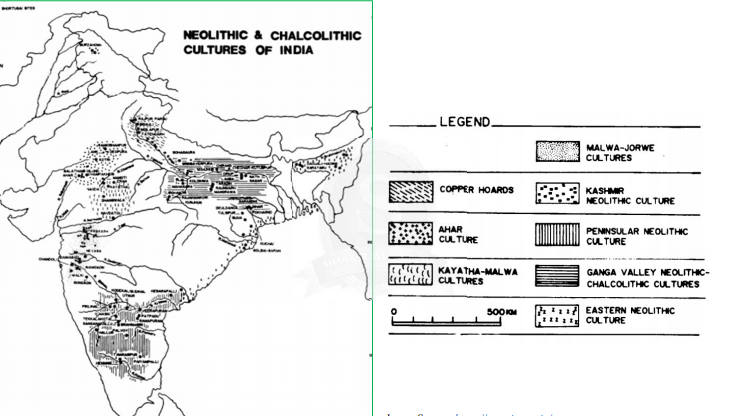
Neolithic and Chalcolithic period
• India – Neolithic period and Chalcolithic period flourished simultaneously – 4th to 2nd millennia B.C.
Represents farming based, settled village way of life.
• Neolithic culture – restricted distribution.
Kashmir valley, northern Vindhyas, middle Ganga
valley, and eastern, north-eastern and south India.
• Chalcolithic cultures – wider distribution.
Entire Ganga valley, eastern RJ, Malwa or western MP, some parts of GJ, western MH, and the northern Vindhyas.
Differences
• Mainly regarding distribution pattern,
technology, architecture and ceramics.
Marked increase in the number of settlements.
Introduction of copper-bronze – tools, weapons and ornaments etc.
Improvement in architecture.
Introduction of wheel-made pottery.
Diversification of wares.
Decoration of vessels by painted and incised designs.
India’s Important chalcolithic cultures
- Ochre-coloured pottery (OCP) culture:
Indo-Gangetic Divide and upper Ganga-Yamuna
Doab.
Named after a ceramic type – extremely rolled
and fragile – wash of red ochre which is easily
washed off.
First recognised by B.B. Lal in 1951 in a small
excavation at Bisauli and Rajpur Parsu (U.P). - Ahar culture or Banas culture:
Mewar region of Rajasthan.
Among the earliest Chalcolithic cultures of India.
Type site – Ahar, in District Udaipur, Rajasthan – excavated in1961-62. - Kayatha and Malwa cultures:
Malwa region of western MP. Kayatha site in Ujjain dist., MP. Malwa culture – most predominant
chalcolithic culture of central India. - Malwa and Jorwe cultures – western
Maharashtra.
Jorwe – important and characteristic
chalcolithic culture of Maharashtra –
extend all over except the coastal
strip on the west and Vidarbha.
Jorwe site in Ahmadnagar district,
Gujrat – discovered in 1950. - Narhan culture and variants – northern
Vindhyas and the middle and lower Ganga
valley.
Narhan village situated at the left bank
of Ghaghara river – Gorakhpur, Uttar
Pradesh.
Pre-iron Phase Chalcolithic culture with
the principal ceramic assemblages of
white painted Black-and-Red Ware.

 Eduindex
You must be logged in to post a comment.