

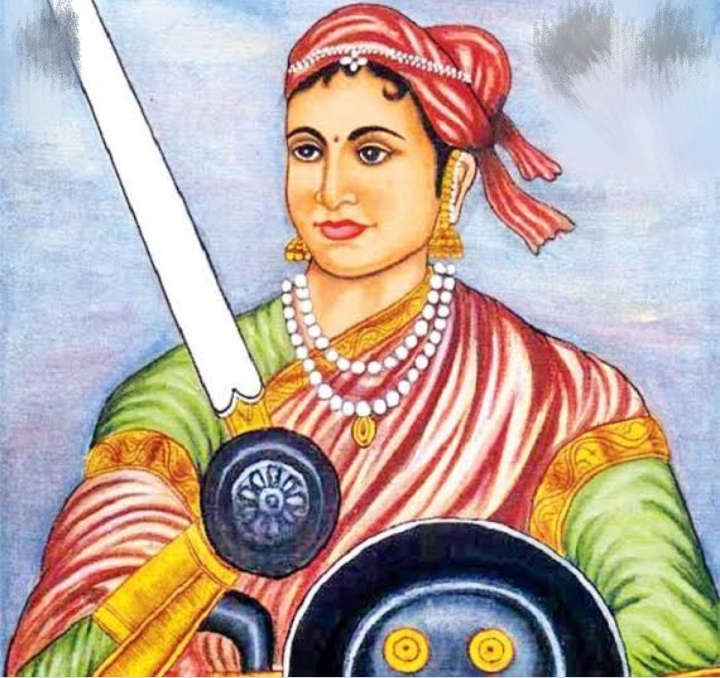
Rani Lakshmibai is an unforgettable warrior in the Indian History. Lakshmi Bai was born around 1827 in present-day Varanasi in northeast India. Named Manikarnika, she was the daughter of a Brahman who worked as an adviser to the court of the peshwa, or prime minister, of the Maratha Empire, Baji Rao II. Though not aristocratic, Brahmans belonged to a higher caste of priests and scholars. When Manikarnika was four, her mother died, and she moved to court with her father. The peshwa raised her like his own; she received an education unlike most girls and trained with the boys in martial arts, fencing, and riding.
Rani & the Annexation of Jhansi
In May 1842, Manikarnika was married to Maharaja Gangadhar Rao Newalkar, the Maharaja of Jhansi. Sometime later she was named Lakshmibai after the revered Hindu goddess Lakshmi. In 1851, she gave birth to a son Damodar Rao, who died in infancy after four months. Sans any heir, the Maharaja adopted the son of his cousin. The boy, originally called Anand Rao, was given the name Damodar Rao on the day before the Maharaja died. The Maharaja conducted the adoption procedure with a British political officer in attendance and gave a letter to the latter with instructions to treat the child with respect. In his letter, the Maharaja also mentioned that following his death, his widow Lakshmibai should be given the government of Jhansi for her lifetime.
The Maharaja died in November 1853, and thereafter the British East India Company, under Governor-General Lord Dalhousie refused to recognise the adopted son of the Maharaja as his heir and annexed the state of Jhansi applying the policy of ‘Doctrine of Lapse.’ The turn of events infuriated Lakshmibai who was generally known to the British as “the Rani of Jhansi”. She resolved not to surrender Jhansi to the British. The British ordered Lakshmibai to leave the Jhansi palace and fort and commissioned to her a yearly pension of Rs. 60,000 in March 1854, which the young queen refused, declaring, “I will not give up my Jhansi.”
The Revolt of 1857 & Rani Lakshmibai
Regarded as the first major resistance against the British rule, the Indian Rebellion of 1857 for the first time posed some kind of a threat to the British rule in India. It began in the form of a sepoy mutiny against the British East India Company in the garrison town of Meerut on May 10, 1857.
As she took control of her kingdom and organized her forces to fight the colonialists, a revolt by Indian soldiers, or sepoys, in the company’s army, which began to the north in Meerut, caught fire. Rather than a single cause, the revolt had been stoked by an accumulation of grievances over what was seen as a British attempt to undermine traditional Indian society and religion.
Till such time, Lakshmibai had not revolted against the British and had actually sought permission from the British political officer Captain Alexander Skene to build a group of armed men for her security, which she was allowed.

The rebels of the 12th Bengal Native Infantry captured the fort of Gwalior in June 1857, and massacred several European officers and their families. The involvement of Lakshmibai in such incident remains obscure and debatable till present. The sepoys left Jhansi acquiring hefty money from Lakshmibai and threatened to destroy the palace she resided in. Post the massacre, Lakshmibai took charge of administration of the city and wrote about the incident to the commissioner of the Saugor division, Major Erskine. The latter replied on July 2 that year requesting her to manage the District on behalf of the British Government till the time a British Superintendent arrived. Meanwhile, Lakshmibai had to defend Jhansi against a group of mutineers as well as from Company allies, Datia and Orchha.
Her appeal to the British for help later fell on deaf ears, the governor-general considered her responsible for the massacre. This, however, did not deter the courageous Lakshmibai to protect Jhansi at any cost. She got a foundry built to cast cannon to be used on the fort walls. She also mustered forces which included former Jhansi feudatories and also some mutineers and managed to defeat the invaders in August 1857. Lakshmibai then ruled Jhansi peacefully till January 1858.
The British had announced to send troops to Jhansi, but the troops did not arrive for long. Meanwhile, a section of Lakshmibai’s advisers, who wanted to free Jhansi from the British rule, bolstered their position and when the British troops finally reached Jhansi in March 1858, they were taken aback by the kind of defence set up by the city. The fort was equipped with heavy guns that could fire across the town. Sir Hugh Rose, who was in command of the Central Indian Field Force, declared that if the city does not surrender it will be destroyed. At this juncture Lakshmibai proclaimed that they would fight for independence till their last breath. She fought the British troops in defending Jhansi when it was besieged by Rose on March 23, 1858. She put up a tough resistance to the British forces and also sought and received help from Tantia Tope.
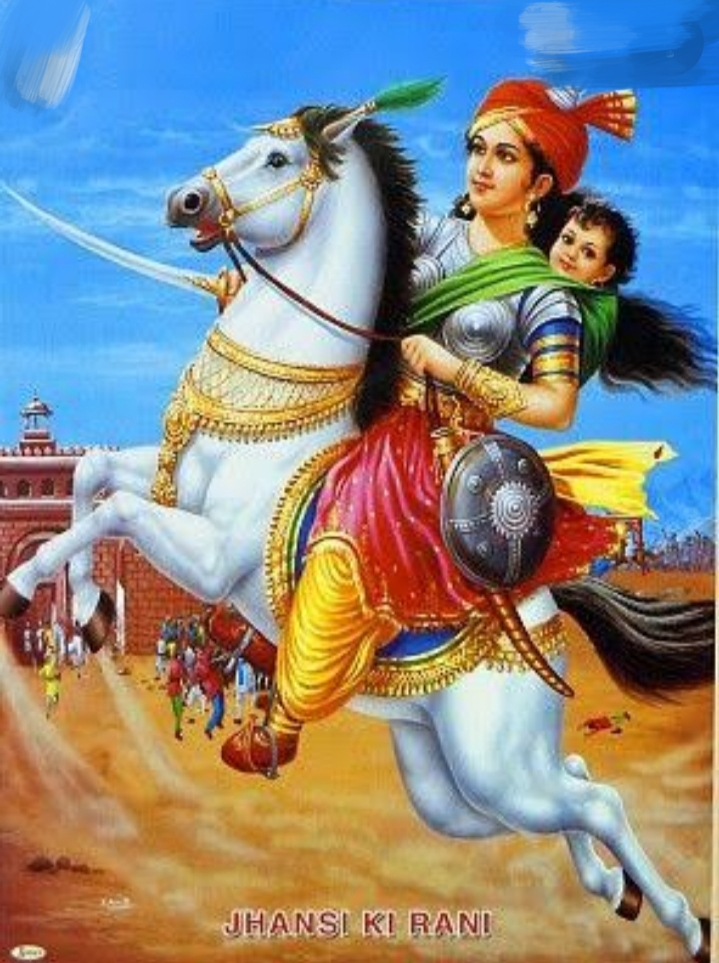
Although her troops were overpowered by the British, Lakshmibai did not surrender. The valiant Rani jumped from the fort on her horse, Badal, with Damodar Rao on her back and managed to escape in the night escorted with her guards. The other warriors who escaped with her included Dee Lala Bhau Bakshi, Moti Bai, Deewan Raghunath Singh and Khuda Bakhsh Basharat Ali (commandant) among others.
Escaping the fort, she headed east and decamped to Kalpi where other rebels including Tantia Tope joined her. They managed to occupy Kalpi, but the British troops attacked the town on May 22, 1858. Lakshmibai led the Indian troops against the British but could not make headway. Lakshmibai along with Nawab of Banda, Rao Sahib, and Tantia Tope then fled to Gwalior and joined the other Indian forces. They were successful in occupying Gwalior sans any combat and led a successful assault on the city-fortress of Gwalior seizing its treasury and the arsenal. Thereafter, Nana Sahib was proclaimed as the Peshwa (ruler) and Rao Sahib as his governor (subedar). Lakshmibai, however, expected an attack by the British in Gwalior but failed to convince the other Indian leaders to prepare for a defence. Lakshmibai’s anticipation proved right when the British forces under Rose made a successful attack on Gwalior after capturing Morar on June 16 that year.
Death
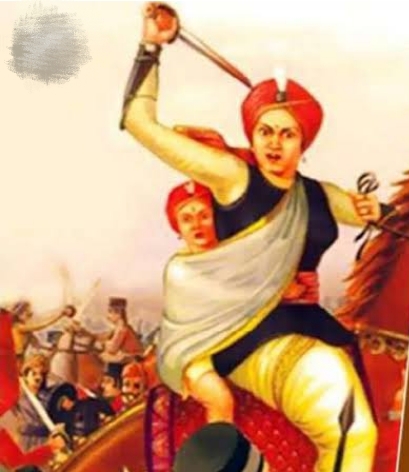
Lakshmibai led a fierce battle against a squadron of the 8th (King’s Royal Irish) Hussars under the command of Captain Heneage in Kotah-ki-Serai, close to the Phool Bagh of Gwalior on June 17, 1858. According to some sources, Lakshmibai wearing a sawar’s uniform died when a soldier “dispatched the young lady with his carbine”, while other sources mention that the Rani wearing an attire of a cavalry leader fought fiercely and when she got severely wounded, she asked a hermit to burn her body so that the British could not capture it. Following her death, her body was cremated by a few local people. According to Rose, the remains of Lakshmibai were interred under a tamarind tree under the Rock of Gwalior “with great ceremony”.
Immortal Rani Lakshmibai
In the course of time, many patriotic songs and poems have been written narrating her bravery, including the Hindi poem ‘Jhansi ki Rani’ by Subhadra Kumari Chauhan, which finds place in curriculum of many Indian schools.
While Lakshmibai is depicted as an iconic figure of the Indian independence movement in Indian novels, poetry, and films, the Victorian novels mostly represent her in negative shade as an unscrupulous, scandalous and bloodthirsty woman.
Several films and television series have been made on her life. These are ‘The Tiger and the Flame’ (1953) and ‘Manikarnika: The Queen of Jhansi’ (2018); television series ‘Jhansi Ki Rani’ (2009).
Many books and stories have also been penned narrating the bravery of Lakshmibai. Some of them are ‘The Queen of Jhansi’ (1956) by Mahasweta Devi, and ‘Rani’ (2007) by Jaishree Mishra.

 Eduindex
You must be logged in to post a comment.