

[By Bhoomika Saini]
1. Use elevation to your advantage.
Heading up hills naturally increases the intensity of your walk even if you’re moving at the same pace or slower. “A walking incline can be even harder than running,” Barrett says. Declines also serve their purpose, activating your core and strengthening your mind-muscle connection as you focus on each step.
Those lucky enough to live near undulating trails or roads can simply plan their route accordingly. If you’re largely on flat land, find any suitable slope—even a sledding hill or a parking-lot ramp—and do four to five hill repeats, walking up purposefully and down intentionally.
2. Do an out-and-back where you can do some stair climbs at the halfway point.
One simple way to add extra intensity into your workout is to incorporate some stairs into your routine. A common way to do this is to map your route to include regular walking as a warm-up, then hitting a flight of stairs for some higher-intensity work, and then walking back home as a cooldown.
For instance, Lewis lives in Philadelphia—home to the art museum with the steps featured famously in the movie Rocky. Someone who lives a mile or so away could plot a route to their base, then climb up and down a couple of times before briskly walking home again, she suggests. (You can also try this stair workout for some inspiration.)
3. Mix in some bodyweight moves.
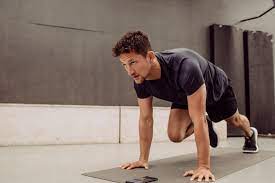
Even if there aren’t stairs in your vicinity, you can still break up a walk with a burst of calisthenics. If you have access to a track or a park with a looped path, try walking the curves and doing dynamic or bodyweight moves on the straightaways, Curry says—for instance, walking lunges, walking planks, or single-leg hopping. No track? Try it by time—for instance, two minutes of walking, then one minute of strength moves.
If you’re near an open playground and don’t mind toting along hand sanitizer, you can do pull-ups or monkey bars. Prefer not to touch? Try toe taps on a curb, step-ups on park benches, or a split squat with one foot elevated on a ledge.
4. Walk to music with a quicker tempo
There’s a reason group fitness classes blast power pop—music not only boosts your mood, research shows it can actually make hard efforts feel easier. What’s more, it can also work as a kind of metronome guiding your pace.
Spotify has playlists for songs of various beats per minute that Lewis loves for keeping the tempo up. Choose one that’s comfortably challenging—say, 130 to 140 BPM—and will last for the duration of time that you want to walk, and aim to keep up with it. (You can also try our SELF playlist of the best workout songs for some motivation, too.)
Or use music as a cue for more intense segments. Walk easy for verses and fast during the chorus, suggests Erin Schirack, a Chicago-based personal trainer and cofounder of MV Fitness. Theodore recommends this bodyweight circuit at the start of every other tune: 10 squats, 10 split squats on each leg, 10 lateral lunges per leg, and 10 push-ups, either on the ground or with your hands on a bench to make it easier.
5. Or even twirl, prance, or twerk.
Professional dancer Bobby O’Brien is the other mind behind MV Fitness in Chicago, which offers dance workouts inspired by music video choreography. Sprinkling a few moves into your walk elevates your heart rate and gives you an opportunity to move in different directions—critical for those of us hunched at desks and over our devices all day, he says. Some of his favorite moves are air punches, grapevines, lateral shuffles, and strutting on the balls of your feet, which works your calves and quads.
Don’t let self-consciousness or a lack of dance training hold you back. After this whole COVID thing and the movement that’s been happening with our country—we’ve all gone through this together. “Let go of everything that’s in your head and don’t worry about what people think.”
6. Use technology to your advantage (or leave it behind).
This is another time when it’s important to consider the purpose of your walk. If it’s a mind-clearing, meditative stroll, it might be best to leave your GPS watch at home and your phone in do-not-disturb mode, Lewis says. But if you’re aiming for fitness benefits, you can use digital tools as motivators.
If you have a watch or fitness tracker with a step count, try to take a few more steps during each 30- or 60-minute walk. Or you can race others using the app Strava, whether it’s against friends or strangers.
If you go this route, just be careful not to let your competitive nature get the best of you. Stress and anxiety can affect what’s known as your rate of perceived exertion, or how hard it feels like you’re working to power through each step.
“You need to listen to your body,” she says, even if the message is to slow down or back off. “If you’re used to hitting a certain number or certain metric, don’t be disappointed by what your Garmin says. You should be more excited and proud that you did something as opposed to nothing.”
7. Close it out with a stretch session.
Taking a few minutes to further loosen warm, limber muscles after a walk can ease some of the strain and fatigue you’ve built up and also give your session a sense of closure.
Your body may guide you to what’s tight and achy. If your form is correct, your shins, calves, and hamstrings may feel sore, Mosier points out. Loosen your calves by standing with the ball of your left foot on a curb or step and your right foot flat on the ground. Lean but don’t bounce until you feel a stretch in your left calf, and hold for 30 to 60 seconds before repeating on the opposite side.
For your hamstrings, step your left foot forward, straighten your left knee, bend the right slightly, then hinge forward at your hips with your back flat. Stretch your arms overhead, reach forward, then slowly stand back up. Repeat five times on each side.
That small act of self-care can go a long way in cementing your walk as an important accomplishment, another way you’re navigating the challenges everyone’s facing right now. It’s this buffer between the workout and the rest of the world, a finishing touch. “It just makes the rest of the day better. And then the next day, you’re prepared to go for a walk again.”

 Eduindex
You must be logged in to post a comment.