

The continents and oceans are however, not evenly distributed in the northern and the southern hemispheres. The northern hemisphere holds 61% of land whereas the southern hemisphere holds 81% of water. It is because of this pattern of land and water distribution, the northern hemisphere is called as the land hemisphere and the southern hemisphere is called as the water hemisphere.
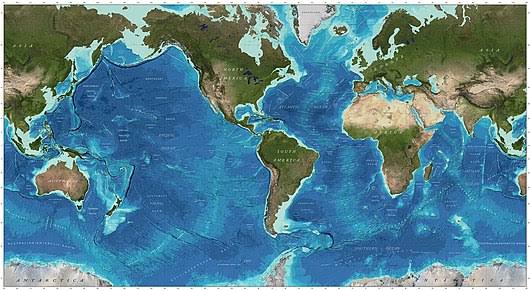
Oceans and seas are considered as resource bowl of the earth because of the immense availability of food, minerals etc., Present distribution of the world’s oceans and major seas are illustrated in the map.

Relief of the Ocean Floor
The ocean basins are characterized by the following major relief features:
✓Continental shelf
✓Continental slope
✓Continental rise
✓Deep sea plain or Abyssal plain
✓Oceanic deep
✓Oceanic ridge
Continental Shelf
A shallow and gently sloping platform extending out from the adjoining continental land mass into the sea is called Continental Shelf. It is almost a uniform zone of sea bed with a gentle gradient.
Continental Slope
A steep slope which descends from the edge of the continental shelf to the deep ocean-bed is called continental slope. It forms a boundary between the Continental Crust and the oceanic crust. This zone is free from deposits as they are steep. The most important characteristic of continental slope is the presence of deep canyons and trenches. Due to the low penetration of sunlight, the slope has nearly freezing temperature. Hence aquatic life has very slow rate of metabolism.

Continental Rise
At the base of the continental slope is a gently sloping layer of sediments which merge into the deep-sea floor. This underwater feature found between continental slope and abyssal plains is called the continental rise. It consists of submarine fans which are similar to the alluvial fans found on land.

Deep Sea Plains or Abyssal Plains
The deep sea plains or abyssal plains are underwater plains found on the deep ocean floor. These plains extend from continental rise to the mid oceanic ridges. The gradient of the slope is very gentle and it appears as a uniform flat and featureless plain. These plains are usually covered by the thick layer of sediments composed of clay, slit and sand, brought by the rivers. These are often characterized by features like abyssal hills, sea mounts, guyots, coral, atoll etc.

Oceanic Deeps
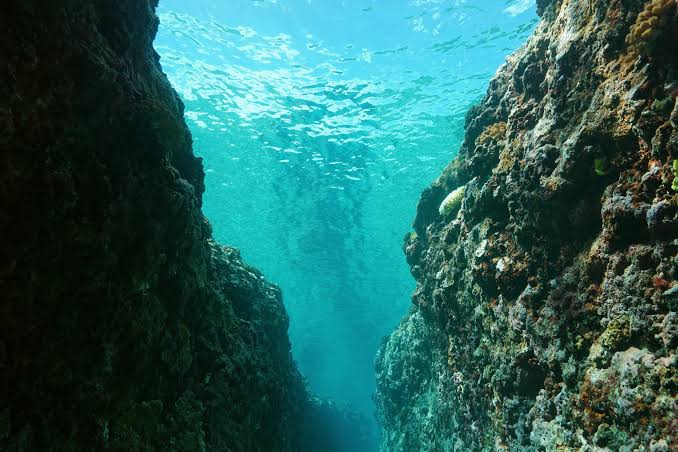
Trenches are the deepest part of the ocean and occupy about 7% of the total relief of the ocean floor. The ocean temperature in the trench is slightly cooler than the freezing temperature. As they are sediment free, most trenches are V-shaped with steep sides. Epicentre of the great earthquakes are all found in the trenches.
Oceanic Ridge
Oceanic ridge is a continuous submarine mountain chain. They are made of young basaltic rock formed when two tectonic plates moves apart. The mid – ocean ridge is probably the most extensive single feature of the earth ‘s topography. Two of the most well known mid – ocean ridges are the Mid – Atlantic Ridge and the East Pacific Ridge. The Mid – Atlantic Ridge is the largest unbroken oceanic ridge.

Movement of the Ocean Water
The ocean water is dynamic. Temperature, salinity, density, external forces of the sun, moon and the winds keep the ocean waters in movement, both horizontally and vertically. Waves and currents are in horizontal motion while tides have vertical motion.
Waves
Of the all movements of the oceans, sea waves are considered to be the strongest. Sea waves are ripples on water caused when winds blow over the sea. The height of these waves depends on the speed of wind, its duration and the direction from which they blow. Sometimes waves are also caused by tremors felt on the ocean floor. Such waves are quite destructive and called Tsunami.

Tides
The periodic rise and fall of water due to the gravitational pull of the sun and moon on earth are called tides. They are classified broadly into Spring tides and Neap tides.
When the Sun, Moon and Earth are aligned in the same line, the collective gravitation pull of the sun and moon on earth’s water strengthens to form a high tide known as spring tide. Such tides always occur on full moon and new moon days.

Ocean Currents
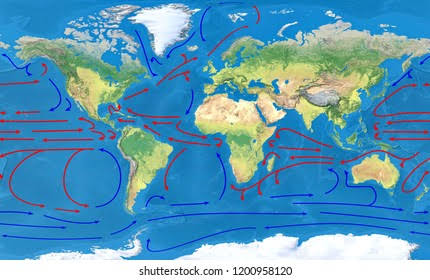
The movement of oceanic water on the surface and at the depths in a definite direction is called ocean current. Ocean currents are in clockwise motion in the northern hemisphere and in the anti – clockwise motion in the southern hemisphere.
The factors that generate ocean currents are :
- Earth’s rotation
- Prevailing winds and
- Differences in temperature and salinity of ocean water.

 Eduindex
You must be logged in to post a comment.