

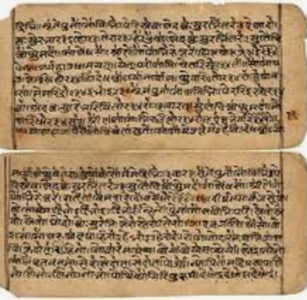
The Vedas are the oldest religious texts of the Hindus. Vedas are regarded as the world’s oldest piece of literature. It is believed that the Veda have composed several thousands of years ago. They were written down by several seers known as “Rishis” in the Hindu tradition. The Vedas were composed in Sanskrit and contain hymns describing the glories of God. They include material, religious, and spiritual knowledge.
The term veda means “knowledge” in that they are thought to contain the fundamental knowledge relating to the underlying cause of, function of, and personal response to existence. They are considered among the oldest, religious works in the world. They are commonly referred to as “scripture”, which is accurate in that they can be defined as holy writ concerning the nature of the Divine.
Unlike the scriptures of other religions, however, the Vedas are not thought to have been revealed to a certain person or persons at a specific historical moment; they are believed to have always existed and were apprehended by sages in deep meditative states at some point prior to c. 1500 BCE but precisely when is unknown. The Vedas existed in oral form and were passed down from master to student for generations until they were committed to writing between c. 1500 – c. 500 BCE (the so-called Vedic Period) in India. They were carefully preserved orally as masters would have students memorize them forwards and backwards with emphasis on exact pronunciation in order to keep what was originally heard intact.
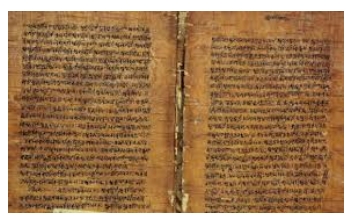
The Vedas are therefore regarded as Shruti in Hinduism meaning “what is heard” as contrasted with other texts designated Smritis (“what is remembered”), accounts of great heroes and their struggles in works such as the Mahabharat, Ramayan, and Bhagvat Gita (although some sects of Hinduism regard the Bhagavat Gita as Shruti). The texts which make up the Four Vedas are:
1. Rig Veda 2.Yajur Veda 3.Sama Veda 4.Atharva Veda
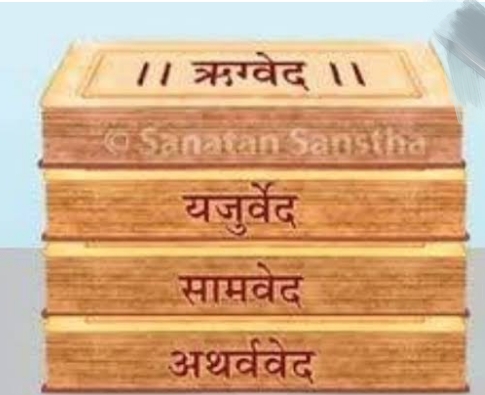
The Rig Veda is the oldest and the Sama Veda and Yajur Veda draw from it directly while the Atharva Veda takes a different course. All four, however, maintain the same vision, and the Upanishads for each of these address the themes and concepts expressed.
Each of these is further divided into types of text included within them:
- Aranyakas – rituals, observances
- Brahmanas – commentaries on said rituals
- Samhitas – benedictions, prayers, mantras
- Upanishads – philosophical narratives and dialogues
The Upanishads are an assortment of texts central to Hinduism that are recorded from oral traditions. They contain information regarding the philosophical principles and concepts of Hinduism, including karma (right action), brahman (ultimate reality), the atman (true Self or soul), moksha (liberation from the cycle of reincarnation) and Vedic doctrines that explain Self-realization through yoga and meditation practices. Upanishad is a Sanskrit word that translates in English to mean “sitting at the feet of” or “sitting down near.” This illustrates the position of receiving wisdom and guidance humbly from a teacher or guru.
The Upanishads are the best known and most often read of the Vedas because their discourse is presented in dialogue/narrative form and they were the first to be translated into other languages. The four Vedas, conversely, are considered the literal sounds of the Divine which, when recited or sung, recreate the primal vibrations of the universe. Accordingly, they are actually impossible to translate and what one reads in a translation should be understood as a paraphrase at best.
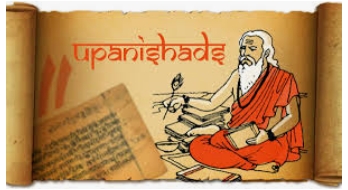
The 13 Upanishads are:
- Brhadaranyaka Upanishad
- Chandogya Upanishad
- Taittiriya Upanishad
- Aitereya Upanishad
- Kausitaki Upanishad
- Kena Upanishad
- Katha Upanishad
- Isha Upanishad
- Svetasvatara Upanishad
- Mundaka Upanishad
- Prashna Upanishad
- Maitri Upanishad
- Mandukya Upanishad
Their origin and dating are considered unknown by some schools of thought but, generally, their composition is dated to between c. 800 – c. 500 BCE for the first six (Brhadaranyaka to Kena) with later dates for the last seven (Katha to Mandukya).

In these sacred texts, we see an internalization of the sacrifice and worship extolled in the Vedas and a deeper understanding and exploration of the internal world of mind and spirit. Composed over several centuries and in many volumes, the Upanishads reflect a strong need to express and communicate the deep mystical states and spiritual contemplations that the ancient yogis experienced.
According to tradition, there were over two hundred Upanishads, but there are only eleven “principal” Upanishads, as commented on by the ancient sage Shankara. The texts are written in a passionate poetic verse describing mystical states and spiritual concepts or in descriptive short stories and dialogues between historical figures.
The teachings of the Upanishads revolve around four primary spiritual themes. These four philosophical concepts are described in many different ways as they can be difficult to grasp. These main teachings are repeatedly reinforced in the texts of the eleven principal Upanishads.
- The first and most important is the realization that the ultimate, formless, and inconceivable Brahman (Godhead) is the same as Atman, as our internal soul. Brahman represents the entire universe, and the Atman is a little piece of that divine oneness that we contain inside us. This philosophical idea is summed up in the mantra Tat Tvam Asi (That Art Thou).
- The idea that the Atman is eternal, and becomes reborn over and over again is central to the concept of reincarnation that is taught in the Upanishads.
- This concept of rebirth is highly tied to the teachings of Karma: the future consequences of one’s current intentions, thoughts, behaviors, and actions.
- It is the accumulation of Karma that binds us to Samsara, the cycle of death and rebirth. To escape the endless cycle of Samsara requires one to attain enlightenment through the realization of Atman/Brahman. It is this state of Self realization that the majority of the Upanishads attempt to describe and encourage us to achieve through the yoga practices of meditation, mental discrimination, and mantra recitation.
Spiritual concepts have exerted a profound influence on the development of Yoga, Hindu, and Indian philosophy. While the yogic practices taught in the Upanishads were primarily mediation based, these philosophical teachings will remain the core beliefs for all of the future developments in the many paths and practices of yoga.

 Eduindex
You must be logged in to post a comment.