

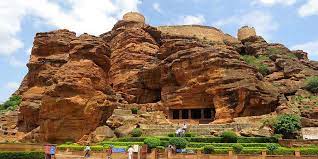
Bhimbetka is a beautiful archaeological site with nature enveloping its caves. It is derived from ‘Bhimbetka’ which means siting place of prince Bhima from the great mythology ‘Mahabharata’. It also manifests for earlier traces of human life on earth and stone age. It is a UNESCO world heritage site; very limited people visit Bhimbetka which maintains its peace and silence. It was founded by Vishnu Walankar in 1957-58 during a visit to Ratapani Sanctuary.
LOCATION
It is situated in the foothills of Vindhya range near Raisen district of Madhya Pradesh, inside Ratapani wildlife sanctuary, the south of these shelters are successive range of Satpura hills. There are over760 rock shelters and 500 are bedecked by rock paintings.
MYTHOLOGY INTEREST
As the name signifies this place is where Bheema use to reside, it is known that pandavs were sent to vanvasa for 12 years and 1-year agyatvasa which means that pandavs were told to live away from Duryodhana’s shadow in agyatvasa. When vanvasa was over Lord Krishna sent pandavs here for some period. Bhima use to reside in these caves. Also, a temple is situated near Bhimbetka in Bhojpur with one of the largest shivling in India where pandavs use to offer prayers.
ARCHITECTURE
Its architectural significance span over upper palaeolithic, Mesolithic, chalcolithic, early history and medieval. There are over 750 archaeological caves spread over 10 km but only 12 to 15 caves are open for tourist to visit, these caves and their rock painting are assumed to be around 10,000 years old.
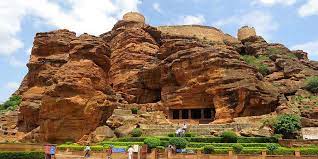
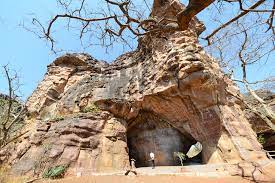
Auditorium cave
It is one of the largest caves in Bhimbetka and is visible from a distance, it is built up of 25-metre-long tunnel and also quartzite towers which are visible from several kilometres distance. Robert Bednarik describes the Auditorium cave as one with a cathedral atmosphere, with “its Gothic arches and soaring spaces”.
Extinct Dickinsonia
Dickinsonia is an extinct genus basal animal. Dickinsonia fossils are known only in the form of imprints. The specimens range from a few millimetres to about 1.4 metres in length and is found in Bhimbetka it is similar to Ediacara Member of Ediacara Hills in South Australia. These fossils are found within sandstone of Bhander Group of Vindhyan Supergroup mixed with sand deposits and intertidal facies
ROCK ART AND PAINTING
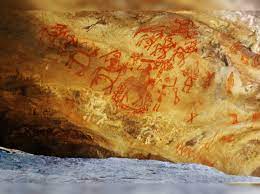
Tribals have always amused the current society with there culture, attires, jewellery, lifestyle and of course their beautiful paintings. One such example is also illustrated by Bhimbetka where paintings from stone age, medieval etc. can be found. The aesthetic art depicts basic story life of people living there and daily struggles in the form of Warli art. As the time flies many things get faded away but these paintings are still headstrong. Tribals used natural red, white, green and yellow colours are also used. The colours are a combination of manganese, hematite, wooden coal, soft red stone, plant leaves and animal fats.
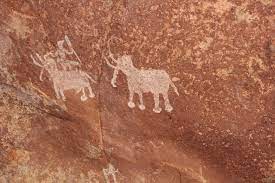
These paintings can be classified according to seven periods-
Period I Upper Palaeolithic: These are linear representations, in green and dark red, of huge figures of animals such as bison, tigers and rhinoceroses.
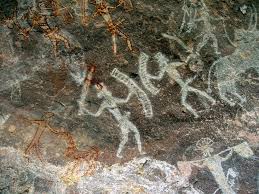
Period II Mesolithic: these show small linear decorations on the body, animals, human figures and hunting scenes and weapons they used- barbed spears, pointed sticks, bows etc. Some scenes are interpreted as depicting tribal war between three tribes. The depiction of communal dances, birds, musical instruments, mothers and children, pregnant women, men carrying dead animals, drinking and burials appear in rhythmic movement.
Period III Chalcolithic: these drawings tell us about the increasing communication and beginning of initial stage of barter system in the form of exchange, the cave dwellers of this area were in contact with the agricultural communities of the Malwa plains, exchanging goods with them.
Period IV & V Early historic: The figures of this group have a schematic and decorative style and are painted mainly in red, white and yellow. The association is of riders, depiction of religious symbols, tunic-like dresses and the existence of scripts of different periods. The religious beliefs are represented by figures of yakshas, tree gods and magical sky chariots.
Period VI & VII Medieval: These paintings are geometric linear and more schematic, but they show degeneration and crudeness in their artistic style. The colours used by the cave dwellers were prepared by combining black manganese oxides, red hematite and charcoal. They depict war scenes between kings.
Zoo Rock
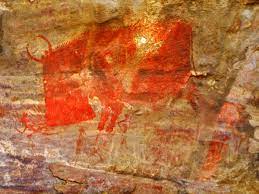
It depicts elephants, barasingha, bison and deer, peacock, a snake, a deer and the sun. On another rock, two elephants with tusks are painted. Hunting scenes with hunters carrying bows, arrows, swords, and shields also find their place in the community of these pre-historic paintings. In one of the caves, a bison is shown in pursuit of a hunter while his two companions appear to stand helplessly nearby; in another, some horsemen are seen, along with archers. In one painting, a large wild bovine (possibly a gaur or bison) is seen where people are trying to save their lives from bison. Also, there are some paintings when sun is a particular point
REFERENCES
Singh, H. (2016, July 28). Rock Shelters of Bhimbetka: Facts at a Glance. Jagranjosh.Com. https://www.jagranjosh.com/general-knowledge/rock-shelters-of-bhimbetka-facts-at-a-glance-1462443813-1
Goyal, A. (2020, October 12). Bhimbetka Rock Shelters and Pre-Historic Cave Paintings. Inditales. https://www.inditales.com/rock-paintings-of-bhimbetka/
Wikipedia contributors. (2021, July 10). Bhimbetka rock shelters. Wikipedia. https://en.wikipedia.org/wiki/Bhimbetka_rock_shelters#Auditorium_cave

 Eduindex
You must be logged in to post a comment.