The Covid created lockdown damaged very badly to education system. schools were closing down and online learning is not everywhere working.
There are some statics
Estimated 1.5 million schools across India closed down due to the pandemic A switch to large-scale digital education is not possible now.
according to a 2019 government survey.Only 24 per cent house-holds have access to the internet,
In rural India, the numbers are far lower, with only 4 per cent households having access The education ministry’s budget for digital e-learning was slashed to Rs 469 crore in 2020-21—the year Covid struck—from Rs 604 crore the previous year
According to world bank :
before the COVID-19 pandemic, world was living in a educational crisis . 258 million children and youth of primary and secondary school age were out of school. quality of education also was very low , meant many who were in school learned too little. The COVID-19 pandemic threatens to make education outcomes even worse. The pandemic has already had profound impacts on education by closing schools almost everywhere in the planet, in the largest simultaneous shock to all education systems in our lifetimes. The damage will become even more severe as the health emergency translates into a deep global recession.
Deepesh Bisht is a first-year student of BAMS in Doon Institute Of Medical Science . He is 18-year-old hasn’t set foot on campus even once since he took admission in 2020 sept . He has taken a virtual tour of the college and has been taking lessons through his laptop and mobile phone. Deepesh isn’t alone in this. That’s how the batch of 2020-the Covid-19 generation-has been experiencing institutional education in a world disrupted by an unprecedented pandemic. Because of this, 47 per cent students have decided against migrating to another city for higher education, revealed a study titled the ‘Big Qs Student Survey’. 50% respondents have also abandoned plans to pursue higher education abroad.
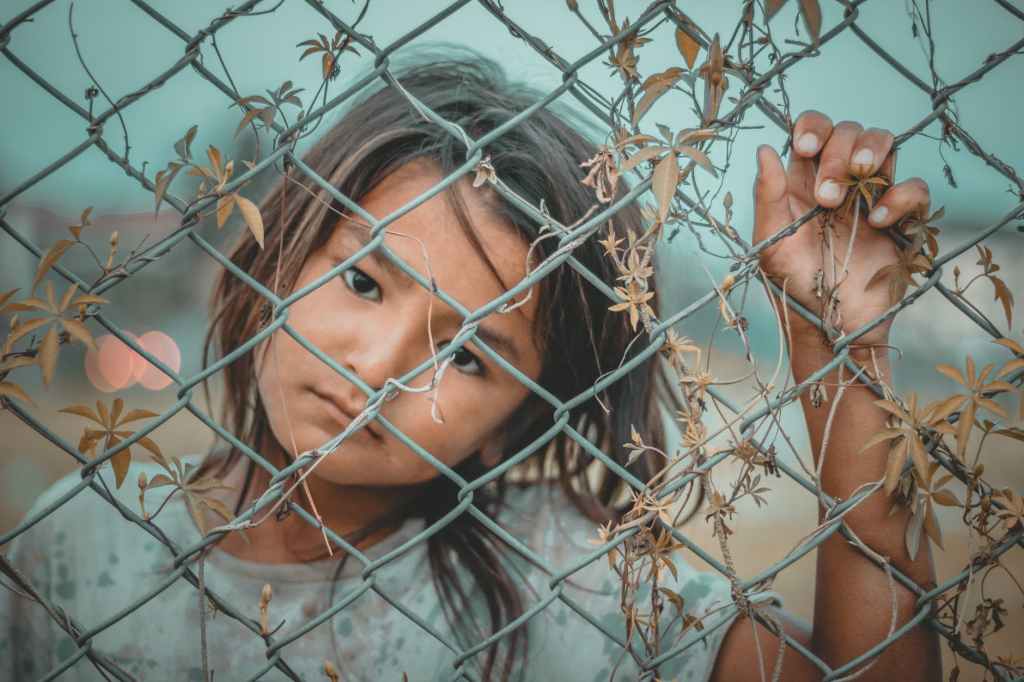
states like Delhi are still confined to homes, spending long hours online, leading to concerns over physical health and stress triggered due to the prolonged use of electronic devices.Even in the national capital, when government schools started online classes during the lockdown, the attendance hovered between “25 and 30 per cent”. students in Assam and several other states have gradually returned to schools and colleges . The education ecosystem of India, already weighed down by myriad issues such as school dropouts, learning deficiencies, teacher absenteeism, gender disparity and lack of infrastructure, now faces yet another big challenge-the widening digital divide.
Hence , this pandemic made our education system digital . This digital education is giving benefit to a part of society only . Poor students were fading away from education. This will create a huge disparity in our society.
Virgin Galactic is a spaceflight company that was founded in 2004 by British businessman Richard Branson. It is the first commercial spaceline company in the world and are developing new spacecraft designs to make space travel accessible to everyone. Their mission is to use space for good while delivering an immaculate customer experience. They believe that space exploration is the ultimate expression of the human desire to push desires and is the pinnacle of acheivements for the human species. Fewer than 600 humans have had the golden opportunity to visit space and there are millions of people who would do anything to go to space. This is what inspired Branson to create Galactic.
The new space age has just begun and Virgin Galactic is pioneering the next generation of reusable spacecrafts. They also are building basic space infrastructure that will enable scientitsts and engineers to conduct space research that would be vital for future life on other planets. Initially, they aim to give safe space experiences to non-professionals in micro gravity environments. Eventually, they expect to operate multiple spacecrafts from various locations to transport passengers to Earth orbiting hotels and science labs. Virgin Galactic is striving to open up space and change the world for the better.
On July 11th 2021, the VSS Unity, Virgin’s commercial spacecraft reached 53 miles beyond the boundary of space and touched down safely. It was launched from Spaceport America in New Mexico and the journey went as smooth as it could go. Onboard were 6 crewmates, including Richard Branson and they went far enough to experience weightlessness and the beautiful view of the Earth’s curvature. The launch of the VSS Unity passenger rocket plane marked Galactic’s 22nd test flight of its SpaceShipTwo system and its fourth crewed mission beyond Earth’s atmosphere. It was also the first to carry a full complement of space travellers – two pilots and four mission specialists.
These commercial space tickets are currently selling for over $250,000 each and the market for space flights is extremely limited, atleast for now. But demand is seemingly quite high as seen from the number of reservations. Virgin has said it plans for at least two more test flights of the spacecraft in the months ahead before beginning regular commercial operations in 2022. By 2030, the value of the space tourism market is said to reach $3 billion. With everything said and done, commercial space travel is still a long way from being viable and accessible to the masses.
SALADS We are avoid the most in our everyday life. Which is SALADS. A salads that are most important to us. It is very important for the digestion of our food as well as for our body. With this we can overcome the deficiencies of many vitamins.
Everyday garnishes are tomato slices, beet-slices, scored cucumber slices, hard-boiled egg slices, etc. Somewhat more fancy garnishes can be made in the following manner:
Carrot curls Slice carrots paper-thin lengthwise with a slicer. Chill in ice-water until very crisp.
Cucumber curls Pare a cucumber by cutting round and round a continuous strip just as you would pare an apple. Chill in ice-water until very crisp.
Cheese balls Shape cream cheese or cottage cheese into balls. Roll lightly in paprika or in finely chopped olives or nuts.
Capsicum rings Take a firm capsicum of good shape, slice thinly crosswise and remove the white portions. Chill in ice-water until very crisp.
Onion rings Take large onions, slice thinly crosswise and separate into rings. Chill in ice-water until very crisp.
Radish roses
Cut off the roots and with a sharp knife, score sections. Chill in ice-water until very crisp.
Kerala is a state in Southern India is known as a tropical paradise of waving palms and wide sandy beaches. Parasurama, an avatar of Vishnu threw his battle axe into the sea after he reached Gokuram from Kanyakumari. as a result, the land of Kerala arose, reclaimed from the waters. He was the sixth of the ten avatar (incarnation) of Vishnu. It is a narrow strip of coastal territory that slopes down the western ghats in a cascade of lush green vegetation, and reaches to the Arabian seas. The culture of Kerala evolved through the Sanskritization of Dravidian ethos, revivalism of religious movements and reform movements against caste discrimination. Kerala showcases a culture unique to itself developed through accommodation, accumulation of various faculties of civilized lifestyle. Hinduism an Islam are the two major religions of Kerala. More than 50 percent of people in Kerala follow Hinduism, and more than 25 percent follow Islam. Around 20 percent are Christians, and others follow Buddhism, Jainism, and other religions. The cultural diversity of Kerala is well known. Kerala is also well-known for its mesmerizing backwaters, ecotourism initiatives, scenic beauty, beaches and mouth watering cuisine.
Old name of Kerala
A treaty brought it under British protection in 1795. Travancore was known for its relatively high literacy rate and its progressive government. After Indian Independence, Travancore and Cochin merged to form the state of Travancore-Cochin, boundaries were redrawn, and it was renamed Kerala in 1956.
Kerala famous spices
Kerala is famous for its spices and hence is popularly known as the Spice Coast of India. It flavor an assortment of species originating from the cultures of Jews, Christians, Muslims and merchants who settled down in this state. Kerala is one of the prominent tourist destinations of India, with coconut-lined, sandy beaches, backwaters, hill stations, ayurvedic tourism and tropical greenery as its major attractions. Kerala is a home to a variety of spices pepper, vanila, cardamom, clove, cinnamon, nutmeg, ginger and turmeric. The flavor of species lingers long in one’s tongue and even longer in one’s memory. Spices shaped Kerala’s tryst with destiny.
Major Festival
ONAM – Onam is a harvest festival celebrated extravagantly by the people of Kerala, India. It is also the state festival of Kerala with State holidays on 4 days starting from Onam Eve (Uthrdom) to the 4th Onam day. Onam Festival falls during the Malayalam month of Chingam (August-September) and marks the commemoration of Vamana avatara of vishnu and the subsequent homecoming of King Mahabali, who Malayalees consider to be just and fair King who was exiled to the underworld. It is one of the festivals celebrated with the most number of cultural elements. Some of them are Vellam Kali, Pulikali, Pookalam, Onatthappan, Thumbi Thullal, Onavillu etc. Another distinct feature of the festival is Ona Sandhya (Onam Feast) and consists of numerous dishes served on a banana leaf and Ona Kodi (Onam Dress).
VISHU – Among the various Hindu festivals in Kerala. Vishu occupies a unique position in more than one respect. As a symbol of the Keralite, Vishu, is free from the usual pomp and show and merry-making associated with other festivities. The frist day of the Malayalam month of medam is the unchangeable day of Vishu. The day on which Vishu falls is the astronomical New Year day. The Malayalees believe that the subject one sees first in the morning of Vishu day. In order to fulfill the desire to look at the auspicious articles, they prepare a “Kani” on the previous day for seening in the next morning. The eldest member of the family takes some silver coins and gives them to a junior member with some raw rice and konna poovu.
There are a plenty of hiding place for virus to stick. If you then touch your face, the virus can infect you. But there are two simple ways you can keep them away, soap and water, and hand sanitizer. It’s not best for any viral outbreak but best solution for covid. So which is better?
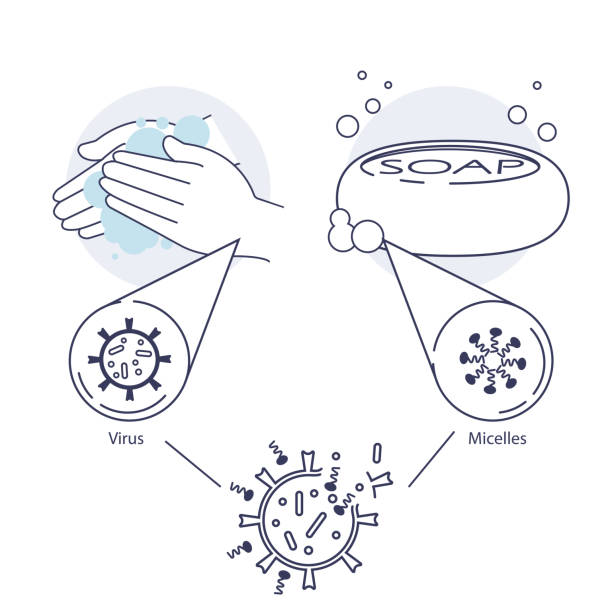
The corona virus that cause covid 19 is one of many viruses whose protective outer surface is made up of lipid bilayer. There lipids are pin shaped molecule whose heads are attracted to water means hydrophilic (water loving), and tails are repelled by it means hydrophobic (water hating). So in water rich environment, lipid naturally forms a shell, with heads outside and tails inside.
The actual process of destroying the virus happens in just one or two seconds. But doctors recommend at least 20 seconds of hand washing because of intricate structure of our hand. Soap and sanitizer need to get everywhere, including our palms, nails, fingertips and between our fingers to protect properly. And when it comes to corona virus outbreak, doctors recommend washing your hand with soap and water frequently. Both soap and sanitizer are similarly effective at killing the virus.
Soap and water has two benefits. It washes away any dirt which could otherwise hide virus particles. And it’s easier to fully cover your hand with soap and water for 20 seconds. On the other hand sanitizer is more convenient to use on the go. ( In the absence of sink and water). Hand sanitizer is just a emergency hands washing kit. When using sanitizer rub your hand together until they’re dry.
Unfortunately there are billions of people who don’t have access to clean drinking water which is a huge problem during this time.
Cleaning hand is very important because studies have found that we touch our face around 9 to 20 times per hour. Touching our face with uncleaned hand may be enough to infect ourselves.
.NET is a software framework which is designed and developed by Microsoft.The first version of .Net framework was 1.0 which came in the year 2002.In easy words, it is a virtual machine for compiling and executing programs written in different languages like C#, VB.Net etc.It is used to develop Form-based applications, Web-based applications, and Web services.There is a variety of programming languages available on the .Net platform, VB.Net and C# being the most common ones.It is used to build applications for Windows, phone, web etc.It provides a lot of functionalities and also supports industry standards..NET Framework supports more than 60 programming languages in which 11 programming languages are designed and developed by Microsoft.The remaining Non-Microsoft Languages or Third Party Languages which are supported by .NET Framework but not designed and developed by Microsoft. Framework performs development, execution & deployment of an application. It support multiple languages, technologies & databases.
COMMON LANGUAGE RUNTIME – MICROSOFT LANGUAGES
C#.NET
VB.NET
C++.NET
J#.NET
F#.NET
JSCRIPT.NET
WINDOWS POWERSHELL
IRON RUBY
IRON PYTHON
C OMEGA
ASML(Abstract State Machine Language)
THIRD PARTY LANGUAGES – NON MICROSOFT LANGUAGES
APL
COBOL
Component Pascal
Hakell
Perl
Python
Smalltalk
Standard ML
TECHNOLOGY AND DATABASES SUPPORTED BY .NET FRAMEWORK
We all have trouble concentrating in our lives. Many of us have to sit and study/work for hours on end, especially after the COVID-19 pandemic which locked everyone inside their homes. However, most of us find it very hard to concentrate very long on our work or studies, and we lose focus or start procrastinating after a short while. The result of this is that we complete minimal work, and end up being unproductive for most of the day because of our loss of concentration. However, there is one simple method, called the Pomodoro Technique, which helps improve productivity and focus.
What is it?
The Pomodoro method is very simple. It requires you to work/study for 25 minutes, and then take a 5-minute break. The reason this method works is also simple: evolutionary biology. The human brain is not designed to focus for extended periods of time on singular task, and is made to consider many different things in our lives. This is a result of survival instincts that have developed within us. To protect us from looming threats, the brain is in a constant state of alertness. This makes focusing on one thing for a long time very hard for your brain. So, adhering to this basic instinct, the Pomodoro method makes it possible for us to work in short bursts of time with full concentration, and then take a few minutes to relax or focus on something else so as to not tire ourselves out. This can be repeated for hours on end and helps retain focus, especially if studying for an exam or completing some work.
Also, this technique has been known to increase the quality of your work. When you take a break, you force yourself to take a few seconds to revaluate and rethink certain things. Sometimes, you find that you have to adjust your work to increase the quality of it. In contrast, when you work on a task without a break, it is easy to lose focus and get lost in the work. That is why the 5-minute breaks are equally important as the 25 minutes of work. You must take your breaks seriously and see them as a reward.
What makes it effective?
It makes it easy to get your work started: We may often find it uncomfortable to start a big task or project, and try to avoid doing it as much as possible until the last minute. The most effective way to break out of this avoidance cycle is to just simply start the work, even if it is with a small step. This procrastination-busting strategy is exactly what the Pomodoro technique asks you to do: break down your big tasks or projects into something you only have to do for the next 25 minutes.
Helps combat distractions: As mentioned earlier, it very easy to get distracted while doing your work and most of us can’t focus on the task at hand for long periods of time continuously. The Pomodoro Technique helps you resist all of those self-interruptions and re-train your brains to focus.
Makes us more aware of time: When most of us are planning out our work, we usually underestimate the time needed to complete the tasks, even when we know similar tasks have taken longer in the past. The Pomodoro technique can be a valuable weapon against this problem, as working in short, timed sessions is not an abstract concept but a concrete event that helps keep track of the time.
It is easy to do: The Pomodoro technique is an accessible technique for everyone as it is more about consistency than perfection. Each session is a fresh start to revaluate your goals, challenge yourself to focus, and limit distractions. You can make the system work for you.
Hence, in case you are having trouble with staying focused and productive, give the Pomodoro technique a try to see if it helps you, just as it as helps so many people.
Demonetization refers to the act of stripping a currency as legal tender. In demonetization, the current form of money is removed from circulation and retired. Furthermore, the replacement of this form of money occurs with new notes or coins. Sometimes, a nation completely introduces a new currency in place of old currency. Most noteworthy, demonetization is a move in which a government bans the notes or coins of a certain denomination.
More than 300,000 acres are burning across six states across the west coast of United States on Sunday. This event was triggered by a record-breaking heat wave in the region.
Communities have been told to evacuate while firefighters battle the wildfire in the extreme conditions. Firefighters from several wildfires in the region said, the air is so dry that most of the water dropped by aircraft to extinguish the flames evaporates even before it reaches the ground. On Saturday, two firefighters in Arizona died when their aircraft crashed while trying to extinguish the roaring flames. In California, residents were urged to cut power consumption after interstate power lines were caught on fire. In the north of Nevada, near the border with California, wildfires were triggered by lightning strikes in the Sierra Nevada Forest region. Reports have said that a fire, which doubled in size between Friday and Saturday, sent up a giant cloud of smoke and ash, combining with the dry heat to generate its own lightning.
Experts say that climate change is expected to increase the frequency of extreme weather events, such as heatwaves. Las Vegas had its all-time high temperature of 47.2 Celsius. The west coast experienced it’s hottest June ever, this year. It comes just weeks after another dangerous heatwave hit North America, in which hundreds of sudden deaths were recorded.
This event is not new. Every year thousands of acres of land and wildlife is burned by wildfires in California and the neighboring west coast states. They have been growing in size and intensity, and have been particularly devastating in the last three to five years. California’s population has doubled since 1970, from 20 million to almost 40 million. Also during this period, climate change has extended the fire season by at least 75 days since the 1970s, putting millions more lives in danger.
For the past few years, wildfires have been an annual, or even monthly event, not only in the US, but many parts of the world. As the need of serious action against climate change is being more and more urgent, there must be steps taken to fight and control wildfires. More funds should be given for research. Properly funded research could study the best ways to predict high-risk areas for wildfire and to better understand how climate change is shifting how wildfires behave. Strict environmental laws need to be passed by the government and enough wildfire disaster relief funds must be used effectively and efficiently to prevent spread of wildfires and protect the people living close to potential threat from wildfires.
Fish dropping from the sky and human-animal hybrids are only a few of the “common” happenings in Haruki Murakami’s stories. The famous Japanese author has millions of admirers across the globe, with his best-selling novels translated into over 50 languages.
Haruki Murakami’s widespread fame signals the twenty-first century’s progress to a much more interconnected society, one where origin has no bearing on impact and everyone is a descendant of the diverse communities that happened to come before. Murakami’s huge reach stems in large part from the scope of his own preferences and capabilities. He not only has made many western readers acquainted with some of the East’s modern written achievements, but he’s also translated several works of English authors like Raymond Carver, F. Scott Fitzgerald, and J.D. Salinger to Japanese, giving Japanese readers exposure to some of these works for the very first time.
Murakami is heavily inspired by Western writers, finding inspiration in authors ranging from Franz Kafka to Kurt Vonnegut. He now admires the novelists Kazuo Ishiguro and Cormac McCarthy. He became particularly captivated to American culture as a young child, devouring any relics he would discover, whether jazz albums, dollar store paperback books, or Hollywood films.
Murakami’s life has been influenced by jazz music. Several of his novels, like Norwegian Wood (from the same Beatles song) as well as Tsukuru Tazaki, depend heavily on the music of Franz Liszt.
When it pertains to Haruki Murakami, there seems to be an odd synchronicity between his supporters and his detractors. Everybody thinks that he’s often humorous, especially in his dialogue. His protagonists, who are frequently drawn into detective storylines without the need for a “FOR HIRE” notice in their windows, and who doesn’t love a detective?
Cats, mundane kitchen activities, dingy barrooms, pop and/or classical theme tunes are always be present in the books, set against a surreal, Manichaean danger zone into which the modest yet progressively resilient protagonist must descend in quest as to what he’s missing, most likely to find something else instead. The hero may also stay a bit of time at the bottom of a well or in another dark and solitary place.
His thoughts and emotions will be torn between yearning for an otherworldly, spiritual lady (typically the one who has vanished) and desire towards a feisty, sensual, down-to-earth woman (who may at first just seem more like his sidekick on the journey but may just turn out to be just what he needed all along).
Murakami has been writing many versions on similar themes for almost 40 years, and he admits about his tendency of reusing certain types of ideas in several interviews. Some people consider his repeats to be a detriment to him. But what divides his detractors is whether they will accommodate his logical leaps and propensity to build dreamworlds which defy consistency and appear to live irrespective of any writer-imposed constraints.
Although the Kyoto-born novelist might not be the first Japanese author to achieve international recognition, Murakami has dramatically changed the perception of Japanese literature throughout the globe, resulting in a high demand for Japanese books to be translated.
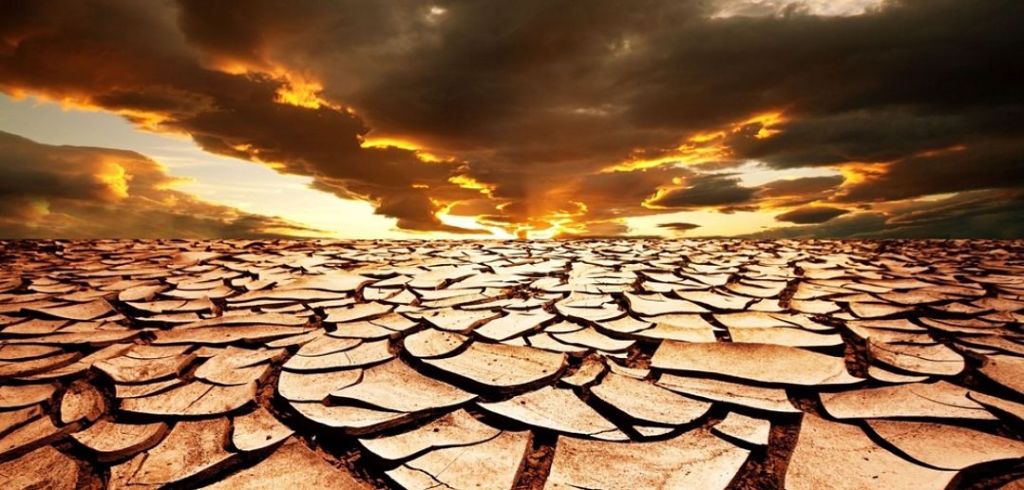
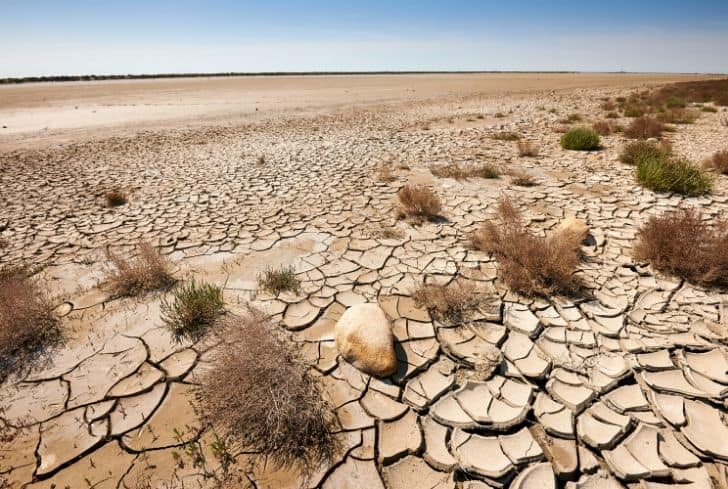
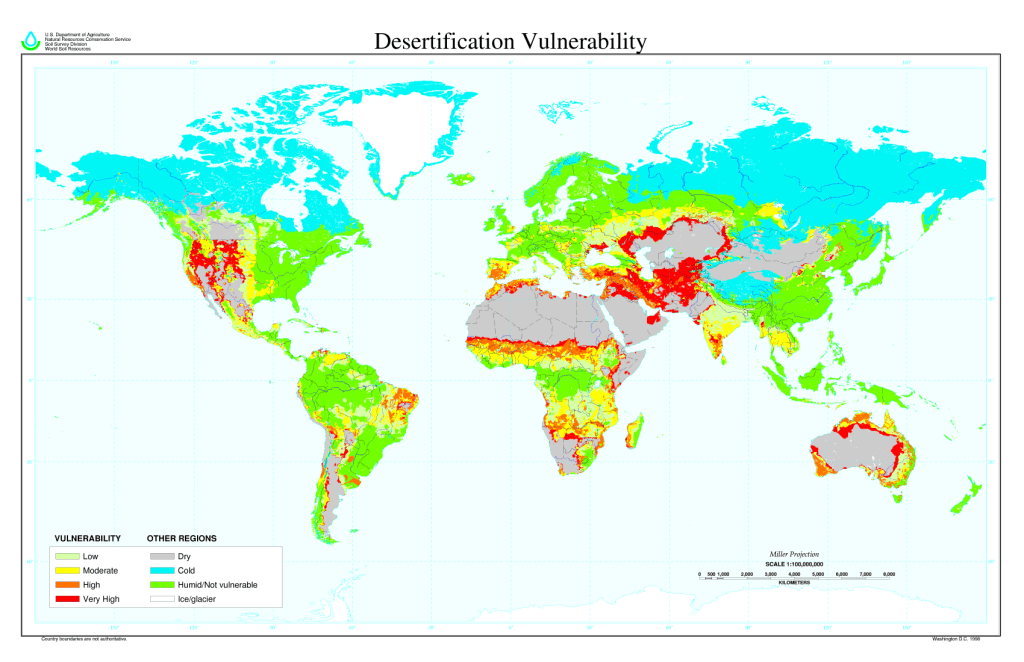
Desertification, an intentionally foreboding term, is at its core land degradation in dryland environments. After nearly 40 years of international attention, the analysis of the causes and consequences of land degradation in dryland systems remains shrouded in the nuanced complexities of multiple interwoven variables (biophysical, anthropogenic, and climatic) working simultaneously to bring about change in these ecologically and socially vulnerable areas. In order to fully grasp the complexities of desertification, this chapter follows a fivefold approach. First, it provides a synthesis of the history and politicization of the term. Second, it establishes desertification’s geospatial context. Third, it identifies the interrelated drivers of land degradation and their impacts, with special focus placed on North Africa, the Middle East, and Central Asia. Fourth, it outlines the current approaches to studying land degradation and desertification. Finally, it concludes by situating the desertification dynamic in the context of sustainability and poverty eradication.
Introduction :-
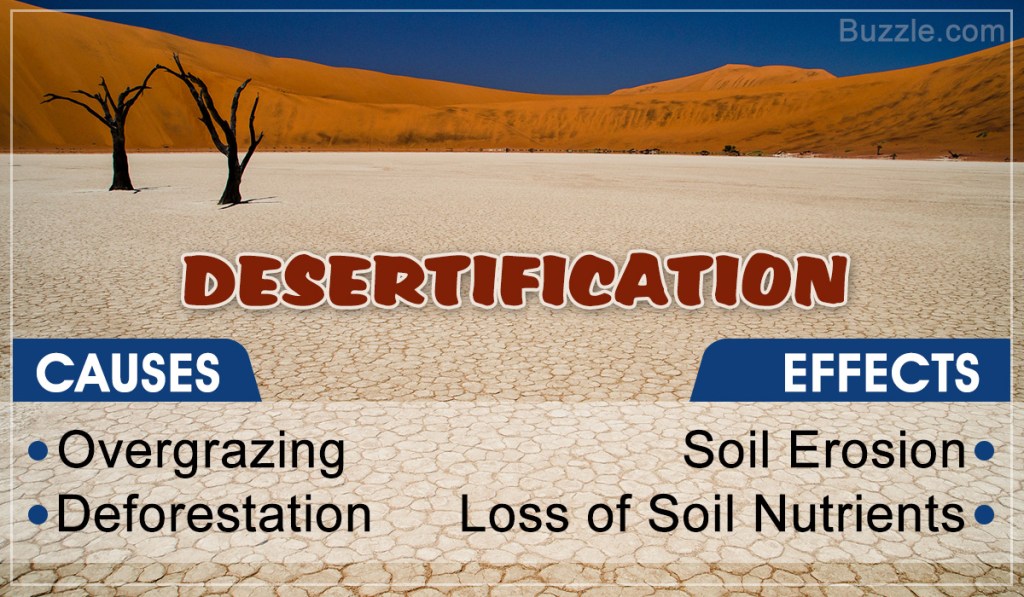
Desertification is defined as a process of land degradation in arid, semi-arid and sub-humid areas due to various factors including climatic variations and human activities. Or, to put it in another way, desertification results in persistent degradation of dryland and fragile ecosystems due to man-made activities and variations in climate. Desertification, in short, is when land that was of another type of biome turns into a desert biome because of changes of all sorts. A huge issue that many countries have is the fact that there are large pockets of land that are going through a process that is known as desertification. Overgrazing is the major cause of desertification worldwide. Other factors that cause desertification include urbanization, climate change, overuse of groundwater, deforestation, natural disasters, and tillage practices in agriculture that make soils more vulnerable to wind. Desertification affects topsoil, groundwater reserves, surface runoff, human, animal, and plant populations. Water scarcity in drylands limits the production of wood, crops, forage, and other services that ecosystems provide to our community. According to UNESCO, one-third of world’s land surface is threatened by desertification, and across the world, it affects the livelihood of millions of people who depend on the benefits of ecosystems that drylands provide. Desertification is another major environmental concern and a significant barrier to meeting basic human needs in drylands and is being constantly threatened by increases in human pressures and climatic variability. It is caused by a variety of factors, such as climate change and human activities. Desertification is a significant global ecological and environmental problem.” Through my project, we’re going to give you an idea as to what are the causes of desertification, the effects that desertification has, and what we can do in order to deal with the problem at hand.
CAUSES OF DESERTIFICATION :–
1. Population Growth :- The population in some desert areas is increasing. In places where there are developments in mining and tourism, people are attracted by jobs. An increased population is putting greater pressure on the environment for resources such as wood and water.
2. Removal of wood – In developing countries, people use wood for cooking. As the population in desert areas increases, there is a greater need for fuel wood. When the land is cleared of trees, the roots of the trees no longer hold the soil together so it is more vulnerable to soil erosion.
3.Overgrazing – An increasing population results in larger desert areas being farmed. Sheep, cattle and goats are overgrazing the vegetation. This leaves the soil exposed to.
4. Soil erosion – This is made worse by overgrazing and the removal of wood. Population growth is the primary cause for soil erosion.
5. Deforestation-When people are looking to move into an area, or they need trees in order to make houses and do other tasks, then they are contributing to the problems related to desertification. Without the plants (especially the trees) around, the rest of the biome cannot thrive.
6. Climate change – The global climate is getting warmer. In desert regions conditions are not only getting warmer but drier too. On average there is less rain now in desert regions than there was 50 years ago.
7. Over drafting of groundwater- Groundwater is the freshwater found underground and also one of the largest water sources. Over drafting is the process in which groundwater is extracted in excess of the equilibrium yield of the aquifer that is pumping or theexcessive pulling up of groundwater from underground aquifers. Its depletion causes desertification.
Devastating Effects of Desertification
:-
1. Farming becomes next to impossible-If an area becomes a desert, then it’s almost impossible to grow substantial crops there without special technologies. This can cost a lot of money to try and do, so many farmers will have to sell their land and leave the desert areas.
2. Decrease in Crop Yields-A major effect of desertification is the decrease in crop yields. Once land turns from arable to arid, it is often on longer suitable for farming purposes anymore. If their land becomes arid, they may no longer be able to provide sufficient crop yields to make a living out of it.
3. Flooding- Without plant life in an area, flooding is a lot more imminent. Not all deserts are dry; those that are wet could experience a lot of flooding because there is nothing to stop the water from gathering and going all over the place. Flooding can also negatively affect the water supply, which we will discuss next.
4. Poor Water Quality-If an area becomes a desert, the water quality is going to become a lot worse than it would have been otherwise. This is because plant life plays a significant role in keeping the water clean and clear; without its presence, it becomes a lot more difficult for you to be able to do that.
5. Biodiversity Loss- In general, the destruction of habitats and desertification may also contribute to a loss of biodiversity. While some species may be able to adjust to the altered environmental conditions properly, many species will not be able to do so and may suffer from serious declines in population.
6. Destruction of Habitats-Desertification often leads to a loss of habitats for many animals and plants. Desertification may alter the living conditions of the local flora and fauna that makes it impossible for animals and plants to sustain their populations.
7. Overpopulation-When areas start to become desert, animals and people will go to other areas where they can actually thrive. This causes crowding and overpopulation, which will, in the long run, end up continuing the cycle of desertification that started this whole thing anyway.
Desertification Is Increasing Because of Global Warming :-
Desertification is a phenomenon that is increasingly understood by scientists. While high
temperatures and droughts prevent plants from growing, arid soils aren’t as good at retaining
water. Human activity (agricultural overexploitation, soil artificialization, deforestation)
contributes to this phenomenon by destroying the environment.
It also leads to biodiversity losses locally, which further accelerates desertification -a positive
(though negative) feedback loop. Desertification also causes the carbon stored in the soil and
plants to be released, which in turn contributes to global warming. These vicious circles are now
well-identified in the scientific community and they are increasingly taking place across the
globe.
But recent studies give us a more precise idea of the speed and extent of these desertification caused changes and how they’re related to global warming. According to a study published in
early January 2018, global warming is helping to accelerate desertification and between 24% and
32% of the globe’s land area could be affected by 2050.
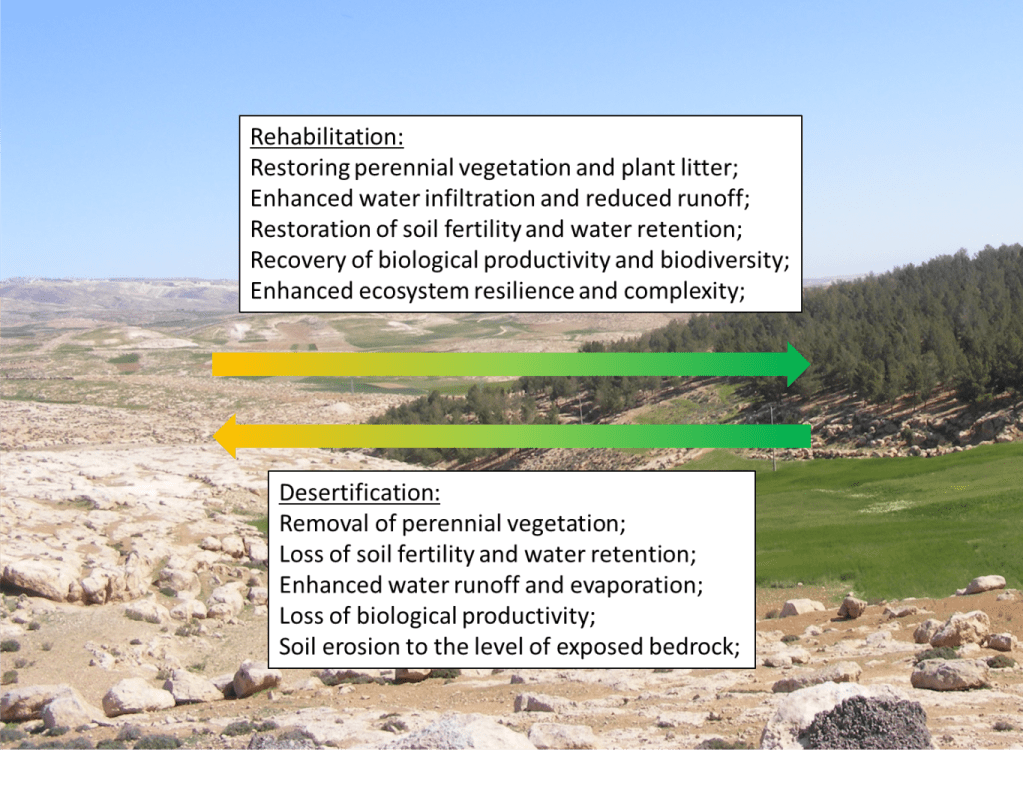
Soil Hydrology of Desertification and Rehabilitation :-
Desertification dramatically alters the hydrology of the degraded soil surfaces. Decertified surfaces are either rocky surfaces or exposed crusted soils with very low water infiltration capacity; water immediately runs off at high speed, causing further soil erosion. Remaining humidity in exposed soils rapidly evaporates in the intensive sunlight, so that resulting biological productivity is a fraction of that of restored ecosystems. In intact or restored ecosystems, large amounts of water can infiltrate through layers of plant litter into rich topsoil, whereby decomposing litter releases the nutrients required for vigorous plant growth Shade provided by perennial plants and plant litter layers also reduces soil surface temperatures and, consequently, evaporation, so that most precipitation becomes available to plants, resulting in water use efficiency.
As we all know the fact that the human psyche is immensely complicated so fresh research that sheds light on why we are the way we are is published every day. Now, Have you ever pondered why you feel or act the way you do? The answer of this question is that the way you are and what you do are largely determined by how your mind works. So human brain is really important without which it’s difficult to survive. Isn’t It remarkable how, at some level, every ‘unique’ mind works the same way?
Here are psychological truths that explain human nature and provide a clear explanation of why things happen to us the way they do, as well as our reactions to them. These mind-blowing psychological truths explain everything about how you act or how you feel the way you do.
Various Research have been conducted which prove that if you make your objectives public, you are less likely to achieve them because you lose motivation to do that.
Our plan A is less likely to succeed if we have a backup plan. Researchers discovered that when volunteers considered a backup plan before beginning a job, they performed worse than those who had not. Furthermore, as students understood they had alternatives, their desire to achieve the first time around dwindled. The researchers emphasize that planning ahead is beneficial, but you may be more effective if your intentions are unclear.
When you go to sleep, the last person on your thoughts is either the source of your happiness or your anguish.
If we’re not in danger, fear might feel pleasant. You receive all the adrenaline, endorphins, and dopamine from a fight-or-flight reaction while you’re watching a terrifying movie or going through a haunted house, but no matter how terrified you are, your brain knows that you’re not actually in danger—so you relax.
Your mind rewrites dull people’s repetitive speeches to make them sound fascinating.
We might be able to bond by “catching” a yawn. Isn’t it sound interesting? Well, Even if you aren’t weary, why do you yawn when someone else does? One of the most popular explanations for why yawning is contagious is that it demonstrates empathy. People who are less inclined to express empathy—for example, toddlers who haven’t yet mastered it are more likely to yawn when seeing the reaction of someone else.
While money may purchase pleasure to some extent, studies suggest that after Rs 49 lakhs per year, more money does nothing to improve contentment.
We want to squeeze cute things for a purpose. When we’re overwhelmed with positive feelings, such when staring at an unbelievably adorable young animal, a little bit of aggressiveness helps us balance off that high, Cuteness aggression is what it’s called, and individuals who have it don’t actually want to destroy that lovely puppy.
We believe that the future is promising. Whether you like where you are now or not, according to study published in Current Biology, most of us have a “optimism bias” that convinces us that the future will be better than the present. We imagine ourselves progressing in our jobs, never getting divorced, raising little angels, and living to a ripe old age. It’s possible that not all of them are feasible.
Smarter individuals have a tendency to underestimate their own abilities. People who are ignorant believe they are clever.
If u find it relatable or interesting comment down in the comment section.
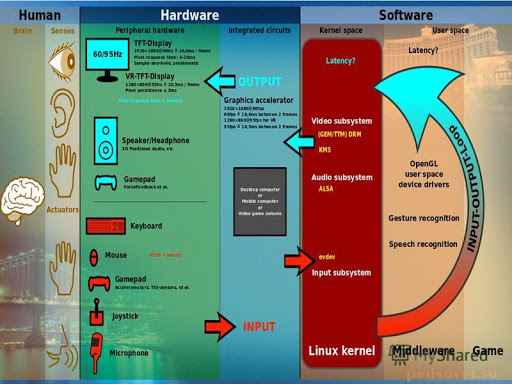
GUI is a Graphical Interface that is a visual representation of communication presented to the user for easy interaction with the machine. GUI means Graphical User Interface. It is the common user Interface that includes Graphical representation like buttons and icons, and communication can be performed by interacting with these icons rather than the usual text-based or command-based communication.
Example of GUI
Need of GUI
The graphical user interface (GUI; sometimes pronounced “gooey”) is used by most commercially popular computer operating systems and software programs today. It’s the kind of interface that allows users to manipulate elements on the screen using a mouse, a stylus, or even a finger. This kind of interface allows word processing or web design programs, for example, to offer WYSIWYG (what you see is what you get) options. Before GUI systems became popular, command line interface (CLI) systems were the norm. As you might imagine, GUI systems have made computers far more user-friendly than CLI systems.
How does it Works ?(InShort)
The graphical user interface is a form of user interface that allows users to interact with electronic devices through graphical icons and audio indicator such as primary notation, instead of text-based user interfaces, typed command labels or text navigation.




































 Eduindex
You must be logged in to post a comment.