The Great Pyramid of Giza

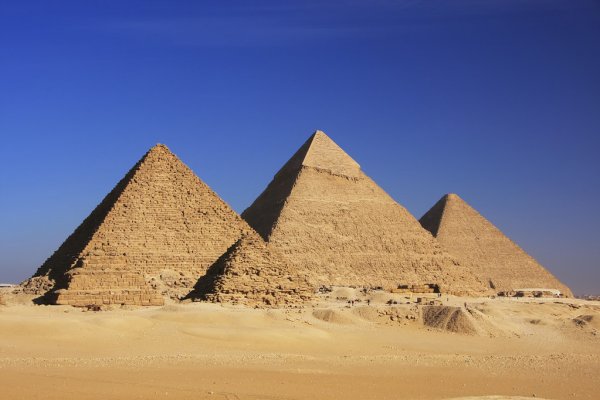
The Great Pyramid of Giza is a defining symbol of Egypt and the last of the ancient Seven Wonders of the World. It is located on the Giza plateau near the modern city of Cairo and was built over a twenty-year period during the reign of the king Khufu (2589-2566 BCE, also known as Cheops) of the 4th Dynasty. Until the Eiffel Tower was completed in Paris, France in 1889 CE, the Great Pyramid was the tallest structure made by human hands in the world; a record it held for over 3,000 years and one unlikely to be broken. Other scholars have pointed to the Lincoln Cathedral spire in England, built in 1300 CE, as the structure which finally surpassed the Great Pyramid in height but, still, the Egyptian monument held the title for an impressive span of time. The pyramid rises to a height of 479 feet (146 metres) with a base of 754 feet (230 metres) and is comprised of over two million blocks of stone. Some of these stones are of such immense size and weight (such as the granite slabs in the King’s Chamber) that the logistics of raising and positioning them so precisely seems an impossibility by modern standards.
Design

In terms of design and planning, some theories suggest that parts of the plan were laid out on the ground at a 1:1 scale. This might account for the accuracy of the workmanship, such that the four sides of the base have an average error of only 58 mm in length. The sides of the pyramid rise at the angle of 51°52′, accurately oriented to the compass’ four cardinal points.

The entrance is around 18 m (59 ft) above the ground on the north side. The Queen’s Chamber and the King’s Chamber are contained inside, connected via a corridor and a slanting gallery 46 m (151 ft) long. The King’s Chamber is shielded from the thrust exerted by the masses of masonry piled on top of it, by five compartments separated by massive horizontal slabs of granite, weighing 25-80 tonnes.

Construction

Most hypotheses are based on the idea that the huge stones were moved from a quarry, and then either dragged, lifted or rolled into place. The most widely accepted theory is that a ramp-like embankment of brick, earth and sand was increased along with the pyramid. Using this embankment, the Egyptians would have hauled the stone blocks using sledges, rollers and levers.

There is also disagreement about the size and nature of the workforce required. The Ancient Greeks thought that slave labour was used, with the historian Herodotus theorising that it took 20 years and 100,000 slaves to build. However, Egyptologists in the 20th century discovered archaeological remains of workers’ camps, which gave rise to the belief that a more limited workforce of as few as 20,000 could have been sufficient, with the workers being skilled rather than slaves.

The core of the pyramid was formed from 2.3 million limestone blocks. The outer casing was made using white Tura limestone, crafted to form a smooth surface with intricate joints unrivalled by any other Egyptian masonry. However, this casing was gradually plundered during ancient and medieval times, although some of the stones can still be seen around the base today.

Shine Bright Like a Diamond:

Today, the Giza pyramids wear the tawny tones of their surrounding Libyan Desert. But back in their heyday, they sparkled. Originally, the pyramids were encased in slabs of highly polished white limestone. When the sun struck them, they lit up and shimmered. Some researchers believe that the pyramids’ capstones were plated in gold as well.

Those dazzling façades have long been stripped—some sources report that those blocks of stone were repurposed and used to build mosques—but you can still see remnants of a once-snowy cap atop the middle pyramid.

The Great Pyramid of Giza

The Great Pyramid of Giza is a defining symbol of Egypt and the last of the ancient Seven Wonders of the World. It is located on the Giza plateau near the modern city of Cairo and was built over a twenty-year period during the reign of the king Khufu (2589-2566 BCE, also known as Cheops) of the 4th Dynasty. Until the Eiffel Tower was completed in Paris, France in 1889 CE, the Great Pyramid was the tallest structure made by human hands in the world; a record it held for over 3,000 years and one unlikely to be broken. Other scholars have pointed to the Lincoln Cathedral spire in England, built in 1300 CE, as the structure which finally surpassed the Great Pyramid in height but, still, the Egyptian monument held the title for an impressive span of time. The pyramid rises to a height of 479 feet (146 metres) with a base of 754 feet (230 metres) and is comprised of over two million blocks of stone. Some of these stones are of such immense size and weight (such as the granite slabs in the King’s Chamber) that the logistics of raising and positioning them so precisely seems an impossibility by modern standards.

Design

In terms of design and planning, some theories suggest that parts of the plan were laid out on the ground at a 1:1 scale. This might account for the accuracy of the workmanship, such that the four sides of the base have an average error of only 58 mm in length. The sides of the pyramid rise at the angle of 51°52′, accurately oriented to the compass’ four cardinal points.

The entrance is around 18 m (59 ft) above the ground on the north side. The Queen’s Chamber and the King’s Chamber are contained inside, connected via a corridor and a slanting gallery 46 m (151 ft) long. The King’s Chamber is shielded from the thrust exerted by the masses of masonry piled on top of it, by five compartments separated by massive horizontal slabs of granite, weighing 25-80 tonnes.

Construction

Most hypotheses are based on the idea that the huge stones were moved from a quarry, and then either dragged, lifted or rolled into place. The most widely accepted theory is that a ramp-like embankment of brick, earth and sand was increased along with the pyramid. Using this embankment, the Egyptians would have hauled the stone blocks using sledges, rollers and levers.

There is also disagreement about the size and nature of the workforce required. The Ancient Greeks thought that slave labour was used, with the historian Herodotus theorising that it took 20 years and 100,000 slaves to build. However, Egyptologists in the 20th century discovered archaeological remains of workers’ camps, which gave rise to the belief that a more limited workforce of as few as 20,000 could have been sufficient, with the workers being skilled rather than slaves.

The core of the pyramid was formed from 2.3 million limestone blocks. The outer casing was made using white Tura limestone, crafted to form a smooth surface with intricate joints unrivalled by any other Egyptian masonry. However, this casing was gradually plundered during ancient and medieval times, although some of the stones can still be seen around the base today.

Shine Bright Like a Diamond:

Today, the Giza pyramids wear the tawny tones of their surrounding Libyan Desert. But back in their heyday, they sparkled. Originally, the pyramids were encased in slabs of highly polished white limestone. When the sun struck them, they lit up and shimmered. Some researchers believe that the pyramids’ capstones were plated in gold as well.

Those dazzling façades have long been stripped—some sources report that those blocks of stone were repurposed and used to build mosques—but you can still see remnants of a once-snowy cap atop the middle pyramid.

Down Syndrome

Down syndrome also known as Trisomy 21 is a chromosomal condition that is associated with intellectual disability, a characteristic facial appearance, and weak muscle tone (hypotonia) in infancy. All affected individuals experience cognitive delays, but the intellectual disability is usually mild to moderate.

People with Down syndrome often have a characteristic facial appearance that includes a flattened appearance to the face, outside corners of the eyes that point upward, small ears, a short neck and a tongue that tends to stick out of the mouth. Affected individuals may have a variety of birth defects. Many people with Down syndrome have small hands and feet and a single crease across the palms of their hands. About half of all affected children are born with a heart defect. Digestive abnormalities, such as a blockage of the intestine, are less common.

Most cases of Down syndrome are not inherited. When the condition is caused by trisomy 21, the chromosomal abnormality occurs as a random event during the formation of reproductive cells in a parent. The abnormality usually occurs in egg cells, but it occasionally occurs in sperm cells. An error in cell division called nondisjunction results in a reproductive cell with an abnormal number of chromosomes. For example, an egg or sperm cell may gain an extra copy of chromosome 21

Down Syndrome

Down syndrome also known as Trisomy 21 is a chromosomal condition that is associated with intellectual disability, a characteristic facial appearance, and weak muscle tone (hypotonia) in infancy. All affected individuals experience cognitive delays, but the intellectual disability is usually mild to moderate.

People with Down syndrome often have a characteristic facial appearance that includes a flattened appearance to the face, outside corners of the eyes that point upward, small ears, a short neck and a tongue that tends to stick out of the mouth. Affected individuals may have a variety of birth defects. Many people with Down syndrome have small hands and feet and a single crease across the palms of their hands. About half of all affected children are born with a heart defect. Digestive abnormalities, such as a blockage of the intestine, are less common.

Most cases of Down syndrome are not inherited. When the condition is caused by trisomy 21, the chromosomal abnormality occurs as a random event during the formation of reproductive cells in a parent. The abnormality usually occurs in egg cells, but it occasionally occurs in sperm cells. An error in cell division called nondisjunction results in a reproductive cell with an abnormal number of chromosomes. For example, an egg or sperm cell may gain an extra copy of chromosome 21

Love looks through a telescope; envy, through a microscope

• The invention of the microscope has opened up a whole new dimension in science. By using microscopes scientists were able to discover the existence of microorganisms, study the structure of cells, and see the smallest parts of plants, animals, and fungi.

Today, the microscope is still a commonly used tool to diagnosis illness in hospitals and clinics all over the world.

• Since their original invention, microscopes have moved beyond the simple visible light refracting lenses.

Electrons, x-rays, and infrared rays are used by far more sophisticated and expensive microscopes to detect even smaller and smaller structures. Scanning electron microscopes are able to resolve viruses, which are far smaller than any cell.

The most familiar type of microscope is the optical, or light, microscope, in which glass lenses are used to form the image. …… Other types of microscopes use the wave nature of various physical processes.

The most important is the electron microscope, which uses a beam of electrons in its image formation. A microscope is an instrument that makes an enlarged image of a small object, thus revealing details too small to be seen by the unaided eye.

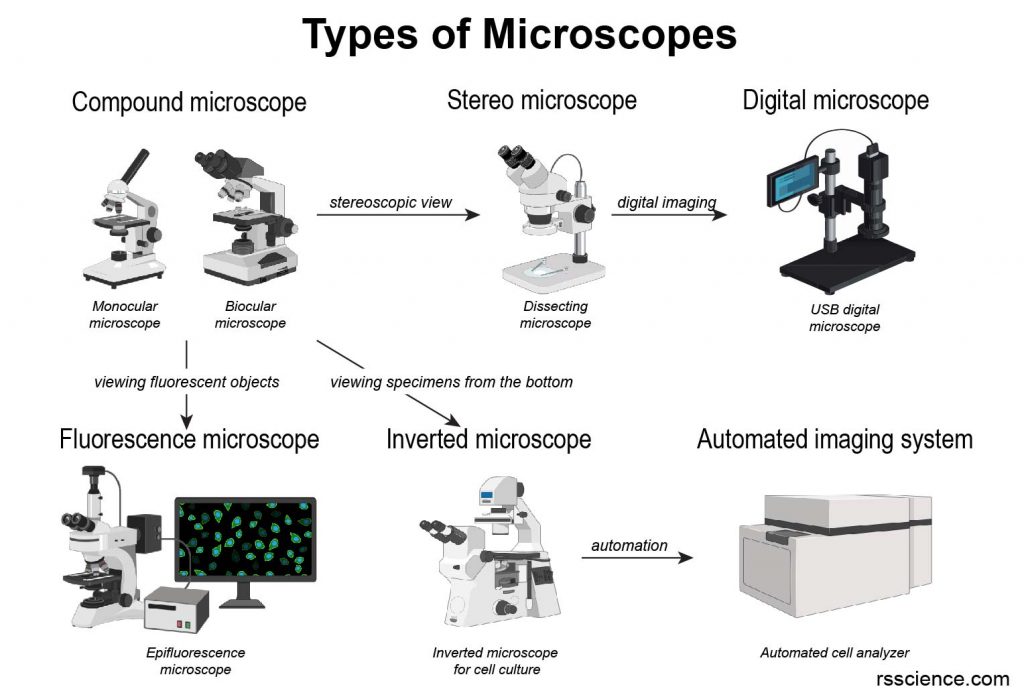
Simple Microscope – contains only one lens.

Ex. Magnifying glass.

Compound light microscope – a system of two lens that work together.

Electron microscopes – uses electrons to provide detailed views of specimens.

Ex. TEM and SEM

Dissecting microscope – allows for the viewing of specimens without the use of slide.

Love looks through a telescope; envy, through a microscope

• The invention of the microscope has opened up a whole new dimension in science. By using microscopes scientists were able to discover the existence of microorganisms, study the structure of cells, and see the smallest parts of plants, animals, and fungi.

Today, the microscope is still a commonly used tool to diagnosis illness in hospitals and clinics all over the world.

• Since their original invention, microscopes have moved beyond the simple visible light refracting lenses.

Electrons, x-rays, and infrared rays are used by far more sophisticated and expensive microscopes to detect even smaller and smaller structures. Scanning electron microscopes are able to resolve viruses, which are far smaller than any cell.

The most familiar type of microscope is the optical, or light, microscope, in which glass lenses are used to form the image. …… Other types of microscopes use the wave nature of various physical processes.

The most important is the electron microscope, which uses a beam of electrons in its image formation. A microscope is an instrument that makes an enlarged image of a small object, thus revealing details too small to be seen by the unaided eye.

Simple Microscope – contains only one lens.

Ex. Magnifying glass.

Compound light microscope – a system of two lens that work together.

Electron microscopes – uses electrons to provide detailed views of specimens.

Ex. TEM and SEM

Dissecting microscope – allows for the viewing of specimens without the use of slide.

Unveiling of a 100-Qubit Quantum Computing System

Atom Computing, a quantum computing firm, has announced the development of a quantum computing machine with unrivaled capabilities. The Phoenix system, which is in its initial iteration, can hold up to 100 qubits and is touted to be ‘exceptionally’ stable with lengthy coherence periods, allowing for high performance. Separately, the firm reported the receipt of approximately $15 million in Series A investment and the appointment of a new CEO.

With optical tweezers, Atom Computing’s Phoenix can capture 100 atomic qubits (of an alkaline earth element) in a vacuum container. Lasers are then used to alter the quantum states of atomic qubits. Atom Computing’s Phoenix, according to the firm, is ideal for complicated calculations since its qubits are exceptionally robust and have very long coherence times (over 100 ms).

Using optical tweezers to manipulate atomic qubits in a vacuum environment is not a novel concept. Although Honeywell sells similar devices, their quantum computers only have six qubits. According to Atom Computing, their laser technology and platform design enable the scalability of the number of qubits to 100 units. The firm must, however, demonstrate such a system.

“The development of quantum computing has advanced to the point that it is no longer a decade away. Because of our systems’ scalability and reliability, we are certain that we will be able to lead the industry to genuine quantum advantage “Atom Computing’s CEO and President, Rob Hays, stated. “We’ll be able to solve complicated problems that were previously impossible to handle with traditional computing, even with Moore’s Law’s exponential performance improvements and massively scalable cluster designs.”

Atom Computing announced that it has raised $15 million in Series A investment from venture capital companies Venrock, Innovation Endeavors, and Prelude Ventures, in addition to providing the first information about its Phoenix quantum computing system. The funds will go toward the construction of the Phoenix quantum computing system.

Rob Hays has also been named CEO and President of the firm. Hays previously worked at Intel for 20 years, establishing the company’s Xeon roadmap. Later in his career, he worked at Lenovo, where he established the company’s data center product and service strategy.

Unveiling of a 100-Qubit Quantum Computing System

Atom Computing, a quantum computing firm, has announced the development of a quantum computing machine with unrivaled capabilities. The Phoenix system, which is in its initial iteration, can hold up to 100 qubits and is touted to be ‘exceptionally’ stable with lengthy coherence periods, allowing for high performance. Separately, the firm reported the receipt of approximately $15 million in Series A investment and the appointment of a new CEO.

With optical tweezers, Atom Computing’s Phoenix can capture 100 atomic qubits (of an alkaline earth element) in a vacuum container. Lasers are then used to alter the quantum states of atomic qubits. Atom Computing’s Phoenix, according to the firm, is ideal for complicated calculations since its qubits are exceptionally robust and have very long coherence times (over 100 ms).

Using optical tweezers to manipulate atomic qubits in a vacuum environment is not a novel concept. Although Honeywell sells similar devices, their quantum computers only have six qubits. According to Atom Computing, their laser technology and platform design enable the scalability of the number of qubits to 100 units. The firm must, however, demonstrate such a system.

“The development of quantum computing has advanced to the point that it is no longer a decade away. Because of our systems’ scalability and reliability, we are certain that we will be able to lead the industry to genuine quantum advantage “Atom Computing’s CEO and President, Rob Hays, stated. “We’ll be able to solve complicated problems that were previously impossible to handle with traditional computing, even with Moore’s Law’s exponential performance improvements and massively scalable cluster designs.”

Atom Computing announced that it has raised $15 million in Series A investment from venture capital companies Venrock, Innovation Endeavors, and Prelude Ventures, in addition to providing the first information about its Phoenix quantum computing system. The funds will go toward the construction of the Phoenix quantum computing system.

Rob Hays has also been named CEO and President of the firm. Hays previously worked at Intel for 20 years, establishing the company’s Xeon roadmap. Later in his career, he worked at Lenovo, where he established the company’s data center product and service strategy.

POVERTY


Poverty, the state of one who lacks a usual or socially acceptable amount of money or material possessions. Poverty is said to exist when people lack the means to satisfy their basic needs. In this context, the identification of poor people first requires a determination of what constitutes basic needs. These may be defined as narrowly as “those necessary for survival” or as broadly as “those reflecting the prevailing standard of living in the community.” The first criterion would cover only those people near the borderline of starvation or death from exposure; the second would extend to people whose nutrition, housing, and clothing, though adequate to preserve life, do not measure up to those of the population as a whole. The problem of definition is further compounded by the noneconomic connotations that the word poverty has acquired. Poverty has been associated, for example, with poor health, low levels of education or skills, an inability or an unwillingness to work, high rates of disruptive or disorderly behavior, and improvidence. While these attributes have often been found to exist with poverty, their inclusion in a definition of poverty would tend to obscure the relation between them and the inability to provide for one’s basic needs. Whatever definition one uses, authorities and laypersons alike commonly assume that the effects of poverty are harmful to both individuals and society.

Although poverty is a phenomenon as old as human history, its significance has changed over time. Under traditional (i.e., nonindustrial zed) modes of economic production, widespread poverty had been accepted as inevitable. The total output of goods and services, even if equally distributed, would still have been insufficient to give the entire population a comfortable standard of living by prevailing standards. With the economic productivity that resulted from industrialization, however, this ceased to be the case—especially in the world’s most industrialized countries, where national outputs were sufficient to raise the entire population to a comfortable level if the necessary redistribution could be arranged without adversely affecting output.


 How does poverty affect children?
Children usually depend on their parents or guardians. They don’t have the resources to pull themselves out of poverty. This makes them more likely to experience the problems common to poverty, including:

  • Illness due to unsafe water and poor sanitation
  • Malnutrition (for example, leading to stunted growth)
  • Lack of access to education (for example, leading to depressed future productivity)
  • Inadequate health care

Child poverty has other negative effects. It can trigger a cycle of poverty that lasts generations, increase the incidence of early marriage and raise psychological issues of stress and shame. However, with the right response, starting with education, the cycle of poverty can be broken.


 What can I do to reduce poverty?
You can find and support creditable organizations that are working to reduce poverty in the world’s poorest communities. There are a variety of organizations focused on different aspects of poverty. These can include access to health care and education services, labor rights and conditions, or by demographic such as women and children.

Supporting these organizations can involve everything from making financial donations, to volunteering, to advocacy work. With World Vision, there are several ways that you can get involved in the fight against poverty. You can donate through our Gift Cataloguebecome a child ambassadorsupport a community and more.

Diabetes

Diabetes is a chronic (long-lasting) health condition that affects how your body turns food into energy. If you have diabetes, your body either doesn’t make enough insulin or can’t use the insulin it makes as well as it should. When there isn’t enough insulin or cells stop responding to insulin, too much blood sugar stays in your bloodstream. Over time, that can cause serious health problems. There isn’t a cure yet for diabetes, but losing weight, eating healthy food, and being active can really help.

Types of Diabetes

TYPE 1- Type 1 diabetes is thought to be caused by an autoimmune reaction (the body attacks itself by mistake) that stops your body from making insulin. Approximately 5-10% of the people who have diabetes have type 1.  It’s usually diagnosed in children, teens, and young adults. If you have type 1 diabetes, you’ll need to take insulin every day to survive

TYPE 2- With type 2 diabetes, your body doesn’t use insulin well and can’t keep blood sugar at normal levels. About 90-95% of people with diabetes have type 2. It develops over many years and is usually diagnosed in adults (but more and more in children, teens, and young adults).

GESTATIONAL DIABETES- Gestational diabetes develops in pregnant women who have never had diabetes. If you have gestational diabetes, your baby could be at higher risk for health problems. Gestational diabetes usually goes away after your baby is born but increases your risk for type 2 diabetes later in life. Your baby is more likely to have obesity as a child or teen, and more likely to develop type 2 diabetes later in life too.

PREDIABETES- With prediabetes, blood sugar levels are higher than normal, but not high enough yet to be diagnosed as type 2 diabetes. Prediabetes raises your risk for type 2 diabetes, heart disease, and stroke. 

Also diabetes runs in the family so if your parents or grandparents have diabetes, you have increased chances for getting diabetes. Personally diabetes runs in my family so my blood sugar is naturally high so the only way I can prevent getting diabetes is a healthy lifestyle, and decreased consumption of sugar.

Diabetes

Diabetes is a chronic (long-lasting) health condition that affects how your body turns food into energy. If you have diabetes, your body either doesn’t make enough insulin or can’t use the insulin it makes as well as it should. When there isn’t enough insulin or cells stop responding to insulin, too much blood sugar stays in your bloodstream. Over time, that can cause serious health problems. There isn’t a cure yet for diabetes, but losing weight, eating healthy food, and being active can really help.

Types of Diabetes

TYPE 1- Type 1 diabetes is thought to be caused by an autoimmune reaction (the body attacks itself by mistake) that stops your body from making insulin. Approximately 5-10% of the people who have diabetes have type 1.  It’s usually diagnosed in children, teens, and young adults. If you have type 1 diabetes, you’ll need to take insulin every day to survive

TYPE 2- With type 2 diabetes, your body doesn’t use insulin well and can’t keep blood sugar at normal levels. About 90-95% of people with diabetes have type 2. It develops over many years and is usually diagnosed in adults (but more and more in children, teens, and young adults).

GESTATIONAL DIABETES- Gestational diabetes develops in pregnant women who have never had diabetes. If you have gestational diabetes, your baby could be at higher risk for health problems. Gestational diabetes usually goes away after your baby is born but increases your risk for type 2 diabetes later in life. Your baby is more likely to have obesity as a child or teen, and more likely to develop type 2 diabetes later in life too.

PREDIABETES- With prediabetes, blood sugar levels are higher than normal, but not high enough yet to be diagnosed as type 2 diabetes. Prediabetes raises your risk for type 2 diabetes, heart disease, and stroke. 

Also diabetes runs in the family so if your parents or grandparents have diabetes, you have increased chances for getting diabetes. Personally diabetes runs in my family so my blood sugar is naturally high so the only way I can prevent getting diabetes is a healthy lifestyle, and decreased consumption of sugar.

Does Execution Simply Mean An Initiative?

“Dreams reach their final destination when executed.”

  • Amatullah P.

What exactly is Execution for you? A dictionary nerd would give the perfect definition of it but the ‘Dictionary of Business’ has a completely different meaning altogether. Let’s begin with the standard way and get you imagining!

Till now, we made you analyse the aftermath of building a company but this story will drag you into that internal process of thought!

It’s been a struggling journey all along. You are broke and want some source of income which is quite obvious. That is when your company is born because it has started occupying some space in your thought. Now, you plan towards executing its existence in the society. Of course, you don’t begin with that company motive in head. The first thought is always to go for a job wherein you receive ample experience from which you can learn and set up your own business. Let us consider that you are ready to begin your own company which means that you will now have to execute your motive. Executing here doesn’t simply mean initiating. Execution includes the proper steps you take into getting your company a success! Of course, you are not required to become an overnight news sensation. All you need to do is, just take the correct steps towards your company.

Execution means employing eligible employees for your company, being updated with the current market trends and coming up with suitable services, efficiently marketing your goods and services either through social media or any other network which is in exquisite demand during the given period of time! All the steps that you take which would guarantee success of your company come under the umbrella term Execution in business. Coming up with customer attractions like discounts, giveaways, buy 1 get 1 free offers are examples of perfectly executing your business in the smoothest way possible! You want people to buy your products and these attractions are sure to get the flies in the trap! Of course, the word ‘Trap’ shouldn’t be literally considered here because you don’t want to impose your services on people rather make them opt for those willingly and with love. That’s exactly why, Execution as a concept turns out to be handy!

The example of KFC has been discussed in the earlier article as well. How it started with the sale of chicken and became a widespread branch including more variety in food items which is the way they executed their business to make it run for a long long period of time. They considered the needs of people and came up with convenient offers to keep fuelling the company. Effective planning in short, is what we term as Execution. By this, you are not expected to lay down a prospectus with phenomenal ideas, all clashing into one another, making it difficult for you to decide! You are not expected to stretch a wide sheet of paper and jot down ideas from different sources. It’s because experience teaches you all but if you are a perfectionist then you are free to do so. There is no obligation in the negation! 😂

By now, you must have understood the key to effective functioning of a company which lies in the way you run it- Execution. Yes, execution is similar to initiation. Yes, execution is beginning the task but it also carries a deeper meaning wherein the way you begin that task, too is involved.

Thank You For Reading!

Debate against Evolution

Yes, I know that Evolution is a world wide accepted topic but these points always about makes me doubt whether evolution is real or not

I want to first start by saying that evolution is a hypothesis made by charles darwin. In the late 18th century, naturalist George Louis Leclerc suggested that life on Earth was 75,000 years old and that men had descended from apes. Another step in evolution theory was taken by Erasmus Darwin, Charles Darwin’s grandfather, who said the Earth was millions of years old and that species did evolve, even if he could not explain how. When charles darwin had introduced this topic any information about where we had come was unknown so people believed darwins theory very easily and did not contradict it. the scientists dint even bother to verify the theory until now.

The greatest claim that i can introduce is that evolution has never been observed. Now people will say that we have never see god so how do we know god exists but the truth is that we just assume god to exist there is no proof just like evolution. As for fossils people just find the fossils of different animals and they are so desperate to find a relation they connect different fossils and call it evolution.

Everyone says that we have evolved from apes but where is the proof a couple of fossils of apes and humans proves nothing like that we can say we have evolved from mice after all they are 98% similar to men and apes are also similar around the same percentage.Creationists claim that evolution relies on certain types of evidence that do not give reliable information about the past.

A common objection to evolution is that it is simply too unlikely for life, in its complexity and apparent “design”, to have arisen “by chance”. It is argued that the odds of life having arisen without a deliberate intelligence guiding it are so astronomically low that it is unreasonable not to infer an intelligent designer from the natural world, Even darwin had realised that there are so many questions that could come up about his theory infact when the question about how such a complex organ like eye could be developed one scientist due to lack of proof had said that the eye was designed by god.

Also if we really come from apes then why are other apes alive around the world why dont they become human as well?

Debate against Evolution

Yes, I know that Evolution is a world wide accepted topic but these points always about makes me doubt whether evolution is real or not

I want to first start by saying that evolution is a hypothesis made by charles darwin. In the late 18th century, naturalist George Louis Leclerc suggested that life on Earth was 75,000 years old and that men had descended from apes. Another step in evolution theory was taken by Erasmus Darwin, Charles Darwin’s grandfather, who said the Earth was millions of years old and that species did evolve, even if he could not explain how. When charles darwin had introduced this topic any information about where we had come was unknown so people believed darwins theory very easily and did not contradict it. the scientists dint even bother to verify the theory until now.

The greatest claim that i can introduce is that evolution has never been observed. Now people will say that we have never see god so how do we know god exists but the truth is that we just assume god to exist there is no proof just like evolution. As for fossils people just find the fossils of different animals and they are so desperate to find a relation they connect different fossils and call it evolution.

Everyone says that we have evolved from apes but where is the proof a couple of fossils of apes and humans proves nothing like that we can say we have evolved from mice after all they are 98% similar to men and apes are also similar around the same percentage.Creationists claim that evolution relies on certain types of evidence that do not give reliable information about the past.

A common objection to evolution is that it is simply too unlikely for life, in its complexity and apparent “design”, to have arisen “by chance”. It is argued that the odds of life having arisen without a deliberate intelligence guiding it are so astronomically low that it is unreasonable not to infer an intelligent designer from the natural world, Even darwin had realised that there are so many questions that could come up about his theory infact when the question about how such a complex organ like eye could be developed one scientist due to lack of proof had said that the eye was designed by god.

Also if we really come from apes then why are other apes alive around the world why dont they become human as well?

what is the reason number of divorce cases In increasing in India?

Respecting our society and our culture, no person takes divorce. It is said everywhere that the number of divorces in India is very less.

And the divorce rate in India is the lowest among all the countries in the world. Statistics show that only 1 in 100 Indian marriages result in divorce, which is much less than 50% of US marriages that break up. The divorce rate was even lower in India over the past decade, where only 7.40 out of 1,000 marriages were annulled.

Now, If we talk about the old times, then if we talk about our Hindu tradition, then marriage was considered as a relationship of seven births which never broke. There was something similar in the law but then an agreement came and permission was given to get a mutual divorce. And people started taking Divorce and after that our society started changing and the rate of Divorce started increasing. And what is due to family breakdown are given below.

Reasons for divorce

1. Extramarital affair:

Even after marriage, whether it is from the side of the husband or from the side of the wife, but even after marriage, there are affairs. Having a relationship with someone other than the wife, which causes a rift in the relationship of the husband- wife And their family comes on the verge of breaking up, this is the biggest reason for getting divorced.

2. Money:

Today, society has become so complex that it becomes difficult for one person to walk home. When many needs are not fulfilled due to lack of money, then the matter reaches till the fight. So money also becomes the reason for divorce to an extent.

3.Lack of communication:

There is no good communication between husband and wife. When there is no good talk between husband and wife, then there is a rift in the relationship and the relationship breaks down and reaches on the verge of divorce.

4.The constant argument between husband and wife:

There is a constant debate on any matter, whether it is small or big, but the debate keeps on going on. Because of understanding each other, accusations are being made against each other And this constant argument breaks their relationship, fills bitterness in their relationship, which breaks the relationship.

5.Unrealistic expectations:

Husband and wife have a lot of expectations from each other, and if they are not able to fulfill, then it leads to divorce.

6. Lack of feelings:

When husband and wife do not have feelings for each other have no emotion And when there is no feelings and no emotion in the relationship, then it seems that the relationship is being dragged And that is also a big reason for getting divorced in India.

7. Lack of equality:

It means not to give equal status to each other. That you do not want to give the status of equality to each other, whether it is from the side of the wife or from the side of the husband. You want to suppress your wife or your husband, due to which there is no equality between the two, due to which their relationship reaches to divorce.

8.They don’t want to marry each other but get married because of family

Husband and wife do not feel like getting married, come under the pressure of the family and get married under the pressure of relatives. Due to which this relationship is called a forced relationship And such relationships mostly do not work and get divorced.

9. Emotional abuses:

husband and wife are using each other a lot, because of understanding each other, they insult each other Emotional torturing each other and due to this excess, their relationship deteriorates and the matter reaches to divorce. And this is the 9th main reason due to which divorce cases are increasing in India.

10. Family:

Due to lack of good relations with each other’s family Because of this, the relationship between husband and wife also does not get good. And many types of disputes arise in the family, due to which the husband and wife do not like to live with the family and because of this also their relationship ends.

11.Ego

And apart from this, education is the reason why people are becoming self-reliant, which is very good for our society, but at the same time ego also comes in them And this ego starts coming between husband and wife relationship and the matter reaches till divorce And this ego starts coming between husband and wife relationship and the matter reaches till divorce.