
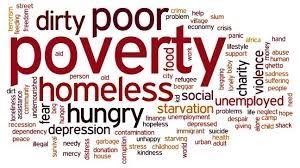
POVERTY

What is poverty?

Poverty is about not having enough money to meet basic needs including food, clothing and shelter. However, poverty is more, much more than just not having enough money.

The World Bank Organization describes poverty in this way:

“Poverty is hunger. Poverty is lack of shelter. Poverty is being sick and not being able to see a doctor. Poverty is not having access to school and not knowing how to read. Poverty is not having a job, is fear for the future, living one day at a time.

Poverty has many faces, changing from place to place and across time, and has been described in many ways. Most often, poverty is a situation people want to escape. So poverty is a call to action — for the poor and the wealthy alike — a call to change the world so that many more may have enough to eat, adequate shelter, access to education and health, protection from violence, and a voice in what happens in their communities.”

In addition to a lack of money, poverty is about not being able to participate in recreational activities; not being able to send children on a day trip with their schoolmates or to a birthday party; not being able to pay for medications for an illness. These are all costs of being poor. Those people who are barely able to pay for food and shelter simply can’t consider these other expenses. When people are excluded within a society, when they are not well educated and when they have a higher incidence of illness, there are negative consequences for society. We all pay the price for poverty. The increased cost on the health system, the justice system and other systems that provide supports to those living in poverty has an impact on our economy.

While much progress has been made in measuring and analyzing poverty, the World Bank Organization is doing more work to identify indicators for the other dimensions of poverty. This work includes identifying social indicators to track education, health, access to services, vulnerability, and social exclusion.

There is no one cause of poverty, and the results of it are different in every case. Poverty varies considerably depending on the situation. Feeling poor in Canada is different from living in poverty in Russia or Zimbabwe. The differences between rich and poor within the borders of a country can also be great.

Despite the many definitions, one thing is certain; poverty is a complex societal issue. No matter how poverty is defined, it can be agreed that it is an issue that requires everyone’s attention. It is important that all members of our society work together to provide the opportunities for all our members to reach their full potential. It helps all of us to help one another.

On the basis of social, economical and political aspects, there are different ways to identify the type of Poverty:

  1. Absolute poverty.
  2. Relative Poverty.
  3. Situational Poverty.
  4. Generational Poverty.
  5. Rural Poverty.
  6. Urban Poverty.

Now let us understand them one by one:

1.Absolute poverty: Also known as extreme poverty or abject poverty, it involves the scarcity of basic food, clean water, health, shelter, education and information. Those who belong to absolute poverty tend to struggle to live and experience a lot of child deaths from preventable diseases like malaria, cholera and water-contamination related diseases. Absolute Poverty is usually uncommon in developed countries.

It was first introduced in 1990, the “dollar a day” poverty line measured absolute poverty by the standards of the world’s poorest countries. In October 2015, the World Bank reset it to $1.90 a day. This number is controversial; therefore each nation has its own threshold for absolute poverty line.

“It is a condition so limited by malnutrition, illiteracy, disease, squalid surroundings, high infant mortality, and low life expectancy as to be beneath any reasonable definition of human decency.” Said by Robert McNamara, the former president of the World Bank.

2.Relative Poverty: It is defined from the social perspective that is living standard compared to the economic standards of population living in surroundings. Hence it is a measure of income inequality. For example, a family can be considered poor if it cannot afford vacations, or cannot buy presents for children at Christmas, or cannot send its young to the university.

Usually, relative poverty is measured as the percentage of the population with income less than some fixed proportion of median income.

It is a widely used measure to ascertain poverty rates in wealthy developed nations.

In European Union the “relative poverty measure is the most prominent and most–quoted of the EU social inclusion indicators”

3.Situational Poverty: It is a temporary type of poverty based on occurrence of an adverse event like environmental disaster, job loss and severe health problem.
People can help themselves even with a small assistance, as the poverty comes because of unfortunate event.

4.Generational Poverty: It is handed over to individual and families from one generation to the one. This is more complicated as there is no escape because the people are trapped in its cause and unable to access the tools required to get out of it.

“Occurs in families where at least two generations have been born into poverty. Families living in this type of poverty are not equipped with the tools to move out of their situation” (Jensen, 2009).

5.Rural Poverty: It occurs in rural areas with population below 50,000. It is the area where there are less job opportunities, less access to services, less support for disabilities and quality education opportunities. People are tending to live mostly on the farming and other menial work available to the surroundings.

The rural poverty rate is growing and has exceeded the urban rate every year since data collection began in the 1960s. The difference between the two poverty rates has averaged about 5 percent for the last 30 years, with urban rates near 10–15 percent and rural rates near 15–20 percent (Jolliffe, 2004).

6.Urban Poverty: It occurs in the metropolitan areas with population over 50,000. These are some major challenges faced by the Urban Poor:

• Limited access to health and education.
• Inadequate housing and services.
• Violent and unhealthy environment because of overcrowding.
• Little or no social protection mechanism.

POVERTY

What is poverty?

Poverty is about not having enough money to meet basic needs including food, clothing and shelter. However, poverty is more, much more than just not having enough money.

The World Bank Organization describes poverty in this way:

“Poverty is hunger. Poverty is lack of shelter. Poverty is being sick and not being able to see a doctor. Poverty is not having access to school and not knowing how to read. Poverty is not having a job, is fear for the future, living one day at a time.

Poverty has many faces, changing from place to place and across time, and has been described in many ways. Most often, poverty is a situation people want to escape. So poverty is a call to action — for the poor and the wealthy alike — a call to change the world so that many more may have enough to eat, adequate shelter, access to education and health, protection from violence, and a voice in what happens in their communities.”

In addition to a lack of money, poverty is about not being able to participate in recreational activities; not being able to send children on a day trip with their schoolmates or to a birthday party; not being able to pay for medications for an illness. These are all costs of being poor. Those people who are barely able to pay for food and shelter simply can’t consider these other expenses. When people are excluded within a society, when they are not well educated and when they have a higher incidence of illness, there are negative consequences for society. We all pay the price for poverty. The increased cost on the health system, the justice system and other systems that provide supports to those living in poverty has an impact on our economy.

While much progress has been made in measuring and analyzing poverty, the World Bank Organization is doing more work to identify indicators for the other dimensions of poverty. This work includes identifying social indicators to track education, health, access to services, vulnerability, and social exclusion.

There is no one cause of poverty, and the results of it are different in every case. Poverty varies considerably depending on the situation. Feeling poor in Canada is different from living in poverty in Russia or Zimbabwe. The differences between rich and poor within the borders of a country can also be great.

Despite the many definitions, one thing is certain; poverty is a complex societal issue. No matter how poverty is defined, it can be agreed that it is an issue that requires everyone’s attention. It is important that all members of our society work together to provide the opportunities for all our members to reach their full potential. It helps all of us to help one another.

On the basis of social, economical and political aspects, there are different ways to identify the type of Poverty:

  1. Absolute poverty.
  2. Relative Poverty.
  3. Situational Poverty.
  4. Generational Poverty.
  5. Rural Poverty.
  6. Urban Poverty.

Now let us understand them one by one:

1.Absolute poverty: Also known as extreme poverty or abject poverty, it involves the scarcity of basic food, clean water, health, shelter, education and information. Those who belong to absolute poverty tend to struggle to live and experience a lot of child deaths from preventable diseases like malaria, cholera and water-contamination related diseases. Absolute Poverty is usually uncommon in developed countries.

It was first introduced in 1990, the “dollar a day” poverty line measured absolute poverty by the standards of the world’s poorest countries. In October 2015, the World Bank reset it to $1.90 a day. This number is controversial; therefore each nation has its own threshold for absolute poverty line.

“It is a condition so limited by malnutrition, illiteracy, disease, squalid surroundings, high infant mortality, and low life expectancy as to be beneath any reasonable definition of human decency.” Said by Robert McNamara, the former president of the World Bank.

2.Relative Poverty: It is defined from the social perspective that is living standard compared to the economic standards of population living in surroundings. Hence it is a measure of income inequality. For example, a family can be considered poor if it cannot afford vacations, or cannot buy presents for children at Christmas, or cannot send its young to the university.

Usually, relative poverty is measured as the percentage of the population with income less than some fixed proportion of median income.

It is a widely used measure to ascertain poverty rates in wealthy developed nations.

In European Union the “relative poverty measure is the most prominent and most–quoted of the EU social inclusion indicators”

3.Situational Poverty: It is a temporary type of poverty based on occurrence of an adverse event like environmental disaster, job loss and severe health problem.
People can help themselves even with a small assistance, as the poverty comes because of unfortunate event.

4.Generational Poverty: It is handed over to individual and families from one generation to the one. This is more complicated as there is no escape because the people are trapped in its cause and unable to access the tools required to get out of it.

“Occurs in families where at least two generations have been born into poverty. Families living in this type of poverty are not equipped with the tools to move out of their situation” (Jensen, 2009).

5.Rural Poverty: It occurs in rural areas with population below 50,000. It is the area where there are less job opportunities, less access to services, less support for disabilities and quality education opportunities. People are tending to live mostly on the farming and other menial work available to the surroundings.

The rural poverty rate is growing and has exceeded the urban rate every year since data collection began in the 1960s. The difference between the two poverty rates has averaged about 5 percent for the last 30 years, with urban rates near 10–15 percent and rural rates near 15–20 percent (Jolliffe, 2004).

6.Urban Poverty: It occurs in the metropolitan areas with population over 50,000. These are some major challenges faced by the Urban Poor:

• Limited access to health and education.
• Inadequate housing and services.
• Violent and unhealthy environment because of overcrowding.
• Little or no social protection mechanism.

QUTUB MINAR

Qutub-Minar in red and buff sandstone is the highest tower in India.

Built in the 13th century, the magnificent tower stands in the capital, Delhi. It has a diameter of 14.32m at the base and about 2.75m on the top with a height of 72.5m. It is an architectural marvel of ancient India.

The complex has a number of other important monuments such as the gateway built in 1310, the Alai Darwaza, Quwwat-ul-Islam Mosque; the tombs of Altamish, Ala-ud-din Khalji and Imam Zamin; the Alai Minar, a 7m high Iron Pillar, etc.

Qutub-ud-Din Aibak of Slave Dynasty laid the foundation of Minar in A.D. 1199 for the use of mu’azzin (crier) to give calls for prayer and raised the first storey, to which were added three more storeys by his successor and son-in-law, Shams-ud-Din Itutmish (A.D. 1211-36). All the storeys are surrounded by a projected balcony encircling the minar and supported by stone brackets, which are decorated with honey-comb design, more conspicuously in the first storey.

Quwwat-ul-Islam Mosque, to the north-east of minar was built by Qutub-ud-Din Aibak in A.D. 1198. It is the earliest extant – mosque built by the Delhi Sultans. It consists of a rectangular courtyard enclosed by cloisters, erected with the carved columns and architectural members of 27 Hindu and Jaina temples, which were demolished by Qutub-ud-Din Aibak as recorded in his inscription on the main eastern entrance. Later, a lofty arched screen was erected and the mosque was enlarged, by Shams-ud- Din Itutmish (A.D. 1210-35) and Ala-ud-Din Khalji. The Iron Pillar in the courtyard bears an inscription in Sanskrit in Brahmi script of fourth century A.D., according to which the pillar was set up as a Vishnudhvaja (standard of god Vishnu) on the hill known as Vishnupada in memory of a mighty king named Chandra. A deep socket on the top of the ornate capital indicates that probably an image of Garuda was fixed into it.

The tomb of Itutmish (A.D. 1211-36) was built in A.D. 1235. It is a plain square chamber of red sandstone, profusely carved with inscriptions, geometrical and arabesque patterns in Saracenic tradition on the entrances and the whole of interior. Some of the motifs viz., the wheel, tassel, etc., are reminiscent of Hindu designs.

Alai- Darwaza, the southern gateway of the Quwwat-ul-Islam mosque was constructed by Ala-ud-Din Khalji in A.H. 710 (A.D. 1311) as recorded in the inscriptions engraved on it. This is the first building employing Islamic principles of construction and ornamentation.

Alai Minar, which stands to the north of Qutub-Minar, was commenced by Ala-ud-Din Khalji, with the intention of making it twice the size of earlier Minar. He could complete only the first storey, which now has an extant height of 25 m. The other remains in the Qutub complex comprise madrasa, graves, tombs, mosque and architectural members.

UNESCO has declared the highest stone tower in India as a world heritage.

QUTUB MINAR

Qutub-Minar in red and buff sandstone is the highest tower in India.

Built in the 13th century, the magnificent tower stands in the capital, Delhi. It has a diameter of 14.32m at the base and about 2.75m on the top with a height of 72.5m. It is an architectural marvel of ancient India.

The complex has a number of other important monuments such as the gateway built in 1310, the Alai Darwaza, Quwwat-ul-Islam Mosque; the tombs of Altamish, Ala-ud-din Khalji and Imam Zamin; the Alai Minar, a 7m high Iron Pillar, etc.

Qutub-ud-Din Aibak of Slave Dynasty laid the foundation of Minar in A.D. 1199 for the use of mu’azzin (crier) to give calls for prayer and raised the first storey, to which were added three more storeys by his successor and son-in-law, Shams-ud-Din Itutmish (A.D. 1211-36). All the storeys are surrounded by a projected balcony encircling the minar and supported by stone brackets, which are decorated with honey-comb design, more conspicuously in the first storey.

Quwwat-ul-Islam Mosque, to the north-east of minar was built by Qutub-ud-Din Aibak in A.D. 1198. It is the earliest extant – mosque built by the Delhi Sultans. It consists of a rectangular courtyard enclosed by cloisters, erected with the carved columns and architectural members of 27 Hindu and Jaina temples, which were demolished by Qutub-ud-Din Aibak as recorded in his inscription on the main eastern entrance. Later, a lofty arched screen was erected and the mosque was enlarged, by Shams-ud- Din Itutmish (A.D. 1210-35) and Ala-ud-Din Khalji. The Iron Pillar in the courtyard bears an inscription in Sanskrit in Brahmi script of fourth century A.D., according to which the pillar was set up as a Vishnudhvaja (standard of god Vishnu) on the hill known as Vishnupada in memory of a mighty king named Chandra. A deep socket on the top of the ornate capital indicates that probably an image of Garuda was fixed into it.

The tomb of Itutmish (A.D. 1211-36) was built in A.D. 1235. It is a plain square chamber of red sandstone, profusely carved with inscriptions, geometrical and arabesque patterns in Saracenic tradition on the entrances and the whole of interior. Some of the motifs viz., the wheel, tassel, etc., are reminiscent of Hindu designs.

Alai- Darwaza, the southern gateway of the Quwwat-ul-Islam mosque was constructed by Ala-ud-Din Khalji in A.H. 710 (A.D. 1311) as recorded in the inscriptions engraved on it. This is the first building employing Islamic principles of construction and ornamentation.

Alai Minar, which stands to the north of Qutub-Minar, was commenced by Ala-ud-Din Khalji, with the intention of making it twice the size of earlier Minar. He could complete only the first storey, which now has an extant height of 25 m. The other remains in the Qutub complex comprise madrasa, graves, tombs, mosque and architectural members.

UNESCO has declared the highest stone tower in India as a world heritage.

FRIENDSHIP

Friendship is one of the greatest bonds anyone can ever wish for. Lucky are those who have friends they can trust. Friendship is a devoted relationship between two individuals. They both feel immense care and love for each other. Usually, a friendship is shared by two people who have similar interests and feelings.

You meet many along the way of life but only some stay with you forever. Those are your real friends who stay by your side through thick and thin. Friendship is the most beautiful gift you can present to anyone. It is one which stays with a person forever.

True Friendship

A person is acquainted with many persons in their life. However, the closest ones become our friends. You may have a large friend circle in school or college, but you know you can only count on one or two people with whom you share true friendship.

There are essentially two types of friends, one is good friends the other are true friends or best friends. They’re the ones with whom we have a special bond of love and affection. In other words, having a true friend makes our lives easier and full of happiness.

Most importantly, true friendship stands for a relationship free of any judgments. In a true friendship, a person can be themselves completely without the fear of being judged. It makes you feel loved and accepted. This kind of freedom is what every human strives to have in their lives.

In short, true friendship is what gives us reason to stay strong in life. Having a loving family and all is okay but you also need true friendship to be completely happy. Some people don’t even have families but they have friends who’re like their family only. Thus, we see having true friends means a lot to everyone.

FRIENDSHIP

Friendship is one of the greatest bonds anyone can ever wish for. Lucky are those who have friends they can trust. Friendship is a devoted relationship between two individuals. They both feel immense care and love for each other. Usually, a friendship is shared by two people who have similar interests and feelings.

You meet many along the way of life but only some stay with you forever. Those are your real friends who stay by your side through thick and thin. Friendship is the most beautiful gift you can present to anyone. It is one which stays with a person forever.

True Friendship

A person is acquainted with many persons in their life. However, the closest ones become our friends. You may have a large friend circle in school or college, but you know you can only count on one or two people with whom you share true friendship.

There are essentially two types of friends, one is good friends the other are true friends or best friends. They’re the ones with whom we have a special bond of love and affection. In other words, having a true friend makes our lives easier and full of happiness.

Most importantly, true friendship stands for a relationship free of any judgments. In a true friendship, a person can be themselves completely without the fear of being judged. It makes you feel loved and accepted. This kind of freedom is what every human strives to have in their lives.

In short, true friendship is what gives us reason to stay strong in life. Having a loving family and all is okay but you also need true friendship to be completely happy. Some people don’t even have families but they have friends who’re like their family only. Thus, we see having true friends means a lot to everyone.

Challenges in the new Digital era

Covid-19 pandemic has exposed the deep fault lines that have created challenges for India’s march towards a digitally enabled society.

During the pandemic, several essential services, ranging from access to healthcare services (including vaccination) to education, livelihoods, and rations — have felt the effects of unequal distribution of technology in the country.

Thus, with increasing inequalities and the burden on systems, the need for digitally driven programmes is now more urgent than ever before.

Digital Challenge

  • Digitally Inaccessible Remote Communities: The first wave of Covid-19 brought with it an immediate and urgent need for the development sector to shift towards technology, when faced by the inability to access communities remotely.
    • A survey in June 2020 indicated that only about half of the respondents were aware of online classes being held in their communities.
    • The consequences of these gaps are likely dire – an estimated 10 million girls could drop out of school.
  • Unserved Remote Areas: With digital services not being uniformly distributed, communities in remote areas often require on-ground staff to deploy and supplement digital tools.
    • They may also face significant barriers in accessing funding for innovative and infrastructural digital solutions.
  • Digital Divide: During the second wave, urban Indians have consistently relied on social media platforms to seek life-saving medical supplies but rural Indian could not utilise it to the fullest.
    • Unequal access to the internet has also made accessing and registering for Covid-19 vaccines in India a challenge, leaving millions of Indians unable to even register for them.
  • Digital Illiteracy: It’s apparent that a majority of Indian citizens lack digital literacy and online safety is an alien concept to many who may have digital literacy.
    • Language and accessibility barriers and limited data and infrastructural systems further compound the scenario.
  • Social barriers and systemic inequality also play a large role in this — even today, mobile ownership among women is significantly lower than their male counterparts.
    • Moreover, communities continue to remain averse to mobile devices in the hands of young people, especially young women, to prevent them from disrupting existing patriarchal systems.

Way Forward

  • Need For Technology Enabled Development Sector: It is time for the development sector to shift towards technology-driven ecosystems, to enable a more systematic and concerted effort to bridge the present digital divide and help access remote communities digitally. NGO’s and CSO’s can play a vital role in this step.
  • Technological Intervention: The process of creating and implementing digital solutions is multi-layered and complex. According to many CSOs, the first step is to address the demands posed by technological interventions across a programme life cycle.
    • This calls for customised digital interventions. The issue gets complicated because CSOs need to work with local communities who face digital challenges themselves. Digital interventions have to factor in these imperatives.
  • Feedback from People: The success of technology-based programmes is ultimately contingent on the support for it on the ground, and community feedback is critical to driving successful and sustainable programmes.
    • Programmes, therefore, need to integrate and account for interpersonal mediation and the last-mile “human touch”.
  • Partnership with Stakeholders: To enable them to incorporate technology at scale, CSOs require more systematic partnerships with stakeholders across the development ecosystem.
    • Collaboration with the government and other civil society partners is vital to normalising the use of technology-based interventions at scale.
    • For example, the government and private sector service providers need to prioritise the availability of digital infrastructure and connectivity while civil society integrates programmatic responses into government priorities.
  • Documenting the Learning: There are no blanket solutions to the critical challenges that come with embracing technology in framing programmes for the development sector.
    • Documenting their learnings is an important first step in pushing for more open conversations with regard to digital interventions in India.

Conclusion

Recognising the essential role that digital tools, access and literacy will play in the months and years to come, Civil societies and NGOs can play a major role in bringing technological revolution in their working.

Challenges in the new Digital era

Covid-19 pandemic has exposed the deep fault lines that have created challenges for India’s march towards a digitally enabled society.

During the pandemic, several essential services, ranging from access to healthcare services (including vaccination) to education, livelihoods, and rations — have felt the effects of unequal distribution of technology in the country.

Thus, with increasing inequalities and the burden on systems, the need for digitally driven programmes is now more urgent than ever before.

Digital Challenge

  • Digitally Inaccessible Remote Communities: The first wave of Covid-19 brought with it an immediate and urgent need for the development sector to shift towards technology, when faced by the inability to access communities remotely.
    • A survey in June 2020 indicated that only about half of the respondents were aware of online classes being held in their communities.
    • The consequences of these gaps are likely dire – an estimated 10 million girls could drop out of school.
  • Unserved Remote Areas: With digital services not being uniformly distributed, communities in remote areas often require on-ground staff to deploy and supplement digital tools.
    • They may also face significant barriers in accessing funding for innovative and infrastructural digital solutions.
  • Digital Divide: During the second wave, urban Indians have consistently relied on social media platforms to seek life-saving medical supplies but rural Indian could not utilise it to the fullest.
    • Unequal access to the internet has also made accessing and registering for Covid-19 vaccines in India a challenge, leaving millions of Indians unable to even register for them.
  • Digital Illiteracy: It’s apparent that a majority of Indian citizens lack digital literacy and online safety is an alien concept to many who may have digital literacy.
    • Language and accessibility barriers and limited data and infrastructural systems further compound the scenario.
  • Social barriers and systemic inequality also play a large role in this — even today, mobile ownership among women is significantly lower than their male counterparts.
    • Moreover, communities continue to remain averse to mobile devices in the hands of young people, especially young women, to prevent them from disrupting existing patriarchal systems.

Way Forward

  • Need For Technology Enabled Development Sector: It is time for the development sector to shift towards technology-driven ecosystems, to enable a more systematic and concerted effort to bridge the present digital divide and help access remote communities digitally. NGO’s and CSO’s can play a vital role in this step.
  • Technological Intervention: The process of creating and implementing digital solutions is multi-layered and complex. According to many CSOs, the first step is to address the demands posed by technological interventions across a programme life cycle.
    • This calls for customised digital interventions. The issue gets complicated because CSOs need to work with local communities who face digital challenges themselves. Digital interventions have to factor in these imperatives.
  • Feedback from People: The success of technology-based programmes is ultimately contingent on the support for it on the ground, and community feedback is critical to driving successful and sustainable programmes.
    • Programmes, therefore, need to integrate and account for interpersonal mediation and the last-mile “human touch”.
  • Partnership with Stakeholders: To enable them to incorporate technology at scale, CSOs require more systematic partnerships with stakeholders across the development ecosystem.
    • Collaboration with the government and other civil society partners is vital to normalising the use of technology-based interventions at scale.
    • For example, the government and private sector service providers need to prioritise the availability of digital infrastructure and connectivity while civil society integrates programmatic responses into government priorities.
  • Documenting the Learning: There are no blanket solutions to the critical challenges that come with embracing technology in framing programmes for the development sector.
    • Documenting their learnings is an important first step in pushing for more open conversations with regard to digital interventions in India.

Conclusion

Recognising the essential role that digital tools, access and literacy will play in the months and years to come, Civil societies and NGOs can play a major role in bringing technological revolution in their working.

Why is healthcare in the U.S. so expensive ?

These days, all it takes is one surprise medical bill to send a patient into bankruptcy. The United States’ health care system operates differently from many others in the world with high costs for the individual as a distinguishing characteristic. In fact, the higher prices mean the U.S. spends more on health care than other “developed countries,”. According to a February 2020 survey, almost one in three Americans worries about affording health care. So, what exactly makes health care in the U.S. so expensive?

The most important reason is that U.S. health care is based on a “for-profit insurance system,” one of the only ones in the world, according to Carmen Balber, executive director of Consumer Watchdog, who’s advocated for reform in the health-insurance market. In the U.S, most health insurance is administered by private companies and individuals must pay for it themselves, even if their employer subsidizes some of it. The underlying motive to make money has a ripple effect that increases prices.

Similarly, Dr. Georges Benjamin, executive director of the American Public Health Association, pointed to a lack of universal health care, where everyone is guaranteed access without undergoing financial hardship, as a primary reason for high costs.”Part of our system is that everybody is … paying for somebody else’s underpayment, whether they like it or not,” he said. “Everybody is trying to figure out who else can pay for it instead of them.”

Pay per service

U.S. health care exists in a system where patients are charged based on the services they receive. In many parts of the healthcare ecosystem, people are paid for volume, and so that fuels an orientation toward, ‘Might as well get an extra scan.’ It’s in the economic interest of the hospital, the physician, the health care system when they’re being paid fee-for service, and the justification is that more is better.

As a result, there’s lower use of primary care, because the fee-for-service model “encourages overutilization.” Instead of taking people in a room, examining them, taking the history and spending the time talking to patients, doctors are quick to jump to getting a CAT scan or a diagnostic test when a history and physical exam would tell the answer. The fee-for-service creates an incentive to provide more procedures, instead of helping patients get healthier so that the nation as a whole needs fewer procedures.

Lack of government regulation

The companies that provide and charge for health care, like hospital systems and drug makers, have more power to keep costs high when they’re negotiating with multiple potential payers, like various private insurance companies. But when they must negotiate with a single payer, like the federal government, there’s more pressure to meet the demand in order to sell their services.

For example, a study found that private insurance companies paid almost two and a half times what Medicare would’ve paid for the same medical service at the same facility.

To make matters costlier, the U.S. government doesn’t regulate what most companies in the health care space can charge for their services, whether it’s insurance, drugs or care itself.

Consolidation of insurance and hospital systems

While the U.S. healthcare system itself may be fragmented, in many parts of the country, there’s only one or two companies providing health insurance or medical care. This means that, again, there’s little to no incentive for them to lower costs since patients don’t have much of a choice.

What’s more, health care providers are paid, on average, much more in the U.S. than in other countries. “Despite the enormous cost that we have in America for health care, we don’t get the same value of our health care dollar as other nations do,” Benjamin added. “If you get sick, this is the place to be, no doubt about that, but … we don’t have a system with everybody in and nobody out.”

Why is healthcare in the U.S. so expensive ?

These days, all it takes is one surprise medical bill to send a patient into bankruptcy. The United States’ health care system operates differently from many others in the world with high costs for the individual as a distinguishing characteristic. In fact, the higher prices mean the U.S. spends more on health care than other “developed countries,”. According to a February 2020 survey, almost one in three Americans worries about affording health care. So, what exactly makes health care in the U.S. so expensive?

The most important reason is that U.S. health care is based on a “for-profit insurance system,” one of the only ones in the world, according to Carmen Balber, executive director of Consumer Watchdog, who’s advocated for reform in the health-insurance market. In the U.S, most health insurance is administered by private companies and individuals must pay for it themselves, even if their employer subsidizes some of it. The underlying motive to make money has a ripple effect that increases prices.

Similarly, Dr. Georges Benjamin, executive director of the American Public Health Association, pointed to a lack of universal health care, where everyone is guaranteed access without undergoing financial hardship, as a primary reason for high costs.”Part of our system is that everybody is … paying for somebody else’s underpayment, whether they like it or not,” he said. “Everybody is trying to figure out who else can pay for it instead of them.”

Pay per service

U.S. health care exists in a system where patients are charged based on the services they receive. In many parts of the healthcare ecosystem, people are paid for volume, and so that fuels an orientation toward, ‘Might as well get an extra scan.’ It’s in the economic interest of the hospital, the physician, the health care system when they’re being paid fee-for service, and the justification is that more is better.

As a result, there’s lower use of primary care, because the fee-for-service model “encourages overutilization.” Instead of taking people in a room, examining them, taking the history and spending the time talking to patients, doctors are quick to jump to getting a CAT scan or a diagnostic test when a history and physical exam would tell the answer. The fee-for-service creates an incentive to provide more procedures, instead of helping patients get healthier so that the nation as a whole needs fewer procedures.

Lack of government regulation

The companies that provide and charge for health care, like hospital systems and drug makers, have more power to keep costs high when they’re negotiating with multiple potential payers, like various private insurance companies. But when they must negotiate with a single payer, like the federal government, there’s more pressure to meet the demand in order to sell their services.

For example, a study found that private insurance companies paid almost two and a half times what Medicare would’ve paid for the same medical service at the same facility.

To make matters costlier, the U.S. government doesn’t regulate what most companies in the health care space can charge for their services, whether it’s insurance, drugs or care itself.

Consolidation of insurance and hospital systems

While the U.S. healthcare system itself may be fragmented, in many parts of the country, there’s only one or two companies providing health insurance or medical care. This means that, again, there’s little to no incentive for them to lower costs since patients don’t have much of a choice.

What’s more, health care providers are paid, on average, much more in the U.S. than in other countries. “Despite the enormous cost that we have in America for health care, we don’t get the same value of our health care dollar as other nations do,” Benjamin added. “If you get sick, this is the place to be, no doubt about that, but … we don’t have a system with everybody in and nobody out.”

TINY PORTIONS OF FOOD AND FANCY RESTUARANTS

It all started in France when that people decided o serve tiny portions of food for a very simple reason that is to make enough place for some dessert and a fancy coffee. When you eat a lot of food at once you tend to forgot the taste or get used to it that it doesn’t leave a mark i your memory. But the less amount of food that you eat you happen to remember the taste for a lot longer and appreciate it.

Most fancy restaurants have 3-6 course meals that makes it easy for you to try them all out . It would be a waste if you ordered a 6 course meal that consists of a large amount of food and not have enough space in your tummy to finish it off. People often happen to appreciate things that are rare and limited edition, therefore eating a tiny amount of luxurious food is somewhat pleasure seeking to the people.

The chefs don’t just make food, they make pieces of art. It is impossible to make food look art when it is served in a large amount as it might end up looking like ‘a meal that is made by emptying the fridge’. It also is very pleasing to the people when they eat something very elegant with shiny cutlery and pretty clothes, rather than eating something messy and huge with pretty clothes.

Fancy restaurants are all about dim lighting, pretty aura, and delicate fragrances. These aspects make the atmosphere look more comfortable and keeps you from leaving the place early. Whereas the scenario with tiny and cheap restaurants are that they are more prone to attract people’s gaze and are brightly lit, that makes the people cautious of what they eat, how they eat, and with who they eat.

Fun fact is that the fancy restaurants can make a new dish with the left over food and you wouldn’t know. They can actually save a large amount of food from being thrown away, that the fast food makers fail to do so.

Article by : Haniah Mirza

TINY PORTIONS OF FOOD AND FANCY RESTUARANTS

It all started in France when that people decided o serve tiny portions of food for a very simple reason that is to make enough place for some dessert and a fancy coffee. When you eat a lot of food at once you tend to forgot the taste or get used to it that it doesn’t leave a mark i your memory. But the less amount of food that you eat you happen to remember the taste for a lot longer and appreciate it.

Most fancy restaurants have 3-6 course meals that makes it easy for you to try them all out . It would be a waste if you ordered a 6 course meal that consists of a large amount of food and not have enough space in your tummy to finish it off. People often happen to appreciate things that are rare and limited edition, therefore eating a tiny amount of luxurious food is somewhat pleasure seeking to the people.

The chefs don’t just make food, they make pieces of art. It is impossible to make food look art when it is served in a large amount as it might end up looking like ‘a meal that is made by emptying the fridge’. It also is very pleasing to the people when they eat something very elegant with shiny cutlery and pretty clothes, rather than eating something messy and huge with pretty clothes.

Fancy restaurants are all about dim lighting, pretty aura, and delicate fragrances. These aspects make the atmosphere look more comfortable and keeps you from leaving the place early. Whereas the scenario with tiny and cheap restaurants are that they are more prone to attract people’s gaze and are brightly lit, that makes the people cautious of what they eat, how they eat, and with who they eat.

Fun fact is that the fancy restaurants can make a new dish with the left over food and you wouldn’t know. They can actually save a large amount of food from being thrown away, that the fast food makers fail to do so.

Article by : Haniah Mirza

Why the rise in divorce ?

Between 1970 and 2008, Cheng-Tong Lir Wang and Evan Schofer, two sociologists from the University of California discovered that the global divorce rate rose from 2.6 divorces for every 1,000 married people to 5.5 – the rate had more than doubled. Meanwhile, in 2017 India’s divorce rate — stood at 1%, according to a report from the Organisation for Economic Co-operation and Development. While the absolute number of divorces has gone up from 1 in 1,000 to 13 in 1,000 over the last decade or so, India still remains at the top of the list of countries with the lowest divorce rates. But why a sudden increase in divorce rates for a country where marriage holds the highest status and divorce is still a taboo?

Divorces are riddled with stigma in India with divorced women being looked down upon in society. One of the main reasons for the rise in divorce rates is women finally taking a stand against the injustice done to them for generations. Today, three billion women and girls live in a country where rape within marriage is not explicitly criminalized. But injustice and violations take other forms as well. In one out of five countries girls do not have the same inheritance rights as boys, while in others (a total of 19 countries) women are required by law to obey their husbands. Around one third of married women in developing countries report having little or no say over their own healthcare. A divorce gives them the opportunity to be more in control of their lives and not rely on anyone else.

Cheating and affairs are also major contributors to divorce in India. This issue has grown with the growth of a more digitalised world, with apps providing the ability to contact people at a ‘tap’ of a screen. Many Indian women in marriages are even aware of their husbands having affairs and ‘turn a blind-eye’ due to their age or years in the marriage. But it does not mean the dynamics of the marriage are happy anymore. Having an affair is the one thing that is destructive to a marriage, once found out. It destroys trust, love and care but for many, the marriage will carry on due to family and society pressures.

Indian marriages are influenced, supported and inspired by family. But also, sadly, marriages are destroyed by family too. Especially, extended family. The most common marital issue is that of the in-laws and the daughter-in-law. Breakdown of Indian marriages where the daughter-in-law is not good enough for the in-laws is one of the biggest reasons for divorce in India. From issues like ‘not enough dowry’ to ‘not being part of the family’ to ‘stealing the son from the family’ are all typical examples of the cause.

Divorce has led to the death of marriages which gives it a reputation of it being a negative word. But women are challenging that perception now and pushing for a change. Through stand-up comedies, spoken word poetry, Instagram accounts and support groups, they are fighting the stigma around divorce, one act, one verse, one post at a time. The end of a marriage could mean the beginning of a happy life and not necessarily the end of life itself.

Why the rise in divorce ?

Between 1970 and 2008, Cheng-Tong Lir Wang and Evan Schofer, two sociologists from the University of California discovered that the global divorce rate rose from 2.6 divorces for every 1,000 married people to 5.5 – the rate had more than doubled. Meanwhile, in 2017 India’s divorce rate — stood at 1%, according to a report from the Organisation for Economic Co-operation and Development. While the absolute number of divorces has gone up from 1 in 1,000 to 13 in 1,000 over the last decade or so, India still remains at the top of the list of countries with the lowest divorce rates. But why a sudden increase in divorce rates for a country where marriage holds the highest status and divorce is still a taboo?

Divorces are riddled with stigma in India with divorced women being looked down upon in society. One of the main reasons for the rise in divorce rates is women finally taking a stand against the injustice done to them for generations. Today, three billion women and girls live in a country where rape within marriage is not explicitly criminalized. But injustice and violations take other forms as well. In one out of five countries girls do not have the same inheritance rights as boys, while in others (a total of 19 countries) women are required by law to obey their husbands. Around one third of married women in developing countries report having little or no say over their own healthcare. A divorce gives them the opportunity to be more in control of their lives and not rely on anyone else.

Cheating and affairs are also major contributors to divorce in India. This issue has grown with the growth of a more digitalised world, with apps providing the ability to contact people at a ‘tap’ of a screen. Many Indian women in marriages are even aware of their husbands having affairs and ‘turn a blind-eye’ due to their age or years in the marriage. But it does not mean the dynamics of the marriage are happy anymore. Having an affair is the one thing that is destructive to a marriage, once found out. It destroys trust, love and care but for many, the marriage will carry on due to family and society pressures.

Indian marriages are influenced, supported and inspired by family. But also, sadly, marriages are destroyed by family too. Especially, extended family. The most common marital issue is that of the in-laws and the daughter-in-law. Breakdown of Indian marriages where the daughter-in-law is not good enough for the in-laws is one of the biggest reasons for divorce in India. From issues like ‘not enough dowry’ to ‘not being part of the family’ to ‘stealing the son from the family’ are all typical examples of the cause.

Divorce has led to the death of marriages which gives it a reputation of it being a negative word. But women are challenging that perception now and pushing for a change. Through stand-up comedies, spoken word poetry, Instagram accounts and support groups, they are fighting the stigma around divorce, one act, one verse, one post at a time. The end of a marriage could mean the beginning of a happy life and not necessarily the end of life itself.

Goods and Services Tax

Everyone may have heard about GST up to this point. GST is for Goods & Services Tax, which is a national tax levied on the manufacture, sale, and consumption of goods and services that makes no distinction between goods and services for taxation. It will largely replace all indirect taxes levied by the Indian central and state governments on goods and services. In India, The Atal Bihari Vajpayee government proposed the introduction of GST in 2000. The Goods and Service Tax Act was passed by Parliament on March 29, 2017, and into effect on July 1, 2017. To put it another way, the Products and Service Tax (GST) is a tax that is levied on the provision of goods and services.

For the purpose of tax collection, it was split into five tax slabs: 0%, 5%, 12%, 18%, and 28 percent. Individual state governments tax petroleum goods, alcoholic beverages, electricity, and real estate separately. Rough precious and semi-precious stones are taxed at a special rate of 0.25 percent, while gold is taxed at 3%. Furthermore, a 22 percent cess or other charges on top of the 28 percent applies to few things, such as aerated drinks, expensive cars, and tobacco products, are subject to GST. Pre-GST, most commodities had a statutory tax rate of around 26.5 percent; post-GST, most goods are likely to have a tax rate of around 18 percent. 

OBJECTIVES OF GST:

One of the main goals of the Products and Service Tax (GST) is to avoid double taxation or the effects of taxes on the cost of production and delivery of goods and services. The elimination of cascading effects, i.e. tax on tax till ultimate consumers, will considerably improve the competitiveness of original goods and services in the market, resulting in a positive influence on the country’s GDP growth. It is not only desirable but also necessary, to implement a GST to replace the existing numerous tax structures of the federal and state governments. It would be conceivable to offer full credit for input taxes collected if multiple taxes were integrated into a GST system. GST, or Goods and Services Tax, is a destination-based consumption tax based on the VAT idea.

 GST Rate of other countries:-

Australia 10%

France 19.6% 

Canada 5%

Germany 19%

Japan 5%

Singapore 7%

New Zealand 15%

Types of GST :

1. CGST (Central Goods and Service Tax)

The Central Goods and Services Tax (CGST) is a federal tax on goods and services. It applies to vendors who do business within the state. The collected taxes will be shared with the central authority. 

2. SGST (State Goods and Service Tax) 

A state’s Goods and Services Tax (SGST) is a tax on goods and services. It applies to vendors who do business in the state. The collected taxes will be distributed to the appropriate state authority.

3. IGST (Integrated Goods and Service Tax)

The Integrated Goods and Services Tax (IGST) is a type of tax that applies to both goods and services. It is relevant to suppliers who do interstate and import operations. The collected taxes will be split between the federal and state governments.


4. UTGST (Union Territory Goods and Services Tax)

 The UTGST is levied on supplies made in the Union Territories of the Andaman and Nicobar Islands,

Chandigarh, Dadra and Nagar Haveli, Daman and Diu, and Lakshadweep.

GST Advantages

  1. GST is an easy-to-understand tax that also reduces the number of indirect taxes.
  2. There will be no hidden taxes and the cost of conducting business would be cheaper because GST will not be a burden to registered shops.
  3. People will benefit because prices will drop, which will boost businesses since consumption will rise.
  4. Separate taxes for goods and services, as is the current taxation system, necessitate the split of transaction values into the value of products and services for taxation, resulting in increased complexities, administrative, and compliance expenses.
  5. When all of the taxes are integrated into the GST system, the tax burden can be divided evenly between manufacturing and services.
  6. GST will be levied only at the ultimate point of consumption, following the VAT principle, and not at numerous stages along the way (from manufacturing to retail outlets). This will aid in the removal of economic distortions and the creation of a common national market.
  7. GST will also aid in the creation of a transparent and anti-corruption tax administration. Currently, a tax is assessed when a finished product leaves a factory, which is paid by the manufacturer, and it is levied again when the product is sold at a retail outlet.
  8. GST is supported by the GSTN, a fully integrated tax infrastructure that handles all aspects of the tax.

Disadvantages

According to some economists, GST in India might have a detrimental impact on the real estate sector. It would raise the cost of new homes by up to 8% and diminish demand by roughly 12%.

According to some experts, CGST (Central GST) and SGST (State GST) are simply new names for the Central Excise/Service Tax, VAT, and CST. As a result, the number of tax levels does not decrease significantly.

Currently, only 4% of retail products are subject to tax. Garments and clothing may become more expensive after the GST is implemented.

It would have an impact on the aviation sector. Currently, service taxes on airfares range from 6% to 9%. With GST, the rate will rise to over 15%, nearly doubling the tax rate.

The entire ecosystem would experience teething problems and learn as a result of the adoption and migration to the new GST system.