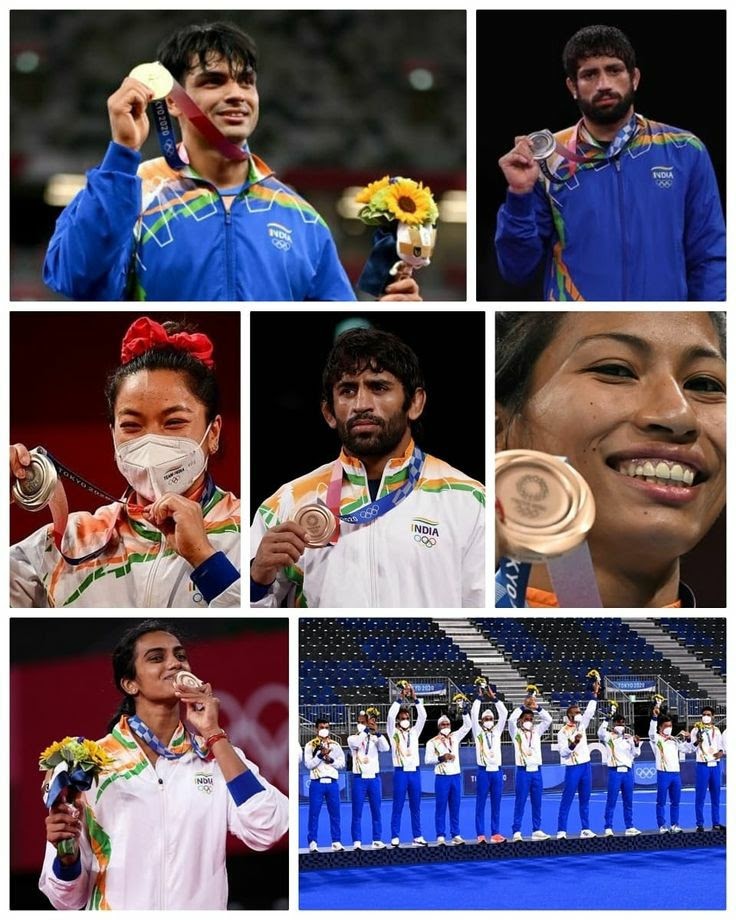
India’s medal in Tokyo Olympic 2020

India Medal Tally Tokyo Olympics – 1 Gold, 2 Silver, 4 Bronze, Medal table is given here. Check the Tokyo Olympic Medal tally for India from here. Tokyo Olympic 2020 is organized in Japan this year. Players from all around the world are performing to win medals for their country. India already has broken its previous record of 6 medals in a single Olympic as they have won 7 medals on Tokyo Olympic 2021 already.
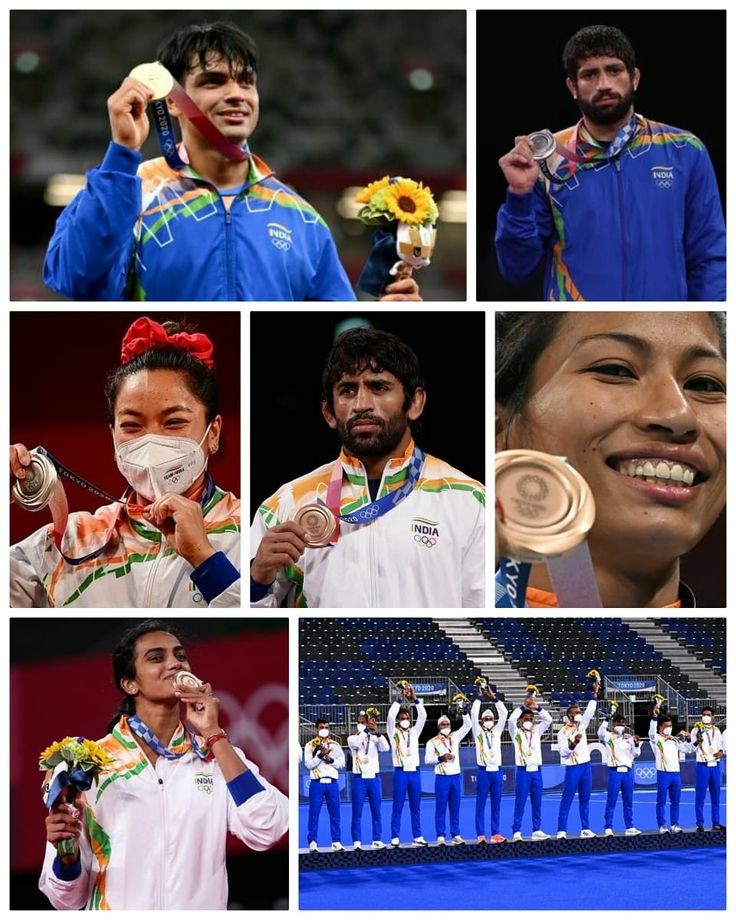
India finished 48th on the medal tally in Tokyo, its highest ranking in over four decades (if one were to go by the total number of medals, India would have actually finished 33rd. However, ranking is done primarily based on gold medals won). The previous best in this period was the 51st rank finish at Beijing in 2008, when India won three medals, including Abhinav Bindra’s gold.India has finished significantly higher in the era in which it used to win gold in hockey, but that time is not really comparable both because of the dozens of countries that have come into being since then and the expansion in the number of sports and hence medals. In Moscow, for instance, India finished at 23rd rank but with just a solitary medal, the hockey gold. A repeat of that at Tokyo would have placed India at joint 63rd, a measure of how different the two eras are.In London 2012, India had finished 57th despite winning more medals than in Beijing because the medal table ranks countries by gold, silver and bronze in that order and India didn’t win a gold in London. In Rio in 2016, the medal tally crashed to just two and so did the ranking to 67th. From there, it’s now gone up nearly 20 places.

The saven warriors

1gold, 2 silver, 4 bronze – India produced it’s richest-ever medal haul and the finest performance of all time at the 2020 Tokyo Olympics, which ended on Sunday. Here are the men and women of steel and thunder who made India proud and gave the nation something to cheer about in these dark times of a deadly pandemic.

1.neeraj chopra

There were bigger names with better records in Tokyo. But while most succumbed to the pressure of the big stage, the 23-year-old boy from Haryana’s Panipat district relished and revelled in the moment. Following his golden throw, millions became emotional on hearing the national anthem at the Olympics for the first time since Beijing 2008. A fitting climax to the story of Neeraj Chopra, who chanced upon the sport while trying to lose weight and who overcame a clutch of injuries to give Indian athletics its greatest moment on the world’s biggest sporting stage .

GameAthleteMedal
Javelin throwneeraj chopraGold

2.Saikhom Mirabai chanu

Much was expected from Mirabai Chanu at Rio 2016. She flopped, failing to make a single clean and jerk lift. The pressure to deliver was crushing at Tokyo 2020. But coached by Vijay Sharma, the amiable 26-year-old from Manipur made light work of the heavy weights to clinch a silver with a smile in the 49kg category. Redemption had never been more satisfying and sweeter for the woman who picked up logs to gather winter fuel for her family as a child.

Game AthleteMedal
Weight Lifting (49 Kg Women)Mirabai ChanuSilver

3.Ravi Kumar Dahiya

He was ranked world no. 4. But in the run-up to the Olympics, the focus was hardly ever on the 23-year-old Olympic debutant from Sonipat. Unmindful, Kumar produced a performance of stunning audacity and endurance while trailing 2-9 against opponent Nurislam Sanayev in the semis. Desperate to get out of his iron grip, the Kazakh bit him badly in his forearm but Dahiya wouldn’t let go till the tide was turned. Dahiya fought hard but lost in the final to become India’s second silver medal-winning wrestler after Sushil Kumar. A fiercely determined athlete, he could well improve upon his medal colour in 2024.

GameAthleteMedal
Wrestling (57 KG)Ravi Kumar DahiyaSilver

4.Men’s team ( hockey)

None of them was born when India last won an Olympic medal in hockey. But nothing, not even a potentially morale-sapping 7-1 loss to Australia, could stop captain Manpreet Singh’s boys from their tryst with the podium. The defeat spurred them to deliver one superlative performance after another, resulting in a bronze playoff. The match against Germany was for the ages. You can keep watching India’s 5-4 triumph for the rest of your lives. But this team holds the promise of many more wins to come.

GameAthleteMedal
HockeyIndian Hockey TeamBronze

5.pv sindhu

In the early stages in Tokyo, she looked below her best. But like a finely-tuned precision instrument, Pusarla Venkata Sindhu hit the perfect notes as the tournament peaked. She simply swatted aside Chinese He Bing Jiao 21-13, 21-15 in the bronze medal playoff to add a second Olympic medal in her kitty. When it’s PV Sindhu, once is not enough.

GameAthleteMedal
Women’s Singles BadmintonPV SindhuBronze

6.Lovlina Borgohain

Covid-19 affected her preparation. But the tall pugilist from Assam tried to make the best of the situation. She lifted LPG cylinders, worked in the paddy fields to keep fit. In Tokyo, Lovlina showed the world she could fearlessly box with the best. Five feet, nine inches tall, she used her long reach to devastating effect to fashion an amazing medal story.

GameAthleteMedal
Women’s Welterweight BoxingLovlina BorgohainBronze

7.Bajrang punia

Wrestler Bajrang Punia, also in his debut appearance at the quadrennial event, beat Kazakhstan’s Daulet Niyazbekov in the men’s 65kg freestyle wrestling playoff to claim the bronze medal. Punia, who belongs to Khuddan village in Jhajjar district, pinned Kazakhstan’s Daulet Niyazbekov.It was India’s sixth medal of the Tokyo Olympics – equalling their best-ever haul at a single edition of the Olympics.

GameAthleteMedal
Wrestling (65 Kg)Bajrang PuniaBronze

for more sports news related to Olympics visit the site link given below 👇

https://youtube.com/c/Olympics

https://youtube.com/c/TheLallantop

THE SOUL OF INCREDIBLE INDIA – ODISHA

Odisha , formerly Orissa , is an Indian state located in Eastern India. It is the 8th largest state by area, and the 11th largest by population. The state has the third largest population of Scheduled Tribes in India. It neighbours the states of West Bengal and Jharkhand to the north, Chhattisgarh to the west, Andhra Pradesh to the south, and a very negligible border with Telangana to the southwest. Odisha has a coastline of 485 kilometres along the Bay of Bengal. The region is also known as Utkala and is mentioned in India’s national anthem, “Jana Gana Mana”. The language of Odisha is Odia, which is one of the Classical Languages of India.

The ancient kingdom of Kalinga, which was invaded by the Mauryan emperor Ashoka (which was again won back from them by king Kharavela) in 261 BCE resulting in the Kalinga War (The lethal war with Kalinga transformed the vengeful Emperor Ashoka into a stable and peaceful emperor, and he became a patron of Buddhism), coincides with the borders of modern-day Odisha. The modern boundaries of Odisha were demarcated by the British Indian government when Orissa Province was established on 1 April 1936, consisting of the Odia-speaking districts of Bihar and Orissa Province. The first of April is celebrated as Utkala Dibasa. Cuttack was made the capital of the region by Anantavarman Chodaganga in c. 1135, after which the city was used as the capital by many rulers, through the British era until 1948. Thereafter, Bhubaneswar became the capital of Odisha.

The economy of Odisha is the 16th-largest state economy in India with ₹5.33 lakh crore in gross domestic product and a per capita GDP of ₹116,614 . Odisha ranks 32nd among Indian states in human development index.

CUISINE –
Odisha has a culinary tradition spanning centuries. The kitchen of the Shri Jagannath Temple, Puri is reputed to be the largest in the world, with 1,000 chefs, working around 752 wood-burning clay hearths called chulas, to feed over 10,000 people each day.

The syrupy dessert Pahala rasagola made in Odisha is known throughout the world. Chhenapoda is another major Odisha sweet cuisine, which originated in Nayagarh. Dalma (a mix of dal and selected vegetables) is widely known cuisine, better served with ghee.

The “Odisha Rasagola” was awarded a GI tag 29 July 2019 after a long battle about the origin of the famous sweet with West Bengal.

DANCE –
Odissi dance and music are classical art forms. Odissi is the oldest surviving dance form in India on the basis of archaeological evidence. Odissi has a long, unbroken tradition of 2,000 years, and finds mention in the Natyashastra of Bharatamuni, possibly written c. 200 BC. However, the dance form nearly became extinct during the British period, only to be revived after India’s independence by a few gurus.

The variety of dances includes Ghumura Dance, Chhau dance, Jhumair, Mahari dance, Dalkhai and Gotipua.

TOURISM –
The Lingaraja Temple at Bhubaneswar has a 150-foot high deula while the Jagannath Temple, Puri is about 200 feet high and dominates the skyline. Only a portion of the Konark Sun Temple at Konark in Puri district, the largest of the temples of the “Holy Golden Triangle” exists today, and it is still staggering in size. It stands out as a masterpiece in Odisha architecture. Sarala Temple, regarded as one of the most spiritually elevated expressions of Shaktism is in Jagatsinghpur district. It is also one of the holiest places in Odisha and a major tourist attraction. Maa Tarini Temple situated in Kendujhar district is also a famous pilgrimage destination. Every day thousands of coconuts are given to Maa Tarini by devotees for fulfilling their wishes.

Odisha’ s varying topography – from the wooded Eastern Ghats to the fertile river basin – has proven ideal for evolution of compact and unique ecosystems. This creates treasure troves of flora and fauna that are inviting to many migratory species of birds and reptiles. Bhitarkanika National Park in Kendrapada district is famous for its second largest mangrove ecosystem. The bird sanctuary in Chilika Lake (Asia’s largest brackish water lake). The tiger reserve and waterfalls in Simlipal National Park, Mayurbhanj district are integral parts of eco-tourism in Odisha, arranged by Odisha Tourism.

Daringbadi is a hill station in the Kandhamal district. It is known as “Kashmir of Odisha”, for its climatic similarity. Chandipur, in Baleswar district is a calm and serene site, is mostly unexplored by tourists. The unique specialty of this beach is the ebb tides that recede up to 4 km and tend to disappear rhythmically.

In the western part of Odisha, Hirakud Dam in Sambalpur district is the longest earthen dam in the World. It also forms the biggest artificial lake in Asia. The Debrigarh Wildlife Sanctuary is situated near Hirakud Dam. Samaleswari Temple is a Hindu temple in Sambalpur city, dedicated to the goddess known as ‘Samaleswari’, the presiding deity of Sambalpur, is a strong religious force in western part of Odisha and Chhattisgarh state. The Leaning Temple of Huma is located near Sambalpur. The temple is dedicated to the Hindu god Lord Bimaleshwar. Sri Sri Harishankar Devasthana, is a temple on the slopes of Gandhamardhan hills, Balangir district. It is popular for its scenes of nature and connection to two Hindu lords, Vishnu and Shiva. On the opposite side of the Gandhamardhan hills is the temple of Sri Nrusinghanath, is situated at the foothills of Gandhamardhan Hill near Paikmal, Bargarh district.

In the southern part of Odisha, The Taratarini Temple on the Kumari hills at the bank of the Rushikulya river near Berhampur city in Ganjam district. Here worshiped as the Breast Shrine (Sthana Peetha) and manifestations of Adi Shakti. The Tara Tarini Shakti Peetha is one of the oldest pilgrimage centers of the Mother Goddess and is one of four major ancient Tantra Peetha and Shakti Peethas in India. Deomali is a mountain peak of the Eastern Ghats. It is located in Koraput district. This peak with an elevation of about 1,672 m, is the highest peak in Odisha.

The share of foreign tourists’ arrival in the state is below one percent of total foreign tourist arrivals at all India level.

RACISM

Racism is not just an added stress to individuals of minority ethnic groups, but is a pathogen which generates depression.

Racism usually occurs at workplace and schools and is mostly experienced by immigrants and refugees.

The immigrants and refugees are often taken advantage as labour force, human trafficking and even cases of rape and child marriage.

Their human rights must be protected, so they will have the right to life and liberty, freedom from slavery and torture, freedom of opinion and expression, the right to work and education to eradicate poverty, and end child marriage.

Being racist towards someone can impact that person a lot, as it can cause depression, low self-esteem, losses in a psychological sense and a sense of helplessness.

Even preteens and teenagers have experienced racism at school and on social media platforms.

If we search on the net we can get a lot of results about teenagers’ suicide due to racism and discrimination, because they felt isolated, hated, not accepted in their own society or even worthless.

Racism and discrimination should be stopped because we should be ONE to make this world a greater place. The planet is for everyone to live in, because everybody is equal as we all bleed the same color.

Everyone should change their mindset to treat everyone equally, regardless of race, sex, nationality, ethnicity, language, religion, or any other status.

It’s up to the parents to nurture their children because racism isn’t something you are born with, it is taught.

Thermoregulation in Camel

Camel is a desert mammal. It is called the ship of the desert as it is well adapted to live in hot sand of deserts. The camel has the following adaptations for desert life:

1. Camel is an eurythermal animals as it has the ability to tolerate wide variations in temperature. 2. Camel is a warm blooded animal (homeotherm) as it can keep its body temperature well above the ambient temperature as other mammals and birds. 3. Camel is also a hypothermic animal as it can keep its body temperature abnormally low during night. 4. Camel is an endothermic animal as it has the ability to generate temperature from the body. 5. The camel is a temporal heterothermic animal as their body temperature is very high during hot day and very low during cool night. It cannot maintain the body temperature within a narrow range. It absorbs heat and allows its body temperature to go high up 58°C*, on a hot day. Similarly, during night, it allows its body temperature to drop several degrees below normal. 6. Camel is a large animal. It cannot hide into a burrow like small animals during hot days. 7. As it is a large animal, its surface/mass ratio is low and heat capacity is high. 8. Camel has a thick pelagic that helps insulate from external heat. 9.Low surface area and thick pelagic retard the absorption of heat from the surrounding. 10. Camel has high specific heat of tissue water.This helps camel to absorb relatively large quantities of heat for a given rise in body temperature. 11. The dehydrated camel can also tolerate an elevation of its core temperature by several degrees, further increasing its heat absorbing capacity. 12. The camel allows its body temperature to go high up without sweating. This prevents loss of water from the body. 13. Camels fur acts as an effective barrier to heat transfer. It helps conserve water and retard heating up of the body. 14. Camel drinks large quantity of water in a short time.15. The camel has long eyelashes that keep its eyes safe from wind borne sand. 16. It has muscular nostrils that it can completely or partially close at will.

CHILD LABOUR

Children are the future. But when instead of helping them discover themselves, they are directed to labour it indirectly affects the growth of the country. Children, they need to play, they need to fall and learn to get up, they need to enjoy being a kid. But with child labour, this all is just a dream. Even now, there are those children, who are working hard day and night, just so they could eat one times food, those children who are studying from the worn-out books, from whom you can barely read. 

Government has set many rights and laws to eradicate child labour, to get children to school. Eg- the right to education act, etc. But still, we need to take some concrete steps, to ensure that no child will be deprived of education, childhood, that no child will be forced to work. Child labour is a curse, for every child. Their potential is dug deep into the ground, they are withheld from the opportunities to prove themselves. Where they could possibly be learning, dreaming, they are forced to labour. 

We all need to come together. We need to take actions. We need to stop wherever child labours are working. We need to provide them with education, the food so that they won’t need to work. We need to stop those people who are forcing homeless children to work. Actions speak louder than work. So if you agree with me think about the ways you can child labour near your locality, school anywhere you see. Think about those ways and put them to work. If determined, Even one person can make a change. 

Section 45 in The Income- Tax Act, 1995

45. Capital gains 1(1) 2 ] Any profits or gains arising from the transfer of a capital asset effected in the previous year shall, save as otherwise provided in sections 34 ] 54, 54B, 5 ] 67 54D, 8 54E, 54F 9 , 54G and 54H]]]]], be chargeable to income- tax under the head” Capital gains”, and shall be deemed to be the income of the previous year in which the transfer took place.

(2) 10 Notwithstanding anything contained in sub- section (1), the profits or gains arising from the transfer by way of conversion by the owner of a capital asset into, or its treatment by him as, stock- in- trade of a business carried on by him shall be chargeable to income- tax as his income of the previous year in which such stock- in- trade is sold or otherwise transferred by him and, for the purposes of section 48, the fair market value of the asset on the date of such conversion or treatment shall be deemed to be the full value of the consideration received or accruing as a result of the transfer of the capital asset.]

(3) 11 The profits or gains arising from the transfer of a capital asset by a person to a firm or other association of persons or body of individuals (not being a company or a co- operative society) in which he is or becomes a partner or member, by way of capital contribution or otherwise, shall be chargeable to tax as his income of the previous year in which such transfer takes place and, for the purposes of section 48, the amount recorded in the books of account of the firm, association or body as the value of the capital asset shall be deemed to be the full value of the consideration received or accruing as a result of the transfer of the capital asset.

(4) The profits or gains arising from the transfer of a capital asset by way of distribution of capital assets on the dissolution of a firm or other association of persons or body of individuals (not being a company or a co- operative society) or otherwise, shall be chargeable to tax as the income of the firm, association or body, of the previous year in which the

Artificial Intelligence: Can the AI take over?

Artificial Intelligence is a topic with a vast appeal to the en masse. People believe that it is the future of human techologies. But beyond that, people are of various school of thoughts. The first group assumes that AI shall help humanity achieve singularity – a point in technological development that shall mean an utopia. We shall spend all our time towards spiritual and emotional development while most of the crude tasks shall be taken care by machines. The second school of thought assumes that AI shall take over humanity as its overlords. Let us analyse both.

The history of animated, self-thinking, free willed machines is not new at all. It has been imagined for centuries by fiction writers. However, the modern conception of AI in scientific thinking started about 80 years ago. John McCarthy, an American mathematician proposed the idea of such machines back in the first half of the 20th century. Alan Turing, the inventor of the Turing Machine, a British mathematician also proposed his idea of intelligent machines, his proposal now famously called the Turing Test. However, for the next 40 years or so, no important research occurred in the field. It was only in the last decades of the 20th century, when the research started again and not before humanity entered into the 21st century that something formidable was created.

As of today, AI has invaded all spaces of human endeavor. Mechanics, mechatronics, smart devices, our smartphones – all of it is infiltrated with AI. But this AI is what most scientists call ‘weak AI’. It cannot really think. It has a predefined algorithm and then it uses that algorithm to capture inputs and ‘learn’ about new scenarios as per its algorithmic definitions. This AI cannot work without human input and can certainly not take over the world. It can however carry out some actions that are equivalent to evolution as the AI at the Facebook research Center developed their own language to communicate. However, this evolution still does not mean that the AI is “thinking”. It is just evolving its learning based on a preprogrammed code. It is nothing like human beings where discretion is a thing. Even the famous robot AI, Sophia is but a weak AI – a little better than SIRI and google assistant but that is all there is to it. It is not a self-thinking, free-willed machine.

Sophia the Robot – Keynote Speaker | London Speaker Bureau
Sophia, the robot

Researchers have tried hard to create strong AIs with a completely different set of ethical concerns – the main obviously being how would such machines live with humans if they are free to think – but have failed so far. And believe it or not, strong AIs might really not be a thing for at least another 50-100 years at the very least. Maybe even a couple of centuries after that.

So, if you’ve watched the movie Prometheus or Covenant and are scared of the possibility of David being a reality, grab a cup of coffee and relax. By the way, both the movies are really good!

Alien: Covenant, a review by guest columnist David 8 | by Charles Evans |  Medium
David-8 from the movie Prometheus.

FEMINISM

Term ‘Feminism’ was initially brought up as a Label for women to fight against the discriminations happening towards them under it’s name. The purpose of the concept was to retrieve back the rights of women, breaking all the Stereotypes and putting an end to the prejudice beared by females since the earliest times. The beginners fought for women rights but never had a mission to demean males’ in any form or lower their status or rights so as to provide a higher position to women. Feminism was never invented to disregard men’s existence but all it was meant for is making the society aware of the fact that women deserve to have the same standard and respect EQUAL to that of Men. Majority of each and every person who has come across the notion, considered it worthy of all the attention and a very important agenda for empowerment. Feminism raised several issues and even unveiled injustices occurrings taking place against women in tremendous ways worldwide. For example, To receive an equal pay – as of the Male worker in the company while working on the same position, To get the freedom of working, dressing and living with their own choice, To ensure safety, To fight against domestic violence, sexual harassment and the superstitious harmful practices such as Female genital mutilation / cutting.

Image source

HOWEVER!!!

Likewise every law has a loophole, there are always Some people in a crowd who just couldn’t think Right! So Here’s where came a wave of demolishing the concept of Feminism. While, the movement was bringing a good change in the social norms and actually convincing the people about the shortcomings on the grounds of Building Equality, the fake flag bearers of Morality amd virtue started exaggerating the agenda. They created a state of Gender Bias all around. Some women would try to take unfair benefits in the name of feminism namely, a practice called PSEUDO FEMINISM. This includes examples such as; women’s income tax slab is higher than men’s. A woman who earns till 3,00,000-3,50,000 is exempt from tax payment. If both men and women earn the same account, why should it only be the men who pay tax. Another example is As of 2009, 175 men had been kidnapped and abducted for the purpose of illicit intercourse, according to the 2012 NCRB data. As per a reliable source the cases were registered under the Indian Penal Code (IPC) Sec 363 to 369, 371 to 373. Such cases are not dealt with in the same way as the abuse committed on women, even under regulation.

A Dilemma

But Why can’t we just accept, respect and treat both the genders equally at the same time? We are already living in a culture where both Women and Men face so many challenges everyday due to Orthodox mindsets of people. Upon that, these Psuedo feminists suggest that women deserve more respect, priority, benefits than any other genders everywhere. They believe that the world should be governed/ controlled by females and they also potray all men as nemesis, responsible for all crimes against women. Little do they know, The most brutal crimes against women are conducted by another women themselves at many places. You get enough proofs of this on daily basis especially, when you are an Indian citizen. As here, there’s no place to be where you won’t find an elder Lady or even young girls judging others for one’s clothes or casual behaviour. The biggest example to this (in India) is when “A women is proclaimed as responsible for her own rape. She is ashamed for wearing certain clothes and provoking Men herself to do this injustice to them”. Now this is why Not only the “Men” But every single person irrespective of their gender or age having that narrow mindset with preconceived representations in their head of how a Women is a weaker gender, supposed to be kept and treated like slaves, etc. are responsible. And an even bigger mistake that Pseudo feminists do here is to blame and hurt those who are innocent considering it their right. Such incidents not only could hurt the image as well as emotions of the ones who are actually decent but also can pave a way for their thoughts to turn in a wrong direction. It creates an unjust impression of the actual concept of Feminism in everyone’s mind specially, in today’s era where every news is spread on social media at an incredible pace amd affects millions of brains which could even change the supporters and drive their views to become Feminism’s antagonists.

CONTRACT OF INDEMNITY

contract of indemnity basically involves one party promising the other party to make good its losses. These losses may arise either due to the conduct of the other party or that of somebody else.

To indemnify something basically means to make good a loss. In other words, it means that one party will compensate the other in case it suffers some losses.

For example, A promises to deliver certain goods to B for Rs. 2,000 every month. C comes in and promises to indemnify B’s losses if A fails to so deliver the goods. This is how B and C will enter into contractual obligations of indemnity.

A contract of insurance is very similar to indemnity contracts. Here, the insurer promises to compensate the insured for his losses. In return, he receives consideration in the form of premium. However, the Contract Act does not strictly govern these kinds of transactions. This is because the Insurance Act and other such laws contain specific provisions for insurance contracts.

Parties under Indemnity Contracts

There are generally two parties in indemnity contracts. The person who promises to indemnify for a loss is the Indemnifier. On the other hand, the person whose losses the indemnifier promises to make good is the Indemnified. We can also refer to the Indemnified party as the Indemnity Holder. For example, in the earlier example, C is the Indemnifier and B is the Indemnity Holder.

Nature of Indemnity Contracts

An indemnity contract may be either express or implied. In other words, parties may expressly create such a contract as per their own terms. The nature of circumstances may also create indemnity obligations impliedly. For example, A does an act at the request of B. If B suffers some losses and A offers to compensate him, they impliedly create an indemnity contract.

Rights of an Indemnity Holder

When parties expressly make a contract of indemnity, they can determine their own terms and conditions. However, sometimes they may not do so. In such a case, the indemnity holder can enforce the following rights against the indemnifier:

1) The indemnifier will have to pay damages which the indemnity holder will claim in a suit.

2) The indemnity holder can even compel the indemnifier to pay the costs he incurs in litigating the suit.

3) If the parties agree to legally compromise the suit, the indemnifier has to pay the compromise amount.

Contract of Guarantee

Apart from indemnity contracts, the Contract Act also governs contracts of guarantee. These contracts might appear similar to indemnity contracts but there are some differences between them.

In guarantee contracts, one party contracts to perform a promise or discharge a liability of a third party. This will happen in case the third party fails to discharge its obligations and defaults. However, the burden of discharging the burden will first lie on the defaulting third party.

The person who gives the guarantee is the Surety. On the other hand, the person for whom the Surety gives the guarantee is the Principal Debtor. Similarly, the person to whom he gives such a guarantee is the Creditor.

Differences between Indemnity and Guarantee

There are some important differences between the contracts of indemnity and guarantee.

Firstly, there are just two parties in indemnity, while there are three in contracts of guarantee.

Secondly, in a guarantee, there is an existing debt/duty which the surety guarantees to discharge. On the other hand, liability in indemnity is contingent and may not arise at all.

Thirdly, an indemnifier might act without the debtor’s behest, while a surety always waits for the principal debtor’s request.

Finally, the liability of an indemnifier towards the indemnity holder is primary. Whereas, in guarantee, the surety’s liability is secondary. This is because the primary liability lies on the principal debtor himself.

PARADISE ON EARTH

A new State comprising three distinct religions of Jammu, Kashmir and Ladakh was formed with Maharaja Gulab Singh as its founder ruler. It was established on 14 May 1954.

Popularly known as the “Paradise on Earth”, Jammu and Kashmir is world famous for its scenic splendour, snow-capped mountains, plentiful wildlife, exquisite monuments, hospitable people and local handicrafts.

Jammu and Kashmir is a region administered by India as a union territory and consists of the southern portion of the larger Kashmir region, which has been the subject of a dispute between India and Pakistan since 1947, and between India and China since 1962. The Line of Control separates Jammu and Kashmir from the Pakistani-administered territories of Azad Kashmir and Gilgit-Baltistan in the west and north. It lies to the north of the Indian states of Himachal Pradesh and Punjab and to the west of Ladakh, which is also subject to the dispute as a part of Kashmir, and administered by India as a union territory.

Provisions for the formation of the union territory of Jammu and Kashmir were contained within the Jammu and Kashmir Reorganisation Act, 2019, which was passed by both houses of the Parliament of India in August 2019. The act re-constituted the former state of Jammu and Kashmir into two union territories, Jammu and Kashmir and Ladakh, with effect from 31 October 2019.

The state of Jammu and Kashmir was accorded special status by Article 370 of the Constitution of India. In contrast to other states of India, Jammu and Kashmir had its own constitution, flag and administrative autonomy. Indian citizens from other states were not allowed to purchase land or property in Jammu and Kashmir.

Jammu and Kashmir had three distinct areas: Hindu-majority Jammu region, Muslim-majority Kashmir Valley and Buddhist-dominated Ladakh. Unrest and violence persisted in the Kashmiri Valley and, following a disputed state election in 1987, an insurgency persisted in protest over autonomy and rights.

The Bharatiya Janata Party (BJP) came to power in the 2014 Indian general election and five years later included in their 2019 election manifesto the revocation of Article 370 of the Constitution of India, in order to bring Jammu and Kashmir to equal status with other states.

A resolution to repeal Article 370 was passed by both the houses of the Parliament of India in August 2019. At the same time, a reorganisation act was also passed, which would reconstitute the state into two union territories, Jammu and Kashmir and Ladakh. The reorganisation took effect from 31 October 2019.

In September 2019 nearly 4,000 people, including two former Chief Ministers and hundreds of other politicians, were arrested by the Indian authorities in Kashmir; the state was put under a lockdown and communication and internet services were suspended.

Jammu and Kashmir is home to several valleys such as the Kashmir Valley, Chenab Valley, Sindh Valley and Lidder Valley. Some major tourist attractions in Jammu and Kashmir are Srinagar, the Mughal Gardens, Gulmarg, Pahalgam, Patnitop and Jammu. Every year, thousands of Hindu pilgrims visit holy shrines of Vaishno Devi and Amarnath which has had significant impact on the state’s economy.

The Kashmir valley is one of the top tourist destinations of India. Gulmarg, one of the most popular ski resort destinations in India, is also home to the world’s highest green golf course. The decrease in violence in the state has boosted the state’s economy, specifically tourism.

Jammu and Kashmir is also famous for its scenic beauty, flower gardens, apple farms and more. It attracts tourists for its unique handicrafts and the world-famous Kashmiri Shawls.

ReplyForward

WORLD WAR II

World War II was a war globally fought between many world countries that formed two military alliances – Allies and Axis Powers. This war lasted between 1939-1945. More than 30 countries had participated involving around 100 personnel. World War II was the deadliest of wars. Countries had strategically used military resources and bombing strategies to conquer. Nuclear weapons used during this war still haunts the country that was a victim of such inhuman act to destroy humanity. Millions of people had died as a result of genocides, outbreak of dangerous diseases, starvation, large massacres.

This war is said to gave generally started on 1st September 1939, when Adolf Hitler of Nazi Germany captured Poland. The United Kingdom and France had declared war on Germany. Germany had control over Europe countries and decided to join Italy and Japan, forming Axis Alliance. In mid-1940’s, France had failed and was falling, while campaigns were run in North Africa and East Africa. So, the war then continued between the Axis power and United Kingdom.

Nazi Germany went on to conquer Soviet Union opening the Eastern Front. This strategy trapped the Axis Power. Japan aimed to capture most parts of Asia and the Pacific. But it in a state of war with Republic of China in 1937. In 1941, Japan attacked America and British territories.  It even tried to capture Central Pacific and Southeast Asia. US declared war on Japan after it attacked on the US fleet at Pearl Harbor. Germany and Italy were defeated. Germans were being defeated with on Eastern Front. Western allies captured and occupied Germany and France. Soviet Union reacquired it territories. Germans had occupied European countries but with Hitler’s death the Germans had surrendered. A statement called Potsdam Declaration, stated surrender of Japanese military forces was refused to sign by Japan. USA dropped nuclear bomb on Hiroshika on 6th August and Nagasaki on 9th August that was today. The fear of more nuclear bombings and Soviet Union invasion, Japan signed document of surrender. France, China, United Kingdom, United States and Soviet Union had become victorious. At the end, USA and Soviet Union had become major powers to influence countries around the world.

World War II proved to be devastating with millions of deaths around the world.  Adolf Hitler was responsible for Holocaust that killed more than 6 million people. Policies of Hitler were against Jews that involved mass killing. Ukrainians and Russians were also mercilessly killed. Biological and chemical weapons were tested against innocent people and the prisoners by Germans and Japanese. Germans had captured young children and deported to Auschwitz. They forced to labor and were medically experimented. Germans occupied millions of Europeans and slaved them in German industry. Japan had camps of prisoners of wars that were mainly used as labor camp. Nuclear bombings in Japan were the worst of all. The fatality of the bombings still haunts Japanese people affecting the young generation through physical disability. Asia witnessed greater than 10 million killings. Nanking Massacre killed thousands of Chinese civilians. They were raped and murdered.

World War caused tremendous life and property destruction. Economies of various countries had failed to provide for the civilians due to enormous financial loss. This war showcased pure hatred towards innocent civilians.

HYPNOTHERAPY

Hypnotherapy is an adjunctive technique that utilizes hypnosis to aid in the treatment of specific symptoms or health conditions. Hypnotherapy works by inducing a hypnotic state marked by waking awareness that allows people to experience detached external attention and to focus on inner experiences. It is sometimes used as part of a treatment plan for phobias and other anxiety disorders. It is also sometimes used for pain management, weight loss, smoking cessation, and a variety of other applications. Formal explorations in the therapeutic uses for hypnosis began in the late 1700s but did not gain scientific credibility until much more recently. Modern researchers have further explored how hypnosis can be used, which conditions it can treat, and how effective it may be compared to other treatments.

What Hypnotherapy Can Help With

There are many different reasons why a person might want to try hypnotherapy. Research suggests that some possible applications include:

  • Chronic pain conditions
  • Dementia symptoms
  • Nausea and vomiting related to chemotherapy
  • Pain during childbirth, dental procedures, or surgery
  • Skin conditions, such as psoriasis and warts
  • Symptoms of irritable bowel syndrome (IBS)
  • Symptoms of attention-deficit/hyperactivity disorder (ADHD)

Hypnotherapy may also be used by licensed physicians and psychologists in the treatment of conditions like anxiety disorders, depression, eating disorders, and post traumatic stress disorder (PTSD).

Benefits of Hypnotherapy

Some people may experience dramatic results with hypnotherapy. In other cases, people may simply feel very relaxed. Some of the benefits of hypnotherapy may include:

  • Awareness: Some people remain fully aware during the entire experience. They recall everything that happens and are even able to have conversations while under hypnosis. Other people may experience states of relaxation that are so deep that they may even feel detached from what is happening.
  • Focus: Most of the time, we are distracted by our surroundings. Whether the TV is blaring, your kids are demanding attention or your spouse wants to talk, it can be difficult to fully focus on yourself. Our conscious minds are also cluttered. You may be worried about paying a bill, concerned about an upcoming project, or planning tonight’s dinner. The therapy session is intended to break through these day-to-day concerns and allow you to focus completely on the problem at hand.
  • Relaxation: In the hypnotic state, you are deeply relaxed. Your conscious mind is quieted, allowing your unconscous mind to deeply focus on your issue. You are also calmer, and therefore more receptive to facing your problems or fears.

Most hypnotherapists utilize a series of calming messages, such as “you are safe” and “no one can harm you” to reassure their clients that during hypnosis they can objectively face their problems without having a panicked reaction.

Effectiveness

The effectiveness and impact of hypnotherapy can vary based on the individual and how the treatment is used. Hypnotherapy has been shown to have some degree of efficacy for certain applications, particularly:

  • Pain reduction and control during dental procedures and childbirth
  • Reduction in nausea and vomiting in individuals being treated for cancer with chemotherapy
  • Reduction in the severity of symptoms associated with irritable bowel syndrome (IBS)

While it may help people cope with problems related to stress and anxiety, it may be best applied when used in conjunction with first-line treatments such as cognitive behaviour therapy (CBT) and medications.

Things to Consider

While hypnotherapy is generally safe and well-tolerated, that does not mean that it doesn’t pose some potential risks, such as: 

  • Hypnotherapy can produce false or distorted memories in some cases.
  • People who are very suggestible may experience a decreased sense of personal control while under hypnosis.
  • Some people can experience side effects such as anxiety, headaches, or dizziness.
  • Hypnotherapy may not be appropriate for people who are experiencing symptoms of psychosis such as hallucinations and delusions

Common Misconceptions

Hypnotherapy is still considered controversial, as many mental health professionals dispute its effectiveness. There are a number of myths and misconceptions about hypnotherapy that can affect how people view this therapeutic tool.

  • Hypnotherapy is often confused with stage hypnosis. Stage hypnotists are performers who are excellent at reading people. They seekextroverts who will put on a great show for the crowd. Whether or not their subjects are truly hypnotized is debatable, but they are willing to go along with the sometimes outrageous suggestions of the stage hypnotist.
  • Hypnotherapy doesn’t cause you to forget what happened. You will remember the things that occur during your hypnotic state, you will not be asleep or unconscious, and you will be able to break the hypnotic trance at any time.
  • Hypnotherapy doesn’t cause you to lose control. During hypnotherapy, you remain in control. It is not possible for anyone to force you to do anything against your will, even under hypnosis. You will be tuned in to the work at hand, and so may not pay attention to your surroundings, but you will always be in charge of your own actions, behaviors, and statements.
  • Being hypnotizable doesn’t mean you are less intelligent. While some people believe that they cannot be hypnotized, research suggests that most people are hypnotizable to a certain degree. Only about 10% of people are difficult or impossible to hypnotize.