
LEARNING ALGEBRA FROM A NEW PERSPECTIVE


Algebraic expressions that we see and encounter today
is way different than it was centuries ago. Until 19th century,
 they
consisted of theories. The father of algebra Muhammad ibn Musa al-Khwarizmi
described algebra to be reduction and balancing of terms that is a
transposition to other sides of the equation. Algebra went through different
stages to development along the centuries. Along which the three stages that
gives us the history of symbolic algebra are to be discussed in this article.


1. RHEOTORICAL STAGE

In this stage, the algebraic expressions were written in
sentences. For example, an equation as: x+ 24= 36 would be described as
‘something added to 24 gives us 36’. It was developed by Babylonians back in
the 16th century.


2. SYNCOPATED ALGEBRA

In this stage, the symbolism was used but it didn’t
contain all of the characteristics of symbolic algebra, there were some
restrictions involved. Syncopated algebra made its first appearance in the 3rd
century AD through Diophantus Arithmetic, followed by Brahmgupta’s Brahma
Sphuta Siddhanta back in the 7th century.


3. SYMBOLIC ALGEBRA

Symbolic algebra made its appearance through Islamic
mathematicians such as Ibn al-Banna in 13-14th centuries and
al-Qalasadi in 15th century in their works. And it was fully
developed by Francois Viete in the 10th century. Later, Rene
Descartes by 17th century, introduced the use of ‘x’ in an equation.
He also showed that problem in geometry can be expressed and solved in terms of
algebra. Quadratic equations played an important role in early algebra and it
is to be noted that earlier only three types of quadratic equations existed:


x2
+px=q

x2
=px+q

x2
+q=px

Since math was used in commerce there were no use of
negative terms. ‘p’ and ‘q’ was positive in each of the above cases and so were
the roots.


On to most interesting part where mathematical
expressions were solved with geometric practices. Between the rheotorical and
syncopated stage of symbolic algebra, the geometric constructive algebra’ was
developed by classical Greek and Vedic Indian Mathematicians in which equations
were solved through geometry.

Now let’s look at this equation:

x2
+26x=27

Since we already know how to find roots of quadratic
equation, i.e. by using,

x=-b±√(b2 -4ac)2a

As they didn’t consider the negative part, let us
exclude that and put the respective values, we will get

x=-26+262 -[4×1×(-27)]2×1

x=-26+(676+108)2


And now let’s solve it with the help of figures. Taking
the x^2 
as a square of side x and thus the term gives its area.
And the 26x can be denoted as rectangle with sides 26 and x and the term being
the area.

Now, if we divide the rectangle into two equal parts
which will give us two rectangle of side x and 13.
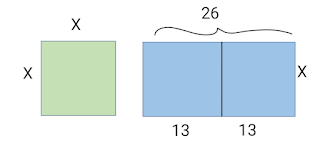
By placing the rectangles on two adjacent sides of the
square, we will see a L shaped figure which can we converted into a square if
we added a square of side 13 in the space.
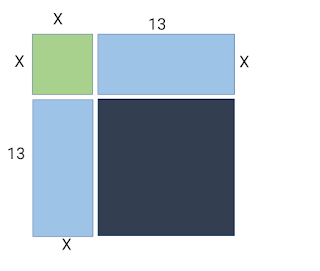
And since we added a square, we now have to add 169, which
is the area of the additional square, on each sides of the equation. It gives
us

x2
+26x+169=246

 The left-hand
side of the equation represents the sum of areas of the 2 squares and 2 rectangle
and the right-hand side gives the total area. Since all the shapes collectively
makes a square, the number 246 denotes the area of the biggest square. And hence
14 will be the length of the sides. And now we know that the value of x must be
1.

While this method will only work on positive
entities and will only give the positive part of the solution, we can now see the quadratic equations from a whole new perspective.

Diwali, our festival of joy!


Source: by Freepik

Days come and go, festivals pass by in a jiffy. But there’s something special about the festival of lights. It begins with a loud bang from the crackers, goes on with serial lights and rockets lighting up the skies, and ends with a sweet note in courtesy of the laddoss and chaklis made and shared among friends and families. 

This is Diwali for us! Diwali is celebrated with great pomp and harmony, usually in the states of Maharashtra, Goa, Karnataka, and Tamil Nadu in India. It falls between the months of October and November and becomes the reason for dressing up, eating traditional sweets, bursting crackers, and family gatherings. 

The origin of Diwali, the festival of lights.

As we celebrate, let us look at the origins of this beloved festival and learn what makes this an auspicious occasion. There aren’t any definite origins as there are several reasons behind celebration of this festival across different states of India. 

  • According to the epic Ramayana by Valmiki, Diwali is celebrated on the account of Lord Rama’s return to Ayodhya with his wife Seeta and brother Lakshmana after spending 14 years in exile and defeating the evil king Raavana. 

  • According to the most popular beliefs, Diwali marks the birth of Goddess Lakshmi from Samudra Manthan, the cosmic ocean of milk churned by gods and demons alike. Goddess Lakshmi had chosen Vishnu as her husband on the night of Diwali, forming an unbreakable bond. 

  • In the epic Mahabharata, the five pandava brothers were deceived into losing a bet while gambling and got banished by the Kauravas from Hastinapur for 12 years. According to the epic, Diwali is celebrated on the account of their return to Hastinapur during the Kartik Amavasya. 

  • In Sikhism, Diwali is celebrated on the account of Guru Hargobind being released by Mughal emperor Jehangir.  

  • In Jainism, the festival is celebrated as an anniversary of Mahavira’s soul finally seeking Nirvana. 

  • In many states of the western India, like Gujarath, Diwali is regarded as the beginning of a new year. 

  • In eastern India, comprising West Bengal, Diwali is celebrated in the honor of their Goddess Kali. Who is well known for her destructive rampage against the demons of the earth. 

How is Diwali celebrated?

With countless memes being reiterated regarding cleaning your household during this festive season. It becomes an important preparatory requirement for Diwali celebration. Dry fruits and sweetmeats are also exchanged ahead of the main Diwali celebrations. Outdoor and indoor parties as well as craft shows begin to create the ambiance for the forthcoming festival of lights. Gambling, as seen in Mahabharata being enacted by Pandavas and Kauravas, is a traditional festive game that is played during the week before Diwali alongside card games. 

Finally! the five days of Diwali

Let’s begin with Choti or little Diwali. It’s the day before the main event that is dedicated to preparations for the festival. We can’t be out buying crackers and sweets right in the middle of our Diwali right? There is fun and anticipation as we await the day of the main festival to be greeted with loud crackers and sweet smelling gulab jamuns, laddoos, and other delicious snacks. Oh, and also watch your step, because you might be the subject of someone’s wrath if you step on one of the painstakingly made rangolis


Source: By Unsplash


And now comes the main event, people greet the festival with a loud bang as the sun sets. Both the land and the skies are lit by fireworks. As usual, there begins an opposition against usage of firecrackers by environmentalists and naysayers. But they could never dampen the festive spirits of the true enthusiasts. By the end of the day, both the so-called environmentalists as well as the enthusiasts are united by festive delicacies. Thanks to the prior purchases, exchanges and preparations. 

The final days of the festive season witnesses sisters praying for the well being for their brothers and, hopefully receiving generous returns from their siblings. 

What should I do during Diwali?

Most probably you wouldn’t be having that question. But if your friends bailed out on you and you have no plans, then maybe you could write content like me. Just kidding! On a serious note, there will definitely be a movie releasing every Diwali which you can watch along with your family. If you are one of those naysayers to fireworks, you could take a trip to a nearby exotic location. You can use the holiday and the bonus to meet up with some old friends which you have been putting off for another day. 

Happy Diwali! May the festival bring lots of joy into your hearts! 

THINK LIKE A BILLIONARE

“If you follow the crowd, you will certainly be lost in it. If you think like everyone, how will you create your own identity”. Why many entrepreneurs get confined to just a street corner? And why only a few, move ahead to create massive business empires? There is only one difference between these two groups. “The difference is thinking!”. Thinking has the power, to transform a blank page into a new invention. Thinking has the power to transform a blank page into the night sky.So stop blaming your luck or destiny. Business is a race where winning companies are miles ahead. But still, there is a strategy that can defeat these masters of business. This strategy is taught at Stanford, Harvard, IIM’s. If you can master this strategy, success will certainly follow you. Business is not just a ladder of success, it is also a bed of thorns. No new restaurant can beat McDonald’s 65 years of experience. No new IT company can compete with the 52 year old TCS. There is only one chance for these new companies to succeed. Instead of competing, the new company can make the competition irrelevant. Do something that you will change the rules of business. In the mobile network industry, there is a long queue of salesman to get every new customer. In the same industry, Jio adopted the strategy of Business Model Transformation. Jio changed the rules of the mobile network industry. Where other mobile networks were focussed on phone calls. Jio came and made the whole story about Internet Data. By bringing transformational change in the industry, If you also want to create transformational change, don’t think what business you will do. Rather think, how can you transform the whole industry, iTunes transformed the music industry. Netflix brought changes in the television and film industry. As time changes every moment. Evry industry can also be changed, just changemakers are required. Transforming the industry can be very easy and the most difficult just find out the unfulfilled needs of the customers, and fulfill them. The need to get an instant taxi was fulfilled by Uber. The need to shop at home was fulfilled by Amazon. Similarly, in every product round you. There is a possibility of new business. Just open your eyes. Don’t participate in the competition. Create something new. Because on a crowded street, you will never reach far. Move ahead in the path, which no one has chosen. In the end, this new path will make you reach the pinnacle of success. Therefore, think different from the rest. People who think differently from the crowd Make History.

“Winners don’t cry and give in to the fate”.

Book recommendations- genre: Comedy & Humour.

A comedic novel is often a work of fiction in which the author attempts to entertain the reader, sometimes subtly and as part of a well-crafted story, and sometimes above all else. It’s true that comedy fiction is literary work whose primary goal is to make people laugh, but this isn’t always as evident as it appears.

Fan Fiction: A Mem-Noir: Inspired by True Events by Brent Spiner & Jeanne Darst. 

Set in 1991, just as Star Trek: The Next Generation has catapulted the cast to global fame, young and impressionable actor Brent Spiner receives a mysterious package and a series of disturbing letters that send him on a terrifying and bizarre journey that enlists the help of Paramount Security, the LAPD, and even the FBI to put an end to the threat that threatens his life and career.

This is the fictitious autobiography that takes readers inside the life of Brent Spiner and offers an astonishing storey about the trappings of popularity and the anxiety he feels, with a cast of characters ranging from Patrick Stewart to Levar Burton to Trek founder Gene Roddenberry, to others wholly created.

Brent Spiner’s spectacular and humorous novel is an intimate look at a celebrity’s little off-kilter connection with his followers. This noir comedy could just be the one if the Coen Brothers were to develop a Star Trek film addressing the complexities of fan fanaticism and sci-fi.

Hyperbole and a Half: Unfortunate Situations, Flawed Coping Mechanisms, Mayhem, and Other Things That Happened by Allie Brosh.

This book is a list of events that happened in the author life, it involves pictures, words, stories about things that happened to the author because of herself and foolishness, stories about things that happened to other people because of her and her foolishness. Stories about dogs and an endless laughter that will have you crying because your stomach hurts. 

How To Train Your Dad by Gary Paulsen. 

Carl, a 12-year-old, is fed up with his father’s obsessive pursuit of an off-the-grid lifestyle. His father may be clever, but dumpster diving for food, rummaging through trash for usable items, and dressing entirely in clothing purchased at garage sales is becoming tiresome. Carl adopts the principles set forth in a randomly discovered puppy-training pamphlet to “retrain” his father’s mindset… a crackpot experiment that produces some very unintentional results. Increasingly concerned about what his classmates and a certain girl at his new school might think of his circumstances—and encouraged by his off-kilter best friend—Carl adopts the principles set forth in a randomly discovered puppy-training pamphlet to “retrain” his father’s mindset… a crackpot

This is a feisty and humorous family novel.

Everyone You Hate is Going to Die: And Other Comforting Thoughts on Family, Friends, Sex, Love, and More Things That Ruin Your Life by Daniel Sloss.

A subversive and hilarious deep-dive into one of today’s hottest young comedians’ favourite subject: relationships.

At the same time, Daniel Sloss’ humour engages, enrages, offends, unsettles, educates, soothes, and has audiences screaming with laughter. Sloss has two Netflix comedy specials: DARK, a brilliant, laugh-out-loud meditation on our relationship with death; and Jigsaw, which rips apart the ideas of love, romantic relationships, and marriage–and, according to Sloss, has caused 160 divorces and 95,000 break-ups (he has the tweets to prove it). Daniel Sloss Live: X, his HBO spectacular on male toxicity, is a stunning 85 minutes.Now, in his first book, he picks up where Jigsaw and his other specials left off, tackling every kind of relationship imaginable–with one’s country (Daniel’s is Scotland), with America, with lovers, ex-lovers, ex-lovers who you hate, ex-lovers who hate you, with parents, best friends (male and female), not-best friends, children, and siblings. Every connection gets the humorous, cruel (but always incisive) Sloss treatment in Everyone You Hate Is Going to Die, as he shows why all of our relationships are fragile, absurd, and awful–but, just maybe, vital and meaningful as well.