Reflecting on a quote

“Education is the most powerful weapon which you can use to change the world.” – Nelson Mandela

If we turn the pages of history it will be vivid that the root of every revolution – be it French Revolution or India’s struggle for freedom – lies in the vision that was bestowed on the leaders through education. Raja Rammohan Roy, known as the Father of Modern India was one of the pioneers of socio-religious movements in 19th Century. Having been educated in modern sciences, literature, he chose the path of modernization and not the westernisation of natives. B.R Ambedkar was not just bluffing or rambling around when he wanted people belonging to the so-called, “lower castes” to be educated which would lead to their ultimate emancipation. Mahatma Gandhi who led many mass movements is the best manifestation of how powerful this weapon is!

Now, let’s not confuse between a literate and an educated one, doing so will make you look so not educated and so literate! Back then in the 19th Century, many elite and middle class were literate but only educated visionaries took a stand for what they thought would lead to the ultimate well-being of the people – be it Dayanand Saraswati’s “Back to Vedas” or Narayan Guru’s effort towards the upliftment of the lower sections of society or even Greta Thunberg’s “Friday for Future.”

The youth anywhere have that caged, powerful energy within them and the lack of proper channelization of energy is the sole reason for high crime rates, for escalating crisis in the world. If only it was imparted education on how to put to use that powerful flow of energy we wouldn’t have to read about heinous crimes, about devastating effect of environmental degradation, about all those taboos prevailing in the society taking its toll on people’s lives every day.

The reason that we are in the midst of such a grave crisis, which seems like every good thing is retreating from our life, from our world is because the ones who are literate did not actually turn out to be educated. They have actually let everything slide away, being so keen on getting a degree, a job in this ever-competitive world and meeting their aspirations; but these aspirations might turn out to be futile in the long run if the knowledge we possess has never been used to bring a change in ourselves nor in others while the world still continues to wait for someone to come to its rescue. It’s time that we become that “someone”.

It’s high time that we use education, the weapon that we possess to fight against the evils and to change the mind-set of people. It is not a work that would be done overnight like an assignment but it will be a long one which might go on for years. However, the important concern is that it needs to be started with oneself, bringing changes at micro level, moving towards the greater goal. After all, it’s those “little drops of water that makes the mighty ocean.”

It is equally necessary that people in every corner are aware about things happening around them. Governments need to focus on seriously implementing all those policies meant for imparting quality education to all girls and boys alike – channelizing their potential energy and enabling them to be a part of the process of emancipation of the world in crisis for it is not a hidden truth anymore that political freedom will be rendered redundant and futile if people are devoid of social freedom.

Education is the basic and a natural right that every individual should have as it is the only way for the world to escape the devastation that awaits – or why not say the devastation which has already started.

Image Credit: Google
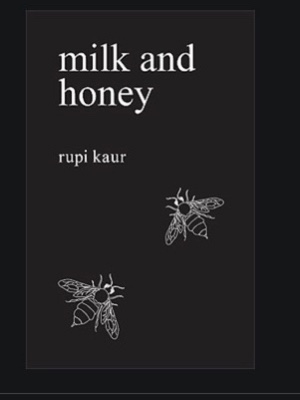
About the author: L.M. Montgomery

the creator of thoughtful grins on little souls, the molder of a legend, the light of an eye-blinding ray of literature, Lucy Maud Montgomery, or better known as L.M Montgomery is one of THE most phenomenal and unparalleled authors I have ever known. the beauty of her writing is miraculous, the plot of her stories is out of this world. She is honestly my crush and will be lifelong. Bloomed into this world on the 30th of November, 1874 in the chilly town of Clifton to Clara Woolner Macneill Montgomery and  Hugh John Montgomery. Hardly had she reached her 2nd year in the world, when her mother, Clara, passed away suffering from Tuberculosis. Since then, she was lonesome and quiet. A blessed child, the seven-year-old lucy, moved to Prince Albert to lead her childhood with her grandparents, when she found her imaginary friends holding her hand, later, that time of her existence was credited as a development and expansion of her creativity. In 1887, the witty and bright lucy of 13, wrote in her diary that she had, quoting, “early dreams of future fame”, she didn’t know that fate took her ‘early dreams’ very seriously.

the year 1883 was spent with her attending the Prince of Wales college to get a teacher’s license, and slowly, her love for Prince Edward Island grew as she strolled solitarily through the tranquil and starry paths down the countryside. Remarkably extraordinary as she was, Lucy completed her two-year teaching program in one year, clearly a prodigy. After, she explored the fields of literature at Dalhousie University, Halifax, nova scotia.

A part of her life was spent teaching in various schools located in Prince Edward Island after she left dalhousie university. Though Not a fan of teaching, it lent her the time to write, a hobby she loved more than herself. The spree of resplendent writing began in the year 1887 when she started publishing her short creations in several newspapers and magazines. And look how it turned out, over a hundred stories were published and hence started her journey to endless fame and love.

A gorgeous beauty, she was known to own her ‘good looks’. Those good looks resulted in many love interests in Lucy’s life. At the blooming age of fourteen, a boy named Nate Lockhart gained her affection, In response, she got the same too. Their liking turned into a relationship, for lucy, the relationship meant merely a humourous and witty friendship. Unfortunately, the love between the two birds ended abruptly when she refused his proposal.

The year 1908 can be called THE BIG BREAK for Montgomery. It is the divine and holy year ANNE OF THE GREEN GABLES was published. No surprise an immediate success, by November 1909, It had accomplished more than 6 printings. Still alive in the shelves of bibliophiles and the history of literature, We can still feel each emotion throbbing through every page we turn in the book. Every sentence is magical, some parts of the story representing real circumstances in Montgomery’s life, it is partly fictional, The plot of it almost real. This light, funny, and beautiful story is the epitome of a relax read with fun and philosophical expressions. You’ll laugh, you’ll cry, you’ll have a new perspective of seeing things. The readers can feel the author’s soul which is put into it.

So many years have passed, so many revolutions the earth has taken, and still, here I am, writing about this miraculous phenomenon whom we know as our beloved L.M Montgomery.

Remembering Savitri Khanolkar, The Designer of Param Vir Chakra

Param Vir Chakra is India’s highest gallantry award.From Major Somnath Sharma to Captain Vikram Batra, 21 brave hearts of the Indian Armed Forces have so far received the prestigious Param Vir Chakra award. When Major Somnath Sharma, the first recipient of this award, laid down his life while defending his motherland, this award actually did not exist. It was later, when India became a republic in 1950, that the award was introduced, but with effect from 15th August 1947.

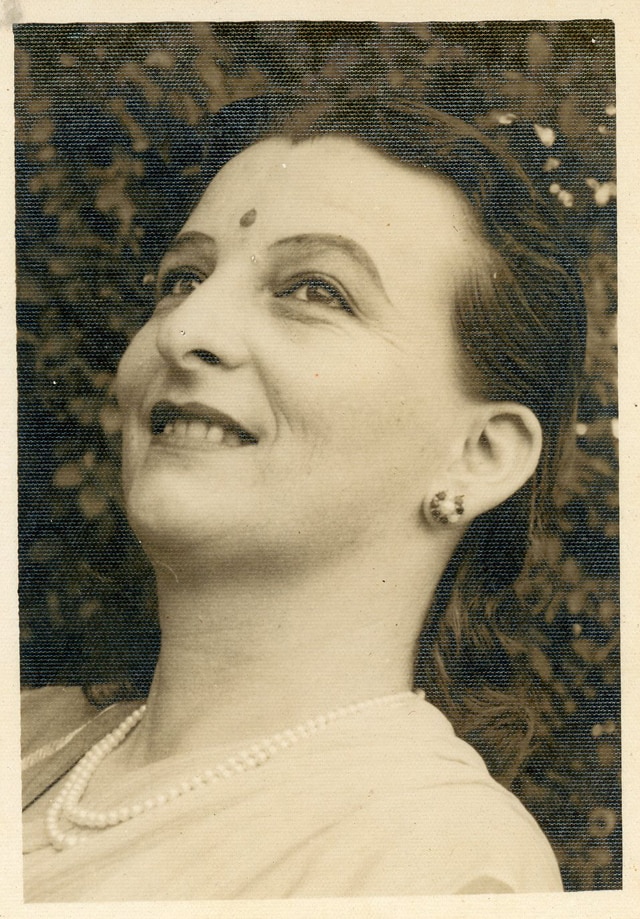
I’m sure most of you might have heard about this award, but what many are unaware of is that India’s highest military decoration was designed by a Swiss-born woman Eve Yvonne Maday de Maros aka Savitri Bhai Khanolkar. 

Image source: dnaindia.com

Life as Eve Yvonne Maday de Maros

Eve was born in Neuchatel, Switzerland, to a Hungarian father Andre de Maday and a Russian mother Marthe Hentzelt, on the 20th of July 1913. She was raised by her father, after her mother’s death. She spent her early childhood in Geneva. As a child, she loved nature and liked being outdoors. 

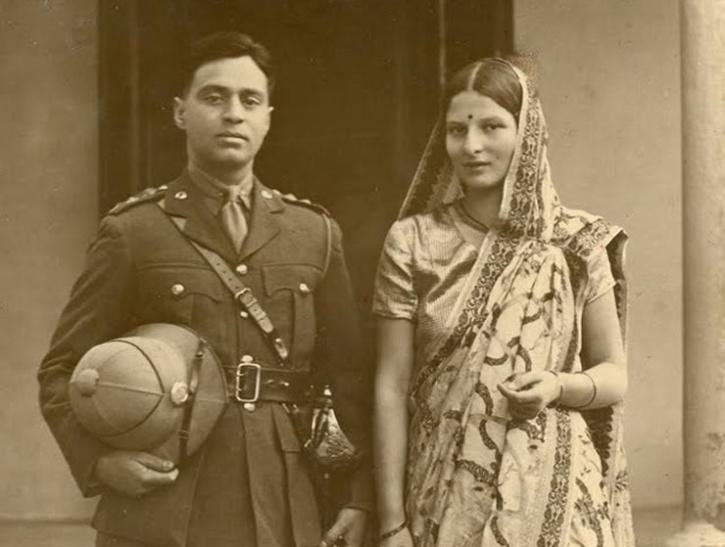
A turning point in her life was when in the winter of 1929, on a skiing holiday, she met Vikram Ramji Khanolkar, a young Indian Army cadet. Vikram, at that time was undergoing training at the Royal Military Academy, Sandhurst and was holidaying in  Switzerland during a team break. The meeting was just the beginning of what later blossomed into a cross country love story. Neither Vikram’s age nor her father’s disapproval stopped her from pursuing her love. She moved to India a few years later and got married to the love of her life in 1932. She converted to Hinduism and adopted the name Savitri Bhai Khanolkar after moving to India.

Life as Savitri Khanolkar

Savitri Khanolkar was a European lady with an Indian soul. She loved everything about India and its culture, which made her cross-cultural transition rather smooth and comfortable. She picked up Hindi, Marathi and Sanskrit within a couple of years and could converse fluently in all the three. She was keenly interested in India’s history and culture and devoted herself to learning more about the country’s mythology, traditions and religious scriptures. She was a talented artist and made a series of paintings depicting the various ideals and principles of Vedanta and Hindu philosophy. She also wrote two books – ‘Sanskrit Dictionary of Names’ and ‘Saints of Maharashtra.’ Those who knew her personally described her as a warm and compassionate person with a great passion for the Hindu philosophy.

Maj General Vikram Khanolkar and Savitri Khanolkar | Image Source: indiatimes.com

Designer of Param Vir Chakra

After India became independent in 1947, especially in the light of the Indo-Pak war that had broken out, there was a pressing need to create new military honours and awards for independent India. Adjutant General Major General Hira Lal Atal had been assigned this responsibility. Major Atal hardly needed to think twice before choosing Savitri Bhai for the task. Her passion for Indian culture and Vedanta philosophy, talent as an artist  and her in-depth knowledge of the country’s ancient history and traditions made her an ideal candidate for the job. Her military association as an army wife was an added bonus. She was asked to design the Indian equivalent of the British Victoria Cross – the Param Vir Chakra.

Param Vir Chakra : Design Inspiration

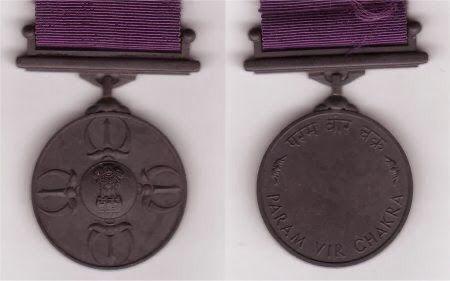
Savitri Bhai took inspiration from India’s ancient puranic literature and legends to design the Param Vir Chakra medal.She selected Indra’s weapon, the Vajra, which was made from the bones of Maharshi Dadhichi for the design. Maharshi Dadhichi was known for the ultimate sacrifice that he had made by giving up his body and thereby enabling the Gods to fashion the deadly weapon Vajra from his bones. The presence of Vajra in the medal is symbolic of the power and the selfless sacrifices of our legendary war heroes. 

The final design consisted of the National emblem embossed in the centre, surrounded by four replicas of the double Vajra imprinted on the medal face and the rear side had the words ‘Param Vir Chakra’ inscribed both in English and Hindi, separated by Lotus flowers.The medal was cast in bronze and held by a purple ribbon.

Apart from the Param Vir Chakra, she also designed other gallantry medals including Ashok Chakra, Maha Vir Chakra, Kirti Chakra, Vir Chakra and Shaurya Chakra.

Coincidentally, the first PVC recipient turned out to be Savitri Bhai’s future son-in-law’s brother, Major Somnath Sharma.

Image Source : twitter

Later life 

During the course of her life, Savitri Bhai always found time to engage in social work. She was a follower of Sri Ramakrishna and she immersed herself in numerous social activities through Ramakrishna Mission. She also worked for the welfare of Jawans and their families and refugees who had been displaced during partition. She lost her husband to a heart attack in 1952, after which she found solace in spirituality and retired to Ramakrishna Math.

The life of Savitri Bhai Khanolkar was truly a remarkable one. Be it joining the North India Flying Club or learning Indian classical dance and music or attending Patna university, she enjoyed every bit of her life as an Indian woman. She passed away on 26th November 1990, after leading a full life.