Get More Done : Strategies for an Effective To-Do List

The term ‘To-Do List’ evokes different images for different people. For some it is that of a never-ending-ever-growing scroll of magic paper that gives them nightmares. For others it might come across as something only the boring folks, who schedule even their loo breaks, do. And then there is another bunch who considers it to be their life saviour which keeps them sane through the madness of their daily chores and tasks. 

Whatever be the image that you have conjured up, a fact that one cannot deny is that an effective to-do list is one of the simplest yet powerful productivity tools that can work wonders in increasing your overall productivity. 

Though it is one of the best and most efficient productivity techniques around, the success of it depends on how effectively it is being used. Moreover, if not used in the correct way, it can do more harm than good. 

Photo by Breakingpic on Pexels.com

So, let’s now see some of the strategies to help you kick-start your art-of-making-the-perfect-list journey 

Pick a suitable medium

Choosing a medium that you are comfortable with is the first and foremost thing to be considered while making a list. It may differ according to the personal preferences of people. It doesn’t matter whether you choose an app or the good old pen and paper, what is important is to stick to the one that you have chosen.Having your tasks scattered across different mediums makes managing and tracking the tasks difficult.

Dump all those tasks eating up your brain to the list

Transfer all those ideas, goals and tasks to the medium that you have chosen. Don’t bother assessing its value or prioritising it (yet). For now, just dig out every single thing from your brain and dump it onto your list.

Identify the ones which align with your purpose

It’s important that you need to have a clear idea about what you want to accomplish in life and accordingly pick tasks that’ll help you realise your goals. Write down clearly why you need to do the task and how it adds value to your life. Identifying your whys gives the brain the much needed motivation and energy to tackle the task.

Break the list into multiple lists

So now you have a big list of all the items that aligns with your long-term goals listed right in front of you. This list will contain all your goals listed out together. Let’s now split them into separate lists . Three basic lists that you can use are : 

  • The Master List , where you keep a list of your long term goals .For eg: Write a novel. Here, you could categorise the goals as personal, professional, finance, health etc. 
  • The Weekly List contains all those items that need to be ticked off by the end of the week. This would essentially contain tasks which would help in achieving your long term goals, plus other things that need your attention during the week. 
  • High Impact List is the one that contains the tasks which are of the highest priority and needs your immediate attention. These might or might not be related to the other two lists. 

Apart from these you could also keep a separate list for the daily activities that you need to track. For eg : If Doing exercise is something that you want to track on a daily basis, then instead of adding this item to your high impact list, add it to a separate list which is meant solely for daily activities. 

You can come up with as many lists as you want. But I would suggest not to overdo it (then you might end up having to come up with another list to track the list of lists ! ). 

List down tasks, not goals on your list

Your master list is the one where you have all the goals listed and when it comes to creating weekly lists, you need to make sure that you break your goals down into actionable items and put those on the list. In this way, you get clarity on how to go about with achieving the long term goals. Make it as specific as possible.

Prioritize 

From the weekly list, identify the items that are of the highest priority and move them to the High Impact List. This is the list that you need to follow to keep track of the items that need to be completed by the end of the day. Sit with your list and identify the ones that are urgent and important and rank them accordingly. Setting priorities makes sure that you don’t end up cleaning your kitchen drawer when you have an important assignment due for the day.

Photo by Suzy Hazelwood on Pexels.com

The shorter the better

One of the mistakes people make while creating a list is to cram up the list with as many items as they can think of. By doing so chances are high that you may end up not finishing most of the tasks on your list. And, there is nothing more depressing than staring at a long list of pending tasks at the end of the day. So keep it short. There is no hard and fast rule as to the maximum number of items that you can put on your list. Start with as low as three and experiment and find out the number that works for you. 

Set a time limit for each task and measure the time taken

Each person has a different pace at which he works. To find out yours, roughly estimate the time you think you would need to complete a task and once you are done with the task, compare it with the actual time taken. This way, you will have a realistic idea about how many tasks you can complete in a day and can accordingly decide the length of your list. 

Break bigger tasks into a set of smaller tasks

While you time your tasks, you might come across some tasks which need more time.Say for example, writing a blog post might not fit into the two hour window that has been allotted to it. In such cases, break the task down into a number of smaller tasks – research the topic, write, edit, select pictures etc. By breaking it down, you will have a clear step-by-step strategy listed right in front of you.Also, instead of waiting to check off that one big monstrous item, you can now check off 3-4 small items. That’s a pleasure in itself, isn’t it ?

Create a May-Be-Later-If-I-Feel-Like list

This is one of my personal favourites. All those items that you want to do but which are neither urgent nor important go on this list. Say for eg: learn to knit, may be something you might want to do but definitely not when you have a project release coming up the following week. 

Always expect the unexpected

As much as we all want everything to go as planned, in reality that’s not always possible. At times, unexpected events may pop up. So, it’s always a good idea to leave a bit of cushion time between your tasks. Not just that it leaves you with some wiggle room in case of emergencies but also provides you that much needed breather from the tasks on normal days.
Block time for yourself

Always always always make sure to take some time out of your schedule to relax. Burnout is real ! So it’s really important that you find time to pause, breathe and relax. Adding break time to your list is essential to help the brain maintain its focus and energy levels. 

Revisit and Re-evaluate your list periodically

Constant evaluations and reevaluations are needed for this productivity tool to work effectively. At the end of each day set aside some time to sit with your list and reflect on what worked and what didn’t. Move those items which you feel are of low priority to your may-be list. Re-prioritise the list, play around with it and you will eventually figure out a strategy that works best for you. It’s all about experimenting, buddy !

 Make the list the day before

Though it is not a rule that you should make the list on the previous day, it is always better if you can do so. At the end of each day, after you evaluate your list for that day, you would already be in a state of mind where it is easier for you to figure out what items need to go on the list for the next day. Also, if you have a list of tasks ready right in front of you in the morning, you know exactly what’s on your plate for the day and hence you can use your morning energy on productive stuff rather than wasting it on planning your day.

Create a Done List

Even if you hate every other list mentioned above, this is one list that you are gonna love. It is a list of all the tasks that you have accomplished. Once you complete a task, along with crossing it off from the main list, add it to your Done List. That’s double the euphoria, you see ! This list is a reminder to yourself of how close you have come to your end goal and is an instant mood booster on days you feel low. Also, do not forget to celebrate even the smallest of your milestones.

Bottom line

Learning to make an effective to do list is not something that you can master overnight. It takes a lot of experimenting to figure out the strategies that work for you. There are no hard and fast rules here. Remember not to obsess too much with the idea of making that perfect list in the first go. Have patience and keep experimenting until you figure out a strategy that best suits your needs. Good Luck !


World Children’s Day and its significance

Photo by samer daboul on Pexels.com

Children are called as the leaders of the future generations. They are also known to be the torch bearers for the future of the human society.  Universal Children’s Day is celebrated every year on the 20th of November as an observance to promote children rights and welfare. Every year, the United Nations (UN) provides a particular theme for this day to improve the conditions of children and build a better environment for them. It was first celebrated in the year 1954 to encourage unity and friendliness among children across various nations. In the year 1959, the United Nations General Assembly accepted the Declaration of the children’s rights on the 20th of November. Therefore, this day is celebrated as Universal Children’s Day.

The theme

The theme for this year by UNICEF is to help children to recover from interruptions and learning losses experienced through the pandemic in the last two years and contribute towards the betterment of the children. Hence, the UNICEF has started a #GoBlue Campaign to highlight the issues faced by children due to the COVID-19 pandemic. This pandemic has shown us how unequal and unfair things have been for the children of the nation. From climate change to racism, many children have been deprived from their basic rights and the youngsters have been raising their voices against such injustices to lead the world towards a better future. Hence, the UNGA has requested several countries to support this cause so the children will be able to lead a better life. To support this cause, the United Nations Children’s Fund (UNICEF) will be holding a parliamentary meeting today at 7:30 pm to raise awareness regarding such issues.  

India’s Contribution

IMAGE: ANI

India has also supported this campaign by illuminating monuments like Qutub Minar and Rashtrapati Bhavan with blue lights. The parliament buildings like North block and south block have also been lit up in the capital city of India on the occasion of World Children’s Day.

Conclusion

This purpose of this year’s theme is to encourage children and youngsters to highlight the issues faced by them and urges adults to understand and take the required actions for the future generations’ well-being. This World Children’s Day, it is extremely important to raise awareness against the discrimination and the racism faced by little children. it is more important than ever, that the leaders listen to their ideas and demands and take actions accordingly. It is our responsibility as a human being to create and build a better world for the children and we must work extremely hard towards achieving that goal.

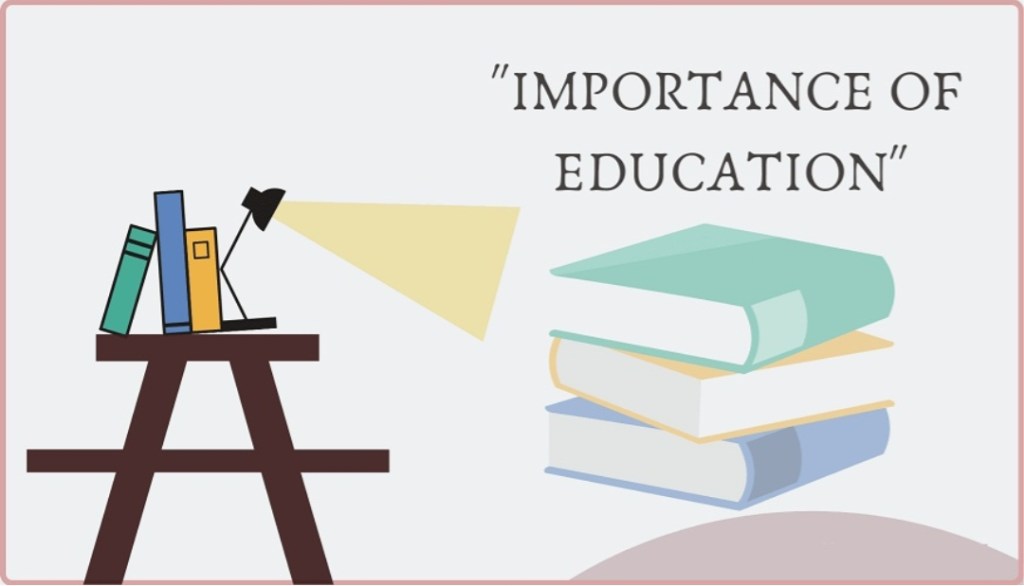
IMPORTANCE OF EDUCATION:-

Education is one of the important thing in this world.Without education we cannot lead a good life.Education is the key to success in life.

Education plays the significant role in the human race.Educated people are responsible for the better future for Society and country.An educated person has the ability to decision making.Education teaches us writing and reading.Reading and writing is the first step in education.Education improves the person mentally to handle the difficult situation.

Education improve the humans personality.Educated person is brave, confident to face any situation.Most of the well known persons are educated.Education helps in the development and innovation of technology.

The technology,science, millitary all are improved because of the education.Without education nothing happened in this world.Education help us to acquire knowledge.knowledge can be used to make better living.Education is the weapon which cannot be break by anyone.

Education teaches us to be honest and polite.Educated peoples are always respected in the society.

Education teaches us to be civilized. Education helps us to understand the feelings.It provides the manpower like police, doctor and millitary.Education improves us mentally strong to face the hard situation in both outer and inner life.Education brings peace in the world.

A DISCOURSE ON ECO-FEMINISM

Ecofeminism is a concept, a movement bringing out the relationship between women and nature. It claims that both the women and nature have been overexploited by patriarchy and the culture. However, it in no way flows in one single course, with the basic concept, it has many dimensions to it and many proponents and variations to it as well. The relationship between women and nature, as constructed by various scholars, is based on three claims – ‘Empirical’, ‘Conceptual’ and ‘Epistemological’ in nature (Sharnappa, 2016). The first claim which is empirical in nature relates socio-economic and political poverty of women with the destruction of nature. It has been observed that the women are the firsthand victim of consequence of destruction of environment – given the dependency of women on nature. The conceptual claim brings out the “hierarchy and dualism” on which society is structured. It throws light on ‘patriarchy’ as the root cause of domination of women and exploitation of nature. The third claim, epistemological in character, focuses on the knowledge of nature which women possess more when compared to any other. Being the humans residing in the rural areas more while men migrating for other works, they have been agrarian cultivators, thus, possessing more knowledge regarding the sustenance of nature.

The Eco-feminism has been documented well in the western world; however, it doesn’t mean that it didn’t exist in the other part. The theory of eco-feminism has evolved over the years and the socio-economic as well as the political concerns of the region has influenced its course. For instance, the differences in the ‘Western Eco-Feminist Discourse’ and ‘Indian Ecofeminist Discourse’ have been brought out by many. The basic departure in the conceptualization of ecofeminism is related to the emphasis on the kind of environmental crisis (Sharnappa, 2016). It has been pointed out that while ecofeminism in the West has emphasised on the direct impact of science and technology on the nature and the consequent impact on women, ecofeminist discourse in India has more or less revolved around the threat to traditional methods of production and subsistence since majority of population still depends on it. The threat that has been taken into account pertains to the building of dams, industrialization, impact of logging. So, the scholars have pointed out that the environment crisis in India revolves around the attempt to reduce the impact of such threats on the victims, generally the peasants.

The exploitation of women, especially the peasants has been stressed by many scholars. Vandana Shiva, one of the pioneers of eco-feminism movement in India focuses on this aspect – the way in which technological development has robbed many peasants, especially women of the ‘third world’ of their traditional practices. She believes that “only path to survival and liberation for women is an ecological one of harmony, sustainability, diversity, as opposed to domination, exploitation and surplus”. Bina Agarwal, an Indian Economist and also one of the critiques of ecofeminist’ arguments, too, provides three-fold explanation to why women are most affected – highlighting the class-gender dimensions to the effect of environmental degradation. She asserts that given the pre-existing gendered division of labour, women in the poor households are worse hit. The disparities in the distribution of ‘sustainable resources’ (for e.g., healthcare) which actually deprive women to access the basics, adds to the burden. Furthermore, the women also have limited rights to private properties, access to employment opportunities and others which only aggravates the plight. She asserts that due to the exploitation and destruction of the nature, women have to work longer in order to gather woods; have to walk longer distance to access to water and the caste factor only adds to the woes; becoming more prone to water-borne disease or the un-healthy environment are some of the effect. Given these conditions and their condition in the labour markets well as their position in accessing the resources and basics, women, especially those of lower caste bear and face the most severe outcome of the exploitation of nature.

The assumptions and principles of ecofeminism has its own share of constructive criticism and variations to it. Bina Agarwal, while critiquing ecofeminists’ argument puts forward a different argument, or say perspective than those of Shiva’s. She contests that ecofeminism does not cover the structure in its entirety. She argues that ecofeminism sees women as a single entity – ‘in unitary’, it does not see her in the context of differences in caste, class, race, etc. Furthermore, it also does not take into account the material reality of women and just interrelates the nature and women ideologically; neither it talks about how ideological shifts are caused by the dominant groups and ‘how such shifts get embedded’. Thus, at this juncture she brings in the concept of ‘feminist environmentalism’ wherein she presents the relationship between men and women rooted in material reality as well. She brings in the elements of how gender and class change the course of any discourse especially which involves women. Thus, women’s interaction with nature must be located within the material reality of caste, class and gender along with all other concerns and not just seeing her(s) as ‘unitary’.

Another point that has been raised is that ecofeminism assigns the responsibility of fighting against the environmental threat solely on women without even taking into account if the women are equipped enough for it. It thus, needs to call for sharing the responsibility between both the gender and not just on the women. The discourse, the impact of the movement should not just be confined to the saving of nature or as Bhasin said’ “clearing up the mess all the time”. It should extend to granting of rights, skill-upgradation and involvement of women in the decision-making process. Thus, in order to strengthen the force or the movement, the diversity as well the different concerns need to be taken into account.

Image Credit: Google