National Book Trust announces of 75 Selected Authors under the PM- YUVA Mentorship Scheme

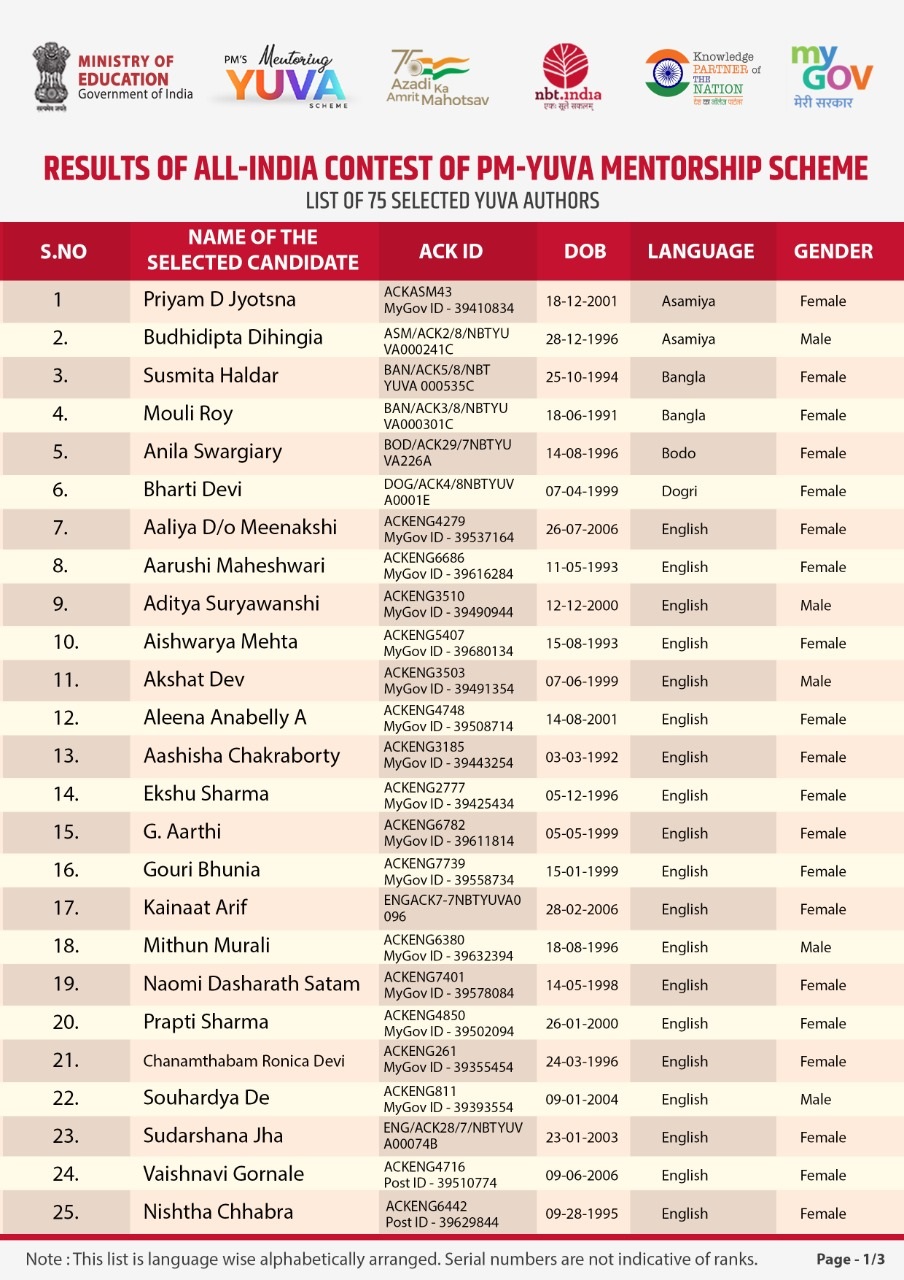
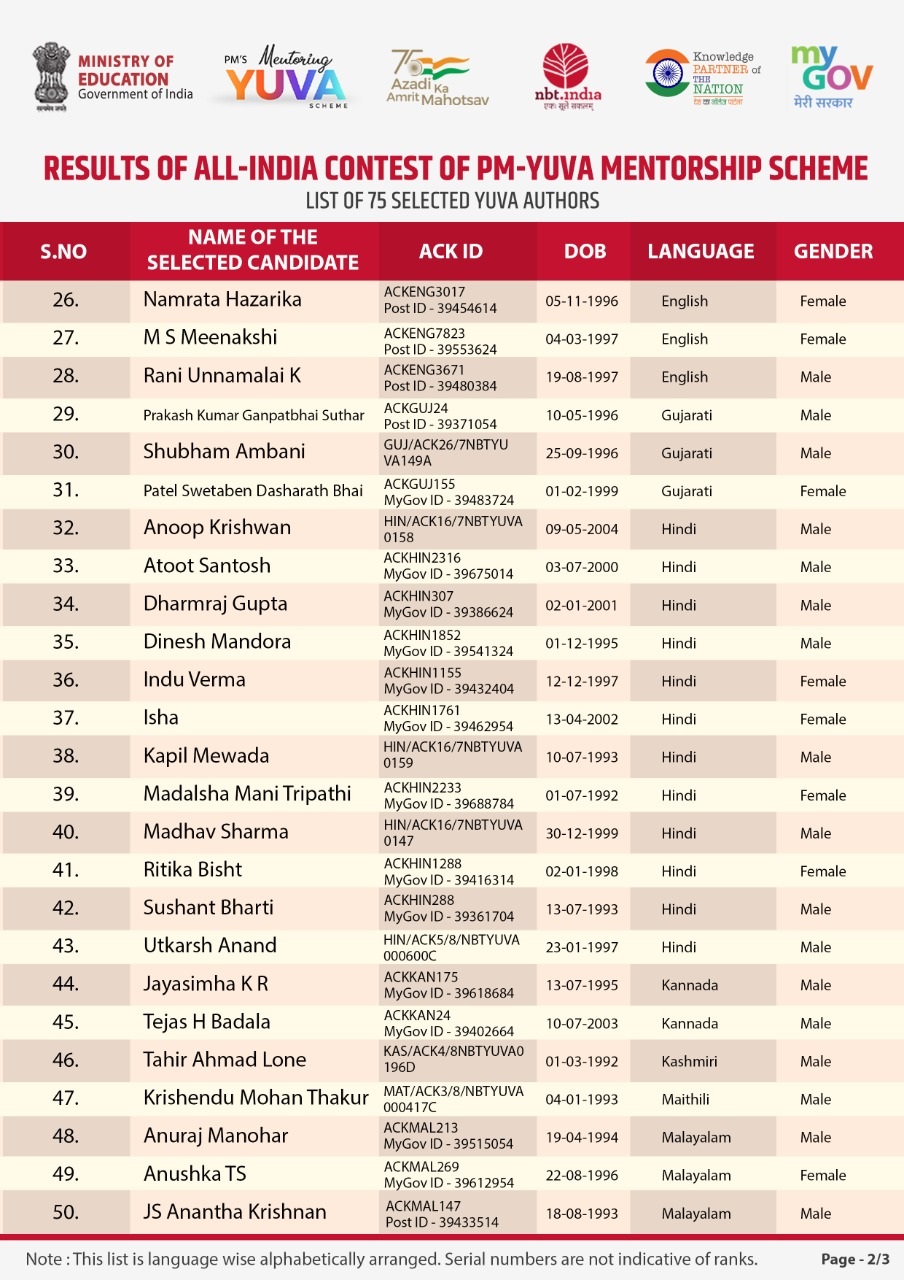
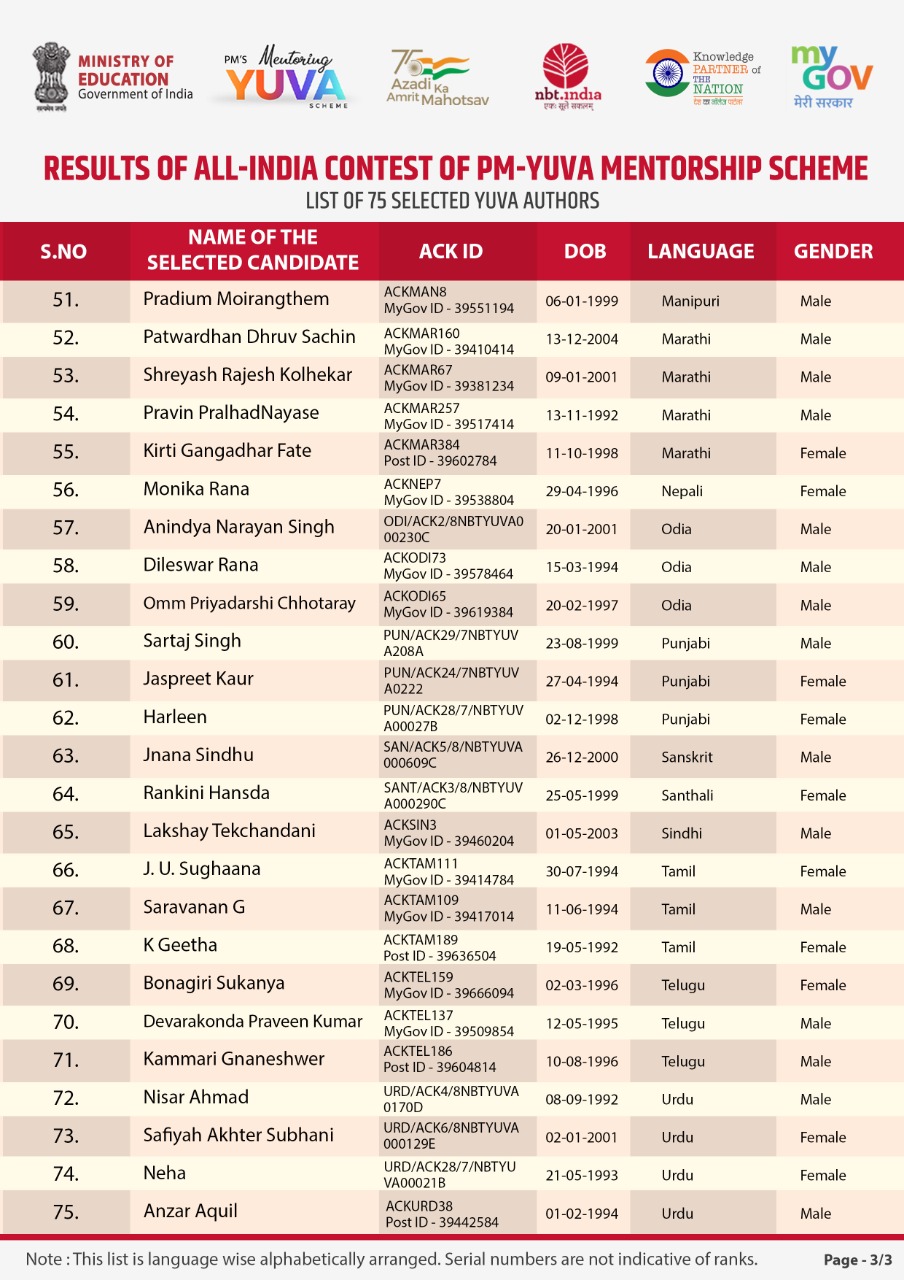
 National Book Trust, India, under Ministry of Education, today announced the results of the All-India Contest organized on the Theme ‘National Movement of India’ under the PM-YUVA Mentorship Scheme as part of Azadi Ka Amrit Mahotsav programmes. As per the Scheme, 75 Authors were to be selected through this contest for a Scholarship-cum-Mentorship Scheme for the young authors below the age of 30 years.

The All-India Contest was organized from 1st June-31st July 2021 through MyGov and National Book Trust, India platforms. Nearly 16000 entries in 22 Official languages and English were received from all across the country including some from Indian Diaspora Community. All the book proposals were read by multiple panels of experts and went through three layers of scrutiny.

It may be recalled that during his Mann Ki Baat address dated 31st January 2021, the Prime Minister Shri Narendra Modi had stated: “I call upon our young friends to write about our freedom fighters, events associated with them & tales of valour during freedom struggle from their areas.” Thereafter the PM-YUVA Mentorship Scheme for young authors was launched by the Ministry of Education, Government of India with National Book Trust, India as the Implementing Agency. 

Out of the 75 selected authors, 38 are males and 37 are females. Further, two are below 15 years, whereas there are 16 authors in the age-group of 15-20 years, 32 fall in the age group of 21-25 years and 25 authors are in the age group of 26-30 years. 

The selected authors will undergo six-months of Mentorship in which they would be provided research and editorial support under the guidance of eminent authors and the Editorial Team of National Book Trust, India to develop their book proposals as full-fledged books to be published by the Trust as part of Azadi Ka Amrit Mahotsav initiatives. Their published books will be later translated into other Indian languages as well.

During mentorship, the selected authors will receive a scholarship of ₹50,000 per month for a period of six months. Further, a royalty of 10% will be payable to the authors on successful publications of their books.

     *****                

Engineering education in local languages and mother tongue

 Engineering education in local languages and mother tongue to be an instrument of empowerment, said Union Education Minister Shri Dharmendra Pradhan at the valedictory session of the 36th India Engineering Congress (IEI) here today.

Speaking on the occasion Shri Pradhan said that India has been a land of people with scientific temper & robust engineering capabilities and our civilisational history has scientific evidences of structural engineering, water management, maritime engineering, etc. He complimented IEI for furthering India’s engineering traditions and role of IEI in building an Aatmanirbhar Bharat.

The Minister stated that with the implementation of the visionary NEP 2020, we are integrating education with skills, taking a multidisciplinary approach and making skilling and apprenticeship a part of the main curriculum to prepare our youth for the 21st century.He further said that introduction of engineering education in local languages and mother tongue in line with the New Education Policy 2020 to be an instrument of empowerment of our youth and will further strengthen our engineering prowess.

Shri Pradhan stressed that Engineering education should not be restricted to awarding of degrees. We must collectively work towards removing language barriers in the learning process and building capacity of our engineering community.

He urged that IEI must endeavour in further strengthening India’s engineering capacity by innovating, knowledge sharing by its members and creating new paradigms of employability & entrepreneurship.

Atal Ranking of Institutions on Innovation Achievements (ARIIA) 2021

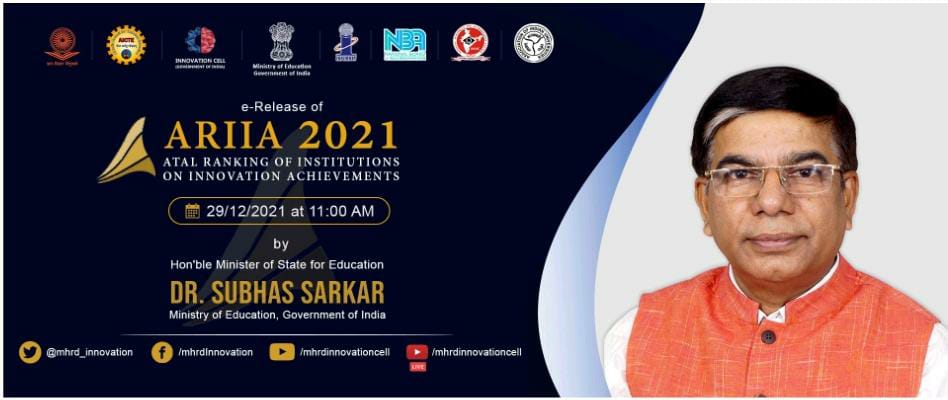
 Atal Rankings of Institutions on Innovation Achievements (ARIIA) 2021 will be virtually announced by the Minister of State for Education, Dr. Subhas Sarkar on 29th December 2021.

ARIIA is a very unique joint initiative of Ministry of Education and AICTE to systematically rank higher educational institutions in India on indicators related to Innovation, Startup and Entrepreneurship Development amongst students and faculty. ARIIA critically evaluate institutions on parameters like patent filing and granted, number of registered students and faculty startups, fund generation by incubated startups, specialised infrastructure created by institutions to promote innovation and entrepreneurship, etc.

Prof. Anil Sahasrabudhe, Chairman, AICTE, highlighted said that India is constantly improving on Global Innovation Index (GII) ranking and has now moved upward to 46th position in 2021 from 81st in 2015. We have also emerged as world’s third largest startup hub but still we have huge scope for improvement, he added. He further said thatt AICTE firmly believes that in coming years, our technical institutes will become fountainhead of next generation technology driven start-ups if we can create a vibrant Innovation and entrepreneurial ecosystem. ARIIA ranking is a major attempt in that direction.

Dr. Abhay Jere, Chief Innovation Officer of Ministry of Education said that the first edition of the ARIIA was launched in 2018 and it has given huge impetus for developing innovation ecosystem in our HEIs. He added that ARIIA-2021, has seen unprecedented participation as compared to earlier editions. This year 1438 institutions (including all IITs, NITs, IISc, etc.) participated as compared 674 HEIs during the 2nd edition of ARIIA (ARIIA-2020) last year. This is more than double as compared to 2nd edition and approximately 4 times as compared to the first edition.

ARIIA-2021 ranks will be announced in 9 separate categories which includes Centrally funded technical institutions (eg IITs, NITs, etc), State Universities, State standalone Technical colleges, Private universities, Private standalone technical colleges, non-technical government and private universities and institutions.

Words of Emotion

10 Positive Benefits Of Listening To Music, According to Science

If you are bored or tired what is the first thing you would do? The most common answer would be that you would do will be to plug your headphone or earphones in and put on a music playlist you love the most. Music over the years has grown with the human population. Music is no more just sounds and words. It has now rather become a means of storytelling, getting our feelings, emotions, and thoughts out. It has now become a means of sharing and connecting with people all over the world. The present times have shown that language, race, color, region, or anything else that divides us is never coming in the way of music. Music has not only made us connect to other people but also has made us connect to ourselves. Music now has become something beyond entertainment and more about cultures, ethnicity, and so many other things coming together. A quote by Henry Wordsworth Longfellow suits this beautifully when he says and quotes “Music is the universal language of mankind.” These words come from a time very long ago but are still presently true to every nature.

Old Cassette Tapes High Resolution Stock Photography and Images - Alamy

Evolution of music

Let us go back to the time when we all used to take the big rectangular box around and wait anxiously and pray that our favorite song plays while we were keeping the radio on. Those were the times when we barely had a few channels on the radio and the most fun part would be shifting from one to another and always managing to learn something new. I am sure all of you right now are just thinking and smiling all the cherished times of listening to music on the radio and enjoying and having fun with friends, families, cousins, and relatives.

 After this came a time of those small cassettes that we have preserved until even today and keep smiling every time you look at it. The multi-tasking of the wooden pencil to write and to fix the long black transparent tape of the cassette is something we all are never going to forget. Radios evolved and now that place to play these cassettes at home or when traveling so every child in their bag would have their favorite cassette safely kept in their cute little travel bags so that they could hear their music when going out.

Later came the beautiful, shiny, and circular CDs whose magic is still alive to the present day. During those times, CD albums became a huge hit in the music industry. It only became a means of business and commercialization but also played a huge impact on the global population. Though the CD was all about handling it more carefully than the cassette, the sound quality in the CDs had its own evolutionary impact. The cassette and the CDs both went hand in hand for so many years. We all remember the time our cars and our houses piled up with CD pouches.

During these, same times how many of you remember putting on 9XM or MTV music channels on your TV and watching the music videos as small children. The colors, the dresses, the actors, singers, background everything that we saw on the screen was like a dream come true. These TV channels introduced us to so many new languages and our dressing sense was because of the most recent music video we had watched. These music videos brought a connection between the people and things on the screen to the people watching them. The best part is we can still relive these moments because these channels are still available on our TVs. Therefore, the next time we get bored we can just go back to these legendary and new music channels and treat ourselves again.

The most iconic evolution of music that brought all the people in the world together united and connected was the combination of the internet and music. All-time famous YouTube stands as the proof. We found the music of regional languages, international languages, and universal languages all under one roof or say one site. The internet through various sites and torrents also made it possible for us to download this amazing music into our desktops that ruled over the human world. People could do so much more than just watch or listen to their favorite music. The combination of music and internet was a sensation, is a sensation, and will always be the sensation.

The most recent and the present music is all on various music apps like Spotify, Gaana, Apple Music, and so many more apps that now play store has dedicated a section for it. Music now is available on various devices such as phones, laptops, internet, radio, cassette, CDs. The most premium time of music is now. Music has so many divisions, categories, genres, not just to one or two things but also regionally, nationally, and internationally as well.

As time will, pass and things will get more progressive and ahead then so will music. Music moves with people. There is so much for music to offer and we as human beings are slowly learning to unfold it.

Music in the present times

Music in the present time is no longer just about fun and time pass. It has become much more than that. Music now is coming into use for making a change, bringing about awareness, standing up for oneself and the society, fighting the evils of the society that is holding us back towards positivity, and so much more. Music is now even in use for reducing anxiety, stress, and bringing about more calmness and positivity. Remember the time when our parents used to say that one could not work properly with the music well that is no longer a problem. Music now helps us to focus, concentrate, and even study for longer hours without any distraction. Music is for every single person. There is no age barrier to it. It is for every age group one can think of whether the group consists of people in their 80s or 20s. During the pandemic, music is playing such an important role in bringing about consistency, positivity, and brightness into people’s lives. It is music that is keeping us connected and alive during these tough times when we cannot even go out of our houses. Nothing was normal and music was one of them. We all remember the virtual disco parties, social distancing parties and so many more changes and evolutions happening with music to adjust and connect with people even when people could not be physically present around each other.

To conclude with a rightful quote of Beethoven and it goes as “Music has the power to change the world”.

References

  1. Google searches for quotes and images.   

TAJ MAHAL

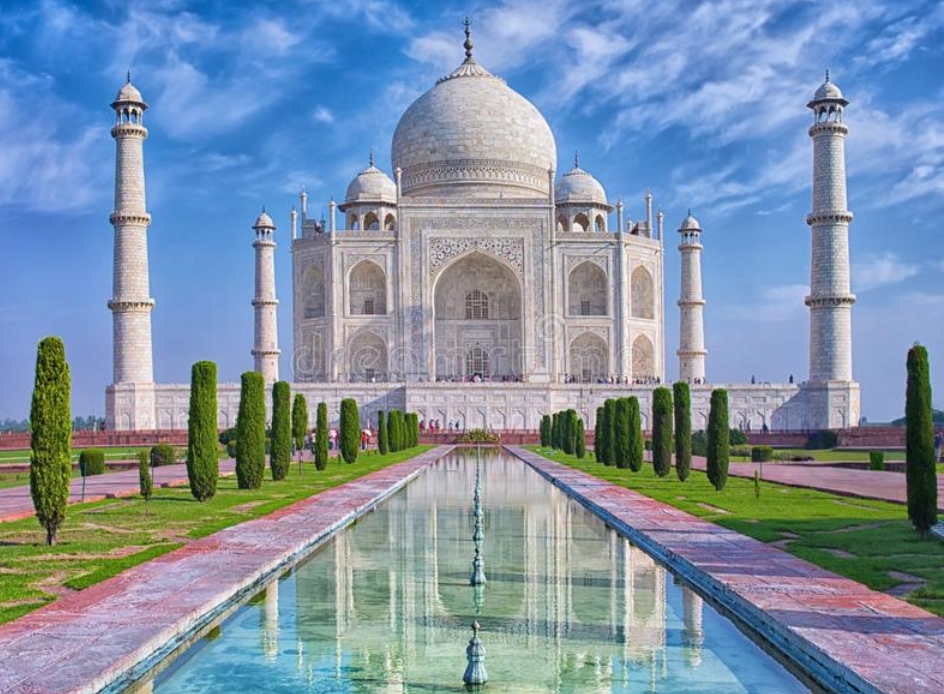
The Taj Mahal is not merely an architectural marvel. Moreover, it also portrays an emperor’s heartfelt passion for the memories of his beloved, embodied in living stone. The grand mausoleum was built between 1631 and 1648 under the orders of the great Mughal Emperor Shah Jahan. This architectural wonder, one of UNESCO’S World Heritage Sites, is situated on the right bank of the Yamuna River in the Agra District of Uttar Pradesh. It is surrounded by expansive Mughal gardens, and occupies an area of almost 17 hectares of land. The Taj Mahal is perhaps the finest example of Indo-Islamic Architecture, and is world renowned for its aesthetic appeal and architectonic beauty. The structure of the Taj Mahal comprises a complex complementary interplay of domes and arches, concave and convex surfaces, solids and voids, and light and shadow. Externally, the lush green gardens, brick red pathway, and the azure canopy garland the pristinely shimmering whiteness of the Taj Mahal, augmenting its halo to a divine level.

HISTORY

About 20,000 workers, including architects, masons, horticulture planners, artists, and carvers, each excelling in their respective fields of work, were employed by the Emperor Shah Jahan in building the Taj Mahal. The cenotaphs of Shah Jahan and his beloved wife, Mumtaz Mahal, lie side by side. The cenotaphs are richly decorated with inlay work and a marble lattice framework, which exhibit the expert workmanship and skill of the craftsmen who put their best into this historical monument. The cenotaphs are primarily for ornamental purposes, as the real graves lie in the crypt at a level lower than them. Decorations with inlaid semiprecious stones, the life-like bas reliefs, calligraphical representations of Koranic verses on the walls, the arch and dome profile of the marble building, and the perfect architectural symmetry of the entire monument are all listed among the features that make the Taj Mahal one of the most unique examples of architectural genius in the history of mankind. The Taj Mahal truly has earned its position among the greatest man-made wonders of our world.

Uniqueness

The Taj Mahal is located in the heart of the busy and densely populated historical city of Agra. Agra lies at one corner of the famous Golden Triangle of tourist destinations in India, which includes Jaipur and Delhi as its other two points. Besides the Taj, Agra has a lot more to offer to its visitors. The city also hosts two other UNESCO World Heritage Sites, namely the breathtaking Agra Fort and Fatehpur Sikri, as well a number of other historical sites. Visitors to the Taj Mahal can enjoy an enriching and unique experience when they visit this destination, both historically and culturally. Shopping is a popular activity among the tourists to Taj Mahal, as the streets leading to this picturesque monument are dotted with souvenir shops selling vibrant and unique north Indian handicrafts, jewelry, sarees, and other items. One must also not forget to try out the delectable local cuisine of the area, especially the Mughlai dishes and north indian sweets

THREATS

Taj Mahal, being one of India’s greatest prides, is afforded great precaution. Especially stringent protective measures were taken during World War II and the India-Pakistan wars in 1965 and 1971 by enclosing the building in scaffolding to protect it against the potential attacks of rival forces. Currently, however, even greater threats to this picturesque monument arise from environmental pollution. The effects of acid rain, caused by emissions from nearby factories, threaten to damage the marble of the building, yellowing it in the process. Recently, the Indian government set up the Taj Trapezium Zone to limit air pollution in the area in and around the Taj Mahal. The decline in the water levels of the Yamuna River also spells bad news for this historical monument, as the lack of moisture has led to the development of cracks and crevices in many parts of the building. The danger persists to this date, and protective measures are continuously being undertaken to improve the structural integrity of this marvellous building. Tourist footfall to the Taj Mahal has also declined in the recent years due to a rise in criminal activities in the area, and the constant hassles faced by the tourists at the hands of touts and hawkers in the streets are real concerns as well. It is thus important that tourists to the Taj Mahal remain cautious and aware of their surroundings, and avoid falling into local sellers’ traps of any kind.

TOURISM

The Taj Mahal has attracted millions of tourists for many years, due to its enchanting beauty and intriguing historical significance. According to recent statistics, about 6.9 million tourists visited this World Heritage Site in 2014 alone. The Taj Mahal is easily accessible via a variety of conveyance services, such as buses, trains, and cars. Air service to nearby Agra is limited, but tourists usually arrive at the Delhi airport in India and then travel to Agra by road or rail. Most travel itineraries of northern India include Taj Mahal on their listed agenda items, and numerous tour operators offer visitors attractive packages to this historical monument. The best time to visit the Taj Mahal is during the months stretching from October through March.

TAJ MAHAL

The Taj Mahal is not merely an architectural marvel. Moreover, it also portrays an emperor’s heartfelt passion for the memories of his beloved, embodied in living stone. The grand mausoleum was built between 1631 and 1648 under the orders of the great Mughal Emperor Shah Jahan. This architectural wonder, one of UNESCO’S World Heritage Sites, is situated on the right bank of the Yamuna River in the Agra District of Uttar Pradesh. It is surrounded by expansive Mughal gardens, and occupies an area of almost 17 hectares of land. The Taj Mahal is perhaps the finest example of Indo-Islamic Architecture, and is world renowned for its aesthetic appeal and architectonic beauty. The structure of the Taj Mahal comprises a complex complementary interplay of domes and arches, concave and convex surfaces, solids and voids, and light and shadow. Externally, the lush green gardens, brick red pathway, and the azure canopy garland the pristinely shimmering whiteness of the Taj Mahal, augmenting its halo to a divine level.

HISTORY

About 20,000 workers, including architects, masons, horticulture planners, artists, and carvers, each excelling in their respective fields of work, were employed by the Emperor Shah Jahan in building the Taj Mahal. The cenotaphs of Shah Jahan and his beloved wife, Mumtaz Mahal, lie side by side. The cenotaphs are richly decorated with inlay work and a marble lattice framework, which exhibit the expert workmanship and skill of the craftsmen who put their best into this historical monument. The cenotaphs are primarily for ornamental purposes, as the real graves lie in the crypt at a level lower than them. Decorations with inlaid semiprecious stones, the life-like bas reliefs, calligraphical representations of Koranic verses on the walls, the arch and dome profile of the marble building, and the perfect architectural symmetry of the entire monument are all listed among the features that make the Taj Mahal one of the most unique examples of architectural genius in the history of mankind. The Taj Mahal truly has earned its position among the greatest man-made wonders of our world.

Uniqueness

The Taj Mahal is located in the heart of the busy and densely populated historical city of Agra. Agra lies at one corner of the famous Golden Triangle of tourist destinations in India, which includes Jaipur and Delhi as its other two points. Besides the Taj, Agra has a lot more to offer to its visitors. The city also hosts two other UNESCO World Heritage Sites, namely the breathtaking Agra Fort and Fatehpur Sikri, as well a number of other historical sites. Visitors to the Taj Mahal can enjoy an enriching and unique experience when they visit this destination, both historically and culturally. Shopping is a popular activity among the tourists to Taj Mahal, as the streets leading to this picturesque monument are dotted with souvenir shops selling vibrant and unique north Indian handicrafts, jewelry, sarees, and other items. One must also not forget to try out the delectable local cuisine of the area, especially the Mughlai dishes and north indian sweets

THREATS

Taj Mahal, being one of India’s greatest prides, is afforded great precaution. Especially stringent protective measures were taken during World War II and the India-Pakistan wars in 1965 and 1971 by enclosing the building in scaffolding to protect it against the potential attacks of rival forces. Currently, however, even greater threats to this picturesque monument arise from environmental pollution. The effects of acid rain, caused by emissions from nearby factories, threaten to damage the marble of the building, yellowing it in the process. Recently, the Indian government set up the Taj Trapezium Zone to limit air pollution in the area in and around the Taj Mahal. The decline in the water levels of the Yamuna River also spells bad news for this historical monument, as the lack of moisture has led to the development of cracks and crevices in many parts of the building. The danger persists to this date, and protective measures are continuously being undertaken to improve the structural integrity of this marvellous building. Tourist footfall to the Taj Mahal has also declined in the recent years due to a rise in criminal activities in the area, and the constant hassles faced by the tourists at the hands of touts and hawkers in the streets are real concerns as well. It is thus important that tourists to the Taj Mahal remain cautious and aware of their surroundings, and avoid falling into local sellers’ traps of any kind.

TOURISM

The Taj Mahal has attracted millions of tourists for many years, due to its enchanting beauty and intriguing historical significance. According to recent statistics, about 6.9 million tourists visited this World Heritage Site in 2014 alone. The Taj Mahal is easily accessible via a variety of conveyance services, such as buses, trains, and cars. Air service to nearby Agra is limited, but tourists usually arrive at the Delhi airport in India and then travel to Agra by road or rail. Most travel itineraries of northern India include Taj Mahal on their listed agenda items, and numerous tour operators offer visitors attractive packages to this historical monument. The best time to visit the Taj Mahal is during the months stretching from October through March.

COMPUTER AND IT’S TYPES:-

A computer is a programmable device that stores, retrieves, and processes data. … The term was later given to mechanical devices as they began replacing human computers. Today’s computers are electronic devices that accept data (input), process that data, produce output, and store storage the results.A computer is a machine that can store and process information. Most computers rely on a binary system, which uses two variables, 0 and 1, to complete tasks such as storing data, calculating algorithms, and displaying information.Computer has become very important nowadays because it is very much accurate, fast and can accomplish many tasks easily.

TYPES OF COMPUTER:-

* ANALOG COMPUTER.

* DIGITAL COMPUTER.

* MAINFRAME COMPUTER.

ANALOG COMPUTER:-


An analog computer or analogue computer is a type of computer that uses the continuously variable aspects of physical phenomena such as electrical, mechanical, or hydraulic quantities to model the problem being solved planimeters, nomograms, operational amplifiers, mechanical integrators, slide rules, tide pool predators, electric integrators are some examples for analog computers.

DIGITAL COMPUTER:-

Digital computer, any of a class of devices capable of solving problems by processing information in discrete form. It operates on data, including magnitudes, letters, and symbols, that are expressed in binary codes using only the two digits 0 and 1.smartphones, calculators, tablets, personal computer are some examples for Digital computers.

MAINFRAME COMPUTER:-

A mainframe computer, informally called a mainframe or big iron, is a computer used primarily by large organizations for critical applications like bulk data processing for tasks such as censuses, industry and consumer statistics, enterprise resource planning, and large-scale transaction processing. IBM zSeries, System z9 and System z10 servers are some examples for Mainframe computers.

Tips to get more marks in exams!

Just knowing the answers to the questions isn’t enough. Most of the time, it matters how you present your answer sheet. The person who will check your paper probably has about 50 – 100 other papers to go through. And that is a tedious job.

So, if he opens your answer sheet and finds all sorts of gibberish in there, well, you better be making sense. On the other hand, with neat paper, the checker might just go easy. So here are some tips on how to present your answers in a theory paper:

Starting with the topics you remember well

Start by answering those questions you can answer properly. The sequence of answering doesn’t matter as long as you write the correct question number to the answer. This way you will not only boost your confidence but also the person who checks your paper will get a good impression.

Draw diagrams wherever required

This will help you form your answers better and make your answer sheet more interesting. Teachers recommend drawing diagrams, especially in subjects like biology. Draw them neatly, label whatever is supposed to, and use a pencil(and preferably a scale) to draw.

Write answers in point form

Do not go on writing paragraphs after paragraphs after paragraphs. No one is going to sit and read every word of it. It’s always better to write the main point and elaborate it in minimum sentences. Underline the keywords in every answer. In the case of numerical- write the formulas used, show the final answer and always write the units wherever required.

Write as neatly as you can

Everyone appreciates good handwriting. So try to be neat. But, don’t let that slow down your speed.

Select the questions carefully

In case you have an option between which questions to solve. Once you get your question paper, spend the first five minutes analysing the questions. Don’t freak out after seeing the questions. Read the questions carefully and try to recall the answer points. You can write down the points in short at the back of your answer sheet (to help you recall later on). Select the questions that you are confident about and try to stick to them. You might not make the right choice later during the exam.

Recheck your paper at the end

Try reserving the last 10 minutes of your exam for rechecking your paper. You can come across silly errors that might’ve cost you your marks or there might be an instance where you forgot to write a particular answer. So, it’s always safe to go through your paper before submitting it.

REference

https://www.quora.com/How-do-I-write-answers-in-exams/answer/Ritija?ch=15&oid=173888791&share=a91c3689&srid=RDpYR&target_type=answer

Infrastructure Development in India

By – Supriya

India is one of the fastest growing economies of the world and is witnessing growth , particularly in manufacturing and service sector. Therefore, to realise the full potential of the growth impulses surging in the economy , the provision of quality and efficient infrastructure services is essential. India ‘ s infrastructure includes performance and connectivity of basic systems and services such as roadways, railways , ports, airports and telecom. Over years, India’s soft infrastructure has grown much faster than the hard infrastructure. Today, the Indian telecommunication industry is the world’s fastest growing industry with 826.93 million mobile phone subscribers , as of April 2011. The market’s first operator was the state – owned Bharat Sanchar Nigam Limited (BSNL) , but liberalisation led to the entry of private players such as Bharti Airtel, Reliance Communications, Tata Teleservices , Idea Cellular and Aircel. A large population , low telephony penetration levels , and a rise in consumer spending power have helped make India the fastest – growing telecom market in the world, and rural India is further expected to increase the growth in mobile phone services in the next four years. In comparison, performance of physical infrastructure in Indian economy has been mixed and uneven. Presently, India maintains one of the world ‘ s largest rail systems , with 18 million daily passengers, a staff of 1.4 million employees and 17,000 trains operating on 64000 kilometres of track. The railways traverse the length and breadth of the country and carry over 30 million passengers and 2.8 million tons of freight daily. India also has a far – reaching road network of over 3.314 million kilometres ,yet in comparison to telecom, performances of these sectors have been inadequate , especially when counted in terms of the country ‘ s surface area or population . While the world’s telecom market grew at a faster pace, the growth in country’s physical infrastructure like roads and railways has been comparatively slower.
For faster development of infrastructure in the country, in 2010-11 General Budget , infrastructure sector has received much priority . Special emphasis has been laid on the development of rural infrastructure development that has been allotted ₹61000 crore, while urban infrastructure development has been allocated ₹5400 crore. Allocation for road infrastructure has also been ₹ 19894 crore and a total of ₹ 48000 crore has been kept aside for Bharat Nirman. To fulfill the significant deficit in the availability of physical infrastructure across different sectors which are hindering economic development, the government is encouraging private participation in the expansion of critical infrastructure and public – private partnership to improve the viability of infrastructure projects. Since infrastructure financing have to fall back on long – term contractual savings, the government has decided to put into effect the financing of infrastructure projects through the India Infrastructure Finance Company Limited (IIFCL) . To support this, the World Bank has lent a record $ 9.2 billion to India in 2010 , to help finance public – private partnership in infrastructure , especially in the roads , power and ports sector. A critical problem facing India’s economy is the sharp and growing regional variations and poor infrastructure in low- income states such as Bihar, Chhattisgarh, Jharkhand, Madhya Pradesh, Orissa and Uttar Pradesh. The Bank has also financed rural credit cooperatives to fund the development of infrastructure in the backwards regions of the country.

THANKYOU !

India has achieved its NDC target with total non-fossil based installed energy capacity of 157.32 GW which is 40.1% of the total installed electricity capacity

 At COP 21, as part of its Nationally Determined Contributions (NDCs), India had committed to achieving 40% of its installed electricity capacity from non-fossil energy sources by 2030. The country has achieved this target in November 2021 itself. The country’s installed Renewable Energy (RE) capacity stands at 150.54 GW (solar: 48.55 GW, wind: 40.03 GW, Small hydro Power: 4.83, Bio-power: 10.62, Large Hydro: 46.51 GW) as on 30.11.2021 while its nuclear energy based installed electricity capacity stands at 6.78 GW. This brings the total non-fossil based installed energy capacity to 157.32 GW which is 40.1% of the total installed electricity capacity of 392.01 GW. In line with the Hon’ble Prime Minister’s announcement at the recently concluded CoP26, the Government is committed to achieving 500 GW of installed electricity capacity from non-fossil fuel sources by the year 2030.
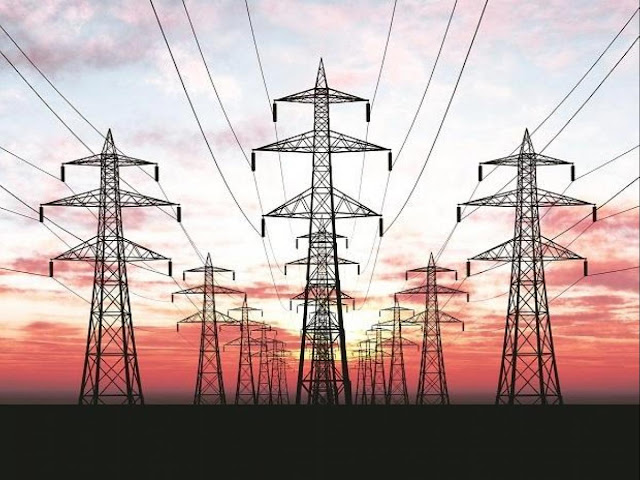
During the last 7.5 years, India has witnessed the fastest rate of growth in renewable energy capacity addition among all large economies, with renewable energy capacity (including large hydro) growing 1.97 times and solar energy expanding over 18 times.


  1. Investment in Renewables
  • India’s renewable energy programme is driven by private sector investment. As per REN21 Renewables 2020 Global status Report , during the period 2014 -2019 renewable energy programmes and projects in India attracted an investment of US$ 64.4 billion. In the year 2019 alone, US$ 11.2 billion were invested. New opportunities have emerged, and altogether new business space has been created. Indian companies have begun to explore foreign stock exchanges as a source of funds. India is progressively becoming a favored destination for investment in renewables.
  • As per Foreign Direct Investment (FDI) data Cell, DPIIT, the Indian ‘Non-Conventional Energy’ sector received approximately US$ 7.27 billion as FDI from the year 2014-15 upto June 2021. Of this, FDI of US$ 797.21 million was attracted during 2020-21. Liberal foreign investment policy allows the foreign investors to enter into joint ventures with an Indian partner for financial and/or technical collaboration and for setting up of renewable energy-based power generation projects. Upto 100 per cent foreign investment as equity qualifies for automatic approval, under the extant FDI policy of the Government.
  1. Major Programmes and Schemes:
  • Pradhan Mantri Kisan Urja Suraksha evam Utthaan Mahabhiyan (PM-KUSUM): To provide energy and water security, de-dieselise the farm sector and also generate additional income for farmers by producing solar power, Government launched PM-KUSUM Scheme for farmers. The Scheme consists of three components:
  • Component A: Installation of 10,000 MW of Decentralized Grid Connected Solar Power Plants each of capacity up to 2 MW
  • Component B: Setting up of 20 lakh standalone Solar Powered Agriculture Pumps
  • Component C: Solarisation of 15 Lakh existing Grid-connected Agriculture Pumps

The Scheme aims to add 30.8 GW of solar capacity with central financial support of over Rs. 34,000 Crore. Based on the learning during first year, business models for feeder level solarisation was included as new variant under Component-C. Convergence of Scheme with PM-KSY and Agriculture Infrastructure Fund also accomplished. For ease of availability of finance the Reserve Bank of India  has included the three components of the Scheme under Priority Sector Lending Guidelines. Cumulatively, about 5000 MW capacity of small solar power plants under component-A, 3.6 lakh standalone solar pumps under component-B and solarisation of over 10 lakh grid connected pumps under the two variants of component-C have been allocated in various States. After restrictions on COVID-19 pandemic were relaxed, installation has picked up and as on 30.11.2021, over 75000 stand-alone solar pumps have been installed under the Component-B, total 20 MW capacity solar power plants installed under Component-A and over 1000 pumps reported solarised under individual pump solarisation variant of Component-C. Implementation of feeder level solarization variant under Component-C, which was introduced in December, 2020 has also started in a number of States.

  • Production Linked Incentive (PLI) Scheme: On 28.04.2021, the Government introduced, Production Linked Incentive Scheme “National Programme on High Efficiency Solar PV Modules” with an outlay of Rs. 4500 crores to support and promote manufacturing of high efficiency solar PV modules, including the upstage vertical components like cells, wafers, ingots and polysilicon in India and thus reduce the import dependence in Solar Photo Voltaic (PV) sector. In pursuance of the decision, a tender for invitation of bids for manufacture of high efficiency solar PV modules was issued. The tender received very encouraging response wherein 18 bids were received which could add another around 55 GW of solar PV module manufacturing to present solar PV module manufacturing capacity of around 11 GW. Letter of Awards have been issued by IREDA on 11.11.2021/02.12.2021 to three successful bidders for setting up 8737 MW capacity of fully integrated solar PV manufacturing units.
  • Solar Parks Scheme: To facilitate large scale grid connected solar power projects, a scheme for “Development of Solar Parks and Ultra Mega Solar Power Projects” is under implementation with a target capacity of 40 GW capacity by March 2022. Solar parks provide solar power developers with a plug and play model, by facilitating necessary infrastructure like land, power evacuation facilities, road connectivity, water facility etc. along with all statutory clearances. As on 30.11.2021, 52 solar parks have been sanctioned with a cumulative capacity of 37.92 GW in 14 states. Solar power projects of an aggregate capacity of around 9.2 GW have already been commissioned in these parks.
  • Roof Top Solar programme Phase-II: Roof Top Solar programme Phase-II for accelerated deployment of solar roof top systems with a target of 40 GW installed capacity by the year 2021-22, is also under implementation. The scheme provides for financial assistance of upto 4 GW of solar roof top capacity to residential sector and there is a provision to incentivise the distribution companies for incremental achievement over the previous year. For residential sector use of domestically manufactured solar cells and modules have been mandated. This scheme is expected to act as catalyst for adding solar cell and module manufacturing capacity in India. As on 30.11.2021, a cumulative 5.7 GW solar roof top projects have been set up in the country. Against the target of 4GW for Residential sector under Rooftop Solar programme Phase-II, allocation of 3.4 GW already made to various states/ UTs and 1.07 GW already installed.
  • Central Public Sector Undertaking (CPSU) Scheme: A scheme for setting up 12 GW Grid- Connected Solar PV Power Projects by Central Public Sector Undertakings with domestic cells and modules is under implementation. Viability Gap Funding support is provided under this scheme. Apart from adding solar capacity, the scheme will also create demand for domestically manufactured solar cells/modules, and thus help domestic manufacturing. Under this scheme, Government has sanctioned around 8.2 GW of projects, as on 30.11.2021.
  • Wind Power

India’s wind power potential at hub height of 120 meters is 695 GW. The wind power installed capacity has grown 1.9 times during past 7.5 years to about 40 GW and 9.67 GW of projects are at various stages of commissioning (as on 30.11 2021). India has the 4th largest wind power capacity in the world.

The wind energy sector is led by the indigenous wind power industry with a strong project ecosystem, operation capabilities and a manufacturing base of about 12 GW per annum. All the major global players of Wind Turbine Manufacturing field have their presence in the country and over 35 different models of wind turbines are being manufactured by more than 15 different companies, through joint ventures under licensed production, subsidiaries of foreign companies, and Indian companies with their own technology. The unit size of wind turbine in India has gone up to 3.6 MW.

Government of India has notified the offshore Wind Energy Policy to harness the potential of offshore wind energy along India’s coastline. Ministry is developing strategy and roadmap for installation of offshore wind projects off the coast of Gujarat and Tamil Nadu.

The Ministry has notified the wind solar hybrid policy, providing a framework for promotion of large grid connected wind-solar PV hybrid projects for optimal and efficient utilization of transmission infrastructure and land, reducing the variability in renewable power generation and achieving better grid stability. As on 30.11.2021, capacity of 3.75 GW of wind-solar hybrid projects have been awarded, out of which 0.2 GW capacity is already commissioned. In addition, capacity of 1.7 GW wind-solar hybrid projects are at various stages of bidding.

  • Off-Grid Solar PV Applications Programme Phase III: Phase-III of the Off-Grid Solar PV Applications Programme for Solar Street Lights, Solar Study Lamps and Solar Power Packs was available as on 31.03.2021. As on 30.11.2021 over 1.45 lakh solar street lights installed, 9.03 lakh solar study lamps distributed and 2.5 MW solar power packs have been set-up as reported by State Nodal agencies (SNAs).
  • Atal Jyoti Yojana (AJAY) Phase-II: The AJAY Ph-II Scheme for installation of solar street lights with 25% fund contribution from MPLAD Funds was discontinued from 1 April 2020 as the Government decided to suspend the MPLAD Funds for next two years i.e. 2020-21 and 2021-22. However, installation of 1.5 lakh solar street lights sanctioned under the scheme till March 2020 was under progress and as on 30.11.2021 around 1.21 lakh solar street lights have reportedly been installed and balance are targeted to be completed by December 2021.
  • Green Energy Corridor

In order to facilitate renewable power evacuation and reshaping the grid for future requirements, the Green Energy Corridor (GEC) projects have been initiated. The first component of the scheme, Inter-state GEC with target capacity of 3200 circuit kilometer (ckm) transmission lines and 17,000 MVA capacity sub-stations, was completed in March 2020. The second component – Intra-state GEC with a target capacity of 9700 ckm transmission lines and 22,600 MVA capacity sub-stations is expected to be completed by June 2022. As on 30.11.2021, 8434 ckm of intra-state transmission lines have been constructed and 15268 MVA intra-state substations have been charged.

  • Other renewables for power generation

The following Bio-energy schemes were under implementation by the Ministry:

  • Programme on Energy from Urban, Industrial and Agricultural Wastes/ Residues
  • Scheme to support Promotion of Biomass based cogeneration in sugar mills and other industries
  • Biogas Power (Off-Grid) Generation and Thermal application Programme (BPGTP)
  • New National Biogas and Organic Manure Programme (NNBOMP)

Ministry of New and Renewable Energy has been implementing above-mentioned schemes 2020-21. The programmes which were valid till 31.03.2021, has been recommended for continuation by EFC for the period FY 2021-22 to 2025-26 only for meeting the already created liabilities. Thus, no new projects after 31.03.2021 are to be sanctioned.

As on 31.11.2021, installed capacity of biomass power and cogeneration projects stood at about 9.4 GW(Bagasse) and 0.77 GWeq (Non-Bagasse) , waste to energy projects capacity was 199.14 MW(grid connected) and 234.97 MWeq (off grid), and about 4.83 GW small hydro power capacity from 1146 small hydro power projects which were operational.

  1. Policies and Initiatives:
  • Waiver of Inter State Transmission System (ISTS) charges for inter-state sale of solar and wind power for projects to be commissioned by 30.06.2025,
  • Keeping in view India’s long-term goals of decarbonising the electricity systems, and achieving energy security, and in keeping with our international commitments, in July 2016, long term Renewable Purchase Obligation growth trajectory, uniformly applicable to all States/UTs up to the year 2021-22, was notified. Further, the Ministry of Power on 29.01.2021 included Hydropower Purchase Obligation (HPO) within Non-Solar Renewable Purchase Obligation (RPO) and notified the long term updated RPO trajectory from 2019-20 to 2021-22 including HPO till 2029-30.
  • Competitive Bidding guidelines for procurement of solar and wind power have been notified under section 63 of Electricity Act, 2003. These Guidelines provide for standardization and uniformity of the procurement process and a risk-sharing framework between various stakeholders, thereby encouraging investments, enhancing bankability and improving profitability for projects. The Guidelines also facilitate transparency and fairness in the procurement processes which have resulted in the drastic fall in solar and wind power prices over the past few years. Solar PV power tariff had dropped to an all-time low of Rs. 1.99 per unit in an auction of projects of 500 MW capacity by Gujarat Urja Vikas Nigam Ltd (GUVNL) in December 2020.
  • To build investor trust by ensuring payment security and tackle the risks related to delays in payments to independent power producers, DISCOMs have been mandated to issue and maintain letters of credit (LCs);
  • Efforts have been undertaken to strengthen and expand the domestic manufacturing eco-system. Schemes namely PM-KUSUM, Solar Rooftop and CPSU have a precondition of Domestic Content Requirement, directly creating a domestic demand of more than 36 GW solar PV (cells & modules). In order to curb proliferation of imported solar PV cells and modules, a Safeguard Duty was imposed w.e.f. 30.07.2018 for two years. It has been extended for one more year at the rates of 14.90 per cent for imports during 30.07.2020 to 29.01.2021; and 14.50 percent for imports during 30.01.2021 to 29.07.2021. Government has decided to impose Basic Customs Duty (BCD) on import of solar PV modules @40% and on import of solar PV cells @25% with effect from 01.04.2022.
  1. Hydrogen Mission

In the Independence Day speech on 15.08.2021, Prime Minister announced the launch of National Hydrogen Mission and stated the goal to make India a global hub for Green Hydrogen production and export. The draft National Green Hydrogen Mission document is under inter-ministerial consultations.

The Mission proposes a framework for inter alia creating demand for Green Hydrogen in sectors such as petroleum refining and fertilizer production; support for indigenous manufacturing of critical technologies; Research & Development activities; and an enabling policy and regulatory framework. The proposed steps will lead to the development of additional renewable energy capacity for Green Hydrogen production.

  1.        One Sun – One World – One Grid (OSOWOG)

A tripartite Memorandum of Understanding (MoU) was signed between the Ministry of New and Renewable Energy (MNRE), the International Solar Alliance (ISA) and the World Bank on 08.09.2020 for a study on the OSOWOG initiative. Currently, the implementation plan, road map and institutional framework is being developed by a consultant appointed for this purpose. The inception report has already been submitted by the consultant in September’2021. The complete study is expected to be completed by mid of 2022.

  1. International Solar Alliance

International Solar Alliance (ISA) was launched by Hon’ble Prime Minister of India, and the President of France on 30.11.2015 at Paris, France. With the signing and ratification of the ISA Framework Agreement by 15 countries, on 06.12.2017, ISA became the first international intergovernmental organization to be headquartered in India.

On 15.07.2020, this amendment came into force, which enables all member States of the UN, including those beyond the tropics, to join the ISA. As on 30.11.2021, 101 countries have signed the Framework Agreement of the ISA. Of these, 80 countries have also ratified the same.

  1. Issues/Challenges ahead
  • Mobilization of the necessary finance and investment on competitive terms: Gearing up the banking sector for arranging finances for larger deployment goals, exploring low-interest rate, long-term international funding, and developing a suitable mechanism for risk mitigation or sharing by addressing both technical and financial bottlenecks are major challenges. Need for mobilization of funds on attractive terms has further increased with launch of PM-KUSUM, which provides farmers an opportunity to become entrepreneurs and participate in India’s growth story. The ongoing efforts for mitigating investment risks, and easing approval processes would also need to be strengthened.
  • Land acquisition: Land acquisition is one of the major challenges in renewable power development. Identification of land with RE potential, its conversion (if needed), clearance from land ceiling Act, decision on land lease rent, clearance from revenue department, and other such clearances take time. State governments have to play a major role in acquisition of land for RE projects.
  • Creating an innovation and manufacturing eco-system in the country;
  • Integrating larger share of renewables with the grid;
  • Enabling supply of firm and dispatchable power from renewables;
  • Enabling penetration of renewables in the so called hard to decarbonize sectors.
  1. Some Steps by MNRE for facilitating RE Sector amid COVID-19 Pandemic:
  • Ensuring uninterrupted operation of Renewable Energy (RE) Plants in lockdown:

MNRE had requested States/UTs for facilitating ensuring uninterrupted essential operation of Renewable Energy Generating Stations (REGS) (solar power plants, wind power plants, solar-wind hybrid power plants, small hydro power plants, biomass / biogas based power plants, etc.) and provide facilitation /permission for material movement needed by them during the nation-wide lockdown for COVID-19 outbreak.

  • Time-Extension of around 7.5 months on account of lock-down and disruption due to COVID-19:

MNRE had issued orders regarding treating lockdown due to COVID-19, as Force Majeure and granting of time-extension of around 7.5 months for renewable energy projects on account of lockdown and disruptions on account of COVID-19.

  • Facilitating Invoicing: by non –insistence on signed hard copy.

MNRE had issued directions regarding accepting invoices over email without insisting on submission of signed hard copy and in cases where Joint Meter Reading (JMR) cannot be signed due to lockdown, acceptance of Invoices generated by RE Developers on basis on photograph of meter reading/ downloaded meter data.

  • Insisting on Must-Run, Timely Payments & no Curtailments:

MNRE had issued clarifications that Renewable Energy (RE) Generating Stations have been granted ‘Must-Run’ status and this status of ‘Must-Run’ remains unchanged during the period of lockdown, and further directing DISCOMs that since RE Generating Stations comprise only a minor portion of the total electricity generation in the country, the payments to RE generators be done on regular basis as was being done prior to lockdown as per established procedure. MNRE further issued directions reiterating that Renewable Energy remains ‘Must-Run’ and any curtailment but for grid safety reason would amount to deemed generation.


A True Prediction

When global warming gets you down, come back stronger – Climate Change:  Vital Signs of the Planet

Have you been feeling the change in the weather recently? Like it is summer but it is getting chilly cold and in winter, you see the hot bright sun shining. By this, you probably have understood what I am trying to talk about today. This article is about something that we have taken for granted for so many years. Yes, I am talking about global warming. Before I start with this article, it is important to quote Eliot Spitzer and it goes as “Global warming threatens our Earth, our economy, our natural resources, and our children’s future. It is clear we must act now.” The present condition of our Earth and its state is proof that the time has come to act and bring about changes before it is too late and it goes out of our hands.

The most basic understanding of global warming is the gradual increase of the heat of the surface of the Earth due to greenhouse gases such as carbon monoxide, carbon dioxide, etc. We have already reached the point where we can no longer say that we are not feeling the effect of global warming in our daily lives because we clearly do and it and we can see it right in front of our eyes. Some change and improvement are desperately needed if do not want this Earth completely falling apart.

Things that cause global warming

None of this means that progress, development, and industrialization are bad. We cannot function without moving forward but it is also necessary to see the way we are moving ahead. If we are moving ahead by damaging and destructing mother nature then it is high time that we think about the ways that we are using to move ahead. It is necessary to keep in mind nature, environment, and other species while we are moving forward towards a better future.

So many things cause global warming. Even the simplest things such as leaving the tap water running while you are brushing, washing clothes also play a major role in causing global warming. Not many people realize but when they leave their fans on, running their AC even when it is not hot outside plays a very important role in increasing global warming. Suppose we are driving our petrol or diesel car or scooter and you are waiting in the signal. If you switch off your vehicle while waiting then it is great but if you do not then it is a high time you think about your actions. The reason I am saying this is that when you leave your vehicle engine running then the fossil fuel that is burning is causing a lot of damage not just through the factor of pollution but also in the factor of global warming. Consumption done by us as an individual, society, state, country, and the entire world plays a major role in global warming. If you are wondering how this is possible then the answer to this question is very simple. When the consumption increases, the waste, production, etc also increases thereby creating more hazards and pressure on the resources, which has a direct impact on our planet. Not just the small things, even bigger things like mining, deforestation, clearing of rich and dense land all have a major role in increasing global warming. So many more things that can come into this category here that destroys mother Earth in the name of progress and development.

How Global Warming Works | HowStuffWorks

The effects of global warming

The effects of the damage that we have been making are evident. Keeping a blind eye towards it as we have been doing for so many years and generations now are not going to help or benefit us in any way. The slow and the gradual melting of the large chunks of the iceberg in the glaciers are the hard-standing proof of the truth and reality. So many species like the polar bear, seals, penguins lost their home and we as the developed species did very little to bring about a positive impact for these creatures. The next destruction we saw was wildfires so many of them that now we hold a large list of them. Due to this the ecosystem went out of line, so many distinct and crucial species of birds, animals, and even plants became extinct and were on the list of endangered. The measures and plans did very little to cover the damage. Over the years, we have seen a major rise in earthquakes, tsunamis, floods, all around the world. This created major havoc not just during the normal time but also during the pandemic. These situations and crises cannot be put aside and dealt with them only when they occur. The most recent occurrence of dormant volcanoes erupting stands as proof that things are not getting any better but rather much worse than before and it is time we act on it.

Bringing about a reduction in the impact and effects of global warming.

Now that we have understood, how global warming is creating such a negative impact and effect on our planet it is time we bring about some changes in the way we humans work. Even the simplest thing of bringing about awareness on global warming and its effects can play a major role in bringing about some change. We are seeing that happening in the present time. People around the world are spreading awareness, and because of that, political leaders and governments around the world are making serious plans and measures to reduce global warming and reconnect with nature. Small changes in our lifestyles such as using rainwater harvesting, public transport, electric vehicles, carpooling, keeping a check on our consumption, protecting our environment, using recyclable, things and so many more things can play a huge role in reducing global warming and make this planet beautiful and nature-loving as it has always been. Time has come that we human beings stop our atrocities, exploitation of nature and our planet Earth before things are not in our hands anymore, and then comes the destruction of no escape.

There is an urgent need for action not just by people of higher power but every single person living on this planet. It is only then we can see a brighter, happier, and beautiful future. To conclude with an important quote by Al Gore as he says and I quote “The story of humankind and our relationship to Earth may be seen as a continuing adventure or a tragedy shrouded in mystery. The choice is ours.”

References

  1. Google searches for images and quotes.

Digital vs Handwritten Notes

An important process in studying and learning is note-taking. Almost every student does it, and it is a practical requirement to pass a class. With the large amounts of information presented in each course, note-taking helps in encoding the information and thus makes it easier to remember. It also produces study materials to refer to later for exams and projects.

TYping (computer)

Typing is a fast and easy way to take the information presented in lectures and textbooks and consolidate them for reference later. But, due to its fast nature, this method leads to the least amount of information retained and will require you to study more later.

The organization is customizable

Limitless folders can be created almost instantly so sorting is as easy as ever. Tags can be applied to files for easy access, sorting, and searching. Each file has a name so it is clear what that file is, and those names can always be changed.

Easy to share

Rather than copying or scanning notes, computers have simple share screens to instantly share with anyone. People can collaborate on the same document like in Google Docs, or files can be emailed and/or texted quickly.

Typing is the fastest

Writing can be time-consuming, especially in a fast lecture. Typing takes the least amount of time so more information can be put on the page and reviewed later.

Import lecture slides

If someone does not want to type out all the information a professor teaches, importing lecture slides is very easy and can be stored on the device.

Backups

Although it is less likely anything bad will happen to a computer since it is more valuable than a notebook, computers can backup manually (or automatically) so that your notes are safe.

Digitally Handwritten (Tablet)

The tablet (and other devices that allow digital handwriting) is a happy medium that has both benefits of the computer and those of paper notes. Sharing and customization are easy and handwriting yields greater retention while the size makes tablets as portable as notebooks.

Portable

Not only is a tablet the size of a notebook (or smaller), but it also takes the place of all of them. All your subjects can be stored on a single device.

Simple and extensive editing capabilities

Handwriting allows you to write anywhere on a sheet and not be restricted by margins or spacing and there are a variety of pen sizes and colours to use. Photos and other elements can be placed anywhere on a page and text wrapping is not a concern. If you want your handwriting to be turned into text, many apps offer that ability.

The organization is customizable

Tablets, and other such devices, offer the same organization options (and sometimes more) as computers.

Easy to share

Sharing is just as easy as with computers.

High retention

Since you are handwriting the notes on the device, there is higher retention and mental processing of the information. This yield to better acquisition of the information and less need for studying later.

Import lecture slides

Storing lecture slides is just as easy and the same as with computers.

Backups

All your notes can be stored on the device or in the cloud. Same as computers.

Paper notes


The standard modality that college students have used for centuries. Paper notes are the most accessible way to take notes. Cheaper than the other two methods, many people utilize paper notes to record information for courses.

Natural feel

Paper is what we all write on. Many aspects of our lives include writing by hand on paper.

Portable

Notebooks are easy to carry and transport. Just so long as there are not too many.

Flexible

There are no restrictions. A page is very flexible in that you can write anywhere on it.

Cheap

Unlike the other options, notebooks can cost only a few dollars or less and pencils/pens are very cheap as well. This is a great option if you do not want to break the bank.

Highest retention

Since you must be very aware of what content you are writing down as well as that erasing is not as easy on say a tablet, there is higher retention of the materials compared to the other modalities discussed.

No distractions

Computers and tablets have notifications and if someone texts you or you get emails on the device, or your favourite game sends an enticing notification to try and get you to play again can cause distractions. This disrupts your flow of learning and breaks your focus. Do Not Disturb is an option, but for a true distraction, a free distraction-free is the best option.

Reference

https://guts.wisc.edu/2020/11/19/pros-and-cons-of-typed-digitally-handwritten-and-paper-notes/

Let It Snow: A Book Review

A contented sigh. That’s it. That is what this beautifully woven book is. And so so much more at the same time. A warm, cozy, funny, bright, and snug tale, Let It Snow by Maureen Johnson, John Green, and Lauren Myracle will spread the Christmas magic whenever you’re reading it. And I am NOT kidding about the warmness, it’s extreme. I mean, I couldn’t hide a smile away from my face while reading this beautiful tale, or tales may I add (there are 3, each by one author)

Set in the frosty ground of Gracetown, This story is about not just one but many interesting persons. Though the fun begins when we discover that these stories are interrelated, deeply. After all, what is it but a small tiny town, lumped with snow, and ice streams?

The first story, The Jubilee Express by Maureen Johnson is impeccably warm and sets the tone for the book ahead. It is a story about a girl named Jubilee. Yeah. Let that sink in. So, Jubilee is, like her name, unique, quirky, and fun. For the most part at least. As Christmas approaches, she faces a series of chronicles and perils that completely change her life. Mind it, in just one day. It is super adventurous and crazy. You would love it as soon as you read it. Also, the thing about Johnson is that she writes with relativity to her readers, so that they feel connected to the character and grow more interested in the book as the story goes. I have to say, she has done a significant job at that. I could totally relate to her, the sarcasm, the unique interpretations of things we see in everyday life(like where you can read about wherever the cat sits, we’ll build a house(understood only when the book is read)).

The next story is A Cheertastic Christmas Miracle by John Green. It lets us in Tobin’s life. A simple guy with a clever mind and succint but explanatory way of speech. He has two friends, the duke(who is actually a girl) and a Korean mate who is obsessed with the word “asshat” , JP. There monotonous life watching james bond movies gets a turning point with a call, It’s Kuen, another of the only 2 Korean guys in Gracetown. Who also works at the nearby waffle house. There is some engrossing news which makes them scurry into a frenzy. And then, as any other mushy, happy and warm holiday book, there life changes. John Green, as always, puts his charm into the book, with his use of everyday lingo, he makes the story light, fun and merry, just like a Christmas should be.

The last one is The Patron Saint Of Pigs by Lauren Myracle. In this story, we witness the life of Addie, a girl with serious emotional problems, but still cheery and fun. A barista, Her aura is full of drama and chaos, but she gets through it sailing. Though we see her a lot on the verge of emotional and mental breakdowns, her friends, Tegan and Dorrie are always by her side. Not throwing any major spoilers, I can’t resist to say that this story is touching, hilarious and absolutely breathtaking. Lauren Myracle has moulded a marvellous creation by writing this.

Christmas is a state of mind.

-Mayzie