
Samagra Shiksha Abhiyan

 The aim of the redesigned Samagra Shiksha Scheme is to universalize access to school education; to promote equity through the inclusion of disadvantaged groups and weaker sections, and to improve the quality of education across all levels of school education from pre-primary to class XII.

The major objectives of the Scheme are: (i) Support States and UTs in implementing the recommendations of the National Education Policy 2020 (NEP 2020); (ii) Support States in implementation of Right of Children to Free and Compulsory Education (RTE) Act, 2009; (iii) Focus on Early Childhood Care and  Education; (iv) Emphasis on Foundational Literacy and Numeracy; (v) Thrust on Holistic, Integrated, Inclusive and activity based Curriculum and Pedagogy to impart 21st century skills among the students; (vi) Provision of quality education and enhancing learning outcomes of students; (vii) Bridging Social and Gender Gaps in School Education; (viii) Ensuring equity and inclusion at all levels of school education; (ix) Strengthening and up-gradation of State Councils for Educational Research and Training (SCERTs)/State Institutes of Education and District Institutes for Education and Training (DIET) as nodal agency for teacher training; (x) Ensuring safe, secure and conducive learning environment and maintenance of standards in schooling provisions and (xi) Promoting vocational  education.

The major interventions, across all levels of school education, proposed under the scheme are: (i) Universal Access including Infrastructure Development and Retention; (ii) Foundational Literacy and Numeracy, (iii) Gender and Equity; (iv) Inclusive Education; (v) Quality and Innovation; (vi) Financial support for Teacher Salary; (vii) Digital initiatives; (viii) RTE Entitlements including uniforms, textbooks etc.; (ix) Support for ECCE; (x) Vocational Education; (xi) Sports and Physical Education; (xii) Strengthening of Teacher Education and Training; (xiii) Monitoring; (xiv) Programme Management; and (xv) National Component.

The redesigned Samagra Shiksha recommends to enhance the direct outreach of the scheme by providing child centric interventions directly to the students through DBT mode.

Under Samagra Shiksha financial assistance is provided to States/ UTs for various ICT and Digital initiatives for setting up of ICT labs, smart classrooms including support for digital boards, virtual classrooms and DTH channels.  States have an option to avail non-recurring grant for setting up of ICT labs in schools having classes 6 to 12 up to Rs. 6.40 lakh per school and recurring grant of up to Rs. 2.40 lakh per school per annum for a period of 5 years OR non-recurring grant of Rs. 2.40 lakh for Smart Class rooms (Maximum 2 smart classrooms per school) and recurring grant of Rs. 0.38 lakh. The recurring cost includes support for instructor, E Content and Digital Resources, Charges for Electricity and Internet connectivity, etc.
Steps taken by the Government for Differently abled Children

 3% seats of total available seats for fresh admissions in Kendriya Vidyalayas (KVs) and Jawahar Navodaya Vidyalayas (JNVs) are horizontally reserved for Differently Abled children. The following measures have been implemented for differently abled children in KVs& JNVs:-

i)          Barrier free access for differently abled students is integral part of Vidyalaya building design. Ramps and special toilets are constructed in schools as well as hostel buildings.

ii)         Teachers are trained to help the students.

iii)        Engaging the services of Special Educators to facilitate the teaching learning process among differently abled children 

iv)        Need based procurement of assistive augmented devices. 

v)         Exemptions from payment of VVN and Tuition Fees.

vi)        The facility of compensation of time in examination, seating arrangement on the ground floor and providing facility of scribe/writer in all examinations for all students with benchmark disability studying in different classes are extended as per CBSE guidelines.

The Government has enacted the Rights of Persons with Disabilities (RPwD) Act, 2016 and the said Act mandates the Government and local authorities to take measures for providing inclusive education to Children with Disabilities (CwDs). Further, the Act also mandates appropriate Government and local authorities to ensure that every child with benchmark disabilities (disability of 40% or more) has access to free education in an appropriate environment till he attains the age of 18 years. 

The Centrally sponsored Samagra Shiksha – is an integrated scheme for School Education of the Department of School Education & Literacy, Ministry of Education, covering children from pre-primary to senior secondary. Under Samagra Shiksha, there is a dedicated component for Inclusive Education for Children with Special Needs (CwSN) through which various provisions are made available for the educational needs such as, identification & assessment camps, provision of aids, appliances, assistive devices, teaching learning materials (TLMs) etc. 

The National Education Policy (NEP), 2020 advocates full equity and inclusion as the cornerstone of education to ensure that all students are able to thrive in the education system. It also underscores within its framework, education of CwSN in order to ensure equitable quality schooling. The Samagra Shiksha scheme has also been aligned with the recommendations of NEP 2020 to ensure that all children have access to quality education with an equitable and inclusive classroom environment.

NIPUN Bharat Scheme

 The Department of School Education and Literacy launched the National Mission on Foundational Literacy and Numeracy called National Initiative for Proficiency in Reading with Understanding and Numeracy (NIPUN Bharat) on 5th July 2021 under the aegis of Centrally Sponsored Scheme of Samagra Shiksha. The mission aims to achieve universal foundationalliteracy and numeracy in primary classes.The Mission Guidelines lays down priorities and actionable agendas for States and UTs to achieve the goal of proficiency in foundational literacy and numeracy for every child by grade 3. Detailed guidelines for the mission have been developed which includes the codification of development goals and learning outcomes for age 3 to 9 years and Lakshya or Targets for Foundational Literacy and Numeracy starting from Balvatikato Grade III. The guidelines for implementation of the NIPUN Bharat mission has been uploaded on the Department’s website under the link mentioned below:

https://dsel.education.gov.in/sites/default/files/NIPUN_BHARAT_GUIDELINES_EN.pdf

As per the NIPUN Bharat implementation guidelines, assessment during the foundational learning can be broadly categorized into two major areas, namely:

    1. School Based Assessment (SBA) through qualitative observation based on performance of the child in a multitude of experiences and activities. Various tools and techniques like anecdotal records, checklist, portfolio, and interactions (through a holistic 360-degree assessment with teacher, peers, family and friends) have been recommended to be used for assessment. Thus, the teachers at the foundational stage need to observe children as they play, work on their task, perform or interact among themselves, to assess children’s interests and learning.
    2. Large-scale standardised assessmentfor assessment of the processes and functioning of the educational systems (such as NAS, SAS, and Third-Party Assessments). The assessment tools commonly used in conducting large scale assessment studies are multiple choice questions (MCQ) and constructed responses are usually avoided to bring in objectivity in the process. These assessments are a mechanism to gauge how well learning is happening in their state, districts, and blocks. In this regard, the National Achievement Survey (NAS) 2021 has been carried out for assessing learning outcome of children in Grade III.

A specialized National Initiative for School Heads’ and Teachers’ Holistic Advancement (NISHTHA 3.0) for the foundational literacy and numeracy covering about 25 lakh teachers at the primary level across all states and UTs has been launched in September, 2021.

NEAT 3.0 and AICTE prescribed technical books in regional languages

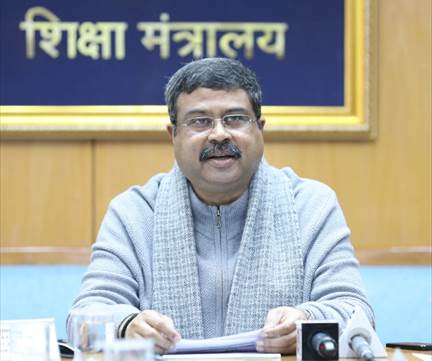
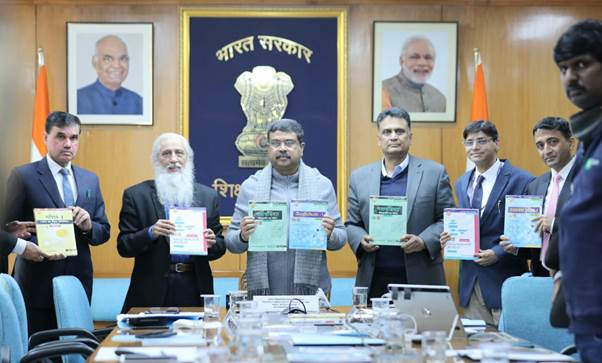
 Union Education Minister and Skill Development Minister Shri Dharmendra Pradhan launched NEAT 3.0, a single platform to provide the best-developed ed-tech solutions and courses to students of the country. The Minister also launched AICTE prescribed technical books in regional languages

11c4c756-47a6-4f6a-8ee7-efa1bf06f7ee.jpg

c487de0f-7471-481c-ae1a-8ff5030aeafe.jpg

Speaking on the occasion Shri Pradhan said that NEAT will be a game-changer in bridging the digital divide, especially among the economically disadvantaged students and also in fulfilling the knowledge-based requirement of India and the world. The Minister informed that 58 global and Indian start-up ed-tech companies are onboard NEAT and are offering 100 courses & e-resources for bettering learning outcomes, developing employable skills and overcoming learning loss. He hoped that the e-content & resources and Digital frameworks like NEAT are a step in the right direction in minimising learning loss.

The Minister encouraged AICTE to integrate courses in NEAT with skill India to tap the opportunities in emerging areas of skill to boost employability and prepare our youth for the future. He urged that AICTE and ed-tech companies to offer e-resources in the least possible cost. Shri Pradhan complimented the global ed-tech companies and Indian start-ups who are a part of NEAT 3.0. He said that all ed-techs are welcome to work with a collaborative approach for making education accessible & affordable. But, ed-techs must remember that there is no place for monopoly and exploitation, he added.

The Minister expressed his happiness that today, more than 12 lakh socially and economically disadvantaged students have received free ed-tech course coupons worth over ₹253 crore under NEAT 3.0. This is one of the biggest gift to the student community from Prime Minister Shri Narendra Modi in the new year 2022, he added. He stated that India will lead the global economy in the 21st century and will be the most preferred market for trade & economy. 

On technical books in regional languages, Shri Pradhan said that our diverse languages are our strength and harnessing them key to building an innovative society. He further said that learning in regional languages will further develop the critical thinking capacity & enable our youth to become global citizens.

NEAT:

National Educational Alliance for Technology (NEAT) is an initiative to provide the use of best-developed technological solutions in the education sector to enhance the employability of the youth on a single platform for learners’ convenience. These solutions use Artificial Intelligence for a personalized and customized learning experience for better learning outcomes and skill development in the niche areas. AICTE, MoE is acting as the facilitator in the process while ensuring that the solutions are freely available to a large number of socially and economically backward students. NEAT has 58 Education Technology Companies with 100 products that help to develop employable skills, capacity building, and bridge learning gaps.