How to be motivated for any goals!

We feel that comfort and convenience are the necessities of life, while all that we need to make ourselves happy is something to be proud of. ” – Albert Einstein

Dip

In all language courses, company building, and any type of creative project, there is immersion. Dip a long distance between beginner luck and real success.
Extraordinary benefits accumulate a handful of people who can push for longer than most.

Starting Before Immersion

In any goal to be achieved, there is a Beginning. It is often overlooked, as it always is.
Getting started is a big problem as you can only reach The Dip if you don’t finish Start, and many people dream of doing something rather than doing it and quitting.

Motivational management

The biggest problem we face in completing our projects is not production or time management, but motivational management. If you are motivated enough to accomplish something, you will move heaven and earth to do it.

Motivation Explained

Motivation is “the reason or reason for a person to do or behave in a certain way,” or to put it another way, “a common desire or determination.”

“If you stop doing what you want to do, then the reasons for quitting are more than just reasons to keep going. Thus, to maintain your motivation you can strengthen the reasons for continuing or weaken the reasons for quitting. Effective motivation often involves both. ” – Ericsson & Poole

Promotion to Start a Project
  • Increase your reason for starting a project, by increasing the importance of starting it.
  • Increase the time you are expected to succeed in the task.
  • Reduce your reasons for the delay, by increasing urgency, using deadlines.
Parkinson’s Law

It says “work grows to complete the available time for its completion.”

Commitment device

Many people use a dedicated device or play around them to find and stay motivated.
You can help your physical goal with things like throwing away your junk food, just bathing in the gym to get there, and similar activities aimed at focusing on your goal. People also use social responsibility in social media to keep themselves motivated by peer pressure.

Stay Motivated

Set small, climbing goals that are fun enough to motivate you and that you expect to achieve.

How to proceed
  • Keep your Expectancy feeling in the project using minimal winnings and achievements.
  • Reward yourself.
  • Maintain a sense of urgency by finding a way to remind yourself of the big picture of the small daily moments of effort.
  • Develop good habits.
  • Get flow.
  • Set clear goals to follow.
  • Save energy.
reference

https://www.nateliason.com/blog/motivation

Teach yourself anything

“It is better to know how to learn than to know.” – Dr Seuss

False Beliefs About Self-Education

Despite having easy access to information, few people take full advantage of the opportunity we have for self-directed learning.
We still believe that to learn something, we need to be formally educated on it, when in fact we’re able to educate ourselves.

Self-Education In The 21st Century

Self-education is the core skill for the 21st century.
Our ability to respond to changes in the landscape of work and technology will be dictated by how skilled self-educators we are, how well we can take full advantage of the information available to us to grow our skillset.

Learning In The Real World

For 12 years, you’ve been trained to apply information that’s pre-packaged for you.
But if you want to do anything independently (entrepreneurship, creative work, etc.) then you have to be able to figure things out without being handed the knowledge beforehand.

The Sandbox Method for Self-Education

This is an ongoing process of self-development and learning, that recognizes that we don’t need to memorize facts, formulas, instead, we need to develop an intuitive understanding of our skills, expose ourselves to different information about the skill, and constantly push ourselves to improve.

Steps of the Sandbox Method
  • Build an area where you can freely play around with the skill you’re trying to learn – Your Sandbox. It should be: low-cost or free, low stakes and public.
  • Research: Resources exist, you just have to figure out what’s worth reading, watching, or listening to (books, blogs, MOOCs etc).
  • Implement and practise purposefully.
  • Get feedback.
What Practicing the Sandbox Method Means
  • Honestly assessing your limits to figure out where you need to improve.
  • Setting a goal just beyond your current ability to motivate yourself to stretch beyond your comfort zone.
  • Practising with intense focus.
  • Get feedback, in whatever way you can, and incorporate that feedback into your practice.
reference

https://medium.com/the-mission/self-education-teach-yourself-anything-with-the-sandbox-method-a4edfc5e1f8e

solve Oxygen shortage by converting Nitrogen Generator into Oxygen Generator

 The Indian Institute of Technology (IIT) Bombay has come up with a creative and ingenious solution to addressing the shortage of medical oxygen for the treatment of COVID-19 patients in the country. The pilot project which has been tested successfully relies on a simple technological hack: conversion of PSA (Pressure Swing Adsorption) Nitrogen Unit to PSA Oxygen Unit!

Initial tests done at IIT Bombay have shown promising results. Oxygen production could be achieved at 3.5 atm pressure, with a purity level of 93% – 96 %. This gaseous oxygen can be utilised for COVID-related needs across existing hospitals and upcoming COVID-19 specific facilities by providing a continuous supply of oxygen.

How can the nitrogen unit be converted into an oxygen unit? ” It has been done by fine-tuning the existing Nitrogen Plant setup and changing the molecular sieves from Carbon to Zeolite” says Prof. Milind Atrey, Dean (R&D), IIT Bombay, who led the project.

“Such nitrogen plants, which take air from the atmosphere as raw material, are available in various industrial plants across India. Therefore, each of them could potentially be converted into an oxygen generator, thus helping us tide over the current public health emergency”, he added.

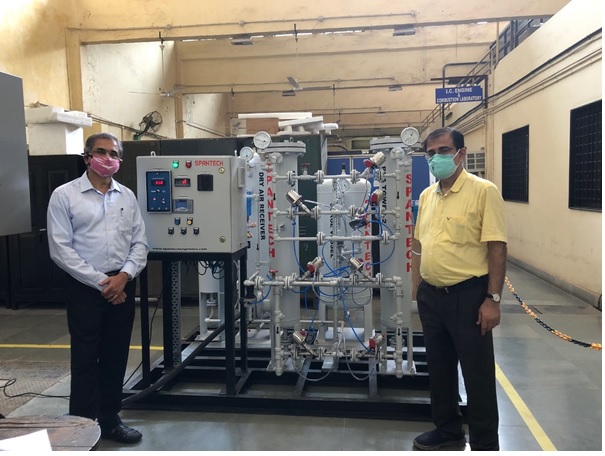
The pilot project is a collaborative effort between IIT Bombay, Tata Consulting Engineers and Spantech Engineers, Mumbai, who deal with PSA Nitrogen & Oxygen plant production.

A PSA Nitrogen plant in the Refrigeration and Cryogenics Laboratory of IIT was identified for conversion, to validate the proof of concept. To undertake this study on an urgent basis, an MoU was signed between IIT Bombay, Tata Consulting Engineers and Spantech Engineers to finalise a SOP that may be leveraged across the country.

Spantech Engineers installed the required plant components as a skid at IIT Bombay for evaluation using IIT Bombay’s infrastructure at the IITB Nitrogen facility at the Refrigeration and Cryogenics lab. This setup for the experiment was developed within three days, and the initial tests have shown promising results, as mentioned above.

Prof. Milind Atrey acknowledges and thanks Mr. Amit Sharma, Managing Director, Tata Consulting Engineers; along with Mr. Rajendra Tahiliani, Promoter, Spantech Engineers and alumnus IIT Bombay (1970); Mr. Raj Mohan, MD, Spantech Engineers; and their passionate team members for their collaboration and partnership on this project.

Congratulating the teams on the successful pilot in a timely manner amidst several constraints, Mr. Amit Sharma said: “We are delighted to partner with IIT Bombay and Spantech Engineers, and contribute towards an innovative solution for emergency oxygen generation using existing infrastructure towards helping the country tide over the current crisis. Such partnerships between industry and academia can accelerate our vision towards the Atma-Nirbhar Bharat.”

Prof. Subhasis Chaudhuri, Director IIT Bombay, congratulated all the involved parties and said that such partnership between academia and industry is highly desirable and essential for the growth and success of our nation.

Annual Convocation of IIM Rohtak

 Union Minister of Education Shri Ramesh Pokhriyal ‘Nishank’virtually addressed the annual Convocation of IIM Rohtak today. A total of 480 students from MBA programme and 12 students from doctoral program attended the convocation ceremony.

Shri Pokhriyal  congratulated the graduating students for their success. He encouraged the students to work hard and contribute to the nation, and society at large. The Minister urged the students to use their talent in the best possible manner and contribute meaningfully in realizing India@75 mission and wished them all the best for their future endeavors.

The Minister congratulated IIM for doing exceptionally well in improving gender and academic diversity in its students population. The efforts of the institute in this direction will help in realizing Prime Minister’s vision of “Beti Bachao and Beti Padhao” mission, he added. Shri Pokhriyal congratulated IIM Rohtak for opening up a new campus in Gurugram, new programs and empowering women in management education in last few years and appreciated its efforts in providing impetus to research and policy work.

Shri Pokhriyal stated that government in the last few years has increased the number of IIMs, IITs, and Central Universities to provide greater opportunities for the youth to get high quality education. He mentioned that Indian educational institutions are improving their position in world rankings and IIM Rohtak has also improved in educational rankings.

Five Year Integrated Programme in Law (BBA-LLB), will be offered by the institute this year. IIM Rohtak is the first and only IIM to have started this programme.


******

“World 1st affordable and long-lasting hygiene product DuroKea Series

 Union Minister of Education Shri Ramesh Pokhriyal ‘Nishank’ virtually launched “World 1st affordable and long-lasting hygiene product DuroKea Series”, developed by IIT Hyderabad researchers. Researcher from Indian Institute of Technology Hyderabad led Dr. Jyotsnendu Giri, Associate Professor in Biomedical Engineering and founder EaffoCare Innovation Pvt. Ltd incubating at iTIC, IIT Hyderabad has developed innovative DuroKea long-lasting technologies to combat COVID-19 virus spreading. Chairman, Board of Governors, IIT Hyderabad, Shri B. V. R. Mohan Reddy; Prof. Founder Dean ESIC Medical College and Hospital, Hyderabad, M. Srinivas; Director IIT Hyderabad, Prof. B. S. Murty and other officials from IIT Hyderabad were present on the occasion.

Speaking on the occasion Shri Pokhriyal said that Durokea Product is aligned with the vision of Prime Minister Shri Narendra Modi to attain self reliance. This next generation DuroKea antimicrobial technology starts at Rs. 189, kills 99.99% of germs instantly and leaves behind the long-lasting protective nanoscale coating up to 35 days till next wash, he said.

The Minister informed that the unique property of DuroKea range is to ensure instant killing (within 60 sec) and prolonged protection which is an immense necessity during this current pandemic situation. This revolutionary antimicrobial property of DuroKea products has been tested and certified by Indian Government accredited lab and field-tested at the IIT Hyderabad campus, he added.

He congratulated Durokea Technology team for this attainment and urge the researchers and students of IIT Hyderabad to continue doing great work and bring the name to the country.”

Congratulating the Durokea Team, Director IIT Hyderabad, Prof. B. S. Murty said, “IIT Hyderabad is always at the forefront of the cute-edge research. It has proven time and again, especially during this pandemic time. IITH has delivered many solutions, including Low-cost Ventilators, Effective Mask, Mobile Apps and Fast COVID-19 Test-Kit. Durokea is one such unique invention to come out of IIT Hyderabad to fight against COVID-19. I define IITH as Invent and Innovate in Technology for Humanity and confident that IIT Hyderabad will continue to deliver many such novel innovations.”

Durokea S, DuroKea M, DuroKea H, and DuroKea H Aqua using innovative “Durokea Technology”, is an adhesive Nano formulation. “Durokea Serious products provide instant killing with prolonged protection against wide range of germs including COVID-19 Virus.Each product has been extensively tested through field trial and validated in different Indian Government accredited laboratories. 
Read more about each product in the enclosed document or visit www.keabiotech.com

This is a highly effective and affordable research innovation from IIT Hyderabad, developed by a team led by Dr. Jyotsnendu Giri, Department of Biomedical Engineering, IIT Hyderabad. Dr. Sunil Kumar Yadava, Dr. Qasim M, Ms. Meenakshi Chauhan, and Ms. Ruby Singh, Ms. SuparnaBasu, Ms. Uzma Hasan, Mr. Jayakkumar and Dr. PurandhiRoopmani has a common vision with this innovation.


34th Convocation of IGNOU

 Union Minister of Education Shri Ramesh Pokhriyal ‘Nishank’ addressed at the 34th Convocation of Indira Gandhi National Open University (IGNOU) through virtual mode. The University awarded 2, 37,844 degrees, diplomas and certificates of different programmes to the successful students at 34th convocation today. The Convocation function was held virtually from the IGNOU Headquarter in light of the surge in COVD-19 cases.

Congratulating the successful students Union Minister of Education lauded the role played by IGNOU since its inception in making quality higher education accessible to all through the affordable Open and Distance Mode. The Minister in his speech stressed on the need to provide education that could make one self-reliant. He further said that Self- Reliance is the key-highlight of the New Education Policy that integrates vocational education bringing constructive changes in the education system. In order to achieve the goal of 50% GER (Gross Enrolment Ratio) by 2035, the university will have to be a crucial contributor, he added.

Highlighting the Choice Based Credit System (CBCS) which is a key part of the New Education Policy, 2020, the Minister said that it provides learners with the flexibility to choose his bouquet of courses and also letting him/her to complete it even after a gap. He urged the university to revamp the existing undergraduate and postgraduate programmes while working on the new programmes according to the needs of the country which not only provide education but also employment to accrue the demographic dividend. On the occasion, he congratulated the University for getting NAAC A++ grade. The Minister also congratulated the meritorious students for their performance.

29 Medals were awarded to the meritorious students at the ceremony virtually. 55 PhD and 13 MPhil Degree certificates were also conferred to the successful students in different streams at the convocation. This time female students have excelled and out of total 29 medals, 21 were awarded to female students and of the total Phd and MPhil degrees awarded, 37 were to female students.

Prof. Nageshwar Rao, Vice-Chancellor of the university in his welcome address presented and apprised the Minister and others present there (and also virtually across India) of the last year report summing up the activities undertaken by the university in the trying times of Corona pandemic. He informed that the university through its network of 56 Regional Centers and 21 schools provided non-stop academic support to learners through Digital technology. He highlighted that apart from the online sessions held by the Regional Centers during the pandemic more than 300 sessions were conducted by IGNOU faculty through the Facebook platform of the university. He reiterated the vision and mission of the university to provide affordable, accessible quality higher education to all sections of society irrespective of their backgrounds increasing the Gross Enrolment Ratio.

The Convocation ceremony was streamed live on ‘YouTube’ and Swayam Prabha Channels for Higher Education Managed by IGNOU in addition to ‘Gyan Darshan, channel of the University, the 56 Regional Centers and the learners across the country.


*****

Decision on CBSE Board Exams

 The Hon’ble Prime Minister chaired a high-level meeting today to review the examinations to be held at various levels in view of the developing Corona situation. Union Education Minister, ShriRameshPokhriyalNishank, Principal Secretary to the Prime Minister, Cabinet Secretary, School and Higher Education Secretaries and other top officials attended the meeting.  

The Prime Minister reiterated that the well being of the students has to be the top priority for the Government.  He also stated that the Centre would keep in mind the best interests of the students and ensure that their health is taken care of at the same time their academic interests are not harmed. 

An overview was given on the X and XII board exam to be held from next month.  The Board exam for class X and XIIconducted by CBSE are scheduled to begin from 4th May, 2021.  The pandemic situation in the country is seeing a resurgence of COVID 19 positive cases in many states, with a few states having been affected more than others. In this situation, schools have been shut down in 11 states. Unlike State Boards, CBSE has an all-India character, and therefore, it is essential to hold exams simultaneouslythroughout  the country. Looking to the present situation of the pandemic and school closures, and also taking in account the safety and well-being of the students,it is decided as follows:

  1. The Board Exams for Class XIIthto be held from May 4thto June, 14th, 2021 are hereby postponed. These exams will be held hereafter. The situation will be reviewed on 1st June 2021 by the Board, and details will be shared subsequently. A notice of at least 15 days will be given before the start of the examinations.


  1. The Board Exams for Class Xth to be held from 4thMay to June 14th, 2021 are hereby cancelled. The results of Class Xth Board will be prepared on the basis of an objective criterion to be developed by the Board. Any candidate who is not satisfied with the marks allocated to him/her on this basis will be given an opportunity to sit in an exam as and when the conditions are conducive to hold the exams.


******

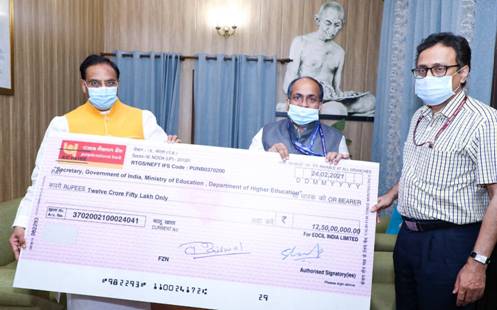
EdCIL pays a highest ever dividend of Rs 12.5 Crore for the year 2019-20.

 EdCIL (India) Limited, a Mini Ratna Category-I CPSE under Ministry of Education, paid a highest ever of Rs 12.5 Crore for the year 2019-20.

Union Minister of Education, Shri Ramesh Pokhriyal ‘Nishank’received the dividend cheque from Shri Manoj Kumar, CMD – EdCIL, in the presence of Dr. Rakesh Ranjan, Additional Secretary (Technical Education) and other officials of the Ministry and EdCIL.

The company registered a turnover of Rs. 326 Crore and a PBT of Rs. 56 Crore during the year 2019-20.

EdCIL offers Project Management and Consultancy solutions across education verticals covering ICT/IT Solutions, Online Testing and Assessment Services, Advisory Services, Infrastructure, PMC, Procurement and Overseas Education Services.The company is executing a mega-project of Ministry of Education called “Study in India” to increase the number of inbound foreign students to India. The program includes setting-up of a large portal, call centre, social media campaign, branding, event management and setting-up of facilitation centres.

******

AICTE Lilavati Awards 2020 on women empowerment

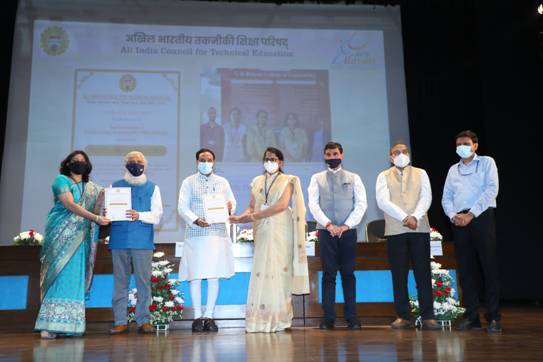
 Union Minister of Education Shri Ramesh Pokhriyal ‘Nishank’ presented the AICTE Lilavati Awards 2020 on women empowerment to the winners in New Delhi today.

Speaking on the occasion Shri Pokhriyal congratulated all the 456 teams who participated in the contest. The Minister said that India is a country where ‘Nari Tu Narayani’ has been an integral part of our ethos and culture. In line with the vision of our Prime Minister, the govt has launched several welfare schemes for the overall development of girls and women in various fields, including Sukanya Samriddhi Yojana, Beti Bachao – Beti Padhao Yojana, etc, he added. Shri Pokhriyal also informed that Government launched Udaan scheme which aims to enable girls of weaker socio-economic status at school level to gain access to higher education. We also started Pragati Yojana to give young women opportunity to further their technical education, he added. Shri Pokhriyal highlighted that the new National Educational Policy has greatly emphasised on gender equality and students should participate in such initiatives to promote women empowerment.

 He welcomed the initiative of AICTE for instituting the Lilawati Awards and stressed that such innovative steps shall be great motivation for girls to join higher education. This initiative will pave a path towards equality in education and innovation, for women

AICTE Chairman Professor Anil Sahasrabudhe said, “I thank Honorable minister Shri Ramesh Pokhriyal ‘Nishank’ for attending the event. AICTE is so happy to present this year’s Lilawati award aimed at empowering womanhood in the nation. Moreover, I congratulate all the teams who submitted the entries. India is a country known for respecting and celebrating the glory of womanhood, and with initiatives like these, AICTE is also contributing its bit to empower the women in our country,” said Sahasrabudhe.

Based on the theme ‘Women Empowerment’, AICTE finalized the winners from a total of 456 entries who competed across 6 sub themes, which include, Women’s Health, Self-Defense, Sanitation and Hygiene, Literacy, Women Entrepreneurship, and Legal Awareness. After analyzing the initial entries, the top 10 entries under each sub-theme were invited for presentation before the two committees headed by Prof Sushma Yadava, Vice-Chancellor, B.P.S. Mahila Vishwavidyalaya Khanpur Kalan, Haryana and Dr. Vinita S. Sahay, Director, IIM Bodh Gaya. 

SWEAT (Sona Women Entrepreneurship and Training) from Sona College of Technology, Tamil Nadu won the contest in the ‘ Women Entrepreneurship’ sub theme. Under the ‘Digital Literacy’ sub theme, Bharatiya Vidyapeeth won the contest. Institute of Management and Entrepreneurship Development Pune won the award under the ‘Literacy’ sub theme. WIT Women Health Coalition from Walchand Institute of Technology, Maharashtra won the award under the ‘Women’s Health’ sub theme. Radiant Seetha from Thiagarajar Polytechnic College won the contest in the ‘Legal Awareness’ sub theme. Finally, Paritrana from St. Joseph’s College of Engineering, Tamil Nadu won the award for the ‘Self Defense’ sub theme. 

Bharatiya Vidyapeeth, who won the award under the digital literacy subtheme suggested that internet revolution that has happened in India post-2014 has played a crucial role in empowering women in the nation. “Post-2014, the internet revolution happened in India, and it has helped women in the country to grow, as information is accessible at their fingertips. However, even now, there are several women in the country who do not have sufficient digital literacy, and we should bring them too to the forefront of the society,” said Bharatiya Vidyapeeth.

LIST OF AWARDEES


Legal Awareness-


Sr. No

Position

Name Of Institute

Name of Team

Team Members

  1.  

Winner

THIAGARAJAR POLYTECHNIC COLLEGE,

TAMIL NADU

RADIANT SEETHA

  1. R. MAHESWARI
  2. M. PONNI
  3. P. KARUNYA DEVI
  4. S. SARANYA
  5. SISTER A.S. CELINE AUGUSTINE MARY
  1.  

1st Runner –Up

NAVODAYA INSTITUTE OF TECHNOLOGY, RAICHIUR, KARNATAKA

WOMEN EMPOWERMENT CELL-NITR


  1. HARSHITA GANGAKHED
  1. M TEJASWINI
  1. GEETA K.M
  1. SHALINI K
  1. CHANNAVEERAMMA E
  1.  

2nd Runner –Up

PONDICHERRY ENGINEERING COLLEGE,

PUDUCHERRY

MALAR

  1. RAJATHY RATHINASAMY
  1. SANTHI GURUSAMY
  1. PALLAVHEE TAMIZHCHELVAN
  1. GUEJALATCHOUMY KOTHANDAPANI
  1. KAVITHA KUMAR RAJENDIRAN
  1.  

LAKSHMI NARAIN COLLEGE OF TECHNOLOGY, MADHYA PRADESH.

UDAAN

  1. AYUSH PURWAR
  1. GARGI DUBEY
  1. MEGHA CHOUBEY
  1. PALAK JAIN
  1. PRAGYA JAIN


Self Defence-

  1.  

Winner

ST. JOSEPH’S COLLEGE OF ENGINEERING,

TAMIL NADU.

PARITRANAS

  1. S. AKSHAYA
  1. DELLECTA JESSY RASHMI
  1. VADAVANNUR CHELLAN RAMAKRISHNAN JAYARAMA PRADEEP
  1. RAMASAMY SREEKANTH
  1. GUNASEKARAN BRINDHA
  1.  

1st Runner –Up

THIAGARAJAR POLYTECHNIC COLLEGE,

TAMIL NADU

SHAKTHI

  1. THEJESWINI V
  1. JAYANTHI C
  1. BHOVANAASHWARI T
  1. UDHAYAKUMAR P
  1. J. AMUL RAJ
 
  1.  

SRI SAI RAM ENGINEERING COLLEGE,

TAMIL NADU.

MAHILA PRATHIRAKSHA ABHIYAAN

  1. K. L. NITHISH RAJA
  1. S. SRIVIDHYA
  1. Dr. M.NITHYA
  1. Dr. K.LATHA
  1. S. SUBHA
  1.  

2nd Runner –Up


VIVEKANANDA INSTITUTE OF TECHNOLOGY,

RAJASTHAN

WARRIORS

  1. DEEPIKA JANGID
  1. TANUSHREE MEHARWAL
  1. RUCHI SHARMA
  1. VANDANA AGARWAL
  1.  

G. H. RAISONI COLLEGE OF ENGINEERING, NAGPUR, MAHARASHTRA

SURAKSHA CHAKRA

  1. MD. AASHIM KHAN
  1. KANCHAN DIYEWAR
  1. VIBHA BORA
  1. BHAKTI PATANKAR
  1. ISHA KHEDIKAR

Sanitation & Hygiene-

  1.  

Winner

SMT. KISHORITAI BHOYAR COLLEGE OF PHARMACY, MAHARASHTRA

SKBCOP ECO CLUB

  1. TANISHKA RANDIVE
  1. PRANJAL TIDKE
  1. DR. RENUKA DAS
  1. SHRUTI NASRE
  2. MR. MANISH AGLAWE
  1.  

1st Runner –Up 

SONA COLLEGE OF TECHNOLOGY, TAMIL NADU

SWSAH (SONA WOMEN SANITATION AND HYGIENE)

  1. PRIYALATHA S
  1. GULSHAN TAJ M N A
  1. PARAMASIVAM S
  1. KANIMOZHI J
  2. RASHMA M
  1.  

ST. JOSEPH’S COLLEGE OF ENGINEERING, TAMIL NADU

VOW –   VIRANGANA OF WASH (WATER SANITATION  HYGIENE)

  1. N HEMAPRIYA
  1. VENKATESAN MUTHULAKSHMI
  1. GANDHIMARUTHIAN LATHASELVI
  1. RENUKA VISWANATHAN
  2. K RAJARAMAN
  1.  

2nd Runner –Up

SRI KRISHNA COLLEGE OF ENGINEERING AND TECHNOLOGY, TAMIL NADU

SKCET SANITATION AND HYGIENE TEAM

  1. KAVIYA S
  1. SUDHIR SOPHIA
  1. KARPAGAM MYLSAMY
  1. R GEETHAMANI R
  2. P A THIRUNAVUKARASU

Women Health-

1.

Winner

WALCHAND INSTITUTE OF TECHNOLOGY,

MAHARASHTRA

WIT WOMEN HEALTH COALITION

  1. DR. RUPALI J.SHELKE
  1. Dr. PRATIBHA YALAGI  ALADEEP
  1. RASHMI DIXIT
  1. DIPALI DILIP AWASEKAR
  2. ROHINI MERGU

2.

1st Runner –Up

POONA COLLEGE OF PHARMACY, MAHARASHTRA

BHARATI PCP SAKHEE

1.VARSHA POKHARKAR

2.ARULMOZHI SATHIYANARAYANAN

3. ASAWARI RAUT

4. MANJUSHA SAJITH

5. SAVITA GOWEKAR

3.

2nd Runner –Up


KUMARAGURU COLLEGE OF TECHNOLOGY,  TAMIL NADU

NATURAL PRODUCTS FOR HEALTHCARE

1. THIYAGARAJAN SATHISH KUMAR

2. KUMARESAN KUPPAMUHTU

3. SOUNDARARAJAN NITHYA PRIYA

4. S. VASUKI

5. S. BHARTHI KAMALA

4.

BIYANI INSTITUTE OF SCIENCE AND MANAGEMENT, RAJASTHAN

BIYANI INSTITUTE OF SCIENCE AND MANAGEMENT

1. SANJAY BIYANI

2. NEETA MAHESHWARI

3. NEHA PANDEY

4. POONAM SHARMA

5. ANJU BHATT

Women Entrepreneurship

1.

Winner

SONA COLLEGE OF TECHNOLOGY TAMIL NADU

SWEAT (SONA WOMEN ENTERPRENURSHIP AND TRAINING)

  1. RAMALINGAM MALATHY
  1. SRINIVASAN PADMA
  1. DHANAKODI RAJA
  1. KRISHNASWAMYPILLAI RANGANATHAN KAVITHA
  2. ARUMUGAM RANJITHKUMAR

2.

1st Runner –Up

ENTREPRENEURSHIP DEVELOPMENT INSTITUTE OF INDIA, GUJARAT

WOMEN EMPOWERMENT

  1. RAJESH GUPTA
  1. BAISHALI MITRA
  1. NIKITA TA
  1. SATYA ACHARYA
  2. RAMAN GUJRAL

3.

2nd Runner –Up

BHILAI INSTITUTE OF TECHNOLOGY

UNMUKTA

  1. MANISHA SHARMA
  1. SHUBHRATA NAGPAL
  1. ARPANA RAWAL

4.

G. H. RAISONI COLLEGE OF ENGINEERING, NAGPUR, MAHARASHTRA.

AATMANIRBHAR

  1. SWAPNA CHOUDHARI
  1. ATUL DESHMUKH

  1. ARCHANA RAUT
  2. BHARGAVI KAKIRWAR
  1. MADHAVI CHAVHAN

Literacy –

1.

Winner

BHARATI VIDYAPEETH ( Deemed to be University) INSTITUTE OF MANAGEMENT & ENTREPRENEURSHIP DEVELOPMENT, PUNE

DIGITAL LITERACY

  1. MS SHWETA TATE
  2. KIRTI GUPTA
  3. ANURADHA YESUGADE
  4. RAJITA DIXIT
  5. HEMA MIRJI

2.

1st Runner –Up

SRI SAI RAM ENGINEERING COLLEGE, TAMIL NADU

SAI STHREE VIDYA ABHIYAAN

  1. S.VASUPRADHA
  2. Dr. SOMA PRATHIBHA
  3. Dr. N. MANI
  4. B. PRIYA
  5. M. SIVA  SANKARI

3.

2nd Runner –Up

HYDERABAD INSTITUTE OF TECHNOLOGY AND MANAGEMENT, HYDERABAD

We-Lit

  1. DEVIKA SUGGUBODI VENKATESWARLU
  1. ARVIND SIDDAPURAM
  1. SURESH AALURI
  1. JOYTHSNA K
  2.    SMT. SUSHEELA DEVI 

4.

SRI MANAKULA VINAYAGAR ENGINEERING COLLEGE, PUDUCHERRY

SUPER SONIC

  1. PAVITHRAN.T
  2. ARVIND.K
  3. BALAMURALI.M
  4. HARINI.G
  5. JASMINE.A


*****

Nanosniffer is world’s first Explosive Trace Detector using microsensor technology

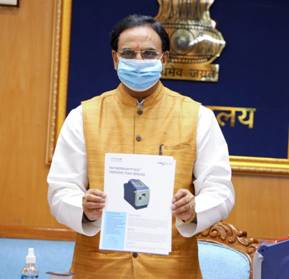
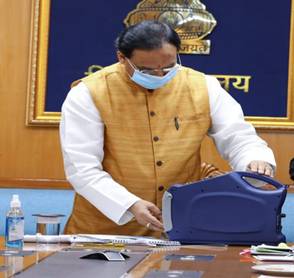
 Union Education Minister, Shri Ramesh Pokhriyal ‘Nishank’ today launched NanoSniffer, the world’s first Microsensor based Explosive Trace Detector (ETD) developed by NanoSniff Technologies, an IIT Bombay incubated startup. Director, IIT Delhi, Shri V. Ramgopal Rao, and senior officials of the Ministry were present on the occasion.

NanoSniffer has been marketed by Vehant Technologies, a spin-off from a former IIT Delhi incubated startup Kritikal Solutions. 


2.jpg1.jpg


Speaking on the occasion, Shri Pokhriyal said that NanoSniffer, developed by NanoSniff Technologies, is a step towards Prime Minister Shri Narendra Modi’s vision of a self-reliant India. NanoSniffer is a 100% Made in India product in terms of research, development & manufacturing. The core technology of NanoSniffer is protected by patents in the U.S. & Europe. The Minister further said that this affordable device will reduce our dependency on imported explosive trace detector devices. It will also encourage other institutions, startups and medium-scale industries to research & develop products indigenously. It’s a perfect example of lab to market product, he added.

The Minister appreciated that this home-grown Explosive trace detector device (ETD) – NanoSniffer can detect explosives in less than 10 seconds and it also identifies and categorizes explosives into different classes. It detects all classes of military, conventional and homemade explosives. NanoSniffer gives visible & audible alerts with sunlight-readable color display, he added.

Union Education Minister said that with the development of this product, IIT Bombay and IIT Delhi along with their offshoot companies are making a sincere effort to boost the nation’s security with advanced and affordable indigenous products. It’s a perfect example of academia and industry collaboration, which will set an example for other startups in India. Our nation is full of talented, knowledgeable and hard-working entrepreneurs, hence why should we import foreign products. It is amazing that now our country is developing & manufacturing products like NanoSniffer, Explosive Trace Detectors, he added

Given the constant threats, which our nation faces due to geo-political realities, explosives & contraband detection has become a norm at high security locations like airports, railways & Metro stations, hotels, malls, and other public places. Check points at such locations are incorporating advanced detection equipment for rapid scanning of people and baggage. Almost all these products for explosive detection are imported at a high cost leading to the loss of valuable foreign exchange by the country. NanoSniffer is a perfect substitute for such products.

NanoSniff Technologies has partnered with Vehant Technologies, a pioneer in Artificial Intelligence/Machine Learning- based Physical Security, Surveillance and Traffic Monitoring & Junction Enforcement Solutions.

NanoSniffer provides trace detection of nano-gram quantity of explosives & delivers result in seconds. It can accurately detect a wide range of military, commercial and homemade explosives threats. Further analysis of the algorithms also helps in categorization of explosives into the appropriate class. With local manufacturing, including its MEMS sensor, it will save a lot of import cost for the country.

NanoSniffer has successfully passed Pune based DRDO’s High Energy Materials Research Laboratory (HEMRL) testing and has also been tested by the country’s elite counter-terror force National Security Guard (NSG).


*****


‘SARTHAQ’, the NEP Implementation Plan for School Education

 Union Education Minister chaired a high level meeting on implementation of NEP-2020 in New Delhi today. Secretary, Higher Education, Shri Amit Khare; Secretary , School Education, Smt Anita Karwal and senior officials of the Ministry were present in the meeting.


In pursuance of the goals and objectives of the National Education Policy (NEP) 2020 issued on 29th July, 2020 and to assist States and UTs in this task, the Department of School Education and Literacy has developed an indicative and suggestive Implementation Plan for School Education,called ‘Students’ and Teachers’ Holistic Advancement through Quality Education (SARTHAQ)’. This implementation plan was released today by the Education Minister Shri Ramesh PokhriyalNishank also as a part of the celebrations leading to the AmritMahotsav on 75 years of Indian independence.

In a significant achievement, under the leadership of Prime Minister Shri Narendra Modi, the  Government has rolled out the Plan of Action of National Education Policy 2020 well within one year.

The plan keeps in mind the concurrent nature of education and adheres to the spirit of federalism. States and UTs are given the flexibility toadapt this plan with local contextualization and also modify as per their needs and requirements. This implementation plan delineates the roadmap and way forward for implementation of NEP, 2020 for the next 10 years, which is very important for its smooth and effective implementation.

SARTHAQ has been developed through wide and intensive consultative process with States and UTs, Autonomous bodies and suggestions received from all stakeholders; around 7177 suggestions/inputs were received from them. A teacher’s fest, ‘ShikshakParv’ was especially organized from 8th to 25th September 2020 for discussing various recommendations of NEP 2020 and its implementation strategies, which attracted around 15 lakh suggestions. 

Speaking on the occasion,ShriPokhriyal urged all the stakeholders to use this plan as a guiding star to undertake transformational reforms in the school education sector. He said that like the policy itself, the plan is also interactive, flexible and inclusive. The major focus of SARTHAQ is to define activities in such a manner which clearly delineate goals, outcomes and timeframe i.e., it links recommendation of NEP with 297 Tasks along with responsible agencies, timelines and 304 outputs of these Tasks. Attempt has also been made to propose activities in a manner, such that it will be built upon the existing structure rather than creating new structures. Thus, SARTHAQ takes care of the spirit and intent of the Policy and is planned to be implemented in a phased manner.

SARTHAQ has also been prepared as an evolving and working document and is broadly suggestive/indicative in nature and will be updated from time to time based on the inputs/feedback received from the stakeholders.

Following outcomes have been envisaged for entire education system afterimplementation of SARTHAQ:

  • New National and State Curriculum Frameworks for School Education , Early Childhood Care and Education, Teacher Education and Adult Education will be developed encompassing the spirit of NEP and will pave way for curriculum reforms
  • Increase in Gross Enrolment Ratio (GER), Net Enrolment Ratio (NER), transition rate and retention rate at all levels and reduction in drop outs and out of school children.
  • Access to quality ECCE and Universal Acquisition of Foundational Literacy and Numeracy by Grade 3.
  • Improvement in Learning Outcomes at all stages with emphasis on teaching and learning through mother tongue/local/regional languages in the early years.
  • Integration of vocational education, sports, arts, knowledge of India, 21st century skills, values of citizenship, awareness of environment conservation, etc. in the curriculum at all stages.
  • Introduction of Experiential learning at all stages and adoption of innovative pedagogies by teachers in classroom transaction.
  • Reforms in Board exams and various entrance tests.
  • Development of high quality and diversified teaching-learning material.
  • Availability of text books in Regional/local/home language.
  • Improvement in quality of Teacher Education Programmes.
  • Improvement in quality of newly recruited teachers and capacity building through Continuous Professional Development.
  • Safe, Secure, inclusive and conducive learning environment for students and teachers.
  • Improvement in infrastructure facilities including barrier free access and sharing of resources among schools.
  • Uniform standards in learning outcomes and governance across public and private schools through setting-up of an online, transparent public disclosure system through establishment of SSSA in states.
  • Integration of technology in educational planning and governance and availability of ICT and quality e-content in classrooms.

SARTHAQ will pave the way for our children and youth to meet the diverse national and global challenges of the present and the future and help them to imbibe 21st century skills along with India’s tradition, culture and value system as envisioned in National Education Policy 2020. ShriPokhriyal stated that it is envisaged that the implementation of SARTHAQ would benefit all stakeholders including 25 crore students, 15 lakh schools, 94 lakh teachers, Educational Administrators, Parents, and community as education is the backbone of an equitable and just society.

*****