15th November declared to be observed as Janjatiya Gaurav Divas every year

 Scheduled Tribes (ST) constitute approximately 8.6 percent of population of India numbering around 10.4 crores. There are over 705 Scheduled tribes notified under article 342 of the Constitution of India. In keeping with the vision of Prime Minister Shri Narendra Modi of ‘Sabka Saath, Sabka Vikas, Sabka Vishwas’, the Government of India has focused on development of tribes and conservation of their heritage and culture as a priority.

The Ministry of Tribal Affairs in line with this vision and its enduring commitment for welfare of tribals geared itself to ensure sectoral development through enhanced allocation of financial resources, convergence of efforts, re-engineering of planning and implementation mechanism of the Ministry.

The budget of MoTA also increased from Rs. 3850 crores in 2014-15 to Rs. 7484 crores in 2021-22. This enhanced availability of resources has enabled the Ministry to chart a new progress path with greater commitment to ensure holistic development of tribal communities.

  The major highlights of the Ministry of Tribal Affairs during the year 2021 are as follows:

  • Cabinet approves declaration of 15th November as Janjatiya Gaurav Divas 

The Union Cabinet, chaired by the Prime Minister Shri Narendra Modi has approved declaration of 15thNovember as Janjatiya Gaurav Divas dedicated to the memory of brave tribal freedom fighters so that coming generations could know about their sacrifices about the country. 
The date is the birth anniversary of Sri Birsa Munda who is revered as Bhagwan by tribal communities across the country. Pursuant to the speech of Prime Minister on Independence Day of 2016, Government of India has sanctioned 10 tribal freedom fighter museums across the country. Tribal Freedom 

  • Inauguration of Bhagwan Birsa Munda Museum in Jharkhand by Prime Minister

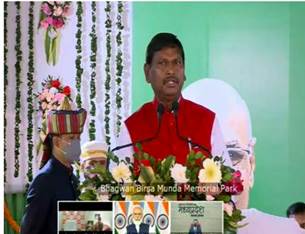
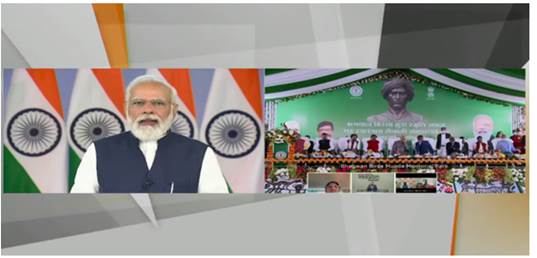
 Prime Minister, Shri Narendra Modi, inaugurated the Bhagwan Birsa Munda Tribal Freedom Fighters Museum and Park. Congratulating citizens of the state and the tribal society, PM Modi dedicated the Birsa Munda Memorial Udyan and Museum to the nation. A 25-feet tall statue of Birsa Munda was installed on the premises. “The project has been developed, in association with the Jharkhand government,” 
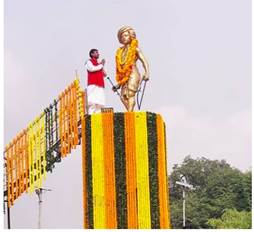
  

It demonstrates the way tribals struggled to protect their forests, land rights, their culture and displays their valour and sacrifices, which is vital for nation-building.

  • Prime minister Shri Narendra Modi laid foundation stone of 50 new Eklavya Model Residential Schools on occasion of Janjatiya Gaurav Divas as part of Azadi Ka Amrit Mahotsav

On the occasion of Janjatiya Garav Divas Prime Minister Shri Narendra Modi laid the foundation stone for the construction of 50 new Eklavya Model Residential Schools (EMRSs) in 27 districts of 7 States and 1 UT through  virtual mode from Bhopal  at an event to commmeorate Azadi ka Amrit Mahotsav (India @ 75). The Ministry of Tribal Affairs has been making continuous efforts in the direction of welfares of the tribal community; education being one of its key areas of intervention. The presently held stately stone laying foundation event marks the indomitable spirit of the Ministry aiming to niche education as a powerful driver for tribal students to pave the roads for future success and accomplishments.  

  • Minister Shri Arjun Munda and MoS Shri Bisheshwar Tudu laid the foundation stone of 11 EMRS in Jharkhand and Odisha.

Shri Arjun Munda and MoS Shri.Bisheshwar Tudu laid the foundation stone of 11 EMRS in Jharkhand and Odisha between July and September 2021. Total 84 EMRS foundation stones were laid during 2021; out of which foundation stone for 50 EMRS was laid by Prime Minister Shri Narendra Modi, total 27 EMRS foundation stone was laid by Tribal Minister Shri Arjun Munda and MoS Shri Bisheshwar Tudu. Other than these, 7 foundation stone of EMRS was laid by State Ministers.

639 EMRSs have been sanctioned, which include 288 under the old scheme and 351 in the new scheme. There are 367 functional EMRSs across the country with around 85,232 students currently enrolled. The construction is under progress in 173 EMRSs, out of which 66 are in the old scheme and 107 are under the new scheme.

These schools are envisaged to be brought at par with Navodaya Vidyalayas. National Education Society for Tribal Students (NESTS) as an autonomous body under the Ministry has been set up to provide overall support and policy directions to the schools in order to bring uniformity in the administration of the schools. The State/UT EMRS Societies at the State/UT level have been set up for day-to-day Administration and Management of the schools.

  • Ministry of Tribal Affairs organized Janjatiya Gaurav Saptah 

The Government of India has announced 15th November, the Birth Anniversary of Bhagwan Birsa Munda as ‘Janjatiya Gaurav Divas’ to pay tribute to the sacrifices and contributions of tribal freedom fighters and for the preservation of cultural heritage and promotion of Indian values of valour, hospitality and national pride.

More than 125 events / activities were organized during the week-long Azadi ka Amrit Mahotsav celebrations from 15th to 22nd November in various parts of the country to mark the Iconic Week to remember the great unsung tribal heroes who have sacrificed their lives and contributed to nation-building.

  • Union Home Minister Shri Amit Shah lays foundation stone for Rani Gaidinliu Tribal Freedom Fighters Museum at Luangkao village in Manipur

The Union Minister of Home Affairs and Minister of Cooperation, Shri Amit Shah, laid the foundation stone of the ‘Rani Gaidinliu Tribal Freedom Fighters Museum’ at Luangkao village, in Manipur’s Tamenglong district. The museum will inspire the youth of the country in dedicating their service to the nation apart from realizing the spirit of the freedom struggle.

Addressing on the occasion the Union Home Minister Shri Amit Shah said that “It has been 75 years since the country achieved independence from the British, and the country has a strong commitment to become a superpower of the globe while celebrating its 100th year of independence 25 years later,”.

The Union Home Minister also remembered the life and sacrifices made by Rani Gaidinliu, whose struggle to free her people from the British began from an early age. Mentioning the freedom fighters of Manipur and others from the northeast region, the Union minister also reminded the gathering of the Central government’s decision to rename Mount Harriet, the third-highest island peak in Andaman and Nicobar Islands, where Manipur’s Maharaja, Kulchandra Singh, and 22 other freedom fighters were imprisoned after the Anglo-Manipur war (1891).

  • Ministry of Tribal Affairs and Microsoft sign MoU on Joint initiative for Digital Transformation of Tribal Schools

The collaboration seeks to skill educators and students in next-generation digital technologies, including Artificial Intelligence. With a vision to build an inclusive, skills-based economy, the Ministry of Tribal Affairs (MoTA) linked a Memorandum of Understanding (MOU) with Microsoft to support the digital transformation of schools such as Eklavya Model Residential Schools (EMRS) and Ashram Schools, among others under the Ministry, at an online event ‘Empowering Youth for Success’. Under affirmative action initiative, Microsoft will make AI curriculum available to tribal students in both English and Hindi at all EMRS schools under the Ministry to skill educators and students in next-generation technologies, including Artificial Intelligence. 

Under this programme in the first phase, 250 EMRS schools were adopted by Microsoft, out of which 50 EMRS schools were given intensive training, and 500 master trainers were trained, in the first phase. 

  • Ministry of Tribal Affairs and CBSE jointly launched an online certificate course on Experiential Learning for the 21st Century for EMRS and CBSE teachers

As part of celebrations of Azadi ka Amrit Mahotsav, the Secretary, Ministry of Tribal Affairs, Shri Anil Kumar Jha and Chairman, CBSE, Shri Manoj Ahuja, jointly launched a certificate course on Experiential Learning for the 21st Century for educators from CBSE and Eklavya Model Residential Schools (EMRSs) in collaboration with Tata Trusts, CETE, TISS (Centre of Excellence in Teacher Education, Tata Institute of Social Sciences), Mumbai and MGIS (Mahatma Gandhi International School), Ahmedabad.

The programme was deployed for 350 educators in 6 States and the event was attended by Shri Asit Gopal, Commissioner, National Education Society for Tribal Students (NESTS), an autonomous organization under the Ministry of Tribal Affairs. Dr Naval Jit Kapoor, Joint Secretary, Ministry of Tribal Affairs and Mr R. Pavithra Kumar of Tata Trusts were also present, on the occasion.

  • Ministry of Tribal Affairs and NCERT join hands for the NISHTHA Capacity Building Programme for EMRS Teachers and Principals

To fulfil the long-standing vision of the Ministry of Tribal Affairs (MoTA) and to achieve academic excellence in Eklavya Model Residential Schools (EMRSs), 120 EMRS teachers and principals from 3 states completed a 40 days’ NISHTHA-National initiative for School Heads and Teachers Holistic Advancement Program’. It was a national flagship program of the NCERT on 19th June 2021. The Capacity Building programme aimed at building competencies among teachers and school principals, additionally, improving the quality of School Education through Integrated Teacher Training.

MoTA recently collaborated with the National Council of Educational Research and Training (NCERT), a national apex education body of several programmatic initiatives and interventions and conducted similar programmes across 350 functional EMRS schools pan India.

  • Shri Pramod Kumar Shukla, English Lecturer from Eklavya Model Residential School, Chattisgarh, receives National Award for Teachers-2021 from President Sh Ram Nath Kovind on Teacher’s Day.

The Hon’ble President, Shri Ram Nath Kovind, on September 5th 2021, presented the National Teacher Award to 44 talented teachers selected from all over the country on the occasion of Teachers’ Day. 
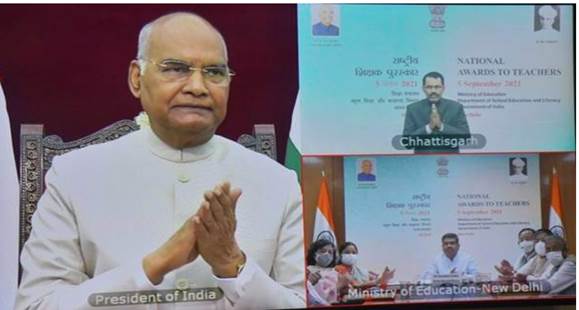
The award was also bestowed upon Shri. Pramod Kumar Shukla, English Lecturer of Eklavya Model Residential School (EMRS), Karpawand, Bastar Chattisgarh. It is the second award in a row for EMRS teachers and holds special significance for Eklavya Model Residential Schools established under the Ministry of Tribal Affairs. In 2020, Smt. Sudha Painuli, Vice Principal, EMRS-Kalsi, Dehradun, Uttarakhand, was felicitated with the award. With the implementation of National Education Policy- 2020, it is believed that greater thrust shall be given to teachers as they gain centre-stage, empowering the teachers to implement the NEP recommendations. It holds direct insinuations to change the facets of EMRSs established for providing quality education to tribal students at the behest of talented and committed teachers.

  • 35.2 lakh tribal students disbursed Pre and Post Matric Scholarships through DBT during 2020-21

The Ministry disbursed an amount of Rs. 2500 crores to 35.2 lakh tribal students under Pre and Post-Matric Scholarship Scheme through Direct Benefit Transfer during 2021, amid the Coronavirus pandemic situation to provide essential support for the continuation of education. In this regard, the State’s portals of Pre-Matric and Post-Matric Schemes have been integrated with DBT Tribal Portal and DBT Bharat Portal. Moreover, 331 Universities have been assimilated into this scheme, while an online student verification process has been undertaken to identify and verify the student’s details.

The total Budget Outlay for Pre/Post Matric, National Fellowship and Scholarship, and the National Overseas Scholarship has been upgraded to Rs. 2546 Crores in 2021 from the previous budget outlay of 2013. Over 32, 08,154 students benefitted from these scholarships and the mode of implementation of this scheme remained fully online, to shift from paper-based application to data-based application as well to reduce the release time of the scholarship.

  • Union Education Minister and Union Tribal Affairs Minister jointly launched School Innovation Ambassador Training Programme

The Union Education Minister, Shri Dharmendra Pradhan and the  Union Minister of Tribal Affairs, Shri Arjun Munda, jointly launched the ‘School Innovation Ambassador Training Program’ for 50,000 school teachers. It aims at training 50,000 School Teachers on Innovation, Entrepreneurship, IPR, Design Thinking, Product development, Idea generation, among others.

  • Ministry of Tribal Affairs Bags Prestigious SKOCH Challenger Award for “Best Performance In E-Governance” & 3 Gold Awards for Its Initiatives

The Ministry of Tribal Affairs (MoTA) received the coveted “SKOCH Challenger Award”- “Best Performance in e-Governance” today for its various initiatives such as Digital Dashboard and Digital Transparency on its 20+ Online Portals with updated information of its implemented schemes, taken during last year. The Award was received by the Union Minister for Tribal Affairs, Shri Arjun Munda, at the Virtual SKOCH Summit. 

The Ministry also received 3 Gold Awards for its initiatives namely “Eco-Rehabilitation of tribal villages through Innovative design in water management using Ice-stupas”, Swasthya: Tribal Health and Nutritional Portal and the Performance Dashboard “Empowering Tribals Transforming India” which were received by Dr Naval Jit Kapoor, Joint Secretary, on behalf of the Ministry. 

  • Ministry of Tribal Affairs bags Award of Appreciation in the 18th CSI SIG E-Governance Awards 2020

The Ministry of Tribal Affairs bagged the prestigious Award of Appreciation in the Project Category-Central Government Entity – in the 18th CSI SIG e-Gov Awards 2020 for their ‘Performance Dashboard Empowering Tribals Transforming India through various ICT initiatives”. The award was received by the Joint secretary of the Ministry of Tribal Affairs, Dr. Navaljit Kapoor from the Chief Minister of Uttar Pradesh Shri Yogi Adityanath in Lucknow.

  • Tribal women making Rakhis with seeds of indigenous trees under Vruksha Bandhan Project

In a unique initiative Ministry of Tribal Affairs in partnership with The Art of Living Foundation, Aurangabad, and Maharashtra launched Vrushka Bandhan Project where 1100 tribal women created Rakhis for Raksha Bandhan with seeds of indigenous trees, which is a unique contribution to increasing forest cover & combating climate change.

The Rakhis were made of indigenous seeds stuck on naturally dyed, soft indigenous, non-toxic, biodegradable cotton. Once used, the seeds can be sown in soil, thereby benefiting the environment. It is expected that thousands of trees would be planted under this project and project will provide employment to tribal women associated with the project.

  • Tribal Affairs Ministry and AIIMS organized workshop for NGOs for mission of Sahi Poshan-Desh Roshan as part of POSHAN MAAH

A workshop for Non-Governmental Organizations on Nutrition and Health was organized by the Ministry of Tribal Affairs on 09th September, 2021, as part of its POSHAN MAAH activities. The purpose of the workshop was to closely associate NGOs working with Ministry of Tribal Affairs in the mission of Sahi Poshan-.Desh Roshan. The workshop was attended by more than 70 NGOs who are working in the health sector in tribal areas.

  • 86 ST Entrepreneurs from Southern States honoured as part of Azadi Ka Amrit Mahotsav Week Celebrations of Tribal Affairs Ministry

In a bid to promote entrepreneurship amongst the tribal community and encourage successful entrepreneurs, a grand event was organized by the National Scheduled Tribes Finance and Development Corporation (NSTFDC) and Ministry of Tribal Affairs, Government of India honoured tribal entrepreneurs on 22nd November 2021 at Visakhapatnam in association with TRICOR-Andhra Pradesh

  • Tribal Affairs Ministry has taken up several initiatives to promote leadership qualities and talent among tribal youth

GOAL (Going Online as Leaders) is a joint initiative of Ministry with Facebook for digitally-enabled mentorship and empowering tribal youth to become leaders in their area of interest. Through the GOAL initiative, renowned people from the industry, arts, politics, business etc., known for their leadership skills or roles, are mobilized to personal mentor tribal youth through a digital medium. GOAL program has so far covered 23 States / UTs.

Ministry of Tribal Affairs continuously strives for fostering partnerships with reputed organizations: working for the welfare of tribes like Microsoft, Art of Living Foundation, Tata Foundation, and SECMOL aimed at taking the project with community participation and for creating awareness about leadership among tribal youth.

  • One Day National Conference on Provisions of the Panchayats (Extension to the Scheduled Areas) Act, 1996 (PESA) organised to celebrate 25th year of PESA 

One of the themes of Amrit Mahotsav is the ‘whole of Government approach’ and ‘Jan Bhagidari’. Taking this into consideration, the Ministry of Tribal Affairs planned several activities during this period both at the National as well as the State Level.

PESA is a significant Act for the welfare of the tribal communities. Officials of the State and Public representatives were asked to visit tribal regions and comprehend the issues of the Tribal at the grassroots level. During the gathering, it was accentuated that safeguarding the culture of the tribal communities is a necessary measure, to be transparent with the tribals and show them the ray of development under rapidly evolving scenarios. Endeavors were made toward this path in many states; different exercises were embraced under PESA in Maharashtra resulting in the economic empowerment of tribals.

  • National Aadi Mahotsav held in Dilli Haat, INA, New Delhi– A Celebration of Tribal Culture, Crafts and Commerce

The National Aadi Mahotsav was held at Dilli Haat, INA, New Delhi, from the 1st to the 15th February 2021. It celebrated several aspects of tribal culture that evinced a lot of interest and witnessed much footfall in the first place. The festival was an attempt to familiarize the people with the rich and diverse craft, the culture of the tribal communities across the country in one place. 

The fortnight-long National Tribal Festival witnessed the participation of thousands of tribal artisans, chefs, artists and cultural troupes from 25 states across the country. The rich tribal culture was evident in the forms of rare tribal handicrafts, handloom and natural products, tribal cuisines as they were exhibited in about 200 stalls. The Aadi Mahotsav succeeded in winning the hearts of the residents of Delhi and witnessed heavy footfall over 15 days and the sales registered. It observed tribal artisans register approx. Rs 4 Crore in direct sales over the past fortnight. Moreover, a purchase order worth Rs 8 Crores was placed by TRIFED; leading to a total of approx. Rs 12 Crores in business transactions for the tribals participating in this festival. The Aadi Mahotsav was in its entirety a celebration of the spirit of tribal life – crafts, culture and cuisine. 

  • Tribes India – Aadi Mahotsav 

As India is celebrating the Azadi ka Amrit Mahotsav, Aadi Mahotsav from 16th November to 30thwas organised in Dili Haat. 
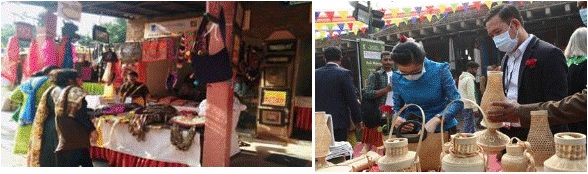
cap 1.png

With more than 200 stalls from across the country and about 1000 artisans and artists participating with their unique stories, the AadiMahotsav is a way to draw the Adivasis into the mainstream. Showcasing traditional art and handicrafts, and the cultural heritage of the country, this festival connects the tribal artisans with larger markets and brings to focus the diversity and richness of the tribes of India.
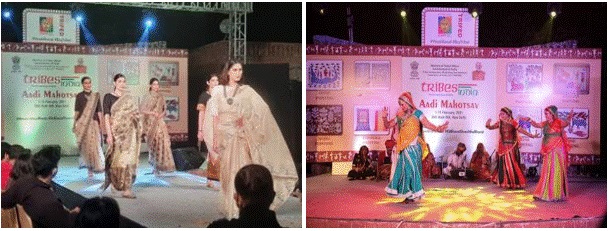
Cap2.png

The Aadi Mahotsav is a mini-India where the exquisite craft traditions of tribal artisans – weavers, potters, puppeteers, and embroiders – are all in one place. With a wide range of artefacts like paintings be it in the Warli style or Pattachitras; jewellery handcrafted in the Dokra style to bead necklaces from the Wancho and Konyak tribes to the famous Toda embroidery from the South; from virgin coconut oil of the Nicobar Islands to multi-flavoured Nutra-beverages of north-east; from colourful puppets and children’s toys to traditional weaves such as Dongri shawls, Bodo weaves, Kota Doria from Rajasthan; iron craft from Bastar to bamboo craft and cane furniture; pottery such as blue pottery and Longpi pottery from Manipur, the festival is a feast for the senses.

  • Shri Arjun Munda, Minister of Tribal Affairs virtually launched the nationwide campaign “COVID Teeka Sang Surakshit Van, Dhan aur Uddyam” to accelerate the pace for COVID vaccination among tribals in India. 

The campaign was launched to leverage the 45,000 Van Dhan Vikas Kendras (VDVK) of the Tribal Co-operative Marketing Development Federation of India (TRIFED), a national level cooperative body under the administrative control of the Ministry of Tribal Affairs, Government of India.

  • M/o Tribal Affairs and Goa Government Jointly Launch Shramshakti Digital Data Solution Tomorrow for Migrant Workers and Tribal Migrant Cell

In a move that would effectively help in the smooth formulation of State and National level programs for migrant workers, the Union Ministry of Tribal Affairs (MoTA) launched “Shram Shakti”, a National Migration Support Portal and Shram-Saathi, a training manual for migrant workers in Goa. To facilitate and support approximately 4 lacs migrants who come from different States to Goa, the Chief Minister of Goa will also launch a dedicated Migration cell in Goa. MoTA has also sanctioned Tribal research Institute, Tribal Museum, Van Dhan Kendras and Tribal Lok Utsav in Goa.

  • Tribal Affairs Minister Shri Arjun Munda launched ‘Adi Prashikshan Portal’ and 3 -Day Online Capacity Building Programme for ST PRI Members 

Hon’ble Union Minister of Tribal Affairs, Shri Arjun Munda, launched the ‘ADI PRASHIKSHAN’ portal and inaugurated a three-day training programme on “Capacity Building Training of Master Trainers for ST PRI Members” as part of Azadi Ka Amrit Mahotsav in New Delhi. 
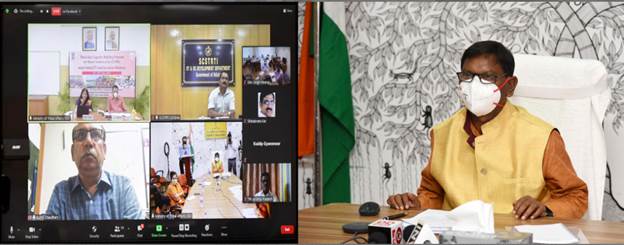
The Adi Prashikshan portal developed by the Ministry acts as a Central Repository of all training programs conducted by Tribal Research Institutes (TRIs), different divisions of Ministry, National Society for Education of Tribal Students (NESTS), Centre of Excellence funded by the Ministry of Tribal Affairs and National Tribal Research Institute.  

  • M/o Tribal Affairs organised the second National Conclave on Sickle Disease in India on World Sickle Cell on 19th June, 2021 Unmukt project to eliminate Sickle Cell Disease launched

To commemorate World Sickle Cell Disease Day on 19th June 2021, the Ministry of Tribal Affairs (MOTA) organized the Second Online National Conclave on Sickle Cell Disease in India’, in partnership with FICCI, Novartis, Piramal Foundation, Apollo Hospitals, NASCO and GASCDO.The event brought together a group of experts on Sickle Cell Disease across India to deliberate on recent advances in Sickle Cell Disease management-ranging from early diagnosis to the latest medicines and advances in the treatment of the disease.
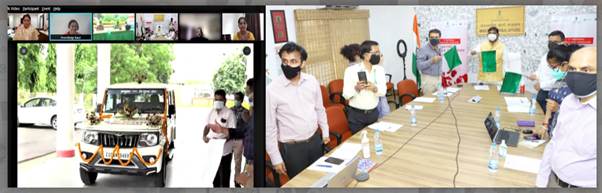


Shri Arjun Munda, Union Minister and Renuka Singh Sauta flagged off mobile vans under the Unmukt project for strengthening screening and timely management of SCD in Khunti district of Jharkhand and Kanker in Chhattisgarh, two tribal districts with a high prevalence of sickle cell disease among tribals.

  • Tribal Health Collaborative ‘Anamaya’: A Multi Stakeholder Initiative to enhance Tribal Health and Nutrition launched

Anamaya, the Tribal Health Collaborative, was launched by Union Minister of Health and Family Welfare Dr Harsh Vardhan and Union Minister of Tribal Affairs, Shri Arjun Munda, at a function in New Delhi . The Collaborative is a multi-stakeholder initiative of the Tribal Affairs Ministry supported by the Piramal Foundation and Bill and Melinda Gates Foundation (BMGF). It will converge efforts of various Government agencies and organisations to enhance the health and nutrition status of the tribal communities of India.

  • Joint Communication for more effective implementation of the Forest Rights Act signed by Environment and Tribal Affairs Ministries

The Forest Rights Act (FRA) 2006 recognizes the rights of the forest-dwelling tribal communities and other traditional forest dwellers. These communities are dependent on forest resources for a variety of needs, including livelihood, habitation and other socio-cultural needs.

A “Joint Communication” was signed by Shri R.P. Gupta, Secretary, Ministry of Environment, Forest & Climate Change (MoEFCC), and Shri Anil Kumar Jha, Secretary, Ministry of Tribal Affairs (MoTA), in the presence of Minister of Environment, Shri Prakash Javadekar and Minister of Tribal Affairs, Shri Arjun Munda. 

The Joint Communication, addressed to all Chief Secretaries of States/UTs, pertains to more effective implementation of the Forest Rights Act (FRA), 2006 and for harnessing the potential for livelihood improvement of the Forest Dwelling Scheduled Tribes (FDSTs) and Other Traditional Forest Dwellers (OTFDs).

  • Shri Arjun Munda, Union Minister for Tribal Affairs inaugurates New Building complex for the Tribal Cultural Research & Training Mission (TRI), Andhra Pradesh as part of Azadi Ka Amrit Mahotsav

Union Minister of Tribal Affairs, Sh. Arjun Munda; MoS Tribal Affairs, Renuka Singh Saruta, and Dy. Chief Minister & Minister for Tribal Welfare, Andhra Pradesh, Smt.Pamula Pushpa Srivaniji virtually inaugurated the New Building complex for the Tribal Cultural Research and Training Mission (TRI) of Andhra Pradesh on 15th  August 2021 as a part of Azadi Ka Amrit Mahotsav India @ 75.

  • Measures undertaken by the Government to improve the livelihood of Tribals during COVID situations

The Ministry of Tribal Affairs provided funds to the State Governments based on their proposals for undertaking various livelihood activities, including agriculture, horticulture, animal husbandry, fisheries and other non-farm based livelihood activities etc. under the schemes ‘Special Central Assistance to Tribal Sub-Scheme (SCA to TSS)’, ‘Development of Particularly Vulnerable Tribal Groups (PVTGs)’ and ‘Grants under Article 275(1)’ during 2020-21. An amount of Rs. 587.47 crore was approved/sanctioned by various State Governments for launching various livelihood activities.

Further, funds to the tune of Rs. 12355.43 crore have been provided as Scheduled Tribe Component (STC) by the other Central Ministries / Departments under livelihood related schemes during 2020-21 and 2021-22.

  • Institutional Support for Development and Marketing of Tribal Products/Produce:
  • Under the scheme, TRIED has been promoting E-Commerce sale of tribal products from its own portal http://www.tribesindia.com and also present on all major e-commerce portals like Amazon, Snapdeal, Flipkart, Paytm, and GEM.
  • TRIFED has made the online sales of Rs. 99.74 lakhs in financial year 2020-21.  During the current financial year 2021-22, TRIFED has made the sale of Rs.127.54 lakhs (Upto 30.11.2021).
  • TRIFED has established a network of 145 Outlets i.e. 97 own Sales outlets, 33 outlets on consignment sale and 15 franchise outlets located across the country as on 30.10.2021.
  • The total number of suppliers/producers empanelled with TRIFED as on 31.10.2021 is 2915.
  • Sale of tribal products by TRIFED during 2019-20 – Rs. 40.30 cr, 2020-21 – Rs. 29.63 cr and 2021-22 (as on 30.10.2021) – Rs. 18.43 cr.
  • Minimum Support Price (MSP) for Minor Forest Produce (MFP) SCHEME:
  • MSP for majority of Minor Forest produce have been increased.
  • 37 new items under the MSP for MFP scheme list from 2020-21.
  • No. of MFP under MSP scheme increased from 50 to 87 during 2020-21.
  • Procurement of MFPs under MSP for MFP scheme by States from GoI funds is Rs. 317.89 Cr. since the implementation of the scheme.
  • Van Dhan Vikas Karyakaram:
  • Under the scheme of ‘MSP for MFP’ Van Dhan Vikas Kendra Clusters (VDVKCs) act as common facility centres for procurement cum value addition to locally available Minor Forest Produce.
  • Rs. 254.64 cr. released to TRIFED in last three years for setting up Van Dhan Vikas kendra Clusters (VDVKCs).
  • 3110 VDVKCs have been sanctioned till date since its inception in 2019-20 benefitting 9.28 lakh MFP gatherers of more than 52000 SHGs.
  • Equity Support to NSTFDC/STFDCs:
  • NSTFDC extends concessional loans to the eligible Scheduled Tribe persons for undertaking any income generation activities/ self-employment through its implementing agencies.
  • Rs. 748.75 cr have been disbursed by NSTFDC in the last three years (2019-20 to 30.11.2021) to 4.04 lakh tribal beneficiaries under its five schemes.
  • NSTFDC has signed MoU with KVIC to act as implementing agency under PMEGP scheme. The MoU aims at providing concessional loans to tribal entrepreneurs seeking financial assistance through banks and SCAs and the ST beneficiaries will get back ended subsidy up to 35% of the unit cost.

****
Investment in manufacturing of EVs, batteries and high technology automotive components in India

 The Ministry of Heavy Industries (MHI) has been continuously working towards making the auto sector in India ‘Aatmanirbhar’ by augmenting ’Make in India’ efforts of the Government and to position India as an alternative manufacturing hub for automobiles and its components. The key initiatives of Ministry of Heavy Industries during the year are as under:

  1. Faster Adoption and Manufacturing of Electric Vehicles in India Phase II (FAME India II) Scheme has been launched with an outlay of Rs 10,000 crore to incentivize demand for Electric Vehicles (EVs) by providing upfront subsidies and creating EV charging infrastructure. 1 million Electric 2 Wheelers, 5 lakh Electric 3 Wheelers, 55,000 Electric Cars and 7,090 Electric Buses are to be supported under FAME II through subsidies. Allocation of Rs 1000 crore has also been made under FAME II for provision of EV charging stations.
  • FAME India II Scheme was redesigned in June 2021 based on experience particularly during Covid-19 pandemic and feedback from industry and users. The redesigned scheme aims at faster proliferation of Electric Vehicles by lowering the upfront costs. Following amendments have been made in the scheme:
  • Demand incentive for Electric 2 Wheelers has been increased from Rs 10,000/KWh to Rs 15,000/KWh with maximum cap increased from 20% to 40% of the cost of vehicles. 
  • For Electric 3 Wheelers, aggregation will be the key method to bring the upfront cost at an affordable level and at par with ICE-3 Wheelers. Energy Efficiency Services Limited (EESL) will aggregate demand for 3 lakh Electric 3 Wheelers for multiple user segments.
  • For Electric Buses, 9 cities with over 4 million population (Mumbai, Delhi, Bangalore, Hyderabad, Ahmedabad, Chennai, Kolkata, Surat and Pune) will be targeted. EESL will aggregate the demand in these 9 cities for remaining Electric Buses under the scheme on OPEX basis.
  • Further the scheme has been extended for further period of 2 years i.e. upto March 31, 2024 

After remodeling of FAME II in June 2021 sale of electric two wheelers has increased to over 5000 per week from 700 per week before remodeling.

Achievements under FAME India II scheme in this year

    • In calendar year 2021, total 1.4 lakh Electric vehicles (1.19 Lakh electric two wheelers, 20.42 K electric three wheelers and 580 electric four wheelers) have been incentivized upto 16 December 2021 amounting to incentive of about Rs 500 Crore under Phase-11 of FAME. Total 1.85 lakh Electric Vehicles have been incentivized under FAME II till now.
    • 835 Electric buses have been deployed (314 in Mumbai, 150 in Navi Mumbai, 90 in Ahmadabad, 105 in UP, 30 in Goa, 25 in Patna, 49 in Surat, 16 in Rajkot, 25 in Delhi, 11 in Chandigarh, 10 in silvassa and 10 in Dehradun), in this year till 16 December 2021. Total 861 Electric buses have been deployed under FAME II.
    • 50 Electric Buses have been sanctioned to GSRTC for deployment in Kewadia a place of national importance.
    • City/State Transport undertakings have issued supply order for 1040 Electric buses in this year till 16 December 2021 (100 in Goa, 100 for intercity bus operation by MS RTC, 40 in the city of Chandigarh, 300 in Delhi by DTC, 300 in Bangalore, 50 for intracity and 50 for intercity bus operation in the city of Tirupati, 100 for intercity bus operation by GSRTC). Total supply orders have been issued for 3428 Electric Buses under FAME
    • Timeline extension has been granted to STUs/CTUs undertakings as per their request to issue Supply Order/Letter of award by STUs/CTUs for 1040 electric buses in this year (100 in Goa, 100 for intercity bus operation by MSRTC, 40 in the city of Chandigarh, 300 in Bangalore, 50 for intra-city and 50 for intercity bus operation in the city of Tirupati, 100 in Rajkot, 150 in Surat, 50 each to KSRTC & NWKSRTC, 50 to Navi Mumbai).
    • 1576 EV charging stations have been sanctioned and Letters of Award have been issued across 9 Expressways and 16 Highways in this year till 1 6 Dec 2021.
    • Letters of Award (LOA) issued for 35 Charging stations have been issued till 1 6 Dec 2021 (25 in the city of Coimbatore and 10 in Erode). Total LOA have been issued for 1797 Charging stations in cities under FAME II.
    • Total 104 EV charging stations have been commissioned in this year till 1 6 December 2021 [91 under FAME I (9 on Delhi – Chandigarh, 3 on Mumbai-Pune Expressways, 12 in Bangalore, 4 in Ranchi, 10 in Goa, 45 in Hyderabad, 6 in Agra and 2 in Shimla) and 13 under FAME —II (4 in the city of Chennai, 3 in Delhi 4 in Nagpur and 2 in Ahmedabad)]
  1. Union Cabinet on May 12, 2021 approved the National Programme on Advanced Chemistry Cell (ACC) with an outlay of Rs 18,100 crore to incentivize setting up of manufacturing facilities in the country for 50 Giga Watt Hour of ACC and 5 GWh of “Niche” ACC. As of now ACC are imported in the country. The scheme was notified on June 9, 2021
  • Through this Scheme, the Government intends to optimally incentivize potential investors, both domestic and overseas, to set- up Giga-scale ACC manufacturing facilities with emphasis on maximum value addition and quality output and achieving pre-committed capacity level within a pre-defined time-period.
  • Total investment of Rs 45,000 crore is envisaged under this scheme. The scheme will reduce the import bills of ACC by Rs 1,50,000 crore.
  • Request for Proposal (RFP) has been issued on October 22, 202 I for inviting proposals from domestic and international manufactures for setting up manufacturing facilities for ACC Battery Storage in India. Pre-Proposal Conference was held on Nov 12, 2021 which was attended by over 100 participants representing over 20 domestic and international manufactures.
  1. Union Cabinet on Sep’ 15, 2021 approved the Productivity Linked Incentive (PLI) scheme for Automobile and Auto Components with an outlay of Rs 25,938 crore to incentivize manufacturing of Advanced Automotive Technology products and attract investments in the Automotive Manufacturing value chain. Its prime objectives include overcoming cost disabilities, creating economies of scale and building a robust supply chain in areas of Advanced Automotive Technology products.
  • It is estimated that over a period of five years, the PLI Scheme for Automobile and Auto Components Industry will attract fresh investment of over 142,500 crore, incremental production of over 12.3 lakh crore and will create additional employment opportunities of over 7.5 lakh jobs.
  • This scheme will facilitate the Automobile Industry to move up the value chain into higher value added products and increase India’s share in global automotive trade.
  • The PLI Scheme is open to existing automotive companies as well as new investors who are currently not in automobile or auto component manufacturing business.
  • The scheme has two components viz Champion OEM Incentive Scheme and Component Champion Incentive Scheme. The Champion OEM Incentive scheme is a ‘sales value linked’ scheme, applicable on Battery Electric Vehicles and Hydrogen Fuel Cell Vehicles of all segments and any other advanced automotive technology as specified by Ministry of Heavy Industries. The Component Champion Incentive scheme is a ‘sales value linked’ scheme, applicable on Advanced Automotive Technology components of vehicles, Completely Knocked Down (CKD)/ Semi Knocked Down (SKD) kits, Vehicle aggregates of 2-Wheelers, 3-Wheelers, passenger vehicles, commercial vehicles and tractors etc. Incentives are applicable both on domestic sales as well as on exports of the eligible products.
  • The scheme provides incentive of 13- 18% on Electric Vehicles, Hydrogen Fuel Cell Vehicles and their components and incentive of 8-13% on Advanced Automotive Technology products related to safety, emission control, shared, convenience, efficiency etc. The incentives will be available for five-year period from FY 2022-23 to FY 2026-27.
  • The PLI scheme for Automobile and Auto components and the Guidelines have been notified on Sep 23, 2021. Application Form for PLI Scheme, List of Advanced Automotive Technology Products and Window for Notice Inviting Applications has been notified on Nov 9, 2021. Window for Notice Inviting Applications is open for 60 days from Nov 11, 2021 to Jan 9, 2022.
  1. Ministry of Heavy Industries organized Round Table on December 4, 2021 in Goa under chairmanship of Dr Mahendra Nath Pandey, Minister for Heavy Industries with all stake holders from Central Government, State Governments & UTs, leaders of Auto OEMs & Automotive Component Manufacturers, Start Ups and Technical Experts to work out strategies to promote adoption of Electric Vehicles in India and attract investment in manufacturing of EVs, batteries and high technology automotive components in India.

Other Initiatives

A 11 .3 km long, Asia’s longest high-speed track (HST) was inaugurated at NATRAX, Indore, Madhya Pradesh by Hon’ble Minister (HI&PE) on June 29, 2021. This will be a one stop solution for all sorts of high speed performance tests for automobiles within the country. Availability of NATRAX HST will encourage indigenous development of wide variety of automobiles.

  1. NATRIP is one of the most significant initiatives of the Govt of India for the growth of Automobile sector in India and includes setting up of “State of the Art” automotive Homogenization, Testing, Certification and R&D infrastructure at three new centers at GARC, Chennai, NATRAX Indore, NIAIMT Silchar and upgradation of three existing centers at ARAI Pune, VRDE Ahmadnagar and ICAT Manesar (Gurugram). This project has been completed on Mar’3l 2021 and subsequently taken over by National Automotive Board (NAB).

In compliance of directives of Cabinet Secretariat for digitization of official records, the work of digitization of more than 15 Lakh pages (accumulated since inception of the project) were completed in Nov 2021 for NAB (NATRIP)/HQ. This is a major work accomplished by NAB (NATRIP) organization in time bound manner.

  1. Issue of GST Concession Certificate to orthopedic disabled persons is one of the important services provided by MHI under its Citizen’s Charter. As a step towards Digital India, an online portal for issuing Aadhar Authenticated GST concession certificate was launched by MHI in Nov 2020. The development of online portal has improved the quality of service rendered by this Ministry. This IT enabled initiative has helped streamlining the process and facilitated issue of 1942 GST Concession Certificate in 10 months period from Jan’21 to Dec’21 (highest ever in the last five year period). This portal has helped the beneficiaries to avail benefits even during Covid- 19 pandemic scenario in 2021.
  1. In order to address the skill gaps and infrastructure development and technology needs for the Capital Goods Sector, Phase I of the Capital Goods scheme was rolled out by the Department in 2014. Phase I of the scheme fostered partnerships between Academia and Industry for engendering technology development with Government support.
    • The outcomes of the Scheme have proved the efficacy of the strategies deployed for technology and industrial infrastructure development.
    • Fifteen Common Engineering Facility Centres(CEFCs) including four Industry 4.0 SAMARTH centres and 6 Technology Innovation Platforms, Eight Centres of Excellence (COEs) for Technology Development, A 500 acres world class Machine Tool Park in Tuiuakuru, Karnataka in partnership with the Government of Karnataka has been established under the scheme. 25 new technologies in the field of machine tools, textile machinery, earth moving machinery, nano and sensor technologies, are being developed at national research institutes of eminence such as IITs, IISc, CMTI, etc. and some of these technologies are undergoing commercialization.
    • 74 workshops, webinars, awareness sessions etc have been organized under the theme Azadi Ka Amrit Mahotsav by SAMARTH Centers, Technology Innovation Platforms, CoEs, and Capital Goods Industry Association in this year.
  1. Development of web based open manufacturing technology innovation platforms: The Ministry of Heavy Industries has developed web based open manufacturing technology innovation platforms under the ongoing Capital Goods Scheme. These platforms wilt help in bringing all India’s technical resources and the concerned Industry on to one platform to kick start and facilitate identification of technology problems faced by Indian Industry and crowd source solutions for the same in a systematic manner so as to facilitate start-ups and angel funding of India innovations. This includes the development of the key ‘mother’ manufacturing technologies’ indigenously through ‘Grand Challenges’ on the Platforms to help achieve the vision of an Aatmanirbhar Bharat and a globally competitive manufacturing sector in India. Hon’ble Minister of Heavy I ndustr les inaugurated the Technology Innovation Platforms on July 2, 2021 (through virtual mode). Details are as below:
    • Six Technology Platforms have been developed by IIT Madras, Central Manufacturing Technology Institute (CMTI), International Centre for Automotive Technology (ICAT), Automotive Research Association of India(ARAI), BHEL and HMT in association with IISc Bangalore. These platforms will focus on development of technologies for the globally competitive manufacturing in India. These platforms will facilitate industry (including OEMs, Tier 1 Tier 2 & Tier companies & Raw Material Manufacturers), start-ups, domain experts/professionals, R&D institutions and academia (colleges & universities), to provide technology solutions, suggestions, expert opinions etc. on issues involving manufacturing technologies. Further, it will facilitate exchange of knowledge with respect to research & development and other technological aspects.
    • Online registration on the Technology Platforms can be done at following url: https://aspire.icat.inhttps://sanrachna.bhe1.in/https://technovuus.araiindia.coin/https://techport.hmtmachinetoo1s.comhttps://kite.iitm.ac.in/, htrps://drishti.cmti.res.in/. Over 60,000 Students, Experts, Institutes, Industries and labs have already registered on these platforms.
  1. MHI is in the process of launching the Phase 2 of the ‘Enhancement of Competitiveness in the Indian Capital Goods Sector’ which will further lead to indigenization of products and technology. The Scheme proposal with total financial outlay of Rs. 1207 cr including Government Budgetary support of Rs. 975 crore is under approval.


****

Electricity (Promotion of generation of Electricity from Must-Run Power Plant) Rules, 2021

 The Ministry of Power in the current year has undertaken an array of reforms. Union Minister for Power and NRE Shri R.K Singh highlighting the reforms said that we have put in place rules and procedures for ease of doing business and ease of living. As a result of the reforms, power sector is poised for greater growth and more reforms are on the anvil in the next year, he remarked.

Shri Singh mentioned that the power sector has shown strong growth in demand in 2021 as it is 14 percent higher than in the previous year, this is indicative of the fact that our economy is recovering and the 28 million new consumers we have added are adding more appliances. The minister noted that the government has continued with reforms in the power sector and efforts also continue to keep the price of power low.

The reforms can be placed in the following categories:

  1. Reforms and Restructuring (R&R)
  • Electricity (Rights of Consumers) Rules, 2020

The Ministry of Power has notified Electricity (Rights of Consumers) Rules, 2020 on 31.12.2020 under section 176 of the Electricity Act, 2003. These Rules shall empower the consumers of electricity and emanate from the conviction that the power systems exist to serve the consumers and the consumers have rights to get the reliable services and quality electricity.  

Implementation of these Rules shall ensure that new electricity connections, refunds and other services are given in a time bound manner.  Wilful disregard to consumer rights will result in levying penalties on service providers.

An amendment to Electricity (Rights of Consumers) Rules, 2020 was also notified on 29.09.2021 wherein the limit for net metering was increased to 500KW from 10KW.

  • Late Payment Surcharge Rules 2021

Electricity (Late Payment Surcharge) Rules, 2021 have been notified by the Central Government on 22nd February, 2021.Late Payment Surcharge means the charges payable by a distribution company to a generating company or electricity trader for power procured from it, or by a user of a transmission system to a transmission licensee on account of delay in payment of monthly charges beyond the due date. Late Payment Surcharge shall be payable on the payment outstanding after the due date at the base rate of Late Payment Surcharge applicable for the period for the first month of default.

  • Waiver of ISTS Transmission Charges and Losses for Solar & Wind Power

In Order to promote generation from renewable sources of energy, Ministry of Power has issued an Order on 5th August 2020 for extension of waiver of Inter State Transmission System (ISTS) charges and losses for transmission of the electricity generated from solar and wind projects commissioned till 30th June 2023.Further an order was issued on 21.06.2021 for extension of waiver of Inter State Transmission System (ISTS) charges for transmission of the electricity generated from solar and wind projects up to 30.06.2025.Moreover vide this order the waiver of ISTS charges shall also be allowed for Hydro Pumped Storage Plant(PSP) and Battery Energy Storage System(BESS).

  • Issuance of Renewable Purchase Obligations (RPO) Trajectory

Long term RPO growth trajectory for the period 2016-17 to 2018-19 has been notified by Ministry of Power on 22.7.2016. .An order on RPO Trajectory for a further period of three years i.e. from 2019-20 to 2021-22 under the provisions of Tariff Policy has been issued by Ministry of Power on 14.06.2018. In super-session of orders dated 22.7.2016 and 14.06.2018, Ministry of Power has specified new RPO trajectory vide order dated 29.01.2021. Trajectory for HPO has also been issued through this order.

This would help in meeting the renewable energy generation targets set by the Central Government.

  • Introduction of Green Day Ahead Market (GDAM)

Green Day Ahead Market (GDAM) is a marketplace for trading of renewable power on a day-ahead basis. This would facilitate accomplishment of green targets as well as support integration of green energy in a most efficient, competitive and transparent manner. GDAM was launched on 25.10.2021.

The Green day Ahead Market will be available through the Power Exchanges. The GDAM market structure will be within the existing Day Ahead Market (DAM) structure but will create a separate clearing mechanism and price discovery for renewable and conventional energy sources.

It will give opportunity to the RE generators to sell their power and reduce curtailment and also the buyer of RE to transparently purchase green power from the market. It would also facilitate the obligated entities to meet its Renewable Purchase Obligation (RPO).

  • Electricity (Timely Recovery of Costs due to Change in Law) Rules, 2021

Timely recovery of the costs due to change in law is having importance as the investment in the power sector largely depends upon the timely payments. At present the pass through under change of law is taking a lot of time, forcing the drying of the investment in the power sector. If payment is not made in time, it impacts the viability of the sector and the developers get financially stressed. If this is not addressed now, the investment will not come and the electricity consumers may face shortages of power once again. In order to address this issue, Ministry of Power has notified Electricity (Timely Recovery of Costs due to Change in Law) Rules, 2021 on 22.10.2021.

  • Electricity (Promotion of generation of Electricity from Must-Run Power Plant) Rules, 2021

Ministry of Power has notified Electricity (Promotion of generation of Electricity from Must-Run Power Plant) Rules, 2021 on 22.10.2021. This rule is mainly to achieve this goal and will help in promotion of the generation from renewable sources. This will ensure that the consumers get green and clean power and secure a healthy environment for the future generation. 

  • Implementation of Phase- 1 of Market Based Economic Despatch (MBED)

With the objective of Redesigning of present market mechanism for lowering the cost of power purchase to Consumers, Framework for Implementation of Phase1 of Market Based Economic Despatch (MBED) wherein mandatory participation by ISGS ( Inter State Generation Stations) plants and voluntary participation by other generators, was communicated to CERC for  implementation from 1st  April, 2022.

  • Redesigning the Renewable Energy Certificate(REC) Mechanism 

Ministry of Power assent was given to make amendment in the existing Renewable Energy Certificate (REC) mechanism, in order to  align the  present REC mechanism with the emerging changes in the power scenario and also to promote new renewable technologies.

  1. Power Market Reforms:
  • Green Term-Ahead Market (GTAM):Pan-India Green Term-Ahead Market in electricity was launched on 1st September, 2020. As a market segment, it has provided one more avenue to renewable to trade electricity which will, inter-alia, help to achieve ambitious renewable energy capacity addition targets of the Government of India. GTAM Contracts will enable obligated entities to procure renewable power at competitive prices at the power exchanges and help meet RPOs.  This would also reduce burden on renewable rich States which can trade the surplus renewable generation generated within the State pan-India. The total cleared volume in G-TAM was 785.83 MU in 2020-2021. In 2021-22, till September, 2021, the total cleared volume was 2744 MU.
  • Green Day Ahead Market (GDAM): After the successful launch of Green Term-Ahead Market (GTAM) in August 2020, “Green Day Ahead Market (GDAM) – a Marketplace for trading of renewable power on a day-ahead basis” has been launched by Sh. R K Singh, Hon’ble Minister of Power and New & Renewable Energy on 25th October, 2021. The intent is to promote merchant green power plants and provide additional sale avenues to existing renewable power plants that are either facing payment risk with the distribution companies (DISCOM) under the existing PPA or have surplus energy. Expected Benefits from the introduction of GDAM are deepening the Green Market, Accelerating the addition of Renewable Capacity, Shift from PPA based Contract to Market-Based Models and Reduction of Curtailment of Green Power. In the Green Day Ahead market launched in October 2021 about 211 MU have been traded from 27.10.2021 to 07.12.2021 at average Price Rs.4.52 per unit.
  • Govt. has introduced Pan India Real Time Market (RTM) of electricity on 3rd June 2020. The introduction of RTMas an organized platform for energy trade closer to real time to the buyers and sellers has not only facilitated grid integration of renewables but also brought greater market efficiency. With RTM, Buyers/sellers have the option of placing buy/sell bids for each 15-minute time block. RTM is benefitting all stakeholders viz. generators including renewable generators having opportunity to sell their surpluses, better management of variability of renewable generation, better utilization of transmission systems, opportunity for distribution utilities to buy or sell power closer to real time and finally consumer getting reliable power supply.In FY 2020-21, the total cleared volume in Real Time Market was 9467.96MU. In FY 2021-22, the total cleared volume in Real Time Market was 9933.4 MU till September, 2021. The highest daily volume of 98.334 MU was traded on 28thAugust, 2021.
  • Despite the Covid 19 pandemic,All India demand continued to achieve the new benchmarks. The highest All India demand of 200570 MW was achieved on 07th July 2021.
  1.   Integrated Power Development Scheme (IPDS)

Government of India notified “Integrated Power Development Scheme” (IPDS) in December’14 to extend financial assistance against capital expenditure to address the gaps in sub transmission and distribution network and metering in urban areas to supplement the resources of Discoms/ Power Departments.

The scheme has an outlay of Rs. 32,612 crore including a budgetary support of Rs 25,354 crore from Government of India during the entire implementation period.

Progress (From 01.11.2020  to 31.10.2021)

  • Total funds invested under the IPDS by GOI + States in this period: around Rs.  3800Cr. with around Rs. 2,290 Cr released as GOI grant from MOP
  • System strengthening of sub-transmission and distribution network has been completed in over 70 circles covering over 500 towns inspite of COVID Pandemic and addition of following infrastructure:
        • 45 new Power Sub-Stations commissioned;
        • Capacity augmentation of more than 50 exiting Power Sub-Stations completed
        • More than 7,000 ckm of Aerial Bunched/Underground cables laid to reduce losses
        • About 3,000 new Distribution Transformers charged for improving power supply in towns
        • Around 1MwP of Solar Panels installed on Govt buildings and Substations as contribution towards green energy
      • Gas Insulated Switchgear (GIS) Substations commissioned for first time in NE States, Haryana; works completed in 25 Substations of AP, Assam, Bihar, Haryana, Rajasthan & Uttarakhand
      • Major projects completed–Underground cabling work under IPDS in Varanasi andKumbh Area, Haridwar
      • Rs.240 Cr approved for around 1000ckm of Underground cabling in Ayodhya
      • Over 5Lakh Smart Meters installed in Andaman Nicobar Islands, Bihar, HP, MP, Punjab& Rajasthan etc.
      • IT enablement of smaller towns completed in 6Discoms&Enterprise Resource Planning (ERP) for improvement in Operational Efficiencies of Discoms completed/upgraded in 5 Discoms during this period.
      • Overall IPDS has contributed in increase in hours of Power supply in urban areas to 22 hours/day and improved consumer convenience though Digital payments etc.

Further, Revamped Reforms Based and Results Linked Distribution Sector Scheme has been approved by Ministry of Power in July 2021 with an outlay of Rs. 3,03,758 crore over a period of five years from FY 2021-22 to FY 2025-26 for providing conditional financial assistance for supporting DISCOMs to undertake reforms and improve performance in a time bound manner with following objectives

      • Improve the quality, reliability and affordability of power supply to consumers through a financially sustainable and operationally efficient Distribution Sector
      • Reduce the AT&C losses to pan-India levels of 12-15% by 2024-25
      • Reduce ACS-ARR gap to zero by 2024-25
  1.    Hydro Power Development:
    • Guidelines for providing Budgetary support for Flood Moderation / Storage Hydro Electric Power projects and Cost of Enabling Infrastructure i.e. roads and bridges were issued by the Ministry on 28.09.2021 to promote the Hydro Sector.
    • All the 04 units of Kameng Hydro Power Project (600 MW) constructed by NEEPCO in Arunachal Pradesh have been fully commissioned and have commenced their operation from 12.02.2021.
    • Luhri Stage-I HEP (210 MW): Investment Approval accorded by GoI on 20.11.2020. Award of EPC package for Civil and HM works awarded on 24.11.2020 and EM works awarded on 16.07.2021.
    • Dhaulasidh HEP (66 MW): Investment Approval accorded by GoI on 01.10.2020. Award of EPC package for Civil and HM works awarded on 06.05.2021.
    • The Model Contract Document for Dispute Avoidance Mechanism in Hydro CPSUs through “Independent Engineer” has been issued vide O.M. dated 27.09.2021.
    • Kholongchhu (600 MW) Hydro Electric Project in Bhutan

The Concession Agreement for the project was signed between Royal Government of Bhutan (RGoB) and Kholongchhu Hydro Energy Limited (KHEL) [Joint Venture (JV) Company of SJVN Ltd (Indian CPSU) & DGPC Bhutan (RGoB PSU)] at Bhutan in the presence of Hon’ble Minister of External Affairs, GoI and Hon’ble Foreign Minister, RGoB on 29.06.2020.  All three main Civil works packages have been awarded on 04.03.2021 & the project is scheduled to be commissioned by Feb., 2026.

    • Lower Arun Hydro Electric Project (679 MW) in Nepal

Lower Arun project was allotted to SJVN Ltd by Government of Nepal (GoN) on Build Own Operate and Transfer (BOOT) basis through international competitive bidding on 04.02.2021.  MoU has been signed for the development of 679 MW Lower Arun HEP between SJVN Ltd and Investment Board Nepal (IBN) on 11th July 2021. 

    • Investment approval for 850 MW Ratle Hydro Electric Project has been accorded on 11.02.2021 with an estimated project cost of Rs. 5281.94 crore (November 2018 PL). The project is scheduled to be completed within 60 months from the date of investment approval.
    • Investment approval for 120 MW Rangit-IV Hydroelectric Project has been accorded on 30.03.2021 with an estimated project cost of Rs.938.29 crore (October 2019 PL). The project is scheduled to be completed within 60 months from the date of investment approval.
  1. Thermal Power:
  • Revised/New Coal Stocking Norms in Coal Based Thermal Power Plants

Central Electricity Authority (CEA), monitors the coal stocks being maintained at the power stations along with their daily coal consumption requirements. The earlier coal stocking norms were advisory in nature, at times; power plants do not maintain coal stock as per the norms, which is not desirable for a sustained plant operation. In view of this, the existing coal stocking norms have been revised and issued by Central Electricity Authority (CEA) on 06.12.2021 to ensure more fuel security to the power plants, reflect true picture of the stocks being maintained at each power stations and ensure sufficient coal stock even during the period of less supply by CIL/SCCL during the month of July to September.

The revised norms mandates 12 to 17 days of coal stock at pit head stations and 20 to 26 days coal stock at non-pit head stations with month-wise variation based on coal despatch/coal consumption pattern during the year corresponding to 85% PLF, and prescribes the coal stocks to be mandatorily maintained by the power plants and penalty mechanism for not maintaining the stocking norms. The coal stock for 17 days at pit head plants and 26 days stocks at non-pit head power plants have been made mandatory during February to June every year.

The power plants are graded as red, yellow and green for not maintaining the coal stocks; and would be penalized for not maintaining their normative availability due to reduced coal stocks and their fixed charges shall be reduced in a graded manner.

  • National Mission on use of Biomass in coal based power plants:

Ministry of Power on 17th November, 2017 issued Policy on biomass utilization for power generation through co-firing in coal based power plants. In this earlier Policy, it was advised in the policy that coal based thermal power plants, except those having ball and tube mill, of power generation utilities, to endeavor to use 5-10% blend of biomass pellets made, primarily, of agro residue along with coal after assessing the technical feasibility, viz. safety aspect etc.   In order to support the energy transition in the country and to achieve the target of cleaner energy sources, the policy has been modified and issued on 08.10.2021. This modified policy would provide the necessary direction in achieving the desired goals.

  • Fuel Linkages under SHAKTI:

Govt. of India, Ministry of Coal had approved a new coal linkage allocation policy on May 17, 2017 named SHAKTI (Scheme for Harnessing & Allocating Koyala Transparently in India). Linkages granted under SHAKTI Policy in the last one year:

Shakti Policy Para B (ii) –  Linkage on auction basis for Independent Power Producers (lPPs) with PPA based on domestic coal. Under clause B(ii) of the SHAKTI Policy, the lPPs participating in auction bid for discount on existing tariff.

    • 4th round auction got completed on 28.09.2021 by PFCCL wherein 3.1983 MT (G11 Grade) was provisionally allocated.

Shakti Policy Para B(viii)(a) – Linkage on auction basis for non-PPA capacity for Short Term & DAM: Ministry of Power issued a methodology in this regard on 02.12.2019 to carry out such auction at every quarter to cater to the dynamic requirements of short term and day-ahead markets (DAM). Amendment to the methodology was issued on 12.05.2020.

    • Till date 5.39 MTs (G13 grade equivalent) of coal have been allocated to various power plants in auctions held for six quarters viz. Apr-June’20, July-Sep’20 and Oct-Dec’20, Jan-Mar’21, Apl-June’21 and July-Sep’21.

    Pilot project for procurement of 2500 MW power:

In order to address the problem of lack of Power Purchase Agreements (PPAs) in the country, the Ministry of Power had notified a scheme for procurement of 2500 MW on competitive basis for a period of 3 years from the generators with commissioned projects having untied capacity.

2nd Round (2500 MW):

    • 21 Bidders (Generating Companies) submitted their Technical and Financial Bid. Financial Bids were opened on 07.02.2020. After e-Reverse Auction Rs 3.26/kWh (Fixed Charge of Rs 1.63 per unit and Variable Charge of Rs 1.63 per unit) tariff was discovered.
    • As per Status report provided by PTC on 10.11.2021, PTC have executed PPAs with the Bidders to whom PFCCL have issued LOAs and PSAs with Utilities/Discoms for a total quantum of 820 MW.
  • Stressed Assets in Thermal Power Sector

Department of Financial Services (DFS) sent a list of stressed projects in the power sector on 22.03.17 to Ministry of Power (MoP). The 34 non-captive coal based power projects mentioned in the DFS list are mostly private and have a total installed capacity of 40,130 MW. Status of 34 thermal power projects of capacity 40,130 MW which are under stress as reported by DFS is as follows:

    1. 17 projects with a total capacity of 20,290 MW have been resolved.
    2. 7 projects with a total capacity of 9,310 MW are at various stages of resolution.
    3. 10 projects with a total capacity of 10,530 MW are at very initial stage of construction and are totally stalled. Such projects have either been ordered to be liquidated or heading towards liquidation.
  1. Highlights under Energy Efficiency :
  • Energy Efficiency Initiatives Launched under the Bharat ka Azadi Ka Amrit Mahotsav
    • With an objective to accelerate Energy Transition in Industrial Sectors, Union Minister of Power released “User Manuals” for different stakeholders of PAT scheme such as BEE, CERC, POSOCO etc. through Video Conferencing on 1st March, 2021.
    • The detailed outcome of PAT Cycle-II including energy savings, investment reported, technology up gradation as well as reduction in CO2 emission was documented by BEE as “Pathways for Accelerated Transformation in Industry Sector” and was released on 1st March 2021 by the Union Minister.
    • Under the vision for ‘Aatmanirbhar Bharat’ Union Minister of Power launched “Energy Efficiency Enterprise (E3) Certifications Programme for Brick manufacturing Sector” in March, 2021 .
    • “Aiming for Sustainable Habitat: New Initiatives in Building Energy Efficiency 2021”Union Minister of Power announced various initiatives being taken by Government of India towards energy efficiency in the building sector on 16th July, 2021. The initiatives launched included:
    • Specifying code compliance approaches and minimum energy performance requirements for building services, and verification framework with Eco Niwas Samhita 2021.
    • The web-based platform ‘The Handbook of Replicable Designs for Energy Efficient Residential Buildings’ as a learning tool, which can be used to create a pool of ready-to-use resources of replicable designs to construct energy-efficient homes in India.
    • Creating an Online Directory of Building Materials that would envisage the process of establishing Standards for energy efficient building materials.
    • Announcement of NEERMAN Awards, (National Energy Efficiency Roadmap for Movement towards Affordable & Natural Habitat), with the goal of encouraging exceptionally efficient building designs complying with BEE’s Energy Conservation Building Codes.
    • Online Star Rating tool for Energy Efficient Homes created to improve energy-efficiency and reduce energy consumption in individual homes. It provides performance analysis to help professionals decide the best options to pick for energy-efficiency of their homes.
    • Training of over 15,000 Architects, Engineers and Government officials on Energy Conservation Building Code (ECBC) 2017 and Eco Niwas Samhita (ENS) 2021).
  • Energy Efficiency in Industry Sector:
    • PAT cycle –II ended on 31st March 2019 wherein 621 Designated Consumers (DCs) from 11 sectors have achieved total energy savings of about 14.08Million tonnes of Oil Equivalent (MTOE) translating into avoiding of about 66 million tonnes of Carbon dioxide. These savings exceeded the notified target by about 18%.The energy saving of PAT Cycle II have been converted to Energy Saving Certificates (ESCerts) tradable at the Power Exchanges. Under the second cycle of PAT, a total of 57.38 lacs ESCerts to 349 industrial units have been issued and 193 industrial units are entitled to purchase 36.68 lacs ESCerts.
    • PAT Cycle –VII has been notified commencing from 2022-23 to 2024-2025 wherein 509 Designated Consumers from 9 sectors have been notified with total energy consumption reduction target of 6.627 MTOE.
  • Energy Efficiency in SME
    • 600 Small Scale Projects have been implemented in 5 Sectors (Ceramics, Dairy, Foundry, Hand Tools, Brass) leading to savingsof about 11452 toe of energy, mitigating 61515 Tonne of CO2 emission, attracted investment of 88 Crs so far. The project is currently in scale-up phase in 23 Clusters.
  • Energy Efficiency in Appliance Sector:
    • 28 appliances in labelling programme.10 Mandatory appliances and 18 Voluntary Appliances.
    • Voluntary star labelling program for UHD TV and Air Compressor launched on 11th January, 2021.
    • Amendment Notification of Tubular Fluorescent Lamps (TFL), LED, Storage Water Heater, Room Air Conditioners, ColorTV  and Refrigerators (FFR and DFR) notified.
    • Existing energy consumption standards for Chillers, Washing Machines, Microwave Ovens has been extended by a period of 1 year starting from 1st January, 2022 to 31st December, 2022.
  • Energy Efficiency in Building Sector:
    • 20 States and Uts namely, Rajasthan, Odisha, Uttarakhand, Punjab, Karnataka, Haryana, Himachal Pradesh, Kerala, Andhra Pradesh, Telangana, Tripura, West Bengal, Uttar Pradesh, Arunachal Pradesh, Sikkim, Assam, Mizoram, Madhya Pradesh and Union Territories (Uts) of Andaman & Nicobar and Puducherry have notified ECBC for their states.
    • Energy Conservation Building Code (ECBC) Cells of BEE, housed at State Designated Agencies (SDAs), are supporting implementation of ECBC at State level. As on 31s October, 2021, 48 ULBs from 8 States have incorporated provisions of ECBC for building approval process.
    • As on 31st October,2021, 264 buildings have been awarded star rating under various categories.
  • Energy Efficiency in Transport Sector:
    • Hon’ble Minister for Road Transport & Highways and Union Minister of Power, launched the “Go Electric” Campaign on 19th February, 2021 to spread awareness on the benefits of e-mobility and EV Charging Infrastructure in India. The launch witnessed the unveiling of “Go Electric” logo which depicts the evolution of e-mobility eco-system.
    • BEE conducted 9 stakeholder consultationwith EV stakeholders to address the challenges faced by implementing agencies in deployment of charging infrastructure.
    • Under the Go- Electric Campaign, State Nodal Agencies / State Designated Agencies have conducted 15 roadshows, 35 webinars and various other awareness activities radio jingles, EV Carnival, hoardings, pamphlets advertisements on electricity bills in multiple states across the country.
  • Strenghthening Energy accounting in DISCOMs:
    • Amendment in exiting Notification: Ministry of Power issued a notification to include all the Electricity Distribution Companies (DISCOMs) under the preview of EC Act. As per the notification (S.O. 3445(E) dated 28th September, 2020), which was formulated in consultation with BEE “All entities have been issued distribution license by State/Joint Electricity Regulatory Commission under the Electricity Act, 2003 (36 of 2003)” are notified as Designated Consumers (DCs). Earlier, the DISCOMs whose annual energy losses were equal to or above 1000 MU were only covered as Designated Consumers.
    • Regulation under EC Act notified by BEE on 6th Oct, 2021 to mandate Energy Accounting by DISCOMs.
  • State Designated Agencies
    • State-wise Actions on Annual targets and Headways on Energy Efficiency (SAATHEE) Portal Launched on 11th January, 2021. It is an interactive web portal for SDAs and will be helpful in capturing physical and financial progress of energy efficiency activities being implemented by States/ Uts across the country.
    • Union Minister for Power chaired a virtual meeting on 22nd October, 2021 with senior officials from State Governments and industry partners to review the current level of activities in the field of energy efficiency and clean energy transition being implemented by State Agencies.   During the meeting, the following reports were released as given below:
      • State Energy Efficiency Index – 2020 – The report of State Energy Efficiency Index – 2020 to help the states in monitoring their programmes by contributing for National Climate Action Goals
    • eBook on Best Operating Practices by SDAs –The e-book on best energy efficiency practices of State Designated Agencies to facilitate the coordination of peer groups and adoption of best practices by other states.
  1. Initiatives for strengthening  Transmission infrastructure
  • Formation of Central Transmission Utility of lndia Ltd (CTUIL): Central Transmission Utility of lndia Ltd (CTUIL), a 100o/o subsidiary of Power Grid Corporation of lndia Ltd, has been notified as the Central Transmission Utility under Section 38 of the Electricity Act 2003 on 9th March 2021 and CTUIL has started functioning w.e.f. 1st April 2021. In due course it will be fully independent and 100% Government owned company.
    • Monetisation of Transmission Assets of Power Grid Corporation of lndia (PGCIL) through lnfrastructure lnvestment Trust (lnvlT)

Based on approval of the CCEA conveyed by MoP vide order 15.09.2020, PGCIL monetised five TBCB projects through POWERGRID lnfrastructure lnvestment Trust (PGlnvlT) in May’21. This is the 1’t lnvlT sponsored by a CPSE and largest public offer by any lnvlT/RelT. PGCIL received Rs.7,735 crore. As per National Monetisation Plan issued by NlTl Aayog, POWERGRID is targeted for carrying out monetisation of Rs. 45,200 crore of assets during FY 2021-22 lo FY 2024-25 (including Rs. 7735 crore already raised during FY 2021-22).

Rules/Policies adopted for robust transmission infrastructure 

  1. MoP Letter dated 06-08-2021 regarding Revised Guidelines and SBDs for procurement of ISTS through TBCB process along with Standard Bidding Documents (SBDs) issued on 06.08.2021 includes Standard Single Stage Request for Proposal for Selection of TSP through TBCB process to establish ISTS projects and Standard Transmission Service Agreement for Development and Operation of ISTS System for Transmission of Electricity through TBCB Route
    • Ministry of Power, in August 2021, has released the revised the Standard Bid Documents (SBDs), containing Request for Proposal (RfP) and Transmission Service Agreement (TSA) for award of Inter-State Transmission System (ISTS) Projects on TBCB. Last SBDs were issued in 2008. Similarly, Ministry of Power had earlier notified “Tariff Based Competitive Bidding (TBCB) Guidelines for Transmission Service” and “Guidelines for Encouraging Competition in Development of Transmission Projects” in April 2006. These Guidelines were also revised and notified in August 2021.
  1. MoP Resolution on Guidelines on Encouraging Competition in Development of Transmission Projects and on TBCB Guidelines as published in Gazette of India on dated 10th Aug 2021
    • Based on extensive stakeholders’ consultation, revised SBDs for award of ISTS systems on TBCB and revised Guidelines have been prepared.   Revised SBD and revised Guidelines would promote ease of doing business for private developers in transmission sector, address concerns of developers on risk sharing, encourage competition in transmission, and facilitate timely completion of transmission lines. All these provisions would bring in more private investment in transmission sector.

3) Electricity (Transmission Planning, Development and Recovery of ISTS Transmission Charges) Rules, 2021 issued on 01.10.2021

    • The Central Government has promulgated the above Rules  paving the way for complete overhauling of transmission system planning to give power sector utilities easier access to electricity transmission network across the country. The rules underpin a system of transmission access which is termed as a General Network Access in the inter-state transmission system.  This providesz flexibility to the States as well as the generating stations to acquire, hold and transfer transmission capacity as per their requirements. Thus, the rules will bring in rationality, responsibility and fairness in the process of transmission planning as well as its costs. 

4) MoP order dated 20.10.2021 for dissolution of 5 Regional Power Committees (Transmission Planning)

    • Prior to this order, regional consultation for planning of ISTS system is done at Regional Power Committee (Transmission Planning) [RPC-TP] and Regional Power Committee [RPC]. In order to fast-track the ISTS planning process, it was agreed to have regional consultation on planning of ISTS system only with RPC and to dissolve RPC-TP. Accordingly, the order will facilitate doing away with dual consultation with regional constituents during ISTS planning process.

5) MoP advisory to all states dated 1.9.2021, along with the Report, for bringing 33 kV system under Transmission for performance improvement of sub-transmission system

    • Ministry of Power had constituted a Committee under the Chairmanship of CMD, POWERGRID, with representatives from Central Electricity Authority, State Transmission Utilities of Haryana, Maharashtra and Odisha and Central Transmission Utility of India Ltd to suggest measures for reduction of losses in the sub-transmission system & for ensuring reliability and efficient performance and to make recommendation for promoting investment in sub-transmission system. The Committee had observed high losses and outage rate at 33 kV level compared to higher voltage level.

Accordingly, to improve the performance of 33 kV system, Ministry of Power has issued advisory to State/Uts on 01.09.2021 to take following actions:

i)33 kV system should be the handed over from DISCOMs to the STU for better planning, loss reduction and increased supply reliability. It can be done in phased manner. In the first phase, incremental assets in 33 kV network and existing overloaded assets/assets can be handed over to STUs.

ii)State Govt. would need to provide financial assistance to STU for upgrading/modernizing their 33 kV assets.

iii)In the event, the State Govt. is not in a position to provide financial assistance to STU, then STU can be asked to form JV with POWERGRID on 50:50 equity basis for mobilising their financial resources.

6) MoP order for Re-constitution of the “National Committee on Transmission” (NCT)

    • As a part of energy transition goal, India has set a target of 500 GW of Renewable Energy capacity by 2030. In view of shorter gestation period required for construction of Renewable Energy Sources compared to that of transmission system, the transmission planning and approval process has been revamped by Ministry of Power to reduce the time taken for planning and approval of transmission system required for evacuation of power from Renewable Energy sources especially.

In order to simplify the process of Inter State Transmission System (ISTS) planning and approval to further facilitate RE development in the country in consonance with energy transition goal, Terms of reference of National Committee on Transmission (NCT) have been modified on 28.10.2021 with delegation of powers to CTU and NCT among others to fast-track ISTS meant for RE.

7) MoP Letter to State & Uts on Report of Task Force on Cyclone Resilient Robust Electricity Trans & Distribution Infrastructure in the Coastal Areas along with Report of Task Force  on Cyclone Resilient Robust Electricity Transmission & Distribution Infrastructure in Coastal Area

    • On the basis of representation received from State, a Task Force was constituted by this Ministry, vide order dated 02.06.2020 to recommend preventive and mitigation measures for minimizing the damages to transmission and distribution infrastructures due to Cyclone in coastal areas of the country.

The task force suggested a multi-pronged approach, which encompasses the change in design philosophy, better planning and adoption of modern technological solutions required to safeguard the T&D infrastructure 

from natural disasters and to increase resilience, reliability and availability of the system. 

After acceptance of the Report by the Ministry, the Report was shared with coastal States and UTs vide MoP’s letter dated 10 June 2021 with a request that each Coastal States/Uts may mark out areas prone to cyclones within 20-30 kms of Coast line and any new construction / reconstruction of Power systems in these areas will follow the design parameters laid down in this report.

***

Petroleum & Natural Gas

 The Ministry of Petroleum & Natural Gas is concerned with exploration and production of Oil & Natural Gas, refining, distribution and marketing, import, export and conservation of petroleum products. Oil and Gas being the important import for our economy, many initiatives have been taken by the Ministry for increasing production and exploitation of all domestic petroleum resources to address the priorities like Energy Access, Energy Efficiency, Energy Sustainability and Energy Security. Following initiatives have been taken up by the Ministry in the current year:

Pradhan Mantri Ujjwala Yojana: PMUY was launched in May, 2016 to provide 8 crore deposit free connections to poor women. The second phase of the scheme Ujjwala 2.0 has been launched by Prime Minister in the Mahoba District of Uttar Pradesh on 10th August, 2021 on pan-India basis to provide additional one Crore LPG connections, along with free first refill and stove. As on 01.12.2021, a total of 80.5 lakh connections have been released under this scheme. This Ministry is monitoring the implementation of the scheme on a daily basis.


Refill Portability: In order to create competition among distributors in the interest of customer service, refill portability was implemented which enables customer to choose his/ her distributor at the time of booking the refill. In such a scenario, a customer not satisfied with services of his parent distributor can choose any distributor from the list of distributors of the same company serving in his locality/area. This would result in better customer satisfaction and impetus for distributors for providing better service. With customers exercising the right to choose the delivery partner, it further motivates the distributors to provide best in class services to the customers and improve their performance ratings. The flexibility to choose the Distributor for each refill further expands the bouquet of digital services being offered to LPG customers.

Hassle free Non-subsidised LPG Connection (Across the counter): To ease out the process of issuance of new connection, LPG Non-subsidised domestic connection can be issued across the counter with the submission of requisite proof of ID and self-declaration of address by the customer. In case customer wants to submit documents to avail subsidy after taking non-subsidised connection, provision is also enabled to convert to subsidised connection, by submitting Proof of Address other than self- declaration subject to OMC and NIC dedupe clearance.

Graphical user interface, websiteDescription automatically generated     ApplicationDescription automatically generated

Development of Non-monetized Discoveries: A total of 09 discoveries {03 from nomination regime (03 from ONGC) and 06 from PSC} have been monetised as on November, 2021. Ministry of Petroleum and Natural Gas vide resolution dated 8.11.2019 revised the guidelines for authorization to market transportation fuels, which would promote ease of doing business and boost private players to invest in retail sector. The said resolution applies for marketing of only Motor Spirit and High Speed Diesel for “Bulk” and “Retail” business. Further, under the New Guidelines, authorization has been given to 10 Companies as on 16th December, 2021.

  1. Gas Grid: A total of 21735 Kms of pipelines have been laid upto September, 2021 as part of the Gas Grid. 

Ethanol Blended Petrol (EBP) Programme: During Ethanol Supply Year (ESY) 2020-21, 302.30 crore litre of Ethanol has been procured by OMCs for blending purpose till 30.11.2021. The feedstock wise enhanced ethanol prices have been announced for the ongoing Ethanol Supply Year (ESY) 2021-22- from C heavy Molasses route at Rs.46.66/- per litre; from B heavy Molasses route at Rs.59.08/- per litre; from sugarcane juice/ sugar/ sugar syrup route at Rs.63.45/- per litre; from Maize and damaged food grains route at Rs.52.92/- per litre and from surplus rice available with FCI route at Rs.56.87/- per litre.

Biodiesel Blending Programme: On 4th May, 2021, the Minister of Petroleum & Natural Gas remotely flagged off the first supply of UCO (Used Cooking Oil) based Biodiesel blended Diesel under the EOI Scheme from Indian Oil’s Tikrikalan Terminal, Delhi. The GST rate on biodiesel, which is sold to Oil Marketing Companies for blending with diesel, has been reduced from 12% to 5% by the Ministry of Finance w.e.f. 1st October, 2021.

Sustainable Alternative Towards Affordable Transportation (SATAT): “Sustainable Alternative Towards Affordable Transportation (SATAT)” initiative was launched on 1st October 2018 wherein Oil and Gas Marketing Companies are inviting Expression of Interest (EoI) from potential entrepreneur to procure Compressed Bio Gas (CBG). Under this initiative, 2700 Letters of Intent (LoIs) have been issued till 15th December 2021. Supply of CBG initiated from 16 plants through 26 ROs and injection of CBG in CGD network at one place in Gujarat. 

Reduction of Regulatory Compliance Burden: Reducing compliance burden, simplification of procedures and improving ‘Ease of Doing Business’ is a continuous process in the Petroleum & Natural Gas sector. In the special campaign launched by the Government in the year 2021, a total number of 276 compliances were reduced and procedures simplified.

Performance Indicator of MoP&NG: Production as on 01.12.2021 is 42.65 MtoE (Oil – 19.88 MMT; Gas – 22.77 BCM). Total of 105 exploration blocks covering an area of 1,56,580 sq km awarded till date. 50 discoveries monetized till 30.11.2021. INR 2,75,781 Cr spent on Hydrocarbon infrastructure till 30.11.2021. As on 01.12.2021, 80.5 Lakh LPG connections released against 1.29 Cr cleared application under Ujjwala 2.0. Indian Gas Exchange launched in June 2020. 21,735 km gas pipeline laid upto Sept., 2021. A total of 83.7 Lakh PNG (D) connections and 3532 CNG stations as on 31.10.2021. CAPEX in overseas assets till date is INR 22,681 Cr. Production of ~56 MMToE from overseas O&G assets added since FY 19 (achieved 50% of the target).

DSF-III: DSF-III was launched on 10th June 2021 by the Minister of Petroleum & Natural Gas. Thereafter on 30.07.2021, a Promotional Road show on DSF-III was organized in presence of Hon’ble Minister of Petroleum & Natural Gas, Shri Hardeep Singh Puri.

Setting up of PSA Plants : In view of perturbing situation created due to second wave of Covid-19 and shortage of oxygen supply in various States across India, as per the directions of MoH&FW, 13 Oil PSUs were assigned 110 Hospitals in States of Uttar Pradesh, Bihar, Madhya Pradesh, Rajasthan, Odisha, Karnataka, Kerala, Gujarat, Nagaland, Arunachal Pradesh, Delhi and Maharashtra for setting up a Pressure Swing adsorption (PSA) Oxygen Plants of adequate capacity under CSR activity so as to appropriately address the oxygen shortage in these Hospitals/Districts. CPSEs are setting up PSA Plants of combined capacity of 98840 LPM. A total of 101 Plants are commissioned and others are at later stage of commissioning.

Setting up of Jumbo facilities: In some refineries, LMO (Liquid Medical Oxygen) is not produced, but Oxygen at low pressure is available. This cannot be liquefied or transported via cylinders. As this Oxygen can be used for medical purposes, hence jumbo Covid care Facilities have been set up adjacent to the refinery premises in coordination with the State Govts. The details of such facilities are as below:


PLANT NAME


LOCATION


OXYGENATED BED CAPCITY SUPPORTED

STATUS


PANIPAT NAPTHA CRACKER, IOCL

Panipat, Haryana


500 Beds


Operational


CPCL (IOCL)

Chennai, T.N.

60 Beds

Operational

Bina Refinery

Bina, Madhya Pradesh

200 Beds

Operational

Kochi Refinery

Kochi, Kerala

350 Beds

Operational

HMEL

Kanakwal, Bathinda

100 Beds

Operational


Gasoline Desulphurization (GDS) Unit under CPCL-fuel Quality up-gradation project has been dedicated to the nation by Hon’ble Prime Minister through video conferencing on 17.02.2021. INDMAX project at Bongaigaon Refinery of IOCL was dedicated to nation on 22.02.2021. Propylene Derivatives Petrochemical Project (PDPP) at Kochi Refinery of BPCL was dedicated to the nation by Hon’ble Prime Minister on 14.02.2021. 


******

Petroleum & Natural Gas

 The Ministry of Petroleum & Natural Gas is concerned with exploration and production of Oil & Natural Gas, refining, distribution and marketing, import, export and conservation of petroleum products. Oil and Gas being the important import for our economy, many initiatives have been taken by the Ministry for increasing production and exploitation of all domestic petroleum resources to address the priorities like Energy Access, Energy Efficiency, Energy Sustainability and Energy Security. Following initiatives have been taken up by the Ministry in the current year:

Pradhan Mantri Ujjwala Yojana: PMUY was launched in May, 2016 to provide 8 crore deposit free connections to poor women. The second phase of the scheme Ujjwala 2.0 has been launched by Prime Minister in the Mahoba District of Uttar Pradesh on 10th August, 2021 on pan-India basis to provide additional one Crore LPG connections, along with free first refill and stove. As on 01.12.2021, a total of 80.5 lakh connections have been released under this scheme. This Ministry is monitoring the implementation of the scheme on a daily basis.


Refill Portability: In order to create competition among distributors in the interest of customer service, refill portability was implemented which enables customer to choose his/ her distributor at the time of booking the refill. In such a scenario, a customer not satisfied with services of his parent distributor can choose any distributor from the list of distributors of the same company serving in his locality/area. This would result in better customer satisfaction and impetus for distributors for providing better service. With customers exercising the right to choose the delivery partner, it further motivates the distributors to provide best in class services to the customers and improve their performance ratings. The flexibility to choose the Distributor for each refill further expands the bouquet of digital services being offered to LPG customers.

Hassle free Non-subsidised LPG Connection (Across the counter): To ease out the process of issuance of new connection, LPG Non-subsidised domestic connection can be issued across the counter with the submission of requisite proof of ID and self-declaration of address by the customer. In case customer wants to submit documents to avail subsidy after taking non-subsidised connection, provision is also enabled to convert to subsidised connection, by submitting Proof of Address other than self- declaration subject to OMC and NIC dedupe clearance.

Graphical user interface, websiteDescription automatically generated     ApplicationDescription automatically generated

Development of Non-monetized Discoveries: A total of 09 discoveries {03 from nomination regime (03 from ONGC) and 06 from PSC} have been monetised as on November, 2021. Ministry of Petroleum and Natural Gas vide resolution dated 8.11.2019 revised the guidelines for authorization to market transportation fuels, which would promote ease of doing business and boost private players to invest in retail sector. The said resolution applies for marketing of only Motor Spirit and High Speed Diesel for “Bulk” and “Retail” business. Further, under the New Guidelines, authorization has been given to 10 Companies as on 16th December, 2021.

  1. Gas Grid: A total of 21735 Kms of pipelines have been laid upto September, 2021 as part of the Gas Grid. 

Ethanol Blended Petrol (EBP) Programme: During Ethanol Supply Year (ESY) 2020-21, 302.30 crore litre of Ethanol has been procured by OMCs for blending purpose till 30.11.2021. The feedstock wise enhanced ethanol prices have been announced for the ongoing Ethanol Supply Year (ESY) 2021-22- from C heavy Molasses route at Rs.46.66/- per litre; from B heavy Molasses route at Rs.59.08/- per litre; from sugarcane juice/ sugar/ sugar syrup route at Rs.63.45/- per litre; from Maize and damaged food grains route at Rs.52.92/- per litre and from surplus rice available with FCI route at Rs.56.87/- per litre.

Biodiesel Blending Programme: On 4th May, 2021, the Minister of Petroleum & Natural Gas remotely flagged off the first supply of UCO (Used Cooking Oil) based Biodiesel blended Diesel under the EOI Scheme from Indian Oil’s Tikrikalan Terminal, Delhi. The GST rate on biodiesel, which is sold to Oil Marketing Companies for blending with diesel, has been reduced from 12% to 5% by the Ministry of Finance w.e.f. 1st October, 2021.

Sustainable Alternative Towards Affordable Transportation (SATAT): “Sustainable Alternative Towards Affordable Transportation (SATAT)” initiative was launched on 1st October 2018 wherein Oil and Gas Marketing Companies are inviting Expression of Interest (EoI) from potential entrepreneur to procure Compressed Bio Gas (CBG). Under this initiative, 2700 Letters of Intent (LoIs) have been issued till 15th December 2021. Supply of CBG initiated from 16 plants through 26 ROs and injection of CBG in CGD network at one place in Gujarat. 

Reduction of Regulatory Compliance Burden: Reducing compliance burden, simplification of procedures and improving ‘Ease of Doing Business’ is a continuous process in the Petroleum & Natural Gas sector. In the special campaign launched by the Government in the year 2021, a total number of 276 compliances were reduced and procedures simplified.

Performance Indicator of MoP&NG: Production as on 01.12.2021 is 42.65 MtoE (Oil – 19.88 MMT; Gas – 22.77 BCM). Total of 105 exploration blocks covering an area of 1,56,580 sq km awarded till date. 50 discoveries monetized till 30.11.2021. INR 2,75,781 Cr spent on Hydrocarbon infrastructure till 30.11.2021. As on 01.12.2021, 80.5 Lakh LPG connections released against 1.29 Cr cleared application under Ujjwala 2.0. Indian Gas Exchange launched in June 2020. 21,735 km gas pipeline laid upto Sept., 2021. A total of 83.7 Lakh PNG (D) connections and 3532 CNG stations as on 31.10.2021. CAPEX in overseas assets till date is INR 22,681 Cr. Production of ~56 MMToE from overseas O&G assets added since FY 19 (achieved 50% of the target).

DSF-III: DSF-III was launched on 10th June 2021 by the Minister of Petroleum & Natural Gas. Thereafter on 30.07.2021, a Promotional Road show on DSF-III was organized in presence of Hon’ble Minister of Petroleum & Natural Gas, Shri Hardeep Singh Puri.

Setting up of PSA Plants : In view of perturbing situation created due to second wave of Covid-19 and shortage of oxygen supply in various States across India, as per the directions of MoH&FW, 13 Oil PSUs were assigned 110 Hospitals in States of Uttar Pradesh, Bihar, Madhya Pradesh, Rajasthan, Odisha, Karnataka, Kerala, Gujarat, Nagaland, Arunachal Pradesh, Delhi and Maharashtra for setting up a Pressure Swing adsorption (PSA) Oxygen Plants of adequate capacity under CSR activity so as to appropriately address the oxygen shortage in these Hospitals/Districts. CPSEs are setting up PSA Plants of combined capacity of 98840 LPM. A total of 101 Plants are commissioned and others are at later stage of commissioning.

Setting up of Jumbo facilities: In some refineries, LMO (Liquid Medical Oxygen) is not produced, but Oxygen at low pressure is available. This cannot be liquefied or transported via cylinders. As this Oxygen can be used for medical purposes, hence jumbo Covid care Facilities have been set up adjacent to the refinery premises in coordination with the State Govts. The details of such facilities are as below:


PLANT NAME


LOCATION


OXYGENATED BED CAPCITY SUPPORTED

STATUS


PANIPAT NAPTHA CRACKER, IOCL

Panipat, Haryana


500 Beds


Operational


CPCL (IOCL)

Chennai, T.N.

60 Beds

Operational

Bina Refinery

Bina, Madhya Pradesh

200 Beds

Operational

Kochi Refinery

Kochi, Kerala

350 Beds

Operational

HMEL

Kanakwal, Bathinda

100 Beds

Operational


Gasoline Desulphurization (GDS) Unit under CPCL-fuel Quality up-gradation project has been dedicated to the nation by Hon’ble Prime Minister through video conferencing on 17.02.2021. INDMAX project at Bongaigaon Refinery of IOCL was dedicated to nation on 22.02.2021. Propylene Derivatives Petrochemical Project (PDPP) at Kochi Refinery of BPCL was dedicated to the nation by Hon’ble Prime Minister on 14.02.2021. 


******

Maritime India Vision 2030 launched

 SAGARMALA PRAGRAMME

(i)   Maritime India Summit, 2021

The Prime Minister on March 02, 2021 inaugurated the ‘Maritime India Summit 2021’ through video conferencing. The summit was organized by the Ministry of Ports, Shipping and Waterways and conducted on a virtual platform from 2ndto 4thMarch, 2021. 486 MoUs were signed for Maritime India Summit 2021 by 22 Maritime Ports/Agencies/Authorities for INR 3.39 lakh crore or USD 47.02 Bn across different subsectors. A compendium of 400 Investible Projects for INR 2.24 lakh crore or USD 31.08 Bn for investment was released for the Summit. During the three days of the summit, a number of important announcements were made.

The Prime Minister launched the Maritime India Vision 2030, which contains the targets to be achieved by Maritime Sector over the next decade alongwith the strategies related to each of the stakeholders of MoPSW. Sagar-Manthan: Mercantile Marine Domain Awareness Centre (MM-DAC) which is an information system to enhance maritime safety, search, rescue capability and environment protection was also launched.

MIS 2021 highlights:-

  • About 1.90 lakh delegates registered for the summit.
  • 16 international ministers from 11 nations joined the summit for different sessions.
  • A total of six Union Ministers, Chief Ministers of three states and two State Ministers attended different sessions.
  • A total of 55 CEOs attended the CEO’s forum, which include 31 international CEOs and 24 Indian CEOs.
  • A total of 22 CEOs attended the CEO’s roundtable, which include 11 International and 11 Indian CEOs
  • A total of 185 speakers attended various thematic sessions during the summit, which included 124 Indian speakers and 61 International speakers
  • A total of 110 exhibitors participated in the summit, in 18 pavilions and 107 booths, which led to 7500+ B2B meetings
  • A total of 70500+ Visitors were recorded at the end of three days of the summit.

(ii)        Sea Plane Services

An Memorandum of Understanding signed between Ministry of Ports, Shipping and Waterways and Ministry of Civil Aviation on 15.06.2021 to jointly facilitate the development of “Non-scheduled/Scheduled operation at sea plane services within territorial jurisdiction of India under RCS-UDAN scheme.

(iii)       Public Private Partnership:

In order to further improve the viability of Public Private Partnership projects the following initiatives have been taken:

  • The Model Concession Agreement (MCA) for Public Private Participation (PPP) projects in Major Ports to provide flexibility to cater to the dynamic business environment.
  • A new dispute redressal institutional mechanism in the form of SAROD-Ports has been constituted  jointly by Indian Private Ports & Terminals Association (IPPTA) and Indian Ports Association (IPA)

(iv)    Modal Concession Agreement

To attract more PPP projects and to give flexibility to PPP operators, revised MCA has been issued in November, 2021 with the approval of  Minister of Ports, Shipping and Waterways. 

(v)    Maritime India Vision (MIV) 2030

Maritime India Vision 2030 was formulated by the Ministry of Ports, Shipping and Waterways with the objective of propelling India to the fore­front of the Global Maritime Sector in the next decade.Detailed discussions involving 350+ stakeholders from all parts of the maritime sector viz. ports, shipyards, inland waterways, trade bodies & associations, ministries, legal experts, national and international industry experts were undertaken. Substantial deliberations and ideations running over More than 250 different brainstorming sessions, study of 100+ global benchmarks & best-in-class examples, and anal­ysis of 50+ Acts and Laws (including state & envi­ronmental) have led to development of MIV 2030. Over 150 initiatives covering 515 key activities across 10 themes encompassing all the facets of maritime sector have been identified to form the building blocks for future of the Indian Maritime sector.

MIV 2030 envisions an overall investment of INR 3,00,000 – 3,50,000 Cr across ports, shipping, and in­land waterways categories. This Investment amount excludes projects already under implementation stage as part of Sagarmala project. This vision roadmap is estimated to help unlock INR 20,000+ Cr worth of potential annual revenue for Indian Ports. Further, it is expected to create an additional 20,00,000+ jobs (direct and non-direct) in the Indian maritime sector.

PORTS SECTOR

(i)    Digitization

Major strides have been taken at the major ports towards the digitization of key EXIM processes. The PCS 1x has digitized processes such as Electronic Invoice (e-Invoice), Electronic Payment (e-Payment) and Electronic Delivery Order (e-DO) for physical release of cargo by custodians. Further, the process of generation of electronic Bill of Lading (e-BL) and enabling the Letter of Credit (LC) process to be conducted digitally have already been implemented in the PCS 1x. There is also going to be complete integration between PCS 1x and Indian Customs EDI Gateway (ICEGATE). Partial integration has been completed (PCS 1x is integrated with ICEGATE via SFTP for existing messages, further for SCMTR messages PCS 1x-ICEGATE is getting integrated for API integration). Further, the Radio Frequency Identification Device (RFID) solution has been implemented at all major ports to enable seamless movement of traffic across port gates, including substantial reductions in documentation checks. All Major ports have already implemented Radio Frequency Identification Device (RFID). Up gradation and integration with recent technologies- IGoT, Block Chain to ease transaction and real time basis tracking has been envisaged in Maritime India Vision 2030. Further the process to bootstrap PCS 1x into National Logistics Portal-Marine (NLP-Marine) is already underway which will act as a Unified Digital Platform all maritime stakeholders. NLP Marine + PCS 1x platform is envisaged as the central hub for all interactions with various stakeholders viz. Port, Terminals Shipping Lines/ Agents, CFS and Customs Brokers, Importer / Exporter etc.

(ii)   Enterprise Business System

An Enterprise Business System (EBS) is being implemented at 5 Major Ports (Mumbai,  Chennai, Deendayal, Paradip, Kolkata (including HaldiaPort)) with project cost of approx. 320 crores) to provide a digital port ecosystem that will adopt leading International Practices without losing its alignment to existing local needs. A total of 2474 processes (ChPT – 671, DPT – 376, KoPT – 501, HDC – 374, MbPT – 278 and PPT – 274) were rationalized, harmonized, optimized and standardized to arrive at a final reengineered process count of 162 processes        

(iii)   Western Dock, Paradip Port

The Cabinet approved the project of Deepening and Optimizing of Inner Harbour Facilities of Western Dock at Paradip Port under PPP mode with total estimated cost of Rs. 3004.63 crore. The scope includes Western Dock berths, Capital dredging in the channel and in front of the berths and all other ancillary equipment and facilities. The proposed project envisages construction of Western Dock Basin to handle cape size vessels with an ultimate capacity of 25 MTPA in two phases of 12.50 MTPA each. The project will cater to the requirement of coal and limestone imports besides exports of granulated slag and finished steel products.

(iv)   Major Port Authorities Act, 2021 

The Major Port Authorities Bill was passed by the Lok Sabha on 23.9.2020 and subsequently by the Rajya Sabha on 10.2.2021 with amendments.  The Bill alongwith amendments passed by the Rajya Sabha was again passed by the Lok Sabha on 12.2.2021. After assent by the President the Major Port Authorities Act 2021 was notified by the Legislative Department, Ministry of Law & Justice on 18.2.2021. The Major Port Authorities Act 2021 (1 of 2021) has come into force with effect from 03.11.2021.  Five Rules under the Act have also been notified in the Gazette of India on 23rd November 2021.

(vi)  The Prime Minister dedicated the 8-laning of Korampallam Bridge and Rail over Bridge to the Nation and laid the foundation stone for 5 MW Ground-Based Solar Power Plant at VOC Port, Tuticorin, through video conferencing from Coimbatore.

(vii)  The Mobile X-Ray Container Scanner system installed at Kamarajar Port was commissioned on 1stJuly, 2021. The Mobile X-Ray Container Scanner system is operated by the Container Scanner division of Chennai Customs. 

(viii)   The first Coal Export Movement from N. S. Dock, Syama Prasad Mookerjee Port, Kolkata to Khulna, Bangladesh was flagged off on 02nd July, 2021, for Rampal Power Station set up by Bangladesh India Friendship Power Company Ltd., a JV between NTPC & Bangladesh Power Development Board. 

(ix)  Jawaharlal Nehru Port (JNPT), one of India’s premier container handling ports, flagged a trial operation at the newly constructed coastal berth on 09th July, 2021. 

(x)  The Union Minister for Ports, Shipping and Waterways, Shri Sarbananda Sonowal, virtually flagged-off the dwarf container train service from Jawaharlal Nehru Port on 20.09.2021.

(xi)  Shri V. Shantanu Thakur, Minister of State for Ports, Shipping & Waterways visited Visakhapatnam Port on 23.9.2021. The Minister inaugurated “Grade Separator from H-7 to Convent Junction” and laid Foundation stone for “Development of Cruise Terminal”. 


INLAND WATER TRANSPORT


(i)         Inauguration of projects by Prime Minister

Prime Minister digitally launched Mahabahu Brahmaputra in Assam on 18.02.2021 and inaugurated the following initiatives of IWAI: –

  • Flagging off of 4 Ro-Pax vessels to be operated by Govt. of Assam.
  • MV JFR Jacob – for service between Guwahati and North Guwahati.
  • MV Bob Khathing – for service between Dhubri and Hatsingimari.
  • MV Rani Gaidinllu and MV Sachin Dev Burman – for service between Neamati and Kamalabari (Majuli).
  • Foundation stone for construction of 4 tourist jetties at Jogighopa, Pandu, Biswanathghat and Neamati.
  • Foundation Stone for construction of IWT terminal at Jogighopa.
  • Dedication of IWAI digital portals Card and PANI to the Nation

(ii)        Signing of MoUs

In presence of Union Minister for Ports, Shipping and Waterways, IWAI signed MoUs on 26.08.2021 with:

  • Numaligarh Refinery Limited (NRL) for development of Dhansiri River (NW-31) for movement of Over Dimensional Cargo (ODC) and Project Cargo of Numaligarh Refinery using Inland Water Transport.
  • Hooghly Cochin Shipyard Limited (HSCL), a subsidiary of Cochin Shipyard Limited for construction of Ship Repair Facility Project at Pandu, Guwahati, Assam.

(iii)       Stakeholder Conclave 

A Stakeholder Conclave was organized on “Waterways as Engine of Growth” at Guwahati on 27th August, 2021. Minister of State for Ports Shipping & Waterways and stakeholders participated in the Conclave.

(iv)       Movement of cargo on National Waterways

The Cargo movement on National Waterways continued to be encouraging. This year so far 54.03 Million Ton has been achieved from April-October 2021 against 37.22 Million Ton last year for the same period recording 45.15% increase.

(v)        Inland Vessels Bill, 2021 

Parliament on 02.08.2021 passed the Inland Vessels Bill, 2021, which aims to replace over 100 years old Inland Vessels Act, 1917 (1 of 1917) and usher a new era in the inland water transport sector to make the Legislative framework user friendly and promote ease of doing business.

SHIPPING SECTOR

(i)         All Women Officers’ Sailing’ aboard SCI Tanker M.T. Swarna Krishna

As a part of its on-going Diamond Jubilee celebrations of SCI, and also to commemorate the International Women’s Day on March 08, 2021, SCI achieved a historical feat when Shri Mansukh Mandaviya, Minister of State (Independent Charge) for Ports, Shipping & Waterways, virtually flagged of the “All Women Officers’ Sailing” on MT Swarna Krishna – SCI’s crude oil carrier from JNPT Liquid Berth Jetty on March 06, 2021. 

(ii)        Delivery of Sindhu, 500 pax Passenger vessel to Andaman and Nicobar Administration

Cochin Shipyard Limited delivered the first 500 Pax cum 150 Tons Cargo vessel named “Sindhu” to Andaman and Nicobar Administration on March 27, 2021. This project is a part of a “Make In India” initiative of the Government.

(iii)       Awards and Accolades 

On the occasion of ‘Day of the Seafarer’, which was virtually celebrated on 25th June, 2021, Shipping Corporation of India (SCI) was recognized and conferred with the prestigious National Maritime Day Celebration Award for the historic journey of M.T. Swarna Krishna, being the first Indian Flag vessel with all Women Officers on board.

(iv)       Marine Aids to Navigation Act, 2021 

The Marine Aids to Navigation Act, 2021 has been notified and published in the Gazette of India by Legislative Department, Ministry of Law & Justice on 2nd August, 2021 after getting the President’s assent on 31st July, 2021. The Bill was passed by Lok Sabha on 22ndMarch, 2021 and by the Rajya Sabha on 27thJuly, 2021. The Act aims to replace over 90-year-old Lighthouse Act, 1927, to incorporate the global best practices, technological developments and India’s International obligations in the field of Marine Aids to Navigation. The new Act will facilitate harmonized and effective functioning of aids to marine navigation and Vessel Traffic Services along the Indian coastline. 

(v)        Promotion of flagging of merchant ships in India 

In order to achieve the objective of Atmanirbhar Bharat, the Union Cabinet has approved a scheme to provide Rs.1624 crore over five years as subsidy to Indian Shipping companies in global tenders floated by Ministries and CPSEs for import of government cargo. 

(vi)       Strategic Disinvestment of Shipping Corporation of India 

On 10.11.2021, Shipping Corporation of India (SCI) incorporated a wholly owned subsidiary “Shipping Corporation of India Land and Assets Limited” pursuant to approval of Board of Directors based on the concurrence given by this Ministry and NITI Aayog for hiving off the Non-core Assets of the Company as a part of the Demerger under SCI’s strategic Disinvestment process.

(viii)    Agreement between India and Maldives 

Agreement for augmenting marine safety, security and environment protection in the region through cooperation in the LRIT system between India and Maldives was signed on 30.09.2021 at Male by Minister of Transport and Civil Aviation on behalf of the Government of the Republic of Maldives and High Commissioner of India on behalf of the Government of India. 

(viii)     Inauguration of Lighthouse at Valiyazhikkal

Union Minister for Ports, Shipping & Waterways inaugurated a new Lighthouse at Valiyazhikkal in Alappuzha district of Kerala in the presence of Alappuzha MP, on 30th October, 2021. Construction of the lighthouse will immensely benefit the mariners plying in this Kerala region and the local fishermen will benefit for Day mark in day time and Safe return in Night time from the sea. After obtaining the Coastal Regulatory Zone (CRZ) clearance and other statutory clearance, the 41.26 metre height pentagonal RCC tower with elevator and allied buildings have been constructed and the lighthouse is currently on trial run since 03rd June, 2021.

(ix)       Special Campaign from 2nd October, 2021 to 31st October, 2021

During the drive Minister of Ports, Shipping & Waterways took meetings with the officials of Ministry on the special campaign for disposal of pending matters and issued written instructions on the issues such as Clean India Drive directly to all officers/ Staffs to take necessary action in this regard. Main Secretariat of the Ministry Weeded out 5179 files, organized Swachhta Pakhwada, freed 561 Sq. Feet of floor area and Organizations of this Ministry weeded out 160700 files and 8294 obsolete equipment / furniture disposed of during the campaign. 

(x)        Reducing Compliance Burden (RCB)

The Sub-Nodal Agencies under this Ministry i.e., Directorate General of Shipping and Indian Port Association identified 124 compliances for reduction of same in Phase-I and Phase-II. The progress of RCB was reviewed regularly and the target of reducing the all 124 identified items was achieved before 15th August, 2021.

(xi)       Azadi Ka Amrit Mahotsav Programme

Ministry of Ports, Shipping and Waterways has prepared week wise programme for the celebration of Azadi ka Amrit Mahotsav from March, 2021 to August, 2022 which include programmes for foundation stone laying and inauguration at Major Ports. 27 organizations under the Ministry have organized various activities like Essay Writing Competition, Singing Competition of Patriotic Songs/Inspirational songs, Quiz on National Freedom Movement and India’s rich Culture & Heritage. Programmes on Nutrition, Exercise and Yoga by organizing various competitions have also been done. Programmes for providing Assistance to Old Age Home, Health checkup camp, Eye camp and training programmes for employees and family have also been organized. As on date, around 124 programmes have been organized by various organizations under this Ministry and around 104 programmes details uploaded on Ministry of Culture website after the celebration. 

********

Enhanced Mining Surveillance Activity Under Satellite Based Monitoring


  • Policy Initiatives

Amendment to Act & Rules


  • The Mines and Minerals (Development and Regulation) Act, 1957 (MMDR Act) has been amended through the Mines and Minerals (Development and Regulation) Amendment Act, 2021, which has been notified on 28.03.2021, for giving boost to mineral production, improving ease of doing business in the country and increasing contribution of mineral production to Gross Domestic Product (GDP). Some of the major reforms brought in the Amendment Act, 2021 are as under:
  • Removed the distinction between captive and merchant mines. It allows all captive mines to sell up to 50% of the minerals produced during the year after meeting the requirement of attached plant subject to the payment of additional amount as prescribed under sixth schedule of the MMDR Act. Further, all future auctions will be without any end use restrictions.
  • Resolved all pending cases under section 10A (2) (b) of the Act. 
  • Statutory clearances to be valid even after expiry or termination of mining lease and shall be transferred to the successful bidder in the auction.
  • To ensure ease of doing business,restriction on transfer of mineral concessions are removed and now mineral concession can be transferred without any transfer charge. 
  • Additional amount hasto bepaid by government companies on grant of new lease or extension of lease which will ensure additional revenue to State Government.
  • Central Government is empowered to conduct auction in cases where the States face challenges in conduct of auction or fail to conduct auction within prescribed time fixed in consultation with State Government. The revenue from auctions will accrue to State Government. 
  • Empowered the Central Government to issue directions regarding   composition and utilization of funds under District Mineral Foundation (DMF).  Direction to include the MPs, MLAs and MLCs in the Governing Council was issued in April, 2021.
  • Simplification of exploration regime – (I) National Mineral Exploration Trust (NMET) shall be an autonomous body; (ii) Private entities may be notified under Section 4(1) of the MMDR Act for conducting exploration; (iii) Enable funding of eligible private exploration agencies from NMET; (iv) Provision for seamless PL-cum-ML (composite licence).
  • In order to implement the amendments made in the MMDR Amendment Act, 2021 Ministry of Mines has notified the following Rules:
  • The Minerals (Evidence of Mineral Contents) Rules, 2015 amended through the Minerals (Evidence of Mineral Contents) Amendment Rules, 2021 for simplifying the exploration norms prescribed in the rules for certain category of mineral deposits and benchmarking the MEMC Rules with globally accepted classification standards.
  • Relaxation of Exploration Norms- 
  1. ML for limestone, iron ore and bauxite having surficial deposit can be granted at G3 level of exploration.
  2.  Reassessment of resources in respect of expired, terminated, surrendered or lapsed mines on the basis of available reports of exploration before auction.
  3. Auction of composite licence (PL-Cum-ML) at G4 level for all minerals.
  4. Definition of various stages of exploration, etc., exploration norms for different types of deposits and reporting template.

    • Mineral (Auction) Rules, 2015 amended through Mineral (Auction) Third Amendment Rules, 2021.  The highlights of amendments in the Rules are as follows:
    • Definition of Value of Estimated Resources (VER) clarified to enable its calculation in case average sale price of any mineral is not published for any month.
    • To facilitate auction of CL for minerals (other than placer deposits) whose VER cannot be assessed, but have mining potentiality.
    • To provide for sale of 50% of mineral from auctioned captive mines.
    • Cap on Net Worth requirement for ML – Rs. 200 Cr. and for CL – Rs. 100 Cr.
    • Upfront payment – instalments changed from existing 10%, 10% and 80% to 20%, 20% and 60%.
    • Time-lines added for ML for submission of 1st instalment of upfront payment and for issue of LoI by the State Government.
    • Time-lines added for CL for submission of Performance Security – 15 days (extendable by further 15 days), for issue of LoI by the State Government – 15 days and execution of PL deed of CL – 1 year (extendable by further 6 months) from issue of LoI.
    • The MCR, 2016 has been amended through Minerals (Other than Atomic and Hydro Carbons Energy Mineral) Concession (Fourth Amendment) Rules, 2021 on 2nd November, 2021. The highlights of amendments in the Rules are as follows: 
  1. New rules inserted to provide manner of sale of 50% of mineral produced from the captive leases. With this amendment, the Government has paved the way for releasing of additional minerals in the market by greater utilization of mining capacities of captive mines. The allowance for sale of prescribed quantity of mineral shall also motivate the lessees to enhance the production from the captive mines. Further, payment of additional premium amount, royalty and other statutory payments in respect of the quantity sold shall boost the revenue of the State Governments. 
  1. Provision added to allow disposal of overburden/ waste rock/ mineral below the threshold value, which is generated during the course of mining or beneficiation of the mineral. This will enable ease of doing business for the miners. 
  2. Minimum area for grant of mining lease has been revised from 5 ha. to 4 ha. For certain specific deposits, minimum 2 ha. is provided. 
  3. Part surrender of mining lease area allowed in all cases. Presently, part surrender was allowed only in case of non-grant of forest clearance. 
  4. Rules amended to allow transfer of composite licence or mining lease of all types of mine. 
  5. New rules inserted to provide for mutation of ML/ CL in favour legal heirs on death of the lessee or licence. 
  6. Interest on delayed payments revised from existing 24% to 12%. 
  7. Rules regarding period of mining lease granted to Government companies and their payments incorporated in the MCR, 2016.
  8. Penalty provisions in the rules have been rationalized. Previously, the rules provided for penalty of imprisonment up to 2 years or fine up to 5 lakh rupees or both for violation of each and every rule irrespective of the severity of the violation. Amendment in the rules categorized the violations of the rules under the following major heads: (a) Major Violations: Penalty of imprisonment, fine or both. (b) Minor Violations: Penalty reduced. Penalty of only fine for such violations prescribed. (c) Violation of other rules has been decriminalized. These rules did not cast any significant obligation on the concession holder or any other person. Thus, violation of 49 rules has been decriminalized.  
    • Ministry of Mines has notified the Mineral Conservation and Development (Amendment) Rules, 2021 on 3rd November, 2021 to amend the Mineral Conservation and Development Rules, 2017 [MCDR] to provide rules regarding conservation of minerals, systematic and scientific mining, development of the mineral in the country and for the protection of environment. The highlights of amendments in the Rules are as follows: 

(I) Rules prescribed that that all plans and sections related to mine shall be prepared by combination of Digital Global Positioning System (DGPS) or Total Station or by drone survey in relation to certain or all leases as may be specified by Indian Bureau of Mines (IBM). 

(ii) New Rule inserted to provide for submission of digital images of mining area by lessees and Letter of Intent holders. Lessees having annual excavation plan of 1 million tonne or more or having leased area of 50 hectare or more are required to submit drone survey images of leased area and up to 100 metres outside the lease boundary every year. Other lessees to submit high resolution satellite images. This step will not only improve mine planning practices, security and safety in the mines but also ensure better supervision of mining operations. 

(iii) Requirement of submitting satellite images obtained from CARTOSAT-2 satellite LISS-IV sensor on the scale of cadastral map deleted in view of the insertion of provision for submission of high resolution Georeferenced Ortho-rectified Multispectral satellite and use of drone survey as per Rule 34A. 

(iv) Provision of daily return omitted to reduce compliance burden. Power of taking action against incomplete or wrong or false information in monthly or annual returns given to IBM, in addition to State Govt. 

(v) Allowed engagement of a part-time mining engineer or a part-time geologist for category ‘A’ mines having leased area below 25 hectares. This will ease compliance burden for small miners. 

(vi) In order to increase employment opportunity, diploma in mining and mine surveying granted by duly recognised institute along with a second class certificate of competency issued by the Director General of Mines Safety is added in qualification for full time Mining Engineer. Also, qualification for part time Mining Engineer added. 

(vii) Provision of forfeiture of financial assurance or performance security of the lease holder added in case of non-submission of final mine closure plan within the period specified. 

(viii) Amount of financial assurance increased to five lakh rupees for Category ‘A’ mines and three lakh rupees for Category ‘B’ mines from existing three and two lakh rupees, respectively. 

    • In addition to the above amendments, the Ministry has notified rescission of two rules, namely, Minerals (Transfer of Mining Leases Granted Otherwise than through Auction for Captive Purpose) Rules, 2016 and Mineral (Mining by Government Company), Rules, 2015. These rules had become obsolete in view of the above amendment in the MMDR Act and the MCR, 2016.
    1. Exploration Initiatives
  1. Geological Survey of India (GSI)
  2. GSI has completed 8,577 sq. km Specialized Thematic Mapping (on 1:25,000 scale) out of 23000 sq. km target during Annual Programme  2021-22 till the end of November 2021.
  1. GSI has completed 77,395.1 sq. km National Geochemical Mapping (on 1:50,000 scale) out of 240,000 sq. km target during Annual Programme 2021-22 till the end of November 2021.
  2. GSI has completed 35,220 sq. km National Geophysical Mapping (on 1:50,000 scale) out of 1,00,000 sq. km target during Annual Programme 2021-22 till the end of November 2021.
  3. GSI has completed preliminary marine mineral investigation for 3485 sq. km in Exclusive Economic Zone (EEZ) out of 4,000 sq. km target during Annual Programme 2021-22 till the end of November 2021.
  4. GSI has been engaged in 6 programmes of National Landslide Susceptibility Mapping (NLSM on 1: 50,000 scale) during 2021-22.  GSI has covered 18,640 sq. km by Landslide Susceptibility Mapping out of 35,147 sq. km target during Annual Programme 2021-22 till the end of November 2021.
  5. As per the dissemination policy 2019 of GSI, all reports of mineral exploration, baseline data generation and fundamental geosciences are made available to all stakeholders through GSI portal.
  6. GSI has taken up about 250 mineral exploration projects during 2021-22.
  7. GSI has handed over 43 (G3/G2) reports to the State Government in 2021. Of these, 14 blocks are of limestone, 4 blocks are of base metal, 4 blocks of bauxite, 3 blocks of gluconate, 6 blocks of manganese, 6 blocks of iron ore and one each of diamond, float iron ore, flux grade dunite (MgO), magnetite, PGE and graphite & vanadium.
  1. The state of Odisha has the largest contribution with 11 blocks followed by Rajasthan (6 blocks) and Jharkhand (6 blocks). The other contributing states are Madhya Pradesh- 4 blocks, Meghalaya- 3 blocks, Chhattisgarh- 3 blocks, Bihar- 3 blocks, Gujarat- 2 blocks, Tamil Nadu 2 blocks. Andhra Pradesh, Assam and Karnataka have contributed one block each.
  1. GSI has also handed over 100 potential G4 stage blocks in phase I for auction as Composite Licence to the State Governments in the month of September, 2021 and 52 potential G4 stage blocks in phase II in the month of November, 2021.


(b) Mineral Exploration Corporation Limited (MECL)

 During the year 2021 (Till Nov-21), MECL has submitted 39 nos. of Geological Reports of different minerals commodities e.g. Coal, Lignite, Copper, Limestone, Iron ore, Manganese, Magnesite etc. and added 10,414.36 million tonnes of resources to National Mineral Inventory out of which 17 Geological Reports have been submitted to NMET.

  1. MoU has been signed with Odisha Mineral Exploration Corporation Limited (OMECL), Bhubaneshwar for carrying out detailed exploration and allied works in the state of Odisha.
  2. MoU signed with Department of Mines & Geology (DMG), Rajasthan and Rajashtan State Mines and Minerals Limited (RSMML) for taking up feasibility study for solution mining of potash and pilot plant construction in Rajasthan.
  3. MECL signed MoU with Central Mine Planning and Design Institute (CMPDIL), Ranchi for detailed Energy & Non-Coal exploration in CMPDIL blocks.
  4. MECL signed MoU with Directorate of Mines & Geology (DGM), Goa to expedite assessment of mineral resources and take-up exploration of mineral acreage for carrying out mineral block for its auction.
  5. MoU signed with Directorate of Geology and Mining (DGM), Madhya Pradesh and Madhya Pradesh State Mining Corporation Limited (MPSMCL) for carrying out exploration and allied works for Mineral Acreages in the state of Madhya Pradesh.
  6. Under modernization program, MECL has taken steps on advent of Technological Innovations and adoption of advanced software and equipment etc. such as DATAMINE Studio-RM, Geovia Minex & Geo SURPAC (Dassault System, France), Arc GIS, ERDAS IMAGINE, Slimhole Geophysical logging system, Core scanner, XRF, ICP MS, ICP OES etc
  7. Under strategic diversification program, to increase sustainability and profitability MECL is diversifying its activities in both areas viz. business level and corporate level diversification. MECL has been engaged as Program Manager for carrying out various activities at BGML including appointment of Consultant for its techno-commercial feasibility studies and future action plan of BGML. In addition, MECL has been engaged by Government of Rajasthan as a Program Manager to carry out feasibility study for solution mining of the Potash. Further MECL is also providing consultancy to State Government for technical support to study the feasibility of mineral block for its auction purpose. MECL has deputed nodal officers for various states and posted its geological officials in the state of Madhya Pradesh, Jharkhand, Rajasthan, Karnataka and Goa.
  8.   MECL is also providing geochemical analysis services as a referee agency to various State Governments, CPSEs and other agencies.
    • Union Minister of Coal, Mines and Parliamentary Affairs, Shri Pralhad Joshi inaugurated the 5th National Conclave on Mines and Minerals-2021 in November and felicitated 149 mines obtaining five-star rating under star rating of Mines for the performance year 2017-18 to 2019-20. The Minister also handed over 52 potential mineral blocks carved out of G4 stage mineral investigations to the State Governments. This was in addition to hundred mineral blocks handed over to different state governments earlier in September this year.


    • A technical session with panel discussions was conducted during the Mines and Minerals Conclave to present and discuss about the recent amendments in Mining Laws for easing the process of auctions of Mineral Blocks and mineral exploration. An online portal of Accreditation Scheme developed by Ministry of Mines through QCI-NABET for Exploration Agencies in Mineral Sector has also been launched during the Conclave.
  1. Indian Bureau of Mines (IBM)

Besides IBM’s core charter of functions, i.e. carrying out various field inspections, Ore Dressing investigations, some of the major achievements are;

  1. .Union Minister of Coal, Mines and Parliamentary Affairs, inaugurated 5th National Conclave on Mines and Minerals-2021 on 23.11.2021 and felicitated 149 mines obtaining five star rating under star rating of Mines for the performance year 2017-18 to 2019-20.
  2. Mining Surveillance System (MSS) is a satellite-based monitoring system which aims to establish a regime of responsive mineral administration by curbing instances of illegal mining activity through automatic remote sensing detection technology. Using the Mining Surveillance System, 52 major mineral triggers have been detected across the country in second phase. Out of which 45 have been verified by the State Governments and in 5 cases unauthorized mining activities have been identified. Similarly, in respect of minor minerals, 130 triggers have been generated, out of which 104 have been verified and in 9 cases unauthorized mining activities have been identified. The training programmes to State Government officers for its adoption of the MSS for minor minerals have also been done.  In the third phase in 2020-21, out of the 119 triggers generated for major minerals across the States, 62 triggers have so far been verified by the State Governments and 9 cases are observed as unauthorized Mining after field verification by respective State Governments. 
  3. Total 164 Officers from various States participated in the training of Mining Surveillance System. 
  4. Under Mining Tenement System, Modules of MTS Project viz. PMKKKY, Registration and Daily Returns were already launched. Daily Return and Monthly Return are live to view and submit the returns. 
  1. During the current year, Average Sale Price (ASP) for Minerals up to September, 2021 and of Metals up to October, 2021 have been hosted on IBM website.
  1. IBM has brought out important publications like Indian Minerals Year Book 2019 (vol. I to III), Half Yearly Bulletin on mineral Information for the period Oct.19 to Mar.20 & April 2020 to September, 2020 issues, Statistical Profiles of Minerals for the Year 2018-19 issue, Indian Mineral Industry at a Glance 2016-17 and 2017-18 issues, Bulletin on Mining Lease and Prospecting Licenses 2019 and Monthly Statistics of Mineral Production (MSMP) up to March 2020 issue to disseminate the technical data for interest of all stakeholders.
  2. As part of the capacity building of human resources, conducted 8 online training courses for IBM employees through VC-NIC wherein a total 292 IBM officials participated.
  1. During 2020-21, the IBM offices observed Swachhata Pakhwada during 16th-30th November 2020 in office premises as well in mining site areas, nearby villages and schools.
  2. Initiatives Towards Self- Reliance in Strategic Minerals. 

Khanij Bidesh India Limited (KABIL) 

Under the aegis of Ministry of Mines, a Joint Venture company namely the Khanij Bidesh India Ltd. (KABIL) of NALCO, HCL & MECL has been established. With the objective to ensure mineral security of the country, KABIL is mandated to identify & acquire overseas mineral assets of critical & strategic minerals so as to ensure supply side assurance of energy minerals – primarily the critical & strategic minerals such as Lithium, Cobalt & others. Based on commissioned study and selection criteria various countries have been shortlisted for exploring the mineral asset acquisition abroad.

Engagement of KABIL is underway with select source countries such as Australia, Argentina, Bolivia and Chile etc. which are endowed with the cited critical & strategic minerals. The primary interface has been the respective Embassies & Missions of India in those countries for sharing of information with respect to prospective mineral acreages primarily with state owned organizations for taking up due diligence and investment decisions. 

It is foreseen that securing supply side assurance of the critical & strategic minerals such as Lithium, Cobalt etc. to start with will offer the intended impetus to the “Atma Nirbhar Bharat” initiative of Government of India and will cater to several sectors such as e-mobility, renewable energy, medicine, aerospace, aviation, etc. 

  1. National Aluminium Company Limited (NALCO)
    • Performance Highlights for FY 2020-21:
    • Despite the adverse conditions prevailing due to Covid pandemic, NALCO’s Net Profit for FY 2020-21 has jumped by 840% to Rs.1299.53 crore compared to Rs.138 crore in FY2019-20.
    • Achieved highest ever Bauxite production (73.65 Lakh tonne) since inception in FY 2020-21.
    • Highest ever export metal sale of 1.92 lakh tonne achieved surpassing the previous best of 1.47 lakh tonne achieved decade back in 2009-10.
    • Mining Lease deed of Utkal-D Coal block executed in March, 2021.
    • Total procurement through GeM portal is Rs. 343.19 Crores in FY 2020-21, against Rs. 8.42 crores achieved in 2019-20. 
    • Against mandated procurement target of 25% from MSEs, NALCO achieved 30.42% of total procurement in FY 2020-21.
    • Performance Highlights for FY 2021-22 (Till Nov’2021)
    • The Company achieved Net Profit of Rs.1, 095 Crore during H1 FY 2021-22 against Rs.124 Crore achieved in corresponding period of previous year. 
    • Highest ever Aluminium cast metal production of 2,26,029 MT since inception surpassing the previous H1 highest of 2,21,208 MT in the FY 2010-11.
    • Lean Slurry ash disposal system of CPP to mines void has been commissioned in July’2021. This facilitates environment friendly ash disposal.
    • NALCO’s Panchpatmali Bauxite Mines was awarded 5 Star Rating by Ministry of Mines for sustainable Mining in Nov’2021.
    • Alumina Refinery bagged the CII EXIM Bank Business Excellence Platinum award & Panchpatmali Bauxite Mines received the award in Gold plus category at CII National Quality Summit.
    • NALCO has been granted mining lease of Utkal-E coal block over an area of 523.73 Ha by the Department of Steel & Mines, Government of Odisha on 12.04.2021.
    • NALCO has bagged the Non-Ferrous Best Performance Award 2020-21 instituted by the Indian Institute of Metals (IIM), under the large scale manufacturing unit category in Nov’21.
    • NALCO’s Panchpatmali Bauxite Mine has been awarded the prestigious Pollution Control Excellence Award 2021 by the State Pollution Control Board, Odisha, for effective pollution control measures and sound environment management practices.


    • Major Activities taken up by the Company to help in fighting the Covid-19 Pandemic:
    • NALCO contributed Rs. 7.6 crore (including one-day salary of employees amounting to Rs.2.6 crore) to PM CARES Fund. The Company also contributed one-day salary of employees amounting to Rs.2.6 crore to CM’s Relief Fund, Odisha. Total contribution toward COVID-19 relief fund is Rs. 10.2 crore.
    • Funded 200 bedded exclusive COVID-19 hospital at Nabarangpur and 70 bedded SLNM College & Hospital at Koraput, Odisha.
    • NALCO in convergence with Govt of Odisha, funded 150 Bedded District Covid Hospital at Angul District, Odisha.
    • Set up two exclusive COVID Care Centres (50 bed each), one each at Damanjodi and Angul and one COVID Care Centre at Bhubaneswar (20 bed).
    • 25,70,000 capacity (dose) Covid vaccine Refrigerated Truck, two Ventilator Ambulance and Digital x-ray machine donated to Govt. of Odisha.
    • NALCO’s contribution to the commemoration of Azadi Ka Amrit Mahotsav.
    • NALCO to support and build 300 smart e-class rooms in Odisha as an academic developmental initiative.
    • NALCO, in association with NALCO Foundation reached out to an Old Age Home at Bhubaneswar and donated electronic utility items like refrigerator & mixer grinder, monthly ration, masks and sanitizers.
    • NALCO is celebrating the Azadi Ka Amrit Mahotsav by organizing a number of activities among the school children.  
  1. Hindustan Copper Limited (HCL)
    • Physical Performance Highlights for FY 2020-21:
    • Total copper metal sales of the company were 32,997 tonne in 2020-21.
    • Financial Performance Highlights for FY 2020-21:
    • During 2020-21, the turnover of the Company was Rs.1760.84 crore as against Rs. 803.17 crore during FY 2019-20 registering an increase of 119%. The Profit/(Loss) After Tax from continuing & discontinuing operation during FY 2020-21 was Rs 109.98 crore.


    • Highlights of other Achievements:
    • HCL being the first non-banking PSU to raise capital of Rs.500 Crore from the market for the ongoing capital expenditure project through QIP (qualified Institutional Placement) route in April 2021.
    • HCL facilitated Govt. of India to disinvest GoI shareholding by around 6.62% through OFS (Offer For Sale) route in Sept’2021.
    • HCL procured 41.12% of total procurement from MSME vendors in FY 2020-21 against the mandatory target of 25%. 
    • Power Purchase agreement (PPA) has been signed with party for installation of 4.5 MWp solar plant at MCP Unit. 
    • The Malanjkhand underground mining project has achieved important milestones i.e interconnection of north and south mines at 240 mRL & 295 mRL. This has created readiness for taking out ore production through decline from underground mines.
    • HCL has signed a long-term sale agreement with a domestic primary copper producer for sale of around 60% of its total quantity of annual copper concentrate production. 
    • Awards & Accolades:
    • DGMS, Ministry of Labour & Employment, GoI, intimated HCL about selection of National Safety Award (Mines) – 2017(Winner) & 2018 (Runner both LIFRM-type-6 category) for Kolihan Mine,
    • National Safety Award (Mines) 2018 (Winner-LIFRM-type-6 category) and 2019 (Runner-LAFP -type-6 category) for Khetri Mine,
    • National Safety Award (Mines)- 2020 (Runner) (LAFP- type -4 category) for Malanjkhand mine,
    • Khetri mine of HCL was adjudged as five star rated mine for the year 2017-18 and the award has been given by Hon’ble Minister of Mines on 23.11.2021 in the 5th National conclave on Mines & minerals at New Delhi.

  Research & Development (R&D) Initiatives 

 Jawaharlal Nehru Aluminium Research Development & Design Centre (JNARDDC)

  1. During 2021 JNARDDC was granted one patent for novel R&D process.  

Patent no. 340231 dated 02.07.2020 (Inventor – Dr Md Najar PA) for “Development of process for selective in-situ dissolution of alumina & silica bearing mineral phases in bauxite at room temperature for geo–analytical application”.  The selective and self-sustained dissolution of alumina (Al2O3) and silica (SiO2) bearing mineral phases in bauxite such as gibbsite and kaolinite at room temperature enable rapid determination of the mineral constituents both at the exploration site as well laboratory with comparable accuracy. The distinguished advantage of the process is its easy flexibility and portability to remote mining sites for quick assessment of bauxite and laterite samples and need of minimum infrastructural support. 

  1. JNARDDC successfully upgraded its NABL accreditation from ISO/IEC 17025:2005 to ISO/IEC 17025:2017 with inclusion of new scope covering all parameters of chemical testing of chromite ore which is expected to enhance the business opportunities.
  2. Setting up of Coal Characterization and Research Laboratory (CCRL) in record time (to test coke/coal samples for various parameters through proximate analysis – fixed carbon, moisture, volatile matter and ash & gross calorific value by prescribed IS/ASTM methods), acquiring NABL accreditation for CCRL (ISO/IEC 17025:2017) and substantial inflow of coal referee samples for analysis which will provide major boost to the earnings of the Centre in the times to come. 
  3. Developing expertise for providing end to end technology solutions (optimized die design, fabricated dies with process parameters by process integration) for small and medium enterprises for manufacturing of critical extrusion profiles. Currently, critical extrusion profiles are developed based on implicit knowledge of shop floor personnel gained on basis of hit and run trials which are not only costly but also time consuming. In order to effectively utilize the extrusion facilities, Centre is focusing on new end user applications such as profiles used in automobiles, building and construction, aerospace so that prototype can be made and demonstrated to end user industries to promote consumption. 
  4. Bureau of Energy Efficiency (BEE), Ministry of Power renewed the nomination of JNARDDC as a sector expert for the aluminium sector under the PAT (Perform, Achieve & Trade) Scheme in National Mission for Enhanced Energy Efficiency (NMEEE) under Climate Change Project
  5. Nomination and authorization of JNARDDC by Ministry of Mines (MoM), Govt of India to carry out the functions earmarked for Metal Recycling Authority as stipulated in the “National Non-Ferrous Metal Scrap Recycling Framework 2020” (excluding statutory functions) till a regular authority is notified. JNARDDC will work under the supervision of Ministry of Mines and closely co-ordinate with MoEF & CC, CPCB/SPCB’s, Dept. of Consumer Affairs, Bureau of Indian Standards and other Stakeholders for performing various activities related to Non-Ferrous Metal (namely Al, Cu, Zn and Pb) Recycling which ensures proper guidelines for scrap handling, processing, quality, certification and environmental norms etc. A platform will be devised to bring all the stakeholders including recyclers, OEMs, scrap traders, generators etc. for reporting or registration in an organized manner under one umbrella. The Centre has initiated the activities to ensure that the desired frame work is in place and implemented.


  1. National Institute of Rock Mechanics (NIRM)

 NIRM Established as an R&D support and expertise to Mining Sector. NIRM deals with field and laboratory investigations, basic and applied research and solving complex problems in almost entire spectrum of Rock Mechanics and Rock Engineering related to Mining and Civil engineering activities. 

  1. During the period affected by Pandemic due to covid-19 NIRM had taken all efforts to complete its scientific investigations and the scientific initiatives were involved in major mines (coal and metal). NIRM through advanced geological, in-situ stress measurements, numerical modelling, excavation design, engineering geophysical investigations, advanced monitoring of underground structures and stability of excavations have provided tailor made scientific services that resulted in significant advantages in terms of time, money, safety and productivity in the civil and mining industries.
  2. Engineering geophysical investigations in the old, abandoned mines areas (8 locations) in the state of Madhya Pradesh have led to mapping the old remnant huge cavity pockets that were hazardous to surface buildings including residential colonies. This prevented untoward safety incidents and environmental hazards associated with such abandoned mines. 
  3. The in-situ stress measurements of NIRM have vital for design and excavation of underground caverns of defence sector in Visakhapatnam. NIRM is continuing to provide its expertise for the classification and identification of suitable rock for armour rocks for ports and naval base near Visakhapatnam.
  4. The 3D numerical model analysis of underground excavations in Arun 3 HEP, Nepal and Punatsangchu HEP in Bhutan identified the zones of rockmass for critical displacements and behavioural trend for more efficient design for long term stability of the underground structures.  
  5. For the new and upcoming units of Kudankulam nuclear power plant (KKNPP), Tamil Nadu (2 x 1000 MW) near operating units 1 and 2, NIRM technical guidance led to completion of rock excavation and about 0.14 lakhs cubic meter of hard rock was excavated safely.
  1. Key scientific initiatives for various upcoming hydel and mining projects within the country and abroad are taken up to continue the scientific contribution for civil, mining and infrastructure sectors.
  2. NIRM made various scientific publications in national and international journals. A large participation of NIRM scientists is scheduled for the international conference at Malaysia – on Geotechnical challenges in Mining, Tunneling & Underground structures.

*******

Multilateral agreement with 120 countries to enable faster customs clearance of Postal items


For more than 150 years, the Department of Posts (DoP) has been the backbone of the country’s communication and has played a crucial role in the country’s social economic development. It touches the lives of Indian citizens in many ways: delivering mails, accepting deposits under Small Savings Schemes, providing life insurance cover under Postal Life Insurance (PLI) and Rural Postal Life Insurance (RPLI) and providing retail services like bill collection, sale of forms, etc. The DoP also acts as an agent for Government of India in discharging other services for citizens such as Mahatma Gandhi National Rural Employment Guarantee Scheme (MGNREGS) wage disbursement and old age pension payments. The Year End Review for Department of Posts highlights the achievements, and progress on various initiatives of department in the year 2021.


  1. Supply Chain and e-Commerce: Mail, Express Services and Parcel:


    • Real time updation of delivery: Postman Mobile App implemented in 1.43 lakh POs including 98,454 Post Offices in rural areas. Real time delivery status of 47.5 crore from January-October, 2021 Speed Post and registered articles done through the Postman Mobile App.


    • 98% letter box is attached with Departmental Post Offices have been covered under electronic clearance through Mobile App named “Nanyatha”.


    • A flagship product of Department of Posts “Speed Post” marked are venue of Rs. 1413.34 crores for handling of traffic of 34.97 Crores during the period of January 2021 to October2021.


    • Department is the sole delivery partner of UIDAI since it since option. DoP so far been delivered 166.73 crore Aadhaar cards through ordinary posts and 1.56 crores Aadhaar PVC cards through Speed Post from Jan 2013 to Nov 2021.


    • Department of Post shas entered into a tie up with LIC of India for providing complete print to post solution for printing and delivery of policy bonds issued by LIC where in more than 2 crore Policy Bonds are expected to be printed, posted and delivered in a year through Speed Post, generating are venue of more than Rs.100 crores per annum.


    • Department of Posts has entered into tie up with Election Commission of India (ECI) for delivery of Elect or Photo Identity Cards (EPICs) through Speed Post. In the initial phase, ECI would provide 6-7 Crore EPICs for delivery through Speed Post, generating are venue of around Rs. 100 in a year.
    • Department of Posts has installed Global Positioning System (GPS) in approx. 1263 operational Mail Motor Services (MMS) vehicles across the country and also implemented PS based online tracking system for all the MMS operative vehicles in all Postal Circles with 24X7 control rooms.


    • 17 additional new MMS vehicles have been purchased for Jammu & Kashmir Postal circle to improve inter-state connectivity.


    • 75 new vehicles have been replaced against condemned vehicles in various Circles during the current FY 2021-22.


    • A multilateral agreement for the exchange of electronic advanced data (EAD) has been entered into with more than 120 countries. This agreement shall enable transmission of electronic customs data of International Postal items before their physical arrival at the destination country. It shall also enable faster customs clearance of Postal items.


    • PRIME United States Postal Services (USPS) tracked service agreement is signed between India Post and USPS. It will meet the customers demand for a cost-efficient and track-able service. It will help in increasing the mail volume and revenue of India post.


    • In order to simplify and ease the customs clearance of International articles, automated Postal Bill of Export (PBE) Software is being developed by DoP. The first version of automated (PBE) software is developed and it is under production environment. It will ease the process of commercial export through Postal Channel by enabling customs clearance in digital mode. After implementation of this software the booking of commercial exports will not remain limited to notified locations.


    • International Business Center (IBC) Surat was inaugurated by Minister of State for Communications on 03.11.21. It will provide a much-needed platform in the region to boost commercial export and will fulfill the demands of exporters. 


    • During the 2nd wave of COVID-19, Department of Posts in collaboration with Customs authorities, facilitated clearance, processing and delivery of COVID related emergency shipments received through post from abroad e. g. oxygen concentrators, equipment, medicines etc. In order to further facilitate the clearance and faster delivery of such shipments a COVID helpdesk was established at Dak Bhawan and all Offices of Exchange.


  1. Banking Services and Financial Inclusion:


    • Digital Financial empowerment of the public at large: DOP serves more than 29.29 crore Active POSB accounts through 1.56 lakh post offices across length & breadth of the country and have an outstanding balance of Rs. 12,56,073 crore under Post Office Savings Bank (POSB) Schemes. Overall, 1.67 crore new accounts opened and Rs. 4.71 lakh crore Deposits, Rs. 3.48 lakh crore withdrawal made thereby approx. Rs. 8.19 lakh crore volume of transactions handled in CBS (Core Banking Service) POs. As a result, Net addition of 51.45 lakh accounts and Net deposits of Rs. 1,22,851 crore have been done in CBS POs since April, 2021.The Post Office CBS system is the largest network in the world with 24,971 Offices already on this network. Further 1,29,219 Branch Post Offices have been also enabled to access the network on real time basis. The CBS has enabled the DOP in providing 24×7 services through ATMs, Internet & Mobile Banking.


    • Financial Empowerment of Rural Populace: All the 9 Small Savings Schemes of MoF are available in 1.56 lakh Post Offices. 5 Schemes, namely, Monthly Income Scheme, Senior Citizens Savings Scheme, Public Provident Fund, National Savings Certificate & Kisan Vikas Patra have been introduced in Bos (Branch Post Offices). People living in rural India will not be required to come to town & cities to do any Post Office Savings Bank (POSB) transaction. The same will be available at their doorstep through local Branch Post Offices.


    • Economic Empowerment of Girl Child: Sukanya Samriddhi Account (SSA) scheme is also known as girl child prosperity scheme and was launched by Prime Minister Shri Narendra Modi Ji on 22nd January, 2015 in Panipat, Haryana. SSA scheme ensures a bright future for girl children. This scheme has facilitated them in proper education, marriage expenses and securing their future. The Sukanya Samriddhi Account can be opened in any post office. A total of 2.26 Crore Sukanya Samriddhi Accounts have been opened with deposits amounting to Rs. 80,509.29 Crore, by the Department of Posts, till October, 2021 since introduction of the scheme. Approx. 86% of the total SSA accounts in the country are through Post Offices only.


    • Insurance and Pension coverage of masses at reasonable rates: The PM Jan Suraksha Schemes, namely, Pradhan Mantri Suraksha Bima Yojana (PMSBY), Pradhan Mantri Jeewan Jyoti Bima Yojana (PMJJBY) & Atal Pension Yojana (APY) were launched by Hon’ble Prime Minister in May, 2015. The DOP has been playing an active role under these Government of India flagship schemes and had made 3.47 Lakh Atal Pension Yojana (APY), 7.54 Lakh Pradhan Mantri Jeevan Jyoti Bima Yojana (PMJJBY) (including annual auto renewals) and 1.38 crore Pradhan Mantri Suraksha Bima Yojana (PMSBY) (including annual auto renewals) enrolments so far.


3. Postal Life Insurance (PLI)/Rural Postal Life Insurance (RPLI):


    • A provision has been introduced for claimant to file an appeal against rejection of death claim cases in PLI/RPLI.


    • “Sankalan” e-compendium comprising Post Office Life Insurance Rules 2011, various Standard Operating Procedures, Forms etc. was released on occasion of PLI Day i.e., 01.02.2021 for ease of officials working at various offices as well as for the use of customers and is also available on website.


    • Rule 61 of POLI Rules, 2011 has been amended wherein the restriction of two (2) years for settlement of claim on death due to suicide has been reduced to one (1) year, at par with insurance industry practice.


    • Business Performance of PLI and RPLI: As on 31.10.2021, there were a total of 100.51 lakh active PLI and RPLI policies with an aggregate sum assured of Rs. 2.32 lakh crores.


    • Investment Functions of PLI and RPLI Fund: The total corpus of PLI/RPLI fund has reached Rs. 1.27 lakh crores upto 31.10.2021.


    • Bima Gram Yojana : From January 2021 to October 2021, 6,657 villages brought under the coverage of Bima Gram Yojana (BGY). Each Bima Gram Yojana village has at least 100 households covered by one RPLI policy.


    • Customer can procure Postal Life Insurance policies online without visiting Post Office. To facilitate multiple payment option of PLI premium and disbursement like Maturity/ Surrender/  Survival/  Death  /  loan,  a  close  integration  with  Post  Office  Savings  Bank (POSB) has been done, wherein policy holders can use Standing Instructions (SI), POSB eBanking, mobile banking facility and also use Post Office ATM facilities. Multiple payment gateways have also introduced in the system for online premium payment.


    • PLI/RPLI Policy bonds in digital format are now available to policy holders through DigiLocker.


4. Citizen Centric Services:

    • Post Office Passport Seva Kendras (PoPSK): With the growing need of citizens for a passport, Ministry of External Affairs and Department of Posts have mutually agreed for setting up Post Office Passport Seva Kendras (PoPSKs) in post offices to utilise the reach and infrastructure of Post Offices for delivering passport services. 428 PoPSKs have been made operational till date, of which 02 PoPSKs have been opened in 2021 namely (i) Dombivali, Maharashtra and (ii) Ekma, Bihar. 12,01,360 applications have been processed through PoPSKs from January, 2021 to October, 2021.


    • Aadhar Enrolment and Updation Centres: The facility has brought convenience to the citizens by way of generating new Aadhaar and updating their Aadhaar cards in case of any   change/mis-match.   More   than   42,000   Postal   Officials/MTS/GDS   have   been trained/certified to perform Aadhaar operations. The Aadhaar Enrolments are done free of cost. 13,352 Post Office Aadhaar Centres have been set up across the country. 1,49,50,803 requests for enrollments / updations have been processed by these Centres from January, 2021 to October, 2021.


    • Direct Benefit Transfer (DBT): More than 3.29 crores transactions were performed involving an amount of Rs. 3607 crores for a period from January, 2021 to October, 2021. Disbursed benefits of more than 275 schemes of different Ministries to beneficiaries including those in remote and rural areas.


    • Digital Inclusion: 1,29,252 Branch Post offices are using SIM based handheld Point of Sale (POS) devices.


  •     Digital Advancement of Rural Post Offices for a New India (DARPAN): Carried out 12.87

crores online Postal and financial transactions involving an amount of Rs.19,402/- crores for a period from January, 2021 to October, 2021 through 1,29,252lakh Branch Post Offices in the rural areas of the country. More than 1.95 crores transactions per month are taking place through DARPAN devices.


    • PO-CSC (Post Office-Common Service Centres): A convergence of Post Offices and Common Service Centres for effective delivery of various citizen centric services is a part of the five-year Vision Document (2019-24) of the Department of Posts. Accordingly, 91867 Post offices are now providing CSC services through Digital Sewa Portal of CSC.


      • Launched on 04.05.2020 in 22 Pilot Post Offices selected from 11 Circles.


        • Expanded to 91867 offices by Oct 2021.
        • MoA Signed between DoP and CSC-SPV on 15.12.2020
        • More than 49669 Operators trained
        • 100+ CSC Services are offered through these POs which include G2C and B2C Services.
        • Since its inception, as on 31.10.2021, 7.37 Lakh transactions worth ₹59.9 Crores were delivered through 91867 PO-CSCs


      • Some of Government to Citizen Schemes Promoted by CSC are:
        • Pradhan Mantri Street Vendors’ Atma Nirbhar Nidhi Yojana

(PMSVANIDHI)

        • Pradhan Mantri Jan Arogya Yojana (Ayushman Bharat)
        • Pradhan Mantri Shram Yogi Maan-dhan Yojana (PM-SYM)
        • Pradhan Mantri Laghu Vyapari Maan-dhan Yojana (PM-LVM)
        • The Election Card Printing
        • Various e-District Services
        • Some of B2C (Business to Citizens) Services offered are
        • Bharat Bill Payment System Bills (Electric, Gas, Water bills etc…)
        • Renewal Premium collection for Life Insurance Policies and General Insurance such as Motor Vehicle,etc
        • Third party services such as EMI collections for various loans offered by financial institutions and submission of online application forms for loans.
        • Travel services such as Ticket booking service is available for Flight, Train and Bus Tickets


    • Opening of new Branch Post Offices (BOs) in 90 identified Left Wing Extremism (LWE) affecteddistricts in the country: In pursuance of the Ministry of Home Affairs (MHA) Note for Cabinet Committee on Security (CCS), a proposal for opening of 4903 new Branch Post Offices (BOs) in 90 identified LWE districts in the country was under taken. In the first phase, 1789 Branch Post Offices have been opened, so far. Recently, Ministry of Finance (MoF) has approved the proposal for opening of remaining 3114 BOs in 90 LWE districts. In this context, 3114 Gramin Dak Sewaks –Branch Postmaster & Assistant Branch Postmaster posts have already been sanctioned to all concerned circles viz, Andhra Pradesh, Bihar, Chhattisgarh, Jharkhand, Madhya Pradesh, Maharashtra, Orissa, Telangana & Uttar Pradesh respectively for opening of remaining 3114 BOs in 90 LWE districts. All concerned circles have already been intimated to make 3114 BOs functional by the end of the March.


5. Public Grievances:


    • Centralized Public Grievance Redress and Monitoring System (CPGRAMS): Revamping of Centralized Public Grievance Redress and Monitoring System (CPGRAMS) was done by mapping over 1.5 lakh Post Offices till the level of Branch Post Offices byintuitive navigation of complaints to the line-end offices for faster resolution of grievances. Department of Posts was the first Department to revamp CPGRAMS in collaboration with Department of Administrative Reforms & Public Grievances. This version not only saves time of resolution but also reduces human intervention by bypassing infructuous levels. The option of remedy of Appeals against resolution was provided to the complainants on CPGRAMS in Jan 2021. The details of the grievances handled in 2021 upto 15.11.2021 areas under:-


Year

Complaints received during the period    including

B/F

Complaints settled during the period

% of settlement               of settle ment

Average disposal time (days)

01.01.2021 to

15.11.2021

48637

46585

96

16


    • Social Media Cell: Social Media Cell is an independent entity and deals with the Twitter, Facebook & Instagram accounts of the Department of Posts. Social media team has been strengthened and its working hours extended from 8 hours a day to 16 hours a day. Consequently, the overall average first response time was brought down to 1 hr 35 minutes from over 4 hours. The details of the complaints handled in 2021 upto15.11.2021 areas under:-

Year

Complaints

received during the period

Complaints

settled during the period

% of settlement

01.01.2021 to

15.11.2021

2,39,133

2,37,187

99.2 %


    • India Post Call Centre (IPCC): The Department rolled out India Post Call Centre (IPCC) on 01.06.2018in Varanasi. The facility of Interactive Voice Response System (IVRS) in IPCC is available for customers 24*7*365. Presently, IPCC is working in eleven languages mapped with geographical locations of the customers. 1.46 crore calls have been serviced in IPCC since its inception. Postal Life Insurance/Rural Postal Life Insurance and Financial Services facilities have been integrated in IPCC which enables IPCC to disseminate the citizens’ centric information to the citizens.


    • Implementation of Dynamic Queue Management System (DQMS) in Post Offices: Dynamic Queue Management System (DQMS) has wire based calling terminal which is available at counters and operates on a stand-alone software. A dispenser with thermal printer is available at the entry gate. DQMS has been installed in 325 Head Post Offices having six or more than six working counters. This has helped the public in reducing waiting time, increase in processing capacity, providing comfort level to staff and customers and monitoring customer flow.


    • Special Campaign to reduce pendency from 2nd Oct to 31st Oct 2021: Among all Ministries/Departments of Government of India, Department of Posts also participated in the special campaign from 2nd Oct to 31st Oct 2021, to reduce pendency. During the special campaign, the Department ensured significant disposal of Public Grievances, references from Members of Parliament, State Governments and Parliament Assurances. Further, all efforts were taken to improve records management, weeding out of files and overall cleanliness of Government Offices.


    • Initiatives taken by the Department in the COVID-l9 situation: CPGRAMS Portal: A separate category for ‘COVID-19’ grievances was created on CPGRAMS to address and monitor grievances of the public with regard to their postal needs in the backdrop of the pandemic. 879 grievances have been resolved within the prescribed timeline of 3 days from 01.01.2021 to 22.11.2021.


6. Marketing & Visibility of Department of Posts:


    • Department of Posts is also taking a number of steps to increase the visibility and awareness about postal products and services. In the current fiscal, the Department has undertaken several activities/ campaigns for the marketing of its products and services which include release of advertisement in Radio, TV, Hoardings, etc. The Social Media handles are being utilized for marketing of its products and services.


    • Apart from this, the Department of Posts is among the first few Departments of Government of India to set up its social media accounts. This enabled the Department in engaging with its customer base directly. So far, the Department of Posts has over 308.4K followers on Facebook, 323.8K on Twitter, 9.8k on Instagram and 204.9K on KOO. Videos related to the Department of Posts and various schemes of the Department are being uploaded on YouTube. There is constant update on the activities undertaken by the Department and promotion of Departmental products is being done on daily basis.
    • Department of Posts also has its own web portal (https://www.indiapost.gov.in) wherein information is regularly uploaded and updated for generating a broader awareness and visibility about the activities, products and services of the Department.
    • Through social media accounts of the Department of Posts, updates to the citizens about the Government initiatives, services being provided by the Department, and activities undertaken are being done.
    • Release of advertisement for promotion, publicity and advertising of Postal Life Insurance and Rural Postal Life Insurance through Radio Jingles in AIR FM and local FM channels across the country in the month of March 2021.
    • Under the initiative of the Government of India, Ministry of Information and Broadcasting shared creative for promotion and publicity of “Pradhan Mantri Garib Kalyan Anna Yojana” PM-GKAY Foodgrains through Post Offices. This special scheme was initially available for 2 months (May & June) which was extended to November 2021. The creative on PM-GKAY was displayed in all the Post Offices across the country.


    • Under the initiative of the Government of India, Ministry of Information and Broadcasting shared Jan Andolan Campaign 2021 creatives with renewed emphasis on ‘Dawaibhi, KadaiBhi’ with focus on the five-fold strategy viz Testing, Tracing, Treatment, COVID appropriate behaviour and Vaccination which was shared to all Circles on 8th April, 2021. The same was displayed in all Post Offices and also through the Social Media Handles of the Department of Posts.


    • Ministry of Information and Broadcasting shared creatives on “Vaccines for all, Free for all” campaign, an initiative of the Government of India, was carried out in all Post Offices in the month of June 2021. This campaign was also carried out in the Social Media Handles of the Department of Posts.


    • Ministry of Information and Broadcasting shared creatives on India’s achievement of “100 Crore vaccination mark”, which was displayed in all Post Offices across India. The creatives were also displayed in the Social Media Handle of the Department of Posts.


    • In the online campaign for celebrating Azadi ka Amrit Mahotsav which is being coordinated by the Ministry of Culture, a major event relating to rendering of National Anthem of India (Rashtragaan) was done through the link https://rashtragaan.in/ which was shared to all Directorates/Divisions/Sections  of  the  Department  and  also  to  the  Circles.  A total of 2,11,608 of the Department took part in the online campaign.


    • An online quiz competition was held over the Social Media Handles of the Department of Posts in commemoration of Azadi ka Amrit Mahotsav in the run up to Independence Day 2021. Four winners were selected from four Social Media Handles of the Department which was declared on 15th August 2021 and were presented with goody bags.


    • In regard to dissemination of information about the constitutional right to legal aid and availability of free legal aid services, NALSA has entered into a collaborative project with the Department of Posts. In this collaborative project Nation-wide sensitization is done through all Post offices across India owing to their well-established network. This dissemination of information of NALSA is being provided free of cost as a social obligation of the Department of Posts.


    • 11th Oct to 17th Oct 2021 was celebrated as India Post- Azadi Ka Amrit Mahotsav ICONIC Week, during which various activities, programs, webinars were conducted and also promoted on social media in collaboration with PIB and MyGov. Briefly described as below:


  • As engaging activities, a week-long activity for audience in collaboration with My Gov was organised where audience were asked to share snap/photo of their preserved letters/postcards along with brief touching story about it, at My Gov platform. Also, on Philately day, audience were requested to share their first stamp collected with the story behind it.


  • Webinars on the themes of “How India Post is contributing towards financial inclusion in rural areas”, on “Postal Life Insurance-Insuring Lives & Assuring Happiness” and “India Post for MSME, Small Business, Artisans “Aatmanirbhar Bharat’s Logistics partner” were live streamed on the social media handles of the Department.


  • In respect of on ground activities, various financial inclusion Melas with special focus on Sukanya Samriddhi Yojana, PLI/RPLI were conducted across the country. Coverage on the Melas were done on the Social Media Handles of the Department. In respect of on ground activities, various financial inclusion Melas with special focus on Sukanya Samriddhi Yojana, PLI/RPLI were conducted across the country. Coverage on the Melas were done on the Social Media Handles of the Department.


  • Documentary on India@75 (Azadi ka Amrit Mahotsav), as provided by Ministry of Culture were displayed in the Melas to bring awareness and special cover on India@75 in consultation with Ministry of Culture was release which was also displayed through the Social Media Handles of the Department.


  • The whole week milestone on number of Sukanya Samriddhi Accounts opened, total number of life insured/covered were also shared through the Social Media Handles of the Department.


  • On 14th October ‘Business Development Day’, a total of 1.16 lakhs Aadhaar transactions (enrollment/updation) were done in 1641 Camps/Melas across the country and the same was also shared through the Social Media Handles of the Department.


  • Special Covers on Unsung Heroes of the respective State / UT in consultation with Ministry of Culture were released on Philately Day. The same was also shared on Social Media Handles of the Department.


************

Environment, Forest and Climate Change

 The Vision of this Ministry is to provide the citizens of India a clean, green and healthy environment with peoples’ participation and to support higher and inclusive economic growth through sustainable utilization of available natural resources.  This Ministry has achieved different milestones to plan, promote, co-ordinate and oversee the implementation of India’s environmental and forestry policies and programmes related to conservation of the country’s natural resources including its lakes and rivers, its biodiversity, forests and wildlife, ensuring the welfare of animals, and the prevention and abatement of pollution.  The major achievements during year 2021 are as follows: –

Azadi ka Amrit Mahotsav: 

Green Good Deed of the Week campaign: In order to commemorate the 75thyear of independence, the country is celebrating a 75 week-long “Azadi ka Amrut Mahotsav”. An outreach programme for promoting sustainable lifestyle –“Green Good Deed of the Week” campaign is being organized as a part of this Mahotsav through Eco-clubs since 12th March 2021. State Nodal Agencies and Eco-clubs organized various activities to promote sustainable lifestyle like cleanliness/ plantation drives, painting/ slogan/ essay competitions, awareness on single-use plastics, awareness on environment-friendly ways of celebrating festivals, etc.

Iconic week celebration: The Iconic Week of the Ministry of Environment, Forest and Climate Change (MoEF&CC) as a part of the Azadi ka Amrut Mahotsav was celebrated from 4th to 10thOctober, 2021. The major themes identified for activities of the week were lake/ wetland conservation, curbing of use of single-use plastics, wildlife conservation, forest conservation and coastal conservation. Activities like Green Pledge, webinars, promotion of Green Good Deeds and screening of videos on the identified themes were organized in schools/ colleges across the country in co-ordination with Department of School Education & Literacy and SNAs. 

Swachhta Campaign from October 2 –November 1, 2021 

  • The Swachhta Campaign was observed for one month starting from 2nd October – 1st November, 2021. During the campaign, a big number of files have been reviewed by the various divisions in the Ministry of Environment, Forest and Climate Change which comes to a huge total of 45,154 files. Out of which around 41,758 files have been weeded out which has resulted in generation of paper waste of approximately 9 tonnes. A heavy duty shredder machine was specially brought to do the huge task. A revenue generation of Rs. 18 thousand has been generated out of the process of disposal of the waste generated by weeding of the files. A sufficient clear and open area in the Indira Prayavaran Bhawan appx 3000 sq.ft. has been reclaimed.
  • The Ministry has organised an auction of the e-Waste to dispose of all obsolete items including computers, printers, photocopiers and other electronic equipment. The e-waste bid has already been finalised at a price of Rs. 5.21 lakh to M/s. Clean Waste Management, Burari, Delhi. The shifting of e-waste material has been completed.
  • The Ministry has also organised an auction to dispose of all obsolete furniture items including tables, chairs, almirahs, side racks, sofa sets and other waste furniture items. The furniture waste bid has already been finalised at a price of Rs. 6.80 lakh to M/s Patel scrap.

Sustainable Development Goals (SDGs)

The UN General Assembly in its 70th Session considered and adopted the 17 Sustainable Development Goals (SDGs) and associated 169 targets for the next 15 years. The 17 SDGs came into force with effect from 1st January, 2016. Though not legally binding, the SDGs have become de facto international obligations and have potential to reorient domestic spending priorities of the countries during the decade ending 2030. The SDG 13, 15 and 12 have been mapped majorly to Ministry of Environment, Forest and Climate Change. Significant strides have been made in achieving SDG 13 (Urgent action to protect against Climate Change and its impact) as 24% reduction in emission intensity of GDP against 2005 levels has been achieved in 2016 itself. India has emphasized that Climate Finance from developed countries as promised in the Paris agreement is integral to achieve this goal. Similarly, country’s pledge on land degradation neutrality and intense afforestation are helping the country move towards SDG 15(Sustainable use of terrestrial Ecosystems and prevention of Biodiversity Loss). The commitment of the country in implementing the Extended Producer responsibility in plastics and ratification of Basel Convention to monitor hazardous substances is a remarkable step in moving towards SDG12 for ensuring sustainable production and consumption patterns. The 2030 Agenda also underscored that quality, reliable and disaggregated data will be needed for measurement of progress and to ensure that “No One is Left Behind”. MoEF&CC is strengthening its data systems for realistic monitoring of progress on the sustainable development goals.

Climate Change

As a responsible member of the International community of nations, the Government will continue to engage in a meaningful way with deliberations in the International fora/ UN climate summit duly keeping in mind the national developmental goals and priorities through the various international meets and at present India is a president of UNCCD.

  • Ministry of Environment Forest and Climate Change took part in the 26th Session of the Conference of Parties (COP-26) to the United Nations Framework Convention on Climate Change (UNFCCC) was held in Glasgow, United Kingdom for green net zero program The National Statement in the World Leaders Summit was delivered by the Hon’ble Prime Minister at COP-26, which the following mainly discussed and highlighted during the summit
    • India’s non-fossil energy capacity to reach 500 GW by 2030
    • India will meet 50 per cent of its energy requirements with renewable energy by 2030.
    • India will reduce its total projected carbon emissions by one billion tonnes from now to 2030.
    • India will reduce the carbon intensity of its economy by 45 per cent by 2030, over 2005 levels.
    • By 2070, India will achieve the target of net zero emissions. 
  • The transfer of climate finance and low-cost climate technologies have become more important for implementation of climate actions by the developing countries. The ambitions on climate finance by developed countries cannot remain the same as they were at the time of Paris Agreement in 2015 and the Indian Delegation led by Hon’ble Minister for Environment, Forest & Climate Change attending the COP Summit through multilateral negotiations with major countries for adoption of greener norms in the global scenario.
  • The Glasgow Climate Conference adopted decisions, which inter-alia, include adoption of an overarching decision titled “Glasgow Climate Pact” that stresses the urgency of enhancing ambition and action in relation to mitigation, adaptation and finance in this critical decade to address the gaps in the implementation of the goals of the Paris Agreement. The Glasgow Climate Pact also noted with deep regret that the goal of developed country Parties to mobilize jointly USD 100 billion per year by 2020 has not yet been met. The COP 26 outcome also include completion of work related to rules, procedures, and guidelines for the implementation of the Paris Agreement including that for cooperative approaches, mechanisms and non-market approaches referred to in Article 6, enhanced transparency framework, and common timeframes for Nationally Determined Contributions (NDCs) and it was discussed with Ministers and Representatives from United Kingdom, Scotland, South Korea, Australia, BASIC countries, Nepal, Bhutan, Maldives, France, Canada, Brazil, USA, UAE, Germany, Norway, Singapore, Jamaica, Sweden, and Japan. Hon’ble Minister also held meetings with the Ministers of Like Minded Developing Countries and also with representatives from United Nations Environment Programme, United Nations Convention to Combat Desertification, and Green Climate Fund.
  • For strengthening impact, the Indian Delegation also participated in side events on the side-lines of COP 26 which include South Asia Co-operative Environment Programme, International Solar Alliance, CDRI, Leadership Group for Industry Transition and Namami Gange.

PARIVESH

In order to streamline the procedure for early grant of Clearances under this Ministry PARIVESH portal has been simplified for grant of Environmental Clearances which is now been reduced to 70 working days..

In pursuant to the spirit of ‘Digital India’ and capturing the essence of Minimum Government and Maximum Governance, a Single-Window Integrated Environmental Management System named PARIVESH (Pro-Active and Responsive facilitation by Interactive, Virtuous and Environmental Single Window Hub) has been developed by the Ministry of Environment, Forest and Climate Change for complete online, expeditious and transparent system for environment, forest, wildlife and CRZ clearances in the country. The facility is operational for processing of applications for Environmental Clearances (ECs), Forest Clearances(FCs), Coastal Regulatory Zone Clearances (CRZ). Over the years, the existing system of ‘PARIVESH’ has undergone numerous modifications and customization in alignment with statutory provisions and requirements.

Ministry in recent times has automated various processes through PARIVESH such as development of online module in PARIVESH for dispensation for requirement of EC for expansion / modernization with no increase in pollution load, aligning the EIA Notification with MMDR Amendment Act 2021, Online generation of EC with unique identification number etc.

Due to the above initiatives along with other Policy reforms, the average time taken for grant of EC in all the sectors has reduced significantly from more than 150 days in 2019 to less than 90 days. In some of the sectors, the ECs are being granted even within 60 days also accordingly, ECs for 7787 projects was granted under EIA Notification in 2021.

Ministry has decided to upgrade the existing PARIVESH to provide a “single window” solution for administration of environmental regulations. Centralized Processing Centre (CPC) has been proposed to be set up in the Ministry of Environment, Forest & Climate Change. Upgraded PARIVESH will not only strengthen the clearance processes but also encourages ease of doing business in the country. Know Your Approval module with inbuilt decision rules in the envisaged system will guide the Users about the applicability of clearances to the proposed project activity. In addition, it will minimize repetitive efforts of the Users and the same time will ensure single version of the truth across all applicable clearances. Further, in the envisaged system redundancies in the process flow will be minimized to maximum extant.

DPR of the project proposal has been approved. Total time line for overall development of modules is 64 weeks, however modules for critical major clearance processes would be made live in 42 weeks from the date of on boarding of NIC’s system integrator. 

Nagar Van Yojana:

Ministery is implementing Nagar Van Yojana and revised its guidelines in October 2021 with an aim at developing 400 Nagar Vans and 200 Nagar Vatikas with the objective to significantly enhance the tree outside forests and green cover in cities leading to better environment, enhancement of biodiversity and ecological benefits to the urban and peri-urban areas apart from improving quality of life of city dwellers. The scheme will be funded from the National Fund under CAMPA at a total cost of Rs. 895.00 crore during the period 2020-21 to 2024-25.

School Nursery Yojana: Ministry is implementing School Nursery Yojana with an aim to associate students in the process of raising plantations as part of their learning and by providing an environment for the students to understand and appreciate the significance of plants in maintaining and sustaining the natural ecosystem. The scheme ‘School Nursery Yojana’ is proposed to be implemented for the period of five years..

Compensatory Afforestation Fund Management and Planning Authority (CAMPA)

The “National Compensatory Afforestation Fund Management and Planning Authority” (National Authority) came into existence in place of the Ad-hoc CAMPA with effect from 30.09.2018; the day the Compensatory Afforestation Fund (CAF) Act, 2016 and CAF Rules, 2018 came into force. Hon’ble Minister, Environment, Forest and Climate Change, Government of India is the chairperson of the Governing Body of the National Authority. The National Authority manages and utilises the “National Compensatory Afforestation Fund” (National Fund), which has been created under the public account of India. The other fund at the State/UT level is known as “State Compensatory Afforestation Fund” under the public accounts of respective States/UTs. CAF collected against approvals under the Forest (Conservation) Act, 1980 is distributed in the ratio of 90:10 between the concerned State Fund and National Fund and are made available to the National Authority and respective State Authorities through budgetary process. Until 07.10.2021 funds amounting to Rs 6,63,63.12 crore was transferred from state specific bank accounts maintained at New Delhi to the public Account of India and Rs. 48,606.39 crore was disbursed from the National Fund to 32 States, who have created their public accounts and completed reconciliation.  Until now, twenty-eight schemes amounting to Rs 1329.78 crore has been approved from the National Fund. Similarly, Annual Plans of Operation (APOs) of 31 States/UTs worth Rs 9,926.48 crore have been approved from the respective State Fund during current financial year. The activities included in the APOs are mostly related to forestry and wildlife management.  At national level, achievement of compensatory afforestation (CA) in 9,06,583 Ha against the target of 10,63,031 ha is major achievements of CAMPA. The average survival percentage of CA has been reported to be 73 percent.

Wildlife

The project Dolphin and the project lion have been initiated and the associated environmental impact of this are also strengthen at the major sanctuary and forest areas for cleaner Environmental Protection of endangered species. 

  • The Protected Area coverage in the country has been steadily increasing. The coverage of Protected Areas which was 4.90% of country’s geographical area in 2014 has now increased to 5.03%. This includes an increase in Protected Areas in the country from 740 with area of 1,61,081.62 sq.kms. in 2014 to present 981 with an area of 1,71,921 sq.kms. 
  • Population of several species like Tiger, Asiatic Lion, Greater one Horned Rhinoceros, Asian elephants, etc. increased. Wildlife health is being addressed to aggressively monitor zoonotic diseases. 
  • India has taken a leadership role in conservation of migratory birds along the Central Asian Flyway and had organized a two day workshop  in October 2021, with  Central Asian Flyway (CAF) Range countries on conservation of migratory birds along the Central Asian Flyway.
  • The Ministry has released ‘Guidelines for sustainable ecotourism in forest and wildlife areas-2021 in October 2021. These guidelines emphasise on participation of local community in ecotourism activities.

Biodiversity Conservation

India enacted the Biological Diversity (BD) Act in 2002, and notified the Rules in 2004, through an extensive consultative process initiated in 1994. India was one of the first few countries to have enacted such a comprehensive legislation on biodiversity. 

The Act is implemented through a three-tier institutional mechanism, at national, state and local levels: The National Biodiversity Authority (NBA) at the national level set up by the Government of India, State Biodiversity Boards set up by the State Governments at the State level, and Biodiversity Management Committees (BMCs) constituted by the elected bodies at the local level.

The Convention on Biological Diversity (CBD) will hold its second part of the 15th Conference of the Parties (COP 15) in Kunming, China in 2022 in which delegates will come together to adopt a “Post-2020 Global Biodiversity Framework”. The vision for proposed framework is that “By 2050, biodiversity is valued, conserved, restored and wisely used, maintaining ecosystem services, sustaining a healthy planet and delivering benefits essential for all people. 2021 is viewed as a decisive year on biodiversity action. India joined High Ambition Coalition for Nature and People which calls for protecting at least 30 percent of world’s land and ocean by 2030 where India has already reported about 27% of area as conserved under Aichi Target 11 to CBD.

The Biological Diversity (Amendment) Bill, 2021 is being introduced to simplify, streamline and reduce compliance burden in order to encourage conducive environment for collaborative research and investments, simplify patent application process, widen the scope of levying access and benefit sharing with local communities and for further conservation of biological resources, without compromising the objectives of United Nation Convention on Biological Diversity and its Nagoya Protocol and also national interests.’

National Biodiversity Authority

National Biodiversity Authority, a statutory body of the Ministry of Environment Forest and Climate Change established to implement the Biological Diversity Act, 2002 has ensured that 28 State Biodiversity Boards, 8 Union Territory Biodiversity Councils and 2,76,156 Biodiversity Management Committees have been constituted in all local bodies to implement the provisions of the Act. NBA has accorded approvals for over 3000 applications to access biological resources and traditional knowledge for undertaking research, commercial utilization and patents. The BD Act envisages its implementation through consultation with local communities living in forest and rural areas. India is a leading country in issuing Internationally Recognized Certificate of Compliance (IRCC) which recognizes stakeholders for legally accessing biological resources. Till date, out of the 3297 IRCCs issued globally, 2339 IRCCs have been issued by India. Besides, 22 Biodiversity Heritage Sites have been notified by 12 State Governments and 159 plants and 175 animals have been notified as threatened species in 18 states and 2 Union Territories. Seventeen institutions of national importance have been recognized as national Repositories for preserving voucher specimens of biodiversity

Wetland

  • The number of Ramsar sites (Wetlands of International Importance) in India have increased to 47 covering an area of 10,90,230 hectares which include 21 new sites designated during 2019-2021. India has the largest number of Ramsar sites in South Asia.  A dedicated web portal for wetlands has been developed and was launched on 2nd October, 2021 (Gandhi Jayanti). The portal indianwetlands.in is a publicly available information and knowledge platform to facilitate knowledge sharing, information dissemination, host capacity building material, and provide a single-point access data repository.
  • Health cards prepared for 500 wetlands under the four pronged approach for conservation of wetlands. 

Vienna Convention, Montreal Protocol to Protection of Ozone 

The Ozone Cell of the Ministry of Environment, Forest and Climate Change is the national ozone unit for implementation of the Montreal Protocol in India and phase out of substances controlled under the Montreal Protocol.

After successfully phasing out chlorofluorocarbons, carbon tetrachloride, halons, methyl bromide and methyl chloroform for controlled uses, India is now phasing out hydrochlorofluorocarbons as per the accelerated phase out schedule of the Montreal Protocol

The Government of India ratified the Kigali Amendment to the Montreal Protocol to phase down Hydrofluorocarbons on 27 September 2021 after approval by the Union Cabinet. Hydrofluorocarbons are used in air conditioners, refrigerators, aerosols, foams and other products, which even though do not deplete the stratospheric ozone layer, they have high global warming potential ranging from 12 to 14,000. As per the Kigali Amendment, to the Montreal Protocol, India will complete its phase down of Hydrofluorocarbons in 4 steps from 2032 onwards with cumulative reduction of 85% of production and consumption of HFCs by 2047. In line with the Cabinet decision, National Strategy in consultation with all the stakeholders will be developed by 2023 and funding for preparing the strategy has been secured from the Multilateral Fund

The Ministry of Environment, Forest and Climate Change has developed and launched the India Cooling Action Plan (ICAP) during March 2019, to provide an integrated vision towards cooling across sectors encompassing inter alia reducing cooling demand, refrigerant transition, enhancing energy efficiency and better technology options with a 20-year time horizon. Space cooling in buildings being the most important and can significantly contribute to achieving the goals in the ICAP, has been prioritized for implementation of the recommendations given in the ICAP. Action points for implementation of the recommendations for Space Cooling in Buildings was finalized and launched on the World Ozone Day held on 16th September 2021 and widely disseminated

Following studies were completed as part of non-investment component of HCFC phase out Management Plan Stage-II (HPMP Stage-II)

a) Application of non-ODS and low GWP alternatives in Cold Chain Sector in India

b) Public Procurement Policies for Refrigeration and Air-Conditioning Equipment Using Non-ODS based refrigerants

c) Good servicing practices and Energy efficiency in RAC sector

The above studies were published and launched on 16 September 2021 on the World Ozone Day and were widely disseminated

Preparation of Stage-III of HPMP has been initiated, to the implemented from 2023-2030, after securing funding from the Multilateral Fund for preparation of project proposal.

National Clean Air Program

Ministry of Environment, Forest and Climate Change (MoEF&CC) is implementing National Clean Air Programme (NCAP) for reducing levels of air pollution in non-attainment cities (NACs) of the country since January 2019. NCAP is implemented in targeted 132 cities.

A Commission on Air Quality Management in NCR and Adjoining Areas (CAQM) has been constituted by enactment of an Act by Parliament for better coordination, research, identification and resolution of problems surrounding the air quality index and for matters connected therewith or incidental thereto. 

Avoiding Use of Single Use Plastics and Efficient and Effective Management of Plastic Waste.

  • To enhance the efficacy implementation of PWMR, the Ministry has notified the Plastic Waste Management Amendment Rules, 2021 on 12th August 2021 which also prohibits identified single use plastic items, which have low utility and high littering potential, by 2022.
  • As per the notification, the manufacture, import, stocking, distribution, sale and use of 12 identified single-use plastic items including polystyrene and expanded polystyrene, commodities shall be prohibited with effect from the 1st of July, 2022.
  • The thickness of plastic carry bags has been increased from fifty microns to seventy-five microns with effect from 30th September, 2021, and to one hundred and twenty microns with effect from the 31st December, 2022.
  • The Ministry has organized “Awareness Campaign on Single Use Plastic – 2021”.
  • The States/UTs have been requested to constitute a Special Task Force under Chairpersonship of Chief Secretary/Administrator for elimination of single use plastics and effective implementation of Plastic Waste Management Rules, 2016. 31 Task Forces have been formed.
  • The Ministry of Environment, Forest and Climate Change has notified the draft Regulations on the Extended Producer Responsibility for plastic packaging under Plastic Waste Management Rules, 2016, as amended from time to time on 6th October 2021 for public consultation.

Combating the Land Degradation, Desertification and Drought:

  • India committed to achieve Land Degradation Neutrality and restoration of 26 million hectares of degraded land by 2030, which includes 21 million hectares of Bonn Challenge and additional commitment of 5 million hectares as voluntary commitment. India presently holds the Presidency of UNCCD COP for 2 years till April 2022. 
  • Hon’ble Prime Minister, Shri Narendra Modi graced the High level Dialogue on desertification, land degradation and drought of United Nations General Assembly, held on 14th June 2021 highlighting the initiatives taken by India on combating Land Degradation. 

Integrated Coastal Zone Management

Blue Economy is one of the thrust area of the Government for sustainable development of coastal resources. The development will in due consideration of Conservation & protection of coastal and marine resources, Pollution abatement measures, Management of coastal and Marine ecosystem, Livelihood enhancement with security of coastal community, Capacity building and will also comprehend Sustainable development goals.

10 beaches in 7 States and One Union Territory, have been developed at par with international Standards and has been conferred with prestigious Blue Flag certification for its environmentally sound management and ecological sustainable infrastructures with adequate safety measures. This has resulted in better waste management, maintaining bathing water quality, self-sustaining solar energy-based infrastructure, containing marine littering, enhancing local level livelihood options and increased tourist based economy.

****

Indicators like E-way bills, rail freight, port traffic, GST collections and power consumption demonstrated a V-shaped recovery

 I.          Introduction

  • The year 2020 witnessed turmoil due to COVID-19 pandemic which emerged as the biggest threat to economic growth. Indian economy has witnessed a sharp contraction of 24.4 per cent in Q1 and 7.3 per cent in Q2 of FY 2020-21.
  • To convert COVID pandemic related challenges into opportunity, a series of measures have been taken by the Government to improve the economic situation including inter-alia announcement of the Atmanirbhar package amounting to Rs.29.87 Lakh Crore. Targeted interventions were made to support the economy and livelihood. Moreover, the pace of structural reforms was expedited. 
  • The major reforms undertaken under Atmanirbhar package include Credit guarantee for MSME loans, sectoral structural reforms, policy on strategic disinvestment of CPSEs, reforms in public procurement, setting up of Empowered Group of Secretaries and Project Development Cells for facilitating investment, reduction in compliance burden and single window system for clearances. 
  • These measures, in addition to structural reforms taken up, have assisted the economy in its early revival. India, which was not producing N-95, PPE Kits, ventilators, etc. prior to Corona pandemic has started producing the same and even catering to world markets and became self-reliant. Government has started vaccination drive in January, 2021 and indigenously developed Covaxin vaccine in its fight against Covid pandemic. As on date more than 143 crore Covid doses have already been administered in India. This has not only saved the lives of people but also set momentum for early recovery of the economy.
  • Economy has started showing sign of recovery with GDP growth rebounding to 20.1 per cent in Q1 and 8.4 percent in Q2 of 2021-22. Several high frequency indicators like E-way bills, rail freight, port traffic, GST collections and power consumption have demonstrated a V-shaped recovery in the economy. 

II.        Industrial Performance

  • Industrial sector performance during 2020-21 declined considerably, by -8.4%, mainly due to nationwide closure of industries by the Government to limit the impact caused by Covid-19 pandemic on public health from March 2020 onwards. The Mining & Manufacturing sectors were majorly impacted as they declined by -7.8% & -9.6% respectively, whereas Electricity generation sector declined by -0.5%. 
  • The cumulative Index of Industrial Production for April-October, 2020 declined by 17.3 percent. However, various measures undertaken by the Government including vaccination & the structural reforms and resilience of the Indian industry have helped early revival of the economy, which led to surge in IIP for same period in 2021 by 20.0 per cent. Similarly, the Mining, Manufacturing, and Electricity sector have registered growth of 20.4 percent, 21.2 percent, and 11.4 percent respectively during the same period.

III.       Trends in Growth of Eight Core Industries

  • The Index of Eight Core Industries (ICI) measures the performance of eight core industries i.e. Coal, Crude Oil, Natural Gas, Petroleum Refinery Products, Fertilizers, Steel, Cement and Electricity. The industries included in the ICI comprise 40.27 per cent weight in the Index of Industrial Production (IIP).


  • During 2020-21, the ICI growth rate was -6.4 per cent compared to average growth rate of 3.0 per cent during last 3 years i.e. 2017-18 to 2019-20. The rate of growth has been robust during the current financial year (April to October, 2021-22) i.e. 15.1%. Out of Eight Core sectors, six of them have shown double digit growth with Cement and Steel sectors leading the pack with growth rates of 33.6% & 28.6% respectively. Whereas, Crude Oil & Fertilizers sector growth remain muted in the same period i.e. (April to October, 2021-22). These shows the revival of core industries.


IV.       DPIIT has been spearheading a number of initiatives in this area, ‘To Make in India for the World’. The key steps taken in this regard are as follows: 

1.         Production Linked Incentive Scheme:  

  • Keeping in view India’s vision of becoming ‘Atmanirbhar’ and to enhance India’s Manufacturing capabilities and Exports, an outlay of INR 1.97 lakh crore (US$ 26 billion) has been announced in Union Budget 2021-22 for PLI schemes for 14 key sectors of manufacturing starting from fiscal year (FY) 2021-22. These 14 sectors are namely:  (i) Automobiles and Auto Components, (ii) Pharmaceuticals Drugs, (iii) Specialty Steel, (iv) Telecom & Networking Products, (v) Electronic/Technology Products, (vi) White Goods (ACs and LED Lights), (vii) Food Products, (viii) Textile Products: MMF segment and technical textiles, (ix) High efficiency solar PV modules, and (x) Advanced Chemistry Cell (ACC) Battery (xi) Medical devices (xii) Large scale electronics manufacturing  including mobile phones (xiii)  Critical Key Starting materials /Drug intermediaries and API; and (xiv) Drones and Drone Components.
  • The guidelines for all PLI schemes have already been issued and applications have also been received under a majority of the schemes.
  • While DPIIT is doing the overall coordination for PLI Schemes, it is the nodal Department for PLI scheme for White Goods (Air Conditioners and LED lights), which has an outlay of an outlay of Rs. 6238 Crore. The Scheme Guidelines was published on 4th June 2021. 42 applicants with committed investment of Rs 4,614 crore have been provisionally selected as beneficiaries under this PLI scheme. The selected applicants include 26 for Air Conditioner manufacturing with committed investments of Rs. 3,898 crore and 16 for LED Lights manufacturing with committed investments of Rs. 716 crore.

2.         PM GatiShakti National Master Plan (NMP):

  • The Prime Minister launched Gati Shakti, a National Master Plan for Infrastructure Development, on 13th October, 2021. Gati Shakti is a digital platform which will bring 16 Ministries including Railways and Roadways together for integrated planning and coordinated implementation of infrastructure connectivity projects.
  • PM Gati Shakti aims to address the past issues through institutionalizing holistic planning for stakeholders for major infrastructure projects. Instead of planning & designing separately in silos, the projects will be designed and executed with a common vision. It will incorporate the infrastructure schemes of various Ministries and State Governments like Bharatmala, Sagarmala, inland waterways, dry/land ports, UDAN etc. Economic Zones like textile clusters, pharmaceutical clusters, defence corridors, electronic parks, industrial corridors, fishing clusters, agri zones will be covered to improve connectivity & make Indian businesses more competitive. It will also leverage technology extensively including spatial planning tools with ISRO imagery developed by BiSAG-N (Bhaskaracharya National Institute for Space Applications and Geoinformatics).

3.         Start-up India Programme: 

· The Start-up India initiative was launched by the Prime Minister on 16th January 2016 as a flagship initiative of Government of India. The initiative was intended to build a stronger ecosystem for nurturing India’s start-up culture that would further drive our economic growth, support entrepreneurship, and enable large-scale employment opportunities. With over 60,000 recognized start-ups, India has transformed into the third largest start-up ecosystemsupplementing employability as well as enhancing our self-reliance. Start-up India’s role has been vital in nurturing entrepreneurship beyond Tier 1 cities. The regional growth through the efforts of States and Union Territories (UTs) has created a national ecosystem to thrust our economic goals. While 55% of the recognised start-ups are from Tier-1 cities and 45% of the start-ups are from Tier-2 and Tier-3 cities respectively, 45% of start-ups are represented by women entrepreneurs. This shows the roots of startups have grown deep in the country.

· Recognized start-ups have made deep inroads into Tier-II and Tier-III cities. Startups are now spread across 633 districts with a total of 30 States and UTs with Startup Policies in place. DPIIT recognised start-ups have reported creation of close to 2 lakh jobs in 2021, the highest in four years. Cumulatively, more than 6.5 lakhs jobs have been generated since the launch of Start-up India initiative.

· Under the Fund of Funds for Start-ups (FFS), Rs. 6,495 crore has been committed to 80 Alternative Investment Funds (AIFs) and Rs. 8,085 crore have been invested by supported AIFs in 540 startups. For Start-up India Seed Fund Scheme (SISFS), 58 incubators have been selected and Rs. 232.75 crore have been approved as grant under the Scheme

4.         Investment Promotion 

  1. Investment Clearance Cell

While presenting Budget 2020-21, Union Finance Minister announced plans to set up an Investment Clearance Cell (ICC) that will provide “end to end” facilitation and support to investors, including pre-investment advisory, provide information related to land banks and facilitate clearances at Centre and State level. The cell was proposed to operate through an online digital portal.

Subsequently, DPIIT along with Invest India initiated the process of developing the portal as a National Single Window System (NSWS). Envisioned as a one-stop for taking all the regulatory approvals and services in the country, NSWS [www.nsws.gov.in], was soft-launched on 22nd September 2021 by the Commerce & Industries Minister, Shri Piyush Goyal.

This national portal integrates the existing clearance systems of the various Ministries/ Departments of Govt. of India and State Governments without disruption to the existing IT portals of Ministries/ Departments. Approvals of 18 Ministries/ Departments and 10 States Single Window Systems have been on-boarded in Phase I. Complete on-boarding of 32 Central Departments and 14 States would be in next phases, all remaining States will be on-boarded in a phase manner.

  1. Ease of Doing Business:

DPIIT is continuously making efforts to improve ease of doing business in the country through the three major initiatives being pursued, focusing on – World Bank’s Ease of Doing Business, State & District Reform Action Plan and systematic approach to reduce regulatory compliance burden on businesses. As a result, India’s rank as per World Bank’s EoDB Report improved from 142 in 2014 to 63 in 2020. 

In order to monitor large database of compliances across Central Ministries/Departments and States/UTs, DPIIT has launched the Regulatory Compliance Portal on 1st January, 2021 (https://eodbrcp.dpiit.gov.in/). Based on data uploaded on Regulatory Compliance Portal, more than 25,000 compliances have been reduced by Central Ministries/Departments and States/UTs combined. 

DPIIT had identified 194 compliances for reductions pertaining to PESO, Boiler, IPR, NEIDS, Industrial Licensing. Out of these, 134 compliances have been ‘Reduced”, 31 are ‘under review’ and 29 have been ‘Retained’.  Types of compliance reduced are: (i) Certificate, License and Permission (ii) Filings (iii) Inspection, Examination and Audits (iv) Registers and Records, (v) Display Requirements, (vi) Redundancy (vii) Decriminalization (viii) Technology and (ix) others.

  1. Project Development Cells: 

Project Development Cells (PDCs) have been set up in 29 Ministries/Departments to fast track investment in coordination between the Central Government and State Governments and thereby enhance the pipeline of investible projects in India and in turn increase domestic investment and FDI inflows.

  1. India Industrial Land Bank (IILB)

The IILB is a GIS based portal developed by DPIIT as a one stop repository of all industrial infrastructure related information – connectivity, infra, natural resources & terrain, plot level information on vacant plots, line of activity and contact details. Currently, the IILB has approximately 4500 industrial parks mapped across an area of 5.11 lakh hectare of land serving as a decision support system for investors scouting for land remotely. The system has been integrated with industry-based GIS systems of 24 States/UTs namely Andhra Pradesh, Assam, Bihar, Chhattisgarh, Dadar & Nagar Haveli and Daman & Diu, Goa, Gujarat, Haryana, Himachal Pradesh, Jharkhand, Karnataka, Kerala, Maharashtra, Madhya Pradesh, Odisha, Punjab, Puducherry, Sikkim, Tamil Nadu, Tripura, Telangana, Uttarakhand, UP and have details of 2113 GIS enabled parks on a real-time basis. A mobile application (wherein login is not required) of IILB is also available on Android and iOS stores for the ease of investor.

6.         Foreign Direct Investment

  • FDI policy provisions have been progressively liberalized and simplified across various sectors in the recent past to make India an attractive investment destination. Measures taken by the Government on FDI Policy reforms have resulted in increased FDI inflows in the country, which year after year is setting up new records. FDI inflows in India stood at US $ 45.15 billion in 2014-2015 and have continuously increased since then. FDI inflows increased to US $ 55.56 billion in 2015-2016, US $ 60.22 billion in 2016-2017, US $ 60.97 billion in 2017-2018, US $ 62.00 billion in the year 2018-19, US$ 74.39 billion in the year 2019-20 and India registered its highest ever annual FDI inflow of US$ 81.97 billion (provisional figures) in the financial year 2020-21. These trends in India’s FDI are an endorsement of its status as a preferred investment destination amongst global investors. 

FDI policy reforms during 2021:

  • Insurance Sector: Government issued Press Note 2(2021) dated 14.06.2021 to raise the permissible FDI limit from 49% to 74% in Insurance Companies under the automatic route and allow foreign ownership and control with safeguards. This will facilitate an increased flow of long-term capital, global technology, processes and international best practices, which will support the growth of India’s insurance sector.
  • Petroleum & Natural Gas sector: Press Note 3 (2021) dated 29.07.2021 has been issued to permit foreign investment up to 100% under the automatic route in cases where the Government has accorded an ‘in-principle’ approval for strategic disinvestment of a Public Sector Undertaking (PSU) engaged in the Petroleum and Natural Gas Sector.
  • Telecom sector: Press Note 4 (2021) dated 06.10.2021 has been issued to permit foreign investment up to 100% under automatic route in Telecom services sector.

7.         Intellectual Property Rights (IPR): Framework to attract foreign investors, disseminate creativity and encourage local innovators

  • An effective IPR framework is indispensable to attract foreign investors, disseminate creativity and encourage local innovators to invest in their own ideas. In this context, DPIIT is committed towards strengthening of the IP ecosystem in India. Major initiatives and steps taken during 2021 in this regard are given below:
  • Design (Amendment) Rules, 2021 notified in the Gazette of India on 25.01.2021 incentivize start-ups and small entities to seek protection of their designs and promote design filings, fees have been reduced on similar lines as under Patent and Trademark Rules.
  • Copyright (Amendment) Rules, 2021 notified on 30.03.2021, with the objective of bringing the existing rules in parity with other relevant legislations. It introduces a mandatory annual transparency report to be issued by Copyright Societies. It aims to ensure smooth and flawless compliance in the light of the technological advancement in digital era by adopting electronic means as primary mode of communication and working in the Copyright Office.
  • Patent (Amendment) Rules, 2021: Patent fees for educational institutions have been reduced by 80 percent by way of the Patents (Amendment) Rules, 2021, which came into effect on 21st September 2021. The amendment will provide the same level of support to educational institutions as MSMEs and start-ups and further ensure greater participation of the education institutions in IP ecosystem.

Since the adoption of the National IPR Policy, IP filing in India has witnessed a considerable amount of increase in filing. Despite the adverse Covid situation in India, no negative impact has been seen in the filing of the IPs. Further, the filing of application of Trademark and GI have drastically increased over the years.

8.         One District One Product (ODOP)

  • Government of India is working on a transformational initiative to foster balanced regional development across all districts of the country. This is called the One District One Product (ODOP) initiative, with the objective of identifying and promoting the production of unique products in each district in India that can be globally marketed. This will help realise the true potential of a district, fueling economic growth, generating employment and rural entrepreneurship. ODOP initiative is operationally merged with the ‘Districts as Export Hub’ initiative being implemented by DGFT, Department of Commerce with DPIIT as a major stakeholder to synergize the work undertaken by DGFT. The major activities that are being facilitated by DPIIT with Invest India under ODOP initiative are manufacturing, marketing, branding, internal trade and e-commerce.
  • Ongoing expansion exercise entailing expansion of list from Phase-1 that consisted of 106 products from 103 districts to current Phase-2 that would consist of 739+ products covering 739 districts. Considerable success has been achieved for boosting exports under ODOP initiative.

11.       Swachhata Campaign

  • During this special campaign, 49,686 files have been reviewed in DPIIT and its sub-organizations. Out of the reviewed files, 49,449 files have been weeded outDue to weeding of files, 2222 sq ft area has been vacated/freed in DPIIT and its sub organizations. Due to disposal of redundant/obsolete items, 3277 sq feet of area has been vacated, which has improved cleanliness and hygiene conditions. Besides, revenue of Rs 5,60,000 has been generated.
  • The Department achieved 100% target in respect of public grievances by disposing of all 31 public grievances and 3 public grievances appeals. Further, out of 48 VIP reference, 29 cases have been disposed off. The Department had identified 194 rules/regulation for simplification under “Ease of Doing Business”. Out of these, 134 rules have been simplified.
  • Digitization of old files/records: Even before the special campaign, as per directions of the CIM digitization of old files/ records was undertaken on a priority basis. During the period, scanning/digitization of 12,387 files containing 19,53,666 pages have been completed and all the scanned files have been migrated to e-office for future reference. 
  • Increasing Efficiency decision making in the Government on direction of Cabinet Secretary and advice of DARPG, with the approval of the Competent Authority, DPIIT has revised the Channel of Submission & Level of disposal, for increasing efficiency in decision making and reducing the level up to 4 (maximum).  This will speed up the disposal of cases and improve decision making. 
  • Review by CIM: CIM has reviewed the special drive continuously during the campaign period. After completion of the Special Drive on 31.10.2021, CIM is reviewing progress of the Cleanliness Campaign on weekly basis. CIM is also undertaking frequent rounds of Udyog Bhawan to review the cleanliness of the premises. 

12.       Events organised by DPIIT during India’s presidency of BRICS in 2021:

  • The 13th BRICS Summit was held under India’s Chairship in 2021. It was the third time that India hosted the BRICS Summit after 2012 and 2016. The theme for India’s Chairship was ‘BRICS @ 15: Intra-BRICS Cooperation for Continuity, Consolidation and Consensus’. During India’s presidency of BRICS, 4 events were organized by DPIIT on industry related issues namely- Industry Ministers Meeting, PartNIR Meeting (Partnership on New Industrial Revolution) to promote investment, industrialization, innovation, inclusiveness and digitization, 13th HIPO (Head of Intellectual Property Offices) meeting and Round Table of an interaction among the Trade and Investment agencies of BRICS. 

13        DPIIT has organised following events under Azadi ka Amrit Mahotsav (AKAM):   

  • Ministry of Commerce and Industry was allocated the week from 20.09.2021 to 26.09.2021. Accordingly, DPIIT has held various events during the ‘Udyog Saptah’ i.e. from 20th -26th September, 2021which was widely published by different platforms. Some of the events organized by DPIIT were: 
  1. Press Briefing addressed by Additional Secretary, DPIIT held on 21st September, 2021 on measures to ensure industrial safety in petroleum and explosives Sector as well as reducing cost of doing business and creating an enabling ecosystem for domestic as well as international investors.
  2. Soft launch of National Single Window System on 22nd September, 2021 by Shri Piyush Goyal, for providing end-to-end facilitation, support, including pre-investment advisory, information related to land banks and facilitating clearances at Central and State levels and bring Transparency, Accountability & Responsiveness in the ecosystem and all information will be available on a single dashboard. 
  3. Startup India had coordinated with various States/UTs to organize/participate in startup events consisting of diverse programs, launch of key initiatives, inaugural of startup summits, and launch of startup policies, etc during 21.09.2021 to 26.09.2021 with the aim to foster entrepreneurship on the ground. 
  1. Northeast Business Roundtable held on 23th September, 2021 in the presence of Minister of State Shri Som Parkash to showcase the business and investment opportunities and deliberations on the reforms implemented in the region. 
  1. National Workshop on Reducing Compliance Burden held on 28th September, 2021 in the presence of Hon’ble Union Minister Shri Piyush Goyal, Minister of State Shri Som Parkash and Smt. Anupriya Patel. More than 25,000 compliances have been reduced by Union Ministries, States & UTs so far. 
  1. Industrial Park Rating System Report 2.0 was launched by MoS (Commerce and Industry), Shri Som Parkash on 5th October, 2021. 
  1. PM Gati Shaki launched by Prime Minister Shri Narendra Modi on 13th October, 2021 for multi-modal connectivity.
  • Good Governance Week during 20-25th December, 2021: DPIIT has organized a National Workshop on the “Next Phase of Reforms for Reducing Compliance Burden” on 22nd December, 2021 to realize the nation’s goals of improving “Ease of living” and “Ease of doing business”. Hon’ble Commerce and Industry Minister Shri Piyush Goyal addressed the workshop. 
  • DPIIT will also be organising Innovation Ecosystem week (10th – 16th January, 2022): In the proposed event DPIIT will showcase efforts taken up for promotion of Unicorns and Start-ups. Event will be led by M/o Education.


*****

Social Justice and Empowerment

 1. NASHA MUKT BHARAT ABHIYAN

To tackle the issue of Substance Abuse and a vision to make India Drug Free, Nasha Mukt Bharat Abhiyaan (NMBA) was launched on 15th August 2020, in 272 Districts identified as most vulnerable in terms of usage of drugs in the country. These vulnerable districts were identified on the basis of findings from the Comprehensive National Survey and the inputs provided by the Narcotics Control Bureau (NCB).

The Abhiyaan is a three-pronged attack combining the supply curb by Narcotics Control Bureau, Outreach and Awareness and Demand Reduction effort by Social Justice and Empowerment and treatment through Health Department

Youth, Educational Institutions, Women, Children, Civil Society Organizations/NGOs are envisioned as major target populations and stakeholders of the Nasha Mukt Bharat Abhiyaan

The Nasha Mukt Bharat Abhiyaan was launched in the identified 272 districts on 15th August 2020 and since its launch, a wide range of activities have been conducted throughout the country that have fostered participation from all quarters of society and stakeholders. District Level Nasha Mukt Committees which are headed by the District Collector/Magistrate charted out, planned and taken the lead in the implementation of the Abhiyaan in their respective districts.

  • Till now through the various activities undertaken for the Abhiyaan, 1.4+ Crore people have been reached out so far in the identified districts
  • More than 45+ lakh youth have actively participated in the activities of the Abhiyaan
  • The contribution of 29.5+ Lakh women have been vital in reaching out to a larger community through the Anganwadi & ASHA Workers, ANMs, MahilaMandals& Women SHGs
  • Across the country till now, 30+ lakh students have been reached with events, competitions and sessions organized in 55,000+ educational institutions such as schools & colleges
  • Master Volunteers have been selected and trained to lead the Abhiyaan activities in the 272 identified districts. A strong network of 8,000+ Master Volunteers are actively participating in the Abhiyaan.  
  • The Ministry has tried to take over the online space and engage with the various stakeholders through a range of activities and online events. The Social Media accounts of the Abhiyaan on Twitter, Facebook & Instagram have acted as effective medium for the online presence. 
  • A host of online events like Panel Discussion with DC/DMs, Expert Panel Discussion, Online competitions etc. have also been organized with the involvement and participation from the highest authorities from the Ministry as well as the States & Districts, subject matter & domain experts from different fields, professionals working in the area of substance abuse and the youth at large. 
  • A Mobile Application for the Nasha Mukt Bharat Abhiyaan was launched by the Ministry to gather and collect the data and the information of the activities that are happening on-ground. This App is being used by the selected Master Volunteers who are involved in organizing and conducting activities for the Abhiyaan and also by the District Officials. All this collected data is represented in the NMBA Dashboard where detailed information can be viewed on a district, state and national level. 
  • A Website (http://nmba.dosje.gov.in) for the NMBA has been made live and public with the intention of providing detailed information and insights to the user/viewer about the Abhiyaan. 
  • The NMBA website also has an interactive space for Forum & Discussion to questions on anything related to substance abuse which is answered within the next 24 hours by subject matter and domain experts who are affiliated to eminent institutions like NIMHANS & PGIMER
  • All the rehabilitation, treatment and counselling facilities supported by the Ministry have been geo-tagged 
  • (https://www.google.com/maps/d/u/0/viewer?mid=1tdLtmShkciGDV57B25ZpzI_Mp6CDiN7U&ll=23.65618657066699%2C85.93051471425989&z=5)  to make them accessible and easier to locate. 
  • A short film on the Abhiyaan, its objectives and the efforts of the districts has been made 
  • Eminent Universities & Colleges across the country such as Christ University, Manipal Academy of Higher Education, VIT are actively involved in the implementation of Abhiyaan activities in their campuses and vulnerable communities present around them. 
  • To celebrate Azadi ka Amrit Mahotsav, Ministry has planned to declare 100 districts as ‘Drug Sensitized Districts’ from August 2021 to August 2022 as per defined parameters

2. SMILE-Support for Marginalized Individuals for Livlihood and Enterprise.

The Ministry of Social Justice and Empowerment has formulated an umbrella scheme “SMILE – Support for Marginalized Individuals for Livelihood and Enterprise”, which includes two sub-schemes – ‘Central Sector Scheme for Comprehensive Rehabilitation for Welfare of Transgender Persons’ and ‘Central Sector Scheme for Comprehensive Rehabilitation of persons engaged in the act of Begging’. This umbrella scheme covers several comprehensive measures including welfare measures for both transgender persons and persons who are engaged in the act of begging with focus extensively on rehabilitation, provision of medical facilities, counselling, education, skill development, economic linkages etc with the support of State Governments/UTs/Local Urban Bodies, Voluntary Organizations, Community Based Organizations (CBOs) and institutions and others. The Scheme is expected to be launched soon.

3. Post –Matric Scholarship Scheme for SC students.

Under Post-Matric Scholarship Scheme for SC students, the Union Cabinet approved transformatory changes in the scheme in December, 2020 for the period of 2020-21 to 2025-26 which included fixed sharing pattern of 60:40 between Centre & States and DBT of Central Share to beneficiaries from 2021-22 onwards. Despite having a short implementation time of the revised scheme during March 2021, the achievement of the release made under the scheme was extraordinary and over 105% of the allocated budget. The central assistance amounting to Rs. 4008.60 cr was released covering over 62 lacs beneficiaries (exact figure yet to be reported by States).

As one of the major interventions of the Government was to introduce direct central share to the beneficiary account from FY2021-22 inwards, the Department successfully implementing this provision and in this regards an amount of Rs 245.42 cr has been released to over 4 lakh beneficiaries on 6th December, 2021 as of now.

4. Achievements of NSKFDC

  1. Achievements of loaning scheme of NSKDSC
  • NSKFDC has disbursed Rs. 99.33 Cr to its Channelizing Agencies for extending the benefits of various loan schemes of NSKFDC to 21869 beneficiaries during the calendar year 2021 as on 21.12.21. 
  • With a view to promote mechanized cleaning and also provide livelihood opportunities to the target group, NSKFDC is also providing financial assistance under its Swachhta Udyami Yojana (SUY) for procurement of mechanized cleaning equipments. The beneficiaries from the target group are provided long term work contact for mechanized cleaning from the Urban Local Bodies and related equipments/vehicles are financed under SUY scheme with provision of capital and interest subsidy under SRMS scheme.
  • 28 Loan Mela’s were organised in various cities under Safaimitra Surkasha Challenge to provide financial assistance to target group of NSKFDC for procurement of mechanised cleaning equipments/vehicles under Swachhta Udyami Yojana (SUY) of NSKFDC. 
  • NSKFDC has also provided capital subsidy of Rs.5.19 Cr against 142 beneficiaries from the target group of NSKFDC for procurement of 117 units of mechanized cleaning equipments having total cost of Rs. 13.73 Cr.
  1. Swachhta Udyami Yojna (SUY)

Swachhta Udyami Yojna (SUY) was launched by NSKFDC on the birth anniversary of Mahatma Gandhi on 2nd October 2014 with twin objectives of cleanliness and providing livelihood to Safai Karamcharis and liberated Manual Scavengers and their dependents. NSKFDC provides financial assistance to its target group for procurement of operation of mechanised sanitation related equipments and vehicles.

  1. Financial assistance to Urban Local Bodies (ULBs) under Swachhta Udyami Yojana (SUY) of NSKFDCLoans are provided to Urban Local Bodies (ULBs) under SUY scheme of NSKFDC for procurement of any mechanised cleaning equipment/vehicle having unit cost not exceeding Rs.50.00 Lakhs as per the details given below:

Beneficiary Profile

Maximum Limit (upto)

Rate of Interest

NSKFDC Loan Share

ULB Share

Repayment period

Municipal Corporation/Jal Boards, Public Health & Engineering Departments, Cantonment Boards etc.

Rs.50.00 lacs per unit (no. of units could be more than 1)

4% p.a.(1% rebate for timely repayment)


90%


   10%

Upto 10 years


  1. Financial assistance to is also provided through State Channelizing Agencies (SCAs) under Swachhta Udyami Yojana (SUY) of NSKFDC
  2. Financial assistance to the target group under SUY Scheme 

Grant of Capital and Interest Subsidy under SRMS Scheme: NSKFDC is actively working for the objective of manhole to machine-hole transformation by providing upfront capital Subsidy and interest subsidy under SRMS scheme to promote this initiative.  

CAPITAL SUBSIDY:- Upfront capital subsidy is also admissible for procurement of mechanised cleaning equipments under SRMS Scheme as under:


Range of Project Cost (Rs.)

Capital Subsidy

For individuals

Upto Rs. 5,00,000 

50% of project cost

5,00,000 to 15,00,000

Rs. 2.5 lakh + 25% of remaining project cost 

For Group Projects: 

Upto Rs. 10,00,000 per beneficiary with maximum project cost upto Rs. 50,00,000

Same as admissible to individuals subject to maximum Rs. 3.75 lakh per beneficiary


INTEREST SUBSIDY– The rate of interest as per the scheme is 6% per annum. The difference between the rate of interest charged by the Bank and the rate of interest as per scheme is paid as interest subsidy on monthly basis.

Progress under SUY Scheme For Sanitation Related Projects 

During 2021-22, so far 139 beneficiaries have been provided with upfront capital subsidy of Rs. 5.09 crores for procurement of equipments/machines related to sanitation related projects.

  1. ACHIEVEMENTS OF PRADHAN MANTRI DAKSHTA AUR KUSHALTA SAMPANN HITGRAHI (PM-DAKSH) YOJANA

In 2020-21, Department modified the existing Scheme of Assistance to skilling for OBCs/EBCs/DNTs with inclusion of SCs and Safai Karamcharis including Waste Pickers and  renamed it as PM DAKSH Yojana,  a Central Sector Scheme. The objective is to provide high quality skills through good quality institutions and reputed Training institutes/partners (TIs/TPs) so as to ensure higher employability for the target group. Apart from this, rural artisans who have become marginalized owing to newer technologies in market, would be trained so as to adopt newer processes and increase their incomes. As approved by SFC, the Ministry of Social Justice & Empowerment is to continue Pradhan Mantri Dakshta Aur Kushalta Sampann Hitgrahi (PM-DAKSH) Yojana, with a target to skill around 2,71,000 SCs/OBCs/EBCs/DNT/Safai Karamcharis including Waste Pickers during next five years (2021-22 to 2025-26) with a budget outlay of Rs.450.25 crore.

1.1 Initiative taken under PM DAKSH

  • PM-DAKSH Portal and PM-DAKSH Mobile App were launched by Dr. Virendra Kumar, Hon’ble Minister of Social Justice and Empowerment on 07.08.2021.  The PM-DAKSH portal offers on-line registration for a Free of Cost Skill Development Training Programmes under ‘Pradhan Mantri-Dakshta  Aur  Kushalta  Sampann  Hitgrahi (PM-DAKSH) Yojana’. Applications are invited from the candidates belonging to SCs, OBCs,EBCs,DNTs,  Sanitation workers including waste picker in the age group of 18 to 45 years. 
  • The four interventions such as Up-skilling/Re-skilling, Short Term Training, Long term training and Entrepreneurship Development Programmes (EDB) are introduced for enhancing skill of them. The interested candidates may register themselves at pmdaksh.dosje.gov.in or on Mobile App “PM-DAKSH” to be downloaded from Google Play Store.
  • Letter have already written to Principal Secretaries of State Governments and DMs/DCs to make wide publicity of the PM-DAKSH Yojana. 

       1.2 Year end Achievement of PM-DAKSH

  • PM-DAKSH Portal and PM-DAKSH Mobile App were launched by Dr. Virendra Kumar, Hon’ble Minister of Social Justice and Empowerment on 07.08.2021.  The PM-DAKSH portal offers on-line registration for a Free of Cost Skill Development Training Programmes under ‘Pradhan Mantri-Dakshta  Aur  Kushalta  Sampann  Hitgrahi (PM-DAKSH) Yojana’. Applications are invited from the candidates belonging to SCs, OBCs,EBCs,DNTs,  Sanitation workers including waste picker in the age group of 18 to 45 years in four interventions such up-skilling/re-skilling, Short Term Training, Long Term Training and Entrepreneurship Development Programmes (EDP) are introduced for enhancing skill of them.
  • The portal has opened from 08.08.2021 to 30.09.2021 for online registration by the candidates. Status of PM-DAKSH Portal as on 30.11.2021 is as under:

Sl. No.

Interventions

1

Total number of Candidates Registered

51608

2

Total number of Registered Institute/Center

76

3

Total number of training/Courses offered

341

4

Total number of ongoing batches

537

5

Total  number of candidates for which training is commenced

19199

   The physical achievements, Corporation-wise, are as under:-

Physical Achievements (As on 30.11.2021)

Year

NSFDC

NBCFDC

NSKFDC

Total

2021-22*

6539

9770

2890

19,199

* Out of the target (49,800), the training programme has been commenced for 19,199 candidates. The commencement of further training is in progress.


  • Financial Achievement

During 2021-22, an amount of Rs.80.19 crores has been allocated under the scheme. No fund has been released to the Corporations for PM-DAKSH in 2021-22 as it has been decided that the Corporations should first utilize the unspent amount lying with them and after utilization of 80% of fund released  to them in 2020-21, they may send the proposal for further release. 

  1. SCHEME OF SELF EMPLOYMENT SCHEME FOR REHABILITATION OF MANUAL SCAVENGERS (SRMS)
  1. The Scheme has been revised w.e.f. 1.4.2021.  Major revisions made under the Scheme are:-
  1. Enhancement of limit of maximum amount of capital subsidy for self employment projects from Rs. 3.25 lakh to Rs. 5.00 lakh. 
  2. Capital Subsidy to be paid upfront and not  back-ended, as earlier.
  3. Sanitation workers and their dependants have also been made eligible for receiving capital subsidy and interest subsidy for sanitation related projects.
  4. Assistance would also be admissible for group projects costing upto Rs. 50.00 lakh.  Each member of the group can have project share upto Rs. 10.00 lakh. Maximum capital subsidy admissible to each member of the group is Rs. 3.75 lakh. Maximum capital subsidy admissible to group upto Rs. 18.75 lakh.
  1. During 2021, so far 142 sanitation workers have been provided capital subsidy of Rs. 5.19 crore for sanitation related projects.

5. Senior Citizen

On the occasion of International Day of Older Persons (IDOP), the Ministry organized a function at Vigyan Bhawan, New Delhi which was chaired by the Hon’ble Minister of Social Justice and Empowerment. The Hon’ble Vice President of India was the Chief Guest in the function named Vayo Naman-2021. The following activities were done on the occasion:-

  1. Conferment of Vayoshreshtha Samman- National Awards for Senior Citizens 

The Hon’ble Vice President of India conferred Vayoshreshtha Samman to 05 institutions and 06 individuals. The Awards were conferred to institutions for providing services in the field of welfare of the elderly, and to individual senior citizens for showing exemplary work in different fields. 

  1. Dedicating Elderline to the Nation

The Hon’ble Vice President of India dedicated a toll free National Helpline for Senior Citizens named Elderline – 14567- to the Nation. The Helpline provides a platform to the senior citizens for grievance redressal. The Helpline also contributes in the field of awareness generation in respect of the Maintenance and Welfare of Parents and Senior Citizens (MWPSC) Act, 2007, and the Schemes of the Central Government meant for welfare of senior citizens.

  1. Launching of SACRED Portal

A portal namely Senior Able Citizens for Re-Employment in Dignity (SACRED) (https://sacred.dosje.gov.in/) was launched by the Hon’ble Vice President of India. The portal was launched to provide employment to willing senior citizens by virtually matching their preferences with preferences of companies ready to engage such senior citizens.

  1. SAGE portal

A scheme for promoting Silver Economy in the country was launched under Atal Vayo Abhuday Yojana, which aims at assisting start-ups in the field of elderly welfare (silver economy) by the Government of India. These start-ups are to be assisted by way of equity participation of GOI subject to a maximum of 49% equity, and subject to a maximum Rs. 1 crore, per start up. On the occasion of IDOP, selected start ups for F.Y. 2021-22 were announced.

6. Scheme for Economic Empowerment of DNT Communities (SEED)

The Ministry, for the welfare of DNT communities has formulated a scheme namely “ Scheme for Economic Empowerment of DNT Communities (SEED)” with total outlay of Rs. 200 Crore for next five years, having following four components:-

  1. To provide coaching of good quality for DNT candidates to enable them to appear in  competitive examinations, 
  2.   To provide Health Insurance to them, 
  3.   To facilitate livelihood initiative at community level and 
  4. To provide financial assistance for construction of houses for members of these communities.

  *******

Pension and Pensioners’ Welfare


  1.   JEEVAN PRAMAAN (Digital Life Certificate) related reforms
  • In November 2014, an online system for submission of life certificate “Jeevan Pramaan” was launched by the Hon’ble Prime Minister. 
  • Through Jeevan Pramaan, a pensioner can give an online Life Certificate, anytime and from anywhere, by attaching a biometric device to his PC/Mobile or using services of a Common Service Centre (CSC) or any nearest bank branch. 
  • DoPPW roped in the India Posts and Payment Bank (IPPB) under the Department of Posts for Digital Life Certificate. The IPPB is now fulfilling the major initiative of DoPPW, viz. DLC from Home by roping in 1,89,000 Postmen & Gramin Dak Sevaks.  Approximately 2,99,816 Central Government Pensioners have already availed this facility till now. 
  • DoPPW also roped in an Alliance comprising 12 Public Sector Banks which does “Doorstep Banking” for its customers in 100 major cities of the country under Ease of banking reforms for including the collection of Life Certificate also under this service. 
  • As on date total number of DLCs submitted by the Central Government Pensioners is around 1,06,51,196 /- since 2014.  In 2021 total DLCs submitted till date is 19, 45,013.
  • DoPPW has advised all the Pension Disbursing Banks to adopt the Video based Customer Identification Process (V-CIP) as an additional facility for obtaining a Life Certificate from the pensioners, within permissible RBI guide-lines. Most major Banks Pension Disbursing Banks have implemented it in this year.
  • To further ensuring ease of living for all the Pensioners/Family Pensioners, the Department of Pension and Pensioners’ Welfare has engaged with NIC, Ministry of Electronics and Information Technology (Meity) and UIDAI to develop a face-authentication technology-based system based on UIDAI Aadhaar software for submission of digital life certificate by the Pensioners/Family Pensioners. As per this facility, the identity of a person will be established through face authentication technique and it is possible to submit Life Certificate from any Android based smart phone. The Hon’ble MoS (PP) launched this facility on 29.11.2021. The DLC through face authentication technique is a breakthrough technology which will reduce Pensioners’ dependence on external bio-metric devices and make the process more accessible and affordable thus ensuring ease of living for all the Pensioners/Family Pensioners. 
  1.  Review and Rationalisation of Pension Rules – Release of Book on  Central Civil Services (CCS) (Pension) Rules, 2021 
  • The pension, family pension and gratuity in respect of Civil Government servants appointed before 1.1.2004 are regulated by the Central Civil Services (Pension) Rules. 
  • The earlier Pension Rules were notified 50 years ago in 1972. Since then, a large number of amendments to the CCS (Pension) Rules, 1972 have taken place. 
  • Several Office Memoranda, etc. have also been issued from time to time, interpreting and clarifying different provisions of these Rules. Since such instructions and clarifications did not form part of the statutory rules, there was a need to incorporate them in the Rules itself to bring about uniformity in their implementation by Ministries/Departments. 
  • The Sectoral Group of Secretaries-9 (SGoS-9) included the task of review and rationalisation of the Pension Rules in the strategic initiatives to be undertaken by Department of Pension & Pensioners’ Welfare. These strategic initiatives are being monitored by the Cabinet Secretariat/PMO.  Accordingly, the Department has brought out a revised and updated version of the Rules i.e. Civil Services (CCS) (Pension) Rules, 2021. 
  • The Department has developed ‘Bhavishya’, an online pension sanctioning and tracking system. This system has brought about speed, accuracy and accountability in processing of the pension casesOne of the notable features of the new Rules is that they make processing of pension cases through Bhavishya mandatory.  
  • Other important policy and procedural improvements made in the CCS(Pension) Rules, 2021 over CCS (Pension) Rules, 1972 are as under:


Policy Improvements

  • Increment earned during leave, though not actually drawn, will count as emoluments for pension/ family pension /gratuity, irrespective of the duration and kind of leave. 
  • Benefit of retrospective notional increase in pay after retirement (on account of court orders, Review DPCs, etc.) will be available for pension/ gratuity. 
  • A time limit of three months has been fixed for deciding on the question of grant of compassionate allowance, on imposition of penalty of dismissal/removal. Decision on compassionate allowance in past cases of dismissal/removal will also have to be taken within 6 months.
  • The provision for voluntary retirement after thirty years of qualifying service has been omitted, being redundant.
  • Request for withdrawal of notice for voluntary retirement will have to be made at least 15 days before intended date of retirement, so as to give sufficient time to competent authority to take a decision on the request. 
  • Provision has been made for payment of interest and fixing of responsibility in case of delayed payment of pension/family pension/gratuity. 
  • A Government servant deputed to UN Bodies, etc.  will have option to pay or not to pay pension contributions. Service will be counted for pension and gratuity only if contributions are paid. 
  • Children/ siblings suffering from a disability will be considered dependent on the Government servant/pensioner and shall accordingly be eligible for family pension, if their income is less than the entitled family pension plus dearness relief. 
  • A divorced daughter, in whose case a decree of divorce was issued after the death of her parents, will be eligible for family pension if the divorce petition was filed before death of the parents. 
  • In cases where a Government servant dies during the currency of a penalty which has the effect of reducing his pay only during the currency of that penalty, family pension will be calculated based on notional pay ignoring the effect of such penalty. 
  • If a person (e.g. Spouse) eligible to receive family pension is charged with offence of murdering Government servant /pensioner, family pension shall not be paid to that person till the conclusion of the criminal proceedings but shall be paid to other eligible member of the family (e.g. Child). 
  • On death of a Government servant during service, the family members will not be required to pay any outstanding licence fee as also licence fee for a period of next three months, in respect of the Government accommodation. 

Procedural Improvements

  • It will be mandatory to process pension cases through ‘Bhavishya’, an online pension sanctioning and tracking system. 
  • Timelines for processing of pension/family pension cases by HOO and PAO have been streamlined/ rationalised to ensure expeditious issue of PPO on retirement/death of Government servant.
  • The roles of CPAO and Pension Disbursing Authorities/Banks in the pension sanction/ payment process have been indicated in the rules and timelines for them have been provided. 
  • In case a Government servant is not able to fill up forms due to any physical or mental infirmity or the Government servant dies after retirement but before filing pension papers, spouse/family member of the family will be allowed to submit pension papers. 
  • Provisional family pension will be sanctioned immediately on submission of claim for family pension along with death certificate without waiting for forwarding of pension case to the PAO. 
  • Detailed provisions have been included in the rules for sanction and payment of family pension and other benefits to the family of a Government servant/ pensioner who goes missing.
  • So far, the Ministries/Departments were dependent on the Swamy’s Publications for referring to the Rules notified by the Government.  For the first time, the Department has brought out its own Booklet on the Central Civil Services (Pension) Rules, 2021.


3.    Bhavishya (an online tracking system for pension sanction and   payment developed by DOPPW) related reforms

  • The ‘Bhavishya’ platform, an integrated online pension processing system was made mandatory for all central government departments w.e.f. 01.01.2017. 
  • This system is at present being successfully implemented in the main Secretariat of 96 Ministries/ Departments including 812 Attached Offices.  As on date at total number of 1,34,856 cases have been processed ie. PPOs issued which includes more than 55,000 ePPOs
  • The ‘Bhavishya’ system has now been made available on a Mobile App, thereby making it simples especially for those Para Military Forces who are out in the fields to keep track of their pension cases. 
  • Bhavishya 8.0 was released in August, 2020 with this new feature to PUSH the ePPO in Digilocker.  Bhavishya’ is the first application to use the Digilocker Id based PUSH Technology of Digilocker.  
  • Bhavishya provides an option to retiring employees for linking their Digilocker account with “Bhavishya” to get e-PPO.  This initiative has created a permanent record safe from destructionof pensioners’s PPO in Digilocker and eliminates delays in forwarding PPO to new Pensioners, as well as the necessity of handing over a physical copy.


  1.   Achievements regarding Enabling Divyangs
  • A child suffering from a disability was earlier eligible for family pension only if his/her income, from sources other than family pension, was less than the minimum family pension (i.e. Rs. 9000/- p.m.) and the dearness relief admissible thereon. This was causing hardship to children suffering from a disability.  Keeping in view special needs of a child suffering from a disability, orders were issued on 8.2.2021 that the child of a deceased Government servant/pensioner, suffering from a mental or physical disability, shall be eligible for family pension for life, if his/her overall income from sources other than family pension is less than the entitled family pension at ordinary rateand the dearness relief admissible thereon, payable on death of the Government servant/pensioner concerned. This provision has also been incorporated in the Central Civil Services (Pension) Rules, 2021. 
  • If an employee suffered a disability due to an injury or disease in the performance of duty and is retained in Government service in spite of such disablement, a lump sum compensation is paid to him in lieu of the disability element of the disability pension. This benefit was, however, not available to NPS employees.  Orders have been issued vide O.M. 1.1.2021 to extend the benefit of lump sum compensation to the NPS employees also, if they suffer a disability in the performance of duty and are retained in Government service in spite of such disablement.


5.  CPENGRAMS (Centralised Pension Grievance Redress And Monitoring System) related achievements:

  • An Integrated Grievance Cell & Call Centre was inaugurated on 20th June, 2019 for pensioners so that they could register their grievances by calling on the toll-free number 1800-11-1960. 
  • This Department has issued an advisory to all Ministries/Departments to put an accountability mechanism in place and make the concerned answerable for summarily disposing of grievances without proper qualitative action vide OM dt. 6.08.2021. Detailed guidelines in this regard have been re-emphasised vide OM dt 6.08.2021. 
  • From January 2021 till December 2021, 7 VC meetings have been held with around 35 departments regarding long pending grievances.   The year-wise Status of long pending grievance is as under:

6.     Digital Pension Adalat related reforms

  • The first Pension Adalat of the Department was held on September 20, 2017. Out of 29 grievances raised in Adalat, 26 were resolved. 
  • The 2nd Pension Adalat on February 9, 2018.     Out of 34 grievances raised in Adalat, 30 were resolved
  • All India Pension Adalat – 2018: An All-India Pension Adalat on September 18, 2018, wherein Pension Adalats were conducted across Ministries/ Departments throughout the country including all the Central Armed Police Forces (CAPFs) as well as non-Civil Ministries viz. Defence, Railways, Telecom and Posts. The Chief Secretaries of States were also asked to conduct Adalats for the All-India Service Pensioners who fall within the jurisdiction of this Ministry. From the reports received, 12,849 cases were taken up for redressal in these Pension Adalats. 9,368 (73%) grievances relating to Central Govt. Ministries/Departments/ Organizations were resolved. In addition to this, States/UTs, also conducted Pension Adalat for All India Service retired officers, during which 1614 grievances were settled on the same day.  This was one of the largest Pensioner Grievance resolution exercises ever undertaken in the country. 
  • All India Pension Adalat was organized on 23.08.2019 by DoPPW by roping in various Ministries and Departments all over the country.  Around 4,000 Pensioners’ cases were resolved in a single day. 

The Department of Pension & Pensioners’ Welfare conducted a regional Pension Adalat for the first time, outside Delhi, at Jammu on February 29, 2020. Out of 342 shortlisted cases, pertaining to Central government pensioners of various departments, including the CAPFs, 320 cases were settled as per extant rules.

  • First ever on-line All India Pension Adalat held in December 2020/January 2021 by leveraging technology through Video Conferencing. Out of 3643 cases taken up, 2540 cases were resolved on the spot by the different Ministries/Departments which participated in this initiative.
  1.  Achievements relating to Procedural Reforms :
  • In order to ensure timely payment of retirement dues in all cases, instructions have been issued on09.03.2021 for strictly adhering to the timelines prescribed under the CCS (Pension) Rules, for processing of pension cases and for handing over the copy of PPO to the pensioner at the time of retirement along with other retirement dues. 
  • Further instructions have been issued on 03.06.2021 for taking simultaneous action on priority basis for disbursement of regular family pension through the Bank, for payment of other entitlements of the family on death of the Government servant and for ensuring that the PPO for family pension is issued and disbursement of regular family pension is commenced by the Bank not later than one month of the receipt of the claim for family pension. 
  • Instructions have been issued on 16.06.2021 bringing out the documents/ details which are required to be submitted to the Bank by the spouse/family member, whose name is included in the PPO issued to the deceased pensioner. CMDs/CPPCs of the Pension Disbursing Banks have been advised to obtain only the minimum essential details/documents from the applicants for family pension and to ensure that they are not subjected to any harassment by seeking unnecessary details and documents such as details of family members (other than the Applicant) which are not relevant for commencement of family pension by the bank.


  1.   National Pension System (NPS) 
  • The National Pension System (NPS), a Contribution based Pension Scheme, was introduced through a notification dated 22.12.2003 of Department of Economic Affairs. Government servants joining on or after 1.1.2004 are mandatorily covered by the new Scheme. However, the rules relating to service matters of NPS employees were not in place. Based on the recommendations of a Committee under the Chairmanship of Secretary Pension, the CCS (Implementation of National Pension System) Rules, 2021 have been notified on 30.3.2021These rules provide for the procedure and timelines for registration of employees under NPS, rates of contribution, payment of interest on delayed credit of contributions, action on retirement/exit of employees, action in disciplinary cases, option for applicability of Old Pension Scheme in case of death or disability, etc.
  •  DoPPW has notified Central Civil Services (Payment of gratuity under NPS) Rules, 2021 to regulate retirement gratuity and death gratuity to Central Government employees covered under NPS on 24.09.2021.

Administrative Reforms & Public Grievances

 Major developments pertaining to Department of Administrative Reforms & Public Grievances during the year 2021 (Jan-Dec21):


  1. Azaadi Ka Amrit Mahotsava India @75


India is celebrating its 75th year of independence, Azaadi Ka Amrit Mahotsava India @75, from 12thMarch 2021 to 15th August, 2022. DAR&PG has planned a number of Good Governance Workshops, Webinars and Conferences to mark the occasion. As a part of Azaadi Ka Amrit Mahotsava India@75 celebrations, the Department has undertaken following activities:-


2) CPGRAMS Reforms

A number of Reforms were undertaken in the Central Public Grievance Redressal Mechanism, as mentioned below:-


  • Introduction of an Appeal Mechanism/functionality in CPGRAMS

An Appeal Mechanism/functionality in CPGRAMS has been introduced. A separate workflow and functionality for escalation of grievances to appeal authorities in CPGRAMS has been operationalized and made live on 20.01.2021 by the Department of Administrative Reforms and Public Grievances. The time line for resolution of an Appeal by the Nodal Appellate Authority is 30 days of receipt of the same. The Appeal provision has been made for redressal of dissatisfied grievances identified through a mandatory feedback rating to be given by the Citizen on disposal of the grievance by the Nodal Grievance Officers.

The Appellate Authority is one level above the existing designated Nodal Grievance Officers. 79 Ministries/ Departments have appointed Nodal Appellate Authorities details of which are available on the website at pgportal.gov.in. 


  • CPGRAMS Reforms in Other Ministries/ Departments:


CPGRAMS version 7.0 was operationalized in the Ministry/Department of Civil Aviation, Labour & Employment, Higher Education and Department of Personnel & Training on 09.03.2021. CPGRAMS Version 7.0 enables a guided registration process for the citizens through drop-down menu / questionnaire and also direct transition of grievance to the concerned grievance redressal officer by skipping intermediate levels and thus reducing redressal time of a grievance. With this CPGRAM 7.0 has been implemented in 13 Ministries/Departments in GOI.

  • Earlier the maximum stipulated time for disposal of grievances was 60 days. DARPG, vide O.M. dated 22.06.2021 have reduced this stipulated time limit from 60 days to 45 days. 


3) Grievance Redressal

  • A MoU have been signed with IIT, Kanpur to Introduction of Artificial Intelligence (AI)/Machine Learning (ML) tools in the system in partnership with IIT, Kanpur to categories grievances and assess quality of resolution.


  • DARPG signed an MoU with Common Service Centres (CSCs) on 20.09.2021 to increase accessibility of CPGRAMS to rural population. 


  • In phase-I the CPGRAMS portal has been made live in three regional languages i.e.  Bengali, Gujarati and Marathi, which are three highest grievance receiving regions among the non-Hindi speaking States.  


4) Civil Services Day, 2021


The DAR&PG celebrated the Civil Services Day on April-21, 2021. To mark the occasion, tweets were issued by the President, Vice-President, Prime Minister, Home Minister, Minister of External Affairs, Minister of Railways, Minister for Communications, Electronics & Information Technology, Minister of Environment, Forest and Climate Change, Minister of State for Personnel & PMO and Cabinet Secretary. 


        5) Capacity building programme by National Centre for Good Governance


  • National Centre for Good Governance (NCGG), DAR&PG organized a two-day Capacity Building Program for Senior Officers of Union Territory of Ladakh in collaboration with General Administrative Department of Administration of Union Territory of Ladakh at Leh on 9-10 September 2021.  The participants were imparted training on diverse topics to create a Civil Service fully familiar with the Union laws on procurement and financial management, Central Secretariat Manual of Office Procedure (CSMOP), eOffice and also to usher in digital procurement practices through wide spread adoption of GeM and digital governance, keeping in view, Government’s mandate of transparency and ease of business.


         6) Special Campaign for disposal of pending matters (2nd October to 31st October, 2021)                

  • On the direction of Hon’ble Prime Minister of India a Special Campaign on disposal of pending matters and cleanliness drive was undertaken from 2nd October to 31st October, 2021 in every Ministry/ Department of government of India including their attached/ subordinate offices and autonomous organizations across the country and abroad. During the campaign all pending references received from Members of parliament, State Governments, Inter -ministerial references , Parliament assurances and Public grievances were to be taken up for disposal in mission mode approach. Records to be reviewed and files/ papers which have completed their retention cycle was to be weeded out in accordance with the set procedure and protocol. Special cleanliness drive both indoor and outdoor in all government buildings including disposal of scrap was also part of the special campaign. Preparatory phase of campaign was from 13 September to 31 September when pendencies were identified, record rooms and stores were inspected and action plan for campaign were chalked out by the Ministries.   
  • To conduct and coordinate the campaign nodal officers were appointed in each Ministry. A dedicated portal was created to monitor real time progress of the campaign. DARPG coordinated and monitored the campaign aggressively with all the nodal officers. During the campaign about 44.89 lakh records were reviewed and 22 lakh records were weeded out. Rs.62.00 cr. was earned from the disposal of scrap. Weeding out of records and scrap disposal have freed up about 12 lakh sq. ft. space for productive use. Cleaning drive in offices which included renovation/ repair / whitewash etc. was undertaken. About 5968 outdoor cleanliness campaigns were also conducted by the Ministries/ Departments
  • Progress of Special Campaign for disposal has been reported as under 

Sl.No.

Category

Reported Target

Disposal

1.

References from MP’s

11,088

8,765

2.

Parliamentary Assurances

2,262

1,064

3.

Inter-Ministerial References (Cabinet Proposals)

211

176

4.

State Government References

1,236

1,030

5.

Public Grievances

3,30,964

3,03,415

6.

Record Management – Files for Review

45,54,997

44,89,852 Reviewed

23,69,185 identified for weeding

21,89,999 Weeded out

7.

Cleanliness Campaign Sites

6,101

5,968

8.

Easing of Rules/ Processes 

907

699

9.

Public Grievances Appeals

25,978

21,547

10.

Freeing up of space

1,20,1367 sq feet

11.

Scrap disposal earning

Rs.62,54,12,062


7) International Cooperation & Exchange


  • A virtual Bi-lateral meeting between Department of Administrative Reforms and Public Grievances (DARPG) and Public Service Division (PSD) Govt. of Singapore on Cooperation in the field of Personnel Management and Public Administration was held on 06th July, 2021. 


  • A Memorandum of Understanding (MoU) between DARPG and Public Service Commission, Office of the President, Gambia on Refurbishing Personnel Administration and Governance Reforms was signed on 08th July, 2021. The First meeting of India – Gambia Joint Working Group (JWG) was held virtually on 22nd November, 2021 under the aegis of the MoU signed between Department of Administrative Reforms & Public Grievances (DARPG) and the Public Service Commission (PSC), Government of the Republic of Gambia. During the meeting 6 presentations were made by experts from the Indian side on e-HRMS, Mission Karamyogi, e-Office, e-Recruitment, e-examination and pension reforms including New Pension Scheme.


A Two Days DARPG-APSC virtual Conference on Public Administration and Governance Reforms was jointly organized on 13-14 July, 2021 by DARPG and the Australian Public Service Commission (APSC) under the aegis of the MoU signed by DARPG and APSC during 2020.


       8) Regional Conferences     


  • A two-day Regional Conference was organised in collaboration with Government of Jammu & Kashmir on “Replication of Good Governance Practices” at SrinagarJammu & Kashmir on 01-02nd July, 2021.

Delegates from 10 States/Union Territories participated in the Conference. And it was attended by 750 officers through semi-virtual mode, including 250 officials, who attended the conference physically.  Conference unanimously adopted the Behtar Nizam-e-Hakumat – Kashmir Aelamia after extensive deliberations during the sessions held over two days.


  • A two-day Regional Conference on “Strengthening of State Institutes of Public Administration” was organized in Lucknow in collaboration with the Govt. of U.P on November 11-12, 2021. About 95 Delegates from Central Training Institutes and State Institutes of Public Administration including Lal Bahadur Shastri National Academy of Administration participated in the Conference. The conference was jointly inaugurated by the Hon’ble Chief Minister of Uttar Pradesh and MoS for Ministry of Personnel, Public Grievances. The Conference adopted Lucknow Sandesh.


  • Regional Conference on the theme ‘Replication of Good Governance Practices” in collaboration with Govt of Odisha at Bhubaneswar, Odisha was orgainised on December 03-04, 2021. 14 States of North-Eastern and Eastern Region of India (Arunachal Pradesh, Assam, Meghalaya, Manipur, Sikkim, Nagaland, Mizoram, Tripura, Jharkhand, Bihar, West Bengal,  Chhattisgarh and Andhra Pradesh including Odisha) participated in the Conference in a semi-virtual mode. 


Shri Navin Patnaik, Hon’ble Chief Minister of Odisha, and Dr. Jitendra Singh, Minister of State (Independent Charge) of the Ministry of Science and Technology; Minister of State (Independent Charge) of the Ministry of Earth Sciences; Minister of State in the Prime Minister’s Office; Minister of State in the Ministry of Personnel, Public Grievances and Pensions; Minister of State in the Department of Atomic Energy and Minister of State in the Department of Space, Government of India addressed the valedictory session.


9) Good Governance Index 2021

  • Union Minister of Home Affairs and Minister of Cooperation, Shri Amit Shah released the Good Governance Index (GGI) prepared by DARPG on Good Governance Day on 25th December, 2021 at Vigyan Bhavan, New Delhi.

GGI is a comprehensive and implementable framework to assess the State of Governance across the States and UTs which enables ranking of States/Districts .Good Governance Index (GGI) 2021 Framework covered ten sectors and 58 indicators. The sectors of GGI 2020-21 are 1) Agriculture and Allied Sectors, 2) Commerce & Industries, 3) Human Resource Development, 4) Public Health, 5.) Public Infrastructure & Utilities, 6) Economic Governance, 7) Social Welfare & Development, 8) Judicial & Public Security, 9) Environment, and 10) Citizen-Centric Governance. The GGI 2020-21 categorises States and UTs into four categories, i.e., (i) Other States – Group A; (ii) Other States – Group B; (iii) North-East and Hill States; and (iv) Union Territories.

20 States have improved their composite GGI Scores in 2021. Gujarat tops the composite ranking in 58 indicator index followed by Maharashtra and Goa.  Uttar Pradesh registers 8.9 percent improvement in GGI indicators in the period 2019 to 2021.  Jammu and Kashmir registers 3.7 precent improvement in GGI indicators in the period 2019 to 2021. Delhi tops the UT category composite ranking.

10) District Good Governance Index

DARPG finalized District Good Governance Index (DGGI) for Jammu & Kashmir with 10 Governance Sectors and 58 Indicators. This will be India’s first Good Governance Index for a UT.      


11) Good Governance Week


  • DARPG in Collaboration with DOPT, DPIIT, Ministry of External Affairs had convened events for one week under the Good Governance Week (GGW) from December 20 to December 25, 2021 under Azadi Ka Amrut Mahotsav celebrations to commemorate 75 years of progressive India.The theme of the GGW was “Prashasan Gaon ki Aur” a nation- wide campaign for redreseal of Public Grievances and Improving Service Delivery. Over 700 District Collectors participated in the campaign. 

· An exhibition on Good Governance practices- “शासन की बदलती तस्वीर”was setup for 5 days at the Venue where Ministries/ Department showcased the Good Governance practices successfully achieved by them.


“PM Gati Shakti – National Master Plan (NMP)” for providing multi-modal connectivity launched

 The year 2021 was significant for the Ministry of Road Transport and Highways (MoRTH) as it not only continued with the good work done previously but also initiated certain measures which will have far reaching impact on the life of the citizens. The Ministry carried forward with its mission to build good quality of National Highways (NHs) during the year. In the last 7 years, length of NHs has gone up by more than 50% from 91,287 km (as on April 2014) to around 1,41,000 km now. All this happened despite the adverse situation due to Covid restrictions and heavy & long monsoon season.

The Union Cabinet approved “PM Gati Shakti – National Master Plan (NMP)” including institutional framework for rolling out, implementation, monitoring and support mechanism for providing multi-modal connectivity. The Plan was launched by Prime Minister Shri Narendra Modi at an event at Pragati Maidan in the national capital. The Ministry is working actively to realize the Prime Minister’s vision of building an integrated multi-modal national network of transportation and logistics as part of the “PM GatiShakti – National Master Plan”. Work on the Multi- Modal Logistics Parks (MMLPs) gained momentum in 2021, with tenders being invited for two MMLP projects – at Nagpur (Sindhi) and Chennai.

One of the major initiatives taken in 2021 was the announcement of the voluntary Vehicle Scrappage Policy, which will phase out unfit vehicles from the country. The policy, launched by Prime Minister Shri Narendra Modi at a function in Gandhinagar (Gujarat), will not only reduce pollution, caused by the old, unfit vehicles from the road but also lead to substantial employment generation. The policy intends to create scrapping infrastructure in the form of Automated Testing Stations and Registered Vehicle Scrapping Facilities (RVSFs) across the country. Work on it has already started. The first such facility at Noida was recently inaugurated by RTH Minister Shri Nitin Gadkari.

While work continued on the different NH projects and tunnels at high speed, including Delhi-Mumbai Expressway, Bangalore-Chennai Expressway and Zojila Tunnel, the foundation stone was laid for many projects by  Prime Minister Shri Narendra Modi, like the Delhi-Dehradun Expressway which will reduce the existing travel time between Dehradun and the National Capital thereafter, and the Zojila Tunnel. 

As part of citizen-centric move, the Ministry started a new registration mark for vehicles under BH series, wherein those eligible for the scheme need not change the number plate of his vehicle while shifting to another state. This was done to ease the burden of re-registration, which is a cumbersome and time-consuming process. In a significant step towards seamless movement of vehicles on the National Highways, the Ministry made it mandatory to use FASTag at all the toll plazas. 

A number of steps were taken in 2021 to improve the road safety scenario in the country, which includes announcement of reward scheme for Good Samaritan and constitution of Road Safety Board. Similarly, several steps were taken to encourage the use of eco-friendly vehicles and fuel in order to make the environment cleaner. 

A Special Campaign was launched to dispose of pending files. Accordingly, monitoring of disposal of pending MP references as on 30 September, 2021 was done on daily basis through a dedicated portal and efforts were made for its quality disposal through coordination among different offices. Out of 909 references pending as on 30 September, 830 replies were given by the RTH Minister till 14 December and in a day, a maximum of 169 MP references were disposed off. Similarly, through daily monitoring and in collaboration with concerned offices, the Ministry achieved a major target to dispose of 125 State Govt. References, 1339 Public Grievances and 644 PG Appeals during the campaign. 

           MAJOR HIGHLIGHTS OF 2021

 1. PM GATISHAKTI

The Union Cabinet approved “PM Gati Shakti – National Master Plan (NMP)” including institutional framework for rolling out, implementation, monitoring and support mechanism for providing multi-modal connectivity. The Plan was launched by Prime Minister Shri Narendra Modi at an event at Pragati Maidan in the national capital. The NMP aims at bringing in holistic planning and development across the country. All economic zones and infrastructure developments depicted in a single integrated platform will provide spatial visibility of physical linkages to promote comprehensive and integrated multi-modal national network of transportation and logistics with the aim to enhance ease of living, ease of doing business, minimize disruptions and expedite cost efficient completion of works. NMP will boost economic growth, attracting foreign investments and enhance the country’s global competitiveness there by enabling smooth transportation of goods, people and services and creating employment opportunities.

Union RTH Minister Shri Nitin Gadkari chaired a National Conference on “Investment Opportunities in Highways, Transport and Logistics” in Mumbai. The conference was organized with a view to emphasize on the importance of collaboration between various Central and State Government Ministries, its agencies and the private sector to provide an impetus to India’s logistics sector and  in-line with the vision of the Prime Minister, through the “PM Gati Shakti – National Master Plan”. Ministry plans to showcase the investment opportunities in highways, transport and logistics focusing on three central themes – Bharatmala Pariyojana, Asset Monetization and Vehicle Scrappage Policy. Speaking at the occasion, Shri Gadkari urged investors to come forward and invest with an open mind in the infrastructure sector, which offers a diverse array of investment opportunities spanning multiple asset classes including Highways, Multimodal Logistics Parks, Wayside Amenities, Ropeways, Warehousing Zones and more. Secretary Shri Giridhar Aramane said that the aim of the Government under the able leadership of the Prime Minister was to make Indian logistics system comparable to best in the world by reducing the logistics cost of India to 8-10%. He further emphasised that the return from the infrastructure investment is better than other asset class.

          2.VEHICLE SCRAPPAGE POLICY: CONVERTING WASTE TO WEALTH

The voluntary Vehicle Scrappage Policy was launched to create an eco-system for phasing out unfit and polluting vehicles in an environment-friendly and safe manner. It will also create a viable circular economy and bring value for all stakeholders while being environmentally responsible. Prime Minister Shri Narendra Modi addressed an investors’ summit on the issue in Gandhinagar, Gujarat. Speaking at the event, he said the policy will play a big role in the modernization of the vehicular population in the country, removing unfit vehicles from the roads in a scientific manner. He said the policy will not only bring in a fresh investment of more than Rs 10,000 crore but will also generate job opportunities. The Prime Minister pointed out that the new scrappage policy is an important link in the circular economy of Waste to Wealth. 

In order to facilitate setting up of Automated Testing Stations (ATSs), the Ministry came out with Rules for recognition, regulation and control of ATSs. These Rules take into account vehicle safety & emission requirements and global best practices and have been incorporated according to the vehicles and systems in place in India. An automated testing station uses mechanical equipment to automate the various tests required to check fitness to a vehicle. 

The Ministry also come out with detailed procedures for setting up of Registered Vehicle Scrapping Facility, as per Motor Vehicles (Registration and Functions of Vehicle Scrapping Facility) Rules. These Rules are applicable to all Automobile collection centres, Automotive Dismantling, Scrapping and Recycling Facilities and recyclers of all types of automotive waste products.

The Ministry issued a notification G.S.R 714(E)  waiving registration fee for new vehicles, purchased against Certificate of Deposit issued by a Registered Vehicle Scrapping Facility(RVSF). There will be increase in fee for conducting fitness test and renewal of fitness certificate for motor vehicles, more than 15-years old. As per another notification, concession will be granted in motor vehicle tax for a vehicle registered against Certificate of Deposit, issued by a RVSF. The concession shall be up to 25% in case of non-transport (personal) vehicles & up to 15% in case of transport (commercial) vehicles. This will be effective from 1 April 2022.

Union RTH Minister Shri Nitin Gadkari inaugurated a Vehicle Scrapping and Recycling Facility at Noida. The Facility has been set up by Maruti Suzuki in collaboration with Toyota Tshusho Group.  It is spread in an area of 11,000 square km with a capacity of handling 24,000 vehicles per year. 

         3.   NATIONAL HIGHWAYS: CONSTRUCTION & ACHIEVEMENTS

Pace of construction increased from 12 km per day in 2014-15 to 37 km per day in 2020-21 (by more than 3 times). 4,410 km NHs constructed in 2014-15, while 13,327 km NHs constructed in 2020-21. In the last 7 years, length of NHs has gone up by more than 50% from 91,287 km (as on April 2014) to around 1,41,000 km now. In the current financial year 2021-22, the Ministry has so far built 5,407 km on NHs (as on 24 December).

  • Prime Minister Shri Narendra Modi laid the foundation stone of Delhi-Dehradun Expressway (Economic Corridor) of 179 km to be built at a cost of Rs 8,500 crore and Haridwar Spur, connecting Haridwar with Delhi-Dehradun Expressway at a cost of Rs 2,100 crore.
  • Prime Minister Shri Narendra Modi inaugurated the 16 km Varanasi Ring Road project and Varanasi – Ghazipur (72 km) highway project. 
  • Prime Minister  laid the foundation stone for four laning of five sections of Shri Sant Gyaneshawar Maharaj Palkhi Marg (NH-965) and three sections of Shri Sant Tukaram Maharaj Palkhi Marg (NH-965G) at Pandharpur in Maharashtra through video conferencing in November. This will facilitate the movement of Lord Vitthal’s devotees coming from all over the country and outside beyond to Pandharpur. The Prime Minister also dedicated to the nation more than 223 Km of completed and upgraded road projects, constructed with an estimated cost of Rs 1180 crore at different National Highways for boosting connectivity to Pandharpur. 
  • Union Minister Shri Nitin Gadkari laid the foundation stone for 25 National Highway Projects of total length 257 Km with an investment of Rs 11,721 crore at Doda in Jammu & Kashmir. These projects will not only provide all weather connectivity within the valley and agricultural, industrial & socio-economic progress of the region but will also facilitate swift movement of defence forces. The projects will involve rehabilitation and upgradation of some sections, construction of viaduct and tunnel and rectification of black spots in the region. 
  • Shri Nitin Gadkari inaugurated four National highways projects worth Rs 3037 crore with total length of 146 km in Mirzapur (UP) and laid foundation stone for three NH projects in Jaunpur which will cover 86 km with a total cost of Rs 1,123 crore.
  • An MoU was signed between the NHAI and Jawaharlal Nehru Port Trust at Nagpur to set up a multi-modal logistics park at Sindhi in Wardha district. Speaking on the occasion, Shri Gadkari said Nagpur, being in the heart of the country, has the full potential of becoming a logistics capital. 
  • Union Minister Shri Nitin Gadkari, in the presence of MoS  General (Retd) Dr V.K. Singh, inaugurated NH projects with a total cost of Rs 8,364 crore in Meerut. He also laid foundation stone of  NH projects worth Rs 755 crore in Muzaffarnagar in Uttar Pradesh. 
  • In order to enhance transparency, uniformity and leverage latest technology, the National Highways Authority of India has made mandatory use of drones for monthly video recording of National Highway projects during all stages of development, construction, operation and maintenance. Contractors and Concessionaires shall carry out the drone video recording in presence of Team Leader of the Supervision Consultant.
  • Safety audits have been mandated at all stages of road development to reduce accidents. 
  • Union Shri Nitin Gadkari has said that Emergency Landing Facilities are being developed at 19 other places to strengthen country’s security. 
  • INVIT LAUNCH: InvIT raised Rs 5,000 crore till date and planning for Rs 3,000 crore.
  • ToT: Rs. 16,954 crore raised, Bid under process for Bundle 6,7 & 8 with 450 km length
  • SPV formed for Delhi-Mumbai Expressway 
  • National Security Works to BRO, CHARDHAM
  • 3 new zones set up – Road Safety, Tunnelling, Quality control
  • In 2020-21, as many as 14 Wayside Amenities(WSAs) are into operation while 15 WSAs are under construction. In 2021-22, 142 WSAs are targeted for development. Out of these, the NHAI has awarded 39 WSAs and invited bids for the remaining 103 WSAs, which includes 3 in Jammu & Kashmir. As many as 23 WSA sites are on Delhi-Mumbai Expressway and 16 on Brownfield NHs. Five WSAs have been transferred to the Ministry of Tourism for their development.
  • World records: Construction of 2.5 km long 4 lane Concrete pavement at Delhi-Vadodara expressway section within 24 hours.
  • 26 km long single lane bitumen road of Solapur- Bijapur section of NH-52 built just in 21 hours.
  • Intelligent Transport System on Eastern peripheral expressways (EPE) rolled out.
  • Green Plantation Status (2021-22): 62.3 lakh sapling planted till November 2021; More than 2.02 crore sapling planted in between 2016-17 and 2020-21. As many as 12,000 plants transplanted at Dwarka-Expressway project.
  • Elevated corridor built on Nagpur – Jabalpur highway for wildlife preservation.
  • 4 meter high steel wall at NH through Khawasa-Seoni wild life sanctuary in Madhya Pradesh which would absorb light and sound of passing vehicles
  • Delhi-Mumbai Expressway, Animal underpasses, 8 meter tall boundary walls and dedicated sound barriers to increase the safety of animals, 8 lane tunnel through in Mukundara Hills National Park.
  • LIDAR technology for DPR preparation
  • Machine Control Technology to be used in in construction of Lucknow-Kanpur Expressway.
  • Network Survey Vehicle (NSV), Mobile Bridge Inspection Unit (MBIU) for Inventory survey
  • Use of Malaysian and Singapore technology, use of steel fibers in deck slab for increase of span length.


                   4. CITIZEN-CENTRIC MOVES

  • BHARAT SERIES: The Ministry has notified G.S.R 594 (E) dated 26.08.2021 regarding a new registration mark for new vehicles – Bharat series (BH-series). A vehicle with BH mark will not require a new registration mark when the owner shifts from one state to another. This facility is optional for Defence personnel, employees of Central & State Govt; Central & State PSUs; and private sector companies having their offices in 4 or more States/UTs. This IT-based solution for vehicle registration is part of a host of citizen-centric steps taken by the Ministry to facilitate mobility. The Ministry issued a notification G.S.R 240 (E) dated 31.03.2021 through which certain services regarding learning driving license and certificate of registration have been made completely online without going to the RTO, with the help of Aadhaar authentication, on voluntary basis.The Ministry also introduced nomination facility incorporated at the time of registration of the vehicles. This would help the motor vehicles to be registered / transferred in the name of the nominee, in case of death of the owner of the vehicle.
  • International Driving Permit: Ministry has issued a notification G.S.R 15(E) dated 07.01.2021 to facilitate the issuance of International Driving Permit (IDP) for Indian citizens whose IDP has expired while they are abroad. There was no mechanism for its renewal while citizens were abroad and their IDP had expired. Now, with this amendment, Indian citizens can apply for renewal through the Indian Embassies / Missions abroad, from where these applications would move to the VAHAN portal in India, to be considered by the respective RTOs. IDP would be couriered to the citizen at his/her address abroad by the respective RTOs. In a bid to encourage use of eco-friendly vehicles, the Ministry has issued a notification to exempt Battery Operated Vehicles from the payment of fees for issue or renewal of Registration Certificate and assignment of the new registration mark.
  • Mass emission standards for E20 fuel: The Ministry has notified GSR 156(E) dated 8th March 2021 for adoption of mass emission standards for E20 fuel. BIS has already notified fuel specifications of E20 fuel. The Ministry had already notified emission standards of E 85 and E 100 fuel. The compatibility of vehicle to the level of ethanol blend of E20 or E85 or E100 or ED95 shall be defined by the vehicle manufacturers and the same shall be displayed on the vehicle by putting  a clearly visible sticker.
  • Aadhaar for availing contactless services: The Government has notified S.O 1026(E), dated 03.03.2021, vide which certain services relating to driving licences and certificate of registration have been mandated to be completely online with the help of Aadhaar authentication on voluntary basis. This has been done to help citizens   to avail these services in   a hassle-free   manner   and to reduce the footfall in regional transport offices, which will increase the efficiency of officials of the regional transport offices.
  • All India Tourist Vehicles (Authorisation or Permit) Rules, 2021: Travel and tourism industry in our country has increased manifold in the last ten-fifteen years. The growth has been contributed by both domestic and international tourists, and there is a trend of high expectation and consumer experience. Ministry of Road Transport & Highways is in the pursuit of providing seamless movement to tourist passenger vehicles , for which it has notified GSR 166(E) dated 10th March, 2021 regarding “All India Tourist Vehicles (Authorisation or Permit) Rules, 2021”.
  • Licensing of drivers, Fitness and Registration of motor vehicles:  Ministry has notified GSR 240(E) dated 31st March, 2021 to amend the Central Motor Vehicle Rules 1989 and S.O. 1433(E) dated 31stMarch, 2021 to implement sections 4-28, 76 & 77( part) of the Motor Vehicles ( amendment) Act 2019. The following important aspects have been covered:
  • Use of Electronic forms and documents (Medical Certificate, Learners License, Surrender of Driver’s Licence (DL), Renewal of DL)
  • Online learner’s Licence- The complete process of grant of Learner’s licence has been made online, from application to printing of learner’s licence.
  • Grace period for renewal of DL may be availed one year prior to expiry till one year after expiry.
  • National Register – National Register of DL and RC (Certificate of Registration) has come into effect, subsuming state registers of DL and RC of all the States. This will help in updating and accessing the data on real time basis anywhere in the country.
  • Dealer point Registration – The mandatory requirement of furnishing the vehicle for inspection to the RTO has been done away with in case of fully built vehicles. This will ease the process of registration.
  • Renewal of Certificate of Registration is possible 60 days in advance.
  • Temporary registration for 06 months with extension of 30 days (Body building etc)- the time limit of one month has been extended to six months, which will facilitate owners who purchase the chassis for body building.
    • Trade certificate is now possible in electronic form.
    • Alteration, retro fitment to vehicles and adapted vehicles- The complete process of alteration and retro fitment has been brought under the legal framework leading to fixing of liability on both the owner and workshops or authorised agencies performing alteration or retro fitment. It will ensure safety of the vehicle and compliance with provisions of the Act.
    • Insurance is possible in case of Altered vehicles


  • Extension of waiver of requirement of Permit for Transport Category of Vehicles carrying Oxygen during the period of COVID-19 pandemic upto 30th Sept 2021: In view of certain issues brought to the notice of this Ministry that there are problems being faced by certain Transport Vehicles operators in the carriage, transportation and delivery of Oxygen Cylinders or Oxygen Tanks across the States or within a State, and that oxygen is an important item required for the treatment of COVID-19 patients , the Ministry had issued a notification, number SO 3204 (E) dated 21st September 2020 for exemption of Permit requirements as required under Section 66 of the Motor Vehicles Act 1988 till 31st March 2021. The same exemption was extended further till 30 Sept 2021 vide SO 1441 (E) dated 01 April 2021. This was issued to ensure smooth movement and supply of oxygen across the country.
  • Conversion by modification of engines of In-use agriculture tractor, power tiller, construction equipment vehicle and combine harvester: The Ministry has notified GSR 336(E) dated 4th May 2021 to amend CMV Rules 1989 for facilitating Conversion by modification of engines of In-use agriculture tractor, power tiller, construction equipment vehicle and combine harvester for operation on CNG, Bio-CNG, LNG or Replacement of engine of In-use agriculture tractor, power tiller, construction equipment vehicle and combine harvester by New dedicated CNG, Bio-CNG, LNG Engine.
  • Electric power trains of Hybrid Agricultural Tractors and  Pure Electric Agricultural tractors: The Ministry vide GSR 342(E) dated 25th May 2021 has amended the Central Motor Vehicle Rules 1989 to insert a new rule 125J to include safety requirements in respect of electric power trains of Hybrid Agricultural Tractors and Pure Electric Agricultural Tractors. Electric Power Train Agricultural Tractors of category A6 (HybrFnagpurid) and A7 (Pure Electric), manufactured on and after 25th May, 2021, shall conform to the requirements of Automotive Industry Standard (AIS) 168:2021, as amended from time to time, till such time as corresponding Bureau of Indian Standard specifications are notified.
  • Safety roadmap for ethanol and its blends: The Ministry vide GSR 343(E) dated 25th May 2021 has amended the Central Motor Vehicle Rules 1989 to insert a new rule 115K incorporating the requirements for motor vehicles of Categories L,M and N running on anhydrous ethanol or blends of ethanol with gasoline. The safety requirements of motor vehicles of Categories L, M and N, shall be in accordance with AIS 171:2021, as amended from time to time, till the corresponding Standard is notified under the Bureau of Indian Standard Act, 1986 ( of 2016).
  • Accredited Driver Training Centre rules: Shortage of skilled drivers is one of the major issues in the Indian roadways sector. Moreover, a large number of road accidents occur due to lack of knowledge of road regulations. Section 8 of the Motor Vehicles (Amendment) Act 2019 empowers the Central Government to make rules regarding accreditation of driver training centres. In this regard, the Ministry of Road Transport and Highways has published a notification on 7th June, 2021, wherein the requirements to be fulfilled by accredited driver training centres have been mandated. This will help in imparting proper training and knowledge to candidates who enroll at such centres.
  • Common Service Centres (CSC) as “facilitation Centre”: ln order to provide better service to the citizen, the Central Government vide SO 2513(E) dated 23rd June, 2021 has recognised Common Service Centres (CSC) e-Governance Services India Limited to work as “Facilitation Centre”.
     
  • Scheme for Compensation of Hit & Run Accident Victims:  The Ministry vide GSR 526 (E) dated 2nd Aug 2021 has also notified a draft scheme, namely, Scheme for Compensation of Hit  & Run Accident Victims to cater to enhanced compensation ( from Rs 12,500 to Rs 50,000 for grievous hurt and from Rs 25,000 to Rs 2,00,000 for death ) This scheme will supersede the earlier Solatium Scheme, 1989.
  •  PUC Certificates: The Ministry issued a notification for a common format of the Pollution Under Control Certificate to be issued across the country. The move is expected to bring about uniformity of PUC Certificates all over the country. The PUC database can be linked with the National Register. The owner’s mobile number has been made mandatory, on which an SMS alert will be sent for validation and fees.
  • Airbag for the person occupying the front seat, other than the driver: The Ministry notified regarding mandatory provision of an airbag for the passenger seated on the front seat of a vehicle, next to the driver. This was mandated as an important safety feature, and is also based on suggestions of the Supreme Court Committee on Road Safety. It has been mandated that the vehicles manufactured on and after the 1st Day of April, 2021, in the case of new models, and 31st day of August, 2021, in the case of existing models, shall be fitted with airbag for the person occupying the front seat, other than the driver, and the requirement for such airbag shall be as per AIS 145, as amended from time to time, till the corresponding Bureau of Indian Standards (BIS) specifications are notified under the Bureau of Indian Standards Act, 2016 (11 of 2016). However, due to the ongoing COVID 19 pandemic, the Government has decided to extend the timeline in respect of date of implementation for fitment of air bags on existing models upto 31st December 2021. A notification dated 26th August 2021 has been issued for this purpose.
  • Shri Nitin Gadkari inaugurated the country’s first Private LNG Facility plant at Nagpur. Speaking on the occasion, the Minister said we have designed a policy that encourages development of imports substitute cost effective pollution free and indigenous ethanol, bio CNG, LNG and hydrogen fuels. He said the ministry is constantly working on different alternative fuels. 
  • The Ministry has mandated that the fully built buses (with a seating capacity of 22 passengers or above excluding driver) manufactured on and after 1st April 2019, by Original Equipment Manufacturers shall be in accordance with AIS:153, as amended from time to time, till the corresponding BIS specifications are notified under the Bureau of Indian Standards Act, 2016 (11 of 2016).  
  • This Ministry has notified to amend rule 95 of the Central Motor Vehicles Rules 1989, which proposes that the tyres categorised under classes C1, C2 and C3, as defined in AIS 142:2019, shall meet the requirements of rolling resistance, wet grip and rolling sound emissions, specified in Stage 2 of AIS 142:2019, as amended from time to time, till such time the corresponding BIS specifications are notified under the Bureau of Indian Standards Act, 1986. A higher rating for rolling resistance indicates better fuel saving while higher wet grip ratings indicate solid braking capability of the tyre; a lower noise level connotes a more comfortable drive.
  • Electric vehicle Charging Stations are to be provided by the developer as part of the Wayside Amenities (WSAs) being awarded by the National Highways Authority of India (NHAI). Ministry of Heavy Industries (MHI) had invited proposals from Government Organizations/Public Sector Undertakings (PSU) (State/Central)/ Government DISCOMs/ Oil Public Sector Undertakings and similar other Public/Private entities to build and operate Public Electric Vehicle charging infrastructure on Expressways and National Highways under FAME India Scheme Phase-II, wherein Energy Efficiency Services Limited (EESL) consortium with Convergence Energy Services Ltd (subsidiary of EESL) has been awarded the work for setting up of EV charging stations along 16 NH/Expressways.
  • Ministry has decided to look after the development of Ropeways and Alternate Mobility Solutions. The move is expected to give a boost to the sector, by setting up a regulatory regime, and facilitating research and new technology to come into this sector. An amendment to the Government of India (Allocation of Business) Rules, 1961 has been notified, to enable this step. This means that the Ministry will have responsibility for development of ropeway and alternative mobility solutions technology, as well as construction, research, and policy in this area. 
  • To revolutionize the transport of goods and reduce the overall logistic costs, the Automotive Industry Standards Committee has amended its AIS-113 Standard to include the safety requirements of Road-Trains. The standards have been prepared after examining European benchmarks, keeping in mind Indian operating conditions. These standards shall pave the way for a breakthrough intervention for fast and efficient movement of goods along the long-distance freight corridors.

5. FASTag MADE MANDATORY

In a significant step towards seamless movement of vehicles on the National Highways, the Ministry decided that all lanes of the fee plazas on NHs would be declared as “FASTag lane” with effect from midnight of 15-16 February, 2021. The step has promoted fee payment through digital mode, reduce waiting time and fuel consumption, and provide for seamless passage through the fee plazas. More than 4.35 crore FASTags have been issued (as on 21 December, 2021). The average daily collection has reached Rs 106 crore (till November 2021) with average daily Electronic Toll Collection (ETC) transactions of 71.38 lakh. FASTag penetration across the country is at around 97 % and many toll plazas are having 99% penetration. As many as 728 National and 201 State Highway Fee Plazas have already been made FASTag enabled. As per estimates, FASTag will save around ₹20,000 crore per year on fuel, that will save precious foreign exchange and help the environment as well.

    1.  

6.ACTION AGAINST NON-STANDARD VEHICLES

A notification was issued by the Ministry in March 2021 to ensure that vehicles are manufactured as per standards mandated by the Central Government. The idea was to protect citizens in case of manufacturing defects. Vehicle manufacturers will have to pay heavy fines for selling vehicles manufactured and sold in contravention of provisions of the Central Motor Vehicles Rules, 1989, if they do not initiate voluntary recalI of such vehicles. This has become effective from 1 April 2021.

    1.  

7.FOCUS ON NORTH EASTERN REGION

Vice President Shri M. Venkaiah Naidu laid the foundation stone of improvement and widening of Shillong-Dawki section of National Highway-40. The upgraded Highway will not only provide better connectivity in the region, but also form a key link for trade and people movement with neighbouring countries Bangladesh and Myanmar.

  • Prime Minister Shri Narendra Modi laid the foundation stone of two major bridge projects across River Brahmaputra on 18 February. (i) The 2-lane major bridge over Brahmaputra River between Majuli (Kamalabari) and Jorhat (Nimati Ghat) (6.8 km) on NH-71 5K, costing Rs 25.47 crore, will provide easy and all-time access to the people living in Majuli town with rest of Assam. The bridge is expected to be completed by March 2025. (ii) The 4-lane Dhubri (Assam) – Phulbari (Meghalaya) Bridge to be constructed on River Brahamputra on NH-127B, costing Rs 4997 crore, will reduce travel distance from 205 km to only 19 km and travel time from 6 hours to 20 minutes. The bridge will provide another alternative link to Meghalaya, Manipur, Mizoram, Tripura and Barak valley region of Assam with the rest of the country. This project is expected to be completed by September, 2028. 
  • Similarly, Shri Nitin Gadkari inaugurated and laid foundation stone for 16 National Highway projects in Manipur with an investment of Rs 4,148 crore, covering a total length of 298 km. The projects will provide all-weather connectivity to Manipur with rest of the country and neighbouring countries. Inaugurating the projects in Imphal, Shri Gadkari said projects worth Rs 5000 crore have also been sanctioned for the state. 
    1.  

8. MAKING ROADS SAFER: HONOURING GOOD SAMARITAN

A reward scheme was announced in 2021 for Good Samaritan who has saved life of a victim of a fatal accident involving a motor vehicle by administering immediate assistance and rushing to Hospital within the Golden Hour to provide medical treatment. The amount of award would be Rs 5,000 per incident. An individual Good Samaritan can be awarded maximum 5 times in a year. 

  • Ministry notified constitution of National Road Safety Board, which shall be responsible for promoting road safety, innovation and adoption of new technology and for regulating traffic and motor vehicles. Board’s Head Office shall be in the National Capital Region and the Board may establish offices at other places in India. Board shall consist of a Chairman and up to 7 Members, to be appointed by the Central Government.
  • Ministry has come out with draft rules G.S.R 758 (E) for the safety of children below 4 years riding or being carried on a motor cycle. A child below 4 years must wear crash helmet fitting head and safety harness shall be used to attach the child to the motorcyclist whose riding speed should not exceed 40 kmph. 
  • The Ministry also issued a notification amending the Central Motor Vehicle Rules 1989 for “Electronic Monitoring and Enforcement of Road Safety”, wherein electronic enforcement devices will be used for issuing challan. These shall have an approval certificate of the State Government. This certificate shall confirm that the device is accurate and it shall be renewed annually. State Govts shall ensure that such devices are placed at high-risk / high-density corridors on NHs, State Highways & at critical junctions, at least in major cities with more than 1 million population, including 132 cities mentioned in the notification. 

9. COLLABORATION WITH UNIVERSITY OF NSW, AUSTRALIA

The Indian Academy of Highway Engineers (IAHE), under Ministry, signed an Agreement with University of New South Wales (UNSW), Australia for setting up a Centre for Advanced Transportation Technology and Systems at IAHE campus, Noida. The Agreement, signed in a virtual ceremony, chaired by  Shri Nitin Gadkari, is for a project for capacity building, technology transfer and creation of enabling environment for establishment of the Centre in IAHE. The UNSW will also deliver a course, certified by it, on smart transport systems and modelling.

    10. PRESERVING HERITAGE                            

In a significant move, the Ministry amended the Central Motor Vehicles Rules 1989, formalising the registration process of vintage motor vehicles. Accordingly, all 50-plus, 2&4 wheelers, which have been maintained in their original form and have not undergone any substantial overhaul, can be registered as vintage motor vehicles. This is aimed at preserving and promoting the heritage of old vehicles In the country.


Framing standards on provisions relating to Safety, Health and Welfare, Occupational Safety, Health and Working Conditions Code

 A number of major initiatives were undertaken by the ministry of Labour and Employment during the year 2021. These include inauguration of E-Shram portal, EPFO-linked Atma Nirbhar Bharat Yojna and setting up of new/expansions of ESIC hospitals in Gurugram (Manesar), Shahjahanpur, Haridwar, Vishakhapatanam, Meerut and Tinsukia, Assam. The following are the details: E-Shram Portal: The e-Shram portal was inaugurated on 26th August 2021 by Shri Bhupender Yadav, Hon’ble Minister (L&E) in presence of Shri Rameswar Teli, Hon’ble Minister of States (L&E). E-SHRAM portal has been developed for creating a National Database of Unorganized Workers, which is seeded with Aadhaar. It will have details of name, occupation, address, educational qualification, skill types and family details etc. for optimum realization of their employability and extend the benefits of the social security schemes to them. Any worker who is working in unorganized sector and aged between 16-59, is eligible to register on the eSHRAM portal e.g. migrant workers, gig workers, platform workers, agricultural workers, MGNREGA workers, Fishermen, Milkmen, ASHA workers, Anganwadi workers, Street Vendors, Domestic workers, Rickshaw pullers and other workers engaged in similar other occupations in the unorganised sector. 15,53,34,546 registrations have been completed in the eshram portal till 28.12.2021.

Atma Nirbhar Bharat Rozgar Yojana (ABRY)- 

To boost employment generation and to minimize socio-economic impact of COVID-19 pandemic, Ministry of Labour& Employment on 30.12.2020 notified EPFO-linked Atmanirbhar Bharat Rozgar Yojana (ABRY). ABRY will help in formalization of informal employment and create new employment opportunities during and post COVID-19 Pandemic. As on 18th December, 2021 total benefits of Rs. 2966.28 Crore have been given to 42,82,688 beneficiaries through 1,20,697 Establishments under ABRY. 

Progress on EDLI Scheme

Under Employees’ Deposit Linked Insurance (EDLI) Scheme, assurance benefit is provided to eligible family members so as to provide financial assistance in the event of an employee’s unfortunate death while in service. The assurance benefit has been raised from earlier ₹6 Lakhs to ₹7 Lakhs from 28.04.2021Since 15.02.2020, an amount of Rs. 2470.80 Crore has been disbursed to 88,224 beneficiaries across 39,265 establishments as assurance benefit till 30.11.2021.

Occupational Safety, Health and Working Conditions Code, 2020 (OSH &WC Code 2020)

Expert Committees: The Government of India has constituted four Expert Committees for the purpose of framing standards on provisions relating to Safety, Health and Welfare as under Section 18, 23 and 24 of the Occupational Safety, Health and Working Conditions Code, 2020 pertaining to Factories, Dock Works, Building & Other Construction Works and Fire Safety.        

Further the following two Expert Committees are being headed by Director General, DGFASLI: Expert Committee for the purpose of framing standards on provisions relating to Safety, Health and Welfare for workplaces relating to Factories, and Expert Committee for the purpose of framing standards on Occupational Safety and Health for workplaces relating to Dock Work. The Draft standards being prepared, which are nearing completion.


Conduct of All-India Surveys:

Labour Bureau, is conducting the following All-India Surveys under the overall guidance of an Expert Group:

  1.  All India Survey on Migrant Workers. (launched on 1st April, 2021.)
  2.  All India Quarterly Establishment based Employment Survey (AQEES) (launched with effect from 1st April 2021.)
  3. All India Survey on Domestic Workers. (Survey has been flagged off on 22nd November 2021)


The Expert Group, chaired by Prof. S. P. Mukherjee and co-chaired by Dr. Amitabh Kundu, consists of distinguished statisticians and economists, alongwith senior officers of Ministry of Labour and Employment, Ministry of Statistics and Programme Implementation and NITI Aayog. 

6Labour and Employment Minister Shri BhupenderYadav released the report of first quarter of Quarterly Employment Survey (QES) part (April to June 2021), of the All-India Quarterly Establishment-based Employment Survey (AQEES) prepared by the Labour Bureau on 27.09.2021.

The AQEES has been taken up by the Labour Bureau to provide frequent (quarterly) updates about the employment and related variables of establishments, in both organised and unorganised segments of nine selected sectors. 


Tripartite discussion on Global call to action for a human centred recovery from COVID-19

ILO in collaboration with this Ministry has organized a tripartite discussion on the Global call to action for a human centred recovery from COVID-19, in the context of India on 10.12.2021 in New Delhi. Shri Bhupender Yadav, Hon’ble Minister of Labour & Employment gave the Key Note address in the conference. There were two High Level Panel Discussions in the Conference. Shri Sunil Barthwal, Secretary (Labour & Employment) chaired one of the Panel Discussions on “Universal Social Protection and protection of all workers for a human centred sustainable and resilient recovery from COVID-19in the world of work in India”.


Providing medical care facilities ESIC beneficiaries from nearby ESIC empanelled Hospitals in case of non-availability of ESIC Hospital or Dispensary.

Keeping in view the sizeable increase in the number of ESI beneficiaries subsequent to expansion of ESI Scheme in newer geographical areas, efforts were made to strengthen the ESI medical care infrastructure to provide better medical services in the vicinity of beneficiaries’ residence. A step towards easing the hardships of ESI beneficiaries has been taken wherein, from now on ESI beneficiaries who did not have medical care facilities in the 10 KM radius of their residence can now avail medical facilities from ESI empaneled hospital, without referral, with the use of ESI e-Pehchan card/Health Passbook along with Aadhar/Govt. issued Identity Card and avail cashless medical consultation for OPD services directly from such hospital. Reimbursement of the availed medical services and prescribed medicines during OPD consultation will be done through their nearest Dispensary cum Branch Office (DCBO) or Regional Office where DCBO is not available.

Launch of ESIC COVID-19 Relief Scheme, in aid to COVID stricken IPs

In order to provide help and succour to the families of the Insured Persons (IPs) who died due to COVID-19, Employees’ State Insurance Corporation (ESIC) has on 03.06.2021 launched ESIC COVID19 Relief Scheme. Under this scheme 90% of average wages of deceased Insured Person shall be paid to the eligible dependents of the Insured Person who died due to COVID-19. The Scheme is effective for a period of two years w.e.f. 24.03.2020.

The ESI Corporation, in its meeting held on 04.12.2021, has decided to relax the condition of minimum contribution from 70 days to 35 days in one year immediately preceding the diagnosis of Covid-19 disease.  


The spouse of the deceased IP shall also be eligible for medical care on depositing Rs. 120/- every year.

ESIC to construct 300 bedded Hospital including 50 Super Specialty beds at Haridwar, Uttarakhand.

To meet the medical services needs of IPs in Haridwar & surrounding districts, the ESI Corporation has decided to construct 300 bedded ESIC Hospital including 50 bedded Super Specialty beds & Staff Quarters in 5 acres of land at Haridwar, Uttarakhand. After construction, the hospital will provide medical care services to around 2.55 lakh Insured Workers & their family members.

ESIC to construct 350 bedded Hospital with additional 50 bedded SST wing at Vishakhapatnam, Andhra Pradesh.

Keeping its firm to provide good medical healthcare benefits to the Insured Workers and to strengthen its medical care infrastructure of 350 bedded Hospital with an additional 50 bedded SST Wing and 128 Staff Quarters in a plot area of 8.72 acres(approx..) at Sheelanagar, Vishakhapatnam. The proposed hospital, after construction, will provide medical services to around 14 lakh beneficiaries covered under ESI Scheme in Vishakhapatnam & surrounding areas.

Launch of Pilot Project on Annual Preventive Health Check-up Programme for ESI Insured Persons / Insured Women (IPS/IWs) aged 40 years and above

Shri Bhupender Yadav, Hon’ble Minister of Labour & Employment; Environment, Forest and Climate Change, Govt. of India and Chairman, ESIC launched a dedicated Pilot Programme for preventive Annual Health Checkup for Insured Persons aged 40 years and above from VigyanBhawan, New Delhi in 04 ESIC Medical Colleges/Hospitals located at Ahmedabad, Faridabad, Hyderabad and Kolkatta. This will benefit Insured Persons in early detection of diseases.

Construction of 500 bedded ESIC Hospital at Gurugram (Manesar) for expansion of services of existing 100 bedded Hospital

ESIC approved acquisition of the plot admeasuring 8.7 acres for setting up of 500 bed ESIC Hospital at HSIIDC, Manesar.

Setting up of 100 bedded ESIC Hospital at Meerut

The Corporation approved acquisition of land of 2.024 hectares for construction of 100 bed ESIC Hospital at Meerut, which the Govt. of UP provided free of cost.

Taking over of State run ESIS Hospital, Tinsukia, Assam

ESIC Corporation approved taking over of State run hospital at Tinsukia and its subsequent upgradation to a 100 bedded ESIC Hospital.

Inauguration of Dispensary and Branch Office at Rae Bareli & Panki, Uttar Pradesh

ESI Corporation also inaugurated new Dispensaries & Branch Offices at Rae Bareli &Panki on 27.11.2021 and 24.12.2021 respectively. 

Bhoomi Pujan of 30 Bedded ESIC Hospital at Shahjahanpur, Uttar Pradesh.

Bhoomi Pujan of the land acquired through the state govt. of U.P to kick start the construction of 30 bedded ESIC Hospital was also done on 24.12.2021.

Expansion of ESI Scheme 

The ESI Scheme has been further expanded to 52 districts during the calendar year 2021, bringing 2,31,495 employees along with their family members under the Social Security umbrella of ESI Scheme. The benefits of ESI Scheme are now available in 592 districts. It is proposed to extend the coverage of ESI Scheme to all districts of the country by the year 2022. 

National Career Service (NCS):

NCS portal leverages information technology to bring together job seeker and employer on common platform. As on 28-12-2021, the NCS platform has around 1.34 crore active jobseekers with around 1.7 lakh active employers and around 2.21 lakh active vacancies. The total number of vacancies mobilised on the portal since its launch in 2015 is more than 90 lakh.

.

************