Agriculture and Farmers Welfare

 Agriculture has been the bright spot in the economy despite Covid 19 in the year 2021. The Ministry of Agriculture and Farmers Welfare Year End Review of achievements and initiatives of the various Schemes, Programmes and Missions is as follows: 


Achievement of Department of Agriculture & Farmers’ Welfare for the year 2021-22


  1. Production: For year 2021-22, the production data is available for only kharif crops (as per first advance estimates) 
  • Foodgrains (kharif) – 150.50 MT
  • Oilseeds (kharif) – 23.39 MT
  • Sugarcane – 419.25 MT


  1. PM- KISAN:


  • Under Pradhan Mantri Kisan Samman Nidhi Scheme (PM-KISAN), more than 1.60 lakh crore rupees have been directly transferred to more than 11.54 crore farmers till now.


  1. PM-KMDY:


  • Total 21,42,718 number of farmers have been enrolled under Pradhan Mantri Kisan Maandhan Yojana (PM-KMDY).


  1. AIF


  • Till date, a total of 8702 projects have been sanctioned under the scheme with a loan amount of Rs. 6254 crores, out of which, Rs. 2291 crores have been disbursed for 4315 projects.


  1. MSP:


  • The Union Budget for 2018-19 had announced the pre-determined principle to keep MSP at levels of one and half times of the cost of production. In line with the same principle, Government had announced the increase in MSP for all mandated kharif crops of year 2021-22 on 9th June, 2021. The expected returns to farmers over their cost of production is estimated to be highest in case of bajra (85%), followed byurad (65%) and tur (arhar) (62%). For rest of the crops, return to farmers over their cost of production is estimated to be at least 50%.
  • On 8th September, 2021, the Government has announced the MSP for all mandated Rabi crops for Rabi Marketing Season (RMS) 2022-23. The expected returns to farmers over their cost of production are estimated to be highest in case of wheat and rapeseed & mustard (100% each), followed by lentil (79%); gram (74%); barley (60%); safflower (50%).


  1. National Food Security Mission:


  • During 2021-22, NFSM is being implemented in identified districts of 28 states & 2 Union Territories (UTs) viz. Jammu & Kashmir and Ladakh in the country:
  • NFSM-Rice in 193 districts of 24 states & UT of Jammu & Kashmir.
  • NFSM-Wheat in 124 districts of 10 states & 2 UTs viz. Jammu & Kashmir and Ladakh.
  • NFSM-Pulses in 644 districts of 28 states & 2 UTs viz. Jammu & Kashmir and Ladakh. NFSM-Coarse Cereals in 269 districts of 26 states & 2 UTs viz. Jammu & Kashmir and Ladakh. 
  • NFSM-Nutri-Cereals in 212 districts of 14 states.
  • NFSM-Coarse Cereals in 269 districts of 26 stats & 2 UTs viz. Jammu & Kashmir and Ladakh. 
  • NFSM-Commercial Crops, Cotton is implemented in 15 states, Jute in 9 states and Sugarcane in 13 states of the country.
  • The Targeting Rice Fallow Area (TRFA) programme under NFSM is implemented in 11 states of the country to promote cultivation of pulses in rice fallow areas of the states.
  • An amount of Rs. 1560.00 crore (BE) has been allocated for NFSM during 2021-22.


  • Oilseeds:


  • NFSM-Oilseeds is being implemented in 27 States and 3 UTs. 
  • Annual Action Plan of the states / UTs have been approved for an amount of Rs. 276.46 crores. Out of this, an amount of Rs. 62.42 crore has been released to the state so far for implementation of NFSM-Oilseeds.
  • Besides, Annual Action Plan of the 8 states for an amount of Rs. 50.00 crore has been approved for implementation of TRFA Oilseeds. 
  • Govt. of India has fixed targets of 29.21 million ha for area coverage, 36.56 MTs for production and 1337 kg/ha for productivity under Oilseeds. 
  • Distribution of over 834535 Soyabeanminikits with yield of not less than 20 qtl/ha and distribution of 58416 groundnut seed minikits with yield not less than 22 qtl/ha under Kharif 2021-22 season. 
  • In Rabi season, over 8,20,600 Mustard minikits and 11,000 groundnut minikits are plan to be distributed.


  1. Mission Organic Value Chain Development for North Eastern Regions (MOVCDNER):


  • 170 FPO/FPCs created covering 153116 farmers and 155495 ha area
  • 288 Collection, Aggregation, Grading units, Custom Hiring Centres, 26 processing and pack house entities created under FPO/FPCs and private ownership
  • 93 transportation vehicles provided to FPO/FPCs
  • 7 states developed their own brands
  • Marketing facilitation of ginger, turmeric, pineapple and king chilli have been major success and FPCs have been supported with buyback agreements
  • The export of king chilli sauce, pineapple (canned) and ginger flakes to UK, USA, Australia, France and Swaziland have already started
  • Industry mentorship model with necessary infrastructure development with 3 FPCs
  • Contract production of Ginger and Turmeric with 100% buyback assurance finalized with 3FPOs in Arunachal Pradesh with Parvata Foods
  • Contract cultivation of other high value crops such as Perila, black thai ginger and Calandula flowers is under process.


  1. Paramparagat Krishi Vikas Yojana (PKVY):


  • Under PKVY Scheme 19043 clusters formed during 2018-19 to 2020-21 in Phase-II against the target of 20500 clusters. Work continue in 19043 clusters (Phase-II) and old 11891 clusters of Phase-I (2015-16 to 2017-18) in 2021-22.
  • Total 3.81 lakh ha area covered formed during 2018-19 to 2021-22 in Phase-II against the target of 4.10 lakh ha area and work continues in 2.38 lakh ha area covered in Phase-I (2015-16 to 2017-18) in 2021-22 under PKVY. 
  • Total 9.52 lakh farmers have been benefitted during 2018-19 to 2020-21 in Phase-II and farmers are engaged for completing the spillover activities during the CFY 2021-22.
  • In addition to above, Under NamamiGangeProgrammeRs 101.56 crore funds has been released for 6181 clusters and 1.23 lakh ha area covered till date since 2017-18.
  • In addition to above, under natural farming fund released for an area of 4.09 lakh ha area since 2020-21.
  • In Jaivik-kheti portal total 5.45 lakh farmers, 16905 local groups, 75 input suppliers, 7881 buyers and 178696 products have been registered.
  • Government has initiated Large Area Certification (LAC) programme since 2020-21 to certify large traditional/default organic areas such as hills, islands, tribal or desert belt with no past history of GMO and agro chemical uses.  Under this programme 14,445 ha area under Car Nicobar and Nancowry group of islands in Union Territory of A&N Islands have been certified to transform entire territory of these islands to organic similar to Sikkim. Proposal of 5000 ha area has been received from Ladakh under LAC and fund Rs 11.475 lakh has been released. The entire cultivable land of 2700 ha area of Lakshadweep have been certified organic under Large area certification
  • Various Brands developed and business tie-ups have been formed with various business groups for marketing of organic produce under PKVY Scheme.  


Rashtrya Krishi Vikas Yojana (RKVY-RAFTAAR) in 2021-22


  • Rs. 1034.21 crore has been released to the States during 2021-22.
  • So far, 286 projects has been approved by the States for implementation during 2021-22 .


  1. Seeds:


  • During 2021-22, under Seed Village Programme, assistance amounting to Rs. 13.44 crore has been released and 6.32 lakh farmers benefited (as on date). 
  • Under National Seed Reserve 1.75 lakh qtls. seeds of short and medium crop varieties proposed to be maintained to meet the contingency and unforeseen situations like drought and flood for Kharif-2021 and an amount of Rs.4.77 crore has been released.
  • During 2021-22, a total amount of Rs.1.33 crore has been released to create Seed Storage Capacity of 2600 MT.
  • Transport subsidy of Rs. 4.86 crore has been released for movement of 2.54 lakh quintals of seeds to North-Eastern States and other States etc.
  • Rs.4.00 crore has been released for strengthening and renovation of 5 Seed Testing laboratories   in the Country.
  • An amount of Rs.0.30 crore has been released for establishment of 3 Green House in the Country.
  • An amount of Rs.0.06 Crore has been released for organizing Training on Seed related Activities in the Country. 
  • An amount of Rs.1.43 Crore has been provided for support to Seed Certification Agency (for the staff cost). 


  1. Agricultural Mechanization:


  • During 2021-22, an amount of Rs.331.94 Crore, Rs.193.35 Crore, Rs.159.59 Crore respectively have been sanctioned to Punjab, Haryana and Uttar Pradesh under Promotion of Agricultural Mechanization for In-Situ Management of Crop Residue.
  • An amount of Rs. 523.04 crores have been allocated/ released to the State Governments for provided 75,223 numbers of various machines and equipment to the formers on subsidy, 1540 Custom Hiring Centers, 53 Hi-tech hubs and 2629 Farm Machinery Banks.
  • 10,166 trainees have been trained & 394 numbers of demonstrations have been conducted through FMTTIs, 829 agricultural machineries and equipment have been tested through FMTTIs and Identified Institutes of DA&FW, 75,223 numbers of agricultural machinery & equipment have been distributed on subsidy to the farmers and 4222 numbers of Custom Hiring Centers/Hi-tech Hubs/Farm Machinery Banks have been established to provide machines and equipment to small and marginal farmers on rental basis.
  • On multi-lingual mobile app-based aggregator platform ‘FARMS’ (Farm Machinery Solutions) App 42,179 service providers have registered with more than 1,64,011 machines for renting. More than 5,23,95,476 farmers/other users have also registered for availing the services through this app.


  1. Pradhan Mantri Fasal BimaYojana(PMFBY):
  2.  
  • Against budget provision of Rs. 16000 crore, Rs. 9719.24 crore have been released/utilized during 2021-22.


  • During Kharif 2021, total number of 484.6 lakh farmers applications have been enrolled over an area of 244.7 lakh ha. for a sum insured of Rs. 99368 crore.
  • Out of the partial claims of Rs. 11148 crore for the year 2020-21, claims of Rs. 10385 crore have already been paid to 110.7 lakh farmer applications.


  1. Rained Farming System:


  • Government has announced for augmentation of Micro-Irrigation Fund corpus created in NABARD of Rs. 5000 cr by another Rs. 5000 cr and continuation during 15th Finance Commission for expanding area of micro-irrigation in country


  • An  area of 59.37 lakh ha has been covered under Micro Irrigation in the country from 2015-16 till date under PMKSY-Per Drop More Crop programme.


  1. Budget Allocation:


  • The Department of Agriculture, Cooperation and Farmers’ Welfare has been allocated Rs 1,23,018 crore in financial year 2021-22.


  1. Trade:


  • The export of Agri and allied commodities during 2020-21 were Rs. 310811.44Croreas compared to the same period last year indicating an increase of 22.86 %. The commodities which posted significant positive growth in exports were wheat, Other Cereals, Rice (other than Basmati), Soya meal, Raw Cotton, Fresh Vegetable, and Processed Vegetables etc. 
  • Wheat and other cereals posted huge growth over last year, i.e., increased from Rs444.20 Crore to Rs4173.08 Crore and Rs1454.72 Crore to Rs5198.42 Crore, respectively. India has witnessed tremendous growth of 839.46 % for Wheat export.Country has witnessed significant growth in export of Other Than-Basmati Rice that is 146.92%. Export of Other Than-Basmati Rice has gone up fromRs14400.33 Crore in 2019-20 to Rs.35557.04 Crore in 2020-21. 
  • Other commodities of Agri& Allied basket witnessing significant increase in export 2020- 2021 as compared to corresponding period during 2019-20, have been Raw Cotton (Rs 13968.38 Crore vs Rs 7539.53 Crore, growth 85.27%), Fresh Vegetable (Rs.5388.03 Crore vs Rs 4617 Crore, growth 16.69%) and Processed Vegetables (Rs 3150.06 Crore vs Rs 2212.03 Crore, growth 42.41%) etc. 
  • The export details of agriculture commodities in 2021-22 (upto October, 2021) are as follows-  Raw cotton – Rs9224.07 Crore, Fresh vegetable – Rs3648.69 Crore, Processed vegetable – Rs1887.94 Crore. 
  • Despite COVID-19, balance of trade in agriculture has favorably increased during 2020-21 to Rs 156300.23 Crore as against Rs. 105530.25 Crore during the same period in 2019-20.


  1. Plant Protection: 
  • During 2021-22, an amount of Rs. 108.74/- Crore has been released (as on 03.12.21). 
  • A total no. of 12,013 (Till October 2021) samples were analyzed for pesticide residue under Monitoring of Pesticide Residue at National Level (MPRNL) Scheme. 
  • Approximately 120.48 Lakh hectare Area has been covered under Locust Surveillance in the year 2021-22. ‘2’ nos. National Training Workshop on Desert Locust was conducted in collaboration with FAO and 22 nos. Locust Awareness Programme has been conducted.
  • Total No. of Farmers Field School (FFSs) conducted under CIPMCs are 70-Kharif & 212-Rabi (undergoing). Total No. of farmers trained under CIPMC are 2450 (Kharif) & 7420 (Rabi). 
  • Up to November, 2021 a total No. of 4,53,573 Export Phyto-Sanitary Certificate and total 1,17,227 Import Release Order has been issued. Total Revenue generated through Plant Quarantine activities is 381.31/- Crore. 
  • Total No. of Registration Certificates (CRs) issued under various categories u/s 9(3b) (provisional registration)/9(3) (new molecule registration)/9(4) (already registered molecules) under Insecticide Act, 1968 w.e.f. up to 28.12.2021 are 23009.
  • A total no. of 46 pesticides have been banned till date. It is further informed that no pesticide has been banned in the year 2021-22 as on 28.12.2021. 
  • Total No. of Awareness Programme conducted under National Institute of Plant Health Management (NIPHM) are 121 Nos. and total No. of persons trained are 5803 Nos.


  1. National Beekeeping & Honey Mission (NBHM):


  • 8 project proposals of the State Govts./ Agencies/ Organizations/ Departments/ ICAR/ CAUs/ SAUs, etc. for total assistance of Rs. 1223.45 lakhs has approved by EC under NBHM by NBB.
  • Madhukranti portal for online registration/ traceability system for source of Honey & other beehive products have been launched.
  • More than 11,000 Beekeepers/ Beekeeping & Honey Societies/ Firms/ Companies with’17.00 lakhs honeybee colonies registered with NBB and uploaded on Madhukranti portal.
  • A State of the Art honey & other beehive products testing lab at lARl, Pusa, New Delhi has been launched.
  • 100 FPOs of Beekeepers/Honey Producers have been allotted to TRIFED (14 nos.), NAFED (60 nos.) and NDDB (26 nos.) in the identified areas/ Districts/Ctusters selected by the National Bee Board (NBB) for implementation of activities under NBHM.
  • AMUL honey has been launched in collaboration with Gujarat Cooperative Milk Marketing Federation Ltd. (GCMMF) and Banaskantha District Cooperative Milk Federation, Gujarat.


  1. ATMA:


  • During the current financial year i.e 201-22, an amount of Rs.225.83 crore has been released to States/UTs under ATMA scheme (till date). States/UTs have reported physical achievements upto 31/10/2021 viz. Training of 20101 Extension Personnel, Training of 734529 Farmers, Exposure Visits of 165148 Farmers, Demonstrations on the field of 210712 Farmers, 320060 farmers visited in 4236 Kisan Melas, Mobilization of 11595 Farmers Interest Groups and Setting up of 10082 Farm Schools on the field of Progressive/Awardee Farmers.


  1. Agri-Clinics and Agri-Business Centers:


  • During 2021-22, with the release of amount of Rs.1194.98 lakhs, total 3033 candidates trained, 1337ventures established and 166 ventures subsidized till now. 


  1. Kisan Call Centre:


  • During 2021-22, total 32,95,656 calls answered and Rs. 2336.01lakhshave been released till now.


  1. Sub-Mission on Agro-forestry (SMAF) Scheme: 


  • Since inception of the scheme w.e.f. FY 2016-17, a total of 401 lakh trees under an area of 93,809 hectares have been planted in the country so far. Under the scheme, about 76,373 farmers have been benefitted under the scheme so far.  


****

Women’s empowerment in Armed Forces

 Key highlights


Move towards Atmanirbhar Bharat


·         Several major initiatives have been launched during the year to make India self-reliant in the field of Defence manufacturing. Atmanirbharta in Defence is aimed at enhancing domestic manufacturing and making the country a net exporter in this field.

·         ‘Make in India’ and ‘Armanirbhar Bharat’ have been given a major impetus during planning and procurement of equipment for Indian Army, wherein, there is endeavor to support the emerging defence industry in the Country.

·         Induction of LCA (Tejas), Arudhra and Aslesha Radars, Astra Air to Air missile, Akash Surface to Air missile system, Advance Light Helicopter and Light Combat Helicopter etc. systems were added in IAF’s inventory proving IAF’s commitment to the vision of ‘Atma Nirbhar Bharat’.

·         The MBT ‘Arjun’ Mk-1A was handed over to the Indian Army by Prime Minister on 14 Feb 2021 and Ministry of Defence (MoD) placed an order with Heavy Vehicles Factory (HVF), Avadi, Chennai for supply of 118 Main Battle Tanks (MBTs) Arjun Mk-1A for Indian Army on September 23, 2021.

·         Advanced Electronic Warfare System ‘Shakti’, designed and developed by Defence Electronics Research Laboratory (DLRL) Hyderabad a laboratory of Defence Research and Development Organisation (DRDO), was handed over to Indian Navy on 19 Nov 2021 by Prime Minister Shri Narendra Modi.

·         Indigenous Aircraft Carrier ‘Vikrant’ successfully accomplished its maiden sea voyage in August 2021. This milestone with few parallels reinforces confidence in the largest indigenously designed platform of Indian Navy and the resolve of countrymen in our quest for ‘Atmanirbahar Bharat’. Commissioning of Vikrant is being targeted by August 15, 2022.  

·         INS Visakhapatnam, first ship of Project 15B, was delivered by Mazagon Dock Limited to Indian Navy on October 28, 2021 at Mumbai and commissioned into IN on November 21, 2021 by the Raksha Mantri.

·         Two sophisticated and potent platforms Karanj and Vela were commissioned on 10 Mar 21 and 25 Nov 21 respectively, with over 75 percentage of Indigenous content, having State-of-the-art weapon fit to strengthen our security apparatus in the Western Seaboard.

·         The forthcoming DefExpo-2022, scheduled to be held at Gandhinagar, Gujarat from 10th to 13th March 2022, is being planned in line with Azadi Ka Amrit   Mahotsav and the wide   expanse   of the   domestic Defence Manufacturing Industry will be co-opted to showcase India @75.

·         Raksha Mantri Shri Rajnath Singh handed over five Defence Research and Development Organisation (DRDO) developed products to the Armed forces and other security agencies at an event held at DRDO Bhawan, New Delhi on 14 December 2021, as part of Azadi Ka Amrit Mahotsav celebrations and iconic week of Ministry of Defence.

·         Raksha Mantri Shri Rajnath Singh handed over six Transfer of Technology (ToT) agreements to seven public and private sector companies. Products handed over to the Armed Forces & Ministry of Home Affairs include Anti-Drone system, Modular Bridge, Smart Anti Airfield Weapon, Chaff Variants and the Light Weight Fire Fighting Suit.

·         Air version of BrahMos supersonic missile was successfully test fired from supersonic fighter aircraft Sukhoi 30 MK-I on December 8, 2021. BrahMos is a Joint Venture between India (DRDO) and Russia (NPOM) for the development, production and marketing of the supersonic cruise missile.

·         DRDO-developed supersonic missile assisted torpedo system was successfully launched on 13 December 2021.

·         To provide autonomy and enhance efficiency, and unleash new growth potential in Ordnance Factories, the Ordnance Factory Board has been converted into seven new Defence Public Sector Undertakings while safeguarding the interest of all stakeholders. The new Defence PSUs have become operational from 1st October, 2021.


Women’s Empowerment in the Armed Forces 


·         Several initiatives have been undertaken by the Ministry of Defence towards empowering Women in the Services. Permanent Commission of women officers has been implemented in the Armed Forces.

·         Prime Minister Shri Narendra Modi made an announcement during his Independence Day speech this year that all Sainik Schools, across India, will now be open for girls. All the Sainik Schools are now offering admissions to girls and more than 350 girls have been admitted so far.

·         BRO appointed women officers to command important Road Construction Companies (RCC) along border areas. In Apr 2021, EE (Civil) Vaishali S Hiwase, a GREF officer took over the reins of 83 Road Construction Company and was employed on an important Indo-China Road connecting Munisairi-Bughdiar-Milam.

·         Government has now allowed girls of the country to appear in the National Defence Academy examination. The necessary administrative training and policy changes have been made. The NDA June 2022 course will have the first batch of women cadets.

·         First batch of women Naval Operations officers were inducted into rotary wing and joined the helicopter squadron INAS 336 at INS Garuda, Kochi on February 03, 2021. Lt Kumudini Tyagi and Lt Riti Singh have operated onboard warships as combat aircrew.


Swarnim Vijay Varsh


·         India celebrated year-long Swarnim Vijay Varsh, marking Nation’s victory over Pakistan in December 1971 War, which led to creation of Bangladesh. This culminated with the celebration of Swarnim Vijay Diwas on December 16, 2021. Prime Minister Shri Narendra Modi recalled the great valour and sacrifice by the Muktijoddhas, Biranganas and bravehearts of the Indian Armed Forces on this momentous occasion.

·         President Shri Ram Nath Kovind also witnessed the Swarnim Vijay Diwas parade at Dhaka in Bangladesh as a special invitee.

·         Contingent of the Indian Army along with other Services participated in the parade in Bangladesh on 17th Dec 2021 to commemorate the 50th year of Victory in 1971 War and creation of new state of Bangladesh.


Strengthening border infrastructure


·         A major thrust area of MoD in the border areas has been to enhance road and transport infrastructure aimed at strengthening defence preparedness as well as supporting local economic development in these areas.

·         On 28 June 2021, Raksha Mantri Shri Rajnath Singh inaugurated 75 Projects of Roads and Bridges constructed by Border Roads Organisation (BRO) in six States and two Union Territories (UTs).

·         BRO constructed road over Umling La Pass, in Eastern Ladakh, at 19,024 ft above sea level has now officially become highest motorable road in the world. Road was inaugurated virtually by Raksha Mantri on Dec 28, 2021.

·         Raksha Mantri dedicated to the Nation 24 bridges and three roads, built by BRO in four States and two Union Territories, on December 28, 2021. Of the 24 bridges, nine are in Jammu & Kashmir; five each in Ladakh & Himachal Pradesh; three in Uttarakhand and one each in Sikkim & Arunachal Pradesh. Of the three roads, two are in Ladakh.

·         BRO organised “India@75” Motorcycle Expedition to commemorate ‘Azadi ka Amrit Mahotsav’ by travelling across the country spreading message of National Integration, Nation Building and Road Safety Awareness. Expedition was flagged off by the Raksha Mantri on October 14, 2021. Defence Secretary flagged-in expedition on December 27, 2021.


NCC: In service of the Nation


·         The cadets of NCC paid tribute to fallen heroes, war heroes and freedom fighters by organizing cleaning of statues and organising Poem Recitation, Nukkad Natak at 75 locations as part of celebration of Azadi ka Amrit Mahotsav celebrations in the month of August 2021. NCC also conducted felicitation of NoKs of Fallen heroes at 13 locations which were broadcasted live on Gallantry Web Portal.

·         Each NCC Unit has adopted statue of prominent persons/ fallen heroes in their Area of Responsibility. NCC has adopted 2187 statues which are cleaned on weekly basis. One such event is live webcasted on Gallantry Web Portal every week since July 2021.

·         The PM launched the NCC Alumni Association on 19 Nov 21 and was registered as the first alumnus of the NCC Alumni Association.


Contribution of MoD in fight against COVID-19


·         The MoD proactively coordinated with the Armed Forces in whole heartedly contributing to the Nation’s fight against COVID-19. Defence Forces established quarantine facilities at 21 locations along with COVID 19 hospitals and 31 mixed hospitals.

  • DRDO constructed 11 COVID Care hospitals at various locations across the country in Delhi, Ahmedabad, Lucknow, Varanasi, Gandhinagar, Rishikesh, Haldwani, Jammu, Srinagar, Guwahati and Imphal.
  • Based on DRDO technology, 931 Nos. of Medical Oxygen Plants were installed & commissioned at 869 sites across the country funded by PMCARES, to make medical oxygen available to COVID patients.

·         Anti-COVID-19 therapeutic application of drug 2-deoxy-D-glucose (2-DG) was developed by Institute of Nuclear Medicine and Allied Sciences, a lab of DRDO, in collaboration with Dr Reddy’s Laboratories (DRL), Hyderabad.

·         INS Sharda of Southern Naval Command and a hired Multi-Purpose Vessel, MPV Meghna were deployed as part of IN’s initiative ‘Oxygen Express’ in Apr 21 to maintain supply of oxygen cylinders to island territories of Lakshadweep & Minicoy islands during peak of COVID.


Other key highlights of the year 2021


·         Prime Minister Shri Narendra Modi inaugurated Defence Office Complexes at Kasturba Gandhi Marg and Africa Avenue in New Delhi on September 16, 2021. The construction was completed within a record time of 12 months, in the midst of the Covid-19 pandemic.

·         Government has approved scheme for setting of Sainik Schools in partnership with NGO’s/Private schools/State Governments, etc on affiliation basis. In the first phase, it is proposed to have 100 Sainik Schools with 2-3 Schools from each State/UT.

·         A concerted effort is being made to move forward from a Single Service approach to integrated planning and execution. Towards this, three Joint Doctrines have been formulated in the last one year, while four new joint doctrines namely Capstone, Space, Cyber and Intelligence Surveillance and Reconnaissance (ISR) are at an advantage stage.

·         Numerous rounds of talks have taken place with the Chinese counterparts to deescalate the situation without compromising on India’s stand of ‘Complete Disengagement and immediate Restoration of status quo ante’.  To this effect, 13 rounds of senior military commanders’ meetings have already been concluded.

·         Inimical elements reenergised their attempts at disrupting peace in the valley by selective targeting of minorities and non-locals, however, proactive measures in the non-kinetic domain and intelligence based kinetic operations by the security forces have been able to counter the nefarious designs of Pakistan sponsored terrorist outfits.

·         The Army has also ensured that the internal situation in the Jammu and Kashmir remained under control. In the year 2021, a total number of 165 terrorists were neutralised by the security forces in which 39 security forces personnel also laid down their lives. The normalcy so brought in by the security forces in year 2021 was amply evident wherein the tourism as well as local employment showed shown positive trend.

·         The Indian Army constantly endeavoured to encourage young sporting talent as part of ‘Mission Olympics’ and the effort paid off with one Gold Medal bagged by Subedar Neeraj Chopra in Tokyo Olympics.

·         The year 2021 witnessed inauguration ceremonies of two new Emergency Landing Facilities. The first was along NH-925A (Gandhav-Bhakasar stretch, Rajasthan) which was inaugurated by the Raksha Mantri on 09 Sep 21. On 16 Nov 21 successful landings were executed by Mirage-2000, C-130J and An-32 aircraft at ELF Sultanpur in Uttar Pradesh. Prime Minister, Chief of Defence Staff and Chief of Air Staff were on board the C-130J aircraft which landed on ELF as part of the inauguration ceremony.

·         Joint Coastal Patrol (JCP) by ICG and Coastal Police for enhancing coastal security, enshrined in the Prime Minister’s Vision Document, was instituted in   Aug 20. Despite challenges posed by COVID-19, enhanced co-ordination and synergy between local Coastal Police personnel and ICG units resulted in timely commencement of JCP on 15 Aug 20. A total of 383 sea sorties, 199 classroom instructions and 985 personnel have been embarked onboard for JCP sorties from 01 January to 16 December 2021.

·         The procurement of 44 Microlight Aircraft Simulators and 60 Rowing Simulators has fructified during the year and delivery and installation is under progress.  The simulators-based training has upgraded the Air Force and Naval Cadets training immensely.

·         Air Marshal VR Chaudhari AVSM VM took over as the Chief of the Air Staff (CAS) on 30 SEP 2021. An alumnus of NDA, the CAS was commissioned in Dec 82 in the fighter stream of the IAF. He has flown more than 3800 hours on multiple fighter and trainer aircraft.

·         Admiral R Hari Kumar took charge as the new chief of the Indian Navy on November 30, 2021. Kumar assumed charge as the 25th Chief of the Naval Staff (CNS) from outgoing Chief Admiral Karambir Singh who retired on superannuation after a career spanning over 41 years in service.

·         The situation of Taliban takeover of Afghanistan posed a unique challenge for the Nation. IAF was called upon to evacuate Indians and some other nationals from Afghanistan. Evacuation activities were undertaken, first from Kandahar, then Mazar-e-Sharif and finally from Kabul. Chaotic situation existed in Kabul as a result of the withdrawal of troops belonging to US and its allies. IAF deployed its C-17 and C-130J aircraft for the evacuation. A C-17 each was utilised for evacuation from Kandahar (10 Jul 21) and Mazar-e-Sharif (10 Aug 21). In addition, five aircraft (four C-17s and one C-130J) were utilised between 15 and 28 Aug 21 to rescue 132 Govt officials, 316 Indian citizens and 126 persons of other nationalities.  

·         The country lost its first Chief of Defence Staff (CDS) General Bipin Rawat, his wife and 12 other personnel of the Armed Forces in a helicopter crash at Coonoor district in Tamil Nadu on December 08, 2021. They served the Nation with utmost diligence. General Bipin Rawat was an outstanding soldier. A true patriot, he greatly contributed to modernising the Armed Forces and security apparatus. As India’s first CDS, General Bipin Rawat worked on diverse aspects relating to the Armed Forces, including defence reforms.

Department of Defence


Inauguration of Defence Office Complexes at Kasturba Gandhi Marg & Africa Avenue in New Delhi


Prime Minister Shri Narendra Modi inaugurated Defence Office Complexes at Kasturba Gandhi Marg and Africa Avenue in New Delhi on 16 Sep 2021. The shifting of Defence hutments offices to new Defence Office Complexes at KG Marg and Africa Avenue will facilitate inception of Central Vista Project as part of which three CCS Building (Defence Enclave) also proposed to come up by (two CCS Enclave Complexes) Jun 2024 and Third Defence Enclave Complex by Dec by 2026. The project has been driven by the commitment to usher modern and innovative construction technology. The construction has been completed within a record period of 12 months, in the midst of the Covid-19 pandemic. Concomitantly, a seamless coordination was ensured by a Joint Coordination Committee (JCC) for manpower & space planning, allocation of space to stakeholders, completion and shifting process from hutments to Defence Office Complexes at KG Marg and Africa Avenue.


Setting Up Of 100 New Sainik Schools


Government has approved a scheme for setting of Sainik Schools in partnership with NGO’s/Private schools/State Governments, etc on affiliation basis. Interested parties in any State/Union Territory, can apply for affiliation to the Sainik Schools Society subject to their fulfilling of the qualifying requirements and adherence to affiliation bye-laws. In the first phase, it is proposed to have 100 Sainik Schools with 2-3 Schools from each State/UT, in a graded manner class-wise, starting from Class 6 onwards, with an effort to cover as many States and UTs as possible. These schools will be affiliated to partner with Sainik Schools Society of Ministry of Defence to create a system that combines academic rigor with a degree of discipline and regimentation. As envisioned in the National Education Policy these schools will also provide increasing focus on value-based education like our teaching of ancient times which will enable the children develop pride in its rich culture and heritage.


Admission of Girl Cadets in Sainik Schools


          Prime Minister Shri Narendra Modi made an announcement during his Independence Day speech 2021 that all Sainik Schools will now be open for girls. Following the announcement, all the Sainik Schools have offered admission to girls and more than 350 girls have been admitted so far. The strength is likely to increase in upcoming Academic Sessions. Transformation of Sainik Schools from all boys schools to co-ed would facilitate personality and traits development. Best possible interaction methodology is being adopted in all schools. This decision has opened doors of quality training of girls cadets at par with boys.


Launch of Digital Interactive Screens at National War Memorial


After dedication of National War Memorial, it was felt that there is an imperative need to enhance the digital appeal of the prestigious monument for the visitors, dignitaries & public at large at the National War Memorial to have a modern and state-of-art Digital display platform/facilities installed at the memorial commensurate with the sanctity of the prestigious National monument for Audio-Visual display of information about the  battle casualties along with citations/acts of bravery for easy access and to enhance visitors & public pay homage and tribute, digitally. In this connection an initiative was taken by MoD for Enhancement of Digital Appeal at National War Memorial for a wholesome experience to the visitors and four digital screens have been installed. Besides providing information to visitors, the digital screens have facilitated paying of virtual tribute at the National War Memorial with Augmented Reality (AR) feature which incorporates provision of virtual photograph with Battle Causalities, interactive screens to search Roll of Honour of 26,275 Battle Casualties and OTP-based registration of visitors.

The Website and App of NWM showcase the Memorial history, significance, concept and details of the Battle Casualties. The features incorporated in the website/app include  multilingual interaction in 21 regional languages to facilitate easier comprehension for visitors from all over the country, user friendly features for specially/differently abled persons, creation and integration of 166 Bluetooth Beacons for location and live mobile mapping with virtual tour guide, audio commentary in 21 languages providing information on various battles/ wars, Param Vir Chakra awardees and guided routes within the Memorial, High­ Definition 360 degree view of the National War Memorial including Param Yodha Sthal, search facility to locate individual names amongst 26,275 battle casualties, online quizzes/events and provision for online donations to Armed Forces Battle Casualties Welfare Fund. Both Interactive Digital Screens and NWM Website/App for NWM were inaugurated by PM in ‘Rashtra Raksha Samarpan Parv’ at Jhansi on 19 Nov 2021.


Department of Military affairs


           Appointment of Chief of Defence Staff (CDS) and creation of Department of Military Affairs (DMA) remains the most significant and transformative defence reform undertaken by any Government since Independence. Being seized of its import, the DMA has taken on the responsibility of spearheading several reforms within the military establishment towards ensuring optimum utilisation of scarce national resources, enhancing synergy and jointness between the Services and steering the modernisation of the military to face the ‘ever changing challenges of modern warfare’, as articulated by Prime Minister Shri Narendra Modi.

           Under DMA, the Logistics structure is being fully revamped to make it more efficient. In this regard, three Joint Services Study Groups (JSSG) are developing common logistic policies for services that will enhance all supply chain functions such as planning, procurement, inventory-maintenance, distribution, disposal and documentation. A pilot project based on the establishment of Joint Logistic Nodes (JLN) each at Mumbai, Guwahati and Port Blair has already rolled off.

           A concerted effort is being made to move forward from a Single Service approach to integrated planning and execution. Towards this, three Joint Doctrines have been formulated in the last one year, while four new joint doctrines namely Capstone, Space, Cyber and Intelligence Surveillance and Reconnaissance (ISR) are at an advantage stage.

           In order to enhance Combat Capability and balance defence expenditure, more than 270 logistic installations of the Indian Army have been closed or scaled down, resulting in substantial savings to the exchequer, besides increasing the “Teeth to Tail” ratio. A holistic review of the training methodology is also underway to modernise, integrate and rationalise training as also ensure optimal utilisation of infrastructure and resources. Ten subjects have been fixed for conducting joint training among the three services.  Of these, joint training has already started in Five areas.

           Keeping in mind the goal of ‘Aatmanirbhar Bharat’, Department of Military Affairs, Ministry of Defence released the first Positive Indigenisation List of 101 items in August 2020 and the Second Positive Indigenisation List comprising of 108 items on 31 May 2021. These selected items will only be procured from domestic industry. These lists comprising major combat platforms, advanced weapon systems, armament and ammunition to make India self-reliant in Defence Sector. These lists besides signalling nation’s resolve to cut down import of defence hardware, are also a recognition of the growing capability of domestic industry in defence manufacturing, built over the last six years based on a number of transformational steps initiated by the Government.

·                    The work of establishing Theatre/Joint Commands is also progressing swiftly. The Study group reports have been analysed and implementation Roadmap is under deliberation.

·                    A ‘Tri–Services Joint working Group’ has also been setup to study and work out the nuances of integrating Communication Networks between the Services.

·                    A review is being done to right size/reshape the units of the Army.

           The Department is striving to promote integration of the three Services through joint planning, for the best use of military capabilities. Military procedures are being worked out to integrate defence Planning, Procurement and Operations. Some other measures are also being progressed to rationalise the utilisation of existing resources.

           Prominent among these are:

·         Bring about reforms in the functioning of three Services aimed at augmenting combat capabilities by reducing wasteful expenditure.

·         Promote use of indigenous equipment and usher greater self-reliance in the defence industrial sector.

·         Ensure optimal utilisation of Infrastructure and rationalise it through jointness among the Services.

·         Promote Jointness and Standardisation between Services.

·         Promulgate Joint Staff Assignments for Career Progression and increase cross staffing.

·         IVth Cadre review of the Armed Forces.

·         Abolition of obsolete Rules and Acts.

·         Review terms of deployment of Territorial Army.

           The Department has proactively coordinated with the Armed Forces in whole heartedly contributing to the nation’s fight against COVID-19, evacuating more than 4000 Indian diaspora from Iran, Wuhan, China, Maldives, Sri Lanka and Iran. Defence Forces established quarantine facilities at 21 locations along with COVID 19 hospitals and 31 mixed hospitals nominated for national COVID pool. Defence Services were instrumental in setting up and operating medical facilities in Delhi (Narela, Shakurbasti and Delhi Cantt) and Bihar (Patna and Muzarfarpur). As part of International outreach, medical teams were provided and deployed at Maldives, Kuwait, Mauritius, and Comoros apart from assistance in terms of medical stores and items to China, Bhutan, Nepal, Mauritius, Seychelles, etc. Under operation Samudra Setu 2IN ships were involved in transporting more than 1100 MT of liquid Oxygen, more than 14,000 oxygen cylinders with 314 kilo litres of oxygen and other critical medical aid to assist in the national effort against Covid.

           The DMA has undertaken various steps towards opening up defence airspace. These initiatives have assisted in expanding the footprints of civil aviation industry in the country by facilitating the Flexible use of Airspace (FUA) & Joint User Aerodromes (JUA). A large number of initiatives have been instituted to ensure easy availability of defence airspace to the civilian operators, through accord of priority clearance for scheduled flights, time sharing of height bands, etc.

The country lost its first Chief of Defence Staff (CDS) General Bipin Rawat, his wife and 12 other personnel of the Armed Forces in a helicopter crash at Coonoor district in Tamil Nadu on December 08, 2021. They served the Nation with utmost diligence. General Bipin Rawat was an outstanding soldier. A true patriot, he greatly contributed to modernising the Armed Forces and security apparatus. His insights and perspectives on strategic matters were exceptional. As India’s first CDS, General Bipin Rawat worked on diverse aspects relating to the Armed Forces, including defence reforms. He brought with him a rich experience of serving in the Indian Army. The Nation will never forget his exceptional service.

           Several initiatives have been undertaken by the Services towards empowering Women in Services. Permanent Commission of women officers has been implemented in the Armed Forces.

           Some other key initiatives include:

·                Induction of 10 women officers into the fighter stream of the Air Force.

·                Appointment of women officers onboard ships.

·                Streaming of Women officers into Seaking (Observer) and RPA streams of Navy.

·                Appointment of women officers in Missions abroad.

·                Induction of women personnel into the Corps of Military Police. 

Department of Defence Production


To provide autonomy and enhance efficiency, and unleash new growth potential in Ordnance Factories, the Ordnance Factory Board have been converted into 7 new Defence Public Sector Undertakings while safeguarding the interest of all stakeholders. The new Defence PSUs have become operational from 1st October, 2021. The Government has decided to retain indents/orders worth more than Rs. 62,000 crore, pending with OFB post corporatisation, to ensure continuity in supply of strategic arms and ammunition to the Services. The 7 new Defence PSUs were dedicated to the nation on 15th October 2021.

Two Defence Industrial Corridors (DICs) have been established at Uttar Pradesh and Tamil Nadu to boost Defence manufacturing ecosystem in the country with intent to attract investment of Rs. 10,000 Crore in each DIC. To give further impetus to the growth of Defence Industrial Corridors, both the DICs have been integrated with the Prime Minister’s ‘Gati Shakti’ National Master Plan. Till date, Rs. 1401.68 Crore and Rs. 2252 Crore have been invested in Uttar Pradesh & Tamil Nadu DICs respectively.

 Raksha Mantri launched the fifth edition of Defence India Startup Challenge (DISC 5) on 19th August 2021, as part of iDEX.  The Challenges launched will act as a bridge between the requirements of the Armed Forces & Defence PSUs, and the solution providers, i.e. MSMEs, Startups, individual innovators, R&D institutes and academia. Under DISC-5, 35 challenges from Armed forces & Defence PSUs were thrown open to prospective Startups, Innovators, MSMEs to participate and become critical force multipliers in India’s defence ecosystem.

Apart from the above, in a big boost to the ‘Atmanirbhar Bharat’ campaign, and as a first for iDEX, the Indian Navy signed a Rs. 13 crore contract to procure country’s first indigenously developed Robotic Lifebuoys under the iDEX challenge “Unmanned Surface Vehicles”. The contract was bagged by a Startup – Saif Seas, based at Visakhapatnam.

The Government has approved a Scheme with an outlay of Rs. 500 Crore (2021-22 to 2025-26) to push innovation and support startups in Defence & Aerospace sector. This will enable more than 300 startups to participate in the new design and development projects.

The first contract for setting up first facility for manufacturing of 24 types of spares of Air Force, in Hyderabad have been concluded on 13th August 2021 under the Inter-Governmental Agreement (IGA) on “Mutual Cooperation in Joint Manufacturing of Spares, Components, Aggregates and other material related to Russian/Soviet Origin Arms and Defence equipment.

Aero lndia-21 was successfully conducted on three days from 03rd – 05th February 2021, as the world’s first hybrid Aerospace and Defence (A&D) exhibition since the impasse on public gatherings due to the Novel Coronavirus. The event has set a model for the world to emulate in the new normal.  Despite the numerous challenges posed due to Covid-19 viz. restrictions on International travel, De novo event without a benchmark etc., Aero India witnessed 26,000+ visitors physically over three days and 5+ lakh visitors virtually. A total of 710 exhibitors put up their stalls/pavilions towards promotion of their products and capabilities in the A&D sector.

The forthcoming 12th edition of DefExpo-2022, scheduled to be held at Gandhinagar, Gujarat from 10th to 13th March 2022, is being planned in line with Azadi   Ka Amrit   Mahotsav   and the wide   expanse   of the   domestic Defence Manufacturing Industry will be co-opted to showcase India @75. On 25th October 2021, Raksha Mantri Chaired the Ambassadors’ Round-table for DefExpo-2022. The event was well attended with 97 nations participating. Ambassadors’ of many countries assured the Raksha Mantri of their participation at the highest level.

 Raksha Mantri inaugurated several iconic events of the Department of Defence Production on 13th December, 2021 as part of the dedicated week of the Ministry of Defence to commemorate ‘Azadi Ka Amrit Mahotsav’.  The   events included a virtual exhibition ‘Path to Pride’ showcasing India’s 75-year journey and growth in Defence manufacturing alongwith public exhibitions at 75 locations across the country. Further, 7 unique curated ‘Defence Museums’ were also launched to inform, educate, and inspire the public. A booklet listing 75 commitments to the Nation was also unveiled during the   ceremony.


Major achievements by DPSUs


Hindustan Aeronautics Limited (HAL) Light Combat Aircraft (LCA)-Tejas programme received a major boost with clearance from the Cabinet Committee on Security (CCS) on 13th January 2021 for procurement of ‘improved’ Tejas fighters and trainers from HAL.  This will enhance the capabilities of domestic defence production sector. The total contract value of the LCA MK1A contract received by HAL from MoD is Rs 36468.63 crore.

 Prime Minister dedicated the Arjun Main Battle Tank (MK-1A) with world-class capabilities to the Indian Army on 14th February 2021 in a function at the Jawaharlal Nehru Indoor Stadium in Chennai.

Mazagon Dock Shipbuilders Limited (MDL)’s Submarine ‘Karanj’ was commissioned on 10th March 2021.

INS Visakhapatnam (Destroyer) of MDL was delivered on 28th Oct 2021 and Commissioned into Navy on 21st November 2021 by the Raksha Mantri.

INS Vela (Submarine) of MDL was delivered on 09th November 2021 and commissioned into Indian Navy on 25th November 2021.

The Prime Minister handed over ‘SCG PS Zoroaster’, a Fast Patrol Vessel (FPV) built by Garden Reach Shipbuilders and Engineers Limited (GRSE), to Seychelles Coast Guard on 8th April 2021. The handing over ceremony was conducted in virtual mode.

BEML successfully commissioned & handed over largest indigenous 190 Ton electric drive Dump Truck to NCL, Singrauli on May 11, 2021.

Department of Ex-Servicemen Welfare


Welfares Schemes from the Armed Forces Flag Day Fund


Apart from the Defence Services Estimate (DSE) Budget, Armed Forces Flag Day Fund (AFFDF) is the major source of funding for welfare and rehabilitation of war widows, ESM and their dependents. The Government has been making all out efforts to increase its funding so that we are able to serve a greater number of ESMs/their dependents. During 2019-20, the collection was Rs.47 crore, which is the highest collection so far. During the last financial year 2020-21, despite the pandemic, a collection of around Rs.32 crores was made. 

The rate of scholarship has been increased from Rs 24000 per year to Rs 30,000/- per year for boys and from Rs 27,000 per year to Rs 36,000/- per year for girls wef FY 2019-20.

The nomenclature of the Army Battle Casualties Welfare Fund (ABCWF) has been changed to Armed Forces Battle Casualties Welfare Fund (AFBCWF) for extending the benefits also to the battle casualties of Air Force and Navy. The additional ex-gratia amount has also been enhanced from the existing Rs.2 lakh to Rs.8 lakh for all Battle Casualties except Battle Casualties with disability less than 60%, where the amount has been enhanced from Rs 1 lakh to Rs 4 lakh per casualty.


Expenditure Done and Upcoming Expenditure


Financial assistance of Rs.133.31crore to 37,815 beneficiaries given so far in favour of the Ex-Servicemen/their dependents under various schemes funded from AFFDF during FY 2020-21.  Besides these, an amount of Rs.1.67crore as financial assistance for serious diseases, purchase of modified scooter for disabled and grants to War memorial Hostels and Paraplegic Rehabilitation Centre at Kirkee and Mohali have also been given under the AFFDF. 

An amount of Rs 35.27crore has been disbursed to 10,268 beneficiaries during the FY 2020-21 under the Prime Minister Scholarship Scheme (PMSS). 


Indian Army
 

          The Indian Army has been primarily focussed on maintaining its operational preparedness in line with India’s desire to ensure stability & dominance along the Line of Actual Control (LAC), carried out relentless counter insurgency/counter terrorist operations and maintained high training standards while constantly monitoring and reviewing emerging & future threats to our National security. Despite the challenges imposed by the COVID pandemic, the Indian Army has not just ensured force preservation but has also ensured that its operational readiness remains unaffected.

          The unilateral and provocative actions by the Chinese to change the status quo by force, in more than one area on the LAC, has been responded in adequate measure. To resolve the issue, the militaries of the two countries have been engaged in dialogue at various levels. After sustained joint efforts, disengagement was carried out at many locations. Force levels in areas where disengagement has yet to take place have been adequately enhanced. Threat assessment and internal deliberations have resulted in reorganisation and realignment of forces in keeping with the Army’s mandate of ensuring territorial integrity and to cater for the major augmentation of PLA forces and military infrastructure. Troops continue to deal with Chinese troops in a firm, resolute and peaceful manner while ensuring the sanctity of India’s claims.

Upgradation and development of infrastructure along the Northern Borders is being carried out in a holistic and comprehensive manner, including roads, tunnels for all weather connectivity, four Strategic railway lines, additional bridges across the Brahmaputra, upgradation of bridges on critical Indo-China border roads and storage for supplies, fuel and ammunition. Major efforts have also been undertaken to identify dual use infrastructure.

          Post a heightened situation on the Line of Control (LoC) for over five years, Director Generals of Military Operations (DGMOs) reached on an understanding in February 2021 for achieving mutually beneficial and sustainable peace along the LoC, which continues to sustain. The situation in the hinterland remains dynamic and fragile but under control. Inimical elements reenergised their attempts at disrupting peace in the valley by selective targeting of minorities and non-locals, however, proactive measures in the non-kinetic domain and intelligence based kinetic operations by the security forces have been able to counter the nefarious designs of Pakistan sponsored terrorist outfits. In the challenging times of global pandemic of COVID-19, the Indian Army rendered assistance not only to civil administration but directly to civil populace as well, by carrying out medical evacuations, provision of necessary supplies to needy and educating common people about nitty-gritties of COVID-19. The humane approach of the Army has been appreciated by one and all.

Overall security situation in the North-Eastern Region remained under control. A robust security stance coupled with calibrated, intelligence based & people friendly counter-terror operations by security forces have significantly curtailed the operational space available to terrorist groups, thereby triggering a steady decline in terrorist-initiated incidents. Resultantly, majority of the insurgent groups are in ceasefire. India-Myanmar Border being an important facet of the security calculus, due impetus to border guarding is being given by the Assam Rifles and the Army intend to progressively increase the number of battalions deployed for border guarding in times to come.

Swarnim Vijay Varsh 

To commemorate 50 Glorious Years of 1971 War and creation of a new state, Bangladesh, Swarnim Vijay Varsh was celebrated all across the country. The Armed Forces conducted various events to commemorate the mega victory. Troops, officers as well as the senior commanders of all the three services participated with exuberance in these events. Indian Army also celebrated Swarnim Vijay Varsh in a mega and a befitting manner. A grand event was organised by the Army in the premises of National War Memorial in New Delhi   from 11-16 Dec 2021. A motivational exhibition cum light and sound show was organised for the citizens of the country on Rajpath from 11-14 Dec 2021.

Footfall and enthusiasm of local populace during the event was a treat to see. Event was inaugurated by the Raksha Mantri and was attended by Raksha Rajya Mantri, the three Chiefs of Armed Forces, the Defence Secretary and other dignitaries. To facilitate the Mukti Jodhas of 1971 war, interaction was organised wherein Raksha Mantri interacted with 31 Mukti Jodhas from Bangladesh and several Indian Armed Forces veterans of 1971 war. On 16 Dec 2021 the event finally culminated with Prime Minister laying a wreath in NWM as also lighting the Swarnim Vijay Mashaals which came from various parts of country.

Contingent of the Indian Army along with the other Services participated in Swarnim Vijay Diwas parade at Bangladesh on 17th Dec 2021 to commemorate the 50th year of Victory in 1971 War and creation of new state of Bangladesh. President Shri Ram Nath Kovind witnessed the parade as a special invitee. 

Implementation of jointness among three Services 

Studies on tailor made Theatre Commands are progressing in a satisfactory manner in order to enhance jointness and integration amongst the three Services. A number of restructuring decisions have been taken and their effect will be visible in the coming months. There is a conscious effort to advance on two axes of modernisation and indigenisation simultaneously. Resultantly, handholding of indigenous defence manufacturing sector is being carried out in form of Technology Development Fund (TDF), iDeX and liaison with academia and start-ups.         

Cooperation with Armies of Friendly Vountries 

Army to Army relations with other friendly countries are deeply valuable and well established. It permeates all interactions and exchanges with officers and men of both Armies. High level visits from both sides are an upshot of such relations. The spectrum of cooperation with these countries has expanded to including technical cooperation and training in niche areas. The Indian Army is committed to support the armies of the neighbourhood in the areas of cooperation requested by them. Owing to the Indian Army’s standards of training, professional expertise and reliable defence technology, cooperation is being sought by these countries with the Indian Army and associated services. When necessary we have walked that extra mile to accommodate the requests of our neighbours.  Defence cooperation with India’s strategic partners is focussed towards field of defence technology to support the ‘Make in India’ programme, as well as capability development of the Indian Army.

UN peacekeeping operations 

The Indian Army’s participation in various peacekeeping operations has ensured peace in various parts of the world and has assisted India to carve a niche in UN affairs. The Indian Army currently has approximately 5,300 personnel deployed in eight United Nations (UN) Missions and is currently the third largest troop contributor to UN. It has developed nuanced understanding of various UN related issues like ensuring justice and equality and these capabilities are being appreciated throughout the world. Centre for UN Peacekeeping in India is being developed as ‘Centre of Excellence’ with specific emphasis on creation of state-of-the-art infrastructure and facilities. 

HADR efforts of the Army


The Indian Army’s expertise in HADR Operations is well established and appreciated within India and abroad. We have considerable practical experience of successfully conducting such operations in India and the region. The Indian Army has undertaken initiatives for developing the capability of neighbouring armies in HADR aspects. The Indian Army is engaged with other Armies in sharing best practices and expertise of other Armies in HADR operations. Cooperation in HADR is routinely undertaken through exchanges in various forums and lessons learnt are included as part of Joint Military Exercises with FFCs. The Army recently conducted PANEX 21 (Pandemic Exercise) for BIMSTEC countries in Dec 2021 and Ex KONKAN SHAKTI with UK in November 2021 on HADR. Theme of both the Exercises was contemporary and realistic depicting a pandemic scenario along with a natural calamity in a contested environment. 

Modernisation of the Army


          Modernisation of the Army is progressing at a faster pace especially facilitated by the emergency procurement powers granted to the three Services. The focus of Indian Army is equally on platforms and capabilities. AKASH System, Quick Reaction Surface to Air Missiles (QRSAM), Main Battle Tank Arjun, BrahMos Missiles system, Advanced Light Helicopter (ALH), Light Utility Helicopter (LUH) and Light Combat Helicopter (LCH) helicopters are fine examples of Indian industry’s indigenously designed Hi-Tech and modern equipment. A total of 62 contracts valued at Rs 93,253 crore were signed during the last 3-4 years. In addition to the contracts concluded, currently 94 schemes valued at Rs 1,52,387 crores are at various stages of the procurement process. Out of these, 15 schemes valued at Rs 30,768 crores are at advance stages, wherein final sanction by the competent authorities is awaited. Thirty-five fresh Acceptance of Necessity (AoNs) of a total value of Rs 32,609/- crore have been obtained in the last one year, for initiation of fresh procurement cases, are in addition to contracts carried forwarded from previous years.


Atmanirbhar Bharat Abhiyan


          The Indian Army is committed to the “Atmanirbhar Bharat Abhiyan” initiative of the Government. A number of indigenous design and development projects have been successfully completed with exclusive proprietary rights with the Indian industry. The focus areas are multi capacity drones/UAVs, counter-drone/UAV systems with various capacities, more accurate small arms, better protective equipment, longer reach and advance Artillery weapon systems, Air Defence systems covering entire range of threat spectrum, more potent and futuristic Electronic Warfare measures and better communication. The Indian Army has prioritised its procurement from Indian industry and is handholding numerous indigenisation projects right from design & development stage till the final trials stage. Several endeavours have been undertaken by the Indian Army to boost self-reliance in defence sector. In the current financial year till date, out of 20 AoNs, 19 are ‘Buy Indian’. Further, out of 19 contracts signed, 13 are indigenous worth Rs 33,871 crore. The Indian Army has also taken significant steps on leveraging Artificial Intelligence, 5G, Quantum technology to gain an edge over adversaries and for better management of its forces.


Increase in Proportion of Award of Honorary Commission


An increase in the proportion of Award of Honorary Commission (Hony Lt and equivalents ranks in other services) from 12 per thousand candidates to 15 per thousand candidates has been undertaken as on 13 Aug 2021. This has led to larger number of Junior Commissioned Officers retiring with higher ranks and financial benefits.


Permanent Commission to Women


Women Officers are serving proudly and confidently in various operational theatres of the Indian Army. With an aim to provide equal opportunities to women, the Indian Army has granted Permanent Commission (PC) to women officers at par with their male counterparts. With the grant of PC, women officers can aspire to achieve greater glory and shoulder higher ranks and responsibility. All women officers granted PC are undergoing special training courses and challenging military assignments to empower them for higher leadership roles in the Indian Army. PC to Women Officers in junior batches has also commenced, in which they are considered for PC in their 10th year of service. With grant of PC, the women officers are transcending into an era of gender parity and are gearing up to assume challenging leadership roles, akin to their male counterparts. A special mention is also made to the preparations that are currently underway at the National Defence Academy to induct women cadets from June 2022. A total of 1,700 women soldiers are planned to being inducted into the Corps of Military Police at the rate of 100 women per year (for 17 years). The first batch of women soldiers have successfully completed their training and have joined their units. This is a major development towards women empowerment in the country. 


Women Candidates at NDA 


Government has now allowed girls of the country to appear in the National Defence Academy examination. The necessary administrative training and policy changes have been made. The NDA June 2022 course will have the first batch of women cadets.


          Women in other Ranks


Indian Army has commenced recruitment of women in other ranks in Military Police (MP). The first batch of 100 women MP passed out in May 2021 and have been posted to various units.


Making India proud in Tokyo Olympics


          The Indian Army constantly endeavoured to encourage young sporting talent as part of ‘Mission Olympics’ and the effort paid off with one Gold Medal bagged by Subedar Neeraj Chopra.


Welfare of personnel, Veer Naris & Next of Kin


          There has been a special focus on the welfare of the Indian Army personnel, Veer Naris, veterans and their families through empowerment initiatives like imparting education, skills and opportunities for resettlement courses. Continuous efforts are being made to ensure timely processing and effective resolution of queries for all Next of Kin.


Indian Navy


Operational Deployment


Mission Based Deployments


Indian Navy undertook Mission Based Deployments in Areas of Interest in the Indian Ocean Region (IOR) to safeguard national maritime interests and maintain continuous/near continuous presence in areas of significant maritime importance in the IOR. These deployments were in consonance with Hon’ble PM’s vision of ‘Security And Growth for All in the Region (SAGAR)’. IN ships and aircraft were regularly deployed in the Gulf of Oman/Persian Gulf, Gulf of Aden/Red Sea, South and Central IOR, off Sunda Strait, Andaman Sea/approaches to Malacca Strait and Northern Bay of Bengal. These deployments facilitated enhanced Maritime Domain Awareness, swift Humanitarian Assistance and Disaster Relief (HADR) assistance to IOR littorals, security to Indian and international maritime community and operational engagements with friendly navies through capability development and capacity building programmes. These deployments also enabled IN to be the ‘first responder’ and ‘preferred security partner’ across the IOR. Seven Mission Based Deployments were undertaken to keep the Malacca Straits, Java Sea, South China Sea Dondra-Malacca ISL and Gulf of Aden under surveillance.


Operation SANKALP


Amidst the increasing US-Iran tensions in the Gulf region, since Jun 19, IN  has been undertaking Maritime Security Operation code-named Op SANKALP in the Gulf Region to ensure safe passage of Indian Flag Merchant Vessels (IFMVs) transiting through the Strait of Hormuz. Since execution, IN has deployed 27 warships and escorted approximately 305 Lakh Tonnes of cargo onboard 375 IFMVs, thereby provided a sense of reassurance to our seafarers, and protecting Indian owned hulls and the trade embarked on them.


Operation Samudra Setu II


In end Apr 21, IN launched Operation Samudra Setu-II to augment the national mission for meeting medical oxygen requirements. Accordingly, ten IN warships were deployed for nearly two months and traversed more than 53000 nm (nearly 100,000 km) as part of Samudra Setu-II.  These ships transshipped 1150 Metric Tons of Liquid Medical Oxygen and 319.40 KL Oxygen in cylinders along with other medical aid {23 Empty Oxygen containers (20 MT) and other critical medical aid like Oxygen concentrators (173), Rapid Antigen Detection (RAD) Test Kits (10,000), PPEs (450) and Ventilators (140)}.


Oxygen Express


INS Sharda and a hired Multi-Purpose Vessel, MPV Meghna from the Southern Naval Command were deployed as part of IN’s initiative ‘Oxygen Express’ in Apr 21, to maintain supply of oxygen cylinders to island territories of Lakshadweep & Minicoy islands during peak of COVID pandemic.


Mission SAGAR


In response to requests from Friendly Foreign Countries and maritime neighbours, Indian Navy undertook transhipment of Liquid Medical Oxygen (LMO) and other medical equipment onboard IN Ships to five nations in IOR and South China Sea (SCS), under the overall ambit of Mission SAGAR.


Long Range Operational Deployments


IN Ships Ranvijay, Kora, Shivalik and Kadmatt were deployed on Long Range Operational deployment to South East Asia and Western Pacific countries from August–October 2021. IN Ship Tabar was deployed for Long Range Operational deployment to Western Europe and Arctic countries to participate in Russian Navy Day Celebrations and conduct bi-lateral exercises with Royal Navy and Russian Navy from June–September 2021.

IN Ships Kochi and Trikand were deployed on Long Range Operational deployment to Gulf region for conduct of bilateral exercises with regional navies in August 2021. The ships of first training Squadron were deployed for Long Range training deployment to Southern IOR countries viz Mauritius, Seychelles, Madagascar in March 2021 and Sri Lanka in October 2021.


Exercises with Foreign Navies


NAVDEX-21


IN Ships Pralaya and Mysore participated at NAVDEX- 21 from
20-25 Feb 21, at Abu Dhabi, UAE. This was the first time that two IN ships attended NAVDEX. Participation by Indian Defence OEMs and Shipyards included GRSE, MDL, GSL, BDL, DRDO, BRAMHOS, etc.  GRSE was nodal agency for coordination and setting up of the India Pavilion during NAVDEX-21.


Ex LAPEROUSE


IN participated in multilateral Ex-Laperouse from April 05 – 07, 2021, in Bay of Bengal with French, Australian, Japan and US Navies. IN ships Satpura, Kiltan and IN aircraft P8I along with French Navy (FN) ships Tonnerre and Surcouf, US Navy (USN) ship Somerset, Japan Maritime Self Defence Force (JMSDF) ship Akebono and Royal Australian Navy (RAN) ships Anzac and Sirius participated in the exercise.


IN-European Union Naval Force (EUNAVFOR) Exercise


The maiden IN- EUNAVFOR Joint Naval Exercise was conducted in the Gulf of Aden from June 18 – 19, 2021. IN ship Trikand along with four warships from three other navies participated in the exercise (Italian Navy Ship ITS Carabinere, Spanish Navy Ship ESPS Navarra, and two French Navy Ships Tonnerre and Surcouf). 


INDRA Navy 2021


IN and Russian Federation Navy (RuFN) Bilateral exercise INDRA Navy was conducted in Baltic Sea from July 28 – 29, 2021. RuFN ships Zelyony Dol, Odintsovo and IN ship Tabar participated in the exercise.


Cutlass Express


IN Ship Talwar participated in Exercise Cutlass Express 2021 at Mombasa, Kenya from 26 July – 07 August, 2021 conducted by US AFRICOM. 15 countries and five International organisations participated in the exercise. VBSS training of personnel from Kenya, Djibouti, Mozambique, Cameroon and Georgia was conducted onboard Talwar during the exercise.


Konkan 2021


IN and Royal Navy (RN) bilateral exercise Konkan was conducted at/ off Portsmouth, UK from August 12 – 17, 2021. RN ship HMS Westminster and IN Ship Tabar participated in the exercise.


Malabar 2021


Multi-lateral exercise between INUSNJMSDF and RAN ships was conducted in two phases from August 26 – 29, 2021 in the Philippines Sea and October 12 – 15, 2021 in the Southern Bay of Bengal.


SIMBEX 2021


IN and Republic of Singapore Navy (RSN) Bilateral exercise SIMBEX 2021 was conducted in the SCS from September 2 – 4, 2021. RSN ship SteadfastVigor and Archer class submarine along with IN Ships RanvijayKora, Kiltan and IN aircraft P8I participated in the exercise.


Samudra Shakti 2021


IN and Indonesian Navy (IDN) Bilateral exercise Samudra Shakti was conducted at/ off Jakarta, Indonesia from September 21 – 22, 2021. IDN Ships KRI Bung TomoMalahayati and aircraft CN-235 and IN Ships Shivalik and Kadmatt participated in the exercise.

Konkan Shakti


Maiden Exercise Konkan Shakti, between India and United Kingdom Armed forces (Tri –Services Exercise) was conducted in the Arabian Sea from October 21 – 27, 2021. IN ships Kochi, Chennai, Kolkata, Teg, Talwar, IN aircraft P8I and MiG 29K along with United Kingdom Carrier Strike Group comprising Royal Navy Ships HMS Queen ElizabethDefenderRichmond and Auxiliary ship Fort Victoria participated in the exercise.

India-Singapore-Thailand Trilateral Exercise (SITMEX)


The 3rd SITMEX hosted by the Royal Thai Navy (RTN) was held from November 15-16, 2021 off Andaman Sea.


Assistance to Foreign Governments


Transportation of COVID Vaccines


A P-8I was deployed to Port Louis on January 22, 2021 to transport one lakh doses of COVID-19 vaccines, gifted by GoI. On January 23, 2021, one P-8I was deployed to Seychelles to transport 50,000 doses of COVID-19 vaccines, gifted by the GoI.


5th India – Singapore Defence Minsters’ Dialogue


The 5th edition of Defence Ministers’ Dialogue was held though VC on January 20, 2021. The Raksha Mantri of India and Minister of Defence, Singapore co-chaired the dialogue. DCNS attended the event, where ‘Implementing Arrangement on Mutual Submarine Rescue Support & Cooperation’ was signed.


Fast Patrol Vessel (FPV) – Seychelles


The Prime Minister handed over the newly constructed FPV PS Zoroaster to the President of Seychelles, during a virtual ceremony held on April 08, 2021. The vessel was constructed by  GRSE, and delivered to Seychelles by an IN crew on February 15, 2021.


Lease of Passenger Variant Dornier to Mauritius


A Passenger Variant Dornier has been provided on lease for two years by IN to Maritime Air Squadron, Mauritius on September 09, 2021. The aircraft is on lease until a new Dornier aircraft is provided by India against a Defence Line of Credit.


Training of Foreign Naval Personnel in India


The Indian Navy has been instrumental in projecting its ‘soft power’ across the Indo-Pacific region through training of more than 15,000 personnel from over 45 Friendly Foreign Countries (FFCs) over the past few decades. Over the past five years, India has been the most preferred destination for training of foreign personnel from IOR littoral countries and beyond, with an average of 1000 foreign personnel undergoing training in India every year. This has been possible due to our sustained perseverance and constantly evolving training acumen through infrastructure augmentation and quality training faculty. The Indian Navy has been and would in future share and deliver the finest training in order to build capacity and everlasting relationships with FFCs.


Hydrographic FC Initiatives of IN.


42nd Indian Scientific Expedition to Antarctica


Hydrographic Survey team consisting of an Officer and a Hydro sailor is participating in the 42nd Indian Scientific Expedition to Antarctica from Nov 2021 to May 2022. They would be carrying out Hydrographic Survey off Larseman Hill and Princess Astrid Coast.


Humanitarian Assistance (HADR) & Search and Rescue (SAR) Operations


Kerala/Chellanam Flood Relief


The Southern Naval Command (SNC) was at forefront of relief operations during the floods in Chellanam, Kerala in May, 2021 wherein several teams were deployed to assist the Local administration in flood relief operations. In a similar situation at Kottayam in Kerala, assistance was provided by IN helicopters for ferrying relief material to the flood affected areas on October 17, 2021.


SAR Operation Post Cyclone ‘Tauktae’


Cyclone ‘Tauktae’ formed around 400 NM SSW of Mumbai on 15 May 21, tracked northward along the West coast of India making landfall near Diu as an ‘Extremely Severe Cyclonic Storm’ on May 17, 2021. During the Cyclone’s transit/landfall along the West coast, IN conducted extensive SAR operations.


HADR Assistance for Cyclone ‘Yaas’


A ‘low pressure area’ formed over East Central Bay of Bengal on May 22, 2021, intensified into a ‘Very Severe Cyclonic Storm’ and crossed coast on May 26, 2021 near Dhamra, Odisha and West Bengal. IN proactively deployed IN ships MysoreRanvijayKamorta and Shakti with HADR pellets for rendering assistance to civil authorities.


Diving Assistance at Meghalaya


Diving assistance was provided to Govt. of Meghalaya from June 12–July 06, 2021 for retrieving the coal miners trapped in flooded coal mine at East Jaintia hills. operation resulted in recovery of mortal remains of 03 coal miners


Flood Relief Assistance to Maharashtra & Karnataka


Based on request from the Civil administration received on July 22, 2021 for providing assistance at various districts in Maharashtra and Karnataka owing to floods, ten Flood relief Teams (FRTs), were deployed for rescue efforts in Maharashtra and Karnataka. Air sorties were flown by IN helicopters from Mumbai and Goa and one ALH was deployed at Ratnagiri for rescue mission.  FRTs deployed in Ratnagiri District (Chiplun/ Khed), provided Meals Ready to Eat/packaged food and medical assistance to approximately 200 families. FRTs ex-Karwar deployed in Uttar Kannada District (Mallapur Taluk and Kaiga township) rescued over 235 stranded residents and brought them to safety.


Gujarat Flood Relief


A request from the Civil administration was received by Headquarters, Gujarat Naval Area on September 13, 2021 for providing rescue assistance at Rajkot and Jamnagar owing to floods due to incessant rains. Five Flood Relief Teams (FRTs) were deployed for assistance. More than 400 civilians were rescued and shifted to safe areas during the operation.


Commissioning and Launching/Start Production


Maiden Sea Trials of IAC1


Indigenous Aircraft Carrier (IAC) ‘Vikrant’ successfully accomplished its maiden sea voyage in August 2021. This land mark milestone with few parallels reinforces confidence in the largest indigenously designed platform of Indian Navy and the resolve of countrymen in our quest for ‘Atma Nirbahar Bharat’. Commissioning of Vikrant is being targeted by August 15, 2022.  


Commissioning of Visakhapatnam


Visakhapatnam, the first ship of Project 15B, was delivered by Mazagon Dock Limited to the IN on October 28, 2021 at Mumbai and commissioned into IN on November 21, 2021 by Shri Rajnath Singh, Raksha Mantri.


Commissioning of Submarines


Two sophisticated and potent platforms Karanj and Vela were commissioned on 10 Mar 21 and 25 Nov 21 respectively, with over 75 percentage of Indigenous content, having State-of-the-art weapon fit to strengthen our security apparatus in the Western Seaboard.


Commissioning of IN  LCUs L58 (Yard 2099)


IN  LCU L58 was commissioned at Port Blair on March 31, 2021, by Lt Gen Manoj Pande, Commander-in-Chief, A&N Command. The ship is the last vessel in the series of eight LCU MK IV ships constructed by GRSE, Kolkata. 


Commissioning of INAS 323


First ALH Mk III Squadron was commissioned at INS Hansa as INAS 323 on April 19, 2021, by Shri Shripad Yasso Naik, Raksha Rajya Mantri.

Induction of Advanced Light Helicopter


A new Flight comprising two Advanced Light Helicopters were inducted at INS Shikra on October 29, 2021.


Launching Ceremony of 7th Ship, Tushil


The ‘Launching Ceremony’ of 7th ship Tushil was held on October 28, 2021 at Yantar Shipyard, Kaliningrad, Russia, in the presence of Ambassador of the Republic of India to the Russian Federation and a delegation from IHQ MoD(N).


Decommissioning


Following IN ships were decommissioned in 2021:


Ser

Ship

Type of Ship

Date of Decommissioning

(a) 

IN FAC T81

Fast Attack Craft

28 Jan 21

(b) 

Rajput

Destroyer

21 May 21

(c) 

Sandhayak

Survey Ship

04 Jun 21

(d) 

IN FAC T 80

Fast Attack Craft

07 Oct 21

(e) 

Khukri

Missile Corvette

23 Dec 21


Joint Logistics Node at Mumbai


Consequent to the directions given by the Prime Minister during CCC – January 2017, the Service HQs identified the areas for Inter-service synergy at Regional Command level. Accordingly, Government sanction letter was issued in Oct 20 and a Joint Logistics Node {JLN (Mbi)} was established in Western Naval Command, Mumbai wef April 01, 2021 with IN as the lead service.


Innovation and Indigenisation


IN has constantly strived towards achieving ‘Self-Reliance through Indigenisation’ and has synchronised the efforts in tandem with various flagship schemes of Govt of India, viz., ‘Make in India’, ‘Technology Development Fund’ and ‘Innovation for Defence Excellence’, in addition to procurement under the ‘Revenue’ route. IN has been the torch bearer amongst the three Services to leverage the distinct advantages of Govt schemes and has engaged actively with our industries ranging from Major to MSMEs including Start-ups; to encourage their active participation in our Indigenisation Programmes.


Induction of Niche Technologies


A wide range of niche technologies are being inducted to enhance long range precision attack capabilities. Loitering Munitions in land and sea based versions are being inducted to enhance the targeting capabilities. Additionally, containerised missile systems are being inducted to enhance the operational capability and to augment flexibility in operations.


Integrated Unmanned Roadmap for Indian Navy


In keeping with the evolving technological transformation globally, an Integrated Unmanned Roadmap for IN has been prepared by IN which was released by the Raksha Mantri on October 18, 2021 during Commander’s Conference. An unclassified version of the same is being formulated for reference by industry for focusing their R&D efforts.


IN Effort during COVID-19


COVID Care


INHS Asvini performed the dual role of a Tertiary Care Medical Facility for the whole of IN as well as a Covid Care Tertiary Hospital since the onset of Covid 19 Pandemic. The infrastructure and trained manpower were re-appropriated within the available resources. A 250 bedded tertiary care Covid set up was established by re-appropriating the existing beds. This includes 20 High-dependence unit and 10 ICU beds. Clientele included serving, veteran & their dependents & provided aid to Civil authority by providing trained Manpower to Covid Care Centers established in Delhi, Ahmadabad & Patna.


COVID Battle Field Nursing Assistant (BFNA) Training


BFNA training and refresher training is continued at naval hospitals pandemic to train non-medical personnel to take over duties of paramedical staff in COVID related duties. This manpower is available to be deployed at short notice to deal with medical emergency.


Airlift of Evacuation Pods


INAS 311 ex-Dega has the distinction of having pioneered the carriage of COVID Evacuation pods manufactured by NAY (K) in the Para Dornier for undertaking evacuation of patients. A sortie was undertaken on May 07, 2021 to Kochi Garuda for airlifting two COVID-19 Evacuation pods Ex-NAY(K) for use in the ENC.


Welfare and Empowerment


The Indian Navy is committed to the welfare, well-being and dignity of the women. It is a constant endeavour of Indian Navy to provide maximum support to women employees and women family members in order to maintain high morale and motivation at all times. IN has taken concerted efforts to ensure empowerment of women employees and their active participation in activities/ work at respective units.

Appointment of women to Frontline Combat Platforms


Woman Officers are being posted on frontline warships including INS Vikramaditya, which  holds a strength of 04 women officers (including 02 NAI trainee officers), at par with male officers. Currently 28 women officers are appointed to ships and numbers are being progressively increased. Accordingly, the infrastructure onboard ships is being augmented to accommodate additional women officers. A progressively large number of women medical officers are being posted to afloat appointments in keeping with the extant policy of providing gender sensitive opportunities.


Woman Naval Air Operations Officers


In yet another first in history of Naval aviation, the first batch of women Naval Operations officers were inducted into the rotary wing and joined the helicopter squadron INAS 336 at INS Garuda, Kochi on February 03, 2021. Lt Kumudini Tyagi and Lt Riti Singh have operated onboard warships as combat aircrew post completion of their Seaking conversion. This is the first time in Indian Navy that women are operating from Helicopters. They are presently undergoing training at Kochi. This has given them the opportunity to operate complex weapons, sensors and equipment on modern aircraft.


Women on Foreign Operational Deployment


Further, the first woman officer was deputed to Maldives as part of operational crew for maiden Dornier deployment in September, 2020.  Women officers have also been inducted in Remotely Piloted Aircraft (RPA) stream in 2021 and the first officer is presently undergoing RPA conversion training.


Important Activities


Golden Jubilee Celebrations


The year 2021 marks the 50th anniversary of magnificent victory of India in the 1971 war. The year is being observed as ‘Swarnim Vijay Varsh’ by the Services. Activities started on December 16, 2020 by observing Vijay Diwas in New Delhi and culminated on December 16, 2021. A wide range of multifarious events/ activities such as Maha Connect, Victory flame movement events, Goa Film festival, Webinar, Seminar, Special memorial service at Diu, Equipment and Weapon Pavilion and SVV flavour in all Navy week events was undertaken with appropriation facilitation of veterans and 1971 war gallantry award winner.


Award of President’s Colour


President and the Supreme Commander of the Armed Forces Shri Ram Nath Kovind awarded the President’s Colour to Indian Naval Aviation at INS Hansa, Goa on September 06, 2021 and to the 22nd Missile Vessel Squadron (Killers Squadron) at Mumbai on December 08, 2021.


Indian Air Force


The changes in technology fuelled the perennial quest for modernisation of Indian Air Force keeping the challenges-to-come in mind, throughout the year 2021. Thus, a plethora of activities spread over a large canvas, were carried out by IAF in the year. Salient activities undertaken during the year are enumerated in the succeeding paragraphs.


Eastern Ladakh


During the Eastern Ladakh contingency IAF moved its sensors, aerial platforms and associate equipment to the region to deal with any and every situation. The limitations and challenges posed by the terrain and weather were addressed with suitable adaptation and preparation. The IAF also provided the Indian Army with logistics and air maintenance support. The requirements of IAF and IA in terms of ISR were also effectively met.


Modernisation


The IAF added not only aircraft to its arsenal but also various Air Defence Systems and information technology systems. While doing this, it did not lose sight of ‘Atmanirbhar Bharat’. Induction of LCA (Tejas), Arudhra and Aslesha Radars, Astra Air to Air missile, Akash Surface to Air missile system, Advance Light Helicopter and Light Combat Helicopter are a testimony of IAF’s commitment to this vision. These systems were added in IAF’s inventory. In order to synergize efforts for make in India, IAF has set up a dedicated Make PMU (Project Management Unit) which would act as an umbrella for ensuring that the projects come to rapid fruition.  First Firing Unit of MRSAM was formally inducted into IAF on 09 Sep 21 at AF Stn Jaisalmer by Raksha mantri Shri Rajnath Singh.

The year 2021 saw the total number of Rafale aircraft go up to 30. 19 Low Level Transportable Radars (LTTR) have also been supplied to IAF wherein BEL benefitted through the Transfer of Technology (ToT) as well.

A contract after approval of CCS was signed to pave way for induction of C-295 transport aircraft. IAF would be inducting 56 of these aircraft as replacement for its Avro fleet. Procurement of a Full Motion Simulator (FMS) for the C-295s is also included as a part of the contract. The year also saw the transfer of ownership, operations and maintenance of the two B777-300 ER aircraft from Air India to IAF for the purpose of VVIP operations.


Emergency Landing Facilities (ELFs)


          The year 2021 witnessed inauguration ceremonies of two new ELFs. The first was along NH-925A (Gandhav-Bhakasar stretch, Rajasthan) which was inaugurated by the Raksha Mantri on 09 Sep 21. On 16 Nov 21 successful landings were executed by Mirage-2000, C-130J and An-32 aircraft at ELF Sultanpur in Uttar Pradesh. Prime Minister , Chief of Defence Staff and Chief of Air Staff were on board the C-130J aircraft which landed on the ELF as part of the inauguration ceremony.


Humanitarian Assistance and Disaster Relief (HADR)


          Afghanistan Evacuation Operations


The situation of Taliban takeover of Afghanistan posed a unique challenge for the Nation. IAF was called upon to evacuate Indians and some other nationals from Afghanistan. Evacuation activities were undertaken, first from Kandahar, then Mazar-e-Sharif and finally from Kabul. Chaotic situation existed in Kabul as a result of the withdrawal of troops belonging to US and its allies. IAF deployed its C-17 and C-130J aircraft for the evacuation. A C-17 each was utilised for evacuation from Kandahar (10 Jul 21) and Mazar-e-Sharif (10 Aug 21). In addition five aircraft (four C-17s and one C-130J) were utilised between 15 and 28 Aug 21 to rescue 132 Govt officials, 316 Indian citizens and 126 persons of other nationalities.

Covid Related HADR Operations.      IAF was called upon to augment medical oxygen supplies as part of the national effort towards COVID-19 mitigation during the second wave. IAF transport assets were tasked for various domestic and international commitments. This entailed a ‘surge’ type airlift operation (both domestic as well as international) which was sustained for more than 40 days at a stretch. 42 Heavy and medium airlift assets which included C-17, IL-76 and C-130Js were used for these operations. 3757 hrs were flown, airlifting 15306 Tons of COVID related medical equipment and supplies.

Other HADR Operations. Year 2021 saw a spate of natural disasters, namely the floods in Maharashtra and southern parts of the country, West Bengal, Bihar and Gujarat. Landslides due to heavy rains were also witnessed in Himachal Pradesh and Uttarakhand. Rains also created havoc in Madhya Pradesh. The IAF flew 855 sorties/776 hours, airlifted over 400 Tons of relief material and saved lives of more than 3000 persons.


Exercises


In this no war–no peace kind of a situation, IAF trained hard. Several exercises were undertaken nationally and internationally. A few salient ones are:

(a)      Ex Zapad-21. A bi-service Indo-Russian exercise took place at Chakalovasky, Russia in Sep 21. IAF participated with one IL-76 aircraft.

(b)      Ex Peace Mission. In Sep 21, an IL-76 aircraft of IAF participated in SCO exercise named Peace Mission-21.

(c)      Ex Blue Flag and Ex with Egyptian Air Force.  Three IL-78 aircraft along with five Mirage 2000 aircraft took part in multilateral exercise ‘Blue Flag’ in Israel during Oct 21. On their return journey, these IAF aircraft participated in an exercise with the Egyptian Air Force.

(d)      Ex Yudh Abhyas 21. A C-17 aircraft of IAF participated in bilateral engagements with PACAF after induction of IA troops at Alaska, USA.


Revamped Official Website


The Indian Air Force launched a revamped website ‘indianairforce.nic.in’ with better visual effects and enhanced content and contemporary graphics. The website was designed and developed with in-house resources.


IAF Contribution Towards Efficient Use of Indian Air Space


          The Indian Air Force and Ministry of Civil Aviation have jointly formed a mechanism for efficient use of airspace. To achieve this, airspace management cells at National and regional levels have been created to facilitate transit through restricted airspaces. This has resulted in reduced flying time for civil aircraft accruing savings for the airlines and reduction of carbon footprints. The Airspace Management Cells (AMC) are jointly manned by IAF and Airports Authority of India (AAI) personnel.

Along with the airspace, IAF has also been actively engaged with MoCA for sharing its airports for supporting the increased demands of civil aviation. Accordingly, 39 out of 53 IAF airfields and 08 Advanced Landing Grounds (ALGs) in North Eastern region have been opened for joint use to accommodate civil scheduled flights. This also includes flight operations under Regional Connectivity Scheme – Ude Desh Ka Aam Nagrik( RCS-UDAN).


Conclusion


The vision of the IAF is ‘to acquire strategic reach and capabilities across the spectrum of conflict that serve the ends of military diplomacy, nation building and enable force projection within India’s strategic area of influence.’  Towards this, the IAF is pursuing a focussed modernisation plan to transform into a strategic aerospace power with full spectrum capability. The IAF is striving towards self-sufficiency by promoting ‘Make in India’ through focused, sustained and evolved Indigenisation Programmes. IAF is committed to progressively reducing India’s reliance on foreign manufactured defence equipment and to continue to strive in supporting country’s ‘Make in India’ initiative.  


Indian Coast Guard


Operations


With the increase in the assets of Indian Coast Guard (ICG) the impetus on Maritime Surveillance received the desired boost. Indian Coast Guard ships and aircraft are deployed daily towards surveillance efforts in the Maritime Zone of India.


Fire Fighting Assistance and Rescue of Crew from OSV Greatship Rohini (Owned by ONGC).
 

On 13 Feb 21, MF DSC distress alert was received from OSV Greatship Rohini (Call Sign AVHD) with 18 Indian crew in position 296 Prongs Lt 92 nm. On receipt of the information, ICG Ships Samarth & Samudra Prahari were diverted for assisting the distressed vessel.


ICGS Samarth reached datum on 13 Feb 21. On investigation with the distress vessel, the ship was informed that the fire occurred in Engine Room of the OSV Greatship Rohini while undertaking cargo operation near NQO Platform. Three crew were reportedly missing and one crew was reported with burn injury and required medical evacuation. CG Dornier ex-Daman also arrived overhead distressed vessel for aerial assessment. The injured crew was shifted via ship rescue boat to nearby NQO platform and was shifted ashore through ONGC Helo to Juhu Helibase for further medical treatment. ICG also requested ONGC ships in vicinity i.e MV Albatros and OSV Greatship Dipti for rendering assistance. ICGS Samarth and ONGC vessels continuously undertook boundary cooling.


Celebration of ‘Azadi ka Amrut Mahotsav’  


In accordance to GoI directives for celebration of 75th anniversary of India’s Independence as ‘Azadi Ka Amrut Mahotsav’ commencing from 12 Mar 21, Indian Coast Guard was directed to undertook interaction with fishermen community at 75 coastal villages on the day of commencement. Twenty-five special CIPs were conducted at 25 various places along coastal villages.


Aid to Civil Authority


ICG Efforts during Extremely Severe Cyclonic Storm “TAUKTAE


Consequent to prediction by IMD on 11 May 21 regarding development of a low pressure area over Southeast Arabian Sea and likelihood of formation of cyclonic storm over East Central Arabian Sea on 16 May 21, ICG had initiated preventive measures since 11 May 21. ICG lower formation Headquarters on west coast including Lakshadweep Islands and western Tamil Nadu coast alerted Fisheries authorities/association and commenced maintaining one to one liaison with State/Central Agencies through MRCC Mumbai and respective state/UT MRSC to account fishing boats and alert fishing boats at sea to take shelter in nearest port/return to base port. Regional Operating Centres (ROC) and Remote Operating Stations (ROS) commenced transmitting weather alerts in vernacular languages to warn fishing boats/mariners in their area of jurisdiction. Port authorities and merchant vessels at anchorages were alerted for initiating preventive measures and proceed to safety. ICG Headquarters based on the West Coast/Lakshadweep islands coordinated with local state/UT authorities for initiating preventive measures and also attended various coordination meetings for cyclone preparedness on video conferencing.
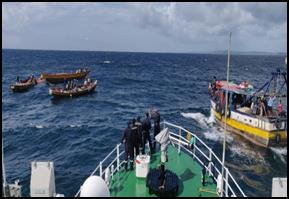


The weather alerts by ICG ships and aircraft were issued in vernacular language on VHF radio. MRCC Mumbai coordinated with various stake holders during the preventive stage and issued advisory to ONGC Control Room on 13 May 21 and 15 May 21 for alerting Oil Rigs and other vessels in Offshore Development Areas (ODAs) to take preventive measures for safety as per their SOPs, monitoring of all Offshore Support Vessels (OSVs)/ support vessels and initiate contingency measures. ICG establishments along the west coast and Lakshadweep islands coordinated with State/UT Fisheries Departments and 7535 Indian Fishing boats were accounted by the Fisheries departments at various ports/harbour/sea.


ICG Efforts Towards Severe Cyclonic Storm ‘YAAS’


Consequent to prediction by IMD regarding a low pressure over East Central Bay of Bengal and adjoining North Andaman sea around 22 May 21, ICG had initiated multiple preventive measures w.e.f. 18 May 21. ICG lower formation Headquarters on east coast including A&N Islands alerted

Port authorities and merchant vessels at anchorages alerted on weather requesting for initiating preventive measures and proceed to safety. ICG Headquarters based on the East Coast/A&N Islands coordinated with local state/UT authorities for initiating preventive measures and also attended various coordination meetings for cyclone preparedness on video conferencing. 12-15 ICG ships and 02-03 Dornier aircraft were deployed daily on east coast and A&N Islands for alerting fishing boats to take shelter, merchant vessels transiting through area to clear path of cyclone and merchant vessels anchored at various ports to pick up anchor and move to safe area.

The weather alerts by ICG ships and aircraft were issued in vernacular language on VHF radio. CGDHQ-6 issued advisory to ONGC for alerting Oil Rigs and other vessels in Offshore Development Areas (ODAs) to take preventive measures for safety as per their SOPs, monitoring of all Offshore Support Vessels (OSVs)/ support vessels and initiate contingency measures.  ICG coordinated with operators and Single Point Mooring (SPM) operations were suspended by all operators due to impending cyclone.
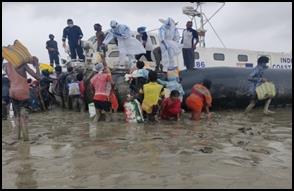
 

Evacuation of Stranded Personnel during Cyclone ‘YAAS’.    


CGDHQ-8 Haldia received information from State Administration about stranded personnel at Nayachara Island on 26 May 21. Immediately, 02 Air Cushion Vehicles (ACVs) were launched and 77 stranded people from Nayachara Island were evacuated by hovercrafts.


Assistance to Neighbouring Countries/Foreign Vessels


Operation ‘Sagar Aaraksha-II’ off Colombo


MV X-Press Pearl a Singapore registered container vessel anchored about 9.5 nautical miles northwest of Colombo reported fire at No 2 hold on 20 May 21. The ship was awaiting permission to enter Colombo port and was carrying 1,486 containers carrying multiple type of cargo viz. Nitric Acid, LDPE, Sodium Hydroxide alongwith other chemicals and cosmetics. However, the fire was reported extinguished by pumping CO2 into hold using shipboard system. The fire was re-ignited on 25 May 21. The situation further deteriorated with rapid explosions on the vessel and converted to Major fire engulfing entire ship and the crew were evacuated safely. In order to contain the major fire onboard and to mitigate the potential threat to marine environment from the likely oil spill, assistance was sought by Sri Lankan authorities through High Commission of India (HCI) at Colombo and South Asia Co-operative Environment Programme (SACEP). Upon receipt of the request, an operation codenamed “Sagar Aaraksha II” was launched and ICGS Vaibhav undertaking surveillance in Gulf of Mannar (GoM) was diverted to augment the firefighting efforts. Additionally, ICGS Vajra was deployed from Tuticorin with five Divers and PR equipment/material for enhancement of support. ICGS Vaibhav and ICGS Vajra spearheaded the firefighting efforts in coordination with four OSVs viz. Posh Teal, Astro Capella, Boka Expedition and Panama using external firefighting systems. CG aircraft was launched from Chennai on 26 May 21 for aerial reconnaissance.

ICGS Samudra Prahari, a specialised Pollution Response Vessel was also deployed and the vessel arrived onscene on 29 May 21. ICGS Samudra Prahari, ICGS Vajra and ICGS Vaibhav carried out multiple FIFI runs on MV X-Press Pearl using AFFF and Seawater. Foam was continuously sprayed on the casualty with concentrated efforts at midship area and funnel. With consistent firefighting for a duration of six days, the fire was completely doused on 01 Jun 21.

On 09 Jun 21, the salvor confirmed that most of the bunker and other oil incinerated during fire and also the sheen near the vessel was not indicative of HFO/Oil spillage. The Operation ‘Sagar Aaraksha II’ was therefore terminated on 11 Jun 21. Operation ‘Sagar Aaraksha II’ provided a much needed succor to our neighbouring country in the line of Prime Minister’s Vision of “Neighbourhood First Policy” and succeeded in avoiding major maritime disaster.


Coastal Security


SOP on Joint Coastal Patrol (JCP) by ICG and Coastal Police
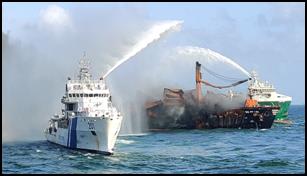
 

Joint Coastal Patrol (JCP) by ICG and Coastal Police for enhancing coastal security, enshrined in the Prime Minister’s Vision Document, was instituted in   Aug 20. Despite challenges posed by COVID-19, enhanced co-ordination and synergy between local Coastal Police personnel and ICG units resulted in timely commencement of JCP on 15 Aug 20. A total of 383 sea sorties, 199 classroom instructions and 985 personnel have been embarked onboard for JCP sortiesfrom 01 Jan21 till to date.


Search & Rescue


National Maritime Search and Rescue Board Meeting


The 19th National Maritime SAR Board Meeting was conducted at Vigyan Bhawan, New Delhi on 25 Nov 21. The meeting was chaired by DGICG K Natarajan PVSM, PTM, TM Chairman, National Maritime Search and Rescue Board and Chief Guest were Dr.  Sanjeev Ranjan, IAS, Secretary (Shipping), Shri Jatindra Nath Swain, IAS, Secretary (Fisheries). Fisheries officials from Tamilnadu, Gujarat & Kerala presented their status of various safety measures and initiatives being progressed.


SARCOMEX


SAR Communication Exercise (SARCOMEX) are conducted by ICG with adjoining countries MRCCs & RCCs to strengthen the Regional SAR services, develop interoperability and capacity building. ICG initiative to engage maritime nation in Indian Ocean Region has resulted in first hand exposure of MRCC operator on distress communication. During current year 2021 ICG engaged in 14 SARCOMEX with 11 countries.

          (a)      Government of India has designated Indian Coast Guard as the      Indian implementing agency for SAR in Indian Ocean Rim Ocean      Association (IORA).

          (b)      MoD, GoI has also nominated ICG as the Nodal Agency for SAR       xin the Indo Pacific Region.

          (c)      During current year 2021, ICG units have saved 494 lives and        have carried out 10 Medevac operations.


IMO Award for Exceptional Bravery at Sea


          Every year, International Maritime Organisation (IMO) confers award for exceptional bravery at sea.  The purpose of the award is to provide an unique, international recognition for those who, at the risk of losing their own life, perform acts of exceptional bravery, displaying outstanding courage at sea. This award is conferred on individuals or groups of individuals (viz ship/ SQN/ MRCCs/ MRSCs/ MRSSCs etc) who, perform acts of exceptional bravery in attempting to save life at sea or in attempting to prevent or mitigate damage to marine environment. Winner of the award is presented with a medal, which is accompanied by a certificate citing act of exceptional bravery performed. Government of India has approved forwarding of two nominations from ICG every year for ‘IMO Award for Exceptional Bravery at Sea’ w.e.f. 2014. The nomination of four ICG team members from Sarang for preparing the tow of the abandoned VLCC MV New Diamond on fire off Sri Lanka coast was forwarded by DGS to IMO as India’s nomination to IMO Bravery Awards 2021. IMO has awarded ‘Certificate of Commendation’ to the ICG team.


          Approval-in-Principle for setting up of 29 MRSCc


MoD, GoI accorded Approval in principle for setting up of 29 MRSCs vide MoD letter No. 17(18)/2020-D(CG) dated 24 Jun 21 with an allocation of Rs. 43.89 crore   under capital head Rs. 22.11 crore and under Revenue head. Rs. 21.78 crore.


International Cooperation


Visit of Indian Coast Guards Ships to Foreign Countries.


          Overseas Deployment (OSD) of ICGS Samrat


ICGS Samrat with integral helicopter was deployed from 24 Oct 21 to 01 Nov 21 to Gan, Maldives for ferrying replacement ALH helicopter (CG 854) from Kochi to Gan, Maldives and bringing ALH helicopter (CG 853) from Gan, Maldives to Kochi for routines alongwith EEZ surveillance off Maldives.


          Overseas Deployment (OSD) of ICGS Vajra


ICGS Vajra with integral helicopter (CG-817), ICGS Apoorva and CGDO ex 747 Sqn (CG), CGAE, Kochi visited Maldives from 20-24 Nov 21 to conduct Trilateral Maritime Exercise DOSTI-XV amongst Coasts Guards of India, Maldives and Sri Lanka to consolidate the professional and working relationship with the Coast Guard of respective countries.


Capacity & Capability Building of Foreign Coast Guard Agencies


          Conduct of Maritime Law & Ops Course


ICG conducted Maritime Law and Ops Course at CGTC, Kochi for officers and sailors from 06 Sep – 01 Oct 21 and 04-22 Oct 21 respectively online due to COVID-19 pandemic.  16 officers and 21 sailors from Coast Guard agencies from FFCs viz; Bangladesh, Equatorial Guinea, Ghana, Ivory Coast, Kenya, Mauritius, Myanmar, Nigeria and Namibia were trained in the course.


Training and exercise


Training on Marine Oil Finger Printing


ICG and Japan Coast Guard (JCG) collaborate with each other under provisions of Memorandum of Cooperation (MoC) towards ‘Establishment of Collaborative Relationship to Combat Crimes at Sea and develop Regional Cooperation’ between ICG and JCG. As part of professional interaction and exchange of best practices, the National Strike Team of JCG conducted a two-day online training on ‘Marine Oil Finger Printing and Hazardous Noxious Substances Response’ for ICG officers on 22 and 23 Jun 21. ICG is the central coordinating agency for oil spill response in India and also Competent National Authority under SACEP for response to Oil and Chemical Pollution in South Asian Seas.


          Trilateral Exercise ‘DOSTI-XV’ at Male


Trilateral Exercise ‘DOSTI-XV’ was conducted at Male between 20 to 24 Nov 21. ICG Ship Vajra with integral Chetak helicopter, Apoorva and ICG Dornier participated in exercise alongwith ships from Sri Lanka(CG) and MNDF(CG), Maldives. Maldives Defence Minister, ADG ICG, DG SLG, Chief of Defence Force (MNDF) and Commander, MNDF witnessed the DOSTI-XV exercise. During the exercise, for the first time officers from Bangladesh Coast Guard (BCG), Seychelles Coast Guard (SCG) and National Coast Guard (NCG) Mauritius participated as an Observers.


Aviation


          Aero India Show 2021
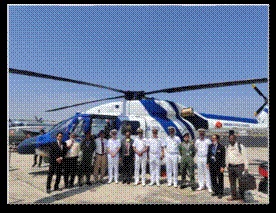
 

Asia’s largest military aviation exhibition  ‘Aero India Show – 2021’ was held at Bengaluru from 04-05 Feb 21 by Department of Defence Production, MoD. The ICG ALH MK-III was the part of the fly past formation during the aero show. Various Aerospace, Maritime and Defence industry participated in the show to achieve the envisaged vision “Aatmnirbhar Bharat’. The ICG represented and show cased its aviation capabilities. A presentation was also delivered by DGICG on ‘Collaborative and Cooperative Mechanism for Ocean Peacekeeping’ during the IOR Seminar, conducted by DDP in Aero India 2021. Further ALH MK III Helicopter documents were accepted by DGICG accepted from Chief Managing Director  HAL in presence of Raksha Mantri.


16 Advanced Light Helicopters (ALH Mk-III)
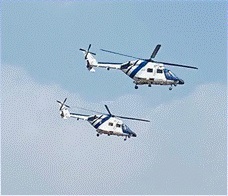
 

The ICG operates a mix of Fixed and Rotary wing aircraft to carry out its Charter including Surveillance, Interdiction, Search and Rescue, Medical Evacuation (MEDEVAC), Causality Evacuation (CASEVAC) etc. With the growing maritime trade and increased commercial activities in our Maritime Zones, there is a need for enhanced surveillance which necessitates commensurate fleet augmentation both for Fixed and Rotary wing platforms. Towards this end, a Contract for supply of 16 ALH Mk-III aircraft to the ICG was concluded with  HAL, Bangalore on 29 Mar 2017. The helicopters are being fitted with 19 state-of-the-art equipment such as Surveillance Radar, EO-IR Pod, Medical Intensive Care Unit (MICU), AIS, TCAS, and ADELT etc. for maritime roles.


Major Events


          Celebrations of ‘Azadi Ka Amrit Mahotsav” by ICG


To commemorate the 75th anniversary celebrations of our Independence and towards “Azadi Ka Amrit Mahotsav” on 15 Aug 21, Indian Coast Guard hoisted the National Flag at 100 inhabited and uninhabited Islands including.


          17TH Investiture  Ceremony


Defence minister Sh. Rajnath Singh awarded President’s Tatrakshak Medals (PTM) and Tatrakshak Medals (TM) to personnel of Indian Coast Guard for Gallantry/ Distinguished/ Meritorious service during  17th Investiture Ceremony conducted at New Delhi on 09 Oct 21. 21 Gallantry/ Distinguished/Meritorious medals awarded to ICG personnel by Defence Minister in a resplendent Investiture Ceremony.  Defence Minister also interacted with awardees and their families post the ceremony. While speaking at the Investiture Ceremony at the National Stadium Complex, he said the growth of the maritime interest in India was made possible because of the morale, enthusiasm and energy shown by the ICG. 
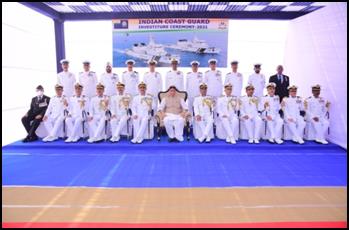
 

Visit of RM and General Bipin Rawat, Chief of Defence Staff


Raksha Mantri Shri Rajnath Singh and General Bipin Rawat, Chief of Defence Staff visited Coast Guard Headquarters on  09 Oct 21 and addressed Coast Guard Commanders and Senior officers during the 38th Coast Guard Commanders Conference conducted between 09-11 Oct 21.  The Raksha Mantri was given a presentation on ICG operational and administrative developments by Director General K Natrajan, PVSM, PTM, TM that complies of ICG Operations including fire-fighting, Search and Rescue, Environment Protection, Anti-Drug trafficking and combating transnational maritime crimes etc. Capacities and capabilities of the Indian Coast Guard including issues pertaining to Coastal Security were also discussed during the visit.


          Coast Guard Commanders Conference


38th Coast Guard Commanders Conference was conducted between 09-10 Oct 21 at ICG HQ, New Delhi. Raksha Mantri Shri Rajnath Singh inaugurated Conference and addressed Commanders/Senior officers of ICG during the Commanders Conference.  The Raksha Mantri was also given a presentation on recent operational and administrative developments by ICG. A wide range of issues pertaining to further strengthening and progressing of ICG as well as legitimate legal maritime issues for safe, secure and clean seas were discussed indepth during the conference.


          Commissioning of ICG Ship Vigraha


Indian Coast Guard Ship Vigraha, the 7th of Vikram Class Offshore Patrol Vessel (OPVs) constructed by  Larsen & Toubro Ltd. Kattupalli, in line with  PM’s vision of ‘Atmanirbhar Bharat- Make in India’ was commissioned at Chennai by  Raksha Mantri Shri Rajnath Singh on 28 Aug 21 in the Presence of  Shri T Thennarasu,  Min of  Industries,  Tamil     Nadu,  Gen MM Naravane COAS, DG Krishnaswamy Natarajan, PVSM, PTM, TM, Director General Indian Coast Guard, Shri JD Patil,  Director,  L&T and other senior dignitaries of the Central and State Government.


          Commissioning of ICGS Sajag


National Security Advisor Shri Ajit Doval commissioned ICGS Sajag, through video conferencing on 29 May 21 in the presence of Dr. Ajay Kumar, Defence Secretary and Director General K Natarajan, PVSM, PTM, TM, DGICG and other senior dignitaries of the central and state Government. ICGS Sajag is the 3rd in the series of 105 Mtr Offshore Patrol Vessel indigenously designed and built by  Goa Shipyard Limited.


          Commissioning of ICGS Sarthak


Director General K Natarajan, PVSM, PTM, TM, DGICG commissioned ICGS Sarthak on 28 Oct 21 in the presence of COMCG(W), DDG(P&P) & CMD(GSL). ICGS Sarthak is 105 Mtr Offshore Patrol Vessel (OPV) indigenously designed and built by  Goa Shipyard Limited in line with Prime Ministers vision of ‘Make in India’, a fine example of ‘Atmanirbhar Bharat’. The ship will provide significant impetus to maritime surveillance prowess of Indian Coast Guard.


          E-Induction of Advanced Light Helicopter (ALH) MK-III


On 12 Jun 21, signaling a new paradigm in Op preparedness, 03 Advanced Light Helicopter (ALH) Mk-III were inducted into ICG by Dr. Ajay Kumar, Defence Secretary, Govt. of India through video conferencing in the presence of  Director General K Natarajan, PVSM, PTM, TM, DGICG and other senior dignitaries of the central and state Government. 

Defence Research and Development Organisation


Handing over & Supply order of Main Battle Tank Arjun Mk-1A


The MBT Arjun Mk-1A is incorporated with many versatile and improved features over Mk-1, which makes it much more superior battle tank. Crew comfort, advanced land navigation system and enhanced night vision capabilities for both tank commander and driver are some of the progressions. It is a highly potent and dependable war-fighting machine.

The MBT ‘Arjun’ Mk-1A was handed over to the Indian Army by Prime Minister on 14 Feb 2021 and Ministry of Defence (MoD) placed an order with Heavy Vehicles Factory (HVF), Avadi, Chennai for supply of 118 Main Battle Tanks (MBTs) Arjun Mk-1A for the Indian Army on September 23, 2021. The order, worth Rs 7,523 crore, will provide further boost to the ‘Make in India’ initiative in defence sector and is a big step towards achieving ‘Aatmanirbhar Bharat’. 


DRDO Designed and Developed Advanced Electronic Warfare Suite ‘Shakti’ handed over to Indian Navy


Advanced Electronic Warfare (EW) System ‘Shakti’ has been designed and developed by Defence Electronics Research Laboratory (DLRL) Hyderabad a laboratory of Defence Research and Development Organisation (DRDO) for Capital Warships of the Indian Navy for the interception, detection, classification, identification and jamming of conventional and modern Radars. The Shakti EW system will provide an electronic layer of defence against modern radars and anti-ship missiles to ensure electronic dominance and survivability in the maritime battlefield. This system will replace the earlier generation EW Systems of the Indian Navy. This system was handed over to Indian Navy on 19 Nov 2021 by Prime Minister Shri Narendra Modi.

DRDO Handed over Air Defence Missile System to Indian Air Force


The MRSAM (IAF) is an advanced network centric combat Air Defence System developed jointly by DRDO and Israel Aerospace Industries (IAI) in collaboration with the Indian industry comprising of private and public sectors including MSMEs. In a significant boost to India’s defence capabilities, the first deliverable Firing Unit (FU) of Medium Range Surface to Air Missile System was handed over to IAF on September 09, 2021 in the presence of Raksha Mantri.


Handing over of DRDO developed products to Armed Forces


Raksha Mantri Shri Rajnath Singh handed over five Defence Research and Development Organisation (DRDO) developed products to the Armed forces and other security agencies at an event held at DRDO Bhawan, New Delhi on 14 December 2021, as part of Azadi Ka Amrit Mahotsav celebrations and iconic week of Ministry of Defence.

He also handed over six Transfer of Technology (ToT) agreements to seven public and private sector companies. Earlier DRDO organised a Seminar on “Preparing for The Future” where Vice Chiefs of the Armed Forces and DRDO Scientists shared their views. Products handed over to the Armed Forces & Ministry of Home Affairs are Anti-Drone system, Modular Bridge, Smart Anti Airfield Weapon, Chaff Variants and the Light Weight Fire Fighting Suit. 

Advanced Chaff Technology


Advanced Chaff Technology has been developed by DRDO to safeguard the naval ships as well as fighter aircrafts of Indian Air Force (IAF) against hostile radar threats and enemy missile attack. DRDO’s Defence Laboratory Jodhpur, has developed the advanced Chaff material and chaff cartridge-118/I in collaboration with High Energy Materials Research Laboratory (HEMRL), a Pune based laboratory of DRDO, meeting qualitative requirements of forces.  Chaff is a passive expendable electronic countermeasure technology used worldwide to protect naval ship from enemy’s radar and radio frequency (RF) missile seekers. Successful development of Advanced Chaff Technology is another step towards Atmanirbhar Bharat.


Production lot of 12 Short Span Bridging System (SSBS)-10 m inducted into Indian Army


The SSBS-10 m plays a crucial role of bridging the gaps as a single span providing a wide, fully decked roadway, ensuring faster movement of the troops. This bridging system is compatible with Sarvatra Bridging System. The system will help in quick movement of troops and enhance the mobilization of resources.


Solid Fuel Ducted Ramjet (SFDR)


Solid Fuel Ducted Ramjet has been developed and flight tested by DRDO. During the test, air launch scenario was simulated using a booster motor. Subsequently, nozzle-less booster accelerated it to required Mach number for Ramjet operation. Success of SFDR propulsion technology is a significant milestone which paves way for development of long-range air-to-air missiles in the country.


Maiden launch of New Generation Agni P Ballistic Missile


New Generation Ballistic Missile Agni P was successfully flight tested. Agni P is a new generation advanced variant of Agni class of missiles.


Air Independent Propulsion (AIP) System


DRDO developed a full-scale Land-Based Prototype (LBP) for demonstration of Hydrogen Fuel cell-based AIP System, which when inducted by the Indian Navy would enhance the underwater endurance of conventional submarines. The indigenous system successfully completed 14 days of Endurance Trials. While there are different types of AIP systems being pursued internationally, fuel cell based AIP of DRDO is unique as the hydrogen is generated onboard.


Long Range Surface to Air Missiles (LRSAM)


LRSAM system has been jointly developed by DRDO and Israel Aerospace Industries (IAI), Israel to strengthen air defence capabilities of Indian Navy. The Missile system can provide point and area defence against various aerial targets including fighter aircraft, subsonic & supersonic cruise missiles. It is designed with active Radio Frequency (RF) seeker to identify, track, engage and destroy the target with high kill probability.  Final production batch of LRSAM was flagged off completing the delivery within the given timeline.


ATGMs Helina (Army Version) and Dhruvastra (Air Force Version)


Helina and Dhruvastra are third generation, Lock On Before Launch (LOBL) fire and forget Anti-Tank Guided Missiles that can engage targets both in direct hit mode as well as top attack mode. The system has all-weather day and night capability and can defeat battle tanks with conventional armour as well as with explosive reactive armour. It is one of the most-advanced anti-tank weapon in the world.


Man Portable Anti-tank Guided Missile (MPATGM)


In a major boost towards Atmanirbhar Bharat and strengthening of Indian Army, DRDO flight-tested the indigenously developed low weight, fire and forget Man Portable Antitank Guided Missile (MPATGM). The missile incorporates state-of-the-art Miniaturized Infrared Imaging Seeker along with advanced avionics.


Vertical Launch of Short-Range Surface to Air Missile (VL-SRSAM)


The missile has been developed for the Indian Navy for neutralizing various aerial threats at close ranges including sea-skimming targets. Two vertical launches of the missile were carried out and on both the occasions, VL-SRSAM intercepted the simulated targets with pinpoint accuracy. The missiles were tested for minimum and maximum ranges.


New Generation Akash Missile (Akash-NG)


The successful flight trial of New Generation Surface to Air Akash-NG Missile was conducted from a land-based platform with all weapon system elements such as Multifunction Radar, Command, Control & Communication System and launcher participating in deployment configuration. The missile successfully demonstrated high manoeuvrability required for neutralising fast and agile aerial threats. Akash-NG weapon system will prove to be a force multiplier for the air defence capability of the Indian Air Force. 

Maiden Flight Test of Akash Prime Missile


A new version of the Akash Missile – ‘Akash Prime’ was successfully flight tested. In comparison to the existing Akash System, Akash Prime is equipped with an indigenous active Radio Frequency (RF) seeker for improved accuracy.


          Flight Test of Vertical Launch Short Range Surface to Air Missile


Vertical Launch Short Range Surface to Air Missile was successfully flight tested on 07 Dec 2021.  The launch was conducted from a vertical launcher against an electronic target at a very low altitude. The launch of the system was conducted to validate integrated operation of all weapon system components including the vertical launcher unit with controller, canisterised flight vehicle, weapon control system etc. required for future launches of the missile from Indian Naval Ships. The first trial was conducted on 22 February 2021 and this is confirmatory trial to prove the consistent performance of the configuration and integrated operation. 

Air version of BrahMos supersonic cruise missile


Air version of BrahMos supersonic cruise missile was successfully test fired from the supersonic fighter aircraft Sukhoi 30 MK-I on 08 December 2021. BrahMos is a Joint Venture between India (DRDO) and Russia (NPOM) for the development, production and marketing of the supersonic cruise missile. The launch is a major milestone in the BrahMos development. It clears the system for the serial production of air-version BrahMos missiles within the country.


Successful tests carried out for Pinaka Extended Range System, Area Denial Munitions & New Indigenous Fuzes


Successful tests of Pinaka Extended Range (Pinaka-ER), Area Denial Munitions (ADM) and indigenously developed fuzes have been carried out at various test ranges. The Pinaka-ER Multi Barrel Rocket Launcher System was successfully tested. The system is jointly designed by laboratories of Defence Research and Development Organisation (DRDO) – Armament Research & Development Establishment (ARDE), Pune and High Energy Materials Research Laboratory (HEMRL), Pune.


DRDO & Indian Air Force successfully flight-test indigenous Stand-Off Anti-Tank Missile


Defence Research and Development Organisation (DRDO) and Indian Air Force (IAF) flight-tested the indigenously designed and developed Helicopter launched Stand-off Anti-tank (SANT) Missile on 11 December 2021. The missile is equipped with a state-of-the-art MMW seeker which provides high precision strike capability from a safe distance. The weapon can neutralise targets in a range up to 10 kms. The SANT missile has been designed and developed by Research Centre Imarat (RCI), Hyderabad in coordination with other DRDO labs and participation from industries.


          Supersonic missile assisted torpedo system


Defence Research and Development Organisation (DRDO) developed supersonic missile assisted torpedo system was successfully launched on 13 December 2021. The system is a next generation missile-based standoff torpedo delivery system. The system has been designed to enhance anti-submarine warfare capability far beyond the conventional range of the torpedo. 


          Enhanced Range 122mm Caliber Rocket


Defence Research and Development Organisation (DRDO) successfully test fired enhanced range versions of indigenously developed 122mm Caliber Rocket from a Multi-Barrel Rocket Launcher (MBRL) on 25 June 2021. These rockets have been developed for Army applications and can destroy targets up to 40 km.  The rocket systems have been developed jointly by Pune-based Armament Research and Development Establishment (ARDE) and High Energy Materials Research Laboratory (HEMRL) with manufacturing support from  Economic Explosives Limited, Nagpur.


Flight Tests of Indigenously-Developed Smart Anti-Airfield Weapon


Two flight tests of indigenously-developed smart anti-airfield weapon have been carried out jointly by Defence Research & Development Organisation (DRDO) and Indian Air Force (IAF). The two different configurations based on satellite navigation and electro optical sensors have been successfully tested. Electro optical seeker based flight test of this class of bomb has been conducted for the first time in the country. The electro optic sensor has been developed indigenously. The weapon was launched by an IAF aircraft. 

Flight Trials of ABHYAS -High-Speed Expendable Aerial Target (HEAT)


ABHYAS is an expendable high-speed unmanned aerial target, being developed by DRDO. The configuration of ABHYAS is designed on an in-line small gas turbine engine and uses an indigenously developed MEMS based navigation system for its navigation and guidance. Three successful flight trials of ABHYAS were conducted from ITR Balasore, Odisha. During the test campaign, the user requirements were successfully achieved. The vehicle can be used as the target for the evaluation of various missile systems.


First indigenous 9mm Machine Pistol jointly developed by DRDO and Indian Army.


Infantry School, Mhow and DRDO’s Armament Research & Development Establishment (ARDE), Pune jointly designed and developed the 9 mm Machine Pistol in record time of four months. The weapon has huge potential as personal weapon for heavy weapon detachments, commanders’ tanks and aircraft crews, drivers/dispatch riders, radio/radar operators, closed quarter battle, counterinsurgency and counter terrorism operations etc. The weapon is named “Asmi” meaning “Pride”, “Self-Respect” and “Hard Work”.                                                               


Light Weight Bullet Proof Jacket


To make the soldiers more comfortable, light weight Bullet Proof Jacket (BPJ) weighing 9.0 kilogram, has been developed for the India Army. The importance of this vital development lies in the fact that each gram of BPJ weight reduction is crucial in enhancing soldier comfort while ensuring the survivability. This technology reduces the weight of the medium sized BPJ from 10.4 to 9.0 kg.                                                                                       


Single Crystal Blades Technology


Helicopters used in defence applications need compact and powerful aero-engines for their reliable operation at extreme conditions. To achieve this, state-of-the-art Single Crystal Blades having complex shape and geometry, manufactured out of Nickel based super alloys capable of withstanding high temperatures of operation are used. DRDO developed single crystal blades technology and supplied 60 of these blades to Hindustan Aeronautics Limited (HAL). Very few countries in the world such as USA, UK, France and Russia have the capability to design and manufacture such Single Crystal (SX) components.


CRPF Uses Casualty Transport Bike “Rakshita”


Rakshita, a bike-based casualty transport emergency vehicle was handed over to Central Reserve Police Force (CRPF). The bike ambulance will help in overcoming the problems faced by Indian security forces and emergency healthcare providers. Rakshita is fitted with a customized reclining Casualty Evacuation Seat (CES), which can be fitted in and taken out as per requirement, a head immobilizer, safety harness jacket, hand and foot straps for safety, adjustable foot rest, physiological parameter measuring equipment with wireless monitoring capability and auto warning system for driver.


Bilateral Innovation Agreement between DRDO & Directorate of Defence R&D, Israel


As a tangible demonstration of the growing Indo–Israeli technological cooperation, Defence Research and Development Organisation (DRDO) and Directorate of Defence Research and Development (DDR&D), Ministry of Defence, Israel have entered into a Bilateral Innovation Agreement (BIA) to promote innovation and accelerated R&D in startups and MSMEs of both countries for the development of dual use technologies and products in the areas such as Drones, Robotics, Artificial Intelligence, Quantum technology, Photonics, Biosensing, Brain-Machine Interface, Energy Storage, Wearable Devices, Natural Language Processing, etc.


DRDO signed framework MoU with MoRTH for Geo-hazard Management


Defence Research and Development Organisation (DRDO) has entered into a framework memorandum of understanding (MoU) with the Ministry of Road Transport & Highways (MoRTH) to strengthen collaboration in the field of technical exchange and co-operation on sustainable geohazard management. The MoU was signed between Dr G Satheesh Reddy, Secretary DDR&D & Chairman DRDO and Shri Giridhar Aramane Secretary MoRTH. As per the agreement, DRDO and MoRTH will co-operate in various mutually beneficial areas related to geohazard management. The initiative will ensure safety against the adverse effects of landslides and other natural calamities on national highways in the country.  


DRDO Skill Development Centre for Fire Safety Training


Raksha Mantri Shri Rajnath Singh has inaugurated Skill Development Centre (SDC) for Fire Safety Training of Defence Research and Development Organisation (DRDO) at Pilkhuwa in Uttar Pradesh through virtual mode on 22 February 2021. The facility, created by Delhi based DRDO laboratory Centre for Fire, Explosive and Environment Safety (CFEES); is aimed at developing trained human resources, fire safety technology and products to save precious human lives and valued assets. DRDO facility would be utilised for imparting fire prevention and fire-fighting training to the Fire Service personnel of Indian Armed Forces, DRDO, Ordnance Factories, Coast Guard and defence undertakings. In addition, trainees from Bhutan,
Sri Lanka and other neighbouring countries would also be imparted training at the Centre.


DRDO Dare to Dream 2.0 Awards & launch of Dare to Dream 3.0


Raksha Mantri Shri Rajnath Singh felicitated the winners of ‘Dare to Dream 2.0’ Contest of Defence Research & Development Organisation (DRDO) and gave away awards to 40 winners – 22 in Individual category and 18 in Startup category. He also launched ‘Dare to Dream 3.0’ to promote innovators & startups and provide a platform for the young ignited minds in the country.

Dare to Dream is DRDO’s pan-India contest to promote Indian academicians, individuals and startups to develop emerging defence and aerospace technologies/systems. DRDO provides technical and financial support to the winners for realisation of their ideas under the Technology Development Fund (TDF) scheme.


Three products/systems indigenously developed by DRDO were also handed over to the Armed Forces


·ARINC818 Video Processing and Switching Module: The module, developed for the Indian Air Force, was handed over to the Vice Chief of Air Staff. It is a state-of-the-art module with high bandwidth, low latency, channel bonding, easy networking and will cater to 5th generation aircraft development programmes.

·Sonar Performance Modelling System: Developed for the Indian Navy, the system was handed over to Vice Chief of Naval Staff. It is useful for Indian Naval ships, submarines and under water surveillance stations etc.

·Bund Blasting Device Mk-II: The device, developed for Indian Army, was handed over to the Vice Chief of Army Staff. It is used to reduce the height of Ditch-cum-Bund obstacles to enhance the mobility of mechanised infantry during wartime.

Greater linkages between DRDO and academia

A Memorandum of Understanding (MoU) was also exchanged between Prof HA Pandya, Vice Chancellor, Gujarat University and Secretary Department of Defence R&D and Chairman DRDO Dr G Satheesh Reddy for establishing an Advanced Technology Centre ‘Sardar Vallabhbhai Patel Centre for Cyber-Security Research’ at Gujarat University for conducting directed research in cyber security.

Corporate Initiatives


Enabling Industry


DRDO has been nurturing as well as encouraging industry to take up defence manufacturing. Today, more than 2000 industry partners have joined hands with DRDO in delivery of components, subsystems, systems, platforms and technologies for Indian Armed Forces. Many industries have achieved the capability and the capacity to become the lead system integrator. The technology of all systems is transferred to the Indian Industry for production and supply

Many of the defence technologies developed by DRDO have good potential and utility for application in commercial market too and are transferred to the industry for commercial exploitation. DRDO nurtured industry partners have become part of global supply chain and have started exports of DRDO developed systems to friendly countries. Some of the initiatives to nurture Indian industry for defence production are as follows:


          Transfer of Technology (ToT)


DRDO provides the relevant ‘know-how’ in the form of Technology Transfer Documents (TTD) and handholding support to Indian industry. Technology is transferred to Development cum Production Partner (DcPP) / Development Partner (DP) / Production Agency (PA) without any ToT Fee and to other industries with a one-time ToT Fee @5% of total project sanction cost. Royalty is not charged on net sales to Indian Armed Forces and other Govt Departments. 2% royalty is applicable for sales in Indian commercial market and exports. Details are available at website https://drdo.gov.in/transfer-.


          Technology Development Fund (TDF)


In TDFa corpus fund of Rs. 100 Cr has been created to enable Indian industries, specially MSMEs, for indigenisation of the defence products, sub systems and components. The fund may also be utilised for developing new technologies as required by DRDO, Services and DPSUs. The cost of each project under TDF can be up to Rs 10 Cr. The industry can get funding up to 90% of the project cost. Details are available at website https://tdf.drdo.gov.in.


          DRDO Patents for Indian Industry


All patents and relevant intellectual publications are available on DRDO website. These can be used by Indian industry free of cost. For any further support, DRDO is ready for handholding and for working out the modalities.


          Development and Production Partner


DRDO engages industry as Development Cum Production Partner (DcPP) /Development Partners (DP) / Production Agency (PA) during the execution of its projects and programmes. The selection of industries is carried out based on procurement rules and procedures.


          Testing Support


A number of advanced test facilities & equipment are available at Labs for trial & testing of the products before acceptance by the User. DRDO provides access to the world-class high-end test facilities to Indian industries involved in designing, developing and manufacturing. The list of these Test Facilities is given on DRDO website. This assures development of high-quality defence products.


          Evaluation and Certification Support


DRDO provides unique certification to niche industry for aerospace & crypto products. CEMILAC provides certification support to industry for military airworthiness. SAG, Delhi provides testing and certification support for IT and crypto products developed by industries on request of Services.


          DRDO Products for Export


DRDO developed products have created interest among Nations. Some systems like radars, Akash missiles & simulation systems have been exported.


          Enhanced Integration with Academia


A regular MTech program in Defence Technology has been launched by DRDO and AICTE to impact necessary theoretical and experimental knowledge, skill and aptitude in various defence technology areas. Program will motivate aspiring engineers help the country achieving Atmanirbhar Bharat. DRDO also signed MoU with Gujarat University, Ahmedabad, & Institute of Infrastructure Technology Research and Management, Gandhinagar for introduction of Defence Technology courses in their Post Graduate and B.Tech courses respectively and courses started from Feb 2021. Ten Centre of Excellences are operating to encourage research in frontier Science & Technology related to defence.


Contributions during Second Wave of COVID-19


The DRDO gave best when Nation needed most. DRDO has spread message of hope with its nimble transformation from missiles-maker to mask-designer and main battle tank designer to an innovator for saving lives. Summary of major efforts made by DRDO during the second wave of COVID-19 is listed below:


a. DRDO Covid Care Hospitals       DRDO had constructed the 1000 bed makeshift hospital in Delhi in record time of 11 days during first wave. Based on this efficient and effective model of augmenting healthcare infrastructure, during more virulent second wave, DRDO constructed 11 more Covid Care hospitals at various locations across the country including Delhi, Ahmedabad, Lucknow, Varanasi, Gandhinagar, Rishikesh, Haldwani, Jammu, Srinagar, Guwahati and Imphal.  These hospitals were constructed and made operational for meeting the local needs.

b.        Medical Oxygen Plants (MOP) Based on DRDO technology, 931 Nos. of Medical Oxygen Plants were installed & commissioned at 869 sites across the country funded by PMCARES, to make medical oxygen available to COVID patients. These Medical Oxygen Plants are designed for a flow rate of 1,000 litres per minute (LPM). The system can cater to 190 patients at a flow rate of 5 LPM and charge 195 cylinders per day. The Medical Oxygen Plant (MOP) technology has been developed by DRDO based on the On‐Board Oxygen Generation for LCA, Tejas. These plants will overcome the logistics issues of oxygen transportation and help COVID-19 patients in emergency.

c.  Oxycare Oxygen Supply System DRDO has developed a unique system, Oxycare which senses the individual’s SPO2 level and accordingly regulates oxygen supply from a cylinder. This helps to optimise the quantity of oxygen used by the patient. Funded through PMCARES, 1.5 lakhs such systems have been ordered by Govt. of India. Under this sanction, 1,00,000 manual and 50,000 automatic Oxycare systems along with non-rebreather masks are being procured.

d.  2-deoxy-D-glucose (2-DG)

               An Anti-COVID-19 therapeutic application of the drug 2-deoxy-D-glucose (2-DG) was developed by Institute of Nuclear Medicine and Allied Sciences (INMAS), a lab of DRDO, in collaboration with Dr Reddy’s Laboratories (DRL), Hyderabad. Drug Controller general of India (DCGI) has approved the emergency use of this drug. It can be administered only upon prescription and under the supervision of a qualified physician to hospitalised moderate to severe COVID-19 patients as an adjunct therapy to the existing standard of care.


Conclusion


DRDO, being the guiding force, has made giant strides in strengthening self-reliance in complex defence technologies, weapon systems and platforms. The organization has been a torch bearer for advanced technology development and has provided thrust to Aatmanirbhar Bharat. In this endeavor, the initiatives, guidelines and policies rolled by the organization has created an ecosphere. DRDO alongwith academia, MSMEs, Production Agencies, Startup, TDF partners etc. form the part of the defence R&D ecosphere. This enabled ecosphere will achieve complete self reliance in defence; work coherently in new technological area; strive for better field worthy products; generate employment and harness new talents in the industry.

DRDO has also developed many technologies and products to combat COVID and has played an important role in indigenous development of ventilators, PPEs, masks, hospitals, COVID drug and oxygen plants during the critical time of pandemic. All  these enabling technologies have led India into and era of Aatmanirbhar Bharat


Border Road Organisation


Infrastructure


          Inauguration of 75 Projects of Roads and Bridges by  Raksha Mantri


On 28 June 2021, Raksha Mantri Shri Rajnath Singh inaugurated 75 Projects of Roads and Bridges constructed by BRO in six States and two Union Territories (UTs).  These Projects, 63 Bridges and 07 Roads, were dedicated to the Nation by Raksha Mantri in a ceremony which took place at Kyungam, 88 kms from Leh in the Union Territory of Ladakh.  Chief Minister, Arunachal Pradesh, Shri Pema Khandu, Chief Minister, Himachal Pradesh, Shri Jairam Thakur, Chief Minister, Uttarakhand, Shri Tirath Singh Rawat, Chief Minister, Sikkim, Shri Prem Singh Tamang, Minister of State (Independent Charge) for Development of North Eastern Region & Minister of State, PMO, Dr Jitendra Singh; MP from Jammu & Kashmir Shri Jugal Kishore Sharma, MPs from Uttarakhand & Mizoram Shri Ajay Tamta & Shri C Lalrosanga respectively among those who attended event virtually. 


Raksha Mantri virtually dedicated to the Nation 24 bridges & three roads built by BRO in four States & two Union Territories


Raksha Mantri dedicated to the Nation 24 bridges and three roads, built by BRO in four States and two Union Territories, through a virtual event from New Delhi on December 28, 2021. Of the 24 bridges, nine are in Jammu & Kashmir; five each in Ladakh & Himachal Pradesh; three in Uttarakhand and one each in Sikkim & Arunachal Pradesh. Of the three roads, two are in Ladakh and one is in West Bengal. The main highlight was the inauguration of India’s first indigenous Class 70 140-feet Double-Lane Modular Bridge, built at the height of 11,000 feet at Flag Hill Dokala, Sikkim and Chisumle-Demchok road at Umling La Pass at over 19,000 feet in Ladakh which also holds the Guinness World Record of world’s highest motorable road.


          Guinness World Record for Constructing Highest Motorable Road


BRO constructed road over Umling La Pass, in Eastern Ladakh, at 19,024 ft above sea level has now officially become the highest motorable road in the world, a record previously held by a road in Bolivia at 18,953 ft enroute to volcano Uturuncu. On 16 Nov 2021, in an online ceremony organised by the official adjudicator from Guinness World Record, United Kingdom, the award was conferred to BRO, Lt General Rajeev Chaudhry, VSM, DGBR received the award on behalf of BRO. The 52 Km long road connecting Chismule to Demchok is approximately 15 km from the LAC and assumes strategic importance. Its construction is expected to enhance the socio-economic conditions of the locals and will promote tourism in the remote border areas of Ladakh.


          Final Breakthrough Blast of Sela Tunnel


On 14 Oct 2021,  Raksha Mantri Shri Rajnath Singh, through e-ceremony, carried out the last blast of 1555 m long Sela Main Tunnel (T2) in West Kameng District of Arunachal Pradesh. The tunnel is being constructed on important Balipara-Charduar-Tawang Road (B-C-T).  Once completed the Sela Tunnel will be the longest bi-lane tunnel at altitude above 13000 ft, the second tunnel of Sela Tunnel project, of 980 m length, which started this year has also crossed the 700 m mark. The completion of tunnel in 2022 will facilitate uninterrupted move of troops across the important Sela Pass and will provide all weather connectivity to the regions ahead of Tawang till the important Indo-China borders.


Capability Development


          Inauguration of Centre of Excellence on Road safety & Awareness (CoERSA) & Centre of Excellence for Roads, Bridges and Tunnelling (CoERBAT)


Raksha Mantri on 11 Jun 2021, inaugurated Centre of Excellence on Road safety & Awareness (CoERSA) & Centre of Excellence for Roads Bridges and Tunnelling (CoERBAT), established by BRO at Seema Sadak Bhawan. These Institutions were established by BRO with an aim to spread greater Road Safety Awareness amongst the public and also focus on aspect of Road Safety through Audit followed by analysis & remedial actions. CoERSA and CoERBAT will focus on institutionalising the knowledge gained over the years by BRO in development of roads, bridges, airfields and tunnels.


Adventure


          Ind@75 BRO Motorcycle Expedition


The first of its kind “India@75 BRO Motorcycle Expedition” was flagged off by  Raksha Mantri Shri Rajnath Singh from New Delhi on 14 Oct 2021. The 5th leg of the expedition is in progress and has so far completed 50 days since it was flagged off, the expedition will traverse approximately 20000 Kms with 75 Riders over 75 Days to celebrate India’s 75 Years of Independence, the aim of Expedition is to touch cord with the citizens on themes of “National Integration, Nation Building & Road Safety Awareness”. The Expedition will culminate on 27 Dec 2021 at New Delhi,  Raksha Rajya Mantri Shri Ajay Bhatt is expected to Flag in the team.


Women Empowerment


Women Officers for construction of Important Infra in Border Areas


First time in the history, Border Roads Organisation appointed women officers to command important Road Construction Companies (RCC) along border areas. In Apr 2021, EE (Civil) Vaishali S Hiwase, a GREF officer took over the reins of 83 Road Construction Company and was employed on an important Indo-China Road connecting Munisairi-Bughdiar-Milam. On August 30, 2021, Major Aaina Rana took charge as CommandingOfficer, 75 RCC at Pipalkoti in Chamoli District in Uttarakhand and became the first Indian Army Engineer Officer to command a road construction company, also all three platoon commanders under her, Captain Anjana, AEE (Civ) Ms Bhawana Joshi, and AEE (Civ) Ms Vishnumaya K have together created the first-ever women RCC. 

National Cadet Corps


Camp Training


The normal physical training has resumed in NCC from September 2021. All mandatory camps and adventure activities are being conducted.


Ek Bharat Shreshtha Bharat (EBSB)   


NCC Cadets of all the State Directorates participated in the online EBSB weekly Camps every month. During these online webinars are conducted wherein three hours daily interactive sessions based on cultural exchange were organized, between the paired Guest & Host State Directorate cadets. NCC Cadets of all the State Directorates participated in the online EBSB weekly Camps every month. Total 196 online camps were conducted till Nov 2021.


Online Training During COVID


Due to the COVID situation Online Training continued during the Year 2020-21.  Extensive use of Mobile Training App version 1.0 and Version 2.0 were resorted to by the Cadet for training.  However, all certification examination was conducted offline. 


Special National Integration Camps (SNICs)


A total of Six SNICs were conducted in the remote geographic extremities of the Nation at Srinagar/ Leh, Jaisalmer, Kakinada, Lakshadweep, Port Blair & Kohima/ Dimapur for a strength of 300 cadets each. SNIC Delhi was held between 08 Nov and 20 Dec 2021 with the strength of 50 cadets and 02 ANOs.


Flying Training


Due to Covid 19 restricted flying was carried out in the training year 2020-21 and in the current training year. The efforts are on for formalizing the Flight Safety section of NCC Air wing. This would facilitate accident investigation within the time frame and timely implementation of CoI recommendations. Three directorates have procured simulators for introducing cadets to the flying environment.


Yachting Special Training Camps.


102 Naval cadets qualified Yachting All India Level I/II/III exams.  Increase from one to four nodes has been undertaken. The same was conducted from 08 Dec to 15 Dec 2021 at Bhopal, Kochi, Vishakhapatnam and Goa.


Rock Climbing Training Camp (RCTC).  


RCTC was conducted by NCC Directorate MP&CG for SD (273 cadets and 10 ANOs) and SW (273 cadets and 10 ANOs) cadets w.e.f 10 Nov to 28 Nov 2021 and 02 Dec to 20 Dec 2021 respectively in Gwalior (MP).

Republic Day Camp (RDC).


Republic Day Camp is conducted at Army Parade Ground, Delhi Cantt from 01 to 29 January, every year in Delhi. The Camp is attended by approx. 2070 cadets from all over India and approx. 15 Officers and 100-120 cadets of friendly foreign countries also attend the Camp from 15 January to 29 January as guests of the NCC. The Camp is traditionally inaugurated by the Vice President of India on 06 Jan and culminates with the Prime Minister’s Rally on 28 Jan. During RDC-21 the number of participating cadets was restricted to 597 due to COVID restrictions.


          Attachment Training

          (a)      Increase in Army attachment, from 20000 to 28000, IMA attachment from 120 cadets to 250 cadets and OTA attachment from 50 cadets to 100 cadets, increase in Overseas Deployment (OSD) by IN vacancies is planned from 20 to 30 cadets.

          (b)      OSD with Coast Guard is being taken up.


Training App Launch Ver 01 & 02


          NCC Training App Version 1 was launched by Raksha Mantri on 27 Aug 2020 through an online ceremony. NCC Training App version 2.0 was launched on 28 May 2021 by Def Secy. The App includes Brief on NCC, Syllabus, Precis, Interactive Videos, Frequently Asked Questions and also Query by Cadets. Online training of cadets under guidance of respective ANOs is under progress.


Azadi Ka Amrit Mahotsav events and Social Service and Community Development activities


Paying Tribute to Fallen Heroes    


As part of celebration of Azadi ka Amrit Mahotsav in the month of August 2021, cadets of NCC paid tribute to fallen heroes, war heroes and freedom fighters by organizing cleaning of statues and organising Poem Recitation, Nukkad Natak  at 75 locations. NCC also conducted felicitation of NoKs of Fallen  heroes at 13 locations which were broadcasted live on Gallantry Web Portal.


Fit India Freedom Run 2.0


Fit India Campaign 2.0 was launched by Ministry of Youth & Sports Affairs on 13 Aug 2021. Cadets and Staff of NCC also actively participated in the event and are registered on portal directly as per the directions of MoYA. Event culminated on 02 Oct 2021. Around 12.5 lakh cadets participated in the event.


Clean India Campaign 


NCC participated in the Clean India Campaign conducted under the aegis of Ministry of Youth & Sports Affairs in the month of Oct 2021. 260705 NCC cadets have participated in the Campaign.


Adoption of Statues


Each NCC Unit has adopted statue of prominent persons/fallen heroes in their Area of Responsibility. NCC has adopted 2187 statues which are cleaned on weekly basis. One such event is live webcasted on Gallantry Web Portal every week since July 2021.      


Ganga Utsav


NCC participated in Ganga Utsav – A River Festival conducted under the aegis of National Mission for Clean Ganga (NMCG) from 1st to 3rd November 2021 to contribute towards conservation, rejuvenation of Ganga and other major rivers across the country through awareness programmes and youth participation. 41,228 NCC cadets participated in the event.


Vijay Shrankhala Aur Sanskritiyon Ka Maha Sangam


NCC conducted ’Vijay Shrankhala Aur Sanskritiyon Ka Maha Sangam’ mega event by carrying out felicitation of 75 fallen  heroes of 1971 War at 75 locations across the country and congregation of cadets from all State Directorates at New Delhi for the mega event which showcased the culture of their respective region. This event was conducted from 28 Nov 2021 to 17 Dec 2021 and highlighted the theme of ‘Unity in Diversity’.  Raksha Mantri was the Chief Guest for the closing ceremony.


Puneet Sagar Abhiyan


NCC now plans to carry out a nationwide campaign to Clean Sea Shores/Beaches of the plastic waste & other waste along the Sea Shores and increase awareness about importance of keeping the Sea shores free from Plastic waste. A total of 3,40,000 cadets from 127 Coastal Area NCC Units will participate in the month-long activity from 01- 30 Dec 2021.


Shaheedon Ko Shat Shat Naman   


NCC plans to undertake a mega event ‘Shaheedon ko Shat Shat Naman’, throughout the Nation including the National Capital in concert with the Republic Day Celebration on 26 January 2022. In the event, NOK of each fallen heroes of all three services, pan India, will be visited by NCC Offrs/ Permanent Instructor Staff & Cadets of the State Directorates and presented with a plaque on 26 Jan 2022 at the same time when the PM pays homage to fallen  heroes at the National War Memorial.


Swachhta Pakhwada at National War Memorial C Hexagon


A Swachhta Pakhwada will be conducted at National War Memorial C hexagon from 19-31 Jan 2022 to keep the general area of Rajpath and C Hexagon clean during Republic Day functions by spreading mass awareness, organizing cleanliness campaigns and supplementing efforts of other agencies tasked for maintenance of that area.


Induction of Simulators


Major emphasis of training has always been on outdoor activities but several restrictions   are imposed on conduct of outdoor training especially in school/colleges located in towns/cites. To overcome space problem & impart training on weapon & equipments, training simulator for Army, Air & Navy cadets are being procured & few of them have already been installed also.  Details of simulator are as under:-

(a)      .22 Four Lane Simulators        –        98

(b)      Microlite Simulators                –        40

(c)      Rowing Simulators                  –        60

Sports Activities at National Level.

NCC cadets were indulged in sports activities depending upon COVID-19 situation prevalent in their area & as per schedule of National Sports Tournaments. Major Sports events in which NCC cadets showcased their talent are as under:


Jawaharlal Nehru Hockey Cup Tournament


This year NCC teams in Junior Boys (two team), Junior Girls and Sub-Jr Boys categories are participating in the prestigious Jawaharlal Nehru Hockey Tournament 2021, where they played against some of the best teams in the country. This year, NCC Junior Girls Team won Gold medal in the Jawaharlal Nehru Hockey Cup Tournament which was conducted from 29 Oct 2021 to 10 Nov 2021.


Inter Directorate Sports Shooting Championship (IDSSC)


IDSSC camp selection trials for All India G V Mavlankar Shooting Championship was conducted from 23 Sep to 02 Oct 2021 at Mhow by NCC Directorate MP&CG. All State Directorate participated in this event with (16 in previous years) 20 cadets each.  The NCC Cadets qualifying the selection criteria will be  part of DG NCC Shooting team for participation at the All India G V Mavlankar Shooting Championship.


All India GV Mavlankar Shooting Championship


Firing being one of the core training activities of NCC, shooting discipline enjoys special place in NCC sporting activities. Selected Cadets during the Inter Directorate Sports Shooting Championship participate in the National Rifle Association of India (NRAI) events like All India GV Mavlankar Shooting Championship Competition. NCC shooting teams have been performing well in the event for the last many years and this year 55 Cadet participated and NCC shooting team won following medals in XXXTH All India GV Mavlankar Shooting Championship Competition-2021: –

                   (i)       Gold                     –        04

                   (ii)      Silver                    –        04

                   (iii)     Bronze                  –        02

                            Total                               10


National Shooting Championship Competition 


Every year NCC Shooting Team participates in the prestigious National Shooting Championship Competition (NSCC). This year 2021, 29 NCC shooters have been selected for 64th National Shooting Championship Competition. No medal was won by NCC Shooting Teams.


Expansion of Youth Exchange Programme.


Case for initiation of YEP was taken up with Govt of seven foreign countries i.e., Australia, France, UK, USA, Canada, Israel & Thailand through Defence attaches of Indian Embassy/ High Commissions in respective countries.


NCC Alumni Association


NCC Alumni Association has been registered under the Societies Registration Act 1860 to bring together all Ex NCC Cadets and uniformed persons, who have served in NCC for furtherance of aims of NCC and effectively participate in National Building Process. The PM launched the NCC Alumni Association on 19 Nov 21 and was registered as the first alumnus of the NCC Alumni Association.


NCC Training App


NCC Training App Version 1.0, to make online study material available 24 x 7, was launched by Raksha Mantri on 27 Aug 2021. The App is being used extensively by the cadets.  This app has brought about a paradigm shift in training philosophy by ensuring easy availability of updated training material. Based on feedback from the environment, an upgraded version 2.0 (Bilingual) was developed and was launched on 28 May 2021 by Defence Secretary.  Entire training material (Syllabus, Precis & FAQs) incl 225 Training Videos uploaded on app are available in Hindi & English and the cadets are utilizing it to the optimum.


NCC Digital Forum


NCC Digital Forum has been developed with assistance from My Gov and was launched on 24 Dec 2020 to encourage max number of cadets to contribute and share their experiences online. Upgraded version of the same was made operational in May 21.  The forum provides for an unprecedented exchange of experiences amongst 15 lac NCC Cadets across the country thereby contributing towards National Integration and Nation Buildings.  A large number of cadets have registered on the forum and are regularly contributing valuable contents.


Procurement of Cloth Khaki


The sanction of Raksha Mantri facilitated procurement of approx. 34 lakh metres of cloth Khaki thereby benefitting around 5.66 lakh Army NCC Cadets.


Procurement of Simulators


The procurement of 44 Microlight Aircraft Simulators and 60 Rowing Simulators has fructified during the year and delivery and installation is under progress.  The simulators-based training has upgraded the Air Force and Naval Cadets training immensely.


Disbursement of Stitching Charges


The disbursement of stitching charges at the rate of Rs 332/- per cadet amounting to Rs 37.60 Crs was undertaken during the year on Direct Benefit Transfer (DBT) mode.  The scheme has benefited approx. 5.70 lakh cadets.


Procurement of Vehicles


HQ DGNCC placed contracts for procurement of 325 nos. of vehicles (all types) against the deficiency of the NCC units.  These vehicles are under delivery and would improve the training and administration standards considerably.


Procurement through GeM


All procurements are being undertaken utilizing GeM portal.  The efforts of NCC have been appreciated by GeM authorities.

Water Resources, River Development & Ganga Rejuvenation

 The key initiatives/achievements of Department of Water Resources, River Development & Ganga Rejuvenation, Ministry of Jal Shakti during the Year-2021 are as under:


Ken-Betwa Interlinking of Rivers Project:

The Union Cabinet approved the funding and implementation of Ken-Betwa inter-linking of rivers project on 8.12.2021.  The total cost of Ken-Betwa link project has been assessed at Rs.44,605 crore at 2020-21 price levels.  On 22nd March 2021, in presence of the Hon’ble Prime Minister, a historic agreement was signed between the Union Minister of Jal Shakti and the Chief Ministers of Madhya Pradesh and Uttar Pradesh to implement the first major centrally driven river interlinking project in the country. This agreement heralds the beginning of inter- state cooperation to implement the vision of Sh. Atal Bihari Vajpayee to carry water from areas that have surpluses to drought prone and water deficit areas, through the interlinking of rivers.

 This project involves transfer of water from the Ken to the Betwa River through the construction of Daudhan Dam and a canal linking the two rivers, the Lower Orr Project, Kotha Barrage and Bina Complex Multipurpose Project. The project will provide an annual irrigation of 10.62 lakh ha, drinking water supply to a population of about 62 lakhs and also generate 103 MW of hydropower and 27 MW solar power. The Project is proposed to be implemented in 8 years with state of the art technology. 

The Project will be of immense benefit to the water starved Bundelkhand region, spread across the states of MP and UP.  This project will provide enormous benefits to the districts of Panna, Tikamgarh, Chhatarpur, Sagar, Damoh, Datia, Vidisha, Shivpuri and Raisen of Madhya Pradesh and Banda, Mahoba, Jhansi & Lalitpur of Uttar Pradesh. 

The project is expected to boost socio-economic prosperity in the backward Bundelkhand region on account of increased agricultural activities and employment generation. It would also help in arresting distress migration from this region.

This project also comprehensively provides for environment management and safeguards. For this purpose a comprehensive landscape management plan is under finalization by Wildlife Institute of India.


Dam Safety Bill (now Act), 2021

After China and USA, India is the 3rd largest dam-owning nation in the world. Although India’s track record of dam safety is at par with that of the developed nations, there have been instances of unwarranted dam failures and of poor maintenance issues.

The landmark Dam Safety Bill was passed by the Rajya Sabha on 2nd December, 2021, paving the way for enactment of the Dam Safety Act in the country. The Dam Safety Bill (2019) was passed by the Lok Sabha on 2ndAugust 2019. The Bill provides for adequate surveillance, inspection, operation, and maintenance of all the large dams in the country so as to prevent dam failure related disasters. The Bill provides for an institutional mechanism at both Central and State levels to address structural and non-structural measures required for ensuring the safe functioning of dams. 

As per the provision of the Bill, a National Committee on Dam Safety (NCDS) will be constituted to help evolve uniform dam safety policies, protocols, and procedures. The Bill also provides for the establishment of a National Dam Safety Authority (NDSA) as a regulatory body for ensuring the nationwide implementation of dam safety policies and standards. At the State level, the Bill prescribes for the constitution of State Committees on Dam Safety (SCDS) and the establishment of the State Dam Safety Organisations (SDSO).

The Dam Safety Bill also addresses in a comprehensive manner, critical concerns related to dam safety on account of emerging climate change related challenges. This Bill provides for regular inspection and hazard classification of dams. It also provides for drawing up of emergency action plans and comprehensive dam safety reviews by an independent panel of experts. There is provision for an emergency flood warning system to address the safety concerns of downstream inhabitants.

Through this Bill the Dam owners are required to provide resources for timely repair and maintenance of the dam structure, along with related machinery.

This Bill looks at Dam Safety holistically and provides for not only structural aspects, but also operational and maintenance efficacy through prescription of strict O & M protocols.

This Bill has penal provisions, involving offences and penalties, for ensuring compliance of the provisions.

Definite timelines have been provided in the Bill for the establishment of a robust institutional framework, with the support of both the Centre and the States. The Bill also focuses on implementation of mandatory dam safety actions by the dam owners within a defined timeline. The passage of this Bill heralds a new era of dam safety and water resources management in India.


Pradhan Mantri Krishi Sinchai Yojana (PMKSY)-

  1. Accelerated Irrigation Benefit Programmeme (AIBP)- Including CADWM: 

This Government is committed to ensure “हर खेत को पानीहर घर को जल”. To achieve this target schemes of the department of Water Resources, River Development and Ganga Rejuvenation like Pradhan Mantri Krishi Sinchai Yojana (PMKSY) and Atal Bhujal Yojana are ensuring targeted delivery. Under PMKSY, against the Ultimate Irrigation Potential of 76.03 Lakh ha., Irrigation potential of 63.85 Lakh ha. has been created up to 31.03.2021. 44 projects out 99 projects have been completed so far. 

The Government of India on 27.7.2016 approved funding of the 99 prioritized irrigation projects (and 7 phases) with an estimated balance cost of Rs. 77,595 Crore (Central share- Rs. 31,342crore; State share- Rs. 46,253 Crore) for completion in phases. The works include both the AIBP and CAD works. Funding arrangement for both Central Assistance (CA) and State Share made through NABARD under Long Term Irrigation Fund (LTIF). Targeted Irrigation Potential to be created under the scheme is 34.63 Lakh ha. An expenditure of Rs.50437 crore (upto March 2021) has been reported to be incurred by the concerned State Governments on these projects since 2016-17.

Government of India is implementing a scheme called Command Area Development & Water Management (CADWM) under Pradhan Mantri Krishi Sinchai Yojana (PMKSY). The scheme was launched with an aim to enhance physical access of water on farm and expand cultivable area under assured irrigation. During 2016-17 to 2020-21 (upto March, 2021), CA amounting to Rs 2747.35 Crore was released to 76 projects while the CCA progress reported by States is 14.96 Lakh ha. During 2021-22 (till 28th December 2021), CA amounting to Rs 33.71 Crore has been sanctioned to 01 project.


Implementation of PMKSY AIBP (including CADWM) during 2021-26:

The Government of India has approved implementation of Pradhan Mantri Krishi Sinchayee Yojana (PMKSY) for 2021-26 with an outlay of ₹93,068 Crore on date 15-Dec-2021 to benefit about 22 Lakh farmers. The Union Cabinet has approved central support of ₹37,454 Crore to States and ₹20,434.56 Crore of debt servicing for loan availed by Government of India for irrigation development during PMKSY 2016-21. 

A slew of Innovative measures and modification have been made to improve implementation and maximize benefits.


  1. Pradhan Mantri Krishi Sinchayi Yojana – Har Khet Ko Pani – Ground Water (PMKSY-HKKP-GW)

Pradhan Mantri Krishi Sinchayi Yojana (PMKSY) was formulated with the vision of extending the coverage of irrigation ‘Har Khet Ko Pani’ in a focused manner. Ground water component aims utilizing ground water for irrigation purpose in areas, where ground water is sufficiently available

The beneficiary under this scheme is small and marginal farmers only with priority to be given to SC/ST and Women farmers. Ground Water irrigation facility through Dug wells, Dug cum Bore wells, Tube wells and Bore wells etc. can be funded for schemes in areas categorized as SAFE and meeting the following criteria:

So far 15 projects in 12 States amounting Rs.1719 Crore were approved with Central assistance of Rs 1270 Crore. Up to 27th December’2021 Rs 458.41 Crore has been released as central Assistance to 10 States. However, Telangana and West Bengal states have not yet signed MOA for implementation of the scheme with DoWR, Ministry of Jal Shakti. 

As on November’2021, more than 22500 irrigation wells have been constructed and command area of more than 37700 ha has been created, benefiting nearly 36000 small and marginal farmers. 


Dam Rehabilitation and Improvement Project (DRIP) Phase II and Phase III:

India ranks third globally after China and USA with 5334 large dams in operation. About 411 dams are under construction. In addition, there are several thousand smaller dams. These dams are vital for ensuring the water security of the Country. The Union Cabinet approved externally aided DRIP Phase II and Phase III in its meeting held on October 29, 2020. 19 States and 3 Central Agencies are involved. The Budget Outlay is Rs. 10, 211 Cr. Duration of Scheme is ten (10) years, to be implemented in two phases, each of six (6) years duration with two (2) years overlap.

The Phase II of the Scheme is being co-financed by two multi-lateral funding Agencies – World Bank and Asian Infrastructure Investment Bank (AIIB). The Loan Agreement and the Project Agreements with World Bank in respect of 10 States and CWC, has been declared effective since October 12, 2021.


Central Water Commission:

CWC has conducted in-house Sedimentation Assessment Studies of 12 reservoirs using remote sensing technologies. These in-house studies have been conducted using Microwave data (instead of optical data). The advantage of using microwave data is that the images are not affected by cloud cover, and we get images of the reservoirs near FRL during monsoon season as well (which is relatively difficult with optical imageries as when the reservoir is full, most of the time it is monsoon season and it is cloudy). 

The nominations were processed for 4 historical irrigation structure of India for the “World Heritage Irrigation Structure Award (WHIS)” of ICID. In 2021, India won the highest number of WHIS awards. Four reservoirs that won WHIS in 2021 are: 1) Dhukwan Weir, U.P. 2) Grand Anicut, TN, 3) Veeranam Tank, TN, and 4) Kalingarayan Anicut, TN.

The monitoring of 477 glacial lakes & water bodies having size greater than 50 ha in the Indian Himalayan region using satellite remote sensing has been completed for the year 2021. This activity is carried out every year monthly from June to October.

During the year 2021, 3 new Flood Forecasting Stations (1 Level and 2 Inflow) have been added in the States of Rajasthan and Madhya Pradesh. During the period from 1st May to 14th December 2021, 10571 flood forecasts (6670 Level and 3901 Inflow) were issued, out of which 9935 (6456 Level and 3479 Inflow) forecasts were within limit of accuracy. Daily Flood Situation Reports and Special Advisories were also issued during extreme flood situations. 314 Red and 784 Orange Bulletins were also issued and updated on hourly and 3-hourly basis respectively. All flood information were updated in FF Website, Twitter and Facebook Pages of Flood Forecasting of CWC.

Monitoring of Reservoir: Number of reservoirs under the monitoring of Central Water Commission has increased to 133. Weekly Bulletins of Live Storage Status of the Country were issued even during the COVID 19 Pandemic Lockdown without fail. Simultaneously, weekly Bulletins of Live Storage Status of the Country were also issued for Crop Weather Watch Group Meeting of Ministry of Agriculture and Farmers’ Welfare every Friday even during the COVID 19 Pandemic situation.


 ATAL BHUJAL YOJANA (ATAL JAL)

 In a country like India, if we wish to achieve successful implementation of any scheme, community participation “जन भागीदारी” is an essential condition. Towards this end, Atal Bhujal Yojana has been designed with focus on community participation and demand side interventions for sustainable ground water management in identified water stressed areas. Atal Bhujal Yojana envisages improved source sustainability for Jal Jeevan Mission, positive contribution to the Government’s goal of doubling farmers’ income and inculcating behavioural changes in the community to facilitate optimal water use. Under Atal Bhujal Yojana, an amount of Rs. 109 crore has been released to the States in 2020-21.


Atal Bhujal Yojana (Atal Jal) is a Central Sector Scheme of Government of India with an outlay of Rs 6000 Crore, with focus on community participation and demand side interventions for sustainable ground water management in identified water stressed areas of seven States in the country viz. Gujarat, Haryana, Karnataka, Madhya Pradesh, Maharashtra, Rajasthan and Uttar Prasdesh. The scheme, partly funded by the World Bank, was launched by the Hon’ble Prime Minister on 25.12.2019 and is being implemented from 1.04.2020 for a period of 5 years. 

Central Ground Water Board:

1. National Aquifer Mapping and Management Programme: NAQUIM studies for aquifer mapping and management plan formulation have been taken up by CGWB under the scheme Ground Water Management & Regulation. During 2021 (1st January to 30th November 2021), Aquifer Maps and Management Plans for 3.7 Lakh km2 have been prepared covering various parts of the country. So far, under the Aquifer Mapping programme, an area of 18.4 lakh km2 has been covered out of the total ~25 lakh km2 area identified for mapping in the country.


High Resolution Aquifer Mapping and Management In Arid Areas Of India:


Central Ground Water Board (CGWB), Ministry of Jal Shakti has initiated also high resolution mapping of aquifers using modern heli-borne geophysical survey in parts of the arid areas spread over the states of Rajasthan, Gujarat and Haryana. The study has been taken up in collaboration with Ministry of Science and Technology. Under phase- I of the project, the work has been initiated in nearly 1 lakh sq km. Heli-borne survey under this project was inaugurated by Shri Gajendra Singh Shekhawat, Hon’ble Minister of Jal Shakti and Dr Jitendra Singh, Hon’ble Minister of State (Independent Charge) of Science & Technology on 5th October 2021 at Jodhpur, Rajasthan.


National Water Informatics Centre:

Realizing the need for availability of reliable and up-to-date water data for efficient management of water resources of the country, the Government has recently established National Water Informatics Center as a repository of nation-wide water resources data and as a reliable system for water resources data storage, collation, management and dissemination. Data on water resources and allied themes like rainfall, river water levels and discharge, ground water levels, reservoir levels, water quality, soil moisture, etc. are disseminated through a GIS enabled public platform “india.wris.gov.in” to all stakeholders and general public.


Progress under the scheme “Irrigation Census”:

Minor Irrigation Census conducted quinquennially in order to create a sound and reliable database on groundwater and surface water minor irrigation schemes in the country. The Minor Irrigation Census is conducted under the centrally sponsored scheme “Irrigation Census” with 100% central funding through which State Statistical Cells constituted under different States/UTs are also supported. The sixth Minor Irrigation Census with reference year 2017-18 is currently under implementation where in the Ministry has also launched the first Census of Water bodies covering all water bodies in the country, both rural and urban.


 Flood Management and Border Areas Programme (FMBAP)

The “Flood Management Programme (FMP)” and “River Management Activities and Works related to Border Areas” (RMBA) under operation during XII Five Year Plan were merged as “Flood Management and Border Areas Programme” (FMBAP) for the period 2017-18 to 2019-20 and further extended upto March, 2021. Since the inception of FMP, so far Central Assistance of Rs. 6447.76 Cr. has been released to Union Territories/State Governments under this programme. 415 projects completed under this Programme has given protection to an area of around 4.994 mha and protected a population of about 52.21 million.


India and Bangladesh Matters


1. India Bangladesh Water Resources Secretary Level meeting under the framework of Joint Rivers Commission held on 16th March, 2021 at New Delhi 

The India-Bangladesh Water Resources Secretary level meeting under the framework of the Joint Rivers Commission was held on 16th March 2021 at New Delhi. The Indian delegation was led by Shri Pankaj Kumar, Secretary (WR,RD &GR) and the Bangladesh delegation was led by Mr. Kabir Bin Anwar, Senior Secretary, Ministry of Water Resources, Government of the People’s Republic of Bangladesh


2. India-Bangladesh 75th Joint Committee Meeting and Technical Level Meeting held on virtual platform during 5th to 6th January, 2021 & Bangladesh 76th Joint Committee Meeting held at Dhaka on 25th November, 2021 


Meetings held for finalization of Annual Report on sharing of the Ganga/Ganges waters at Farakka for the lean season of the year 2020/21. 


NATIONAL RIVER CONSERVATION DIRECTORATE

Cleaning of river is a continuous process and Government of India is supplementing the efforts of the State Governments in addressing the challenges of pollution of rivers by providing financial and technical assistance. Assistance is provided to State Governments for abatement of pollution in identified stretches of various rivers (excluding river Ganga and its tributaries) under the Centrally Sponsored Scheme of National River Conservation Plan (NRCP) on cost sharing basis between the Central & State Governments for taking up various pollution abatement works relating to interception & diversion of raw sewage, construction of sewerage systems, setting up of sewage treatment plants, low cost sanitation, river front/bathing ghat development, etc. 


Jurisdiction of Krishna River Management Board (KRMB) & Godavari River Management Board (GRMB)

  • DoWR, RD&GR, Ministry of Jal Shakti issued the Notification of jurisdiction of KRMB/GRMB, Dated 15.07.2021. 

SURFACE MINOR IRRIGATION (SMI) AND REPAIR, RENOVATION AND RESTORATION (RRR) OF WATER BODIES SCHEMES OF PMKSY-HKKP:

Under the Repair, Renovation and Restoration (RRR) of Water Bodies scheme, since 12th plan onwards, 2218 schemes are ongoing with an estimated cost of Rs. 1910 crore. Central Assistance (CA) of Rs. 470 Crore has been released to states up to March, 2021. Further, 1591 water bodies have been reported to be completed up to March, 2021. Target irrigation potential restoration of these schemes is 1.888 L Ha and out of this, 1.319 L Ha is reported to be restored till March, 2021. In the current financial year, Rs. 6.645 Crore has been released to one RRR of Water Bodies schemes of Tamil Nadu till date.

National Hydrology Project

National Hydrology Project (NHP), a Central Sector Scheme, is being implemented w.e.f. by DOWR, RD & GR on pan India basis with the support of the World Bank. The objective of the project is to improve the extent, quality, and accessibility of water resources information and to strengthen the capacity of targeted water resources professionals and management institutions in India.


In line with the defined objective, NHP is striving hard to bring transformation in the water resources sector as a whole. Moving away from the current system of decision making based on experience and judgments’, improved water management is being attempted through introduction of informed decision making, relying on a host of modern analytical tools and loads of data from automated sensors on each component of the water cycle in real-time or near real-time. The same is being done in a collaborative mode by involvement of Central and State Government Organizations to ensure proper capacity building is there and the sense of ownership prevails among the Organizations referred as Implementing Agencies (IAs) of NHP. There are 48 IAs which are taking forward this initiative spanned over a period of 8 years (from 2016-17 to 2023-24). 


NATIONAL WATER MISSION:

“Catch the Rain Campaign”


“Catch the Rain” with a tagline “Catch the Rain – when it falls, where it falls” to nudge all stake-holders to create Rain Water Harvesting Structures (RWHS) suitable to the climatic conditions and sub-soil strata to catch the rains with the people’s active participation. Under this campaign drives to make water harvesting pits, rooftop RWHS, check dams, etc; removal of encroachments and de-silting of tanks to increase their storage capacity; removal of obstructions in the channels which bring water to them from the catchment areas, etc; repairs to step-wells and using defunct bore-wells to put the water back to aquifers, etc are some of the activities suggested to be taken up.


“Jal Shakti Abhiyan: Catch the Rain” campaign

Ministry of Jal Shakti has taken up the “Jal Shakti Abhiyan: Catch the Rain” (JSA:CTR) with the theme “Catch the Rain – Where it Falls When it Falls” to cover all the blocks of all districts (rural as well as urban areas) across the country druing 22nd March 2021 to 30th November 2021 – the pre-monsoon and monsoon period.


The “Jal Shakti Abhiyan: Catch The Rain” campaign was launched by the Hon’ble Prime Minister on 22 March 2021, the World Water Day, in a virtual event in which the Hon’ble PM addressed Central and State Government officers of the Department concerned, District Magistrates / District Collectors/ Deputy Commissioners of districts and Sarpanchs of Gram Panchayats through Video Conferencing. Hon’ble Prime Minister also interacted with five sarpanchs, one each from Maharashtra, Karnataka, Rajasthan, Gujarat and Uttarakhand- to discuss issues related to Water Conservation in their respective villages. On the same day the Gram Sabhas were also organized in these Gram Panchayats to take “Jal Shapath” and discuss issues related to water conservation.


Hon’ble Prime Minister wrote a letter dated 24.03.2021 addressed to all Sarpanchs in the country urging them to take steps for water conservation and play by play active role in JSA:CTR campaign and to ensure community participation. Hon’ble Prime Minister wrote a letter dated 25.03.2021 to Hon’ble Chief Ministers of states seeking their co-operation.


NATIONAL MISSION FOR CLEAN GANGA:

The government notified NMCG as an authority under EP Act, 1986 and created empowered institutions and laid down fundamental principles with a comprehensive framework for rejuvenation of rivers in Ganga Basin. This approach is now considered a model for application for rejuvenation of other rivers in the country. It integrates rivers, tributaries, wetlands, flood plains, springs and small rivers as a singlesystem. 344 projects have been sanctioned under Namami Gange at a cost of Rs. 29,990 crores for sewerage projects, industrial pollution abatement, River front Ghats and crematoria, afforestation and biodiversity conservation, Rural sanitation and other related projects. Out of it, 147 projects have been completed and the remaining are under execution. Pace of execution has increased manifold reflected in total expenditure of Rs. 10,100 crores from 2014 till March 2021. This is more than double as compared to that from 1985-86 to 2014.

In 2021, the National Mission for Clean Ganga (NMCG) sanctioned 24 projects at a total cost of Rs 1208.77 Cr., bringing the cumulative total to 357 projects sanctioned worth Rs 30,780.18 Cr. In the same period, NMCG also completed 37 projects which resulted in the completion of total 177 projects. 

With regard to sewerage infrastructure, 18 projects were completed this year. Till date, 160 sewerage infrastructure projects have been sanctioned in the Ganga Basin for the creation of 5,024 MLD treatment capacity and 5,227 km sewer network. On 25th October 2021, Hon’ble Prime Minister inaugurated the 10 MLD STP at Ramnagar, Varanasi District as well as 8 kunds in Varanasi.

Several public outreach programmes were also organized by NMCG, which included Ganga Quest, Ganga Utsav, Ganga Mashal Abhiyan, etc. – all of which received an overwhelming response. Ganga Quest 2021 saw active participation of over 11 Lakh persons from India as well as from over 113 countries. Ganga Utsav 2021, organized under the Azaadi Ka Amrit Mahotsav campaign, celebrated not just River Ganga but all other rivers in the country. It responded to the clarion call given by Hon’ble Prime Minister and laid the foundation for Nadi Utsav, wherein festivities were conducted across the country in collaboration with Ministry of Culture and Ministry of Tourism. During Ganga Utsav, NMCG also set the world record for the ‘most photos of handwritten notes uploaded to Facebook within an hour’ for the Guinness Book of World Records.


********


MoHUA opens ‘Urban Geospatial Data Stories Challenge-2022’

 Ministry of Housing and Urban Affairs (MoHUA)  announced the opening of  Urban Geospatial Data Stories Challenge to foster adoption of geospatial technologies & to promote innovation in India’s urban ecosystem. The challenge has been organized with select Smart Cities that will be publishing high quality GIS datasets. More than 1000 geospatial datasets have been made available to the registered participants from national geospatial agencies, private sector enterprises, scientific and academic institutions, businesses, consumer services & start-ups to analyse this data and create insightful data stories. 

Leading up to the ‘Azadi Ka Amrit Mahotsav- Smart Cities: Smart Urbanization’ conference scheduled to be held in Surat, during February 2022, the Urban Geospatial Data Stories Challenge is part of a series of pre-event initiatives being undertaken by MoHUA to foster adoption of geospatial technologies & to promote innovation in India’s urban ecosystem. The challenge will commence for the registered participants on 1st January, 2022 and conclude by end of January 2022.

The Challenge has been designed to promote Geospatial Policy and to make India a Geospatial enabled nation. Sharing and integration of wide range of data will empower citizens and enterprises to create, assess, and use geospatial data and information for empowering people and making urban services and applications more effective. Built on the concept of ‘open innovation’ & ‘open data sharing’, the hackathon is likely to benefit stakeholders across all cities in India. Assimilation of innovative ideas & solutions from a wide array of geo spatial experts covering academia, private sector, emerging technologies, and government would help in solving some of the most common problems faced by the citizens of any city and replicating the successful ideas in other cities.

800 participants have registered till date and more than 10 Agencies have partnered for mentoring and evaluation, making this challenge a collaborative effort towards making India a Geospatial enabled nation. The Challenge details, including datasets and guidelines for participation are available online at https://urbanhack.niua.org/

Azadi Ka Amrit Mahotsav

Azadi Ka Amrit Mahotsav is an initiative of the Government of India to celebrate and commemorate 75 years of progressive India and the glorious history of its people, culture and achievements. This Mahotsav is dedicated to the people of India who have not only been instrumental in bringing India thus far in its evolutionary journey, but also hold within them the power and potential to enable Prime Minister Modi’s vision of activating India 2.0, fuelled by the spirit of Atmanirbhar Bharat.

Azadi ka Amrit Mahotsav is an embodiment of all that is progressive about India’s socio-cultural, political, and economic identity. The official journey of “Azadi ka Amrit Mahotsav” commenced on 12th March 2021 which starts a 75-week countdown to our 75th anniversary of Independence.

***

Key Initiatives and Achievements of Ministry of Rural Development

 Deendayal Antyodaya Yojana – National Rural Livelihoods Mission (DAY-NRLM)

  1. Launched in 2011, the Deendayal Antyodaya Yojana – National Rural Livelihoods Mission (DAY-NRLM) aims at mobilizing about 9-10 crore rural poor households into Self Help Groups (SHGs) in a phased manner and provide them long-term support such that they diversify their livelihoods, improve their incomes and quality of life.


As on 30th November 2021, Mission has its footprints in 6769 blocks of 706 districts in 30 states and 6 UTs. It has mobilised a total of 8.01 Crore women from poor and vulnerable communities into 73.19 lakhs SHGs and formed 4,24,189 Village organisation and 32,406 CLFsIn the current year, 248 blocks have been covered with the mobilization of 41.02 lakh households into 3.81 lakh SHGs.


These community institutions have been provided Capitalization Support fund in the form of Revolving Fund (RF) and Community Investment Fund (CIF) to the tune of Rs 15,661.13 Crore. In the current FY, Rs. 2241.90 Crore have been provided as RF and CIF.


Around 3.5 lakhs community resource persons (CRPs[1]) have been developed for providing capacity building and technical support to community institutions.


DAY NRLM has been able to facilitate a total of Rs. 4.35 lakh crore of Bank Loan to the SHGs from April 2013 till 30th November, 2021. The Non-performing Assets (NPA) is just 2.57% which shows the remarkable repayments culture in the SHG members under DAY-NRLM and also the confidence of women in the program. To provide last mile delivery of financial services, 55079 SHG members have been deployed as BC Sakhi (Business Correspondents/BC Points). The BC Sakhi provide last mile financial services including deposit, credit, remittance, disbursement of pensions & scholarships, payment of MGNREGA wages and enrollment under insurance and pension schemes.


On Livelihood front, 1.44 crore Mahila Kisans have been covered under DAY- NRLM, out of which 30 lakh have been covered in the current Financial Year. A total of 182 Producer Enterprises/Farmer Producer Organisations (PEs/FPOs) have been formed for organized livelihoods. A total of 22,292 Custom Hiring Centers/Tool banks of agricultural implements have been established, out of which 2629 CHCs have been formed in the current year.


A total of 1,78,328 small enterprises have been facilitated for SHG members or their family members under the Start-up Village Entrepreneurship Programme (SVEP), a sub-scheme of DAY-NRLM. 22783 enterprises were formed in the current year.


Major events held during the year

  1. DAY-NRLM National Awards are intended to provide public recognition to the outstanding performance of the community institutions- Self-Help Groups and Village Organizations promoted under DAY-NRLM. 


  1. Through an online platform, the Prime Minister interacted with the SHG members of DAY-NRLM on the 12th of August’21 to know about the work being done by them. The event was also utilized for supporting the work of SHGs by releasing funds to the SHGs members. A compendium of 75 inspirational success stories by SHG women was also released by the Prime Minister.


In addition, the Prime Minister also released funds to the SHGs under DAY-NRLM:

    1. Release of 25 Cr to 7,500 SHG members under PMFME
    2. Release of first instalment of Rs. 4.13 Crore to 75 FPOs
    3. Release of Rs.1,625 Cr of Capitalization support to 4.07 Lakh SHGs in 30 states and UTs


Deen Dayal Upadhyaya Grameen Kaushalya Yojana (DDU-GKY) RSETI:


A total of 39.17 lakh candidates have been trained under RSETIs in 64 courses [59 National Skill Qualification Framework (NSQF) aligned and 5 MoRD approved] and 27.34 lakh candidates settled in either self-employment or wage employment till November, 2021. Around 3.06 lakh candidates have trained under the programme between 01.01.2021 and 30.11.2021, while 1.88 lakh candidates have been settled between the same duration. The programme is currently being implemented in 27 States and 6 UTs with 585 RSETIs sponsored by 23 leading Banks. 


Building on to the schemes’ objective of training and settlement of candidates, either through self-employment or wage employment, new initiatives are introduced time and again. This allows for knowledge sharing with various schemes and paves the way for new learnings. Some of the initiatives that were introduced this year include establishing an ‘Assessment & Certification Board of RSETIs’ for independent assessment of trainees of RSETI to ensure credibility to their trainings. 


DDU-GKY:


The DDU-GKY program is currently being implemented in 27 States and 4 UTs and has over 2369 Training Centres in 1891 projects, in partnership with over 877 Project Implementing Agencies conducting training across 57 sectors, and over 616 job-roles. During FY 2021-22, a total of 23,186 candidates have been trained and 22,067 candidates have been placed till 30.11.2021. 


Progress since Inception under DDU GKY (2014-15) – Total of 11.23 lakh candidates have been trained and 7.13 lakh placed (till 30.11.2021).


Year-wise performance of DDUGKY

Year

Total no. of candidates trained under DDU-GKY

Total no. of candidates placed under DDU-GKY

2014-15

43,038

21,446

2015-16

2,36,471

1,09,512

2016-17

1,62,586

1,47,883

2017-18

1,31,527

75,787

2018-19

2,41,509

1,37,251

2019-20 

2,47,177

1,50,214

2020-21

38,289

49,563

2021-22(till Nov’21)

23,186

22,067

Total

11,23,783

7,13,723


75 PwD candidates from DDU-GKY & RSETI schemes were given out ‘Hunarbaaz Awards’ on the occasion of Antyodaya Diwas. The virtual event was jointly organised by MoRD and NIRD in association with State Rural Livelihood Missions (SRLMs) and Rural Self-employment Training Institutes. CEOs of SRLMs and Directors of RSETIs handed over the awards at the respective states to the specially-abled achievers. Some of the candidates who received the awards addressed the audience and recounted their life journey and the difference that skill training brought to their lives. Employers and training partners also shared their experiences of skilling and employing the candidates and also put forth suggestions to explore newer directions in the journey of inclusion


Pradhan Mantri Gram Sadak Yojana (PMGSY)

  1. 2,067 Habitations connected with all weather reoads.
  2. 42,305 Km road length and 788 bridges sanctioned
  3. 40,931 Km road length completed, despite Covid related lock-downs, as compared to 31,736 Km in the year 2020 and 38,006 in year 2019.
  4. 13,969 Km road length completed using new and green technologies.


Saansad Adarsh Gram Yojana (SAGY)


Saansad Adarsh Gram Yojana (SAGY) is a unique scheme of the Ministry of Rural Development wherein, for the first time, the leadership, capacity, commitment and energy of the Members of Parliament are being leveraged directly for development at the Gram Panchayat level. Saansad Adarsh Gram Yojana (SAGY) was launched on 11 October 2014 with the aim of creating holistically developed model Gram Panchayats across the country. Primarily, the goal is to develop three Adarsh Grams by March 2019, of which one would be achieved by 2016. Thereafter, five such Adarsh Grams (one per year) will be selected and developed by 2024. These ‘Adarsh Grams’ serve as ‘nucleus of health, cleanliness, greenery and cordiality’ within the village community and, become schools of local development and governance, inspiring neighboring Gram Panchayats.


The role of Members of Parliament is that of a catalyst. They identify the Gram Panchayat to be developed into Adarsh Gram Panchayat, engage with the community, help propagate the values of the scheme, enable the initiation of start-up activities to build up the right environment and facilitate the planning process. The District Collector is the nodal officer for implementing SAGY. The District collectors conduct a monthly review meeting with representatives of the participating line departments. The Members of Parliament concerned chair the review meetings. The heads of the Gram Panchayats concerned also are invited for these monthly meetings.


Achievements :

Identification of Gram Panchayats 
The Members of Parliament adopted 1,011 Gram Panchayats under SAGY-II (2019-24). In addition, 703 Gram Panchayats across the country were identified under Phase-I of SAGY. Further, 502 Gram Panchayats have been taken up under the Phase-II and 305 Gram Panchayats under Phase-III for development under SAGY as on 29 December 2020. 

Phase-wise status of identification of GPs under SAGY, based on information available on the SAGY portal (saanjhi.gov.in) as on 29 December 2021


Sl

Year

No. of SAGY GPs

1

Phase – I (2014-16)

703

2

Phase – II (2016-19)

502

3

Phase – III (2017-19)

305

4

Phase – IV (2019-20)

451

5

Phase – V (2020-21)

250

6

Phase – VI (2021-22)

146

  1. Village Development Plan
    The Gram Panchayats adopted under SAGY prepare Village Development Plans (VDP) containing prioritised time-bound activities to achieve holistic progress of the village, through convergence of resources. Under SAGY, VDPs have been prepared for 1,824 GPs and works are under progress. In order to keep track of the progress of projects listed in the VDP, a Tracking Template has been developed and the progress is monitored online. As on 29 December 2021, 54,701 projects have been completed and 6,732 projects are in progress in these Gram Panchayats. 


Sl

Phase

No. of SAGY GPs

No. of GPs that uploaded VDP

No. of GPs that updated VDP progress

No. of projects planned

No. of projects completed

No. of projects in-progress

1

Phase-I (2014-16)

703

689

672

41104

27880

3296

2

Phase-II (2016-19)

502

431

392

21648

15693

1204

3

Phase-III (2016-19)

305

245

225

9048

6411

689

4

Phase-IV (2019-20)

451

295

209

8845

3811

1047

5

Phase-V

(2020-21)

249

118

50

3519

834

338

6

Phase- VI

(2021-22)

146

46

11

941

72

158


  1. Capacity Building of the Charge Officers under SAGY

Considering the COVID-19 pandemic, SAGY Division has organised capacity building programmes on SAGY in coordination with NIRD&PR through webinars for the Charge Officers and other stakeholders of SAGY GPs during 27-29 May 2021, 29-31 July, 2021 and 28-30 September 2021. A total of 440 Charge Officers have participated in this programme from various States/UTs.


  1. Documentation of Success Stories 

The Ministry of Rural Development has documented many success stories from SAGY Gram Panchayats based on inputs shared by the respective State Governments and made them available for public access on the programme website (https://saanjhi.gov.in/SuccessStory.aspx). A few successful initiatives have also been video documented by the Division (https://saanjhi.gov.in/Success.aspx) as well as Doordarshan, Rajya Sabha TV and other broadcasters. 


  1. SAGY awards have been conceptualised

As per the Chapter 17 of SAGY Guidelines, awards have been proposed to be given in the following categories and the criteria for the awards have been finalized: 

i. Best practices

ii. Best Charge Officers

iii.Best District Collectors

iv.Best Adarsh Grams


  1. Creation of MP Dashboard for the Members of Parliament

A new MP Dashboard has been created for the use of Members of Parliament with information relevant to their constituency/ state. There are similar Dashboards available on saanjhi portal, for the state and district administration, for easy monitoring and evaluation.


  1. SAGY online module for Integrated Government Online Training (iGOT)

A detailed online training module on SAGY was created and published on the Integrated Government Online Training (iGOT) platform, recently launched by the Department of Personnel and Training (DoPT).


  1. Orientation programme on SAGY for Personal Assistants / Representatives of MPs

An orientation programme on SAGY for the Personal Assistants / Representatives of Members of Parlaiment was organised at Krishi Bhawan, New Delhi on 20th and 21st December, 2021. It was attended by over 100 participants. 


Pradhan Mantri Awaas Yojana-Gramin (PMAY-G)

Pradhan Mantri AwaasYojana-Gramin (PMAY-G) is one of the flagship schemes of the Government of India launched on 20th November, 2016 which aims to provide “Housing for All” through the provision of pucca house with basic amenities to all houseless households and households living in kutcha and dilapidated house in rural areas by March 2024. As on 27.12.2021, a total of 2.15 Crore houses have been sanctioned and 1.68 Crore houses have been completed. Against the total target of completion of 44.09 lakh houses in the FY 2021-22, a total of 31 lakh houses has been completed till 27th December 2021.

Key Initiatives 

The program is being implemented and monitored through end to end e-governance solution, AwaasSoft and AwaasApp. AwaasSoft provides functionalities for data entry and monitoring of multiple indicators related to implementation aspects of the scheme. These statistics include, physical progress (registrations, sanctions, house completion and release of instalments etc.), financial progress, status of convergence etc. Since launch of the scheme in 2016, efforts are being taken to make the software more user friendly. New modules have been added in the software for making it more accessible and maintaining transparency in the implementation of the programme. 

The major initiative taken by the Ministry in the context of introducing new modules in the Awaassoft is as below:

  • Landless Module – The scheme has also taken care of landless households in the permanent waitlist (PWL). The State Government must ensure provision of land to landless households on priority as they are the neediest ones. Further, to map landless beneficiaries in the PWL of PMAY-G and to capture the status of availing land or financial assistance for land purchase to the landless beneficiaries, a module on landless has been developed. The module captures the status of land provided to landless beneficiaries either financially assisted or provided land in physical. 
  • E-Ticketing system – A Ticketing System is developed on AwaasSoft, with an aim to resolve/quantify all issue received from States/UTs in technical/policy category whenever faced by them while implementing the scheme of PMAYG. A grievance redressal mechanism is in process of setting up at different levels of administrations such as Gram Panchayat, Block, District, and the State. Issues raised by States/UTs are to be resolved within a stipulated time frame for immediate resolution. The module is available 24X7 and all days of the week. Head of technical team and RH Division are registered on the platform to have a closer look on the issues raised by the States/UTs. 


  • Adhaar Based Payment System –ABPS allows Direct Benefit Transfer (DBT) to the PMAY-G beneficiary in his/ her bank account linked with the Aadhaar number of the concerned beneficiary for safe and authentic transaction.
  • Convergence Module- Convergence module has been developed to monitor the status of benefit availed by PMAYG beneficiary under other Government Schemes focusing on toilet construction, LPG, Drinking water, MGNREGA employment, involvement of SHG etc.
  • In addition to above, a training module on understanding the features of PMAYG, from design to execution, is also available on iGOT platform, which is an e-learning platform intended for capacity building of stakeholders of PMAY-G. 


Shyama Prasad Mukherji Rurban Mission (SPMRM)


The Shyama Prasad Mukherji Rurban Mission was launched by the Prime Minister on February 21st, 2016 with an outlay of Rs. 5142.08 crores. This is a unique programme, designed to deliver catalytic interventions to rural areas on the threshold of growth. 300 Rurban clusters with thematic economic growth points, are being developed across the country under this Mission, with a funding support of up to 30% of the estimated investment for each Rurban cluster, given as Critical Gap Funding (CGF), while 70% of the funds is mobilized by the States through convergence with synergic State and Central programmes as well as private investment and institutional funding. Upon being re-classified as a Centrally Sponsored Scheme, the CGF is now shared between the Centre and the State in a ratio of 60:40 for Plain area States and 90:10 for Himalayan and NE States. The following points which reflect the progress of the Mission, is being highlighted for your understanding:

Progress of the Mission at the National Level

  • The Mission has progressed at a fast pace since the launch in 2016, with Rs. 2,196.85 crore of Central Share of CGF, Rs. 1,159 crore as corresponding State share of CGF and Rs. 103.60 crore of Administrative Funding, released to 28 States and 6 Union Territories over the last five financial years
  • Till date, of the mandated 300 clusters, 299 clusters have been identified and approved across the country. Further, through intense engagements with the States, 291 Integrated Cluster Action Plans (ICAPs), which are the blue prints of investment for each cluster, have been approved for 28 States and 6 UTs
  • Rs. 27,716 crore of investment has been estimated in the approved 291 ICAPs, to be met by the funds mobilized through Convergence as well as the Central and State share of CGF. The reported expenditure on works grounded till date is Rs. 15,167 crore, out of which the CGF is the tune of Rs. 2,506 crore and Rs. 12,661 crore is under Convergence 
  • Of the total investment proposed, nearly 79% is targeted towards saturation of Economic and Basic Amenities. Various Thematic Areas have been identified for saturation of Economic Amenities, such as Agri Services and Processing, followed by Skill development to promote Small and Medium Scale Enterprises and Tourism activities

Mission achievement and Key activities undertaken: 

1. Spatial Planning:

    1. Spatial planning is being carried out using remote sensing and GIS technology under SPMRM. Spatial Planning for rural areas, being new subject, requires handholding support and therefore States were asked to nominate Mentor Institute by DoRD. 33 States/UTs have nominated mentor institutes for spatial plan preparation of which Mentor Institute for 30 States have been approved and others are in process. 
    2. Spatial Planning Platform having spatial plan preparation module has been prepared by BISAG – N under an MoU between Minsitry of Rural Development, Ministry of Panchayati Raj and Bhaskaracharya National Institute of Space Application and Geo-Informatics (BISAG-N). Spatial Planning module for preparation of Economic Plan, Social Infrastructure plan, land use plan, Disaster Management, Utility plan have been developed. On 3rd August 2021, the same was presented to the Secretary, Rural Development. Pilot study for Talabasta, Nirbhoypur and Singarayakonda Clusters is underway. 
    3. The platform has 101 layers detailing out topographical, agro – climatic zone, environmental, socio – economic – infrastructural layers suitable to prepare plan ranging from national to cluster level and further develop plan from Cluster to Village level.Apart from creating 101 layers in the Spatial Planning platform, API integration with PMGSY, Mission Antyodaya, PMAY – G and other schemes are in progress.
    4. Learning management system is being developed for stakeholder training and capacity development in spatial planing, ICAP and DPR preparation, carrying out research and innovation.
    5. A Spatial Planning Expert committee has been approved and members consent has been undertaken. Committee involves technical institutes of repute and other Ministries working in the field. 
    6. Spatial planning being a new subject required an in-depth study to prepare guidelines/ handbooks. A concept note on spatial plan duly approved by the competent authority has been prepared. Further, to handhold stakeholder to prepare the plan a Handbook for Spatial plan preparation of Rurban Clusters is under finalization.

2. RurbanSoft- PFMS Integration and Geo-Rurban App:Real time progress is being captured under the Mission through RurbanSoft (a MIS platform under SPMRM). RurbanSoft has been integrated with PFMS to capture real time financial progress.

    1. All States/UTs are targeted for onboarding PFMS Integration and as per current status, 32 States/UTs have already on-boarded payment through RurbanSoft-PFMS integration.
    2. Geo-Rurban App: An app for Geo-Tagging of the all the assets being constructed under the Mission has been launched in February 2020. Usage of mobile application is leading to geo-tagging of all assets created under the Mission and further helping the Ministry to monitor the physical monitoring of the assets created in the Mission, as well as ensure increased transparency.
    3. Dynamic ranking of Rurban clusters have been initiated on the basis of performance based indicators on RurbanSoft portal. This will enhance the spirit of competition among the States/UTs.

4. To strengthen the financial management system, fund pooling mechanism at State/UT level is being implemented to reduce parking of funds at State Nodal accounts and also the progressive clusters need not wait for Ministry level fund releases

5. Regular review and follow up with States/UTs on engagement of resource at State Project Management Unit, District Project Management Unit /Cluster Development Management Unit professionals for Mission implementation.

6. Capacity building under Rurban Mission:

  1. Regular trainings are organised by the Program Division for all the key officials and professionals at the State and District levels. In this year, trainings have included topics such as experience sharing and peer learning by the States/Clusters, as well as multiple trainings and hand-holding sessions/workshops for the purpose of onboarding the RurbanSoft platform, PFMS integration etc.
  2. Organized development of clusters by rural community and efficient handholding of these clusters by Rurban functionaries is a key aspiration of SPMRM. Dedicated support on spatial planning, Strengthening bottom-up institutions and need for research and innovation for Rurban are amongst the principle learning from NITI Aayog`s evaluation. Specifically, the need for Capacity Building revolves around spatial planning as well as comprehensive aspects pertaining to Rurban Mission to all stakeholders, from bottom-up.
  3. A Knowledge Platform and collaborative ecosystem development for providing clusters stakeholders with capacity building, leadership development and technical support is planned through setting up a dedicated Rurban specific Centre at NIRD&PR, Delhi. The platform will ensure that the support and guidance to Clusters is provided through virtual and in-person interface in the appropriate regional language. Further, this platform shall also provide a regular platform for citizens of the Clusters to participate in the Mission’s implementation through community feedback on various services and initiatives. 


DISHA


            Achievements of the calendar year 2021 are as under : 


  1. Constitution of DISHA Committees:- DISHA Committees have been constituted in 13 more Districts under the Chairmanship of Member of Parliament representing to ensure expeditious development of all the sectors with enhanced community participation and accountability. Thus, DISHA Committees have now been constituted in 711 Districts. 


  1. Meetings of DISHA Committee: DISHA Committee is mandated to monitor the implementation of the Central Government programmes in accordance with prescribed procedures and guidelines and promote synergy and convergence for greater impact through its quarterly meetings convened for the purpose. In the year 2021, 626 DISHA meetings have been held under the Chairpmanship of  Members of Parliament. 


  1. Formation of DISHA Monitoring Cell: To ensure effective, time-bound and result-oriented work of the DISHA Committees, Monitoring Cell at National Level has been formed to coordinate with State Nodal officers for regular conduct of DISHA meetings and follow up of action items decided in the DISHA meetings.


  1. Amendment Modification in Guidelines for Nomination of Members of Parliament in State Level DISHA Committee:  To make State Level DISHA Committee more representative, Para 3 of State Level DISHA Committee Guidelines modified in consultation with Ministry of Parliamentary Affairs and 200 Members of Parliament have been nominated to the State Level DISHA Committees. 


  1. State Level Meeting Reporting Module: To support the operations of DISHA Committee, facilitate structured and effective meetings, a web portal called ‘Meeting Reporting Module’ (https://rural.nic.in/en/disha) has been developed for State Level DISHA meeting. It has salient features such as Notice Board, Proceedings of Meeting and Summary for state and district level meetings which contains schedules meeting date, time, venue, and agenda, meeting notices and minutes and assign action points. 


  1. Social Media Platform for fast Communication: A ‘State DISHA Committee meeting’ Social Media group is created for quick dissemination of important communication from Ministry of Rural Development and capturing the DISHA State Committee meeting information held in States. Similarly 31 State-wise Social Media groups also created to exchange the important communication between districts and MoRD. 


  1. Enhancement in User Experience in DISHA Dashboard: The DISHA dashboard has been developed to create a data-based government solution for planning, monitoring and evaluating various parameters of various schemes under DISHA. DISHA application is envisaged as a single source of information regarding schemes being run by various ministries from different levels to the Gram Panchayat level. To enhance the user experience, recently following activities completed towards facelift of DISHA Dashboard:
  • Landing page developed to improve User Interface containing DISHA introduction, 12 schemes outcome trends, DISHA Meeting reports, Chairman details, Guidelines, Photo-gallery, Circulars and Links of all available schemes on dashboard 
  • Dashboard summary page redesigned completely with new parameters 
  • Improved visualization of scheme’s widgets, added new analytical charts, uniformity/consistency across pages, colour theme enhanced, added sliding navigation panel, heat map, more descriptive titles and labels, increased granularity, added AC/PC view, optimization of Dashboard Application to improve the speed.


International Co-operation


A. Training 


  • Online Training on “Agricultural Engineering Technologies for Enhancing Productivity and Profitability in Agriculture Sector”, ICAR-Central Institute of Agricultural Engineering (CIAE), Bhopal, India, 06 -17 December, 2021
  • Invitation for Talkshow and Seminar virtually held by Indonesia on Thursday, 18th November, 2021
  • AARDO-KOICA joint online Training on “Sustainable Rural Development”(SRD), 27 September-8 October, 2021
  • AARDO-BARD International Online Training Workshop on “Achieving Sustainable Development Goals (SDGs): Financial Inclusion and Rural Transformation”, Bangladesh academy for Rural Development (BARD), Bangladesh, 03-12 August, 2021.
  • AARDO-FERO Online Training Programme on “Sustainable Practices for Smart Agriculture and Livelihood in African-Asian Countries”, 25-29 October 2021, R.O. Korea
  • International Online Training Programme on “Green Innovation in Agriculture and Rural Development”, Rural Development Academy (RDA), Bogura, Bangladesh, 21-30 September 2021
  • Online International Training Programme on “Advanced Techniques ion Fishing and Fish Processing” in ICAR-CIFT, Kochi, India on 31 August-09 September, 2021
  • Online International Training Programme on “Value Chain Management in Fisheries” in ICAR-CIFT, Kochi, India on 13-16 September, 2021
  • Invitation of nominees for the Online 148th Regular Session on “Agricultural development and Policy”, scheduled to be hosted by the International Centre for Land Policy Studies and Training (ICLPST), Taiwan, R.O. China, during 17 September – 10 December 2021
  • International Online Training Workshop on “Achieving Sustainable Development Goals (SDGs): Financial Inclusion and Rural Transformation”, BARD, Cumilla, Bangladesh, 03-12 August, 2021
  • AARDO-MARDI Joint Online programme during July-August 2021, MARDI, Malaysia
  • AARDO International Online Training Programme on “Climate change-Implications and Adaptation” AHKNRD, Islamabad, Pakistan, 31 May to 04 June, 2021
  • Online International Training Programme on “A Panorama of Affordable Innovative, Technologies and Solutions for Rural Development” at IIT Madras (IITM), India on 22 March – 01 April, 2021
  • International Online Training Programme on “Recent Advances in Agricultural Surveys: Remote Sensing and GIS Applications”, ICAR-Indian Agricultural Statistics Research Institute (IASRI), New Delhi, India, 16-26 March, 2021 
  • Online Internation Training Programme on “Natural Resource Management and Climate Change Adaptation”, National Institute of Rural Development & Panchayati Raj (NIRD&PR), Hyderabad, India, 15-24 February, 2021


B. Meeting/Conference


  • Meeting of Dr. Manoj Nardeosingh, Secretary General, AARDO with Minister (Rural Development) on 25th October, 2021 at 12.30 P.M. at Krishi Bhawan
  • 77th Session of Liaison Committee (LC) of AARDO was held on Thursday, 07th October, 2021 at 07th October, 2021.
  • Seventy Second (72nd) Session of Executive Committee (EC) of AARDO was held on 24-25 November, 2021.
  • Seventy Third (73rd) Session of Executive Committee (EC) of AARDO was held on 06-07 December, 2021.
  • 20th General Session of AARDO Conference was held on 08-09 December, 2021.
  • Seventy Fourth (74th) Session of Executive Committee (EC) of AARDO was held on 10 December, 2021.


C. MoU


  • This Ministry had provided additional contribution of USD 6,00,000 (USD 2,00,000 per annum) for the triennium 2009-2011 and the same has been extended for the triennium 2012-2014 and 2015–2017. Additional contribution for the triennium 2021-23 has been signed on 03 December, 2021. Under this programme, five fully funded slots of PGDRDM course of one year in NIRD and eight fully funded training programmes. India has conferred Ambassador Status to Secretary General, AARDO.


D. Membership Contribution


  • Payment of Rs. 1, 00, 00,000/- equivalent to US $ 1,34,862 at the exchange rate of US$ 1 = INR 74.15 (subject to fluctuation), to the African-Asian Rural Development Organization (AARDO), Chanakyapuri, New Delhi on account of 1st Installment of India’s annual membership contribution for the calendar year 2021.
  • Payment of Rs. 68,00,000/- to the Centre on Integrated Rural Development for Asia and the Pacific (CIRDAP), Dhaka, Bangladesh on account of 1st Installment of India’s annual membership contribution for the calendar year 2021.


Freedom2Walk & Cycle Challenges for City Leaders & Citizens

 As part of ‘Azaadi ka Amrit Mahotsav’ (AKAM) celebrations, Smart Cities Mission of the Ministry of Housing and Urban Affairs (MoHUA) is launching two unique national level challenges between 1st to 26th January 2022, viz.  “Freedom 2 Walk & Cycle Challenge for City Leaders”, and “Inter-City Freedom 2 Walk & Cycle Challenge for Citizens”.  The challenges aim to build on the successful nationwide campaign titled “Azadi Ka Amrit Mahotsav- Freedom 2 Walk & Cycle” that was held between October 1-3, 2021. During this event, 100 Smart Cities had actively hosted over 220+ events, to promote walking and cycling. The events ranged from activities to empower women & children to walk, run and cycle, to bring more pedestrians and cyclists to the streets, testing temporary interventions and more. 


The events will build on the momentum of the earlier event, with the intent to develop long-term behavioral change in citizens towards taking up walking and cycling and to make city leaders as walking and cycling champions in each city. 75 cities have registered so far for the Inter-City Citizen’s Challenge. 65 cities and 232 leaders, comprising Commissioners, Additional/Joint/Deputy Commissioners, Smart City CEOs and Key SPV Officials, have signed up so far for the City Leaders campaign.

During the 3 weeks running up to 26 January, 2022, the participants will be required to track their walk, run & cycle activities daily and the best performing cities will be awarded at the end of the challenge. Citizens interested to join the Freedom 2 Walk & Cycle Inter-City Challenge can register for their respective city through the website: https://www.allforsport.in/challenges or through the registration links shared by the official social media handle of the city ULBs.

“I have started cycling more often to work and for recreation over the last couple of years. Not only have I become more physically and mentally fit, it has given me a different perspective towards looking at the city and its needs. Cycling is a humble yet, very powerful tool that can transform the cities we live in. I urge all city leaders to experience their cities through walk and cycle and become champions who inspire others”

– Kunal Kumar, Joint Secretary, Smart Cities Mission, MoHUA


Azadi Ka Amrit Mahotsav

Azadi Ka Amrit Mahotsav is an initiative of the Government of India to celebrate and commemorate 75 years of progressive India and the glorious history of its people, culture and achievements. This Mahotsav is dedicated to the people of India who have not only been instrumental in bringing India thus far in its evolutionary journey but also hold within them the power and potential to enable Prime Minister Modi’s vision of activating India 2.0, fuelled by the spirit of Atmanirbhar Bharat.

Azadi ka Amrit Mahotsav is an embodiment of all that is progressive about India’s socio-cultural, political, and economic identity. The official journey of “Azadi ka Amrit Mahotsav” commenced on 12th March 2021 which starts a 75-week countdown to our 75th anniversary of Independence and will end post a year on 15th August 2022.

MoHUA is organizing a series of events under the clarion call of AKAM to commemorate the 75th anniversary of Independence. As part of this initiative, a two-day Conference on the theme- “Smart Cities, Smart Urbanization” is being organized by MoHUA on 4-5 February 2022 in Surat, Gujarat. These will be preceded by celebration of AKAM through activities organized by MoHUA from 1-31st January 2022 reflecting one or more of five themes namely Freedom Struggle, Actions@75, Achievements@75, Ideas@75 and Resolve@75.

Higher educational institutions should play the role of enabler to drive Indian innovation and start-up ecosystem

 Minister of State for Education, Dr. Subhas Sarkar today virtually announced the Atal Ranking of Institutions on Innovation Achievements (ARIIA) 2021. Prof. Anil Sahasrabudhe, Chairman, AICTE, Shri Rakesh Ranjan, Additional Secretary (Technical Education), Dr. Abhay Jere, Chief Innovation Officer, Ministry of Education’s Innovation Cell and Dr Mohit Gambhir, Innovation Director, Ministry of Education’s Innovation Cell were also present during the release of ARIIA ranking.

On this occasion, Dr. Sarkar said that ARIIA ranking will certainly inspire Indian institutions to reorient their mind-set and build ecosystems to encourage high quality research, innovation and entrepreneurship in their campuses. Giving emphasis on promoting innovation to achieve a $5 trillion economy by year 2025, Dr Sarkar said that more than quantity, the institute should focus on quality of innovations & research. This will help us achieve the Atmanirbhar Bharat in true sense. Dr Sarkar said that ‘Emphasis on Innovation’ is amongst the three vows taken by our Prime Minister Shri Narendra Modi during his recent Kashi visit. The other two vows are for Swatch Bharat and Atmabhirbhar Bharat. Considering all these 3 vows, Innovation is the only path for their fulfilment. Hence, we need to give huge push to Innovation and Entrepreneurship within our educational institutions and ARIIA is one major initiative in that direction. 

While referring to India’s consistent growth in Innovation and Start-up, Dr Sarkar said that India is one of the largest higher educational systems in the world. There are ample opportunities for higher educational institutions to play the role of enabler to drive Indian innovation and start-up ecosystem. A concerted effort by our higher educational institutions is required towards inculcating the culture of innovation and entrepreneurship among our students and to prepare faculty as innovators, out of the box thinkers, creative problem solvers, entrepreneurs, and job creators. This will definitely bring a revolution not only at economic level but also at the social, environmental front. Further, recently announced New Educational Policy 2020 will also make these efforts more effective and efficient and impactful in the long run. 

On this occasion, Dr Sarkar appreciated the efforts done by All India Council for Technical Education (AICTE) and MoE’s Innovation Cell in planning & implementing ARIIA and its two editions successfully. He also launched the 4th edition of ARIIA and urged all the higher educational institutions to participate.

Chairman, AICTE, Prof. Anil Sahasrabudhe said that indigenous version of innovation and entrepreneurship ranking initiative designed through ARIIA by accounting both national and international contexts, will not only help our Higher Educational Institutions to demonstrate their efforts but also orient them in setting goals at institute level to make India move further up in world rankings.

Highlighting the efforts of Innovation Cell in releasing the ARIIA Ranking, Additional Secretary (Technical Education), Shri Rakesh Ranjan said that ARIIA has set a tone and direction for our institutions. It will help in making them globally competitive and front runner in innovation and entrepreneurship. Shri Ranjan applauded the efforts of all the partnering Institutions along with INFLIBNET, who worked tirelessly to make this ranking framework robust and immensely successful.

Atal Ranking of Institutions on Innovation Achievements (ARIIA) is an initiative of Ministry of Education (MoE), Govt. of India to systematically rank all major higher educational institutions in India on indicators related to Innovation, Start-up and Entrepreneurship Development” amongst students and faculties. ARIIA critically evaluate institutions on parameters like patent filing and granted, number of registered students and faculty start-ups, fund generation by incubated start-ups, specialised infrastructure created by institutions to promote innovation and entrepreneurship, etc. 

ARIIA-2021 ranking is announced in various categories which includes Centrally funded technical institutions (eg IITs, NITs, etc), State Universities, State standalone Technical colleges, Private universities, Private standalone technical colleges, non-technical government and private universities and institutions. This year the participation has almost doubled to 1438 Institutes and have quadrupled over first edition.

Detailed results of ARIIA 2021 are available at https://www.ariia.gov.in/

*****

Scope of School Education & Literacy

 To enhance the quality of education across the country, the Government of India has taken following steps:

  1. Samagra Shiksha: Samagra Shiksha an integrated scheme covering all classes from pre-primary to senior secondary has been revamped and aligned with the recommendations of NEP 2020. The scheme aims to ensure that all children have access to quality education with an equitable and inclusive classroom environment which should take care of their diverse background, multilingual needs, different academic abilities and make them active participants in the learning process. The scheme has been extended for a period of five years i.e., from 2021-22 to 2025-26. Samagra Shiksha is providing support for many interventions including   implementation of major NEP recommendations such as emphasis on Foundational Literacy and Numeracy, provision for Holistic Progress Card (HPC), Capacity building of teachers (50 Hrs CPD), Bagless days and internships, support for OOSC in age group of 16- 19 years, Separate stipend for CWSN girl child, identification of CWSN and Resource Centre at block level, expansion of schooling facilities including Residential Hostels, KGBVs, and vocational education etc. 
  2. SARTHAQ: In pursuance of the goals and objectives of the National Education Policy (NEP) 2020 issued on 29th July, 2020 and to assist States and UTs in this task, the Department of School Education and Literacy has developed an indicative and suggestive Implementation Plan for School Education, called ‘Students’ and Teachers’ Holistic Advancement through Quality Education (SARTHAQ)’.This implementation plan was released on 8th April 2021. The plan keeps in mind the concurrent nature of education and adheres to the spirit of federalism. States and UTs are given the flexibility to adapt this plan with local contextualization and also modify as per their needs and requirements. This implementation plan delineates the roadmap and way forward for implementation of NEP, 2020 for the next 10 years, which is very important for its smooth and effective implementation.
  3. National Achievement Survey (NAS) 2021 : NAS was conducted for grade- 3, 5, 8 & 10 on 12th Nov 2021 by the Ministry of Education to evaluate children’s progress and learning competencies as an indicator of the health of the education system, to take appropriate steps for remedial actions at different levels. About 1,18,000school participated in NAS 2021 About 34 lakh students from 718 Districts, including 22 lakh from rural areas and 11 lakh from urban areas, have appeared in NAS 2021
  4. NISHTHA : An integrated teacher training programme 1.0, 2.0, and 3.0 has been introduced for different stages of school education – Teachers, Head Teachers/Principals and other stakeholders in Educational Management and Administration – 
  • NISHTHA 1.0 for Elementary level (Classes I-VIII). The course has been completed by nearly 41 lakh stakeholders.
  • NISHTHA 2.0 for Secondary level (Classes IX-XII) targeted for 10 lakh teachers.
  • NISHTHA 3.0 for NIPUN Bharat (ECCE to Class V) targeted for 25 lakh teachers.

NISHTHA, for “Improving Quality of School Education through Integrated Teacher Training” has been conducted in the states/UTs with the aim to build competencies among all the teachers and school principals. 

NISHTHA (National Initiatives for School Heads and Teacher’s Holistic Development) was launched online through DIKSHA. 33 States/ UTs and 8 autonomous organizations under MoE, MoD and MoTA initiated NISHTHA 2.0 (Secondary) in 10 languages – Hindi, English, Urdu, Gujarati, Punjabi, Telugu, Kannada, Bengali, Marathi and Odia. Under NISHTHA 3.0 (FLN) 28 States/UTs and five autonomous organizations under MoE (KVS, CBSE, CISCE, AEES, and CTSA) initiated NISHTHA 3.0 (FLN) in 8 languages – Hindi, English, Urdu, Gujarati, Telugu, Kannada, Odia and Mizo. 

  1. Learning Outcomes : Learning Outcomes for Secondary level was notified on 23.12.2019. LOs for senior secondary level have been developed and draft document has been shared with States and UTs for feedback.
  2. NIPUN Bharat :  National Initiative for Proficiency in Reading with Understanding and Numeracy (NIPUN Bharat) has been launched under Samagra Shiksha on 5th July 2021, for ensuring that every child in the country necessarily attains foundational literacy and numeracy (FLN) by the end of Grade 3. The goals and objectives of the mission are required to be achieved by all Govt., Govt. Aided and Private Schools so that universal acquisition of FLN skills can be achieved. 
  3. VIDYA PRAVESH  (A School Preparation Module) : NEP-2020 has recommended the development of ‘3-month play-based ‘school preparation module’ for all Grade 1 Students’ with and without preschool education by the NCERT’, as an interim measure to ensure that all children are grade I ready till universal provisioning of quality preschool education is achieved. Accordingly, the NCERT has developed a 3 Months Play Based ‘School Preparation Module’ Vidya Pravesh launched on 29th July 2021 that can be adapted or adopted by States and UTs as per their need.
  4. NEP Achievements Booklet: The National Education Policy 2020(NEP:2020) envisions a substantial transformation in the entire education system at all stages right from Early Childhood Care and Education (ECCE) to higher education. It envisages education as a continuum without any segmentation and focuses on making education more experiential, holistic, integrated, character-building, inquiry-driven, discovery-oriented, learner-centred, discussion-based, flexible, and above all, more joyful. In this context, the implementation of NEP 2020 has been taken in a mission mode and 62 major milestones have been accomplished which will transform the school education sector.
  5. FLN tools and Resources at DIKSHA:  DIKSHA (Digital Infrastructure for Knowledge Sharing) is the national digital platform for school education in India, aims to enable access to digital learning for students and teachers irrespective of their socio-economic backgrounds. It is in the form of a free mobile application and web portal available for use anywhere, anytime and for anyone. Under DIKSHA, a separate vertical for FLN resources has been developed to assist and mentor States/UTs and teachers for implementing NIPUN Bharat guidelines.
  6. Home learning guidelines : The role of parents and caregivers besides school, teachers, community, and volunteers is pivotal in supporting Home-based learning for their children, especially during this period of Covid-19. In view of this, Guidelines for Parent Participation in Home-based Learning during school closure and beyond have been developed. Guidelines shared with States/UTs vide letter dated 18.6.2021 to disseminate to all stakeholders on a wide scale and along with to translate the document into regional languages and use local context for easy access, understanding and widespread use.   


  1. ICT and smart class approvals : Under the Information & Communication Technology (ICT) component of the Smagra Shiksha Scheme, there is a provision to impart computer literacy and computer-enabled learning to children, by developing and deploying curriculum-based interactive multimedia, digital books, virtual labs etc. across the country. It supports the establishment of smart classrooms, and ICT labs in schools, including support for hardware, educational software and e-content for teaching. It envisages covering all Government/Government-aided schools with classes VI to XII.

Till 2021-22, ICT Labs have been approved in 1,14,917 schools and Smart classrooms in 58,499 schools across the country.


  1. Exemplar school: The Finance Minister in her Budget speech on 01.02.2021 has announced to qualitatively strengthen more than 15,000 schools from across the country to include all components of the National Education Policy, 2020. 

The objective is to develop them as exemplar schools in their regions, handholding and mentoring other schools to achieve the ideals of the National Education Policy. A draft proposal has been prepared for implementation of the Scheme for approval of Competent Authority.


  1. Bridge course and AAC by NCERT : NCERT has developed a bridge course for Out of School Children (OoSC) studying in special training centres age group from 6 to 14 years under the provision of Right to Education Act, 2009. The course aims to bridge the learning gaps and help children to be main streamed in regular school. The bridge course also comes with a teacher handbook, which helps the teacher in transaction and assessment of the competencies to bridge the learning gap. 
  2. Alternative Academic Calendar (ACC) : An Alternative Academic Calendar (ACC) for all the stages of school education resources along with textbooks has been developed for school students. Following this calendar, students of all classes can receive school education systematically at home with the help of their teachers through available technological and social media tools till their school gets open. Parents of primary and upper primary students will be guided by teachers about the activities to be conducted with children using mobile phone, SMS, radio, television or various other social media. These activities are related to their syllabus and learning outcomes. Teachers will also be able to guide students by establishing contact with them through mobile phones or social media.


  1. Guidelines for main streaming of Children of Migrant Labourers : Department has issued guidelines for main streaming of Children of Migrant Labourers on 13th  July 2020, allowing for their smooth admissions into schools without asking for any documents other than identity. 
  2. Guidelines for main streaming of out-of-school children : To ensure that children have access to education with quality and equity and to minimize the impact of the pandemic on school education in the country, the Department of School Education has prepared and issued detailed guidelines on 7th January, 2021, on the steps to be taken by the States and UTs. The guidelines, among others, include identification of out of school children from age 6-18 years, enrolment drives and awareness generation, student support while schools are closed, continued Education for children with Special Needs (CWSN), student support on school reopening and Teacher capacity building.
  3. Comprehensive COVID Action plan : The Department of School Education and Literacy vide letter dated 4th May, 2021 has shared the Covid Action plan with States/UTs and other stakeholders for mitigating the loss of learning. Various focus areas and interventions for implementing this roadmap include: 
    1. Preventing drop outs, locating Out of School Children and mainstreaming them.
    2. Tracking children and their learning levels.
    3. Mitigating learning loss – Developing effective home-learning programmes and tracking learning.
    4. Helping teachers reach the last child in the last mile using multiple modes – portal, apps, telecast/broadcast, online/offline etc. 
    5. Teacher capacity building.
    6. Support to schools.
    7. Systematic involvement of parents, community, local self-governments, volunteers, etc. 
    8. Health and safety of teachers and students should be of paramount importance while designing any intervention.


  1. SAFAL: Structured Assessment for Analyzing Learning levels (SAFAL) has been developed by CBSE and launched on 29th July 2021. Competency-based assessment will be introduced in CBSE schools for grades 3, 5 and 8 as per NEP 2020, this assessment will focus on testing for core concepts, application-based questions and higher order thinking skills. SAFAL will ensure progress throughout school years by providing diagnostic information about students’ learning to schools and thus, support school education to move towards competency-based education. The pilot for key stage assessment of classes 3, 5 & 8 will be undertaken in February 2022.
  2. TERMs : Central Board of Secondary Education has developed Teacher Energized Resource Material (TERM) handbooks that will aid teachers in aligning their classroom transactions to a competency framework. To begin with these, handbooks have been developed for two subjects – science and mathematics covering the entire syllabus of grades 6 to 10.  Each chapter of the resource material corresponds to the respective chapters in the NCERT textbooks.
  3. Handbook on 21st-century skills : A handbook on 21st Century Skills has been prepared by the Central Board of Secondary Education to provide a clear understanding of 21st-century skills and also to collectively collaborate towards attaining these skills in each learner.

21.Student learning enhancement guidelines : Learning Enhancement Guidelines have been prepared by NCERT which suggest models for the following three types of scenarios to ensure that no child is deprived of reach of education: 

a) Learning Enhancement during COVID-19 for students without digital devices; 

b)  Learning Enhancement during COVID-19 for students with limited access to digital devices &

c)  Learning Enhancement during COVID-19 for students with digital devices.

i.          Learning Enhancement Programme and Remedial Teaching : Under Samagra Shiksha, remedial teaching and bridge courses have been used at the elementary level and Learning Enhancement Programme (LEP) has been implemented to address the challenges at the secondary level. The students are provided with suitable assistance and guidance following their abilities and learning needs so that they can develop their potential to the maximum extent. The objective of LEP is to identify the learning gaps and equip students with the core learning pre-requisites appropriate for the particular grade. LEP also includes various activities under PBBB for early grades.


ii.         Teacher resources on MOOCs on experiential learning and competency-based learning : MOOC stands for Massive Open Online Course, offer unlimited participation (massive) and are open access, freely available via various sites. There are Special activity-based and highly engaging modules prepared on the pedagogies related to experiential learning and competency-based learning to mitigate the impact of the pandemic. MOOCs (Massive Open Online Courses) pertaining to school and higher education are being offered through SWAYAM Portal. NCERT offers 30 courses for Classes XI and XII covering 11 subjects through SWAYAM portal. 

iii.        Comic books : Department of School Education & Literacy, in its endeavour to provide holistic learning to students has launched comic books aligned to chapters of NCERT textbooks. 100+ comic books have been launched created by teachers of CBSE affiliated schools and curated by NCERT on 24th March 2021.  This innovative initiative will help in increasing the cultural and social sensitivity in our children while imparting knowledge and in continuing their learning through joyful means and also acquire/augment 21st-century skills even during the pandemic.

  1. Padhe Bharat Badhe Bharat : Library grant and Promotion of reading : In order to inculcate reading habit among students of all ages, strengthening of school libraries is being undertaken through provision of books by providing library grant for government schools, under the newly launched centrally sponsored scheme of Samagra Shiksha from 2018-19.  The fund for library grant ranges from Rs. 5000/- to Rs. 20000/- based on the category of the school.  An outlay of Rs. 630.51 Crore for the Year 2020-21 and an outlay of Rs. 716.13 Crore for the Year 2021-22, has been approved under Library Grant for Government Schools in States/UTs.

The old Guidelines on library grant have been revised this year. The present Guidelines dated 28th October 2021, emphasize on the promotion of reading as a whole apart from development of libraries and procurement of library books and the activities that can help achieve these goals. Further, the recommendations of New Education Policy, 2020 were also considered while framing the present guidelines.

  1. Khele India Khile India: Grant for Sports and Physical Education : Realizing the need for holistic development of children, under the Samagra Shiksha, Sports and Physical Education component has been introduced for the first time for encouragement of Sports, Physical activities, Yoga, Co-curricular activities etc.A provision has been made for government schools for sports grant of Rs. 5,000 for Primary schools Rs. 10,000 for upper primary schools and up to Rs 25,000 for secondary and senior secondary schools for meeting the expenses. An outlay of Rs. 642.33 Crore for the Year 2020-21 and an outlay of Rs. 822.19 Crore for the Year 2021-22 has been approved under Sports Grant for Government Schools.

Ministry has issued guidelines to States and UTs to ensure proper utilization of sports grant. These guidelines include an indicative list of age appropriate sports equipment for government schools. Sport specific equipment may also be chosen by the schools, based on availability of infrastructure in the school including availability of play field etc. States and UTs have been advised to encourage schools to include traditional/regional games of the respective State/Region. One responsible person/Physical Education Teacher (PET)/Teacher in charge in every school is to be given the responsibility to take care of the sports equipment and to maintain their stock position.


FIT India Campaign : Schools are actively participating in nationwide ‘Fit India Movement’ to inculcate physical activity / sports into daily life of citizens.  The Department of Sports is organizing a nationwide ‘Fit India Movement’ to inculcate physical activity / sports into daily life of citizens. The Fit India Movement was launched by the Hon’ble Prime Minister on 29th August, 2019 at Indira Gandhi Indoor Stadium, New Delhi which was telecast live on Doordarshan. During the launch function Hon’ble Prime Minister administered a fitness pledge.

FIT India School Week is celebrated from 14th November 2021 till 12th December 2021. In all the four weeks total 288437 schools participated in various activities.

Fit India Star Rating: Department of Sports has prepared a ranking system according to the resources available in the schools of Fit India Schools to make fit India a people’s movement. Department of School Education and Literacy has written to all Principal Secretaries/Secretaries, School Education Department of States/UTs to apply for Fit India Star rating. As on 21st Dec 2021, 444531 Schools have awarded Fit India Flag, and 43074 Schools have applied for 3 Stars Rating and 13008 Schools have applied for 5 Stars rating.
 

FIT India Freedom Run 2.0 :  FIT INDIA FREEDOM RUN 2.0 has been launched by Ministry of Youth Affairs and Sports. We have requested all the Schools under all States/UTs/Autonomous Bodies to participate in large number in this event. FIT India Freedom run was launched on 13th August 2021 and culminated on 2nd October 2021

FIT INDIA Quiz 2021:  for schools has been launched by FIT India Team on 1st September, its preliminary round has been conducted and results are awaited for the same. The objective of the quiz is to spread awareness about fitness among students.
 

FIT India Mobile App : has been launched on 29th August 2021 for Fitness Assessment based on the “Age-Appropriate Fitness Protocols – GOALS (Goals for Active Life Style)”.

  1. PM Poshan

The Cabinet Committee on Economic Affairs (CCEA) approved the Pradhan Mantri Poshan Shakti Nirman (PM POSHAN), a modified version of the existing National Scheme for Mid-Day Meal in Schools (MDM) on 29th September, 2021. PM POSHAN Scheme covers all school children studying in I-VIII classes in Government and Government-aided schools. The Cabinet Committee on Economic Affairs (CCEA) has approved the continuation of the scheme of PM POSHAN (erstwhile MDMS) in Schools for the five-year period 2021-22 to 2025-26 with the financial outlay of central share of Rs.54,061.73 crore for five years from 2021-22 to 2025-26. The CCEA also recommended the provision of Mid Day meal to Pre-primary class (Balvatika) alongwith the existing components.

After reopening of schools in many States and UTs, the Department has advised States/UTs to resume provision of hot cooked meal to eligible children attending schools by strictly adhering to the prevalent COVID protocols and social distancing norms. The States and UTs have also been advised to refer to detailed ‘SOP/Guidelines for Health and Safety protocols for Reopening of Schools and Learning with Physical/Social distancing’. These broad guidelines are aimed at helping State/district/block authorities to prepare for resuming the normal cooking and serving of Mid-Day Meal in schools with focus on food safety, health, and hygiene along with physical/social distancing.

With the approval of Hon’ble Shiksha Mantri, it has been decided to provide monetary assistance through Direct Benefit Transfer (DBT) of cooking cost component of MDM to all eligible children as per MDM norms for summer vacation period of 2021 only as a one time special welfare measure.

During 2021-22, Rs 4008.84 crore was released to States and UTs as central assistance and 30.95 lakh MT foodgrains was allocated to them.  

Food Security Allowance:  During 2021-22 With the approval of Hon’ble Shiksha Mantri, this Department issued advisories to States and UTs to provide Food Security Allowance, comprising of food grains and pulses, oil etc (equivalent to cooking cost) to enable children to meet their nutritional requirement in order to safe guard their immunity. Food Security Allowance has been provided to all enrolled children during closure of schools due to COVID pandemic and during summer vacations as a one time special measure for the first time in the history of the scheme.  About 11.80 crore children are benefited under the scheme studying in 11.20 lakh school in the country.

School Nutrition (Kitchen) Gardens (SNGs): As a part of “Azadi Ka Amrut Mahotsav”, DoSE&L has decided to set up School Nutrition (Kitchen) Gardens (SNGs) and planting in an immense way during the monsoon season  as it is easy to plant during this season due to heavy moisture content in the soil and air and the probabilities of survival of plants is more. School Nutrition (kitchen) Gardens (SNGs) utilizes the schoolyard to reconnect the students to a natural world and make them aware about the true source of their food and teach them valuable gardening, agriculture concepts and skills that integrate with several subjects such as math, science, art, health and physical education and social studies etc. The vegetables and fruits grown in these kitchen gardens are being used in the preparation of MDM. This offers an opportunity for students to eat freshly grown vegetables loaded with vitamins and minerals which are essential source of their physical and mental growth & development. Further, planting in approximately 11.20 lakh schools, the School Nutrition (Kitchen) Gardens shall be an initiative towards reducing the harmful effects of climate change as it reduces the “carbon footprint” of food by decreasing the number of miles it takes to get vegetables, fruits, legumes or pulses from the farm to PM POSHAN kitchen.

During COVID-19 pandemic, this Department has also held continuous consultations with the States and UTs at various levels in order to maintain healthy nutritional level of the children. 

States and UTs have been requested to conduct social audit of the implementation of the Scheme.  Several States have successfully conducted social audit.

Adult Education : A centrally sponsored scheme of Adult Education, Padhna Likhna Abhiyan (PLA) was approved on 25.04.2020 during the Covid-19 pandemic to impartFunctional Literacy to 57 lakh non-literates of 15 years and above age group in the country during F.Y. 2020-21.

            Due to COVID-19 pandemic situation, the States/UTs faced a lot of difficulties to implement the scheme, therefore, the tenure of PLA Scheme was extended thrice by the DoE, MoE, first upto 31.07.2021, second upto 30.09.2021 and third upto 31.03.2022 so that the States/UTs could achieve the target of learners assigned to them.

Till 30th September, 2021, 25 States/UTs of the country conducted Assessment Test/Promotion process of learners and around 21.84 lakh learners appeared in the Assessment Test/Promotion process.

  1. National Means-cum-Merit Scholarship Scheme(NMMSS)

The ’National Means-cum-Merit Scholarship Scheme ’was launched in May, 2008 with the objective to award scholarships to meritorious students of economically weaker sections to arrest their drop out at class VIII and to encourage them to continue their studies at secondary stage. One lakh fresh scholarships are awarded to selected students of class IX every year and their continuation/renewal in classes X to XII for study in State Government, Government-aided and Local body schools all over the country. To maximise the reach of the NMMSS among the meritorious students of economically weaker sections, certain criteria, such as restrictions on Parental income from all sources and a minimum of 55% marks or equivalent grade in Class VII examination for appearing in Selection test for award of scholarship (relaxable by 5% for SC/ST students), have been set. There is reservation as per State Government norms.

Applications of eligible students, who register on the National Scholarship Portal (NSP),are verified by State Governments/UT Administrations who furthers end the proposals/ list of eligible beneficiaries to the Ministry. The Ministry scrutinizes the proposals and sanctions funds for disbursal of scholarships to students directly into their bank accounts through Public Financial Management System (PFMS) by Direct Benefit Transfer(DBT).

Achievement under Nationa lMeans-cum-MeritScholarship Scheme (NMMSS) for the periodJan.2021to Nov,2021


No.ofScholarships                  (Fresh*Renewal)


Amount Sanctioned (Rs.inCrore)

246888


249.35

  1. NFTW 

NFTW is a Foundation to provide financial assistance to teachers, who applied through their respective States /UTs to avail the grant in the schemes of this Foundation which is under control of MoE, Department of SE&L and governed under Charitable Endowment Act, 1890 and Income Tax Act, 1961. 

Financial assistance of Rs 2,30,00,000/- (Approx) has been processed during the year.

  1. National Awards to Teachers
  • The National Awards to Teachers were first instituted in 1958 to recognize excellence and commitment of teachers in shaping the minds as well as future of the youth. From mid-60s, 5th September came to be the fixed date for the function on account of birthday of Dr. Sarvepalli Radhakrishnan, former President of India. The award was to accord public recognition to meritorious teachers working in elementary and secondary schools. 

The guidelines of the National Awards to Teachers Scheme were revised in the year 2018 in order to make the new scheme more transparent, fair, and reward meritorious teachers so that they could be held as examples and inspiration for other teachers. The features of the new scheme are as under:

  1. In the revised guidelines there is a provision for online self-nominations from teachers which are invited on education.gov.in.
  2. All regular teachers are eligible and no minimum years of service is required. This enabled meritorious young teachers to apply.
  3. The numbers of awards have been rationalized to 45+2, as against the earlier 378, thereby restoring the prestige of the awards.
  4. In addition, 2 teachers under Special Category could be selected from differently abled teachers etc., if any.
  5. No State, UT or Organization had a quota in the final selection. This encouraged them to compete for the awards truly at National level.
  6. The final selection is done by an Independent Jury headed by a retired Secretary, Department of School Education & Literacy from amongst nominations received from States/UT’s and Organizations, thereby ensuring that the role of these agencies was not diluted under the new scheme.
  7. The nominated teachers make a presentation before the Jury for final selection. This ensures that all of them are given an opportunity to share the work done by them.

In 2021, for the first time in the history of the National Awards to Teachers, high quality films of one minute duration on the exemplary work done by each one of the awardees have been made since 2018. The films have been shot on location in the respective schools of the awardees, artistically and succinctly capturing the wide gamut of innovative activities like promotion of joyful learning through art & theatre resource mobilization from community, use of free educational apps & ICT, development of school nutrition garden etc. 

For the year 2021 the online self nomination process followed by 3 tier selection process at District, State and National level. The Hon’ble President of India conferred the awards to 44 Awardees through Webinar, due to COVID-19 pandemic situation, on 5th September, 2021 in New Delhi. 

                                                       Miscelleneous

Ek Bharat Shreshtha Bharat Campaign

An illustrative list of suggested activities in accordance with NEP 2020 that may be taken up for Ek Bharat Shreshtha Bharat (EBSB) Programme in schools has been drawn up by the Department of School Education & Literacy and shared with States, UTs and concerned organizations .

All the States/UTs and Institutes under Department of Schools Education & Literacy have been requested to constitute EBSB clubs in their schools.

3.5 Lakh EBSB Clubs have been formed in schools in J&K, Andhra Pradesh, Goa, Uttarakhand, Tripura, Nagaland, Himachal Pradesh, Rajasthan, Odisha, Gujarat, Telangana, Kendriya Vidyalayas and CBSE etc. 

Altogether 3.2 crore students from across the country have participated in EBSB activities during the year 2020-21. All States and Union Territories have been culturally mapped under EBSB.

Rashtriya Ekta Diwas:  Rashtriya Ekta Diwas or National Unity Day-2021 has been observed in online mode this year. A national level story writing activity on the theme is also being hosted by the Department of School Education & Literacy at MyGov platform from 31st October, 2021-30th November, 2021. 

Bhasha Sangam:  Under the umbrella programme ‘Ek Bharat Shreshtha Bharat’, Bhasha Sangam programme is being conducted for promoting languages and linguistic harmony in schools through familiarizing learners with the 22 scheduled languages. About one hundred sentences in the 22 schedule languages of India are presented to learners on various themes and their lived-in contexts. 

Bhasha Sangam programme was held on 1st November, 2021, through launch of a mobile app and 22 booklets (QR coded with audio and Indian Sign Language) with the aim of learning of 100 sentences in the 22 scheduled Indian languages to facilitate listening, comprehension and practice speaking of these languages.

Kala Utsav: National Level Kala Utsav-2020 has been organized from 11 January to 22 January 2021 at national level through online mode; in which a total 574 students from different States/UTs participated. 


Matribhasha Diwas Celebration: The international mother tongue day-2020 was celebrated in all the schools in which 2,16,95,954 students participated from across the country.  

Online Series on Indigenous Sports: During the closure of schools, an online series on Indigenous games of India was organized in coordination with Fit India Cell, Ministry of Sports and Youth Affairs.  

Book on Unity in Cultural Diversity: A book namely “Unity in Cultural Diversity” prepared by the NCERT has been shared with all the States for further dissemination. 

Vidyanjali: Hon’ble Prime Minister launched Vidyanjali programme on 7th September, 2021, with the aim of strengthening schools and improving the quality of school education through community, CSR and private sector involvement across the country. Vidyanjali portal acts as a facilitator by connecting contributors directly to the schools.  The effort is to bridge knowledge / skill / human resource and infrastructure gap in the schools by tapping the potential available outside the government. This is not to substitute the government responsibility, but to compliment, supplement and strengthen government efforts to reach the last mile in the best possible way.

With the help of Vidyanjali – alumni of educational institutions, serving and retired teachers, scientists, government/semi government officials, retired armed forces personnel, self-employed and salaried professionals, homemakers, persons from the Indian diaspora and any other organisation/group or company may volunteer to participate in schools of their choice by sharing their knowledge and skills or by contributing assets/material/equipment.  

The broad categories of contribution include services/activities, sponsorship activities as well as assets/materials such as basic civil infrastructure, basic electrical infrastructure, digital infrastructure, equipment for extra-curricular activities & sports, yoga, health and safety aids, teaching learning materials, maintenance & repairs, office stationery/furniture/support services/needs etc.

Depending on the request raised by the schools, a Volunteer, based on his/her area of expertise/interest or assets & materials, expresses his/her interest to partially/ fully contribute to the schools’ request. So far 99888 schools have onboarded and 11750 volunteers have registered on the Vidyanjali portal.  Volunteers have expressed interest in several areas such as subject assistance, mentoring of gifted children, teaching vocational skills, sponsoring projector, laptop and library for schools etc. 


Statistical Profile of School Education in India


Performance Grading Index (PGI) :   The Performance Grading Index (PGI) developed by Department of School Education & Literacy(DoSEL) aims to assess the  relative performance of the all the State/UTs in a uniform scale to encourage  State/UTs to perform better. The PGI has been conceptualized as a tool to motivate States and UTs to adopt best practices followed by the top performing State.   The PGI has five domains with seventy (70) indicators carrying a score of 1000.  The PGI: State report for the year 2019-20 was released in June 2021. The PGI reports can be viewed in public domain in https://www.education.gov.in/en/statistics-new?shs_term_node_tid_depth=391&Apply=ApplyPGI Report 2019-20 (English)/(Hindi), PGI Report 2018-19 (English)/(Hindi) etc.  As a logical next step of the PGI: State, an 83 indicator based PGI: District has been developed to grade the performance of all districts in school education. The online data collection and compilation mechanism for PGI: District has been developed and launched. The compilation of data for the year 2018-19 and 2019-20 is under process. The PGI: District is expected to help the State education departments to identify gaps at the district level and improve their performance.

UDISE PLUS:  The “Unified District Information System for Education (UDISE) Plus developed by DoSEL  collects data from  more than 15 lakh schools and nearly 26.5 crore students on various indicators on school education on an annual basis. Data in UDISE Plus is filled directly by the schools online in the portal viz., http://udiseplus.gov.in/# .  UDISE Plus data are validated and verified at Block, District and State level for ensuring its authenticity. The  UDISE+ report for  2019-20  has been released in July 2021 can be accessed online at http://dashboard.udiseplus.gov.in.  The compilation of data for the reference year 2020-21 is under process.

Examination Result: The DOSEL complies data on results of Secondary and Higher Secondary Examinations conducted by the various examination boards in the Country. The information is disseminated with a view of having a holistic datasets reflecting the Board Examination Results for both Secondary and Higher Secondary levels. The Examination Result for the year 2020  has been published by the DoSEL in October 2021, which is available in the link https://www.education.gov.in/en/statistics-new?shs_term_node_tid_depth=380&Apply=Apply.

Data Governance Quality Index (DGQI):  The NITI Aayog has developed DGQI platform in 2020 for assessing the data preparedness of the Ministries/ Departments in respect of Central Sector/Centrally Sponsored Schemes. The DGQI assess the Ministries/ Departments of Government of India on a uniform scale of 0 to 5. In DGQI 1.0 ( 2020), DoSE&L was assigned  the score of 2.95 out of 5. NITI Aayog has carried out DGQI 2.0 exercise in 2021 wherein data in respect of 3 schemes of DoSEL viz., Samagra Shiksha, Mid Day Meal and National Means cum Merit Scholarship have been considered for assessment.  In DGQI 2.0 draft report, DoSEL has improved its score from 2.95 to 4.28 making remarkable improvement in 2021.

Kendriya Vidyalaya Sangathan 

1. Inauguration of Digital Language Lab

Smt Savita Kovind, First Lady of India, inaugurated the Digital Language Lab at Dr Rajendra Prasad Kendriya Vidyalaya, President’s Estate on 7th January 2021. The event was attended by Hon’ble Minister of Education as well.

2. Inauguration of new building of KV No. 4 Korba

A newly constructed building for KV No. 4 Korba (Chhattisgarh) equipped with all modern facilities was inaugurated on 21.01.2021 by Hon’ble Shiksha Mantri Dr. Ramesh Pokhariyal Nishank.

3. Inauguration of new building of KV Siddharthnagar

A newly constructed building of Kendriya Vidyalaya Siddharth Nagar was inaugurated on 23rd September 2021 by the Hon’ble Education Minister Shri Dharmendra Pradhan. The new building will facilitate the all-round development of students with its modern amenities.

4. Visit of Hon’ble PM of Denmark

Ms. Mette Frederiksen, Hon’ble PM of Denmark, has visited Kendriya Vidyalaya Sec. 8, RK Puram in Delhi on International Day of the Girl Child to discuss the lives and dreams of the girl students.

5. Chief of Air Staff presents MiG-21 to his alma mater

Air Chief Marshal Rakesh Kumar Singh Bhadauria, Chief of Air Staff visits his alma mater on 6.9.2021 and presented the air frame of a decommissioned MiG-21 Aircraft to KV Sec 47, Chandigarh. Many of his classmates were also present on the occasion along with KVS Officials.

5. Pradhanmantri Rashtriya Bal Puraskar-2021

Two students of Kendriya Vidyalayas were awarded with Pradhanmantri Rashtriya Bal Puraskar-2021 

6. Guinness World Record

TGT (WE) at KV Tirumalagiri, made a successful entry to Guinness Book of World records through ‘Largest display of Origami Peacocks’. He displayed 1776 peacocks and was awarded GWR Record holder certificate.

7. National Award to KV Teacher

Govt. of India felicitates and awards eminent teachers from different organizations on Teachers’ Day every year. From KVS this Award was conferred upon TGT (Librarian) of Kendriya Vidyalaya Pattom for the Academic Year 2020-21.

8. Pariksha  Pe Charcha-2021

In this year’s Pariksha Pe Charcha program conducted on virtual mode, class 10th student of Kendriya Vidyalaya IIT Guwahati, Km. Krishti Saikia got an opportunity to ask exam related question to the Hon’ble Prime Minister, Shri Narendra Modi. Her question was on how to reduce the generation gap between the new generation and the parents. The Prime Minister answered this question in detail and also praised Krishti for her good Hindi, despite having a different mother tongue. 


9. Highest Exam Result in the academic year 

Kendriya Vidyalaya Sangathan has achieved the highest ever result in the CBSE examinations of class 10th and 12th. While 100% (rounded off) students passed in class 10th board exam, 99.99% students passed in class 12th.

11. Details of Kendriya Vidyalayas opened from 01.01.2021 till date

A total number of 3 Kendriya Vidyalayas have been opened till date. As on date KVS is a vast chain of 1248 KVs including three abroad (Moscow, Kathmandu & Tehran)


S.No.

KV Name

State

1

Sadalgah

Karnataka

2

IIT Ropar

Punjab

3

Bilaspur

Haryana

12. Details of KV School Buildings Completed During 2021

A total number of 14 Kendriya Vidyala Buildings were completed during the year 2021.  They are in Pandurana (Madhya Pradesh), Miao (Arunachal Pradesh), Sec- 28 Rohini (Delhi), Chaurai (Madhya Pradesh), Tonk (Rajasthan), Jalore (Rajasthan), Koppal (Karnataka), Chikodi (Karnataka), No. 2 Chhindwada (Madhya Pradesh), Chakur (Maharashtra), Kanhagad (Kerala), Budayan (Haryana), Nagaur (Rajasthan), Sidhharthnagar (Uttar Pradesh)


NAVODYA VIDYALAYA SAMITI

CBSE Class XII results:  A total of 32943 students from 557 JNVs appeared in All India Senior School Certificate Examination – 2021 (Class XII). A total of 32925 students passed in the examination(99.94%) with 32766 students securing First Division(99.46%). 543 JNVs produced 100% pass results and 44 students secured Centum.

UPSC 2020: 27 JNV Alumni were selected for Civil Services in UPSC 2020

In JEE Main 2021, 4292 students of JNVs qualified out of 10247 students appeared (41.89%).

In JEE Advance 2021 1121 NVS students qualified out of 2770 students appeared (40.47%).

In NEET 2021 14025 students of NVS qualified out of 17520 appeared (80.05%)

Joint Music Competition NVS and KVS : NVS secured 1st and 3rd positions in Joint Music Competition between NVS and KVS held at National Level on 9th of September, 2021

INSPIRE Manak Awards:  In INSPIRE MANAK Award 2019-20, out of total 60 selected students at National Level, two (2) students are from NVS.

Khagolshala Asteroid Search Campaign (KASC): JNV students had done preliminary discovery of 384 asteroids under this campaign from January to March in 2 Phases of the program.   Total 9 Asteroids (Provisional Discovery) from 8 teams(16 students) of JNVs were confirmed by International Astronomical Search Collaboration (IASC) and International Astronomical Union.

International Admissions: 3 students from NVS got Admission in International Universities in 2021

Under the “Pradhan Mantri Jan Vikas Karyakram” (PMJVK) of Ministry of Minority Affairs all classrooms (total 1173) have been converted into Smart Classrooms in 99JNVs (including one virtual class in each JNV)

Ministry of Parliamentary Affairs declared the result of 23rd National Youth Parliament. Jawahar Navodaya Vidyalaya Alleppey, Kerala from Hyderabad Region stood first at National level and they have bagged Nehru Running Shield and a Trophy.

National Council Education Research and Training

The National Council of Educational Research and Training (NCERT) is an apex resource organization established in 1961 by the Government of India to assist and advise the Central and the State Governments in the formulation and implementation of their policies and programmes in the field of education, particularly school education and teacher education. It provides academic and technical support for qualitative improvement in school education and undertakes programmes related to educational research, development, training, extension, international cooperation, publication and dissemination of information. 

National Curriculum Framework As a follow-up of the National Education Policy -2020, the NCERT has initiated the groundwork for preparing National Curriculum Framework for School Education, National Curriculum Framework for Early Childhood Care, National Curriculum Framework for Teacher Education and Education and National Curriculum for Adult Education. In order to develop the NCFs on time, the activities initiated are: identified 25 themes from the NEP,2020 for the Focus Groups, shared the strategy document with all the States/UTs, constituted internal committees at NCERT to speed up the process, initiated the process of the development of tech-platform to roll out questionnaires and templates, rolled out MyGovSuvey questionnaire, constituted National Steering Committee (NSC) and conducted first meeting of the NSC, identified national-level nodal officers for each State/UT and  initiated   the process of District level consultations on pilot basis.  

Manodarpan :As part of “Atmanirbhar Bharat Abhiyan”, Manodarpan  programme conducts by NCERT to provide psycho-social support to students, teachers and families for mental health and emotional well-being during the times of COVID-19 and beyond. Under the initiative, a webpage has been created on the website of the MoE. Also, National Toll-free Helpline (8448440632) is set up to provide tele-counselling services to the students (across schools, colleges, and universities), their parents and teachers to address their mental health and psycho-social issues. As per the direction of MoE, ‘ManodarpanCell’ was established at NIE, NCERT, New Delhi in October 2020.   Under Manodarpan, several activities such as running of the tele-helpline, organizing webinars, live interactive sessions ‘Sahyog’ with practicing counsellors, celebrating of ‘Mental Health Week’ in schools and colleges, etc. were conducted.

PM eVidya:  PM eVidya is an initiative by the Ministry of Education, Government of India to facilitate learning of the children. It offers multifarious educational resources in multi-platform mode viz., digital / online, TV, radio, community radio, podcast, etc. DIKSHA,One Nation-One Digital Platform, hosts plenty of multi-modal education contents free for the use of learners, teachers and other stakeholders working in the field of education. DIKSHA has been adopted by almost all the States/UTs, central autonomous bodies/boards including CBSE. DIKSHA can be accessed by learners and teachers across the country and currently supports 31 Indian languages. Each State/UT leverages the DIKSHA platform in its own way, as it has the freedom and choice to use the varied capabilities and solutions of the platform to design and run programs for teachers, learners and administrators.  NCERT entered into a MoU with ISLRTC under which sign language videos were developed jointly. About 610 ISL videos have been recorded and uploaded on DIKSHA. About 3,059 audio book chapters have been developed and uploaded on DIKSHA. DIKSHA also houses learning outcome-based contents for upper primary in the form of video, worksheets and info graphics. Many online quizzes were also used on DIKSHA by school students e.g., National Constitution Quiz with Ministry of Law and Justice, National Yoga Quiz, know your constitution quiz, Discover Gandhi Quiz, etc.  

NCERT also delivered contents for students through 12 PM eVIDYA DTH TV channels (One Class, One Channel from classes I to XII), that delivers class-wise contents on 24×7 basis; these are linked to DIKSHA through QR codes. NCERT has geared up its TV and Radio programme production process and has developed a large number of educational audio video programmes based on NCERT curriculum for its dissemination under PMeVIDYA. As part of One Class, One Channel, 12 DTH TV channels has been started w.e.f. September 1, 2020 and curriculum based programmes are being telecast on 24×7 hours basis from classes 1-12 (a dedicated channel for every class). All the channels are carried by DD Free dish and some of the private cable operators also carry these channels. Contents of these channels are also available on Jio TV Mobile app. Curriculum based educational radio programmes are also broadcast on 230 Radio stations (including 18 Gyan Vani Radio Stations, 80 Community Radio Stations and 132 All India Radio Stations) and podcast on Jio Saavn Mobile app and on iRadio as podcast. Contents disseminated through telecast and broadcast are also available through DIKSHA portal and apps for learning in online mode as part of resilient and cohesive access to digital contents (NEP-2020).

NCERT initiated a webinar series focusing to orient teachers, students and other stakeholders on various ICT tools, digital initiatives at national level, emerging trends in educational technology, cyber safety and security, etc. A variety of sessions in English and Hindi has been conducted live which is simulcast through NCERT Official YouTube Channel live as well as 12 PMeVIDYA DTH TV Channels and Jio TV mobile App. Till June 2021 more than 446 live sessions of one hour each have been organised on ICT tools for teaching learning and assessment to realize the vision of Digital India (2015) and NEP, 2020. A repository of these presentations is also created for easy reference and can be accessed at https://ciet.nic.in/pages.php?id=webinar&ln=en.

Cyber safety and security guidelines:  Safety concerns during online learning are considered seriously and NCERT has designed cyber safety and security guidelines for teachers, students, parents and schools and also has developed guidelines on cyber bullying in collaboration with UNESCO and ISEA-CDAC, MeitY. Online quizzes were conducted to orient various stakeholders in the safe use of technology. Guidelines can be accessed at https://ciet.nic.in/pages.php?id=booklet-on-cyber-safetysecurity&ln=en&ln=en.

ePathshala : ePathshala initiative of the Ministry of Education, GoI is for dissemination of Digital Books and eContents. Using ePathshala web portal (https://epathshala.nic.in/) and mobile app (Android, iOS, Windows), students, teachers, teacher educators and parents can access more that 696 digital books including 377 e-textbooks (classes I to XII) and 6,235 audios and videos of NCERT as free and open resources in various languages (Hindi, English, Sanskrit and Urdu). ePathshala (https://epathshala.nic.in/) portal having nearly 14.6 crores visitors and 49.1 lakhs app downloads. 

NROER:  The National Repository of Open Educational Resources (NROER) web portal is a storehouse of eContents for students, teachers, teacher educators and parents. About 19,723 eContents of NCERT and other collaborative partners are available on NROER for free in various school subjects (Classes I to XII). These curriculum-based e-Contents can be accessed by logging on to: https://nroer.gov.in/welcome NROER is having about 2.5 lakhs visitors and 9,000 unique visitors per day. These contents are also available on official YouTube channel of NCERT.

Vocational Education: Pandit Suderlal Sharma Central Institute of Vocational Education, Bhopal, a Constituent Unit of NCERT developed students’ textbooks for identified job roles under the scheme of Vocationalisation of Secondary and Higher Secondary Education introduced by the MoE, Government of India. The textbooks were developed for 52 job roles in 19 sectors under NSQF approved by Project Approval Board (PAB) and published 57 Student Textbooks in 19 sectors 

Research Projects: NCERT has undertaken research studies in the priority areas of school and teacher education viz.,  Preschool Educationinclusive education, gender in education, syllabi and textbooks, social science, science, language education, ICT, educational psychology, etc.   The Council has taken up block level research projects in different regions of the country.


Pre-service courses: Regular pre-service courses are being conducted in the Regional Institutes of Education of NCERT situated at Ajmer, Bhopal, Bhubaneswar, Mysuru and NERIE, Umiam. (i) Four-year integrated B.Sc.B.Ed., (ii) Two-year M.Sc.(Life Science) Ed. (iii) Four-year integrated B.A.B.Ed., (iv) Two-year B.Ed., (v) Two-year M.Ed. (vi) One-year M. Phil. in Education and (vii) Pre-Ph.D. course in education and one-year Diploma Course in Guidance and Counseling are conducted at the centres. As components of the pre-service course activities like multicultural placement, internship-in-teaching, working with community and field work were organized for students. The RIEs also have facilities for Ph.D. programme and RIE, Bhubaneswar is also recognised as a nodal centre for research in the field of education and for Pre-Ph.D. course in Education. 

The International Relations Division (IRD), NCERT carries out various activities to promote international cooperation to facilitate exchange of information between NCERT and agencies and institutions abroad, signing of MoUs between NCERT and willing agencies/ institutions abroad.  The Division hosts visiting delegations from abroad and facilitates cooperation in the areas of formulation of national education policies, development of national curriculum frameworks, organisation of pre-service and in-service teacher education programmes, formulation and implementation of programmes for vocational education, educational technology and facilitates the participation of faculty from the NCERT in international seminars, etc. MoUs have been signed  between NCERT and the Florida Centre for Reading Research at Florida State University (FSU), USA and College of Education, University of St. Francis (USF), USA, Graduate Institute of Science Education (GISE), National Taiwan Normal University (NTNU), Curtin University, Australia, etc. 

Textbooks: The NCERT continues with the publication of school textbooks, workbooks, supplementary readers, teacher guides, laboratory manuals, source books on assessment, exemplar problems in mathematics, research reports/monographs and educational journals.   The NCERT textbooks are freely adopted by States under their nationalized textbooks programme. They are also widely accepted in schools affiliated to the Central Board of Secondary Education, Kendriya Vidyalayas, Jawahar Navodaya Vidyalayas, Tibetan Schools and many State government schools. 

Inclusive Education: The Council works in the area of education of Children with Disabilities (CWD) and children belonging to socially disadvantaged groups, such as Scheduled Castes (SCs), Scheduled Tribes (STs) and minorities. Implementation of an inclusive system of education for all assumes greater significance for systemic reforms especially in the context of the socially disadvantaged and the persons with disability. Several time bound projects and programmes were taken up by the Council in this area for the year 2021-22. 

National Bal Bhavan

Outreach activities were carried out through online mode, where NBB Activity staff came up with encouragement programmers through motivational videos and educational programmes. These videos were uploaded at NBB’s YouTube channel as well as instructors cooperated with children through video chats and calls and NBB has received tremendous response from the regular students as well as non-regular students.

Some of the important online activities carried out  by NBB are Virtual Exhibitions, Online activities of Bhartnatyam, Online activities on Vocal Music, Online activities on Folk Music, Folk Dance, Instrumental Music (Tabla), Instrumental Music (Sitar), Drama, Painting, Handicraft, Stitchery, Weaving, Clay Craft, Wood Craft, Physical Education, Home Management, Photography, Environment & Aquarium and Animal Corner, Aeromodelling, Astronomy, Museum, Computer and Radio & Electronics

National Institute of Open Schooling

Initiatives during Covid-19:  NIOS initiated the innovative step of imparting live programmes every day on PM eVidya 10 and 12 channels for providing continued learning support for learners at Secondary and Senior Secondary level including Vocational Courses and Indian Sign Language based content. 

Inclusive Education : Indian Sign Language as a subject: Indian Sign Language as a language subject introduced. This can be opted as a language subject in lieu of any other language by deaf/hard of hearing learners. Other learners (except deaf/hard of hearing learners) who wish to study Indian Sign Language can opt this as an additional subject.

NIOS delivers a one-hour live programme in Indian Sign Language twice a week on PM e-Vidya TV Channel 10

Sign language contents developed in 8 subjects at secondary and senior  secondary level .These are available on Diksha Portal, YouTube channel of NIOS and on website

Talking books have been developed in 46 subjects at secondary and 

senior secondary level

Bharatiya Jnana Parampara : NIOS has launched a new stream-‘Bharatiya Jnana Parampara’ (Indian Knowledge Tradition) for OBE Programme, Secondary and Sr. Secondary courses for reviving the Vedic Education, Sanskrit Language and Literature, Indian Philosophy and many other areas of ancient Indian knowledge. 

Basic Literacy assessment of Neo-literates: NIOS has undertaken assessment of basic literacy for around 10 crore adult learners, out of which about 7.6 crore learners have been certified.https://nios.ac.in/nios-nlma-basic-literacy-assessment.aspx. Assessment is done across the country in 31 languages twice a year.

Pradhan Mantri Gramin Digital Saksharta Abhiyaan (PMGDISHA): aims at enabling people to benefit from digitalization. This scheme is inclusive of gender, class and religion. Till now 1.1 crore learners have been certified under this initiative. 

NIOS Education Project for Indian Army (NEPIA): NIOS signed an MoU with the Indian Army wherein Army Troops (Jawans), can complete their 10th or 12th certification from NIOS opting the subjects of their interests and requirements like Military History, Military Studies and Physical Education and Yoga.

Skill Training of Handicraft Artisans and their Children in collaboration with Ministry of Textiles (MoT):  NIOS has so far conducted training of 300 Handicraft Artisans in Handicraft clusters, which includes both self learning and face to face. The practical training is provided along with wage compensation to the artisans while attending the PCP.

Certification of more than 9 lakhs ASHA workers(in collaboration with Ministry of Health and Family Welfare and NHSRC): 55 thousand have already been certified with 1500 District Trainers and State Trainers.


Integration of Vocational with Academic courses: All learners can take 4 academic subjects and 1 vocational course at Secondary and Sr. Secondary level.


Vocational Stream: Beauty and wellness, Agriculture and Animal Husbandry, Yoga and Naturopathy, IT & ITES


Academic Equivalency for ITI Learners through Credit Transer for Secondary and Sr. Secondary.


MoU with MSDE for Education of 9 lakhs non-literares and neo-literates through NIOS Open Basic Education for 370 Jan Shikshan Santhan.


NIOS has done various MoUs with State Govt’s and Ministries –

            i) Food Safety Standards Authority of India (FSSAI): MoU was signed with the Food Safety and Standards Authority of India, Ministry of Health & Family Welfare, was signed on 22nd January 2020. The objective of the MoU is to integrate food safety and awareness content of FSSAI in NIOS curriculum and jointly develop courses on Nutrition and Food Safety to provide joint certification. 


ii) MoU with Kasturba Gandhi Balika Vidyalaya (KGBV), Gandhinagar:  NIOS signed an MoU with Gujarat Council of Elementary Education in November 2019 for offering vocational skills to the girl students enrolled in the KGBVs.  168 KGBVs were accredited under the project to impart skill training to the girls in the area such as Beauty Culture, Basic Computing, Yoga, Indian Embroidery and Cutting Tailoring & Dress Making by the schools. 

iii) MoU with State Govt of Bihar: Skill training of untrained health workers in the State of Bihar – A MoU between NIOS and the State Health Society, Health Department; Govt. of Bihar has been done to train 4 lakh untrained Community Health Workers of Bihar. 


iv) MoU with NHM, Maharashtra: NIOS and National Health Mission, Public Health Department, Government of Maharashtra signed a MoU on 7th May 2019This MoU is focused at offering Vocational programmes to the Health Service Providers of National Health Mission (NHM)through NIOS courses.  The aim is to impart uniform, structured and quality training to the Multipurpose Health Workers (MPW) and Class III Male Health Workers. The course material in Marathi language for the learners is under process.


v) MoU with Indian Medical Association of India (IMA): NIOS and IMA has signed an MoU, the objective of which is to collaborate on projects and programmes related to the Health & Paramedical offered by NIOS. 

vii) MOU with Prashanthi Balamandira Trust: A MOU signed by NIOS with Prashanthi Balamandira Trust on July 2021 for Accreditation of Schools for Secondary & Sr. Secondary Course. The trust has established 23 institutions in 18 districts of Karnataka and one in Telangana. Further it has plans to extent its activities in all the districts of Karnataka and other States too. Nearly 5000 boys and girls are receiving value-based education.


Digital Initiatives


Virtual Open School:Union Minister of Education unveiled the National Institute of Open Schooling’s (NIOS) “Virtual School initiative” on August 14, 2021.

Virtual Open School has been stared from 27th October 2021, about 62 classes of Secondary & Sr. Secondary in different subjects have been conducted successfully.

PM E-Vidya Programmes Transaction of Courses at Secondary and Senior Secondary level on PM e-vidya through live, interactive programmes on weekdays on e-vidya Channel 10 (Secondary) and e-vidya Channel 12 (Senior Secondary). 

SWAYAM MOOCs have been developed using the four quadrant approach – text in PDF, a teaching video, self assessment exercises; and discussion forum. 20 courses are available on SWAYAM MOOCs at the Senior Secondary Level and 16 courses at the Secondary Level.

DIKSHA: NIOS is an active contributor to DIKSHA Portal. NIOS is continuously uploading digital textbooks of various courses at Secondary and Senior Secondary levels on this digital repository.  At present 21 subjects (English Medium) at Secondary level and 32 subjects (English Medium) at Senior Secondary level contents were uploaded.

Audio and Video Resources: NIOS Audio/Video resources are available on the NIOS website www.nios.ac.in and youtube channel.

QR Code, E-pub and Mobile app: Academic Department is making an effort to introduce QR Code, E-pub and Mobile app for SLM in all courses in OBE Programme, Secondary and Senior Secondary level. 


Awards and achievements: The NIOS won the prestigious UNESCO King Sejong Literacy Prize 2021 for ‘Enabling the Education of Persons with Disabilities through technology-enabled inclusive learning materials with special focus on Indian Sign Language-based content’.

The Regional Centre Gandhinagar, NIOS, 24 Study Centres have been Accreditated for Gujarati/Hindi/English medium for Secondary & Sr. Secondary Course for out of School Children (OoSC) under the scheme of Samagra Shiksha, Gujarat Council of School Education (GCSE).

Central Board of Secondary Education

(A) Curricular Initiatives

New Scheme of Assessment for the year 2021-22: CBSE has notified a scheme of biannual examination from the session 2021-22 with    different online/offline alternatives in addition to internal assessments prescribed in the syllabus. The examinations will be held at the end of two terms each on half of the syllabus .The first term examinations of one-and-a-half-hour duration will be held during November-December 2021 internally at the schools of students using the question paper comprising only Multiple Type Questions developed by CBSE and in the presence of external supervisors appointed by CBSE. The second term examination will be held during March –April 2022 in external centers for a reduced duration of 2-hours. This would have descriptive questions. After the notification of this scheme on the month of July 2021, schools have started teaching on the basis of divided syllabus.

Launch of Structured Assessment for Analyzing Learning(SAFAL)forGrades3,5and8 : CBSE launched Structured Assessment for Analyzing Learning (SAFAL), a competency- based assessment forGrades3,5and8 to assess the progress of foundational skills and basic learning outcomes/competencies among students. SAFAL, as a diagnostic assessment, will provide developmental feedback to schools and teachers to improve teaching-learning without additional examination pressure on students. It has been designed to help students, parents, and teachers to track learning progress throughout the school years and not just in Grades 10 and 12. SAFAL results will not be used in any manner by schools for promotion of students to the next grade. SAFAL will be conducted on a pilot basis in CBSE schools for students in Grades 3, 5 and 8 during the academic year 2021-22,in key curricular areas of Language, Mathematics, and EVS/Science.

Launching of CBSE Foundational Literacy and Numeracy(FLN)mission inline with NIPUN BHARAT Guidelines in CBSE Schools : For the implementation of NIPUN BHARAT in its schools,CBSE in association with Central Square Foundation has launched the Professional Development Course on FLN for the capacity building of teachers. The courses have been designed with an aim to bridge the learning gap in early grades, develop the capacity of teachers to understand concepts in the FLN domain and equip them with tools and resources to help them in the classrooms. The Board has also created a microsite called FLN corner and it can be accessed at http://cbseacademic.nic.in/fln/

A question bank of 500 competency-based questions for each grade for grades 1 to 5 available at CBSE FLN microsite.

Launch of CBSE SQAAFramework or School Quality Assurance and Assessment Framework of CBSE: CBSE has been mandated to act as Standards Setting Authority (SSA) for Kendriya Vidyalayas and Navodaya Vidyalayas and frame parameters against which these schools can be assessed for quality interventions. The quality assessment framework launched enable schools to evaluate themselves against the defined standards and embed transformational change and provide the schools with qualitative benchmarks around which they can charter their own self-improvement. Standards have been prepared in different 7 areas of school functioning Curriculum, Pedagogy and Assessment (40% weighting), Infrastructure(10%W), Human Resources(10%W), Inclusive Practices(10%W), Management & Governance(10%W), Leadership(10%W), Beneficiary Satisfaction(10%W). CBSE has initiated a Pilot Study with different schools from across the country including KVs,JNVs has started which will be concluded in January 2022 and orientation programme for schools to sensitize them on the School Quality Assessment Standards Framework are organized. SQAA will be linked to the extension of affiliation from the year 2022.

(B) Major Conferences /Awards

CBSE Honour for Excellence in Teaching and School : Hon’ble Minister of State for Education on September 21,2021 felicitated 22 Teachers and Principals of CBSE affiliated schools in and outside India for demonstrating Excellence in Teaching and School Leadership. The awards for the year 2020-21 were given during an online ceremony in the presence Chairperson CBSE and SecretaryCBSE. The 22 awardees are Primary, Middle, Secondary and Senior Secondary Level teachers, who have not only contributed immensely with their innovative practices, but also stood the challenges during the COVID-19 pandemic and ensured uninterrupted teaching in online modes and reached out to students.

(C) Student Enrichment Activities

    1. Aryabhata Ganit Challenge(AGC) 2021 : As part of celebrating Azadi ka Amrit Mahotsav (lndia@75), CBSE organized Aryabhata Ganit Challenge(AGC)-2021 to enhance mathematical abilities among students.Theme of theAGC-2021wasIndia’sMathematicalHeritage.In order to reach

Out to maximum students across the country, the Board hosted the Aryabhata Ganit

Challenge on MyGov and DIKSHA platforms this year. This challenge was available from 31th August 2021 to 30th September 2021. Students from class 8 to 10 irrespective of the Board are eligible to participate in this challenge.


(ii) Activities for Awareness in Students regarding India’s Freedom Struggle and Singing of Rashtragaan as a part of AzadiKaAmrutMahotsav : CBSE requested its schools to participate in all the events including singing of Rashtragaan that are being organized to commemorate the75thAnniversary of India’s independence under Azadi Ka Amrut Mahotsav (AKAM) by conducting activities like Postermakingcompetition,Paragraphwritingaboutplacesrelatedtofreedomstruggle Role play, Storytelling by grandparents and Quiz etc.


(iii) Adolescent Peer Educators Leadership in LifeSkills, Health and Wellbeing Programme : CBSE has planned to initiate and support the Adolescent Peer Educators Leadership Program for enriching Life Skills, Holistic Health and Wellbeing of its students in collaboration with Expressions India. With the conceptual framework of physical, mental and interpersonal development, certain overarching themes have been identified for taking forward the first phase of implementation of this initiative through a series of orientation programmes. Schools shall nominate four senior students (Peer Educators) – two each from class IX and XI to participate in the comprehensive orientation program and one Teacher and the School Counsellor/ Wellness Teacher to support the 4 peer educators.

(iv) CBSE Reading Challenge 3.0

With a focus on promoting Reading Literacy among the learners, CBSE organised The CBSE Reading Challenge 3.0 for students of classes 6th to 10th for English and Hindi languages. This challenge is available on the DIKSHA platform from 22/11/2021 to 31/12/2021.Students from class 6 th to 10th are eligible to participate in this challenge. The students of schools not affiliated to the CBSE can directly access the course on DIKSHA platform. All students who complete the course would be provided a participation certificate. Participation certificates will be issued online on the DIKSHA platform itself upon completion of the course.


    1. Azadi ka Amrut Mahotsav: DoSEL- DoP 75 Lakh Post Card Campaign: As part of the ongoing celebrations of Azadi ka Amrut Mahotsav (AKAM), the Department of Posts (DoP), Ministry of Communication, along with the Department of School Education and Literacy, Ministry of Education, has beenorganizingthe’75 Lakh Post Card Campaign’, from December                                              1-30,2021 for the students of classes 4th to12th of all schools affiliated to CBSE. The students are required to write a Post Card to Hon’ble Prime Minister of India on any of the two topics- “Unsung Heroes of Freedom Struggle” and “My vision for India in 2047”. The School Heads will shortlist a maximum of 10 post cards and upload on the CBSE portal/MyGov portal. Remaining post cards will be handed over to the local Postal Authorities. At CBSE National Level, 75 best post cards will be selected and be forwarded to DoP for participation in the final event to be held in the third or fourth week of January, 2022.


    1. VeerGatha : In order to disseminate the details of acts of bravery and the life stories of the brave hearts among the students, Department of School Education& Literacy and the Ministry of Defence organised the Veer Gatha Project from 21st October to 20th November 2021. As part of Veer Gatha Project, till 30th November 2021,the schools submitted best selected projects on gallantry award winners prepared by the students. After the regional level evaluation 25 best projects will be selected jointly from CBSE schools and State/UTs. These will be awarded by the Ministry of Defence (MoD) and Ministry of Education (MoE) on the forthcoming Republic Day i.e., on 26th January, 2022. Total19142 Entries were received from CBSE schools. 8,03,978 students of CBSE schools participated in the Veer Gatha Project. Evaluation is under- process.

Publications

  1. Reading Literacy: Practice Book for Students :  the Board has developed and released the book Reading Literacy: Practice Book for Students for English. This practice book provides students of classes7- 10 with an opportunity to engage with a variety of texts in a self-learning mode. It will help students to learn the nuances of the language in an innovative, engaging and functional manner. The five units of this practice book are an eclectic mix of subjects ranging from food, travel, sports to our glorious heritage. The book presents a wide variety of authentic reading materials such as movie reviews, posters, quotations, cartoons, blogs, Instagram posts and more. It provides a rich reading experience to the students. These themes have been carefully curated keeping in mind the interests of the learner and the larger educational goals.

(ii) Handbook of Assessment and Evaluation : The Board in collaboration with Azim Premji University, Bengaluru and Central Square Foundation has developed the Handbook of Assessment and Evaluation: Best Practices in Item Design and Test Development. This handbook will help teachers of all subjects to design test items that are a valid and reliable measure of the student learning .Some of the intended objectives of this handbook are to: Provide guidance for test developers who create questions or tasks for learning assessments; Elaborate the role of learning frameworks for item writing, characteristics, and development of high-quality assessment instruments; and provide inputs construction of marking guides. This handbook breaks down the process of developing assessments into well defined, easy to comprehend modules which would help teachers to design accurate test items for testing varied competencies. The book is available on CBSE Academic website at the link http://cbseacademic.nic.in/web_material/Manuals/Assessment-Evaluation_handbook.pdf.

(iii) CTET Question Paper Anaysis : In line with the vision and recommendations of NEP2020,the Board initiated a study where a qualitative and quantitative review of the CTET papers..This review has substantiated the need to streamlining the test paper development process of CTET examination.  

The syllabus was redefined to a detailed framework that articulates competencies which assess both content knowledge and pedagogical content knowledge. Further, a handbook for experts/ item authors was developed.

The following publications were developed in this process:

    • CTET2020:StudyReport
    • CTET2021:StudyReport
    • Test Development Process:Handbook for Experts
    • Competency Framework:Paper1
    • Competency Framework:Paper2

This work was done in collaboration with Azim Premji University and Central Square Foundation.


(iv) Report of the Committee to Formulate Guidelines to Design Question Paper for The Term I Board Examinations of CBSE (2021-22) : Due to school closure and other restrictions imposed during the COVID 19 pandemic in the academicsession2020-21,and subsequent tsecond wave since April 2021,theCBSE had to cancel 2020-21 Board examinations. The CBSE further announced a Special Scheme of Assessment for Board Examinations for Classes X and XII for the session2021- 22 that included 02 term examinations. A committee of experts and representatives from academia, research, testing organisations and administrators was constituted in July2021 to formulate guidelines for test design and development for Term1 and Term 2 of the session 2021-22. Work was completed and the interim reports were shared earlier in August 2021.

Psychosocial Well Being 

The CBSE Counselling Program:  CBSE Counselling is an annual flagship program of the Board, which aims tofacilitate different categories of secondary and senior secondary students at national and international level through free of cost pre and post exam counselling.

Traditional and advance modes of communications and outreach are adopted to achieve this very objective. CBSE started this pioneering community work 23rdyears ago in 1998 by initially offering telephonic counselling, which now has expanded into different modes and verticals:

Interactive Voice Response System(IVRS) :  CBSE has been providing the facility of IVRS on a toll-free number. The students/parents/stakeholders can obtain pre-recorded useful information on tackling board exams which included tips for better preparation, time and stress management, FAQ’s along with live tele-counselling services.

Counselling for Differently Abled Students CBSE also arranges counselling facility for differently abled Students. Experts are available to attend to the queries throughout this period.

Counselling through Audio-Visual Presentations : Audio-visual presentations were provided on CBSE website on various topics relevant to students as well as parents like Aggression, Internet Addiction Disorder, Depression, Exam Anxiety, Specific Learning Disability, Substance Use Disorder, and Life Skills.


Podcasts : Podcasts and other support material for students, parents and the public were also created and made available. Queries of the students were responded favourably and quickly through e-mails of the Board.


Social Media Engagements: YouTube, Facebook and Instagram platforms were utilized for promoting healthy practices, sharing important messages and connecting with students in a proactive way.Tips and FAQs were also shared on these platforms for the benefit of the students.


Public Responsiveness and Outreach: With the emergence of Social Media in recent times and growing public involvement and interest in this sphere, the Board has proactively created Social media Platforms on YouTube, Twitter, Facebook and Twitter perceiving its importance and utility for wider connectivity & communication with Board’s stakeholders.
Social Media Upsurge: CBSE social media handles have emerged as authentic sources of information for the public. During Lockdown period, there has been a remarkable increase in the number of followers and subscribers.

Monitoring of RTI and Public Grievances Redress : CBSE,in its drive for public facilitation,has aligned public grievance redress mechanism and information disclosure processes under RTI Act 2005 with online systems to ensure transparent and quick response. The Board proactively monitors and facilitates the online and offline RTI and public Grievance settlement.

Public Grievance Settlement under COVID Category : A special CORONA Category was made for grievances pertaining to COVID-19 and the Public Grievances received under this special category were replied within 03 days.


Integrate vocational education into Higher Education system

 National Education Policy 2020


National Education Policy 2020 was launched by the Prime Minister in July 2020. In the year following that, a number of initiatives have been taken by the DoHE-

  1. For integration of Vocational education into the higher education system (a) UGC(Institutions Deemed to be University) Regulation 2019 has been amended; and (b) guidelines have been Issued by UGC and AICTE to enable Higher Education Institutions( HEIs) offer Apprenticeship/Internship embedded degree programme.
  2. National Apprenticeship Training Scheme has been extended for the next five years with an outlay of Rs. 3054 crore which will make, through apprenticeship, around 9 lakh students employable. Under the scheme students will be given apprenticeship in the emerging and frontier technology such as Artificial Intelligence, drone technology, new evolving and emergent areas including expertise required for Production Linked Incentive Scheme, and PM Gati Shakti Programme of the Government.
  3. Apprenticeship Scheme and Internship Embedded course will create a sustainable skilling eco-system. The scope of the National Apprenticeship Training Scheme has been broadened to give apprentices to students from humanities, commerce and science besides engineering stream.
  4. In order to enable students avail internship, an Internship Portal has been launched by the AICTE. The portal currently has 12.35 lakh internships, 73 lakh students and 38,650 employers registered on it.
  5. Graduate-level, master’s and doctoral education in large multidisciplinary universities, while providing rigorous research-based specialization, would also provide opportunities for multidisciplinary work, including in academia, government, and industry. Accordingly, the Academic Bank of Credit was launched on 29.07.2021 by  Prime Minister. This academic bank would digitally store the academic credits earned from various recognized HEIs so that the degrees from an HEI can be awarded taking into account credits earned. The UGC has provided necessary enabling mechanism to the HEIs by way of regulations.
  6. For enabling multiple entry and exit points, thus, removing currently prevalent rigid boundaries and creating new possibilities for life-long learning, guidelines on Multiple Entry /Exit in Academic Programme in Higher Education Institutions have been issued by the UGC.
  7. vii. To enhance Gross Enrolment Ratio (GER), online teaching and learning is one of the options. Accordingly, UGC has notified Open Distance Learning (ODL) and Online Programmes Regulations, 2020 ; and UGC (Credit Framework for online Course through SWAYAM) Regulation 2021 which has broad-based the eligibility of HEIs to offer Online Courses, as well as enhanced the percentage of courses permitted towards credit from 20 % to 40% by using MOOCs SWAYAM.
  8. To enable Institute of Eminence (IOEs) offer offshore courses (for globalization of education), UGC has amended UGC (Institution of Eminence Deemed to be Universities) Regulation.
  9. For promotion of Indian Knowledge System, arts and culture a knowledge Cell has been set up in the Ministry of Education and in All India Council for Technical Education(AICTE).
  10. To achieve the goal of using the mother tongue/local language as a medium of instruction, and/or offer programmes bilingually, in order to increase access and GER and also to promote the strength, usage, and vibrancy of all Indian languages, JEE (Main) and NEET (UG), the all India exams for entry in Engineering and Medical colleges, have been conducted in 12 languages in addition to English. Furthermore, the All India Council for Technical Education (AICTE) has given approval to nineteen engineering colleges to impart engineering courses in six Indian languages across ten states from the Academic year 2021-22.
  11. AICTE has also developed a tool called “AICTE Translation Automation Al Tool” with a vision to translate English language online courses into eleven different Indian languages for access to a more significant number of students in the rural areas.

 SWAYAM

  1. One hundred and fifty four (154) Universities have come on board for accepting credit transfer for courses offered through SWAYAM platform till now.
  2. From the academic year 2022-23 onwards the first year courses in Arts, Commerce, and Science & Engineering are planned to be made available on SWAYAM platform in 12 languages in addition to English to help students from vernacular medium to study well and excel. Al and ML shall be used for this purpose.

 e-PGPathshala: Online Gateway of PG Courses

  1. The National Mission on Education through information Communication Technology (NME-ICT) is envisaged as a Centrally Sponsored Scheme to leverage the potential of ICT, in teaching and learning process for the benefit of all the learners in Higher Education institutions at any-time anywhere mode.
  2. It is one of the largest OER repositories in India having content of PG courses.
  3. It provides high quality e-content for PG programmes for the benefit of the teachers and students. 
  4. It also Address disparities of various kinds such as rich/poor, urban/rural, cast and religion based disparities, geographical disparities, regional disparities etc. 
  5. 778 papers, with 23000 plus e- modules in 67 Subjects have been developed, out of 23 subjects covers the entire syllabus/curriculum. 
  6. About 1.3 crore plus visitors including international visitors have visited the e-PG Pathshala site. The details of international visitors are: USA :- 11843, UK : – 7190, Australia:- 8615, Russia : – 13579, Pakistan : – 7215, UAE : -3924, China :- 28745, New Zealand:- 366, Japan :- 6722, Germany : 23592.
  7. vii. Total YouTube subscriber on Vidya-Mitra Channel is 5,57,000 with a 63,864,531 video views. 
  8. e-PGPathshala content is being used by universities for blended learning.
  9. Content of the e-PG Pathshala has been distributed through I-LMS to several universities for their learning Management System. 
  10. Two by-product viz. e-Pathya (Offline Access to all e-PG Videos) and e-Adhyayan (e-Books): has been developed.
  11. Recently, due to COVID-19 Lockdown the ePGPathshala website has been used widely across all Universities and several Universities have used ePGPathshala content as a flip class room. 
  12. xii. UGC constituted an appraisal/outcome review Committee for review of e-PG Pathshala Project in 2020. And The Committee felt that e-PG Pathshala, has proved to be very useful to faculty as well as the students as an open education resource and strongly recommended to continue this scheme and recommended that Efforts should be made to translate the courses uploaded on e-PG Pathshala Portal initially in eight regional languages viz. Hindi, Marathi, Telugu, Tamil, Malayalam, Kannada, Bangla, and Gujarati.

 Azadi Ka Amrit Mahotsav(AKAM)

Indian Council of Historical Research is organizing countrywide seminars to identify lesser known 75 heroes, incidents, places, organizations and literature associated with national struggle for  independence for publication later on. National Book Trust is publishing 75 books covering the unknown and unsung heroes/ personalities, forgotten places and events associated with the national struggle for freedom. Besides this National Book Trust is also bringing out 75 books on the unknown personalities who have contributed shaping the country after independence. January 2022 has been assigned for celebrating Innovation Ecosystem. During this month the Innovation Cell of the Ministry will organize special programmes to showcase student innovators, providing funding and incubation support to 75 Innovative Technologies developed by students and faculty, launching ‘KAPILA Campaign’ for promoting Intellectual Property awareness.

 Common University Entrance Test (CUET)

The National Education Policy, 2020 recommended that the NTA will serve as a premier, expert, autonomous testing organization to conduct entrance examinations for undergraduate and graduate admissions and fellowships in higher education institutions. Accordingly, it has been decided that there will be a common entrance examination in all Central Universities, Common University Entrance Test (CUET), to be conducted by National Testing Agency (NTA) for admission into all Central Universities from the year 2022-23. This exam shall test conceptual understanding and the ability to apply knowledge and shall aim to eliminate the need for taking coaching for these exams. The process will reduce the burden on students, universities and colleges, and the entire education system.

State Eligibility Test (SET)

During the year 2021, UGC has granted accreditation to following State Nodal SET Agencies for conducting SET:-

  1. Tamil Nadu-SET (Nodal Agency- Annamalai University, Annamalai Nagar, Tamil Nadu).
  2. West Bengal-SET (Nodal Agency- West Bengal College Service Commission)
  3. Jammu Kashmir and Ladakh-SET (Nodal Agency- University of Jammu, Jammu)

Ek Bharat Shreshtha Bharat

Under Ek Bharat Shreshtha Bharat the Ministry has launched two Mobile Apps. The first Bhasha Sangam has a collection of 100 sentences of daily conversation in 22 Indian languages and aims to teach the same to at least 75 lakh people during the AKAM period. The other Mobile App is a fun quiz game on different states of India. Both Apps allow for self testing and certificate generation.

 Unnat Bharat Abhiyan

  1. To promote the higher education in the rural districts, the scheme Unnat Bharat Abhiyan has been launched to cater the rural local needs. The objective of the scheme is to engage reputed higher educational institutions (central and state; public and private) to understand and work in rural areas.
  2. With the intention of enriching rural India, the Higher Educational Institutes are expected to adopt at least 5 villages and customize the available technologies as per the local needs and also to improve the implementation of existing government programs. Therefore, it may be mentioned that program focuses on enrichment of rural India through technological interventions. As of now 2897 (~2900) institutions are participating and ~ 14500 villages have been adopted by them under the scheme.
  3. The Scheme has been extended for a further period of 5 years i.e. up to March 2026 at a financial outlay of Rs 48.53 Cr.

 Scholarship Schemes

The Central Sector Scheme of Scholarship for College and University Students:-

  1. The EFC in its meeting held on 06-07-2021, recommended continuation of the CS
    Scheme “Scholarship for College and University Students” for next five years from 2021-22 to 2025-26 at a total cost of Rs. 1325.00 Crores.
  2. For academic year 2021-22, National Scholarship Portal has been opened on 18th
    August, 2021 to receive Fresh and Renewal online application form. So far 99957 fresh and 115582 renewal number of applications has received on NSP.
  3. This year (Upto November) a total 157528 number of scholarships have been disbursed to the tune of Rs 166.78 cr.

Central Sector Interest Subsidy Scheme (CSIS) & Credit  Guarantee Fund Scheme for Education Loan (CGFSEL):-

  1. The EFC in its meeting held on 06-07-2021, recommended continuation of the CSIS & CGFSEL for next five years from 2021-22 to 2025-26 at a total cost of Rs. 7721.19 crore.
  2. PFMS Integration of Canara Bank web portal with PFMS successfully done. Payment files being moved through the new PFMS Interface.
  3. Web Portal for Claim Year 2020-21 under CSIS Scheme opened on 01.11.2021 upto31.12.2021.
  4. Total Expenditure under CSIS & CGFSEL- Rs. 1623.52 crore in r/o 794694 no. of claims.

Special Scholarship Scheme for J&K

  1. The EFC in its meeting held on 06-07-2021, recommended continuation of the Special Scholarship Scheme for Jammu & Kashmir and Ladakh during FY 2021-22 to 2025-26 at a total cost of Rs. 1111.81 Crores.
  2. This year (Upto November) a total 14665 number of scholarships have been disbursed to the tune of Rs 144 cr.

 Sindhu Central University

For establishment of Central University of UT of Ladakh an act has been passed by the Parliament in the Monsoon Session and has been notified on 13.08.2021.

 Higher Education Financing Agency

  1. HEFA finances for HEIs, KVs, NVs, AIIMS and other educational institutions of the Ministry of Health.
  2. To fund projects to the tune of Rs. 100,000 crores by 2022.
  3. As on 30th November 2021, projects worth Rs. 43115.00 crores have been approved.
  4. A loan amount of Rs. 32807.06 crores has been sanctioned and Rs. 12892.98 crores has actually been disbursed.
  5. The number of educational institutions that have funding through HEFA stands at 97.

 IISER

Permanent campuses of IISER, Tirupati & IISER Berhampur will be setup with capital cost of Rs. 1137.16 crores and Rs. 1129.32 crores respectively. IISER Tirupati and Berhampur have planned to shift in permanent campuses from next year.

DEEMED TO BE UNIVERSITIES

  1. During the year 2021, Morarji Desai National Institute of Yoga, 68, Ashok Road, New Delhi-110001 has been declared as Deemed to be University. Eleven proposals are under consideration.
  2. Following Deemed to be Universities have been included under Section 12-B of UGC Act, 1956:
  1. Sri Balaji Vidyapeeth, Mahatma Gandhi Medical College, Puducherry.
  2. Vels Institute of Science, Technology & Advanced Studies (VISTAS), Pallavaram, Chennai, Tamilnadu.
  3. Bharat Institute of Higher Education & Research, Chennai, Tamilnadu
  1. Off-campus centre of following Deemed to be Universities have been approved.
  1. S.R.M Institute of Science and Technology, Chennai, Tamilnadu.
  2. ICFAI Foundation for Higher Education, Hyderabad, Telangana.

 WOMEN’S STUDIES/GENDER SENSITIZATION SECTION 

  1. At present, 159 Women’s Studies Centres have been established in various Universities and Colleges under this scheme. 
  2. UGC has also initiated the process for creation of excusive/independent online portal for Women’s Studies Centres. 
  3. UGC has issued an advisory on 07-12-2021 for one day awareness programmes on Sexual Harassment in the Work place (Prevention, Prohibition and Redressal of Sexual Harassment of Women Employees and Students in Higher Educational Institutions) Regulations, 2015, in the Universities/affiliated colleges.
  4. Annual return on cases of Sexual harassment: UGC sends advisory once in a year to the Vice-Chancellors of all the Universities with the request to send the information regarding Annual Return on cases of Sexual Harassment yearly and to constitute an Internal Complaint Committee and also inform the same to their affiliated colleges with request to fill an online compliance of Gender Audit at SAKSHAM web portal. Latest advisory has been uploaded on 10-06-2021. 
  5. To implement the guidelines of Gender Champions: UGC sends advisory once in a year to the Vice-Chancellors of all the Universities with the request to implement the guidelines of Gender Champions and also inform the same to their affiliated colleges with request to fill an online compliance of Gender Champion at SAKSHAM web portal. Latest advisory has been uploaded on 13-07-2021. All advisories available on UGC website, i.e. www.ugc.ac.in and saksham.ugc.ac.in.

INTERNATIONAL COOPERATION 

  1. Under the Stipendium Hungaricum Programme 173 Indian students awarded in 2021.
  2. Under the Indo-Israel Joint Research Programme, third party evaluation of the programme has been conducted and the report has been prepared.
  3. In line with the NEP in 2021, guidelines for Internationalization of Higher Education were issued on 29.07.2021, 164 Office for International Affairs were established in Universities, whereas 156 Universities have established Alumni Connect Cell. 

*********

100 days Reading Campaign 'PADHE BHARAT'

 Union Education and Skill Development Minister Shri Dharmendra Pradhan  will be launching a 100 days Reading Campaign ‘Padhe Bharat’ on 1st January, 2022. 100 Days Reading Campaign marks an important step to improve learning levels of students as it develops creativity, critical thinking, vocabulary and the ability to express both verbally and in writing. It helps children to relate to their surroundings and real life situation. 

Children studying in Balvatika to grade VIII will be part of this campaign. The reading campaign will be organised for 100 days (14 weeks) starting from 1st January 2022 to 10th April 2022. The reading campaign aims to have participation of all stakeholders at national and state level including children, teachers, parents, community, educational administrators etc. The 100 days campaign will be continued for fourteen weeks and one activity per week per group has been designed with the focus on making reading enjoyable and build lifelong association with the joy of reading.

A comprehensive guideline on Reading Campaign with age appropriate weekly calendar of activities has been prepared and shared with States and UTs. The activities can be done by children with the help of teachers, parents, peers, siblings or other family members. In order to make the campaign effective, the activities designed have been kept simple and enjoyable so that these can also be easily conducted with the materials/resources available at home and with the help of parents, peers and siblings, in case the schools are closed.