Schindler’s Ark: The Book Review

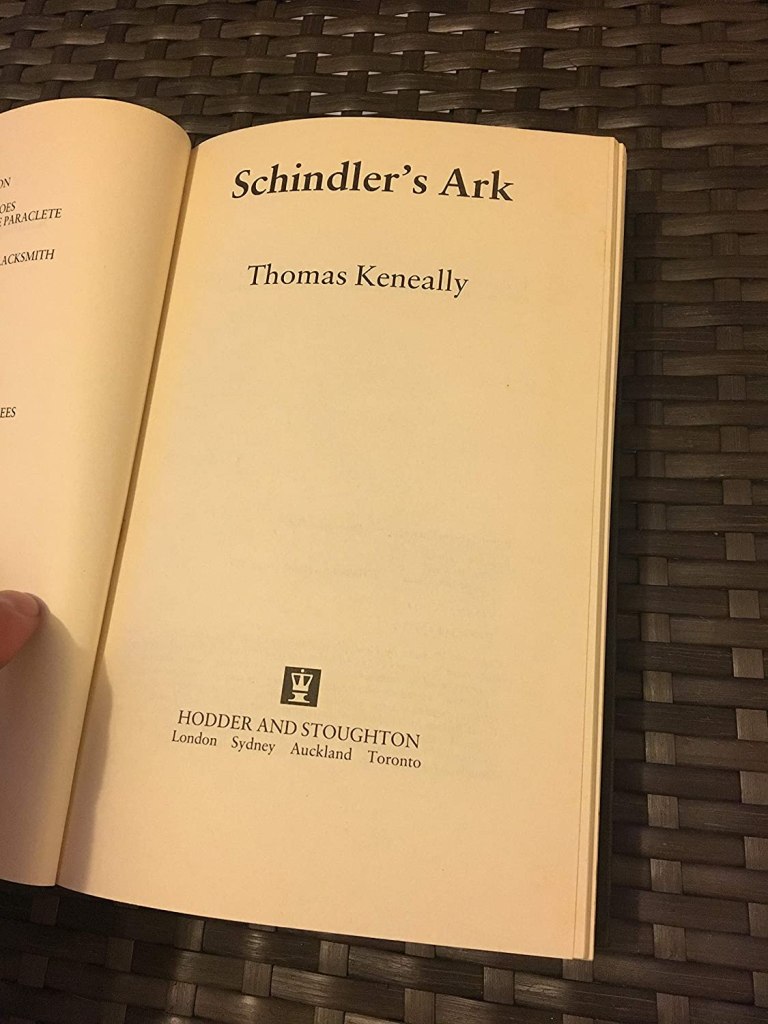
First Printed Edition of Schindler’s Ark

Introduction

Australian author Thomas Keneally‘s novel first “Schindler’s Ark” (later republished as Schindler’s List) brought the story of Oskar Schindler’s rescue of Jewish people during the Nazi Holocaust, to international attention in 1982, when it won the Booker Prize. It was made by Steven Spielberg into the Oscar-winning film Schindler’s Listin 1993, the year Schindler and his wife were named Righteous Among the Nations.

Schindler’s Ark later republished as Schindler’s List

About The Author

Thomas Michael Keneally, (born 7 October 1935) is an Australian novelist, playwright, essayist  and actor.  Keneally’s first story was published in The Bulletin  magazine in 1962 under the pseudonym Bernard Coyle. By February 2014, he had written over 50 books, including 30 novels. He is particularly famed for his Schindler’s Ark  (1982) (later republished as Schindler’s List), the first novel by an Australian to win the Booker Prize and is the basis of the film Schindler’s List. He had already been shortlisted for the Booker three times prior to that: 1972 for The Chant of Jimmie Blacksmith, 1975 for Gossip from the Forest, and 1979 for Confederates. Many of his novels are reworkings of historical material, although modern in their psychology and style.
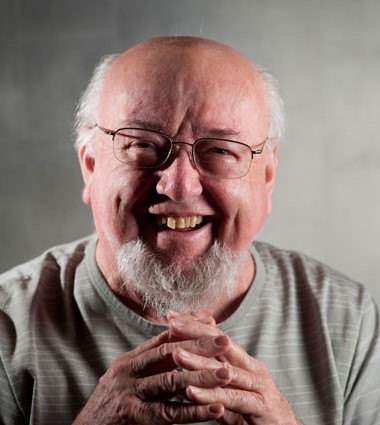
Thomas Keneally

Storyline of The Novel

The story of the novel is based on true events, on account of the Nazi Holocaust during World War II. Oskar Schindler, (born April 28, 1908, Svitavy [Zwittau], MoraviaAustria-Hungary  [now in the Czech Republic]—died October 9, 1974, Hildesheim, West Germany), German industrialist who, aided by his wife and staff, sheltered approximately 1,100 Jews from the Nazis  by employing them in his factories, which supplied the German army during World War II.

Poster of Steven Spielberg‘s movie Schindler’s List (1993)

In the shadow of Auschwitz, a flamboyant German industrialist grew into a living legend to the Jews of Kraków. He was a womaniser, a heavy-drinker and a bon viveur, but to them he became a saviour. This is the extraordinary story of Oskar Schindler, who risked his life to protect Jews in Nazi-occupied Poland and who was transformed by the war into a man with a mission, a compassionate angel of mercy.
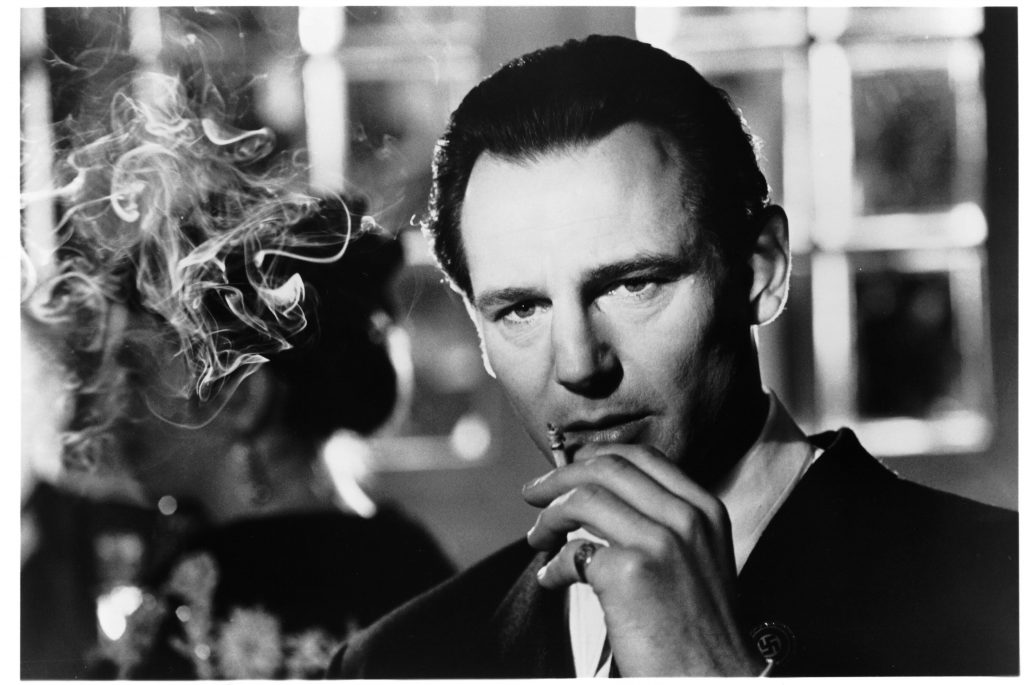
Liam Neeson as Oskar Schindler in Schindler’s List (1993)

Analysis of The Storyline

The novel introduced a vast and diverse cast of characters. However, the focus of the narrative was between Oskar Schindler and Amon Goeth. In the story, there was a dichotomy between what is essentially good and what is evil, that was personified by these two primary characters. Goeth represented everything evil. The war churned out a selfish and heartless sadist who found delight in inflicting pain on the Jews. Ironically, he lusted after his Jewish maid. Schindler, on the other hand, was portrayed as the Good German. He didn’t believe everything that the Nazi regime was saying against the Jews. He was, however, a man of contradictions. Despite being depicted as the epitome of goodness, he lived a self-indulgent lifestyle, which included proclivity towards the bottle and women. His infidelities have been a constant source of pain for his wife, Emilie. He also uses his connections to gain the upper hand in negotiations; it would also be a seminal part of his campaign to save the Jews.  
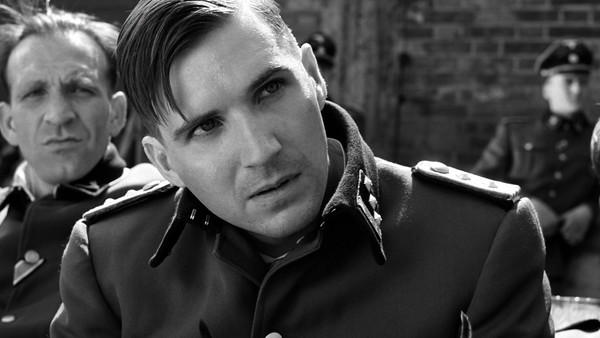
Ralph Fiennes as Amon Goeth in Schindler’s List (1993)

Criticism of The Storyline

The amount of research poured to recreate the story of Oskar Schindler was astounding. And the starting point to this is as interesting as the novel itself. As noted in the Author’s Note, a chance encounter in 1980 led to the novel. Schindler’s motivation for protecting his workers was rarely ever clear, especially at the start. Questions still hound his true intentions. He, after all, brazenly took advantage of the cheap labour the Jews offered at the start of his enterprise. Is Schindler an anti-hero? The answer can be found in Keneally’s extensive research. Through interviews with surviving Schindlerjuden and different Second World War archives, he managed to identify the point in which Schindler decided to protect the Jews. While horseback riding on the hills surrounding Kraków, he witnessed an SS Aktion unfold on the Jewish ghetto below. The Jews were forcefully taken out of their houses. Those who resisted were shot dead, even in the presence of children. Witnessing the atrocious acts firsthand turned Schindler’s stomach. It was then that he resolved to save as many Jews as he can.
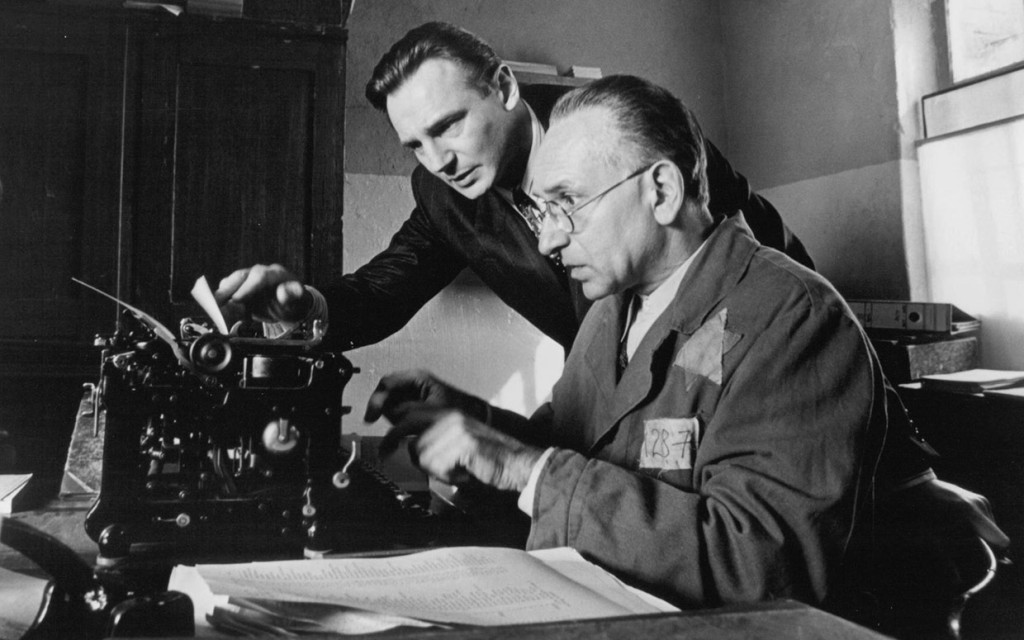
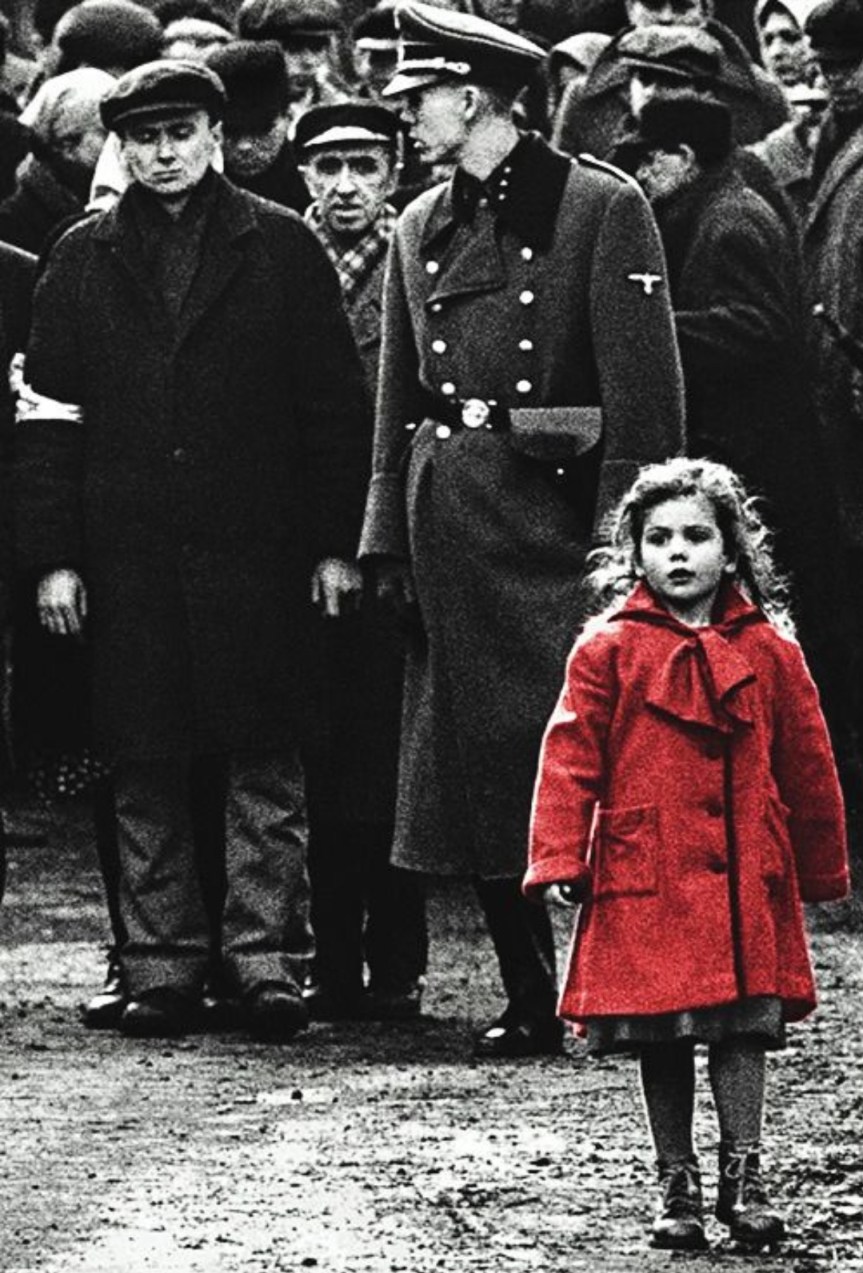
Scene from Schindler’s List (1993)

Overall, what didn’t work was the manner in which Keneally related the story of Oskar Schindler. As the story moved forward, it became clearer that Keneally was unsure of how to deliver the story. His resolve to remain loyal to Oskar’s story was commendable. He endeavored to do just that but it never fully came across. The result was an amalgamation of fiction and historical textbook. The strange mix muddled the story and the result was a perplexing work of historical fiction. It is without a doubt that one of the darkest phases of contemporary human history is the Second World War. Nobody expected that the meteoric ascent of Der Führer, Adolf Hitler, in the German political ladder would lead to a devastation of global scale. As the Axis forces march towards and beyond their boundaries, they would leave death and destruction in their wake, stretching from Europe, to the Pacific, and to the Far East. The consequences of the war would resonate well beyond its time. With genocides, concentration camps, and slave labour commonplace, the war was a reflection of the human conditions. Its peak, the Holocaust, exhibited the extent of the darkest shades of the human spirit. It was a grim portrait.

Indeed, the Second World War brought out the worst in humanity. However, in times of darkness, there are those among us who rise to the occasion. One of them is Oskar Schindler whose story was related by Thomas Keneally in his nonfiction novel, Schindler’s List (1982).

Conclusion

While Keneally‘s dramatization of this great man’s exploits is lacking in novelistic shape or depth, the brutality and heroism are satisfyingly, meticulously presented–as plain, impressive, historical record; and if admirers of Keneally’s more imaginative work may be disappointed, others will find this a worthy volume to place beside one of the several Wallenberg biographies.


Steps to reduce Global Warming

As far as Global Warming is concerned all governments of the world are also taking steps to reduce the emission of greenhouse gases. Countries around the world have recognized this problem and signed a pact in Paris called The Paris Agreement in 2015. They all pledged to reduce their carbon footprints. The Intergovernmental Panel on Climate Change (IPCC), has set a target of not increasing the temperature more than around 2 degrees Celcius and in the later years around 1.5 degrees.

Although everything is not going very well with this agreement. Recently, Donald Trump – president of the United Nations of America pulled out of this agreement citing that developing nations are not doing enough to control their Carbon emission and all the money is going in vain. On the other hand, developing nations like China have argued that developed nations like the United States of America have already developed their nations while polluting the planet. But, it’s now their turn to develop their country and they are doing their bit to curb the carbon emissions.

India is also doing their bit to control the carbon footprint. Under the leadership of the prime minister, Modi India is taking very active steps in the field of renewable energy. Many Solar panel power plants have been opened. Ujjwala scheme was launched to provide LPG connection to the poor which led to an increase in clean fuel consumption in the rural area. We have also been trying to increase our Forrest are by extensively planting trees.

One of the major steps we could take forward is to use renewable sources of energy. To run our home equipment we need to use Solar panels. The government also needs to find ways to use the green energy of electricity production through windmills, Solar panels, etc. We need to use public transport as much as possible. It will reduce the consumption of fuels and thus reduce greenhouse gases. Cycles can also be used for traveling a small distance. We know that while operating, refrigerators and air conditioners release ChloroFluoroCarbons(CFC). When released into the atmosphere they go and react with the ozone and creating a hole in the ozone layer. Through this hole, humans are now exposed to the ultraviolet rays which come with the sunlight.

Anupam Mittal: one of the powerful Shark

Indian entrepreneur, angel investor, former actor and business executive Anupam Mittal is best known as the founder of matrimonial website Shaadi.com, real-estate platform Makaan.com, short video application Mauj and media company Mobango. On 23rd December 1971, Anupam born in Mumbai, Maharashtra. He has pursued his post-graduation from Boston University, and later he has done MBA in Operations and Strategic Management in the academic year 1994-97. After completing MBA in 1997 he started online Indian wedding website named Shaadi.com. ln July 2013, he tied knot with Indian model, Aanchal Kumar.

Anupam Mittal with Aanchal Kumar

Anupam mittal focused on creating a business around planned marriages. During 2000 concept of love marriage in India was not accepted. So this platform provides various options of partner. This platform has more in Pakistan, India etc. He had interest in Bollywood and entertainment. In done 2 movies flavours in 2003 and 99 in 2009. Anupam got outstanding serial Entrepreneur & Angel Investor by The Indus Entrepreneur, Mumbai in 2020. In 2015 Anupam got Karmveer Puraskar award from iCONGO. he is in 50 most powerful people in India.

Anupam mittal is one of the powerful shark in shark tank India. He said to youth,” I have been reflecting on the opportunities we have created,the conversation we have started and most important the fire we have sparkles with shark tank India. I believe that the show has been the catalyst that will change India’s entrepreneurial landscape forever.”

The 5 Different Types of Copywriting You Can See Today

In the marketing and advertising sector, the text that forms a part of an Ad is known as its copy. Copywriting is the process of writing this text. Copywriting may be found on paid Ads, brochures and even on Website pages. The primary objective is what differentiates copywriting from content writing or content marketing. While the goal of content marketing could range from education to entertainment, and awareness, copywriting is mainly focused on making sales, getting people to talk about the brand, and taking the desired actions. The copy should communicate the features, price and values of the product in the quickest way possible.

Here are the different forms of copywriting an aspiring copywriter could get into:

Brand Copywriting

Also called creative copywriting, brand copywriting deals with creating copies that distinguish a brand or company. It is aimed at getting people to recognize a brand with their unique copy, developing strong emotional attachments. Brand copywriters create copy for commercials, posters and jingles for brands. Some popular examples include Nike’s tagline – “Just Do It”, and popular jingles like “I’m lovin’ it” by McDonald’s. It aids in developing brand recognition and brand memory rather than just competing with other brands.

SEO Copywriting

In this age of 24/7 internet and eCommerce, SEO (Search Engine Optimization) is a must-have element. SEO copywriting is all about creating copies that help you get ranked highly on search engines. The copy should be attractive, offering value to readers while also mixing in essential keywords and phrases. A healthy amount of keywords ensure that your blog or web page is visible quickly on search engines, driving traffic to your work. Blog posts, copies of web pages (home page, landing page, etc), articles and product descriptions are forms of SEO copywriting.

Social Media Copywriting

This form of copywriting deals with creating attractive posts for brands on social media. A brand can have profiles on various social media platforms like Facebook, Twitter, Instagram, TikTok and LinkedIn. A social media copywriter attempts to engage its customers through its content on these pages. The aim is to make the brand memorable. The copy would have to suit the style and tone of the social media platform it is posted in. This means that a copy would look different on Facebook and Instagram. It helps reach out to potential consumers and get them to visit your store.

Starbucks on Instagram

Technical Copywriting:

As the name mentions, technical copywriting is all about creating copies that explain information related to your brand or product. The copy goes in-depth in providing useful insight to customers regarding topics like user manuals and product descriptions. This helps in building trust in the brand. Contrary to other forms of copywriting, technical copywriting tends to be more detailed and longer, usually seen in blog posts, user guides and white papers. The tricky part of it is getting the copy to be insightful while also making it simple and easy to understand. You need to have some technical experience and good explanation skills while also using simple language without jargon.

Public Relations Copywriting:

PR copywriters write copies that get your brand noticed by news reporters and journalists, so that they can spread it across various media. This type of copywriting is useful once a brand is established and you want people to remember the brand. Instead of sharing how good your brand is yourself, you get others to talk about your brand. This is generally considered to be unbiased and credible by the viewers because it would be verified and reported by a third party. Press releases and statements of brands and companies you see on television channels and social media are PR copywriting. It can be used to improve a brand’s reputation or as damage control, after something had occurred that could affect the brand’s image negatively.

Discussion on Demand for Grants for Ministry of Development of North East Region

 Key Highlights:

  • A new phase of peace and prosperity has begun in the North East Region as Prime Minister’s agenda of Transforming India and North East region has been made a priority
  • Peace and stability have been established in the region because of which massive infrastructural development and connectivity projects are being undertaken
  • There is an increase of around 110% in total Gross Budgetary Support of 54 Central Ministries to the North East Region amounting to 76,040 crore
  • Massive efforts are being undertaken towards improving rail, road, air, water and telecom connectivity in the region enabling increase in economic development, trade and investment opportunities
  • During 2014-2021, Rs 39,000 crore was spent for improving rail connectivity
  • Regular visits of Union ministers to the North East are bringing a change in effective implementation of Central Sector and Centrally Sponsored Schemes in the North East along with political connectivity with the State Governments of the North East


Replying to a discussion on the working of the Ministry of Development of North Eastern Region (DONER) in the Upper House, Union Minister of Development of North East Region, Tourism and Culture Shri G Kishan Reddy today emphasised that a new phase of peace and prosperity has begun in the North East Region. He said that as part of Prime Minister’s agenda of Transforming India, North East region has been made a priority.

The Union Minister underscored that peace and security were pre-requisites for development. With several landmark initiatives taken to improve the security situation and resultant stability in the region, massive infrastructural development and connectivity projects are being undertaken. Unlike in the past, today there are no road blockades, protests, curfew and firing in the North East, he added.

The Minister pointed out that there was a notable decline in insurgency related incidents from 824 in 2014 to 163 in 2020. He also stated that there was a significant decline in death of civilian and security forces. At the same time, he also pointed out that several historic agreements have been signed with rebel groups to restore peace and stability along with grants of financial packages for their rehabilitation.

Noting the improvement in security, international and domestic businesses are now looking to take advantage of the untapped potential of the NER for investments, Shri Reddy added.

Further, he added that the budget for the region has been massively increased to accelerate the pace and development. He observed that there is an increase of around 110% in total Gross Budgetary Support of 54 Central Ministries to the North East Region, from 36,108 Crores in 2014 to 76,040 Crores in F.Y 2022-23. He further expressed that the newly announced Prime Minister’s Development Initiative for North-East, PM-DevINE, with an outlay of 1500 Crores will accelerate the growth momentum in the spirit of Gati Shakti by supporting infrastructure development and enabling livelihood activities.

Shri Kishan Reddy also spoke on the significant strides made towards enhancing, road, rail and air connectivity. He further stated that to make the North East the growth engine of the country, massive efforts are being undertaken to develop rail connectivity. He further added that during 2014-2021, Rs 39,000 crore was spent for improving rail connectivity.

The Union Minister also said that best of scientific and engineering standards are being adopted and not even the harsh terrain and topography of the region have deterred the efforts of the government. He cited the example of Manipur – Jiribam Imphal rail line, which has made the world record of highest pier bridge of 141 meters.

He also emphasized that the capital connectivity project will add a new chapter in the development of North East region. He pointed out that prior to 2014, only Assam’s capital Guwahati was connected. Today three States have already been connected and remaining five Capital Rail Connectivity projects are ongoing at the cost of Rs. 45016 crore.

He also highlighted that road and highway network of the region is also being strengthened at an unprecedented rate. He pointed out that Government of India has spent Rs 41,546 crore till date. He also said that air connectivity through UDAN and Krishi UDAN has received a lot of boost in the last few years and because of which tourism, trade and investment in the region has received a fillip. Further, he added that over the last 7 years, Rs.3466.10 crore have been spent under 10% GBS to enhance telecom connectivity in the region.

The Minister emphasised the “Act East policy” of the Government, whereby attention is being paid to the important projects of international connectivity in the Northeast like the Agartala – Akhaura Rail Link with Bangladesh, Kaladan Multimodal project with Myanmar and the India-Myanmar-Thailand trilateral highway.

Shri Reddy said that the Centre has worked on developing power infrastructure with an expenditure in excess of 10,000 crore since 2014, which has worked in promoting electrical connectivity and facilitates industrialisation in the North Eastern Region.

The Minister also noted that Development of National Waterway-2 (River Brahmaputra, 891 km) Sadia to Bangladesh Border and National Waterway-16 (River Barak, 121 km) Bhanga-Lakhipur stretch including Indo-Bangladesh Protocol (IBP) route are ongoing projects in the NER and reminded the Hon’ble members that recently MV Lal Bahadur Shastri cargo vessel, carrying 200 MT of food grains for FCI reached Pandu, Guwahati via Bangladesh, which was a landmark event in the growth story of NE region.

He also highlighted the importance of Agriculture for North Eastern Region and the recent National Mission on Edible Oils – Oil Palm (NMEO-OP) approved for 2021-22 to 2025-26 with more than 50% of the a total outlay of Rs. 11,040 crore with the target to cover 3.38 Lakh Hectare in NER against the existing 38,000 Hectare.

The Minister also deliberated on the importance that the government accords to the aspirations of the youth. He added that recognizing the potential of the youth in sports, National Sports University at Manipur is being set up at the cost of Rs.643 crore.

He further informed the House that in the Health sector, Government has spent Rs.25589.72 crore since 2014-15, including Rs. 548.32 crore by Ministry of DoNER to develop health infrastructure in the North East Region and most recently to fight the Covid-19 pandemic. The Minister highlighted the upcoming AIIMS in Guwahati (to be completed in 2022) with a cost of 1,123 crore.

The Union Minister also called upon all the members to work jointly towards development of the North East Region while expressing that India cannot develop unless North East is developed.


The success story of Space X – from Falcon 1 to Starship

The Falcon super heavy launch vehicle was designed to transport people, spaceships, and various cargos into space. Such a powerful unit wasn’t created instantly and it also had its predecessors. The history of the Falcon family of vehicles began with the creation of the Falcon 1- a lightweight launch vehicle with a length of 21.3 meters and a diameter of 1.7 meters and a launch mass of 27.6 tones; the rocket could carry 420 kilograms or 926 pounds of payload on board. It became the first private device that was able to bring cargo into low earth orbit. Construction of the Falcon 1 of only two stages, the first of them consisted of a supporting element with fuel tanks, an engine and a parachute system. They chose kerosene as the fuel and liquid oxygen became its oxidizing agent.

The second stage also contains fuel tanks and an engine; though the latter had less thrust compared to the one in the first stage despite the huge launch cost $7.9 million. Totally five attempts were made to send the Falcon 1 beyond the of our planet nut not all of them were successful. During the debut launch of the rocket, a fire started in the first stage engine; this led to a loss of pressure which caused the engine to shut down in the 34th second of flight. The second attempt to start the Falcon 1 incurred a problem with the fuel system of the second stage fuels stopped flowing into its engine at 474 second of flight it shut down as well. The third time of the Falcon 1 went on a flight, it wasn’t alone of the serious cargo the rocket carried onboard the trailblazer satellites and to NASA microsatellites. In phase one with the first stage he flight went normally but when the time came to separate the stages, the first hit the second when it started engine, so the second stage couldn’t continue its flight.

 The fourth and fifth launches shoed good results but that wasn’t enough. The main problem with Falcon 1 was low demand due to its low payload abilities. For this reason, they designed Falcon 9; this device can carry on onboard 23 tons of cargo. It’s also a two stage launch vehicle and uses kerosene and l liquid oxygen as fuel. The device is currently in operation and the cost of its launch is equal to $62 million. The first stage of the rocket is reusable; it can return to earth and can be used again. The Falcon 9 is designed to not only launch commercial communication satieties but also to deliver dragon 1 to the ISS. Dragon 1 can carry a six ton payload from the earth, this drone supplies the ISS with everything they needs and it also takes goods back.

The dragon 2 is designed to deliver a crew of four people to the ISS and back to earth. Now there is an ultra heavy launch vehicle with a payload capacity of almost 64 tones. It is the most powerful and heavier device called the Falcon heavy. This rocket was first launched on February 6th 2018 and the test was successful. The rocket sent Elon Musk’s car into space- a red Tesla Roadster. After this debut subsequent launches were also conducted without problem. The launch cost is estimated to $150 million.

The first stage of the Falcon heavy consists f three parts. There are three blocks contain 27 incredibly powerful engines in nine each one. The thrust created when takeoff is comparable to 18 Boeing 747s at full power. The second stage is equipped with a single engine. It is planned that the device would be used for missions to the moon and mars. Currently, SpaceX working on the starship manned spacecraft.  According to its creators, this device will be much larger and heavier than all of the company’s existing rockets. This device will able to deliver cargo into space weighing more than a hundred tons. The launch of starship into pace is planned for 2022 to mars with a payload. Who knows, one of the mankind’s largest dreams may come true within the next year.

Magnetic resonance imaging (MRI) – History, Unknown facts

    The MRI (Magnetic resonance imaging) scan is a medical imaging procedure that uses a magnetic field and radio waves to take pictures of our body’s interior. It is mainly used to investigate or diagnose the conditions that affect soft tissue such as tumors or brain disorders. The MRI scanner is a complicated piece of equipment that is expensive to use and found only in specialized centers. Although Raymond Vahan Damadian (1936) is credited with the idea of turning nuclear magnetic resonance to look inside the human body, it was Paul Lauterbur (1929-2007) and Peter Mansfield (1933) who carried out the work most strongly linked to Magnetic resonance imaging (MRI) technology. The technique makes use of hydrogen atoms resonating when bombarded with magnetic energy. MRI provides three dimensional images without harmful radiation and offers more detail than older techniques.

       While training as a doctor in New York, Damadian started investigating living cells with a nuclear magnetic resonance machine. In 1971 he found that the signals carried on for longer with cells from tumors than from healthy ones. But the methods used at this time were neither effective nor practical although Damadian received a patent for such a machine to be used by doctors to pick up cancer cells in 1974.

       The real shift came when Lauterbur, a U.S, chemist, introduced gradients to the magnetic field so that the origin of radio waves from the nuclei of the scanned object could be worked out. Through this he created the first MRI images in two and here dimensions. Mansfield, a physicist from England, came up with a mathematical technique that would speed up scanning and make clearer images. Damadian went on to build the full body MRI machine in 1977 and he produced the first full MRI scan of the heart, lungs, and chest wall of his skinny graduate student, Larry Minkoff – although in a very different way to modern imaging.

Working of an MRI machine

        The key components of an MRI machine are magnet, radio waves, gradient, and a super advanced computer. We all know that human bodies are made up of 60% water, and water is magnetic. Each of the billons of water molecules inside us consists of an oxygen atom bonded to two hydrogen atoms that are called as H2O. Small parts of the hydrogen atoms act as tiny magnets and are very sensitive to magnetic fields. The first step in taking an MRI scan is to use a big magnet to produce a unified magnetic field around the patient. The gradient adjusts the magnetic field into smaller sections of different magnetic strengths to isolate our body parts. Take brain as an example, normally the water molecules inside us are arranged randomly. But when we lie inside the magnetic field, most of our water molecules move at the same rhythm or frequency as the magnetic field. The ones that don’t move along the magnetic field are called low energy water molecules. To create an image of a body part, the machine focuses on the low energy molecules. The radio waves move at the same rhythm or frequency as the magnetic fields in an MRI machine.

       By sending radio waves that match or resonate with the magnetic field, the low energy water molecules absorb the energy they need to move alongside the magnetic field. When the machine stops emitting radio waves, the water molecules that had just moved along the magnetic field release the energy they had absorbed and go back to their position. This movement is detected by the MRI machine and the signal is sent to a powerful computer which uses imaging software to translate the information into an image of the body. By taking images of the body in each section of the magnetic field the machine produces a final three dimensional image of the organ which doctors can analyze to make a diagnosis.

“Medicine is a science of uncertainty and an art of probability”. –William Osler


Evolution of Art – Origin, Milestone and Masterpiece

Expressing oneself through art seems a universal human impulse, while the style of that expression is one of the distinguishing marks of a culture. As difficult as it to define, art typically involves a skilled, imaginative creator, whose creation is pleasing to the senses and often symbolically significant or useful. Art can be verbal, as in poetry, storytelling or literature or can take the form of music and dance. The oldest stories, passed down orally may be lost to us now, but thanks to writing, tales such as the epic of Gilgamesh or the Lliad entered the record and still hold meaning today. Visual art dates back 30,000 years, when Paleolithic humans decorated themselves with beads and shells. Then as now, skilled artisans often mixed aesthetic effect with symbolic meaning.

In an existence that centered on hunting, ancient Australians carved animal and bird tracks into their rocks. Early cave artists in Lascaux, France, painted or engraved more than 2,000 real and mythical animals. Ancient Africans created stirring masks, highly stylized depictions of animals and spirits that allow the wearer to embody the spiritual power of those beings. Even when creating tools or kitchen items, people seem unable to resist decorating or shaping them for beauty. Ancient hunters carved the ivory handles of their knives. Ming dynasty ceramists embellished plates with graceful dragons. Modern pueblo Indians incorporates traditional motifs in to their carved and painted pots. The western fine arts tradition values beauty and message. Once heavily influenced by Christianity and classical mythology, painting and sculptures has more recently moved toward personal expression and abstraction.

Humans have probably been molding clay- one of the most widely available materials in the world- since the earliest times. The era of ceramics began, however, only after the discovery of that very high heat renders clay hard enough to be impervious to water. As societies grew more complex and settled, the need for ways to store water, food, and other commodities increased. In Japan, the Jomon people were making ceramics as early as 11,000 B.C. by about the seventh millennium B.C.; kilns were in use in the Middle East and china, achieving temperatures above 1832°F. Mesopotamians were the first to develop true glazes, through the art of glazing arguably reached its highest expression in the celadon and three color glazes of the medieval china. In the new world, although potters never reached the heights of technology seen elsewhere, Moche, Maya, Aztec, and Puebloan artists created a diversity of expressive figurines and glazed vessels.

When Spanish nobleman Marcelino Sanz de Sautuola described the paintings he discovered in a cave in Altamira, contemporizes declared the whole thing a modern fraud. Subsequent finds confirmed the validity of his claims and proved that Paleolithic people were skilled artists. Early artists used stone tools to engrave shapes into walls. They used pigments from hematite, manganese dioxide, and evergreens to achieve red, yelled, brown, and black colors. Brushes were made from feathers, leaves, and animal hair. Artists also used blowpipes to spray paint around hands and stencils.