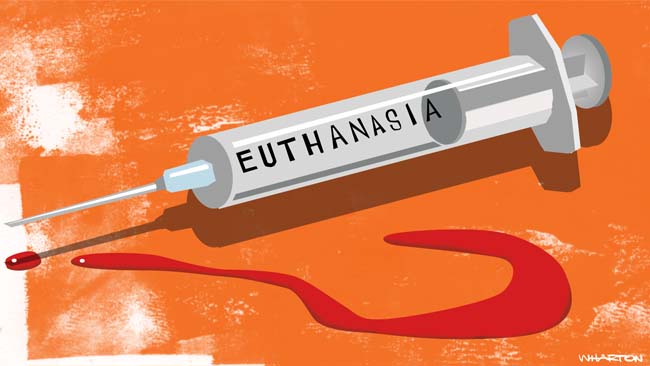
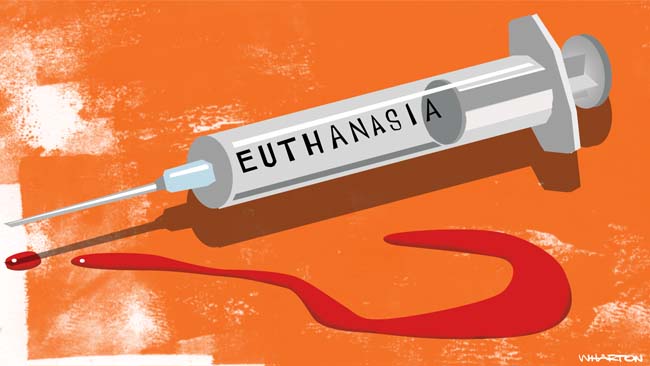
Euthanasia: Right to Die with Dignity

Credit: iPleaders

Introduction

Euthanasia, also called mercy killing, acts or practice of painlessly putting to death persons suffering from a painful and incurable disease or incapacitating physical disorder or allowing them to die by withholding treatment or withdrawing artificial life-support measures. Because there is no specific provision for it in most legal systems, it is usually regarded as either suicide (if performed by the patient himself) or murder (if performed by another). Physicians may, however, lawfully decide not to prolong life in cases of extreme suffering, and they may administer drugs to relieve pain even if this shortens the patient’s life.

What is Euthanasia?

The term was derived from the Greek words ‘EU’ and ‘Thanatos’ which means ‘good or easy death’. Euthanasia can
be defined as the intentional killing by act or omission of a dependent human being for his or her alleged benefit. It is also known as ‘Mercy Killing’ which is an act where the individual who, is in an irremediable condition or has no chances of survival as he is suffering from painful life, painlessly ends his life. The Right to die is a concept that is based on the opinion that a human being is entitled to make any decisions about ending his or her life (this also includes undergoing voluntary euthanasia).

Types of Euthanasia

There are primarily two types of Euthanasia.

  • Active euthanasia refers to the physician’s deliberate act, usually, the administration of lethal drugs, to end an incurably or terminally ill patient’s life.
  • Passive euthanasia refers to withholding or withdrawing treatment that is necessary for maintaining life.


Both euthanasia and assisted suicide are considered illegal in many countries since they can amount to murder in disguise.

Classification of Euthanasia

Euthanasia can also be classed as voluntary or involuntary.

  • Voluntary: When euthanasia is conducted with consent. Voluntary euthanasia is currently legal in Belgium, Luxembourg, The Netherlands, Switzerland, and the states of Oregon and Washington in the U.S.
  • Non-voluntary: When euthanasia is conducted on a person who is unable to consent due to their current health condition. In this scenario, the decision is made by another appropriate person, on behalf of the patient, based on their quality of life and suffering.
  • Involuntary: When euthanasia is performed on a person who would be able to provide informed consent, but does not, either because they do not want to die, or because they were not asked. This is called murder, as it’s often against the patient’s will.

Conclusion

Euthanasia is indeed a contentious issue, with the heart of the debate lying at active voluntary euthanasia and physician-assisted suicide. There is an urgent need to invest in our health care system so that people suffering from
serious ill-health can access free health care. Investment in health care is under ‘Right to Health’ which is bestowed under ‘Right to Life’ of our Constitution. Thus, the complete expenses need to be borne by the State so that the ‘Right to life’ becomes a reality and succeeds before the ‘Right to die with dignity.

The Importance of Internships

Growing up in school, students are constantly reminded that a college education is necessary to make a decent salary. Over the years, it has become evident to many young adults that this statement is indeed true. However, as the need for jobs increases, so does the necessity of being more competitive in a work field. Since our generation has grown up knowing that graduating from college is a necessity, a college education is no longer enough to be competitive in the job market; therefore, our generation has given birth to a new requirement to find the right job after college.

This requirement is known as an internship. Despite the fact that not many internship programs pay their students, an internship is an essential element for a student’s career in today’s society. The skills and opportunities attained after having participated in an internship program definitely outweigh any downside to any part of the program.

A college is a place where students become prepared for many aspects of life. One aspect of life that must be well prepared is networking. The more contacts a person has, the higher the chances of that person getting what he needs. College internships are a resource and the ultimate social network. When a student joins an internship program, he is joining a nexus of connections that will last him for a lifetime.

“Internships are mutually beneficial relationships.” The intern gets an opportunity to look into the real world pertaining to his career, while the employer gets a chance to look for the brightest and hardest working members in the program. Many times in life, it doesn’t necessarily come down to “how much you know” but “who you know”. Internships provide the chance to get to know many important people in the area that best interests a student.

Internships secure a successful way to find employment. For example, the majority of the young men who graduate from Hyles-Anderson College end up interning for their home pastors. Interns return home and eventually become Music Directors, Assistant Pastors, School Teachers, or Bus Directors. However, most of these interns usually receive little to no pay at all when they first begin working for their home church. This is indeed one of the most criticized downsides to many internship programs. Nearly 50% of all Internships in the U.S are unpaid and 85% of graduates are actually willing to intern for free.3

Critics believe that colleges and companies are constantly pushing students to join internship programs because these companies save millions of dollars annually by “hiring” interns. Although this may be true, most graduates that enter an intern program finish the internship receiving a highly coveted job offer. On the other hand, a great number of graduates that don’t have the tool of an internship network usually leave college and cannot find a job. These graduates put up with having to wander from one job to another while the jobs usually have nothing to do with their field of study. Students who are willing to sacrifice a couple months of salary usually end up winning because they find a well-fitting and well-paid job in the end.

Most internships equip members with the necessary experience in their field of study. “The dilemma new graduates most often face is that they’ve got fine academic training but no hard experience.” 4 Employers usually look for applicants who have hands-on experience. When very few people are willing to take the risk of hiring a complete rookie, internship programs are designed for this matter. Internships provide students with great experience and references to add to their resumes.

Graduates are also able to add themselves to a real workforce without having to engage in commitment with a company or an employer. That itself is enough to relieve unnecessary stress on anyone! Not only are these programs beneficial for interns, but for employers as well. Companies can be sure that interns are dedicated and truly interested in the field that they are working in.

Time Management

Time management is the act of planning and managing time that is spent on various activities. It helps to
increase the effectiveness and efficiency of the time utilized. It helps us to work smarter instead of harder
and also enables us to get more work done in less amount of time. Planning time may seem like a waste
of time in itself, however, the benefits of time management are enormous. It results in less stress, Increased
productivity, efficiency, professional and personal growth, etc,. Time is limited and hence, it is important that we plan our time wisely and make the best use of the limited
hours in a day. Time is something that we cannot store or save for later use. We cannot retrieve the time
that has been wasted; hence, we need to learn to use it effectively. If we have to manage time effectively,
we need to be organized and focused.
With the help of time management techniques, we can accomplish more with lesser efforts. Time
management includes effective planning of activities, setting of goals, setting deadlines, delegating work,
prioritizing our activities etc.
Most people feel that they always have too much to do and within too little time. Managing time wisely will
help to find the right balance between time and work. A few people resort to multitasking in order to get
the work done within the specified time limit. At times, this may result in poor performance in the various
tasks assigned
The major mistake committed while working is when one is in a rush to meet the deadline without taking
proper breaks for rest or relaxation. It is impossible for anyone to focus on work and to produce good results
without considering any break in between. It helps to perform better if one takes five minutes to break every
two hours of work. One can either take a walk, enjoy a cup of coffee or simply meditate. Proper time
management is the cornerstone of a successful life and ensures the achievement of one’s goals in a healthy
manner.

How International Yoga Day Ushered a Smile to Everyone Face?

Credit: Wikipedia

Introduction

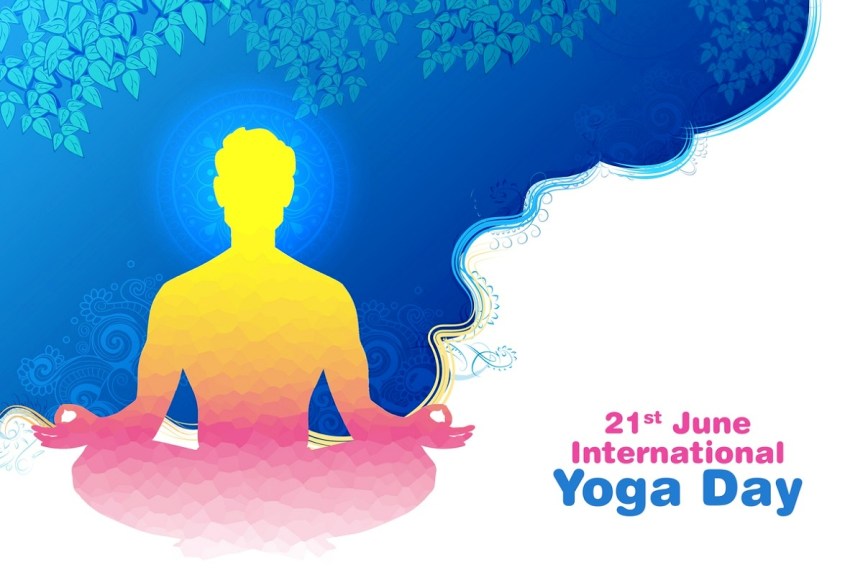
I hope you all are fit and healthy during this covid situation many diseases are occurring so need to take good care of our health. To be healthy and fit we always need to do yoga and exercise in the early morning. The international community observes June 21 as International Yoga Day, recognizing the many benefits of the ancient Indian practice of yoga. The year 2021 marks the 7th annual International Yoga Day.

History of Yoga Day

The practice of yoga finds its origin in India. There is a special day to celebrate yoga is the International Yoga Day which is celebrated on 21st June 2016 every year. This day was internationally recognized by the United Nations General Assembly (UNGA) on December 11, 2014. The idea of an international yoga day was proposed by our Prime Minister, Mr. Narendra Modi on September 27, 2014. Mr. Modi proposed the date to be June 21 and mentioned that this is the longest day of the year in the northern hemisphere and has special significance in many parts of the world. And the first international yoga day was celebrated on June 21, 2015.

Theme of Yoga Day

The message of Yoga in promoting both the physical and mental well-being of humanity has never been more relevant. A growing trend of people around the world embracing Yoga to stay healthy and rejuvenated and to fight social isolation and depression has been witnessed during the pandemic. Recognizing this important role of Yoga, the previous year’s commemoration of the International Day of Yoga focuses on “Yoga for well-being” – how the practice of Yoga can promote the holistic health of every individual. 

What is Yoga?

Yoga is a process in which man tries to bring his mind, body, and soul together. Yoga is a Sanskrit word meaning to meet or be united. Yoga originates from Indian culture. People have been practicing Yoga since about 5000 years ago. Yoga does not have physical fitness primarily; in Yoga, people try to control their body and mind through mental focus and breathing methods. If men teach Yoga, then they are called yogis, and if women teach, they are called yoginis. Yoga Sutra is a 2000-year-old book. This is the only book in which written evidence of Yoga has been found. This book is the oldest book about Yoga. Yoga is divided into six branches, namely Hatha Yoga, Raja yoga, Karma yoga, Bhakti yoga, Jnana yoga, and Tantra yoga. There are also seven chakras of yoga styles namely Sahasram chakra, Ajna chakra, Vishuddha chakra, Anahata chakra, Manipura chakra, Svadhishthana chakra, Muladhara chakra.

Importance of Yoga

Practiced in India since the 5th century, Yoga has been beneficial in keeping the body and mind in sound health. A holistic approach, Yoga targets all the different systems of the body and mind. It is said that the asanas make the body strong and flexible, as health improves; the mind too is renewed with confidence. The practice of Pranayama regulates the purification of the internal system and the organs, acting as a superior and able supplement to asanas. The energy that is generated in the body through these physical practices is then channeled into meditation or Dhyan for stability, peace, and calm.

Objectives of Yoga Day

The main objective to adopt International Yoga Day is as mentioned below.

  • Promote enhanced mental and physical health advantages amongst the people
  • Aware the public of Yoga’s holistic advantages
  • Promote awareness among people about Yoga’s natural and amazing results
  • Assist people to connect with nature while practicing Yoga daily
  • Reduction in the rate of fatal diseases across nations
  • Unification of communities while devoting quality time for health from monotonous work routines.

Conclusion

The AYUSH protocol describes the folding hands logo of Yoga Day as reflecting “the union of individual consciousness with that of universal consciousness, a perfect harmony between mind and body, man and nature, the holistic approach to health and well being. The brown leaves in the logo symbolize the earth element, the green leaves of nature, blue the fire element while the sun symbolizes the source of energy and inspiration.”

References

The Future of Solid-State Batteries

Credit: Forbes

Introduction

All-Solid-State Battery is a type of battery that uses no liquid electrolyte, instead, it uses a solid electrolyte (alternative to the lithium-ion battery). This type of battery still has not been commercially used, but will soon be used in electric vehicles. The demand for the production of solid-state batteries is due to the advantages that arise from the safety issue. Solid electrolytes are solid that exhibit ionic conductivities of about 10−3 S/cm, and it conducts ions between the cathode and anode in the lithium-ion battery.

What is Solid-State Battery?

A solid-state battery has a higher energy density than a Lithium-ion battery that uses a liquid electrolyte solution. It doesn’t have a risk of explosion or fire, so there is no need to have components for safety, thus saving more space. Then we have more space to put more active materials which increases battery capacity in the battery. A solid-state battery can increase energy density per unit area since only a small number of batteries are needed. For that reason, a solid-state battery is perfect to make an Electric Vehicle (EV) battery system of module and pack, which needs high
capacity. Despite improvements in technology over the last decade, issues such as long charging times and weak energy density persist.

What is Lithium-ion Battery?

Lithium Battery uses an intercalated (Intercalation is the reversible inclusion or insertion of a molecule into materials with layered structures) lithium compound as one electrode material, compared to the metallic lithium used in a non-rechargeable lithium battery. The battery consists of electrolyte, which allows for ionic movement, and the two electrodes are the constituent components of a lithium-ion battery cell. Lithium ions move from the negative electrode to the positive electrode during discharge and back when charging.

Advantages of Solid-State Battery

The advantages of the solid-state battery technology include higher cell energy density (by eliminating the carbon anode), lower charge time (by eliminating the need to have lithium diffuse into the carbon particles in conventional lithium-ion cells), ability to undertake more charging cycles, and thereby a longer life, and improved safety. Lower cost could be a game-changer, given that at 30% of the total cost, battery expenses are a key driver of vehicle costs.

R&D in Solid-State Battery

Most companies hope to commercialize their solid-state batteries by 2025, although small-scale production may happen earlier. However, to meet this goal, considerable R&D needs to happen to solve serious issues about material behavior, battery microstructure, charge longevity, and cracking upon thermal expansion and contraction. In another recent development, researchers from Brown University have developed a new material for use in solid-state batteries that is derived from trees. The solid ion conductor combines copper with cellulose nanofibrils—polymer tubes derived from wood. The paper-thin material has an ion conductivity that is up to 100 times better than other polymer ion conductors, making it a possible candidate for a solid battery electrolyte or as an ion-conducting binder for the cathode of an all-solid-state battery.
 

Conclusion

Today’s state-of-the-art batteries—those based on lithium-ion technology—have been honed to near perfection since they were introduced more than 25 years ago, but they are still heavy and occasionally explode and catch fire, as they did in Samsung’s Galaxy Note 7 phones so spectacularly last year. By getting flammable liquid electrolytes out of lithium-ion batteries and replacing them with solid electrolytes, solid-state battery makers hope to usher in an era of safer, more compact, higher-capacity energy storage devices.

References