Business refers to the Organization or enterprising entity engaged in commercial, industrial or professional activities. Business activities have existed since ancient ages and over the period it has evolved according to the changes in its environment. Earlier it was limited to mere exchange of goods in return for other and then with the change in conditions it has reached to a stage where people could buy a good or avail a service from a seller who is miles apart even without face-to-face interface.
In the era of globalization, the scope of a business is very large. There are several examples of businesses growing into huge enterprises from a small virtual venture which even lacked a physical existence in its early stages. Similar to the steps of a ladder, there are several stages like local business, regional business, national business, international business and global business.
Local business
Local business is the first stage of a business enterprise and it exists in the limits of a locality. A local area comprises of surrounding neighborhoods, adjacent areas where native community lives. The local economy is the most primitive form of economy. It existed since ages. It focuses on a particular locality and acts according to the culture and traditions of the society. The customer base of a local business is very limited as its area of operation is only that locality.
Regional business
Regional business concentrates on different regions of a nation. A region is a unit on earth’s surface that has unifying and defining characteristics. It focuses on a regional area and provides a variety of commodities. It is a business between different areas within a country. Credit sales play an important role in this business. It helps in developing better quality infrastructure and transportation facilities
National business
National business is one that operates within the borders of a particular country. It has a business and customer base across a nation and understands the culture of the country. Since a national business has more locations than a local or regional business, it can be more competitive with its pricing. A nation is an organized political union of its member states.
International business
International business is business among different nations. Nations satisfy each other’s needs by supplying their surpluses and in return brings home the scanty resources. International means It means interaction between two or more nations. It is used as an analog to the word foreign.
Global business
It is a business which operates worldwide. It is the pinnacle of any business enterprise. Global means means entire Earth and not just one or two nations. It is synonymous to universal and worldwide. It has a wider scope than international business.
The basic idea to be imbibed from this topic is that no business becomes huge overnight. Just like human beings, a business also takes time to grow. Not all local businesses emerge out as global giants. Only those firms which could identify the changes in the environment and could act accordingly would be able to reach its pinnacle.
Business refers to the Organization or enterprising entity engaged in commercial, industrial or professional activities. Business activities have existed since ancient ages and over the period it has evolved according to the changes in its environment. Earlier it was limited to mere exchange of goods in return for other and then with the change in conditions it has reached to a stage where people could buy a good or avail a service from a seller who is miles apart even without face-to-face interface.
In the era of globalization, the scope of a business is very large. There are several examples of businesses growing into huge enterprises from a small virtual venture which even lacked a physical existence in its early stages. Similar to the steps of a ladder, there are several stages like local business, regional business, national business, international business and global business.
Local business
Local business is the first stage of a business enterprise and it exists in the limits of a locality. A local area comprises of surrounding neighborhoods, adjacent areas where native community lives. The local economy is the most primitive form of economy. It existed since ages. It focuses on a particular locality and acts according to the culture and traditions of the society. The customer base of a local business is very limited as its area of operation is only that locality.
Regional business
Regional business concentrates on different regions of a nation. A region is a unit on earth’s surface that has unifying and defining characteristics. It focuses on a regional area and provides a variety of commodities. It is a business between different areas within a country. Credit sales play an important role in this business. It helps in developing better quality infrastructure and transportation facilities
National business
National business is one that operates within the borders of a particular country. It has a business and customer base across a nation and understands the culture of the country. Since a national business has more locations than a local or regional business, it can be more competitive with its pricing. A nation is an organized political union of its member states.
International business
International business is business among different nations. Nations satisfy each other’s needs by supplying their surpluses and in return brings home the scanty resources. International means It means interaction between two or more nations. It is used as an analog to the word foreign.
Global business
It is a business which operates worldwide. It is the pinnacle of any business enterprise. Global means means entire Earth and not just one or two nations. It is synonymous to universal and worldwide. It has a wider scope than international business.
The basic idea to be imbibed from this topic is that no business becomes huge overnight. Just like human beings, a business also takes time to grow. Not all local businesses emerge out as global giants. Only those firms which could identify the changes in the environment and could act accordingly would be able to reach its pinnacle.
Government regulate the business activities of private enterprises for direct participation in business and set up public enterprises in areas like coal industry, oil industry, steel manufacturing, banking, insurance etc. These units are not owned by Central, State or local Government, managed and controlled by them and are termed as public sector enterprises.
Business activities were occupied to individual and organizations and the government was taking care of essential services such as railways, electricity supply, postal services etc. Private sector did not take interest in areas where investment is high and profit margin is low, such as machine building, infrastructure, oil exploration etc. Industries were also focus in some region that have natural advantages like availability of raw material, skilled labour.
Source: shutterstock
Public sector enterprises defined as any commercial or industrial undertaking owned and managed by the government with a view to maximize social welfare and upholds the Public interest. Public enterprises consist of nationalized private sector enterprises such as banks life insurance of India and enterprise set up by Hindustan, Gas Authority of India limited (GAIL) and State trading Corporation (STC).
During the colonial period, economic activities were limited to essential support facilitate for the maintenance and continued Growth of economy and defense such as railway transport, electricity project, ordinance factories, irrigation works, education and training Institutions.
The public sector to control certain key point in the economy such as the financial institutions for collecting saving of millions of individual and organizations making these available for investment.
By 1980s, besides traditional fields, the major banks and financial institutions, electricity undertakings, shipping, civil aviation, bus services and big enterprises in significance modern industries such as iron and steel, heavy machine building, light engineering, electronic, petroleum and Petro chemical, fertilizers, pharmaceuticals, cotton textiles and cement. The growth of investment in the central undertakings by way of contribution to share capital and long term loans. In addition, the central government had made large investment in departmentally run undertakings.
Characteristics of Public Enterprises
The public enterprises are owned and managed by the central or state Government or local authority. The government may either own the public enterprises or the ownership partly be with the government and with the private industrialists and the public. The control, management and ownership remain primarily with the government e.g, Oil and Natural Gas Corporation Limited (ONGC) and National Thermal Power Corporation (NTPC).
Public enterprises get their capital from government funds and the government has to make provision for their capital in it’s budget. Public enterprises are not move by profit motive. Their major focus on providing services or commodities at reasonable prices. GAIL Gas Authority of India and Indian Oil Corporation make available petroleum on subsidised price to the public.
Public sector enterprises concentrate on providing public utility services like transport, electricity, telecommunication etc. PE are governed by the government and are accountable to the legislature. The government rules and regulations force the Public enterprises to observe excessive formalities in their operations.
Role of Public SectorUndertakingin Public Policy
The public sector enterprises has been important role of achieving economic growth with social justice, generating larger social gains and strengthening country’s economy by removing regional disparities and promoting balanced development in different parts of the country. The impact of public sector undertaking on the regional development.
PSE through useful help and services in the development of human resources in underdeveloped areas. Investment in human capital is considered an essential ingredient of development planning. Such development is only possible if rural demographics ready to cope with modern knowledge and science & technology.
A large number of PSU have been set up in the regions or districts in order to capitalize the rural labour by equipping them with vocational education, technical training and managerial skills. The reason behind it is to transform the unemployed rural people to get self motivated and self inspired employment avenues in local areas economies.
PSU working as a vehicle of communication have taken the new learning to village and acted as agents for introducing changes in existing practices, initiating commercial use of appropriate village technologies in agriculture and allied activities, village artisan and handicrafts and local village industry by inducing use of productivity enhancing equipment and light machinery.
Improvement in economic infrastructure in the areas where policies cannot reach through PSU and active participation of PSU. Constructing and improving connection between village to make accessibility by modern means of transport, electricity for domestic use as well as for commercial and Industrial.
Government regulate the business activities of private enterprises for direct participation in business and set up public enterprises in areas like coal industry, oil industry, steel manufacturing, banking, insurance etc. These units are not owned by Central, State or local Government, managed and controlled by them and are termed as public sector enterprises.
Business activities were occupied to individual and organizations and the government was taking care of essential services such as railways, electricity supply, postal services etc. Private sector did not take interest in areas where investment is high and profit margin is low, such as machine building, infrastructure, oil exploration etc. Industries were also focus in some region that have natural advantages like availability of raw material, skilled labour.
Source: shutterstock
Public sector enterprises defined as any commercial or industrial undertaking owned and managed by the government with a view to maximize social welfare and upholds the Public interest. Public enterprises consist of nationalized private sector enterprises such as banks life insurance of India and enterprise set up by Hindustan, Gas Authority of India limited (GAIL) and State trading Corporation (STC).
During the colonial period, economic activities were limited to essential support facilitate for the maintenance and continued Growth of economy and defense such as railway transport, electricity project, ordinance factories, irrigation works, education and training Institutions.
The public sector to control certain key point in the economy such as the financial institutions for collecting saving of millions of individual and organizations making these available for investment.
By 1980s, besides traditional fields, the major banks and financial institutions, electricity undertakings, shipping, civil aviation, bus services and big enterprises in significance modern industries such as iron and steel, heavy machine building, light engineering, electronic, petroleum and Petro chemical, fertilizers, pharmaceuticals, cotton textiles and cement. The growth of investment in the central undertakings by way of contribution to share capital and long term loans. In addition, the central government had made large investment in departmentally run undertakings.
Characteristics of Public Enterprises
The public enterprises are owned and managed by the central or state Government or local authority. The government may either own the public enterprises or the ownership partly be with the government and with the private industrialists and the public. The control, management and ownership remain primarily with the government e.g, Oil and Natural Gas Corporation Limited (ONGC) and National Thermal Power Corporation (NTPC).
Public enterprises get their capital from government funds and the government has to make provision for their capital in it’s budget. Public enterprises are not move by profit motive. Their major focus on providing services or commodities at reasonable prices. GAIL Gas Authority of India and Indian Oil Corporation make available petroleum on subsidised price to the public.
Public sector enterprises concentrate on providing public utility services like transport, electricity, telecommunication etc. PE are governed by the government and are accountable to the legislature. The government rules and regulations force the Public enterprises to observe excessive formalities in their operations.
Role of Public SectorUndertakingin Public Policy
The public sector enterprises has been important role of achieving economic growth with social justice, generating larger social gains and strengthening country’s economy by removing regional disparities and promoting balanced development in different parts of the country. The impact of public sector undertaking on the regional development.
PSE through useful help and services in the development of human resources in underdeveloped areas. Investment in human capital is considered an essential ingredient of development planning. Such development is only possible if rural demographics ready to cope with modern knowledge and science & technology.
A large number of PSU have been set up in the regions or districts in order to capitalize the rural labour by equipping them with vocational education, technical training and managerial skills. The reason behind it is to transform the unemployed rural people to get self motivated and self inspired employment avenues in local areas economies.
PSU working as a vehicle of communication have taken the new learning to village and acted as agents for introducing changes in existing practices, initiating commercial use of appropriate village technologies in agriculture and allied activities, village artisan and handicrafts and local village industry by inducing use of productivity enhancing equipment and light machinery.
Improvement in economic infrastructure in the areas where policies cannot reach through PSU and active participation of PSU. Constructing and improving connection between village to make accessibility by modern means of transport, electricity for domestic use as well as for commercial and Industrial.
so what comes to your mind when you hear the words economy ,agriculture and industries ,they are somewhere linked right ?we do have a basic idea that agriculture does contribute to our country’s economy and so do these industries but how do they?
India is known as an agricultural country, as most of the population of villages depends on agriculture. Agriculture forms the backbone of the country’s economy. The agricultural sector contributes most to the overall economic development of the country.
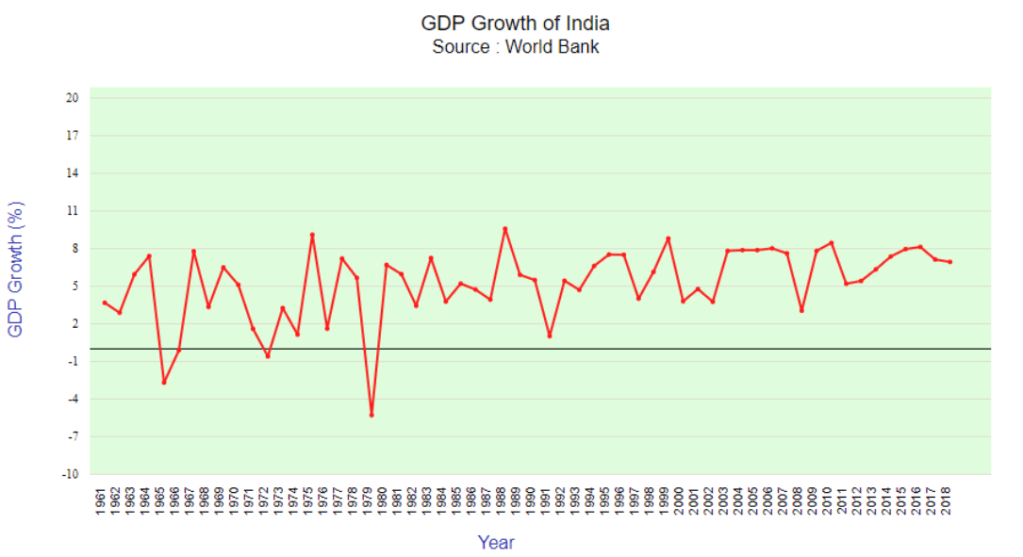
Did you know that historically, India was the largest economy of the world for most of two millennia from the 1st until the 19th century .Since the start of the 21st century, annual average GDP growth has been 6% to 7%,and from 2013 to 2018, India was the world’s fastest major growing economy, surpassing China. . The economy slowed in 2017, due to shocks of “Demonetisation” in 2016 and the introduction of the goods and service tax in 2017.In 2020, pandemic has affected trade and India was the world’s 14th largest importer and the 21st largest exporter.
For a continuous duration of nearly 1700 years from the year 1 AD, India was the top-most economy, constituting 35 to 40% of the world GDP .Under British rule, India’s share of the world economy declined from 24.4% in 1700 down to 4.2% in 1950. India’s GDP (PPP) per capita was stagnant during the mughal empire and began to decline prior to the onset of British rule .India’s share of global industrial output declined from 25% in 1750 down to 2% in 1900. At the same time, the United Kingdom’s share of the world economy rose from 2.9% in 1700 up to 9% in 1870.
There is no doubt that our grievances against the British Empire had a sound basis. As the painstaking statistical work of the Cambridge historian Angus Maddison has shown, India’s share of world income collapsed from 22.6% in 1700, almost equal to Europe’s share of 23.3% at that time, to as low as 3.8% in 1952. Indeed, at the beginning of the 20th century, “the brightest jewel in the British Crown” was the poorest country in the world in terms of per capita income. -MANMOHAN SINGH
In the 1980s and early 1990s the tides began to change. Liberalisation came to India and a growing belief contrary to what Nehru believed, began to rise . By the turn of the 21st century, India had progressed towards a free-market economy, with a substantial reduction in state control of the economy and increased financial liberalisation .
India experienced high growth rates, averaging 9% from 2003 to 2007. Growth then moderated in 2008 due to the global financial crisis. In 2003, Goldman Sachs predicted that India’s GDP in current prices would overtake France and Italy by 2020, Germany, UK and Russia by 2025 and Japan by 2035, making it the third-largest economy of the world, behind the US and China. India is often seen by most economists as a rising economic superpower which will play a major role in the 21st-century global economy.
India started recovery in 2013–14 when the GDP growth rate accelerated to 6.4% from the previous year’s 5.5%. The acceleration continued through 2014–15 and 2015–16 with growth rates of 7.5% and 8.0% respectively. For the first time since 1990, India grew faster than China which registered 6.9% growth in 2015. However the growth rate subsequently decelerated, to 7.1% and 6.6% in 2016–17 and 2017–18 respectively, partly because of the disruptive effects of 2016 Indian banknote demonetisation and to goods and service tax India. India’s GDP growth has been slowing rapidly, from a high of 8.3% in 2016 to just 4.2% in 2019.
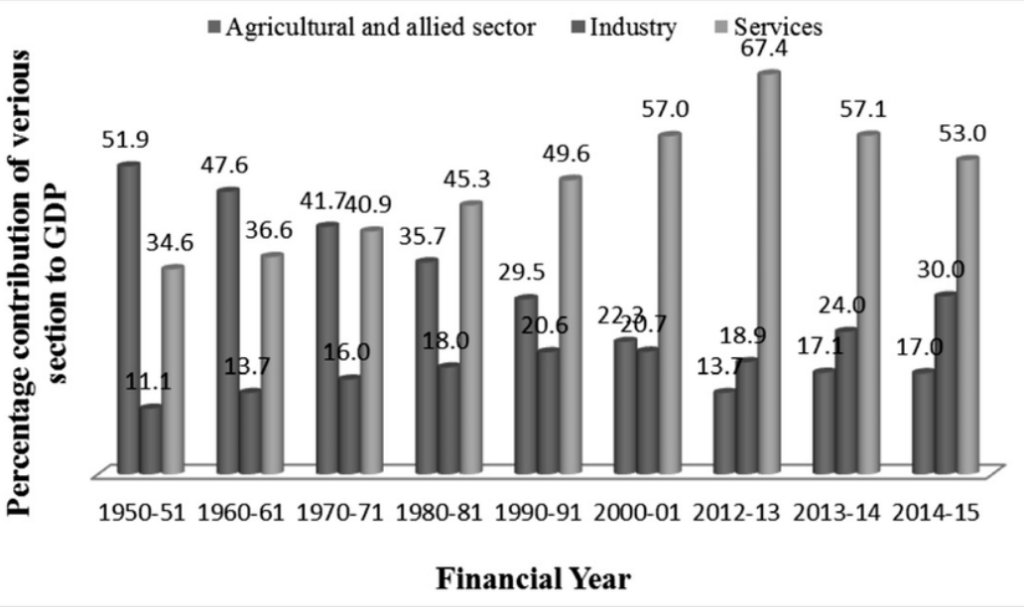
Historically, India has classified and tracked its economy and GDP in three sectors: agriculture, industry, and services.
Agriculture and allied sectors like forestry, logging and fishing accounted for 17% of the GDP, the sector employed 49% of its total workforce in 2014.Agriculture accounted for 23% of GDP, and employed 59% of the country’s total workforce in 2016. As the Indian economy has diversified and grown, agriculture’s contribution to GDP has steadily declined from 1951 to 2011, yet it is still the country’s largest employment source and a significant piece of its overall socio-economic development. Crop-yield-per-unit-area of all crops has grown since 1950, due to the special emphasis placed on agriculture in the five-year plans and steady improvements in irrigation, technology, application of modern agricultural practices and provision of agricultural credit and subsidies since the Green Revolution in India. However, international comparisons reveal the average yield in India is generally 30% to 50% of the highest average yield in the world. The states of Uttar Pradesh, Punjab, Haryana, Madya Pradesh, Andhra Pradesh, Telangana, Bihar, West Bengal, Gujarat and Maharashtra are key contributors to Indian agriculture.
At around 1,530,000 square kilometres (590,000 sq mi), India has the second-largest amount of arable land, after the US, with 52% of total land under cultivation.
Agriculture farming in India is a century-old activity, and is currently the highest contributor to the GDP of India. Agriculture remains the largest contributor to the country’s GDP and farmers constitute 58% of India’s population .Farming is one of the oldest economic activity in our country.
As per 2018, agriculture employed more than 50% of the Indian work force and contributed 17–18% to country’s GDP.
The economic contribution of agriculture to India’s GDP is steadily declining with the country’s broad-based economic growth. Still, agriculture is demographically the broadest economic sector and plays a significant role in the overall socio-economic fabric of India.
The main pillar of the rural economy is based on agriculture. Agricultural land and livestock are the primary means of production for people of the rural areas in any society. Livestock farming consists of the major part of the economy of the majority of people. It relies typically on labor-intensive methods for raising crops and healthy livestock. Livestock feed is shipped all over the country, and land is frequently needed for cultivation, farrowing, watering, and other activities.
The advent of modern technology has also revolutionized the agriculture sector. Farmers are adopting more sophisticated techniques to get more production from small pieces of land. So the use of advanced techniques is urging the farmers to focus on small land in order to get more production. But the farmers also need support from the government and also they need help in hard times like no enough rainfall or over rainfall etc. The government must extend a helping hand towards the farmers ,they are the ones who work selflessly and for the sake of the whole country’s population and they do not worry about in which season they are working in ,they put all their hard work and efforts into their work and they are the ones who worship their proffesion .
The rural economy mainly depends upon agriculture. Even though traditional farming still exists, the use of advanced technology has revolutionized the agriculture sector. It has proved a blessing for small-scale farmers. They can adopt modern agricultural techniques to get more produce from their small farms. Organic farming is another window of opportunity for farmers. They can grow more food to generate better revenue.
The cottage industry or the small scale industry plays a vital role in the rural economy of India. Majority of the population of India lives in rural areas; it is where the real India resides. Apart from agriculture, the cottage industry is the primary source of livelihood in rural India. Cottage industry or the small scale industry are those where the business is carried on at home with small numbers of workforce or labours . the members may be of the same family, religious groups or the community. Most of the workers of the small scale industry are the traditional artisans who have inherited their work as art from their ancestors.
In India, more than 74 per cent of the total population lives in the villages where their lot is linked with agriculture. They have to live in the villages as they cannot leave their fields which give them their ‘living’. Side by side they must be provided with some kind of cottage industries upon which they can depend during that period in which they remain idle and unengaged’.
After independence, our country has been taking gigantic strides towards industrialisation. Cottage industries can become and alternative means of employment for the people living in the rural areas. Cottage industries will be of benefit for our villages, which form the back bone of the nation.
The place of cottage industries in the national economy in the country has been unique since time immemorial. India was famous, in the past, for the wealth of the land and for the high artistic skill of her craftsmen. India was exporting wonderful jewellery and superfine embroideries to Europe. European merchants were attracted towards India more by her craft and industry than by the rich raw material.
It must not be forgotten that cottage industries are the back-bone of our rural economy and no rural uplift is possible without the protection of and encouragement to these small-scale industries. Apart from all other considerations, small-scale or cottage-industries are essential for providing employment to our tillers of soil in their leisure time or when they remain idle.
To improve and encourage the cottage-industry in our country we have to change the views of the general public. The people should be made interested in patronizing home-made goods. A ready market is a further urgency in this direction.
Rural Co-operatives and Rural Banks should be established and stabilized by the Government for advancing short-term loans on nominal interest.
Lastly, adequate marketing facilities should be arranged for them, as sale of goods has now-a-days become as complicated an affair as production itself.
Hence, the artisans must be helped to get the best price of their goods. Frequent exhibitions should be organized to enable the artisans to show their art and industry and give them impetus and inspiration to create still better patterns of handicrafts.
Basically the agriculture and cottage industries are the main sources of livelihood in India and they contribute most to our economy , we all know that these both professions are being practiced from very long period of time ,like around some centuries in India ,they have been contributing to the country’s economy from very beginning. the rural economy’s most percentage is received from agriculture and cottage industry and without their contribution our country’s economy might destroy or decline very rapidly ,even a small change in their contribution percentage might affect the economy of country ,but its economy right and GDP ,it wont stay constant there are many ups and downs ,in a year our GDP might good where as in the other it might be bad we cannot predict that ,there might be various reasons for the decline of GDP, like in 2017 it was demonitisation and in 2020 the pandemic hit us and it affected the whole world’s economy , and India’s GDP has been declined by 23.9% by 2020.
Agriculture and cottage industry are major contribution of rural economy , and for these people if government is trying to extend a helping hand to them then probably our economy might go to better figures and it’s a fact that our rural economy can be developed by agriculture and cottage industries and the Rural Economy in India is wholly agriculture based and it is of tremendous importance because it has vital supply and demand links with the other Indian industries. Agriculture is the main stay of the Indian economy, as it constitutes the backbone of rural India which inhabitants more than 70% of total Indian population.
so what comes to your mind when you hear the words economy ,agriculture and industries ,they are somewhere linked right ?we do have a basic idea that agriculture does contribute to our country’s economy and so do these industries but how do they?
India is known as an agricultural country, as most of the population of villages depends on agriculture. Agriculture forms the backbone of the country’s economy. The agricultural sector contributes most to the overall economic development of the country.
Did you know that historically, India was the largest economy of the world for most of two millennia from the 1st until the 19th century .Since the start of the 21st century, annual average GDP growth has been 6% to 7%,and from 2013 to 2018, India was the world’s fastest major growing economy, surpassing China. . The economy slowed in 2017, due to shocks of “Demonetisation” in 2016 and the introduction of the goods and service tax in 2017.In 2020, pandemic has affected trade and India was the world’s 14th largest importer and the 21st largest exporter.
For a continuous duration of nearly 1700 years from the year 1 AD, India was the top-most economy, constituting 35 to 40% of the world GDP .Under British rule, India’s share of the world economy declined from 24.4% in 1700 down to 4.2% in 1950. India’s GDP (PPP) per capita was stagnant during the mughal empire and began to decline prior to the onset of British rule .India’s share of global industrial output declined from 25% in 1750 down to 2% in 1900. At the same time, the United Kingdom’s share of the world economy rose from 2.9% in 1700 up to 9% in 1870.
There is no doubt that our grievances against the British Empire had a sound basis. As the painstaking statistical work of the Cambridge historian Angus Maddison has shown, India’s share of world income collapsed from 22.6% in 1700, almost equal to Europe’s share of 23.3% at that time, to as low as 3.8% in 1952. Indeed, at the beginning of the 20th century, “the brightest jewel in the British Crown” was the poorest country in the world in terms of per capita income. -MANMOHAN SINGH
In the 1980s and early 1990s the tides began to change. Liberalisation came to India and a growing belief contrary to what Nehru believed, began to rise . By the turn of the 21st century, India had progressed towards a free-market economy, with a substantial reduction in state control of the economy and increased financial liberalisation .
India experienced high growth rates, averaging 9% from 2003 to 2007. Growth then moderated in 2008 due to the global financial crisis. In 2003, Goldman Sachs predicted that India’s GDP in current prices would overtake France and Italy by 2020, Germany, UK and Russia by 2025 and Japan by 2035, making it the third-largest economy of the world, behind the US and China. India is often seen by most economists as a rising economic superpower which will play a major role in the 21st-century global economy.
India started recovery in 2013–14 when the GDP growth rate accelerated to 6.4% from the previous year’s 5.5%. The acceleration continued through 2014–15 and 2015–16 with growth rates of 7.5% and 8.0% respectively. For the first time since 1990, India grew faster than China which registered 6.9% growth in 2015. However the growth rate subsequently decelerated, to 7.1% and 6.6% in 2016–17 and 2017–18 respectively, partly because of the disruptive effects of 2016 Indian banknote demonetisation and to goods and service tax India. India’s GDP growth has been slowing rapidly, from a high of 8.3% in 2016 to just 4.2% in 2019.
Historically, India has classified and tracked its economy and GDP in three sectors: agriculture, industry, and services.
Agriculture and allied sectors like forestry, logging and fishing accounted for 17% of the GDP, the sector employed 49% of its total workforce in 2014.Agriculture accounted for 23% of GDP, and employed 59% of the country’s total workforce in 2016. As the Indian economy has diversified and grown, agriculture’s contribution to GDP has steadily declined from 1951 to 2011, yet it is still the country’s largest employment source and a significant piece of its overall socio-economic development. Crop-yield-per-unit-area of all crops has grown since 1950, due to the special emphasis placed on agriculture in the five-year plans and steady improvements in irrigation, technology, application of modern agricultural practices and provision of agricultural credit and subsidies since the Green Revolution in India. However, international comparisons reveal the average yield in India is generally 30% to 50% of the highest average yield in the world. The states of Uttar Pradesh, Punjab, Haryana, Madya Pradesh, Andhra Pradesh, Telangana, Bihar, West Bengal, Gujarat and Maharashtra are key contributors to Indian agriculture.
At around 1,530,000 square kilometres (590,000 sq mi), India has the second-largest amount of arable land, after the US, with 52% of total land under cultivation.
Agriculture farming in India is a century-old activity, and is currently the highest contributor to the GDP of India. Agriculture remains the largest contributor to the country’s GDP and farmers constitute 58% of India’s population .Farming is one of the oldest economic activity in our country.
As per 2018, agriculture employed more than 50% of the Indian work force and contributed 17–18% to country’s GDP.
The economic contribution of agriculture to India’s GDP is steadily declining with the country’s broad-based economic growth. Still, agriculture is demographically the broadest economic sector and plays a significant role in the overall socio-economic fabric of India.
The main pillar of the rural economy is based on agriculture. Agricultural land and livestock are the primary means of production for people of the rural areas in any society. Livestock farming consists of the major part of the economy of the majority of people. It relies typically on labor-intensive methods for raising crops and healthy livestock. Livestock feed is shipped all over the country, and land is frequently needed for cultivation, farrowing, watering, and other activities.
The advent of modern technology has also revolutionized the agriculture sector. Farmers are adopting more sophisticated techniques to get more production from small pieces of land. So the use of advanced techniques is urging the farmers to focus on small land in order to get more production. But the farmers also need support from the government and also they need help in hard times like no enough rainfall or over rainfall etc. The government must extend a helping hand towards the farmers ,they are the ones who work selflessly and for the sake of the whole country’s population and they do not worry about in which season they are working in ,they put all their hard work and efforts into their work and they are the ones who worship their proffesion .
The rural economy mainly depends upon agriculture. Even though traditional farming still exists, the use of advanced technology has revolutionized the agriculture sector. It has proved a blessing for small-scale farmers. They can adopt modern agricultural techniques to get more produce from their small farms. Organic farming is another window of opportunity for farmers. They can grow more food to generate better revenue.
The cottage industry or the small scale industry plays a vital role in the rural economy of India. Majority of the population of India lives in rural areas; it is where the real India resides. Apart from agriculture, the cottage industry is the primary source of livelihood in rural India. Cottage industry or the small scale industry are those where the business is carried on at home with small numbers of workforce or labours . the members may be of the same family, religious groups or the community. Most of the workers of the small scale industry are the traditional artisans who have inherited their work as art from their ancestors.
In India, more than 74 per cent of the total population lives in the villages where their lot is linked with agriculture. They have to live in the villages as they cannot leave their fields which give them their ‘living’. Side by side they must be provided with some kind of cottage industries upon which they can depend during that period in which they remain idle and unengaged’.
After independence, our country has been taking gigantic strides towards industrialisation. Cottage industries can become and alternative means of employment for the people living in the rural areas. Cottage industries will be of benefit for our villages, which form the back bone of the nation.
The place of cottage industries in the national economy in the country has been unique since time immemorial. India was famous, in the past, for the wealth of the land and for the high artistic skill of her craftsmen. India was exporting wonderful jewellery and superfine embroideries to Europe. European merchants were attracted towards India more by her craft and industry than by the rich raw material.
It must not be forgotten that cottage industries are the back-bone of our rural economy and no rural uplift is possible without the protection of and encouragement to these small-scale industries. Apart from all other considerations, small-scale or cottage-industries are essential for providing employment to our tillers of soil in their leisure time or when they remain idle.
To improve and encourage the cottage-industry in our country we have to change the views of the general public. The people should be made interested in patronizing home-made goods. A ready market is a further urgency in this direction.
Rural Co-operatives and Rural Banks should be established and stabilized by the Government for advancing short-term loans on nominal interest.
Lastly, adequate marketing facilities should be arranged for them, as sale of goods has now-a-days become as complicated an affair as production itself.
Hence, the artisans must be helped to get the best price of their goods. Frequent exhibitions should be organized to enable the artisans to show their art and industry and give them impetus and inspiration to create still better patterns of handicrafts.
Basically the agriculture and cottage industries are the main sources of livelihood in India and they contribute most to our economy , we all know that these both professions are being practiced from very long period of time ,like around some centuries in India ,they have been contributing to the country’s economy from very beginning. the rural economy’s most percentage is received from agriculture and cottage industry and without their contribution our country’s economy might destroy or decline very rapidly ,even a small change in their contribution percentage might affect the economy of country ,but its economy right and GDP ,it wont stay constant there are many ups and downs ,in a year our GDP might good where as in the other it might be bad we cannot predict that ,there might be various reasons for the decline of GDP, like in 2017 it was demonitisation and in 2020 the pandemic hit us and it affected the whole world’s economy , and India’s GDP has been declined by 23.9% by 2020.
Agriculture and cottage industry are major contribution of rural economy , and for these people if government is trying to extend a helping hand to them then probably our economy might go to better figures and it’s a fact that our rural economy can be developed by agriculture and cottage industries and the Rural Economy in India is wholly agriculture based and it is of tremendous importance because it has vital supply and demand links with the other Indian industries. Agriculture is the main stay of the Indian economy, as it constitutes the backbone of rural India which inhabitants more than 70% of total Indian population.





 Eduindex
You must be logged in to post a comment.