

Month: July 2022
Survey, Form And Content Of The Master Plan
What is Social Media Marketing?
Social Media Marketing, know all the information related to it.
Hello friends, maybe I do not need to tell you at all how big is social media, fast it is spreading, and also the number of people using it are also increasing rapidly. The speed of social media has become faster than the Internet.
Today everyone is using the Internet, and more than 3 billion people are using social media all over the world, and it is increasing.
While you are reading this post, you may have missed the figure. And with all this, many social media platforms have also come, and if we talk about the trending social media platforms now, then they are Facebook, Instagram, Twitter, YouTube, Whatsapp, Linkedin, and many more social media platforms. There are media platforms but all of them are the most famous in today’s date.
To know about social media marketing, you must read about digital marketing and want to know more about it, so let us now know what is social media marketing? And we are going to tell you many more things about it.
What is Social Media Marketing?

Social media marketing is a work in which any social media platform such as Facebook, Instagram, and Twitter is used to promote any business and products.
So that any products or services can reach to as many people as possible, and a brand image of any products or services can be created in the mind of the people, s that they can use the products or services.
With the help of social media marketing, it helps any brand or company to reach and talk to its target customers, and they get to know more about the brand or company.
In today’s time, social media marketing has become a big thing for any business, if you want to make your business bigger, or take your old business further, then you must take the help of social media marketing for that. have to take,
Only then you can reach your products or services to all your customers, and for this, you should also have the idea of social media marketing.
What is Social Media Marketing?
We want to tell you how powerful and beneficial a social media account can be for your business.
By being active in social media, you can make your business very big, because in today’s time everyone is going digital, and everyone is coming online if you have not brought your business online yet. So bring it as soon as possible or else it will be too late.
What is Social Media Marketing Video
Benefits of Social Media Marketing- Benefits of Social Media Marketing-
There are many benefits of social media marketing, with the help of which you can get a lot of profit for your business or your website.
In social media marketing, you only need to know about some things online, if you know the website, then you will also know very well about the power of social media, let us know what are the benefits that will help you. Social media will be beneficial.
Increase brand awareness for your brand or website.
If your product is good and can be of great use to the people, and if you are not able to sell it well, then it means that you have not taken any good steps regarding its marketing,
Or even if you have done marketing, then you have made some mistake, in such a situation, social media is a very good platform for how useful those people can be about your website about your product.
Social media can be a very effective thing to tell better about your brand or product and to give more information to people about it. You can easily do many things with the help of social media marketing, and you can give good information about your brand and product to people so that they can use your products.
Generate Leads and Boost Conversions
Generate Leads and Boost Conversation By this means, when you promote your products on social media, with the help of this you can connect with a lot of people, and give them some of their information about whom the leads speak, such as can generate leads by taking their name, mobile number and email ID.
Whenever you launch a new product of yours, then these leads will work for you.
Come, you can tell them all about your new products, and you can give information about them, so that they may get attracted and like your product and also buy it.
What is Social Media Marketing?
a good relationship with customers With the help of social media, you can build a good relationship with your customers, by providing them with good things, and if they have any problems using any of your products, or they want to get information about any products. , then you can take the help of social media, and by helping them you can build a good relationship with them.
Learn from your competitors.
If someone like you is making products, like if you have a shoemaking company, and you make shoes, then it is not that you are just making shoes, many such people in the market make shoes.
So with the help of social media, you will get to know about your competitors, how they are doing, how they are making products, why their products are being sold, and why not us?
So in a way, you will get a lot of information about the competitors with the help of social media, which will be of great use to you, and will also help in taking your business forward.
How to do Social Media Marketing?
Doing social media marketing does not require many skills, but even then you must have some basic knowledge about it, only then you will be able to do social media marketing well.
First of all, you have to create an account on all the famous social media platforms in the name of your brand, let’s know how to do good social media marketing.
First, find out about your target audience. For social media marketing, you have to first select the right audience for your product and brand, if your product is related to children, then you have to find marketing ideas like them,
If your products are for females or males, you will need to find anyone who is over 18 years of age. In this way, first of all, find a target audience for your product.
Create a good social media profile.
You have to keep your social media profile good, keep your brand logo good, prepare a good post daily for social media, and keep in mind, what your product or brand sells, or your website is about Post only related content on social media.
Show your good and best things first.
Share your good stuff first and foremost on social media, post the most and focus on the things that your audience or your customers like the most, and at the same time keep your new ones. Keep informing people about the products or services as well.
What are the best platform forms for social media marketing?
So friends, after understanding what is social media marketing, let us now tell you which social media platform will be good for you, and on which social media platform you should focus the most, and do marketing.
Although nowadays everyone can get good returns due to the internet being available almost everywhere the ones which are trending the most right now are Instagram, Facebook. Let us first know about Instagram marketing.
Instagram marketing:
Friends, if Instagram is most famous for something, then it is, to market your products on Instagram for photos, you have to make good photos and designs of your products or services,
And at the same time, you have to use good hashtags, so that your post can reach more people, and you have to post on Instagram every day and work on it regularly.
Facebook marketing:
If you talk about the most users, then you will find them on Facebook. On Facebook, you have to create a page with the name of your brand, in which you will also have to post well like Instagram,
Also, if you want to run paid ads, then you can run them on Facebook as well as you will get the option to run Facebook’s ads on Instagram.
conclusion-
So friends, in this way now you must understand what is social media marketing and how it is done. Today in this post we have told you Many things have been told about social media marketing.
If you also know anything else about social media marketing, or you have any questions, then you can ask us through the comment box given below.
What is Dedicated Hosting? Its features!

So finally, I am going to talk about Dedicated Hosting in this article. Lets discuss the definition of Dedicated Hosting.
In a Dedicated Hosting, web hosting provider provides a dedicated server, along with dedicated resources to a single user. Dedicated Hosting is ideal for the large number of visitors on a website.
Why Dedicated Hosting is best?

Dedicated hosting is best in all form from all the Hosting plans i.e. Shared Hosting, Cloud Hosting, etc.
In Shared Hosting, the users are sharing the server with many other users. While in VPS Hosting, the users are sharing the server but not the resources such as disc space. But, in a Dedicated Hosting plan, the user gets the whole server with all the resources.
Cost of Dedicated Hosting
A scalable server
Our Windows VPS solutions are designed to meet a wide range of business needs, and will scale up to suit your projects. There is no need to provision resources in advance — you can add them at any time via the OVHcloud Control Panel. This also helps you control your budget.
A dedicated environment
Since you are the administrator of your server, you are free to configure your dedicated environment however you like. With this flexibility, you can easily set up a Windows virtual server to host a website or email service, for example. With our VPS solutions, you get a server environment that is specially adapted to your web projects.
Simplicity and independence
One of the advantages of our virtual private servers is the autonomy they offer. You are free to install and configure the operating system you need, and pick one from a wide range. To further simplify how you set up your web projects, you can also install a web hosting control panel like Plesk, or cPanel.
Unlimited traffic
Your Windows VPS has unlimited ingress and egress traffic*. Depending on the model you choose, it can also reach up to 2 Gbit/s allocated bandwidth. These specifications are perfect for hosting websites and applications with high volumes of traffic, guaranteeing a smooth browsing experience for your users.
*Excludes datacentres in the Asia-Pacific region.
Backup options
We offer automated backup options for your server. Via the OVHcloud Control Panel, you can secure your data by storing backups in an external storage space, or creating a snapshot of your VPS at a specific time.
Availability
Service availability is an important factor, especially for websites and applications that are used every day by your users. Your VPS is set up on an infrastructure with minimal latency, and hardware availability guaranteed by an SLA. This way, you can rest assured that your solutions are based on a stable, robust environment.
That’s all about dedicated web hosting.
What is Digital Currency? Information about e-currencies
Friends, you must have heard the name of Bitcoin at some point or just a few years ago, and if you have not heard it, then it does not matter, what is our article Digital Currency today? In this, you will also get information about bitcoin.
Bitcoin is also a kind of digital currency, the most used cryptocurrency worldwide is bitcoin. It currently has 16.8 million tokens in circulation. And the person who has a bitcoin right now is a lot of money because friends, the price of 1 bitcoin is equal to 30-50 lakh rupees.
So by this, you must have understood and you must have got an idea of how much digital currency is worth. So let us know with this that what is this digital currency? And why is this so much discussed?
What is Digital Currency?

Digital currency is also called e-currency or cryptocurrency, in which the payment method is done completely in electronic form. These currencies, called cyber cash, are discussed all over the world. Digital currency can also be called virtual currency.
Digital currency is a kind of currency, which exists only in digital form, and it is also bought and sold online. Digital currency can be used to buy and sell things online only, you cannot use it for offline things.
Digital Currency i.e. Cryptocurrency
There is no limit to the number of times you can transact in digital currency. Digital currency is more secure than making an online payment by debit or credit card because it uses cryptography, which makes it even more secure.
That is why it is also called Cryptocurrency. The world’s first cryptocurrency is Bitcoin. Depositing it is called mining. Cryptocurrency can be easily transferred to any corner of the world and can be converted to any type of currency like Dollar, Euro, Rupee etc.
Transactions can be done through this currency without any medium through computer networks. At the same time, this digital currency is kept in a digital wallet, Digital Currencies have been banned in many countries, and because of this many illegal works are being done.
List of digital currency
Just as there are many currencies around the world, all countries have their money names, and they also have different values, in the same way, there are many types of digital currency, and they are also of many types, so let us know about AC currency only.
Bitcoin
The most widely used cryptocurrency digital currency around the world is bitcoin. It currently has 16.8 million tokens in circulation. Bitcoin is being called the poster child of the cryptocurrency industry. However, critics of Bitcoin are a bit sceptical about its growth due to its slow speed and high transaction fees.
Litecoin
Litecoin, launched in 2011, was one of the early cryptocurrencies after bitcoin and is often referred to as the “silver to bitcoin gold”.
Zcash
Zcash, a decentralized and open-source cryptocurrency launched in late 2016, promises to be. “If bitcoin is like HTTP for money, then the cash is HTTPS,” analogous cash uses to define itself.
Bitcoin Cash
Launched in the year 2017, Bitcoin Cash is one of the most traded cryptocurrencies in the world. It has a block size of 8MB while the original bitcoin has a block size of 1MB.
Ethereum
Ethereum is built as a decentralized app provider. It has a specific purpose to overcome the need for third-party companies like Apple to build apps. Apps developed on Ethereum will be on a distributed public platform where miners will be able to earn ‘ether’.
Libra
Libra coin is a digital currency created by Facebook. Facebook is developing a wallet for Libra that will allow it to be stored. People will be able to buy and sell Libra as a cryptocurrency.
So friends, now you must have understood what is digital currency? If you have any thing which you do not understand, then you can ask us in the comment box given below, we will try our best to help you.
What is a podcast? Learn About Podcasting
Hello friends, all of you must have seen many videos on YouTube, Facebook and Instagram and you must have made videos. But have you ever created or recorded audio? And have you upload it somewhere?
When you come to social media, you want to share ideas and you use different things for this and share your ideas with people, then friends podcast is also a part of social media, in which you can share your information. Can share with logo.
Starting a podcast is a big thing in itself because in this we have to share information with our Subscribers or Followers, which people should like.
What is a podcast?

A podcast is blogging in a way, as we write articles and then share them with people, in the same way, there is a podcast, the podcast is like a device or mobile app, in which we store any information in the form of audio. and then share that information with the people.
In podcasts, we put our voice in the form of audio. Just like we make a video from our mobile or camera, our voice is also recorded in it along with us, in the same way only our voice is saved in podcasting, which we can share with people.
Nowadays we all think that how can we learn or read more things in less time, and so earlier we used to read books, then we started using youtube to understand something, and now slowly Everyone has started liking to listen to all things.
Example of the podcast:-
We have also started podcasting, in which we will share things related to Digital Marketing, Blogging, Vlog, SEO, and Web Development. Play and listen to the podcast given below.
What are the benefits of podcasting?
Friends, you know what is a podcast and who is called podcasting is, but why should you podcast or what are the benefits of podcasting, so let’s talk a little about it.
If you are a good writer, or you know Poem and you also do poetry, or you like to motivate people, then you must use podcast.
As now more than 55% of people in Google do Voice Search and search for things, when we search anything in Google, Google shows us the same things that we want to see. Voice search is growing very fast in India, and one day it is going to go a long way.
Can you earn money from podcasting?
Yes, you can also earn money by doing podcasting, for this, you just have to make a podcast in a good field, after which you can earn money, it is not that you have created a podcast today and from tomorrow you will start earning money from it. , No…
Friends, there are no shortcut ways to earn money, and some people feel like this, then they will come to know about the matter themselves for some time.
So friends, as you will provide good value to your podcast, and as you get the support of people, they will like your podcast, then your subscribers or people who listen to the podcast will increase, and then you will earn money from the podcast. There will be many ways to find out.
So first of all, if you are good in any field, or you do any work very well, and you also like to do all that work, and you want to share all those things with people, then Start making podcasts today. Start little by little, you will be able to do it.. 🙂
Even if you search by typing something in Google, you will still get the same result that you will get through a voice search. With voice search, we can easily search things on Google.
Suppose you do not know English or anything and you do not know how to write it in Hindi, then you can easily search for anything on Google with your voice, after which you get your answer.
How to do podcasting?
Friends, to do podcasting, first of all, you will need a computer or mobile and a good internet connection for this work. After that, you have to select a good podcast platform.
If you want to start podcasting from your computer or laptop, then for this you have to sign up on online podcasting sites, after which you can start your podcast. These are some of the best podcast hosting sites.
- Anchor
- Podbean.com
- Spreaker.com
If you want to start podcasting from your mobile or tablet, then for this you have to download podcasting apps, after which you can start podcasting. This Anchor Fm mobile app for Android and iOS can be of great use to you.
for android- anchor
For iOS (Apple) – anchor
If you make a podcast using the mobile app, then it will be easy, you will get a lot of options in Anchor Fm, whatever popular podcast platform you are by making a podcast, it is published here for free.
If you have a WordPress website and you want to start a podcast on it, then you can start a podcast on your website using the Seriously Simple Podcasting WordPress plugin.
So this is how podcasting works, with podcasting you can connect with people, build your good followers, and improve your skills even more.
So maybe now you must have understood what is a podcast, and how to do podcasting, so if you have any thing that you have not understood or you want to ask something from us, then you can ask us in the comment box given below. We will do our best to help you.
If you liked this article, and you got to know something good from it, then you must share it on your social media platforms.
Anthropology
Anthropology is the systematic study of humanity, with the goal of understanding our evolutionary origins, our distinctiveness as a species, and the great diversity in our forms of social existence across the world and through time. The focus of Anthropology is on understanding both our shared humanity and diversity, and engaging with diverse ways of being in the world.

Throughout its existence as an academic discipline, anthropology has been located at the intersection of natural science and humanities. The biological evolution of Homo sapiens and the evolution of the capacity for culture that distinguishes humans from all other species are indistinguishable from one another. While the evolution of the human species is a biological development like the processes that gave rise to the other species, the historical appearance of the capacity for culture initiates a qualitative departure from other forms of adaptation, based on an extraordinarily variable creativity not directly linked to survival and ecological adaptation. The historical patterns and processes associated with culture as a medium for growth and change, and the diversification and convergence of cultures through history, are thus major foci of anthropological research
In the middle of the 20th century, the distinct fields of research that separated anthropologists into specialties were physical anthropology, emphasizing the biological process and endowment that distinguishes Homo sapiens from other species, archaeology, based on the physical remnants of past cultures and former conditions of contemporary cultures, usually found buried in the earth, linguistic anthropology, emphasizing the unique human capacity to communicate through articulate speech and the diverse languages of humankind, and social and/or cultural anthropology, emphasizing the cultural systems that distinguish human societies from one another and the patterns of social organization associated with these systems.
” If there were a science
Of human beings it
Would be anthropology
that aims at
understanding the
totality of experience
through structural
context”
-William Dilthey
By Ajeetha.R
Environmental Pollution – Types, Causes, Controls and Abatement Strategies
Environment Pollution: Types, Causes, Effects:
Environmental Pollution is not a new phenomenon, yet it remains one of the greatest threats to the health and well-being of humanity and one of the major environmental causes of death and morbidity. For example, substances such as plastic materials, heavy metals, etc., once released into the atmosphere. By natural processes, it cannot be degraded and are harmful to living organisms. In environmental pollution, pollutants originate from a source, are transported by air or water, and are dumped into the soil by human beings.
The long-term impacts of pollution are still being felt despite global attention to the issue. Day by day, our atmosphere is becoming more and more polluted due to anthropogenic activities. It is usually due to the pollutants released into the air, water, soil, etc., through many human activities. Let us examine the different types of environmental pollution.


What is Right of Way
What is Right of Way
What is Right of Way
What is Blockchain Technology? How does it work?
After all, what is Blockchain? Recently, Bitcoin has been in the headlines for a long time. Today you will get to know everything about it.
Friends, technology had gone a long way in today’s time, there was a time that if we had to send money to someone, then we used to take 1-2 days for that, and then we used to get the money from the bank, or we Sent someone.
Everyone nowadays will be seen talking about Bitcoin, Digital Currency, Dogecoin and Blockchain Technology. But the biggest question is whether every other speaker and listener knows the meaning of blockchain.
Today we are going to tell you about what is Blockchain Technology, and how it can change a lot in the coming time. So let’s know about Blockchain technology.But now with the help of UPI, everything has become very easy. Now in Minto, we can transfer money online to anyone at any time with the help of UPI. So now you can think that how technology has advanced so far.Often we do not miss to play on the term by talking about it, whether we are deeply aware of it or not. Well, we will make sure that after reading this news, after hearing the name of blockchain, you can not only react to it but also analyze it.
What is Blockchain Technology?

Blockchain Technology is such a technology, a platform where not only a digital currency but also anything can be made digital and its record can be kept. That is, blockchain is a digital ledger. At the same time, bitcoin is a digital medium, through which we and you or anyone else can sell and buy some things.
Blockchain technology is a structure that holds public block records in multiple databases, known as “chains”, in a network connected via peer-to-peer nodes. Commonly, this storage is called a ‘digital ledger’.
Blockchain technology is quite old, but it was theorized to be used by Satoshi Nakamoto for the cryptocurrency Bitcoin in 2009. Who Yoshi Nakamoto is a mystery? He published a paper about Digital Currency based on Blockchain.
Advantages of Blockchain
With blockchain, your business process will be better protected with the help of a high level of security. The chances of hacking your business are very less.
Blockchain is a technology that is designed as a program to record financial transactions. It is a digital system in which Internet technology is very tightly embedded.
Thanks to the blockchain, the system becomes difficult to hack. Even if a single block has been tampered with, it will be known that the hacker is hacking the system. If a hacker wants to hack the system then he has to catch all the blocks, which is impossible.
Each computer on the blockchain can describe the entire history of each record. This database is encrypted. In the blockchain system, even if a computer fails, this system continues to work. Whenever new records are to be entered in it, it requires the approval of many computers.
A blockchain system is a digital ledger of transactions with a network of computer systems and servers. Transactions done in all blocks are captured and each new transaction is included in the ledger.
In this way the database is managed by multiple participants. The system uses a hash cryptographic signature to record each transaction and includes each new block created in the block. In such a situation, if someone wants to hack it, then it is difficult to hack it.
What happens in each block of the blockchain?
As the name suggests, so is the work. It consists of many blocks and they are connected – that’s how it became a blockchain. Each block contains the data, the hash and the hash of the previous block. Now let us tell you about the data, the hash and the hash of the previous block.
The data that resides in the Bitcoin blockchain contains the details of the transaction. Information like sender, receiver and account are recorded in it.
The number comes after the data of the hash. You can think of a hash as a biometric which is unique for everyone. Your Face ID can’t match anyone else’s, similarly, this hash is also unique
, If there is any change in the block, it changes the hash.
All the blocks are virtually connected. This is a kind of system in which there is no scope for tampering. Because if anyone wants, the information of the blockchain cannot be changed.
Hash of the previous block – A block also contains the hash of the previous block and because of this, the chain of blocks is formed. That is, they are related to each other.
If you change the data in one block, then you will have to change the data in the other block as well. If this is not done, then the blocks cannot remain connected among themselves. It is not possible in a way that you can change the data from all the blocks around the world. But hackers can do anything.
What is the technology behind Blockchain Technology?
The main technologies behind Blockchain Technology mainly consist of the following three technologies.
- P2P Network (Peer-2-Peer)
- Private Key Cryptography
- Program (the blockchain’s protocol)
Where can Blockchain be used?
Blockchain technology can be used in the following areas apart from crypto-currencies.
- cyber security
- e-governance
- Information Technology and Data Management
- Government Schemes Accounts
- subsidy distribution
- Banking and Insurance
- land records regulation
- academic information
- Digital identity and authentication
- health statistics
- cloud storage
- smart contract
- keeping legal papers
How Secure is Blockchain?
Control in Blockchain is not with one, that is, the risk is less. The bank invests your money in the market and earns money. If the government wants, then the 2000 note kept in your hand will become invalid. For all these reasons, the idea of blockchain-based Bitcoin was published by Satoshi Nakamoto.
The record of transactions done in Bitcoin goes to millions of computers, not a single pass, and it is encrypted. Like a bank has the data of all its customers. That is, how much money is in which person’s account. But when it comes to Bitcoin, this is not the case here in the blockchain. Here no one has everyone’s details, but everyone has everyone’s details.
To do any transaction in Blockchain, all the nodes of the entire network will have to agree, only then that transaction will be valid. Here no single entity can say whether the transaction has taken place or not.
To hack it, you will not have to hack only one system like a bank, but all the systems located in the whole network have to be hacked, so hacking is not such an easy thing that anyone can do this technology. For this, a lot of knowledge is required.
What are the advantages and disadvantages of Blockchain?
Once the data is saved in it, it is difficult to make any changes or tamper with it. Cryptography Encoded Technology is used to keep Digital Ledger safe. Blockchain solves the problem of manipulation. This brings everything to the level of their highest degree of accountability.
Data that is once entered into the blockchain become immutable, and can no longer be changed in any way, which reduces the chances of fraud to a great extent.
conclusion-
Hopefully, by now you must have understood Blockchain, what is Blockchain Technology? How Blockchain Works. Also the difference between bitcoin and blockchain.
Energy Performance Evaluation
Energy performance evaluation is a crucial aspect of building design and operation, aimed at assessing and optimizing a building’s energy consumption and efficiency. It involves using various tools, techniques, and simulations to analyze how a building uses energy for heating, cooling, lighting, and other systems. The goal is to identify opportunities for energy savings, make informed design decisions, and improve the overall sustainability of the building.
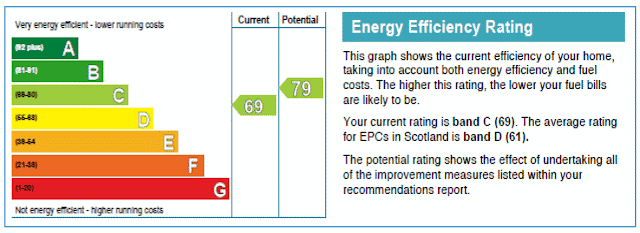

Here’s an overview of the steps involved in energy performance evaluation:
Data Collection: Gather information about the building’s design, construction, and systems. This includes architectural drawings, specifications of building components, HVAC (heating, ventilation, and air conditioning) system details, lighting specifications, and occupancy patterns.
Energy Modeling: Create a computer-based energy model of the building using specialized software. This model simulates the building’s energy consumption based on factors such as its orientation, location, climate, insulation levels, and the performance characteristics of its systems and components.
Simulation: Run simulations using the energy model to predict how the building will perform under different conditions, such as varying outdoor temperatures, occupancy patterns, and lighting schedules. Simulations can help identify peak energy demand times, potential areas of energy waste, and opportunities for improvement.
Baseline Comparison: Compare the simulation results with a baseline scenario, which typically represents a standard or minimum energy efficiency requirement. This comparison helps gauge the effectiveness of energy-saving measures.
Energy Conservation Measures (ECMs): Identify and evaluate various energy-saving strategies and technologies that can be implemented to improve energy efficiency. These measures could include upgrading insulation, optimizing HVAC systems, using energy-efficient lighting, installing renewable energy sources (such as solar panels), and improving building envelope performance.
Sensitivity Analysis: Conduct sensitivity analyses to understand how changes in different parameters affect energy consumption. This helps prioritize which measures have the most significant impact on energy performance.
Cost-Benefit Analysis: Evaluate the costs associated with implementing energy conservation measures against the expected energy savings over the building’s lifespan. This analysis helps in making informed decisions about which measures are financially viable and provide the best return on investment.
Recommendations: Based on the simulation results, sensitivity analysis, and cost-benefit considerations, generate a set of recommendations for improving the building’s energy performance. These recommendations may vary depending on the project’s goals, budget, and timeline.
Monitoring and Verification: After implementing energy-saving measures, continue to monitor the building’s energy consumption to verify the actual performance and compare it to the predicted results. This step helps ensure that the building is achieving the intended energy savings.
Iterative Process: Energy performance evaluation is often an iterative process, with designers and engineers refining their strategies and simulations as the design progresses or as new data becomes available.
By conducting thorough energy performance evaluations, architects, engineers, and building owners can make informed decisions that result in more energy-efficient buildings, reduced operational costs, and a lower environmental impact.
What is Building Performance and Simulation
Two smartphones of Oppo will be launched today, will get 80W super fast charging, 50% will be charged in 15 minutes, know details
Today’s Oppo mega launch event is at 6:00 p.m.Two amazing smartphones of Oppo Reno 8 series, Oppo Reno 8 and Oppo Reno 8 Pro, will be presented at this launch event.The Oppo Reno 8 series smartphone is offered with 80W fast charging support.The company claims that these two smartphones can be charged up to 50 percent in 15 minutes.Oppo Pad Air and Oppo Enco X2 will be presented at this launch event.Possible specifications of the Oppo Reno 8 Pro Oppo Reno 8 Pro smartphone can be offered with 6.7-inch AMOLED display support.Triple rear camera setup will be available in the phone.The main camera has 50 megapixels.While a 32-megapixel camera can be specified for selfies, the phone comes with dual camera support.The phone can be offered with 4,500 mAh battery support.For charging, the phone gets 80W SuperVOOC fast charge support, but conditions of the spec changes can be seen in the processor.Dimenstiy 1300 chipset support can be given in the Oppo Reno 8 5G smartphone.The phone will get a peak brightness of 800 nits.A triple rear camera configuration will be available on the rear.The phone can be charged up to 50 percent in just 15 minutes.You can comfortably use the phone all day long on a single charge.
 Eduindex
You must be logged in to post a comment.