How Firebug Helps You Design Your Blogger Blog

 For most bloggers, the idea of adjusting the coding of their blog to improve the user experience is daunting at best and often quite frightening. HTML5, CSS, and other coding elements are their own virtual language and for the average Blogger user looking to update a personal blog, the automatic settings are about as good as it gets. What if there was a better way to code a blog, whether a beginner or a pro, that could be done within the browser itself?

If you’re using Firefox or Chrome, then you should also be using Firebug. It allows you to code your website in real time, so you can maximize the UX of your blog in no time at all.

You No Longer Need To Edit Through Blogger!

If you’ve ever tried to update a Blogger theme through the editing functions of the website, then you know how difficult it can be. You can preview your designs, but you can’t save any changes to officially see what is going to happen with your site until you publish the edits. If you’ve missed just one line of code or forgotten one small element, you’re going to have to go back into the editing matrix, find the error, update it again, and repeat until you have a responsive blog once again.

What Firebug allows you to do is see all of those elements that make up a website in real time. Instead of editing and then publishing, you can edit in real time and see updates happen, all without affecting the user experiences of visitors that are coming to your site while you’re editing. You can change the fonts, colors, or virtually anything else within the design of the site quickly and see the results of your work as it happens. Don’t like it? Just undo your changes.

It’s really that easy!

Using Firebug to Customize CSS in Blogger

This guide will show you how to modify the CSS code of a Blogger template. Usually, the Blogger Template CSS style declarations are editable through the style.css file, found between the  and  tags.

To download Firebug and get more details regarding its powerful features, visit: Firebug for Firefox, or if you are using Chrome, get the Firebug Lite app. I would recommend to use Firefox, which is more complete and quick, but, nevertheless, both work the same.

Once Firebug is installed, a small bug icon will be available in the upper right of your Web browser’s address bar. Clicking it, a horizontally split screen will be shown at the bottom of the browser’s window. The page will continue to show in the upper half, while the lower half will show the HTML of the current web page.

firebug

To customize any web element from a Blogger template, just click either on the Firebug icon in the toolbar, or the “Inspect Element with Firebug” item in the context menu. Next, click the blue cursor button to Inspect and place the cursor right over the element to customize.

For example, let’s say that we want to change the title of the “Blog Archive” gadget. After we clicked the inspect button, mouse over the “Blog Archive” title which will be highlighted as shown in the screenshot below. To change this element, click on it:

inspect element using firebug

Now that we decided which element we want to change, right click on the “Style” panel and select the “Add rule” option:

add CSS rule in firebug

This will give the class or the id of the highlighted element – in our case, the heading of the Blog Archive (#BlogArchive1 > h2). To edit this rule that we just added, click anywhere near the left curly bracket that will open a text box, so that we can type a new CSS declaration:

firebug css declaration

And here comes the fun part. Let’s say that we want to make the title red. We will type color and hit Enter, then we will type the color value or the red text and hit Enter. We will also set the set the font size to 20px, text alignment to center (text-align: center) and make the text underlined (text-decoration: underline):

modify blogger css with firebug

The cool thing about Firebug is that when modifying any CSS property, you can see the results directly applied on the page. So, after adding these declarations, we’ll see a big red underlined title for our Blog Archive gadget (see in the screenshot above).

To apply this CSS rule on a Blogger template, just select it beginning from the right curly bracket and to the #(id) or .(class) symbol, then right click it and Copy the CSS code.

copy firebug css rule

Before making any change, it’s highly recommended to make a backup of your current template. Go to “Template” and click the “Backup/Restore” button on the upper right side. On the same “Template” location, click on the “Customize” button and navigate to “Advanced” > “Add CSS”. Paste the CSS rule that you just copied into the CSS box:

add firebug css to blogger template

Click the “Apply to blog” button on the upper right corner to save the changes and view your blog.

Firebug Also Gives You One Distinct Advantage…

One of the best reasons to install Firebug into Chrome or Firefox is that it allows you to emulate some of your favorite website designs quickly and easily. Instead of hiring a web designer to do the work, which could cost you thousands, you can simply start Firebug and see what the CSS styles are for your favorite site. This allows you to create a similar widget.

From there, all you’ve got to do is change the coding to make the design elements work under the rules of your own custom.css. This means you can make easy design changes to your Blogger blog without having to go through all of the menus and editing functions so that your template can truly be your own. Do you have some work to do? Sure – but Firebug does all of the primary work for you.

All you’ve got to do is have a creative mind and a few minutes to make changes to the coding design. Whether you’ve been coding for years or are just starting your first blog, this is definitely the best way to make sure that your visitors have the best experience possible!

How To Display Most Commented Posts In Blogger

 One of the best gadgets for your Blogger blog is a popular posts widget for your sidebar. This lets visitors see what your trending posts are right now and encourages them to click on them to read them. This basic widget is just a little too basic, however, for the modern day website visitor. Not only do they want to see your trending posts, but they also want to join the discussions that are happening on your blog. To do that, you’ll need a most commented posts widget for Blogger.

Having a customized widget on your site is a lot easier than you might think. In order to have an effective widget, however, you’re going to need a few specific things to help you out.

most commented posts widget

Here’s What You’re Going To Get

There are certain aspects in the design of a most commented posts widget that you should expect. That’s why you’ll find these specific components with this custom widget:

  • Ordered by popularity. The posts that have the most comments are the most likely to have visitors want to read the post and join in with the conversation. By ordering your posts based on the popularity of them, you’ll give each visitor the chance to see what the hype really is about! This lets you have a charted graphic that gives a visitor easy recognition, but also allows you to keep it straight and aligned if you’re looking for a cleaner look.
  • Graphic incorporation. Blog posts that have at least one graphic incorporated with them will receive 100% more traffic than posts that have no images at all. For every graphic that you include with a blog post, the more likely you are to get a click! The same is true with your most commented posts widget, so be sure to incorporate graphics that stand out with your design.
  • Descriptions that blend in. The internet today revolves around the value that you can provide each individual user. People don’t just click on things because they look visually tempting. They click on them because they promise a level of value that another website like yours isn’t able to provide. By having descriptions that blend in, you’ll be able to enhance the perceived value that your site can provide. This leads to more clicks!

Related: Add Multi-Colored Popular Posts to Blogger

Add the Most Commented Posts Widget to Blogger

Step 1. Log in to your Blogger account and go to Template, press the “Edit HTML” button.

Step 2. Click anywhere inside the code area and press the CTRL + F keys to open the Blogger’ search box. Type the following tag inside it and hit Enter to find it:

Step 3. Just below , add this code:

add code to blogger html

Note: if you can’t find the tag, try to find the following tag instead and add the variables just below it:

<![CDATA[

Step 4. Now search for the following tag (CTRL + F):

]]>

Step 5. And just above it, add this CSS code:

.comment-count {
    padding: 3px 10px;
    background: #fff;
    color: #000;
    font-size: 10px;
    float: right;
}

.most-commented ul {
    padding: 0px !important;
    font-family: Century Gothic, sans-serif;
}

.most-commented ul li {
    list-style-type: none;
    padding: 10px;
    color: #555;
    margin-top: -10px;
}

.most-commented ul li a {
    color: #444;
    font-weight: bold;
    text-decoration: none;
    font-size: 11px;
}

.most-commented ul li img {
    float: left;
    margin: 0px 5px 0px 0px;
    width: 60px;
    height: 60px;
}

.most-commented:nth-child(3n+0) {
    background: $(most.commented.background1);
    width: 100%;
}

.most-commented:nth-child(4n+0) {
    background: $(most.commented.background2);
    width: 95%;
}

.most-commented:nth-child(5n+0) {
    background: $(most.commented.background3);
    width: 90%;
}

.most-commented:nth-child(6n+0) {
    background: $(most.commented.background4);
    width: 85%;
}

.most-commented:nth-child(7n+0) {
    background: $(most.commented.background5);
    width: 80%;
}

Step 6. Save the template.

Now, let’s add the Most Commented Posts widget to the Layout of our Blogger blog. Head over to the “Layout” section of your Blogger dashboard and click on the “Add a gadget” link on the right side. From the pop-up window, scroll down the list and select the “HTML/JavaScript” gadget:

blogger html javascript gadget

Copy and paste this script inside the content box:

function stripTags(s,n) {
    return s.replace(//ig,””).split(/\s+/).slice(0,n-1).join(” “)
}
function mostcommented(feed) {
    var i;
    for (i = 0; i < feed.count ; i++) {
var postURL = “‘” + feed.value.items[i].link + “‘”;
var postTitle = feed.value.items[i].title;
var postthumbnail = ““;
var postDescription = feed.value.items[i].postdescription;
var postComments = feed.value.items[i].commentcount;
var postList = ‘

  • ‘ + postComments + “

    ” + postthumbnail + “‘ + postTitle + “”  + ‘

    ‘ +stripTags(postDescription,10)+’…

    ‘ + ‘

‘;
 document.write(postList);
     }
 }
 
<script src="http://pipes.yahoo.com/pipes/pipe.run?
AddUrlHere=http://helplogger.blogspot.com
&NumberofPosts=5
&_id=2cb5eb603ed55a6264ee1484e5fdd45c
&_callback=mostcommented
&_render=json”
type=”text/javascript”>Add this widget

Here, change http://helplogger.blogspot.com with your blog URL. If you want to add more characters to the description, modify the “10” value in red from “postDescription,10“.

If you want a more simple look (without the thumbnails and post snippets), add this script instead:

function stripTags(s,n)
    {
    return s.replace(//ig,””).split(/\s+/).slice(0,n-1).join(” “)
}
function mostcommented(feed) {
 var i;
 for (i = 0; i < feed.count ; i++)
 {
var postURL = “‘” + feed.value.items[i].link + “‘”;
var postTitle = feed.value.items[i].title;
var postComments = feed.value.items[i].commentcount;
var postList = ‘

‘;
 document.write(postList);
 }
 }
 
<script src="http://pipes.yahoo.com/pipes/pipe.run?
 AddUrlHere=http://helplogger.blogspot.com
&NumberofPosts=5
&_id=2cb5eb603ed55a6264ee1484e5fdd45c
&_callback=mostcommented
&_render=json”
type=”text/javascript”>
Add this widget

…. and replace http://helplogger.blogspot.com with your address.
To add the “comments” text after the comments number, replace the line in red:

‘ + postComments + “

with:

‘ + postComments + ” comments” + “

Once you have finished adding your own settings, press the “Save” button to enable the gadget in the sidebar of your blog. That’s it!

configure html javascript gadget

To change the background colors of the most commented posts, go to “Template” > hit the “Customize” button and navigate to “Advanced” > “Most Commented” tab. Here you can pick 5 different colors by clicking on the color boxes:

blogger template designer

Once you’ve selected your favorite color scheme, click the “Apply to blog” button to save the changes… and you’re done.

Why Use the Most Commented Posts widget?

The basic psychology in every human is that they want to feel like they belong to a community. That’s exactly what this customized widget will bring to your site. No matter what content drew a visitor to see your content, this widget will invite them to join the lively parts of your piece of the internet. This helps to build relationships, with you and with other visitors, and this relationship-building engagement is what you need to start having real value.

Take the time to install this most commented posts widget on your site and you’ll see for yourself why this is one of the most useful widgets that is available right now. Enjoy 😉

How To Host Blogger CSS And JavaScript Files In Google Drive

 Anyone that has ever worked on a web design or development can tell you that where you decide to store your files is important. Every time someone visits your site, the server or host will access this location and bring up the relevant files that need to be displayed. Wherever you decide to store your files, this will have an impact on some important aspects like the speed that your site loads, your overall SEO ranking and your ability to make necessary adjustments to the site.

Things To Think About

When you are designing your online structure and where to store your important CSS and JavaScript files, here is a run down on how this decision might impact your site later on:

Site Loading Speed

By combining some of the style sheets and website files, the Blogger server only has to collect information from a single location. When you split up your files or decentralize the file system, it takes a longer time for all the data to come together to make your site possible.

Slow loading speeds can negatively impact your SEO ratings because the slower the site is, the less likely that visitors are going to wait around for it to load. If someone visits your site and immediately clicks the ‘back’ button because it’s taking too long to load, that is going to increase your bounce rate and provide Google with statistics that show your site is either low quality or irrelevant to the search keywords.

File Storage Affects SEO

In addition to increasing your bounce rate, storing your files in a central location and managing the name of your files can affect SEO site wide. Web crawlers enlisted by Google, or some of the other search engines, index both the code on your site, and the name and directory of your files. If file names are random or not placed in the proper categories, the web crawlers aren’t going to know what to do with the information.

Clear file structure and a central location provide you with incentive to organize everything and name them appropriately. All the content that is relevant to the subject of your website or blog will be in the same location for web crawlers to review.

Storage Locations Affect Editing Abilities

Shuffling through files and folders or opening up FTP connections just to make some simple edits can be a hassle, and take up a lot of time that could have otherwise have been spent writing new content.

If you’re a Blogger site owner, this is something you need to think about. When you need to make alterations to things like social media sharing buttons, popular posts, recent posts and related posts widgets, you have to know where everything is intended to go, or risk losing both available content and money.

Some of the larger sites that produce hundreds of unique articles each month can’t afford to have content in different locations. When articles start to get lost out of order, they run the risk of duplicating content on their site, or forgetting to post it altogether. Things should be right at your fingertips to minimize mistakes and reduce the amount of time spent editing the site while it’s still live.

Storing Javascript/CSS Files With Google Drive

Storing Blogger CSS and JavaScript files with Google Drive will help to eliminate any of the problems mentioned above and reduce the clutter among your services. Taking this method can increase your site speed, increase the opportunities for a successful SEO campaign, and make your life so much easier.

Google Drive provides ample amount of space to store large files, and offers collaboration services so that you can work among different team members on the same project. Some of the files that you upload into the cloud services can remain unpublished and stay within the private site, whereas other files like blog posts can be published or stored to the public site.

Another beneficial feature of storing all your Blogger files on Google Drive is that it is highly secure. Google comes with the backing of one of the leading companies in the technical world so that you can be sure your content is safe from hackers and those looking to compromise your site.

This guide will provide you with step-by-step instructions on how to setup your Blogger site using Google Drive. It’s completely free to take advantage of this strategy, and will provide you with a solid platform from which to build your blog.

Step 1. Prepare the CSS/JavaScript Files

  • First, we need to create the file that we need to host. To host a CSS file, open the Notepad and paste the CSS code (if it is enclosed within the and tags, remove them). 
  • In the Notepad menu, select ‘File’ > ‘Save as’ and type the file name with the .css extension just like I did with mycssfile.css – see the screenshot below.
create a css file
  • In the same window, choose “All files” in the “Save as type” option and set the Character Encoding to UTF-8.
  • If you want to host a JavaScript file, add the .js extension (instead of .css) at the end of your file name (remove the … tags if you see them). Click “Save” and navigate to the location where you want to save the file.

Step 2. Upload Your File on Google Drive

  • Access https://drive.google.com and log in with your Gmail account. After you logged in, click on the ‘Create’ button and add a new separate folder to upload your JavaScript and CSS files.
create folder in Google drive
  • Open the newly created folder, and click on the Upload button with the upward arrow to choose the files that you need to upload.
upload files using google drive
  • Now, navigate to the location where you saved the files, select them (to select multiple files, press and hold down the Ctrl key on your keyboard and then click on them) and press the Open button.
  • After the files have been successfully uploaded, right click on the file names (to select all your files in the folder, click on the checkbox) and select ‘Share’:
share google drive files
  • In the ‘Sharing settings’ window, click on the ‘Change’ link and choose the ‘Public on the web’ option. Press ‘Save’ and copy the link(s) of your uploaded file(s) from the ‘Links to share’ box highlighted in blue, then paste it into a Notepad to use it later.
javascript css file sharing

Step 3. How to Add an External CSS/JavaScript file to Blogger

Before you can use the links, you must replace ‘https://drive.google.com/file/d‘ to ‘https://googledrive.com/host‘ and remove ‘/edit?usp=sharing‘ in the link.

For example, the link to mycssfile.css that I copied looks like this:

https://drive.google.com/file/d/0B4n9GL3eVuV-TkphMkc3SFR2Slk/edit?usp=sharing

Notice the part in blue after the “/file/d/” part. That is the file ID which is used to access it via the new hosting service. It should start with the following URL:

https://googledrive.com/host/

Add the file ID like this (remove the ‘/edit?usp=sharing’ part):

https://googledrive.com/host/0B4n9GL3eVuV-TkphMkc3SFR2Slk

Now log into your Blogger account, select your blog and go to Template > Edit HTML. Click anywhere inside the code area and press the CTRL + F keys to open the search box:

open blogger search box

If you want to add a CSS file, type the following tag inside the search box and hit Enter to find it:

Just BELOW the tag, add this line:

<link rel="stylesheet" type="text/css" href="https://googledrive.com/host/0B4n9GL3eVuV-TkphMkc3SFR2Slk” />

And replace https://googledrive.com/host/0B4n9GL3eVuV-TkphMkc3SFR2Slk with the link of your CSS file:

add external css to blogger

If you want to add a Javascript file, search for the following tag:

And add this line just ABOVE it:

<script src='https://googledrive.com/host/0B4n9GL3eVuV-eVYwLXBrTlZrVDg‘ type=’text/javascript’>

Replace the line in blue with your URL:

add external javascript js to blogger

Finally, press the ‘Save template’ button to save the changes. And you’re done!

In Conclusion

Once you have saved all your file folders and closed out of the drive, open your site in a browser and make sure that all the changes have completed successfully.

Next time you want to edit any of the information or move internal files, all you have to do is open up the Google Drive folder on your account and make the modifications from that location. Those files will then automatically sync to the online folder and make updates to your site. This works the same if you want to change the appearance by modifying the CSS code to extend the header, footer, or make customizations.

As you can see, changing your file storage out so that is CSS and JavaScript is stored on your Google Drive account is easy to do and only takes a few minutes. After you make the change, you can begin benefiting from faster loading speeds, higher SEO rankings, and overall a more convenient platform to work from to increase the efficiency of your work.

How To Add An Instagram Widget In A Blogger Blog

 If you’re not familiar with Instagram, it’s a photo-sharing network that can be downloaded to your smart phone as an application. Think of it as Facebook without the status updates. By developing a simple service that does one thing, and does it well, Instagram has become one of the most prominent photo sharing apps on the market.

The great thing about using Instagram is that it’s not just for individuals. Businesses and non-profits alike can take advantage of this service to share their day and passions with their dedicated customers and fans. These fans number nearly 200 million active users a month, and approximately 7.3 million new daily posts. That’s an astonishing number of potential new customers available for you to capture.

By adding Instagram on Blogger as a widget, you can unleash a new visual aspect of that site and allow visitors to go beyond just words on a page. With the convenience to carry the application around on your smartphone wherever you go, you can snap pictures, apply filters, and upload that content to your profile. From the profile, a widget specially designed for Instagram on Blogger would translate that data and display the image on your site. Even those visitors that aren’t members of Instagram could benefit from such a service.

instagram widget for blogger

It doesn’t matter what you are sharing. Whether you’re the type of person that loves to share pictures of your dinner with the world, or business owner that loves showcasing their brand in everyday life, Instagram can work for you. Adding Instagram on Blogger as a widget also offers an incredibly accessible tool for stock photos to use in new posts.

This guide will explain how to add an Instagram widget to your site with step-by-step instructions. The design of your new Instagram widget is entirely customizable and will allow you to modify the background color, font, and how the widget is actually displayed on the site. When you’re finished, you’ll find that the Instagram widget will blend together effortlessly with your current theme and make your Blogger site truly stand out from the rest.

How to Add An Instagram Widget in Blogger

1. To get the Instagram widget, access the Intagme website here: http://www.intagme.com/

2. Type in your username > select Grid or Slideshow:

instagme username setting

3. Select the Thumbnail size of your images (100px is the default) and choose if you want a border around your Photos or not

instagram widget thumbnail

4. To change the Background Color, simply click on the empty box and pick your favorite color

instagram background color

5. If you want to show the Sharing buttons on your widget, select ‘Yes’, otherwise, click ‘No’.

6. Once you’re satisfied with the widget, press the “Get Code” button and copy your code.

instagram sharing buttons

7. Log into your Blogger account and select your blog > navigate to Layout and click on the “Add a Gadget” link on the right side:

adding instagram to blogger

8. In the pop-up window, scroll down and click on the “HTML/JavaScript” gadget:

add html javascript gadget

9. Paste the code that you got from the Intagme website into the content section and press the ‘Save’ button to save the widget.

instagram code to blogger

10. Click and drag your widget if you want to change its position and press the “Save Arrangement” button on the upper right side.

blogger save arrangement

And that’s it! Now you have your very own Instagram widget on your Blogger blog to share new photos with visitors, and provide just a glimpse of your life when you’re away from the computer. To change or add any of the photos that are displayed in the widget, you’ll have to go directly through the app itself, or log on to your account via Instagram’s website.

Once you’re ready to show off your new work, let all your customers or fans know by posting a Facebook link to the site or a tweet about the changes and asking them to follow you. Just make sure that you’ve added a few photos before making the announcement, so that they have something to look at. After they access your widget, they can like your new photos and interact with you in entirely new ways.

Add 6 Stylish Custom Search Boxes To Blogger

 There’s an unspoken rule in the world of web design that says that every website have a search box. You can, and should, design a custom search gadget to Blogger that contributes to the theme of your site while providing some key benefits to both your customers and you.

Benefits to Customers

Search boxes not only help to increase your website’s design usability, but they’re very convenient to site visitors and regulars. For those that have been to your site before, they know what they want and they want it now. These are the impatient people who don’t feel like wading through different links. If you don’t accommodate this problem you might risk losing those readers.

For newer customers who want to get a feel for your site before investing any more time, it gives them the chance to look for their interests on both eCommerce sites and blog sites.

Benefits To You

Adding a custom search gadget to Blogger perhaps best benefit eCommerce sites because it’s an industry that inherently offers a lot of very specific products. For instance, if you sold clothing apparel and someone was only look for shirts, the search would result would only bring up shirts so that person can look through everything in one place.

Bloggers might not have products to offer, but adding a custom search gadget to Blogger can help site analytics and SEO. Google Analytics offers a tool that will track all the searches performed by your search bar, so that you can use this data when improving your keyword usage and content choices. Google web crawlers and search engine bots will also test out phrases in these boxes on the rare occasion to make sure that all your content leads to somewhere creates a closed loop.

Add Your Own Custom Search Gadget To Blogger

Just because you should have a search bar doesn’t mean you you’re restricted to what time. Your site’s search bar should be easy to find and readily available whenever someone needs it, but other than that the look of the design is up to you. If you want to add a custom search gadget to Blogger, here are 6 stylish choices to pick from. Just copy the code below the search box that you want to add and follow the steps below:

#searchbox{background:#d8d8d8;border:4px solid #e8e8e8;padding:20px 10px;width:250px}input:focus::-webkit-input-placeholder{color:transparent}input:focus:-moz-placeholder{color:transparent}input:focus::-moz-placeholder{color:transparent}#searchbox input{outline:none}#searchbox input[type=”text”]{background:url(https://blogger.googleusercontent.com/img/b/R29vZ2xl/AVvXsEgecsjgsGi6Nn6yLnACDG5umKhFK-S9yP-JD1g6eUeqKadyhCkqR6x_e5VIrnRyH1KzjMWTnhQ6Qn6AsEAz1pv1oFSt0_pMPCtBFOdtHzsd0Imi31GZ7IH2kOECG44FOAL4GdId_-MatqJJ/s1600/search-dark.png) no-repeat 10px 6px #fff;border-width:1px;border-style:solid;border-color:#fff;font:bold 12px Arial,Helvetica,Sans-serif;color:#bebebe;width:55%;padding:8px 15px 8px 30px}#button-submit{background:#6A6F75;border-width:0;padding:9px 0;width:23%;cursor:pointer;font:bold 12px Arial,Helvetica;color:#fff;text-shadow:0 1px 0 #555}#button-submit:hover{background:#4f5356}#button-submit:active{background:#5b5d60;outline:none}#button-submit::-moz-focus-inner{border:0}

#searchbox{width:240px}#searchbox input{outline:none}input:focus::-webkit-input-placeholder{color:transparent}input:focus:-moz-placeholder{color:transparent}input:focus::-moz-placeholder{color:transparent}#searchbox input[type=”text”]{background:url(https://blogger.googleusercontent.com/img/b/R29vZ2xl/AVvXsEgecsjgsGi6Nn6yLnACDG5umKhFK-S9yP-JD1g6eUeqKadyhCkqR6x_e5VIrnRyH1KzjMWTnhQ6Qn6AsEAz1pv1oFSt0_pMPCtBFOdtHzsd0Imi31GZ7IH2kOECG44FOAL4GdId_-MatqJJ/s1600/search-dark.png) no-repeat 10px 13px #f2f2f2;border:2px solid #f2f2f2;font:bold 12px Arial,Helvetica,Sans-serif;color:#6A6F75;width:160px;padding:14px 17px 12px 30px;-webkit-border-radius:5px 0 0 5px;-moz-border-radius:5px 0 0 5px;border-radius:5px 0 0 5px;text-shadow:0 2px 3px #fff;-webkit-transition:all 0.7s ease 0s;-moz-transition:all 0.7s ease 0s;-o-transition:all 0.7s ease 0s;transition:all 0.7s ease 0s;}#searchbox input[type=”text”]:focus{background:#f7f7f7;border:2px solid #f7f7f7;width:200px;padding-left:10px}#button-submit{background:url(https://blogger.googleusercontent.com/img/b/R29vZ2xl/AVvXsEjdl48MEAZ1IEc8wsH9aQ6JZGKDSFV7eH5A8XRP7RwaVxot7aoGhU17MEIz8lPXdK_wwagbATPKIyenP2A-K4YuTLEfQdeZt73pNjb9cCdtuUo4vgG-LYCwyRpHyTuHV3gSO4RJTh-PyD0L/s1600/slider-arrow-right.png) no-repeat;margin-left:-40px;border-width:0;width:43px;height:45px}

#searchbox{background:url(https://blogger.googleusercontent.com/img/b/R29vZ2xl/AVvXsEg9ZhA9IgqPpKtA_mmG57UgO2_AclKLtZJciSxKR5FRCxxjsbdgAqWojhpDQF7w2LC9vqz0igojt0aYcwh2enMvdeGfi4kr8pyf5SqTg3PjRngbdi3d9dOPvT0lvsZeLLgd6Ne9JNYbA-PR/s1600/searchbar.png) no-repeat;width:208px;height:29px}input:focus::-webkit-input-placeholder{color:transparent}input:focus:-moz-placeholder{color:transparent}input:focus::-moz-placeholder{color:transparent}#searchbox input{outline:none}#searchbox input[type=”text”]{background:transparent;margin:3px 0 0 20px;padding:5px 0;border-width:0;font-family:”Arial Narrow”,Arial,sans-serif;font-size:12px;color:#828282;width:70%;display:inline-table;vertical-align:top}#button-submit{background:url(https://blogger.googleusercontent.com/img/b/R29vZ2xl/AVvXsEjFHmpdctCOGvkJhXlVBKLATAIMeIUJu7bRzh6lckB6D0m2lba1HKQMFvHhofuwOyRu8Ca3sF_WhLC4ZzL4X-uzeCDhH0ApcTOWbPHgy6g252pqi7rPk95ZMoqWeWq6N2u16aMtNTLnVgF0/s1600/magnifier.png) no-repeat;border-width:0;cursor:pointer;margin-left:10px;margin-top:4px;width:21px;height:22px}#button-submit:hover{background:url(https://blogger.googleusercontent.com/img/b/R29vZ2xl/AVvXsEh-1NGVO5OArvlnDKpb6hUX-JhmGfGYLIKIURKhRGgAGEiUJT19RYnPxJYEwAg9o3gq1Nqg08HvxN60Zbg6iZPn6ZQVFoVe8qJUzOGWyvo_qVTIHhmb2yLiIt-kKifv_oRHMRuIXQUb-u4c/s1600/magnifier-hover.png) no-repeat}#button-submit:active{background:url(https://blogger.googleusercontent.com/img/b/R29vZ2xl/AVvXsEh-1NGVO5OArvlnDKpb6hUX-JhmGfGYLIKIURKhRGgAGEiUJT19RYnPxJYEwAg9o3gq1Nqg08HvxN60Zbg6iZPn6ZQVFoVe8qJUzOGWyvo_qVTIHhmb2yLiIt-kKifv_oRHMRuIXQUb-u4c/s1600/magnifier-hover.png) no-repeat;outline:none}#button-submit::-moz-focus-inner{border:0}

#searchbox{background:url(https://blogger.googleusercontent.com/img/b/R29vZ2xl/AVvXsEh1rdMRLrJDvCBVdTNCZhEV3yWS-vB0OXH_U1VRERfFddyWUlj05O2A7fkuD1q-7nVeOAksFAIr1c7hAMvAQQHTC_6_F9DXqbQ-STstPNmfBapJAweoRwnnrloazln-R-jAasr2YOXHnkiI/s1600/search-box.png) no-repeat;height:27px;width:202px}input:focus::-webkit-input-placeholder{color:transparent}input:focus:-moz-placeholder{color:transparent}input:focus::-moz-placeholder{color:transparent}#searchbox input{outline:none}#searchbox input[type=”text”]{background:transparent;margin:0 0 0 12px;padding:5px 0;border-width:0;font:italic 12px “Arial Narrow”,Arial,sans-serif;width:77%;color:#828282;display:inline-table;vertical-align:top}#button-submit{background:url(https://blogger.googleusercontent.com/img/b/R29vZ2xl/AVvXsEhf2w6FnYPHrlgXDUgtFq1NVYDEFOPSesF7cAmqgjN2XIhb5W_4DQyvX-gmcaQUSbDhKbCQPr-8Ir0aw2aUzAdXWGv7RZCfrOZwbD1K6diSO6r4pb7u7gaJbHCgUae0kA0mJLXp54tV-QDS/s1600/search-button.png) no-repeat;border-width:0;cursor:pointer;width:30px;height:25px}#button-submit:hover{background:url(https://blogger.googleusercontent.com/img/b/R29vZ2xl/AVvXsEhjF7NMxTK6LvlwzRN46hveIeWNSzdbzRMmklBmckNnVOeprc_TEursiNXsa7UKrE2xLVgvd3-v2iHv3SXY9Sncwb2VIDoI3TaClom_L8yectnOmRdU54aYzdiubhtIW6pjvwDoZp2yMOxk/s1600/search-button-hover.png) no-repeat}#button-submit::-moz-focus-inner{border:0}

#searchbox{background:url(https://blogger.googleusercontent.com/img/b/R29vZ2xl/AVvXsEiTb3TsYjmPks_0oyjRdcZ7q0xox0j5lZmrR8PWzF14IaMDxYlUkWD4pCZy5vHBIsOY91Qhsi8jLgHf9fzjmDO0no3L4rhlKb16LpV4POZL1mf0SsB9uLreoWWU5URgjn5n6qRvjtxhnqlZ/s1600/search-box1.png) no-repeat;width:250px;height:65px}input:focus::-webkit-input-placeholder{color:transparent}input:focus:-moz-placeholder{color:transparent}input:focus::-moz-placeholder{color:transparent}#searchbox input{outline:none}#searchbox input[type=”text”]{background:transparent;padding:2px 0 2px 20px;margin:10px 15px 0 0;border-width:0;font:bold 16px “Brush Script MT”,cursive;color:#595959;width:65%;display:inline-table;vertical-align:top}#button-submit{background:url(https://blogger.googleusercontent.com/img/b/R29vZ2xl/AVvXsEgcz9UBJKwyIjUmmlCRCErYThhBRafChCK72r7xw2VcUnqsEUc6VHgbkIGsosV7oqpZEFh2M4sULMV-knxoaWOyXD8M5ziXdtw5hLCD7V0vp7FBJD6BLKxowrmGSh2PL2pW3APd6lWvSiIK/s1600/magnifier.png) no-repeat;border-width:0;cursor:pointer;margin-top:10px;width:19px;height:25px}#button-submit:hover{background:url(https://blogger.googleusercontent.com/img/b/R29vZ2xl/AVvXsEhHF__9E12rNipwlc2vupNRlrBL1phXOtaX0zhR1kk27ImOYqQ5WKkCsrwIvvymCxveym1BAWXS1sAzAySXjcbIUq-KcskZG1eq4gwuQ-Gqsu1wsnl3fogwQObp1IxC7tQO28p48ANWzhDe/s1600/magnifier-hover.png) no-repeat}#button-submit:active{background:url(https://blogger.googleusercontent.com/img/b/R29vZ2xl/AVvXsEhHF__9E12rNipwlc2vupNRlrBL1phXOtaX0zhR1kk27ImOYqQ5WKkCsrwIvvymCxveym1BAWXS1sAzAySXjcbIUq-KcskZG1eq4gwuQ-Gqsu1wsnl3fogwQObp1IxC7tQO28p48ANWzhDe/s1600/magnifier-hover.png) no-repeat;outline:none}#button-submit::-moz-focus-inner{border:0}

#searchbox{width:280px;background:url(https://blogger.googleusercontent.com/img/b/R29vZ2xl/AVvXsEi04BjH1d2U0L7M-7qW8NtgPCj7N4mnSd6eCWuB8iuUCS0Ksw4DlWS-yp3_IxHh6EID_2r4Iu1OiwLV7NhnItCEh1vkRtZihxDg6FUxn0t-4YpEC_tgnhpxvHd36u7Ff4Laco1W3x7hryp5/s1600/search-box.png) no-repeat}#searchbox input{outline:none}input:focus::-webkit-input-placeholder{color:transparent}input:focus:-moz-placeholder{color:transparent}input:focus::-moz-placeholder{color:transparent}#searchbox input[type=”text”]{background:transparent;border:0;font:14px “Avant Garde”,Avantgarde,”Century Gothic”,CenturyGothic,”AppleGothic”,sans-serif;color:#f2f2f2!important;padding:10px 35px 10px 20px;width:220px}#searchbox input[type=”text”]:focus{color:#fff}#button-submit{background:url(https://blogger.googleusercontent.com/img/b/R29vZ2xl/AVvXsEjg2acA2uL3ZZNZWAv-28O5vjR8KuhNM6BsnV1qofWVXOrBzL-Ei0ODvQ7Hyhk-LlgjM4wcAxralDU8WnBh4LnTlvHyTv28R99E_lEcLJGUwi-xSBe8wMzyvSjqiCAc8dkndOB3ZYvihzuN/s1600/search-icon.png) no-repeat;margin-left:-40px;border-width:0;width:40px;height:50px;cursor:pointer}#button-submit:hover{background:url(https://blogger.googleusercontent.com/img/b/R29vZ2xl/AVvXsEi0Zam0DOCUJNQUQx2HV5CkiQ323V5FHXPGXyYpqhsFGhrDUG1iHCJ9Qc-rd4B9bAsQcrtQpgN5mw4XgWhKVdtnGs27t6rKRjlRddmGW0NRNLqQzxCnhb_GagqUrDSnYL-sIMPnJSRKOiIW/s1600/search-icon-hover.png)}

Steps: How to Add a Custom Search Box to Blogger

Step 1. Log in to your Blogger account, then go to Layout > click on the ‘Add a gadget’ link on the left side.

Step 2. Choose HTML/JavaScript from the pop-up window > paste the code of the search box inside the empty box.

Step 3. Press Save.

That’s it!

There you have it, 6 stylish choices that will let you take advantage from all the great benefits of using a search box, while still helping you make your blog stand out. After adding your new search bar, your visitors will be able to navigate through your site and get to the same place using both the box and the navigation bar.

Where To Find Free Blogger Backgrounds And Textures

 Blogger is a fantastic tool for amateur and professional writers that have a passion for publishing online content. Unlike WordPress or hosting companies that require you to design your site before ever getting started, Blogger is a ready to go service right out of the box that will allow you to start writing for yourself or others on day one. The effort required to sign up for an account is minimal, and you can really get as creative as you want, whenever you want.

Even if you aren’t familiar with web development or design, that’s okay. Blogger is a place for everyone. Thanks to the overwhelming support of the Blogger and creative communities, there are plenty of free to use resources out there to make your site look great and keep you focused on what you love best. Here are some of the top sites for acquiring blogger backgrounds that won’t cost you a dime and will look incredible.

Shabby Blogs

Shabby blogs offers some unique texture and graphic rendered Blogger backgrounds to choose from. All of the designs that they have are created to be standard width so you don’t get a lot of flexibility to choose from; however, there are guides out there that can teach you how to extend the sidebars, header, and footer of your screen if you find one you love and this is something important to you. In addition to offering Blogger backgrounds Shabby blogs also has a section for cute little buttons that you can add to your site to give it an extra special touch.

shabby blogs backgroundshttp://www.shabbyblogs.com/backgrounds.htmlhttp://www.shabbyblogs.com/backgrounds.htmlhttp://www.shabbyblogs.com/backgrounds.html

Hot Bliggity Blog

Aside from having one of the coolest and creative names to say out loud, Hot Bliggity Blog has a wide selection of patterned-based blogs for your site. You can choose between different color schemes, and they also offer three different sizes to pick from, standard, widened, and full width. Best of all, they are really easy to install. All you have to do is click on the install link underneath the image. From there it will copy the code for you into your clipboard and give you instructions on where to paste it.

hot bliggity blog backgroundshttp://hotbliggityblog.com/http://hotbliggityblog.com/

Dotty Dot Dot

Dotty Dot is the place to go if you like geometric type backgrounds that are heavy on squares, plaid, circles, and of course dots. The website is a little bit hard to navigate, but they have a sidebar with a bunch of tags to help you sort through all the available templates and find something you like. Just about every color you can imagine is available if you plan on matching your Blogger backgrounds to your favorite color or font style. The widths of the most of the templates vary so some have heavy padded sidebars, whereas some are very skinny.

http://dottydotdotdesign1.blogspot.com/http://dottydotdotdesign1.blogspot.com/http://dottydotdotdesign1.blogspot.com/http://dottydotdotdesign1.blogspot.com/

LeeLou Blogs

Lee Lou Blogs offers Blogger backgrounds that look a lot like you would find in a scrapbook with a heavy dependency on small pictures and vector graphics. These free templates would go great with any home improvement blog or DIY arts and crafts writer. Most of the free backgrounds are standard size with the high padded sides, but like anything you can get access to more templates if you want to take advantage of any of his premium designs.

http://leelou-blogs.com/

CgTextures

If you just want something basic real basic that won’t distract customers from your content, you can head over to CgTextures. Their site is full of photos and textures that could be added as a background image with a reduced transparency. The blog would still look great and you wouldn’t have to worry as much about trying to match your font style and color so that it fits in with the background. Instead you can draw more focus on what’s important and less on the site’s bells and whistles.

cg textures for blogger backgrounds

Every Stock Photo

Bloggers that want less of an ‘artsy’ look to their site and instead more of a serious appeal can get a picture from Every Stock Photo to use as the background image. You can also benefit by using some of the pictures offered through this site within your blog posts so that you aren’t stuck buying things from premium image providers. There search bar and navigation panel makes it easy to find exactly what you are looking for to see a unique feel to every page.

every stock photo background image

Shizoo-Design

Shizoo-Design is a German based design firm with about 554 different patterns to choose from. You can find everything from conservative shapes to abstract rainbows and splashes of color. All of the textures are provided in a range of size, anywhere from 1000×700 pixels to 1300×600 pixels so that they will comfortably fit your entire site’s background and work with most browsers and computer screen sizes. Brushes and custom icons are also available from the site, free of charge.

shizoo design textures,blogger backgrounds

Patterns of Change

Patterns of Changes offers Blogger backgrounds that are cartoon oriented and that can best be tiled across the screen. The site is perhaps one of the easiest to use compared to all the others on the screen, providing a simple navigation bar where you can choose what color you’d like the pattern to be. When you select one of the colors provided, it will come up with a bunch of different patterns usually associated with that color. For instance, when the color brown is selected, one of the choices ia brown cake. Blogger backgrounds for this site might not be the best choice for business professionals, but they certainly are fun.

patterns of change blogger backgrounds

How to Add a Background Image using the Blogger Template Designer

If you have a background image that you want to upload, then follow these steps:

1. Log into your Blogger account and go to “Template”, press the “Customize” button on the right side. Once the Blogger template designer has opened, you’ll see the Background option on the left – click on it:

change blogger background

2. Now click on the box below the Background image title and it will open a window from where we can select a default background image. On the upper left side of this window, click Upload Image and select the image you would like to use from a location on your computer.

upload background image

Note that you should use a JPG, GIF, or PNG image that is no more than 300k in size. If your image is too large, then you can use the Kraken.io image optimizer to make the image file smaller.

3. After you’ve uploaded your image, click ‘Done’ and you’ll be taken back to the background menu. Here you will see additional options like: “Alignment”, “Tile” and “Scroll with page”:

  • Alignment: change the position of the background image to start either horizontal (left, center, right) or vertical (top and bottom);
  • Tile (Repeat): if you want a small background image to fill the page, choose to repeat (tile) horizontally and/or vertically.
  • Scroll with page: the box is checked by default, this means that the background scroll along with the page contents. If you want the background picture to not move as the page is scrolled and stay exactly where it is, uncheck this box.
background image position

4. For a background image with plain color in the middle for content, you might want to remove the main and header background. Navigate to “Advanced” > “Backgrounds” and type the word “transparent” inside the “Main Background” and “Header Background” box:

change background color

5. If the background is smaller than the content area, we can fix this using CSS. Scroll down and click on the Add CSS option, then paste this CSS code inside the box:

body {
background-size: 200%;
}

.body-fauxcolumn-outer .cap-top {
background: none;
}

Note: to change the size of the background, modify the 200% value in red.

change background size

Once you’re happy with the results, press the ‘Apply to blog’ button and enjoy the new background for your site.

How to Change Background in a Custom Blogger Template

Sometimes the above options might not appear in some custom Blogger templates if the body.background variable hasn’t been defined. In this case, we will need to access the HTML of the template:

1. Go to “Template” and click the “Edit HTML” button, then click anywhere inside the code area. Press the CTRL + F keys to open the Blogger search box:

blogger template html

2. Paste or type the following tag inside the search box and hit Enter to find it:

]]>

3. Immediately before the ]]> tag, paste one of the following code snippets:

For a large background image:

body {
background-image: url(IMAGE-URL.png) !important;
background-repeat: no-repeat;
background-position: center top;
background-attachment: fixed;
background-size: 100%;
}

Note: the no-repeat value prevents the image from repeating either vertically or horizontally. Use background-repeat: repeat-y if you’d like the image to repeat vertically, or background-repeat: repeat-x if you want it to repeat only horizontally. To increase the size of the background, change the 100% value.

adding background in blogger

If using a repeating pattern, add this CSS code instead:

body {
background-image: url(IMAGE-URL.png) !important;
background-repeat: repeat;
background-position: center top;
background-attachment: fixed;
}

4. Open a new tab and upload your background image to Blogger or an image hosting site, and copy the URL of your hosted image to your clipboard. If you don’t know how to do it, please take a look at this tutorial.

After you copied it, replace the text highlighted in blue from above with your image url.

5. Finally, Preview the template to ensure that the background image appears as you want, and press the “Save template” button to save your changes. That’s it!

Using the 8 sites listed above, you have a wide range to choose from when creating a site that really represents you. Given the right tools, designing you blog can be a fun hobby to enjoy that can spark your creativity and improve the quality of your writing. With such a large selection, the hardest part of setting up your new theme will be finding which one you like best.

5 Cool Recent Post Widgets For Blogger

 For bloggers that pride themselves on always staying up-to-date with new content, a recent post widget for Blogger can be an invaluable tool. A recent posts widget for blogger is in many ways similar to a ‘breaking news alert’ that journalists love to use during their reports, providing the most recent and relevant posts that you have to offer.

Adding a recent post widget for Blogger helps to reduce the dependency on email marketing, because you don’t have to send out an email just to let people know you made a new post. Instead, it updates automatically for everyone to see. You can then use this information to design scheduled email newsletters, and take advantage of what’s often referred to as the ‘Twitter effect’ where audiences will regularly check back on your site for the possibility that new posts are available. Without this, you force people to do run their own search for information and content, increasing the likelihood that they’ll leave the site and hurt your bounce rate.

blogger recent posts widgets

Once you’ve managed to attract visitors to one of your posts using the recent post widget for Blogger, it will continue to act as an accessible secondary resource to navigate around your site. That way, you can avoid having them sifting through old content that might be outdated. If you’d rather show off some of your best posts instead of your most recent posts, you can do that instead, or add that feature to the bar with just a few alterations.

Apart from looking great and taking up minimal space, there are too many benefits for you not to have a recent post widget for Blogger. The best part about these add-ons is that they come in a wide variety of designs that will fit any theme.

If you’re interested in adding a widget to your site, here are 5 cool recent post widgets that might catch your eye and fit perfectly with your Blogger template:

Recent Posts Style

rainbow widget, recent posts

function showlatestpostswiththumbs(t){document.write(‘

    ‘);for(var e=0;e<posts_no;e++){var r,n=t.feed.entry[e],i=n.title.$t;if(e==t.feed.entry.length)break;for(var o=0;o<n.link.length;o++){if("replies"==n.link[o].rel&&"text/html"==n.link[o].type)var l=n.link[o].title,m=n.link[o].href;if("alternate"==n.link[o].rel){r=n.link[o].href;break}}var u;try{u=n.media$thumbnail.url}catch(h){s=n.content.$t,a=s.indexOf("<img"),b=s.indexOf('src="',a),c=s.indexOf('"',b+5),d=s.substr(b+5,c-b-5),u=-1!=a&&-1!=b&&-1!=c&&""!=d?d:"https://blogger.googleusercontent.com/img/b/R29vZ2xl/AVvXsEiOBAYS7mop-V-wKT09RCevpG9B0CPFIHeuuws-3SCItmXKNQhxslIqPsND0YxDNPw1lcG1ZY8V7KTAKfa8SNUcRJBRpbByejLHKb7I7frjEiz6jKb9dwGHAl-XvXSbkzU5cgZ6ld792iTe/s1600/no-thumb.png&quot;}var p=n.published.$t,f=p.substring(0,4),g=p.substring(5,7),v=p.substring(8,10),w=new Array;if(w[1]="Jan",w[2]="Feb",w[3]="Mar",w[4]="Apr",w[5]="May",w[6]="Jun",w[7]="Jul",w[8]="Aug",w[9]="Sep",w[10]="Oct",w[11]="Nov",w[12]="Dec",document.write('

  • ‘),1==showpoststhumbs&&document.write(‘‘),document.write(‘
    ‘+i+”

    “),”content”in n)var A=n.content.$t;else if(“summary”in n)var A=n.summary.$t;else var A=””;var k=/]*>/g;if(A=A.replace(k,””),1==post_summary)if(A.length<summary_chars)document.write(A);else{A=A.substring(0,summary_chars);var y=A.lastIndexOf(" ");A=A.substring(0,y),document.write(A+"…")}var _="",$=0;document.write('

    ‘),1==posts_date&&(_=_+w[parseInt(g,10)]+” “+v+” “+f,$=1),1==readmorelink&&(1==$&&(_+=” | “),_=_+’Read more‘,$=1),1==showcommentslink&&(1==$&&(_+=”
    “),”1 Comments”==l&&(l=”1 Comment”),”0 Comments”==l&&(l=”No Comments”),l=’‘+l+”“,_+=l,$=1),document.write(_),document.write(“

    “),document.write(“

  • “)}document.write(“

“)}

var posts_no = 5;
var showpoststhumbs = true;
var readmorelink = true;
var showcommentslink = false;
var posts_date = true;
var post_summary = true;
var summary_chars = 70;

Recent Posts Widget
Your browser does not support JavaScript!

img.recent-post-thumb{width:50px;height:50px;float:right;margin:5px -5px 0px 0px;-webkit-border-radius:50%;-moz-border-radius:50%;border-radius:50%;padding:3px;background: #fff}
ul.recent-posts-container {list-style-type: none; background: #fff;padding: 0px;font:12px ‘Ubuntu Condensed’, sans-serif;margin: 5px 0px 5px 0px;}
ul.recent-posts-container li:nth-child(1n+0) {background: #F49A9A; width: 100%}
ul.recent-posts-container li:nth-child(2n+0) {background: #FCD092; width: 95%}
ul.recent-posts-container li:nth-child(3n+0) {background: #FFF59E; width: 90%;}
ul.recent-posts-container li:nth-child(4n+0) {background: #E1EFA0; width: 85%;}
ul.recent-posts-container li:nth-child(5n+0) {background: #B1DAEF; width: 80%;}
ul.recent-posts-container li {padding:5px 10px;list-style-type: none; margin: 0 0 -5px; color: #777;}
.recent-posts-container a { text-decoration:none; }
.recent-posts-container a:hover { color: #222;}
.post-date {color:#e0c0c6; font-size: 11px; }
.recent-post-title a {font-size: 14px;color: #444; font-weight: bold;}
.recent-post-title {padding: 6px 0px;}
.recent-posts-details a{ color: #222;}
.recent-posts-details {padding: 5px 0px 5px; }

Recent Posts Style

recent posts widget for blogger

function showlatestposts(e){for(var t=0;t<posts_no;t++){var r,s=e.feed.entry[t],n=s.title.$t;if(t==e.feed.entry.length)break;for(var a=0;a<s.link.length;a++)if("alternate"==s.link[a].rel){r=s.link[a].href;break}n=n.link(r);var i="… read more";i=i.link(r);var l=s.published.$t,o=l.substring(0,4),u=l.substring(5,7),c=l.substring(8,10),m=new Array;if(m[1]="Jan",m[2]="Feb",m[3]="Mar",m[4]="Apr",m[5]="May",m[6]="Jun",m[7]="Jul",m[8]="Aug",m[9]="Sep",m[10]="Oct",m[11]="Nov",m[12]="Dec","content"in s)var d=s.content.$t;else if("summary"in s)var d=s.summary.$t;else var d="";var v=/]*>/g;if(d=d.replace(v,””),document.write(‘

  • ‘),document.write(n),document.write(‘
  • ‘),1==post_summary)if(d.length<summary_chars)document.write(d);else{d=d.substring(0,summary_chars);var f=d.lastIndexOf(" ");d=d.substring(0,f),document.write(d+" "+i)}document.write("

    “),1==posts_date&&document.write(‘

    “)}}

    var posts_no = 5;var posts_date = true;var post_summary = true;var summary_chars = 80;
    /feeds/posts/default?orderby=published&alt=json-in-script&callback=showlatestpostsRecent Posts Widget
    Your browser does not support JavaScript!

    .recentpoststyle {counter-reset: countposts;list-style-type: none;}
    .recentpoststyle a {text-decoration: none;color: #49A8D1;}
    .recentpoststyle a:hover {color: #000;}
    .recentpoststyle li:before {content: counter(countposts,decimal);counter-increment: countposts;float: left;z-index: 1;position:relative;font-size: 15px;font-weight: bold;color:#fff;background:#69B7E2; margin:13px 5px 0px -6px;line-height:30px;width:30px;height:30px;text-align:center;-webkit-border-radius:50%;-moz-border-radius:50%;border-radius:50%;}li.recent-post-title{margin-bottom: 5px;padding: 0;}
    .recent-post-title a {color: #444;text-decoration: none;font: bold 13px “Avant Garde”,Avantgarde,”Century Gothic”,CenturyGothic,AppleGothic,sans-serif;}
    .post-date {font-size: 11px;color: #999;margin:5px 0px 15px 32px;}
    .recent-post-summ {border-left:1px solid #69B7E2; color: #777; padding: 0px 5px 0px 20px; margin-left: 10px; font: 15px Garamond,Baskerville,”Baskerville Old Face”,”Hoefler Text”,”Times New Roman”,serif;}

    Recent Posts Style

    recent posts gadget

    function showlatestpostswiththumbs(t){document.write(‘

      ‘);for(var e=0;e<posts_no;e++){var r,n=t.feed.entry[e],i=n.title.$t;if(e==t.feed.entry.length)break;for(var o=0;o<n.link.length;o++){if("replies"==n.link[o].rel&&"text/html"==n.link[o].type)var l=n.link[o].title,m=n.link[o].href;if("alternate"==n.link[o].rel){r=n.link[o].href;break}}var u;try{u=n.media$thumbnail.url}catch(h){s=n.content.$t,a=s.indexOf("<img"),b=s.indexOf('src="',a),c=s.indexOf('"',b+5),d=s.substr(b+5,c-b-5),u=-1!=a&&-1!=b&&-1!=c&&""!=d?d:"https://blogger.googleusercontent.com/img/b/R29vZ2xl/AVvXsEiOBAYS7mop-V-wKT09RCevpG9B0CPFIHeuuws-3SCItmXKNQhxslIqPsND0YxDNPw1lcG1ZY8V7KTAKfa8SNUcRJBRpbByejLHKb7I7frjEiz6jKb9dwGHAl-XvXSbkzU5cgZ6ld792iTe/s1600/no-thumb.png&quot;}var p=n.published.$t,f=p.substring(0,4),g=p.substring(5,7),v=p.substring(8,10),w=new Array;if(w[1]="Jan",w[2]="Feb",w[3]="Mar",w[4]="Apr",w[5]="May",w[6]="Jun",w[7]="Jul",w[8]="Aug",w[9]="Sep",w[10]="Oct",w[11]="Nov",w[12]="Dec",document.write('

    • ‘),1==showpoststhumbs&&document.write(‘‘),document.write(‘
      ‘+i+”

      “),”content”in n)var A=n.content.$t;else if(“summary”in n)var A=n.summary.$t;else var A=””;var k=/]*>/g;if(A=A.replace(k,””),1==post_summary)if(A.length<summary_chars)document.write(A);else{A=A.substring(0,summary_chars);var y=A.lastIndexOf(" ");A=A.substring(0,y),document.write(A+"…")}var _="",$=0;document.write('

      ‘),1==posts_date&&(_=_+w[parseInt(g,10)]+” “+v+” “+f,$=1),1==readmorelink&&(1==$&&(_+=” | “),_=_+’Read more‘,$=1),1==showcommentslink&&(1==$&&(_+=”
      “),”1 Comments”==l&&(l=”1 Comment”),”0 Comments”==l&&(l=”No Comments”),l=’‘+l+”“,_+=l,$=1),document.write(_),document.write(“

      “),document.write(“

    • “)}document.write(“

    “)}

    var posts_no = 5;
    var showpoststhumbs = true;
    var readmorelink = true;
    var showcommentslink = true;
    var posts_date = true;
    var post_summary = true;
    var summary_chars = 40;

    Recent Posts Widget
    Your browser does not support JavaScript!

    img.recent-post-thumb{padding:2px;width:65px;height:65px;float:left;margin:0px 10px 10px;border: 1px solid #69B7E2;}
    .recent-posts-container {font-family:’Oswald’, sans-serif;font-size:12px;}
    ul.recent-posts-container li{list-style-type: none; margin-bottom: 10px;font-size:12px;float:left;width:100%}
    ul.recent-posts-container {counter-reset: countposts;list-style-type:none;padding:0;}
    ul.recent-posts-container li:before {content: counter(countposts,decimal);counter-increment: countposts;z-index: 1;position:absolute; left: 0px; font-size: 13px;font-weight: bold;color: #fff;background: #69B7E2;line-height:25px;height:25px;width:25px;text-align:center;-webkit-border-radius: 50%;-moz-border-radius: 50%;border-radius: 50%;}
    .recent-posts-container a{text-decoration:none;}
    .recent-post-title {margin-bottom:5px;}
    .recent-post-title a {font-size:12px; text-transform: uppercase; color: #2aace3;}
    .recent-posts-details {margin: 5px 0px 0px 92px;font-size:11px;}
    .recent-posts-details a{color: #777;}

    Recent Posts Style

    recent posts for blogger, cool widgets

    function showlatestpostswiththumbs(t){document.write(‘

      ‘);for(var e=0;e<posts_no;e++){var r,n=t.feed.entry[e],i=n.title.$t;if(e==t.feed.entry.length)break;for(var o=0;o<n.link.length;o++){if("replies"==n.link[o].rel&&"text/html"==n.link[o].type)var l=n.link[o].title,m=n.link[o].href;if("alternate"==n.link[o].rel){r=n.link[o].href;break}}var u;try{u=n.media$thumbnail.url}catch(p){s=n.content.$t,a=s.indexOf("<img"),b=s.indexOf('src="',a),c=s.indexOf('"',b+5),d=s.substr(b+5,c-b-5),u=-1!=a&&-1!=b&&-1!=c&&""!=d?d:"https://blogger.googleusercontent.com/img/b/R29vZ2xl/AVvXsEiOBAYS7mop-V-wKT09RCevpG9B0CPFIHeuuws-3SCItmXKNQhxslIqPsND0YxDNPw1lcG1ZY8V7KTAKfa8SNUcRJBRpbByejLHKb7I7frjEiz6jKb9dwGHAl-XvXSbkzU5cgZ6ld792iTe/s1600/no-thumb.png&quot;}var h=n.published.$t,f=h.substring(0,4),w=h.substring(5,7),v=h.substring(8,10),A=new Array;A[1]="Jan",A[2]="Feb",A[3]="Mar",A[4]="Apr",A[5]="May",A[6]="Jun",A[7]="Jul",A[8]="Aug",A[9]="Sep",A[10]="Oct",A[11]="Nov",A[12]="Dec",document.write('

    • ‘),1==posts_date&&document.write(‘

      “),1==showpoststhumbs&&document.write(‘‘),document.write(‘

      ‘+i+”

      “);var g=””,k=0;document.write(‘

      ‘),1==showcommentslink&&(1==k&&(g+=”
      “),”1 Comments”==l&&(l=”1 Comment”),”0 Comments”==l&&(l=”No Comments”),l=’‘+l+”“,g+=l,k=1),1==readmorelink&&(1==k&&(g+=” | “),g=g+’Read more‘,k=1),document.write(g),document.write(“

      “),document.write(“

    • “)}document.write(“

    “)}

    var posts_no = 5;
    var showpoststhumbs = false;
    var readmorelink = true;
    var showcommentslink = true;
    var posts_date = true;

    Recent Posts Widget
    Your browser does not support JavaScript!

    img.recent-post-thumb {padding: 2px; width:35px;height:35px;float:right;margin: -14px 0px 0px 5px; border: 1px solid #cea5ac; border-radius: 10%;}
    .recent-posts-container {font-family: ‘Oswald’, sans-serif;  float: left;width: 100%;min-height: 70px;margin: 5px 0px 5px 0px;padding: 0;font-size:12px;}
    ul.recent-posts-container li {padding:5px 0px;min-height:65px; list-style-type: none; margin: 0px 10px 5px 35px;}
    ul.recent-posts-container {counter-reset: countposts;list-style-type: none;}
    ul.recent-posts-container li:before {content: counter(countposts,decimal);counter-increment: countposts;z-index: 2;position:absolute; left: 5px; font-size: 16px;color: #4D4D4D;background: #F7F7F7;padding: 9px 14px; border: 1px solid #efefef;}
    .recent-posts-container a { text-decoration:none; }
    .recent-posts-container a:hover{color: #4DACE3;}
    .post-date {color:#e0c0c6; font-size: 11px; }
    .recent-post-title a {font-size: 13px; text-transform: uppercase; color: #5C4D4D;}
    .recent-post-title { margin: 5px 0px; }
    .recent-posts-details {border-top: 4px solid #AC707A; margin-top: 5px; padding-top: 5px;}
    .recent-posts-details a{ color: ;}
    a.readmorelink {color: #4DACE3;}

    Recent Post Style #5

    recent posts, blogger gadget

    function showlatestpostswiththumbs(t){document.write(‘

      ‘);for(var e=0;e<posts_no;e++){var r,n=t.feed.entry[e],i=n.title.$t;if(e==t.feed.entry.length)break;for(var o=0;o<n.link.length;o++){if("replies"==n.link[o].rel&&"text/html"==n.link[o].type)var l=n.link[o].title,m=n.link[o].href;if("alternate"==n.link[o].rel){r=n.link[o].href;break}}var u;try{u=n.media$thumbnail.url}catch(p){s=n.content.$t,a=s.indexOf("<img"),b=s.indexOf('src="',a),c=s.indexOf('"',b+5),d=s.substr(b+5,c-b-5),u=-1!=a&&-1!=b&&-1!=c&&""!=d?d:"https://blogger.googleusercontent.com/img/b/R29vZ2xl/AVvXsEiOBAYS7mop-V-wKT09RCevpG9B0CPFIHeuuws-3SCItmXKNQhxslIqPsND0YxDNPw1lcG1ZY8V7KTAKfa8SNUcRJBRpbByejLHKb7I7frjEiz6jKb9dwGHAl-XvXSbkzU5cgZ6ld792iTe/s1600/no-thumb.png&quot;}var h=n.published.$t,f=h.substring(0,4),w=h.substring(5,7),v=h.substring(8,10),A=new Array;A[1]="Jan",A[2]="Feb",A[3]="Mar",A[4]="Apr",A[5]="May",A[6]="Jun",A[7]="Jul",A[8]="Aug",A[9]="Sep",A[10]="Oct",A[11]="Nov",A[12]="Dec",document.write('

    • ‘),1==posts_date&&document.write(‘

      “),1==showpoststhumbs&&document.write(‘‘),document.write(‘

      ‘+i+”

      “);var g=””,k=0;document.write(‘

      ‘),1==showcommentslink&&(1==k&&(g+=”
      “),”1 Comments”==l&&(l=”1 Comment”),”0 Comments”==l&&(l=”No Comments”),l=’‘+l+”“,g+=l,k=1),1==readmorelink&&(1==k&&(g+=” | “),g=g+’Read more‘,k=1),document.write(g),document.write(“

      “),document.write(“

    • “)}document.write(“

    “)}

    var posts_no = 5;
    var showpoststhumbs = true;
    var readmorelink = true;
    var showcommentslink = true;
    var posts_date = true;

    Recent Posts Widget
    Your browser does not support JavaScript!

    img.recent-post-thumb {width:50px;height:50px;float:right;margin: -4px -35px 0px 0px; border: 4px solid #FCD6CB; border-radius: 100%;}
    .recent-posts-container {font-family: ‘Gloria Hallelujah’, cursive;  float: left;width: 100%;min-height: 55px;margin: 5px 0px 5px 0px;padding: 0;font-size:12px;}
    ul.recent-posts-container {counter-reset: countposts;list-style-type: none; background: #fff; }
    ul.recent-posts-container li:before {content: counter(countposts,decimal);counter-increment: countposts;z-index: 2;position:absolute; left: -20px; font-size: 16px;color: #616662;background: #FCD6CB;padding: 9px 14px; border-radius: 100%; margin-top: 15px;}
    ul.recent-posts-container li {padding:5px 0px;min-height:50px; list-style-type: none; margin: -2px 5px 5px 5px;  border-top: 2px solid #FCD6CB;}
    ul.recent-posts-container {border: 2px solid #FCD6CB; }
    .recent-posts-container a { text-decoration:none; }
    .recent-posts-container a:hover { color: #222;}
    .post-date {color:#e0c0c6; font-size: 11px; }
    .recent-post-title a {font-size: 14px;color: #616662;}
    .recent-post-title {padding: 6px 0px;}
    .recent-posts-details a{ color: ;}
    .recent-posts-details {padding-bottom: 5px;}
    a.readmorelink {color: #4DACE3;}

    How to Add Recent Posts Widget on Blogger

    Want to add one of the styles above? Just follow the following steps below:

    1. Log into your Blogger dashboard and click on your blog.
    2. Go to “Layout” and click the “Add a gadget” link on the right side.
    3. From the pop-up window, scroll down and select the “HTML/JavaScript” gadget:
    4. Paste the code of the chosen widget found below it.
    5. Hit the “Save” button and you’re done!

    Keep Your Blog Updated

    Using a recent post widget for Blogger can truly benefit you and improve your skill as a blogger. As you can see, these designs can look great on Blogger sites, but they do act a little bit like a progress report for the author. If you start to fall behind, the dates on your recent post widget will definitely give you away.

    Set a schedule and make sure that you are making regular posts on the blog. These posts will be automatically updated on your widget and readers can view this information whenever they want. Add your recent post widget for Blogger on the every page of the blog or in your template so that these posts can encourage others to continue reading, thus increasing the total time spent on your site.

    Add Load More Posts Or Infinite Scrolling To Blogger

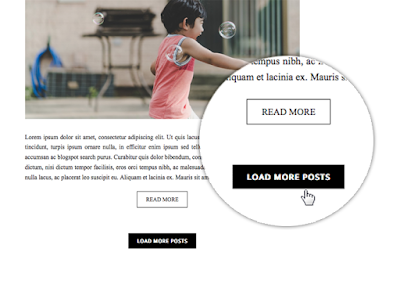
     You might have seen the implementation of infinite scrolling at Facebook, Twitter or Google+. Instead of showing Older / Newer posts links, we can load posts dynamically whenever a “Load more posts” button is clicked, or by scrolling down the page. This tutorial will show you how to implement Ajax based loading script that will add Load More Posts or Infinite Scrolling to Blogger, so that visitors can easily navigate without reloading the page.

    How it works?

    – You have the option to add a ‘Load More Posts’ button or load automatically the older posts as visitors scroll down the page.
    – Once implemented, Load More Posts / Infinite Scrolling applies to all Blogger posts on index pages (homepage, archive, label pages). It can’t be added on individual posts.

    Demo

    To see it live, check out the demo below. When you scroll down to the bottom of the page, you will see the “Load More Posts” button. Once you click it, the next 3 posts set to display will load below.

    infinite scrolling, load more posts

    Adding Load More Posts or Infinite Scrolling to Blogger

    1. Log into your Blogger account and click on your blog where you want to add it.
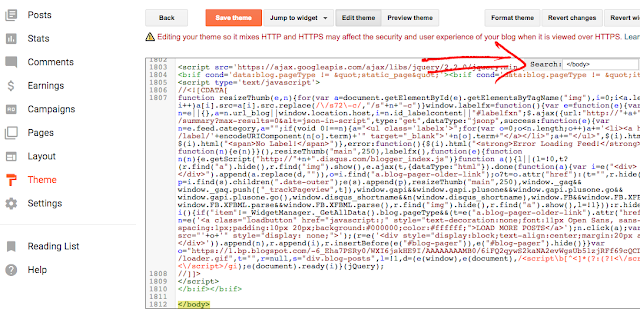
    2. Go to ‘Theme’ and click the ‘Edit HTML’ button to open the Template editor > click anywhere in the code area and press CTRL + F keys (or Command + F) to open the search box.

    3. Type the tag below in the search box and press ENTER to find it:

    4. Just above the  tag, add the script below:

    a. If you want to load posts with ‘Load More Posts’ button like in the demo blog, add this script:

    https://ajax.googleapis.com/ajax/libs/jquery/2.2.0/jquery.min.js

    b. If you want to add the infinite scrolling without button, paste this instead:

    https://ajax.googleapis.com/ajax/libs/jquery/2.2.0/jquery.min.js

    Note: This code uses jQuery library, so if you already have jQuery on your page, please remove the line in red highlighted above.

    5. Click ‘Save template’ button and check the ‘Load More Posts’ button / Infinite Scrolling in your Blogger blog.

    Conclusion

    That’s it! So this is how we can easily add Load More Posts / Infinite Scrolling to Blogger. From now on, our visitors can stay in same page and navigate through infinite number of posts on the fly!

    How To Hide Posts From Blogger Homepage

     The point of blogging is to make your blog posts visible to your target audience as well as to search engines. However, there are times when you need to hide certain blog posts from homepage. For instance, one post may contain outdated information, so you don’t want it to be seen by your audience but you also want to keep it on your site for records purposes. Or perhaps you want a certain post to still be seen on your blog, but you don’t want it to show in the home page.

    Either way, you have to find ways to hide certain blog posts. Fortunately, if you’re using Blogger, you can easily do so by taking a few simple steps. You can use this guide to get started.

    hide post from home page

    Backdate Blogger Posts

    Let’s discuss this technique first since it’s simple and doesn’t require you to deal with any lines of code. Basically, the only thing you need to do is to change the publishing date of the post you want to hide; specifically, you need to backdate it to the oldest possible date. Doing this is effective if your Blogger site is configured to show the latest posts first (as most blogs are); once a post is backdated, it will no longer be shown in the home page.

    How do you do this? If you’re publishing a new post and want to hide it, look for the “Schedule” option on the right side of the post editor and click on “Set date and time”. Choose a previous date on the calendar, click ‘Done’ and Save the post, then go back to your blog’s home page to check if the post has disappeared.

    backdate post, schedule blogger post

    The same process applies if you want to hide an older post; the only difference is that you need to click on the post’s title in the dashboard to open it in the editor. Backdate the post using the steps above and save it, then open your blog to verify that the post is indeed hidden from view.

    Please note that this process will only hide your posts from the homepage. People will still be able to see them if they’d take the time to go through your blog posts from the previous years. This is also the case for those who’d come across your hidden blog post through search engines.

    Hide Blog Posts in Blogger Using Code

    Another thing you can do to hide a blog post is to edit its code. This is a bit complicated since one small mistake can affect the post structure and make it unreadable. This, in turn, can affect your readers’ experience as they browse through your site and even have a negative effect on your search engine optimization techniques. With this in mind, it’s important to be careful when dealing with code.

    Method 1: Hide Blogger Post Using the Post’s label

    There are two techniques to choose from, and one of them involves the label of the blog post you want to hide. If you’re ready to go ahead with this method, you’ll first need to make a backup of your template. Having a backup is important since it ensures you’ll have a copy to fall back on in case something goes wrong.

    Once you’ve backed up the template, go to “Templates”, click on “Edit HTML” and then click anywhere inside the code area -> press CTRL + F keys and search for this line:

    Once you’ve found it, replace it with this code:


                <b:if cond='data:label.name != "add label here“‘>


    Note: replace the text “add label here” with the label (case sensitive) of the blog post that you want to hide in Blogger homepage. Keep in mind that above code won’t work if you have multiple labels on that post, so please make sure the post has only 1 label.

    Important: every post that you want to show on the homepage should have at least one label otherwise they will not be visible because the b:loop statement won’t be executed for them.

    Finally, Save the changes by pressing the ‘Save template’ button on the upper left side of the editor, then view your blog to check if the blog post has been hidden.

    Method 2: Hide Blogger Post Using the Post’s ID Number

    Aside from the method above, you can use another technique that involves the post ID number of the blog post you’d like to hide. To know the ID number, you must go to the dashboard area, find the title of the post you want to hide, and click the “Edit” text link below it. Doing this will open the post in the Blogger editor.

    Once you’re in the editor, click on the address bar above and go to the end part of the URL. Here, you’ll see a line of text that looks like this: postID==, followed by a long string of numbers. This is your post’s ID number. The ID number usually contains 19 numbers, so it will look somehow like this: postID==1234567890123456789. Copy this ID since you’ll need it for the next step.

    hide blogger post using id

    When you have your blog post’s ID, open the Blogger dashboard, go to Template, and click “Edit HTML”. Search for this line:

    Replace it with this one:

    Note: if you found two occurrences of it, replace both of them.

    Now search for this tag:

    Once you find it, paste the following code above it:

    -1234567890123456789{display:none;}

    Don’t forget to replace “1234567890123456789” with the 19-digit ID number of the blog post you’d like to hide. Once you’re done, make sure to save the template. You can open your blog in another tab or browser to check if the post has indeed been hidden.

    That’s it!

    Whether you backdate your post or opt for the post ID method, you have to remember that the blog post you’ve hidden is still on your website. This means that it will still be indexed by search engines, show up on search engine results, and get found by people who are searching for the keywords that are present in the post. If you really want this blog post to be seen by no one, you’ll need to use robots.txt (for Google) to remove it from search results. Better yet, completely delete the post from your Blogger dashboard and just keep a soft copy of it in your computer.

    How To Create A Static Home Page In Blogger

     When it comes to home pages, most websites can be divided into two: static and non-static. As their name implies, static home pages stay permanent no matter how many times the website is updated, while non-static home pages reflect the changes that are made to the site and show the latest posts first.

    The latter has become well-known nowadays due to the rising popularity of personal and even corporate blogs. However, there are still many people who prefer static home pages because it makes their websites look more organized and professional. It also gives them more control over the readers’ experience on their site and helps them create stronger brand awareness through the uniform message that their home page presents.

    Fortunately, if you own a Blogger site and want to make your home page static, you’ll find that creating one isn’t as difficult as it seems. You can create a static home page in Blogger by taking these steps:

    1. Create your static home page

    The first thing you should do is to create a new page for your blog. This will serve as your static home page but, for now, it will look and act like any other page in your site.

    To make this page, you’ll need to go to the main menu of the Blogger dashboard and click on the “Pages” option on the left side on the screen. Doing this will lead you to the “All Pages” menu window. Here, click on the “New Page” button and you’ll enter an editor that looks similar to the Blogger Post editor that you use when publishing a new blog post.

    static home page

    At the top box, enter the title that you want for this page – in this case, let’s call it the “Welcome” page. In the larger text box, type the content that you want to appear on your home page; this can be a paragraph, or two about yourself or your business and what your site is all about.

    Once you’re done, click “Publish”. The window will return to the main “All Pages” menu, and you’ll see the new “Welcome” page you’ve created. Copy the URL of the “Welcome” page since you’ll need it later on. To do this, right click on the ‘View’ link and select ‘Copy Link Location’ from the menu.

    2. Redirect the default home page to the static one

    Once your “Welcome” page is up, the next thing you should do is to change Blogger’s default homepage. This involves redirecting from your site’s original home page to the static homepage that you’ve created so it would be the first thing that people see when they visit your website.

    Related: How to Set Custom Redirects in Blogger

    To do this, you’ll need to go to main Blogger editor menu, click on “Settings” on the left side of the screen, and choose “Search Preferences”. Under the “Errors and redirections” section, you’ll see the “Custom Redirects” option with an “Edit” link beside it. Click on the “Edit” link to open another window, where you’ll see two boxes named “From” (with your blog’s URL beside it) and “To”.

    In the “From” box, enter only a forward slash symbol “/”. In the “To” box, paste the URL that you copied earlier and add the latter part of the URL of the “Welcome” page. For instance, the page’s URL of our demo blog is static-home-page.blogspot.com/welcome.html, so we’ll remove the “http://static-home-page.blogspot.com&#8221; address and add only “/p/welcome.html” in the “To:” box. The “/p” signifies that it’s a static page.

    Next, check the little box beside “Permanent”, click on the “Save” text link, and press the “Save changes” button. Doing these will redirect your site’s main URL to its new static home page. Access your blog on a separate browser to see if it works.

    3. Make tabs for your site

    If you’re not planning to make tabs visible in your blog, you can stop at Step . But, if you want your site to have tabs that indicate the home page, the main blog page, and other pages you may have (such as the FAQs and Contact Us pages), you’ll need to take another step.

    Why is this important? Basically, when visible tabs are enabled in your site, they will show that you have two existing pages: the default home page and the new “Welcome” page you’ve created – both of which redirect to the same static page. This can be confusing for your readers and may even affect your search engine rankings.

    To fix this, you first need to enable tabs by going to the “Layout” menu item and click on the “Add a Gadget” link. You can choose to add it below your blog header or sidebar. In many cases, it’s advisable to add it below blog’s header since they’re more visible and give your website a sleek, professional look.

    Once the pop-up window opens, scroll down and click on the ‘Pages’ link:

    This will open another window named “Configure Page List”. Here, under the “Pages to show” section, you’ll see the default home page and your new static homepage with small boxes beside them. Uncheck the box beside the default home page to hide it from view, check the pages that you want to display in the menu and then click on the “Save” button to save the changes.

    You can stop at this point but, if you want, you can also create a specific tab that will lead to your main blog post page. To do this, edit the “Pages” gadget that you just saved and click “+ Add external link”.

    On the new window that would open, enter the title you’d like for the page (such as “Blog”) along with /index.html web address, then hit “Save Link” and click the “Save” button on the “Configure Page List” window.

    Now, view your site and you will see the pages menu containing the “Welcome” page and “Blog” tabs. To see how this works, you can also visit our demo blog. Enjoy!

    Final Note

    Having a static home page can be beneficial for your blog. Follow the steps above now to create a static home page in Blogger!

    Top 10 Killer Tips To Improve Page Rank

     Page rank is based on an algorithm that determines how close your link is to the query that was put into a search engine such as Google. The more important your link is shown to be, the higher it will be ranked on search results pages. The result is that web traffic increases to the links that are ranked at or near the top.

    How the Page Rank is Calculated?

    The calculations used by the algorithm that determines page rank includes the number of links that are connected to your site. That includes inbound, internal, external, do-follow, and no-follow links along with backlinks. To increase your web traffic, you need to improve page rank so that it pulls in more people who are likely to purchase the products or services that you offer.

    Here are 10 killer ways to improve page ranking so that more people will start visiting your website.

    How to Improve Page Rank?

    Submit Site to Web Directories

    A simple, but very effective way to increase web traffic is adding more high quality backlinks. This can be done simply by submitting the content to respected web or article directories. They provide a great way for more people to see your content. Some good directories include the following:

    By finding the right articles and web directories, you can quickly improve your page rank for your content.

    Post Regularly

    Google like sites that post on a regular basis, so set up a schedule where you have new, fresh content for your site on a daily or weekly basis. Be sure to post on the same day or days each week which will help improve your overall ranking.

    Improve Content

    If the content is well written, informative, and unique, this will help increase the chance that readers will share it with others. The better the content is presented, the more likely it is to be shared and that will improve its page ranking.

    Link Exchange

    This is a well-known technique, but it still works. To get a higher page rank, you will need to get other sites that are ranked higher to link to your site. Therefore, you will automatically have good links that will help boost the ranking of your content. This means that you will need to appeal to those with higher ranked sites to agree to share their link with you.

    Post on Other Sites

    This is also called guest posting, it is another tried-and-true technique that helps you improve page rank. Find blogs that allow for guests to post so that you can receive two or three backlinks in return for what you have submitted. The key is to post on blogs that are in your industry or niche so that you can attract readers to your site.

    Add Comments to Other Sites

    In addition to posting articles, you should also comment regularly on articles posted on other sites. You will need to set up a schedule so that you can comment on a consistent basis on posts that are in your niche or industry. The more you post, the more active you are in the community which means that more your site will grow in status. While most sites today have Disqus installed which means that a link to your site is automatically posted, others still use the Do-Follow which means you will need to include the link.

    Increase Uptime

    Be sure that you choose a web host that offers 99.9% uptime so that your website is available to anyone who wants to visit. Long downtimes can significantly cut into your web traffic, so be sure to choose a provider that is reliable and provides guarantees about uptime.

    Social Bookmark

    The social network is a great way to help increase the visibility of your content and improve page rank as well. By sharing your content on the best social sites, you will get more traffic thanks to the free backlink. Naturally, you’ll want to choose sites that are quite popular like the following;

    • Facebook
    • Google Plus
    • Pinterest
    • Reddit
    • Stumble Upon
    • Digg
    • Delicious

    By sharing with good social media sites, you can increase page rank considerably. Plus, it will work for you over time to help bolster your site. Plus, be sure to be active on your social media sites by responding to questions so that potential customers will stay close to your efforts.

    Multiple Pages

    This is another old, but useful technique that can improve your page rank thanks to internal linking. Basically, you will need multiple pages that you link together for articles or content that is similar in nature. It takes a little work, but it is well worth it to see the results over time.

    Research Popular Keywords

    Focus on keywords that are the most common which means using words that people are most likely to use as queries on search engine sites. By using the most commonly searched keywords, you can help boost your page ranking significantly over time. This means having more visitors and better results when it comes to your sales.

    In addition to these ten proven ways to improve page rank, you should also consider the power of advertising. By creating a simple banner and advertising with it on other sites, you can generate a lot of good backlinks which in turn creates more traffic for your page. Keep in mind that you should be active daily when it comes to blogs and forums that are in your niche as well.

    Another small trick is to add a link to your signature in forums and emails, although you’ll want to avoid any illegal tactics that will put your website into trouble. By using proper techniques, you can improve page rank naturally which builds for your long-term success. After all, your goal is to be successful by increasing the ranking of your content. So, you should put in the time and effort to do things right to succeed.

    Which methods do you use to improve page rank? Share with us in a comment below.

    5 Best Custom Blogger Contact Form Widgets

     In the past, adding a custom contact form for Blogger was quite a complex process, and many bloggers were forced to use third party websites. However, even after Blogger launched its own contact form gadget, it was still considered as highly inadequate. This is because the official gadget would only be implemented on the footer the sidebar. Most bloggers preferred having a separate blogger contact form placed on its own page to make their blogs appear well arranged and more professional as well.

    Having a well laid-out Blogger contact form is very important. This is the tool that visitors, companies, and brands can use to contact you and it is simply a must-have feature for every blogger. If you are not comfortable with sharing your main email address directly on your blog, then a custom Blogger contact form offers an effective way in which people can easily reach you.

    Why you should use a Blogger Contact Form?

    If you are still stuck on third party providers, you should definitely consider switching to the official custom contact form for Blogger since it has various unique benefits, like:

    • Messages are delivered immediately – As the blog administrator, you will receive a message immediately the visitor clicks send.
    • Reliable – It is the official form developed by Blogger, which makes it more trustworthy and reliable way to initiate contact as compared to using third-party services.
    • Questions – The contact form offers a platform for your visitors to ask specific questions that they might have regarding the blog you wrote or your business in general. It can be an excellent way of capturing leads and even lead to conversions if you are selling a certain product or service.
    • Feedback – Visitors can easily comment on your blog by leaving their feedback through your contact form. This feedback can help you determine which post to do next or what areas to address based on the visitors’ comments.
    • Information or service request – For those who are using the blog as a way of marketing a product or service, potential clients can use the custom contact form for Blogger to reach out and request additional information.

    How to Add Blogger Contact Form Gadget

    Before adding a custom Blogger contact form to a static page, we need to add the default contact form in the blog’s sidebar to make it functional:

    1. Log into your Blogger dashboard and go to “Layout” > click on the “Add a gadget” link on the page elements area.

    2. Select “More Gadgets” below the “Basics” tab and click the “+” button to add the Contact Form Gadget.

    blogger contact form

    Hiding Blogger Contact Form from the Sidebar

    Once the contact form has been added, next step is to hide it so that it will appear only in the static page.

    1. Go to “Template” and press the “Edit HTML” button. Once the code editor opens, click anywhere inside the code area and press CTRL + F keys (or Command + F for mac) to open the search box.

    2. Type or paste the following tag inside the search box and hit Enter to find it:

    ]]>

    3. Just above the ]]> tag, add this CSS code:

    #ContactForm1{display: none !important;}

    4. Click the “Save template” button on the upper left side and view your blog. The contact form widget should be gone.

    Adding Custom Blogger Contact Form in a Static Page

    Finally, now that we enabled the functionality of the contact form, let’s add a custom contact form in our Blogger blog…

    1. Go to “Pages” and click the “New page” button. If you already have a Contact us page, just click the “Edit” link below the page title.

    2. Once the Page editor opens, fill up the page title with Contact/Contact Us or any title you want to show. It is recommended doing this before anything in order to make the permalink SEO friendly.

    3. Click on the HTML tab as there we will add the code to make the custom Blogger contact form work. On the right site, change the Page settings to hide (“Don’t allow” or “Don’t allow, hide existing”) the reader comments, then click the “Done” button:

    contact static page

    4. Below are 5 custom Blogger contact form styles. Pick your favorite and copy the code provided, then paste the code inside the HTML box of your page editor:

    Simple Contact Form

    custom blogger contact form

    .contact-form-widget{margin-left:auto;margin-right:auto;width:600px;max-width:100%;padding:40px 0}.contactf-name,.contactf-email{float:left;width:48.25%}.contactf-name{margin-right:3.5%}.contact-form-name,.contact-form-email,.contact-form-email-message,.contact-form-name:hover,.contact-form-name:focus,.contact-form-email:hover,.contact-form-email:focus,.contact-form-email-message:hover,.contact-form-email-message:focus{width:100%;max-width:100%;margin:0 0 20px;padding:10px 15px;font-size:12px;letter-spacing:1px;color:#444;background:#F3F3F3;border:medium none;-webkit-box-shadow:none;-moz-box-shadow:none;box-shadow:none}.contact-form-name,.contact-form-email{height:37px}.contact-form-email-message{height:170px}.contact-form-button-submit,.contact-form-button-submit:hover{width:13%;height:30px;font:normal 12px Arial;letter-spacing:1px;color:#444;display:block;outline:none;margin-bottom:20px;text-align:center;background:#E6E6E6;border:0;cursor:pointer}.contact-form-button-submit:active{outline:none;-webkit-box-shadow:none;box-shadow:none}.contact-form-cross{border:medium none!important;box-shadow:none!important;padding:0!important;height:11px !important;width:11px !important;}

    Contact form with CSS rainbow divider

    colorful contact form for Blogger

    .contact-form-widget{margin-left:auto;margin-right:auto;width:600px;max-width:100%;padding:0}hr{position:relative;height:.75em;border:0;overflow:hidden;margin:0}hr:before{content:””;display:block;position:absolute;top:0;left:0;height:.75em;width:5.1em;background:#C4DD83;box-shadow:5em 0 0 0 #F4FCC9,10em 0 0 0 #FDCD78,15em 0 0 0 #ED786F,20em 0 0 0 #D99DBF,25em 0 0 0 #C39EDC,30em 0 0 0 #679DE2,35em 0 0 0 #62C2E3,40em 0 0 0 #F4FCC9,45em 0 0 0 #FDCD78,50em 0 0 0 #ED786F,55em 0 0 0 #D99DBF,60em 0 0 0 #C39EDC}.contactf-name,.contactf-email{float:left;width:49.25%}.contactf-name{margin-right:1.5%}.contact-form-name,.contact-form-email,.contact-form-email-message,.contact-form-name:hover,.contact-form-name:focus,.contact-form-email:hover,.contact-form-email:focus,.contact-form-email-message:hover,.contact-form-email-message:focus{width:100%;max-width:100%;margin:25px 0 0;padding:10px;font-size:15px;color:#ccc;border-color:#E8E8E8;border-width:2px 2px 4px;-webkit-box-shadow:none;-moz-box-shadow:none;box-shadow:none}.contact-form-name,.contact-form-email{height:40px}.contact-form-email-message{height:100px}.contact-form-button-submit,.contact-form-button-submit:hover{margin-top:25px;width:100%;height:40px;font-size:15px;color:#fff;text-align:center;text-shadow:0 1px 2px rgba(0,0,0,0.25);background:#EE786F;border:0;border-bottom:2px solid #D4685C;outline:none;cursor:pointer;-webkit-box-shadow:inset 0 -2px #D4685C;box-shadow:inset 0 -2px #D4685C}.contact-form-button-submit:active{top:1px;outline:none;-webkit-box-shadow:none;box-shadow:none}.contact-form-cross{border:medium none !important;box-shadow:none !important;padding:0 !important;height:11px !important;width:11px !important;}


    Blogger Contact Form with CSS Ribbon

    contact form with ribbon

    .widget.ContactForm{z-index:1}.contact-form-widget{margin-left:auto;margin-right:auto;width:600px;max-width:100%;padding:25px 0;background:#EBEBE3;-webkit-border-radius:2%;-moz-border-radius:2%;border-radius:2%}.contact-form-widget .form{width:91%;margin:0 auto}.ribbon{font:16px Arial;text-transform:capitalize;text-shadow:0 1px 2px rgba(0,0,0,0.25);position:relative;background:#6B5F53;color:#fff;text-align:center;padding:1em 2em;margin:0 -16px}.ribbon:before,.ribbon:after{content:””;position:absolute;display:block;bottom:-1em;border:1.5em solid #584C40;z-index:-1}.ribbon:before{left:-1.7em;border-right-width:1.2em;border-left-color:transparent}.ribbon:after{right:-1.7em;border-left-width:1.2em;border-right-color:transparent}.ribbon .ribbon-content:before,.ribbon .ribbon-content:after{content:””;position:absolute;display:block;border-style:solid;border-color:#42362A transparent transparent;bottom:-1em}.ribbon .ribbon-content:before{left:0;border-width:1em 0 0 1em}.ribbon .ribbon-content:after{right:0;border-width:1em 1em 0 0}.contactf-name,.contactf-email,.contactf-message{text-align:left;margin-top:25px;color:#a1937b;font-size:13px}.contactf-name,.contactf-email{float:left;width:100%}.contact-form-name,.contact-form-email,.contact-form-email-message,.contact-form-name:hover,.contact-form-name:focus,.contact-form-email:hover,.contact-form-email:focus,.contact-form-email-message:hover,.contact-form-email-message:focus{width:100%;max-width:100%;margin:10px 0 0;padding:10px;font-size:12px;color:#aaa;border-color:#DBD6D1;border-width:1px;box-shadow:none;-webkit-border-radius:5px;-moz-border-radius:5px;border-radius:5px}.contact-form-name,.contact-form-email{height:35px}.contact-form-email-message{height:100px}.contact-form-button-submit,.contact-form-button-submit:hover{margin-top:25px;width:100%;height:37px;font:normal 12px Arial;outline:none;letter-spacing:1px;color:#fff;text-align:center;cursor:pointer;text-shadow:1px 1px 0 #ffe8b2;color:#7c5d1b;border:1px solid #d6a437;background:#febd4b;background:-webkit-gradient(linear,0 0,0 100%,from(#fed970) to(#febd4b));background:-webkit-linear-gradient(#fed970,#febd4b);background:-moz-linear-gradient(#fed970,#febd4b);background:-ms-linear-gradient(#fed970,#febd4b);background:-o-linear-gradient(#fed970,#febd4b);background:linear-gradient(#fed970,#febd4b);-pie-background:linear-gradient(#fed970,#febd4b)}.contact-form-button-submit:active{color:#7c5d1b;border:1px solid #d6a437;background:#febd4b;background:-webkit-gradient(linear,0 0,0 100%,from(#febd4b) to(#fed970));background:-webkit-linear-gradient(#febd4b,#fed970);background:-moz-linear-gradient(#febd4b,#fed970);background:-ms-linear-gradient(#febd4b,#fed970);background:-o-linear-gradient(#febd4b,#fed970);background:linear-gradient(#febd4b,#fed970);-pie-background:linear-gradient(#febd4b,#fed970)}.contact-form-cross{border:medium none!important;box-shadow:none!important;padding:0!important;height:11px !important;width:11px !important;}

    Shoot Me an Email

    Your name:
    E-mail address *:
    Message *:

    Minimal Contact Form

    minimal contact form for Blogger

    .contact-form-widget{margin-left:auto;margin-right:auto;width:600px;max-width:100%;padding:25px;background:#fff}.contact-title{text-align:center;font:41px fantasy;color:#121212;margin-bottom:25px}.contactf-name,.contactf-email{float:left;width:47%}.contactf-name{margin-right:6%}.name-icon img,.email-icon img{background:transparent!important;border:medium none!important;box-shadow:none!important;padding:11px 0!important;width:16px !important;height:16px !important;}.name-icon,.email-icon{position:absolute;z-index:1}.contact-form-name,.contact-form-email,.contact-form-email-message,.contact-form-name:hover,.contact-form-name:focus,.contact-form-email:hover,.contact-form-email:focus,.contact-form-email-message:hover,.contact-form-email-message:focus{width:100%;max-width:100%;margin:0 0 25px;padding:10px 10px 10px 25px;font:bold 16px cursive;text-shadow:0 1px 2px #ddd;color:#121212;background:transparent!important;border-color:#121212;border-width:0 0 2.5px;-webkit-box-shadow:none;-moz-box-shadow:none;box-shadow:none}.contact-form-name,.contact-form-email{height:40px}.contact-form-email-message,.contact-form-email-message:hover,.contact-form-email-message:focus{padding:10px!important}.contact-form-email-message{height:150px;border-width:2.5px!important}.contact-form-button-submit,.contact-form-button-submit:hover{background:#121212!important;width:30%;height:37px;font:bold 13px “Lucida Grande”;letter-spacing:2px;color:#fff;text-align:center;border:medium none;cursor:pointer;display:block;margin:0 auto;outline:none}.contact-form-cross{border:medium none!important;box-shadow:none!important;padding:0!important;width:11px !important;height:11px !important;}

    Get in touch.

    Contact form with speech bubble

    .contact-form-widget{margin-left:auto;margin-right:auto;width:600px;max-width:100%}.contactf-name,.contactf-email{float:left;width:50%}.contact-form-name,.contact-form-email,.contact-form-email-message,.contact-form-name:hover,.contact-form-name:focus,.contact-form-email:hover,.contact-form-email:focus,.contact-form-email-message:hover,.contact-form-email-message:focus{width:100%;max-width:100%;margin:0 0 15px;padding:10px;font-size:14px;color:#777;background:#E2DEDB;border:1px solid #CBC7C4;-webkit-box-shadow:none;-moz-box-shadow:none;box-shadow:none;-webkit-border-radius:20px;-moz-border-radius:20px;border-radius:20px}.contact-form-name,.contact-form-email{height:33px}.contact-form-email-message{height:130px}.contactf-message{position:relative}.contactf-message:after,.contactf-message:before{border-bottom:50px solid transparent;border-left:80px solid #E2DEDB;bottom:-32px;content:”;position:absolute;right:50%;margin-right:-100px}.contactf-message:before{border-left:80px solid #CBC7C4;bottom:-34px;right:50.3%;margin-right:-101px}.cbluebutton{margin-top:25px;width:30%;height:35px;float:right;font-size:15px;color:#fff;display:inline-block;text-align:center;background:linear-gradient(to bottom,#339ad9 0%,#224bbc 100%);box-shadow:0 1px 1px rgba(34,75,188,0.5);border:0;-webkit-border-radius:20px;-moz-border-radius:20px;border-radius:20px}.cbluebutton span .contact-form-button-submit{background:linear-gradient(to bottom,#52b1e2 0%,#397fd0 100%);font:bold 16px “Helvetica Neue”,sans-serif;height:35px;width:100%;color:#FFF;text-shadow:0 1px 1px #224BBC;display:inline-block;box-shadow:0 1px 1px rgba(255,255,255,0.3) inset;cursor:pointer;outline:none;-webkit-border-radius:20px;-moz-border-radius:20px;border-radius:20px}.contact-form-button-submit:active{top:1px;outline:none;-webkit-box-shadow:none;box-shadow:none}.contact-form-cross{border:medium none!important;box-shadow:none!important;padding:0!important;width:11px !important;height:11px !important;}

    5. After you added the code, click the “Publish” button on the upper right side. Now you should be able to see the Blogger contact form live on your static page. To ensure that everything works fine, you can send a message as a test. The message should be delivered to your inbox in a matter of seconds, just make sure that you’re checking the email that you’re using with your Blogger account.

    Frequently Asked Questions about the Custom Contact Form for Blogger

    Where do the messages go?

    Once a visitor asks a question or sends feedback through the Blogger contact form, it is instantly delivered to the email associated with your Blogger account. If a blog has several administrators, then all the individual administrators will receive the comments or questions asked by the visitor.

    What is the benefit of using a separate “Contact Us” page?

    Even though it all comes down to your personal preferences, your blog will look more professional if it has a separate page for the custom contact form for Blogger. It gives you credibility and also offers you the chance to add a specific call to action in the new “Contact Us” page.

    Is it possible to add extra fields?

    Unfortunately, no. You can’t add custom fields such as website, phone number or mailing address since Blogger uses special tags in order to transfer data. In any case, the default fields are well laid-out and will help you to get the basic information you need about your visitors.

    I have installed the Blogger contact form, but it is not working. What could be the problem?

    There are several reasons why you may be having trouble setting up your contact form. The simplest way to troubleshoot is to countercheck the email you linked to the blog and also reinstall the form again.

    Ultimately, by using the custom Blogger contact form you gain from consistency in the type of information you request and also reduce spam since you will not have to display your email directly on the blog.

    How To Create A Blogger Account?

     Are you wondering how to create a Blogger account? Many of us do, because Blogger is one of the most popular blogging platforms out there and it can provide us with an extraordinary, fun way to express ourselves in the online world. Not only is it Blogger a very large blogging website, but it’s also full of categories that you can blog on. You have complete control over what you want to blog, and that does make Blogger an amazing platform to begin with. Yet you do have to wonder how to create a blog on Blogger! We are here to help you understand all of that and so much more as fast as possible, thanks to a detailed guide that will showcase all the necessary instructions in a very easy to read manner.

    Creating a Google account

    What you need to know here is that Google owns Blogger, and because of that you will need to use a Google account to sign in to this platform. You can create a Google account now and then you will be able to continue to the platform without a problem. By creating a Google Account you will be able to access a wide range of Google apps and services like Drive or Mail for example. Visit the page above and share all the necessary information in order to create the necessary Google Account. Thankfully, the process is very easy and it will take only a few minutes of your time. In case you already have a Google Account, you will need to sign on the Blogger page.

    create a google account

    Creating your blog

    Once you are located on the Blogger page, you will need to press the New Blog button in order to start a blog. You will receive a new window where you will learn how to create a Blogger account. This will enable you to share all the necessary information.

    • Make sure that you add a title for your blog in the Title area. This is very important because it will allow you to entice the visitor to read more about you and your content. So, try to make the title relevant and appealing
    • In order for users to find your blog, you will need to create an Address for it. Your blog will have a blogspot.com address, but you will need to choose what goes before blogspot.com. Basically, you can opt for something like abcdef.blogspot.com or anything like that. Remember that this can be modified in the long run. The great thing here is that you will immediately be able to see if that address is available or not. This means you will have the ability to check the address availability really fast.
    • The next step will require you to choose from any of the presets that are available at this point. Starting with a Template is a good idea, but do remember that this can be modified afterwards as well. So it’s a good idea to just pick a template and move onward.
    create a blogger account

    Once you have the blog title, address and template ready to go, you will have to press the Create blog! button. This process will take a little bit until it’s completed properly, so just wait for a few seconds as the new blog will soon be added to the blog list. So, if you were wondering how to create a blog on Blogger, this is the simplest way to do it.

    Maybe the best thing about how to create a Blogger account is that the entire process is very easy to do. Even beginners will have no problem creating and setting up an account. The customization options are plentiful here, so you shouldn’t have any problem setting your account really fast!

    Starting to post

    Although the blog address will be available, you can’t call that a blog unless you start writing content in there. Obviously, you will need to learn how to write a post on Blogger, and we are here to help you with that right now.

    In order to start writing, you will need to click the Create a new post link or you can press the New Post button. Once you do that, you will gain immediate access to the post editor and here you can write the blog as well as make any necessary changes to content that you already wrote.

    create new blogger post

    Write a title for your post

    Your post needs to have a title. Towards the top of the Blogger editor you will see that there is a Post title box. Add in the desired post title there. This shouldn’t eat up a lot of your time, just try to come up with a post title that is enticing, very easy to use and a delight to read for your audience. A catchy title can be great. Don’t opt for the clickbait title that you can see nowadays, make your title feel informative and fun to read as that’s what you want. If you want to write a first post, you need to make it introductory. Write about the goals you have, the type of content you want to add and so on. It will not be easy to write down the first words, but if you create a good title it will be easier for you to translate thoughts into words!

    create blogger post title

    Start the writing process

    You can create a Blogger post in 2 ways. You can either write the post in HTML or you can use the word processor included here. You have a button located in the top left corner which helps you switch between any of these two writing models. The HTML editor helps you create better web content and you can also use it to insert some special web functions. On the other hand, the word processor is more than qualified to offer you all the extra help you might need here.

    blogger post compose html

    Customizing text

    If you want, you will be able to customize the text you want without a problem. You will have the ability to use the toolbar located on top of the editor to modify the text as you see fit. This includes formatting, color, size, alignment and so on. You have a Normal drop-down that helps you change the type of content you want to add, so you should consider changing between the desired heading type as you see fit. This also changes the way search engines process your content, so keep that in mind.  If possible, try to break the content into easy to read pieces. Use the Headings in a strategic manner.

    blogger post heading

    Add an image to your post

    If you want to make your blog post enticing, you should try to add at least an image. These images make posts a lot easier to read and it’s a good idea to make the most out of images if you want to share a great experience for your audience. You will have an “Insert Image” button right above your text editor, on the toolbar. There are multiple options, you can either upload them from your PC/Mac, you can share a link or you can use your webcam to take a picture if you want. However, if you link to other websites, make sure that you showcase their copyright or just refrain from doing that to begin with. There are many sites who do not agree with the idea of having their content stolen, so try to stay away from that!

    insert image in Blogger post

    Modify the post settings

    If you look on the right side of your Post Editor, you will be able to access some Post settings. Remember that these make it easy for you to customize your post right before you choose to publish it!

    blogger post settings
    • Labels are useful if you want to group multiple posts which are very similar to one another.
    • Schedule allows you to publish your content at a later date. It can come in handy if you don’t want to share multiple articles at the same time.
    • Permalink is an option that allows you to select the way your post will be linked to in the future. Usually it will maintain the title structure, but there are other link types you can choose from as well.
    • Location enables you to add a location tag for your post. It’s a very good tool for those that move/travel often
    • Options allows you to modify some features like the user ability to comment on a post for example. You can also choose the way your HTML code is interpreted here as well.

    Previewing

    A great thing about previewing your post is that you will be able to see how it looks when a reader will access it. This is the right time when you need to check your post for any errors, be it grammar or structural ones.

    preview blogger post

    Save the post for later

    This is not the same as scheduling. When you save the post for later, it means that the post just isn’t finished at this time and you will continue to work on it at a later time. You can see this as a draft for your future post.

    save blogger post

    Publishing the post

    If you double or triple checked the post and there are no errors, then you are good to go. Still, it’s a good idea to go through it at least one more time to ensure that all the content you want is there and you don’t have to make any more changes. Add all the necessary labels and tags, make sure that you inserted any links, images and other information that you might need.

    Once everything is ready, you will just have to press the Publish button located at the top of the panel. This is when Blogger will automatically redirect you to the Posts page. Here you will see the post right on top.

    publish blogger post

    Don’t believe that your work is done at this point. In fact, it’s far from that. You still have a long way to go before you properly optimize and improve your blog. After all, people won’t be drawn in to your blog if you have just a single one to begin with. Work hard to write great posts as they will be able to make your blog stand out in the long haul.

    Of course, you do need patience. Writing a good blog does require time and you shouldn’t rush the content creation. Prioritize quality over quantity all the time. If you don’t do that, the experience will be very well worth it in the end.

    How can you expand your blog?

    As we mentioned earlier, writing a single post is great but it won’t draw in a lot of traffic. If you want to write a good post, one that will bring in lots of readers and views, you want to post as often as possible.

    Quality content will always bring in traffic. Update the blog as often as you can. If you can share at least a post per week, you should do that. A good stream of posts will always come in handy, so make sure that you always write some good, enticing content that will help populate your blog.

    If possible, we recommend you to create a post Schedule as this will help you better optimize the way you post. This way you will be able to prepare your content beforehand, so you can have it ready when you want to create a new post. The best approach is to write more than 1 post at a time. One can be posted and the others can be kept for a later date if you so desire.

    create blogger posts

    Write for a niche

    Generalized content works but it won’t really deliver good results for your audience. If you want to get the best results, we recommend you to find a niche as fast as possible. Not only does a niche help you target specific users, but it will also help you become an authority on that topic. We recommend you to research a niche and become an expert on it. This is the best way to create a large audience for a niche and from here to reaching success in blogging will be just a small step.

    Don’t rush the content creation process, especially if you write for a niche. Creating redundant content will just keep people away. As long as you take your time and focus on results for your audience, the experience will be an amazing one. Of course, use the proper content structure in order to cater to the needs of search engines, all while maintaining the content relevant for humans as well!

    Reader interaction

    Once you learn how to create a blog on Blogger you can create more than a blog in order to reach multiple audiences. But the idea here still remains, you will need to interact with the audience. The community will grow more and more as you put out content, so make sure that you always interact with the audience.

    Read the comments and moderate them, make sure that you remove spam. Also, reply to people that are interested in what you write. This will help create and nurture a community around your content, which can be very interesting to do!

    blogger comments

    Advertising your blog

    Your blog will need advertising if you want it to grow really fast. One of the best ways you can do that is by sharing it with people anywhere you can. From social networks to social media or any other location, all of these are great places where you can share your blog. We recommend you to try and do the following:

    • Post a short headline and a link to your article on Twitter
    • Single Blogger is a Google Product, make sure that you use the Google buttons in order to share on Google Plus and perform other similar actions.
    • Encourage readers and friends to share your Blogger posts on Facebook and anywhere they can. This will help you reach a large audience really fast.
    • Make sure that you comment on forums and other blogs. Link to your post there if it’s meaningful for that particular topic. This type of practice is called backlinking and it’s very good for SEO.

    Place ads

    Ads are very important if you want to monetize the blog. You won’t be able to monetize your blog with AdSense unless you have a blog active for around 6 months, so keep that in mind. You also need to have at least 18 years of age and you also have to obey the TOS. AdSense allows you to receive payments based on the amount of impressions generated by your blog.

    sign up for AdSense

    Blog customization

    You can modify just about anything you want on Blogger, it all comes down to you to make the right changes! For example, you will be able to press Layout and then you can modify the block content for each section of your blog. You also have the ability to Add a Gadget if you want. Blogger has lots of add-ons to choose from, all of which can help you better define your blog!

    If you want to customize your Template, keep in mind that there are multiple customization options to choose from. You can also keep the template you have now. Programmers can press the Edit HTML button so they can modify the CSS and HTML code.

    blogger template edit HTML

    Stat tracking

    Blogger has a dedicated option named Stats where you have the ability to monitor the blog performance. Here you have the ability to see the amount of views you get. This way you can identify what posts are performing better than others. As a result, you know what content works great for your audience in the longer term!

    Learning how to create a Blogger account is really easy and you can feel free to create multiple blogs if you want. Just make sure that you write content for all of them. Plus, you can also monetize each one of your blogs if you so desire. Take your time and make sure that you provide valid information for your readers. This should be the main reason to create a Blogger account in the first place!


    How To Use AdSense Custom Channels To Increase RPM

     If you want to boost the AdSense revenue, then you have to try and use all the tools at your disposal to increase the RPM and take your income to new heights. AdSense custom channels are some of the best tools that you can use in this regards. The best thing about these custom channels is that advertisers love them and you can easily adapt them to your needs!

    What are AdSense custom channels?

    When you hear about Google AdSense custom channels, you will most likely be confused in regards to what they are and what they do. But despite the name that can confuse some people, the reason why they were created is that they offer a really good value for AdSense users. Simply put, these custom channels are designed as a reporting tool, and they enable you to manage your ad inventory without that much of a hassle.

    You can also use them to turn the ad inventory into a solution that advertisers can target. As a result, you will be able to boost the AdSense revenue in no time. Aside from that, you can also generate a lot of competition for the advertisers. Of course, you do need to have a good amount of traffic to be appealing to the advertisers. But if you use this tool adequately, the overall results can be downright unique. The custom channels are designed to work with a variety of content hubs as well as publishers. But of course, you have to put all your knowledge to the test.

    AdSense custom channels A/B testing and analytics

    In case you want to boost your revenue with custom channels, you will have to figure out which are the best ads you have, and then you add them into custom channels. You can find the Custom Channels in the Advanced Reports section.

    Here you can filter the type of ads you want to track, and you can also view an overview, active views, engagements, clicks and even custom information.

    Thanks to the AdSense custom channels, you will get to track things like page performance for that ad, what surrounding content was the best, ad placement results, ad size performance and other relevant info. All these things do add up very well, and they are bound to bring you a unique and distinct set of features.

    A/B testing is also easy to do with AdSense custom channels. You track the performance of a text ad against another text ad, or you can opt for a more complex ad test. In fact, you can even make image to text ad comparison if you want. The idea here is to use the power of reports to see which type of ad delivers the best performance.

    Depending on your niche, some types of ads will work better when compared to others. So, the idea is to pick the right one that suits your needs. It’s the best approach and one that does pay off immensely in the end.

    How can you track what blog portion delivers the best revenue?

    This is a very good question and a tricky one to answer as well. There are many reasons why you may be unable to answer this adequately. However, it all comes down to a single comparison. For example, you have a site about technology and another one about healthy eating. Both of them are blogs, but the healthy eating one delivers a much better RPM when compared to the technology one.

    Obviously, when you do A/B testing and see this, you will most likely focus on creating more healthy eating content and less tech content. But your task is to figure out what went wrong with the technology blog too. You can use the power of AdSense custom channels to figure out what caused that issue. Studying the performance over time will help you see what is wrong and this way you can adapt the situation to your advantage.

    Creating a targetable ad inventory with AdSense custom channels

    AdSense custom channels offer your online assets to the advertisers so that they can be targeted without a problem. Basically, the companies that have a video ad about their phone repair services will want an ad slot on your phone-related pages, not on the homepage or anything else. The idea is to opt for targeting, and that’s where AdSense custom channels excel very well. Besides, advertisers have a limited budget, so they do want to get the very best results from you.

    What type of benefits do you get from this? First, you will see that allowing advertiser targeted ads will bring in more competition for ad location and better performing ads. You will also work with advertisers that are knowledgeable and know what they want. Google said they select the best performing ads for your page, so obviously this will help you as well. Plus, advertisers can do smart pricing and earn more money by getting targeted audiences. Simply put, everyone wins with this type of approach, and that’s what manages to deliver the very best outcome.

    How can you set up AdSense custom channels?

    You need to figure out what you want to measure and share to the advertisers. Basically, you create an ad unit, and you can add that to the AdSense custom channels. You can add multiple ones if you want, that is up to you to make the right pick.

    Simply put, you go to My Ads in the AdSense console > Content, and then you select Custom channels. Here you will have to press the New Custom Channel Button. Add a name to the custom channel, and then you can select the ad units that you want. It’s important to let these ad units targetable; you will have a small option related to targeting under this.

    new google adsense custom channel

    You can also remove ad placements if necessary. If you want to see the performance, you just need to go to Performance Reports > Advanced Reports > Custom Channels.

    How to optimize ad placement channels?

    There are some methods you can use to achieve this. Edit some of the best performing channels and as we mentioned above, mark them as targetable. This will offer you a list with some interesting features. You will see the fields that are shown to advertisers. You can also pick where ads appear, and if necessary, the ad location can be for multiple places if you want.

    edit adsense custom channel

    At this point, you will also need to opt for a description of your website, and you should also tell the advertisers why they should be interested in placing ads on your site. Make sure that you harness all your copywriting power. It’s not an easy thing to do, but it may be able to pay off extremely well in the end.

    A good idea is not to make all your channels targetable. What you want is to target solely the ones that are valid for you, as that’s what will make things shine for sure. It’s a very important idea to try and focus on the most important channels at first. If this does work very well for you, then you can adapt it to the most important channels as you see fit.

    Keep testing

    It’s always important to keep testing, because the more you do that, the better the results will end up being for you in the end. AdSense custom channels are designed to be an analytical tool, so it doesn’t matter how many channels you have. If you have around 500, that’s great, if not, experiment and try to create as many channels as you can.

    You shouldn’t expect each channel to deliver its best performance. It will take quite a lot of time and effort to adapt everything to suit your needs. But the idea here is that the more you focus on interacting with the audience, the better the results will be for sure. As long as you know how to handle all of this, the experience will be great, and your site will benefit from that.

    Plus, you shouldn’t expect AdSense custom channels to deliver the best possible value right off the bat. These things do tend to take quite a bit of time for them to work adequately. At first, it may be a bit simple, but as time passes you will see that the results get increasingly better.

    The reason is simple, it will just make things a lot better for you, and the AdSense custom channels performance will increase too. Plus, you get to learn what’s wrong and opt for what is meaningful. While it can take some time and effort to set up everything adequately, AdSense custom channels do work very well. So, try to create and adapt AdSense custom channels to your needs, then the AdSense RPM will increase exponentially!

    20 Best Sites With High Quality Free Stock Photos

     In today’s online business world, tons of people have a need for quality free stock photos for their blogs, company websites, and everything in between.

    Unfortunately, there are still a lot of businesses who are settling for the corny stock photo of yesteryear, either because they don’t know their options or think they are too hard to find.

    That’s where the good news comes in: good stock photos don’t have to be expensive or hidden deep in the crevices of the internet. In our digital age, there’s plenty of solid material out there – if you know where to look. Read for more good news? We have your back, and have taken the hassle out of finding these stellar stock images.

    We’re confident that this collection of resources will help you find exactly what you’re looking for, whether it’s adorable animals, minimalist interior design, and anything in between.

    20 of the Best Sites to Download Royalty Free Stock Photos

    1. Negative Space

    One of the best things about Negative Space is that they are constantly updating their free stock photos every week. With Negative Space, you never need to worry about copyright restrictions, so you can use them for your project without having to jump through hoops.

    Negative Space has a large selection to choose from, and the interface is very user-friendly. It’s easy to sort through the photos in order to find exactly what you need.

    2. Death to the Stock Photo

    The founders of Death to Stock are dedicated to making beautiful photos more accessible. They knew how important it is for those running blogs and online businesses to not spend all of their profit on images for their websites.

    The format is simple: just give them your email to get a new bundle of great stock pictures monthly, then just use the ones that apply to your current project. Easy!

    For businesses with some extra funds to invest, Death to Stock has an affordable Premium membership which gives you access to their entire library of photos (instead of just the pre-selected ones they send), plus some of the profits from the membership are used to further the resource by financing photographers and their projects.

    3. Picjumbo

    Picjumbo is unique in that all of the photos come from a sole photographer, Viktor, who shares his photos from his home in the Czech Republic.

    He updates the selection of photos really frequently, so there is always a fresh batch of high-quality graphics to download. To take it a step further, Viktor offers affordable paid packages for businesses that use stock images frequently. He also has a nifty plugin for the Photoshop and Sketch programs for just under 8 bucks.

    4. Stokpic

    Stokpic is another example of a photographer deciding to give away his photos for free. Ed Gregory decided to share 10 new photos bi-weekly that you can use in any way that suits you.

    The easy user interface allows you to browse his categories like architecture, fashion, and nature.

    5. Kaboompics

    The site’s creator, Karolina, is a Polish web designer. She is the creative engine behind this extensive stockpile of high-quality pictures. The images address a wide variety of topics. As with the rest of the sites, users can use Karolina’s pictures for anything they need.

    A quick visit to the About page of the site shows how big of a reach it has; during our visit to the page, the Image Downloads ticker stood at a whopping 5,051,906.

    6. Startup Stock Photos

    Startup Stock Photos is a company that operates on simplicity. They share pictures they’re taking anyway in order to help businesses find a cheaper way to gain traction online.

    You don’t have to be a startup business to utilize their images, which is fine by them. The images are free, but they wouldn’t say no to a donation.

    7. Freerange

    Freerange photos derive from a community of in-house as well as external talent.

    At Freerange, their principles and motivations are clear: “Freerange Stock was formed with the goal to provide quality stock photos for commercial and non-commercial use. For free. We feel that free stock photos can be good photos.” Can’t argue with that.

    8. Libreshot

    Every photographer brings his/her own unique style to this fun brand of art. At Libreshot lives a very unique collection of free stock photos.

    9. Fancy Crave

    The images on Fancy Crave come without copyright restrictions, and they’re free of all the corniness of typical stock photos.

    Attribution is not legally required, but they note that it is recommended if possible.

    Fancy Craves selects two fresh photos to upload daily, keeping things current and providing beautiful photos to suit all needs.

    10. Unsplash

    The creativity of the title matches the creativity of their photos. They have pages and pages of quirky, one-of-a-kind images for you to choose from.

    As you’ve likely come to expect, these images are able to be used without any copyright restrictions.

    11. StockSnap

    The photos on StockSnap are of superb quality and most of them are especially great for use as backgrounds.

    The selection is so interesting and versatile that it’s easy to find yourself on page 50 of photos all of a sudden. And yes – they’re free.

    12. SplitShire

    SplitShire is an Italy-based organization that offers pages of incredible free photos for you to use at will. Their philanthropic mission is simply: “Helping you to be awesome out there with great content.”

    13. Life of Pix

    Life of Pix was created by Leeroy Advertising Agency (Montreal, Canada) and they have a real knack for supplying great pictures. Naturally, these cool graphics are fine for you to use – no strings attached.

    If pictures aren’t enough for your unique project, they have a sister company called Life of Vids.

    14. Pexels

    Unlike most of the other listed sites, Pexels handpicks their favorite photos from a pool of free image sources to ensure that you’re seeing only top-tier work.

    The images that survive their rigorous selection process are then able to be used in any way you see fit. The site also makes searching for your perfect stock photo as easy as possible.

    15. HubSpot

    HubSpot is a bit different from the rest; there’s somewhat of a shortage of high-quality free stock photos available to those who need solely business-themed graphics. Hubspot has a healthy selection of corporate-style images that are perfect for a professional project.

    16. Gratisography

    The images on Gratisography lie a little further on the wacky side. These creations come from photographer Ryan McGuire, who is known for seeing things a bit differently. His work is significantly quirkier than some other sites (i.e. fake moustaches, pineapples wearing glasses, gummy bears in cereal) but you never know when you project might just call for something out of the ordinary.

    17. Jay Mantri

    Jay Mantri is yet another good-guy photographer who chose to share his amazing photos with the world. His work is quite sophisticated, and a lot of shots leave you wondering how he did it.

    This is one artist we’d say to go check out anyway, even if you don’t have a specific need for scenic, high-class images.

    18. ISO Republic

    ISO’s Republic’s mission is to supply only the best digital images for online businesses of all kinds.

    One visit to their site will tell you immediately that they are serious about the quality of their content. The photos are top-notch quality, and while the subject matter varies, they all maintain a similar level of sophistication.

    Similar to some previously listed sites, you have an option on ISO to register for their email list to get extra content not posted on the site.

    19. New Old Stock

    This free stock photo site embodies classic elegance. They deal exclusively in old photos, usually in black and white. Web designers and history buffs alike will enjoy their large compilation of antique photos. Though there are some unique challenges to the redistribution of old pictures, the site only posts those that have no evidence of copyright issues.

    Their rules are slightly more stringent than other sites, so just make sure to read up on it before using these photos for commercial purposes.

    20. Pixabay

    Pixabay is our final choice of free stock photo collection. It has a great archive of plenty of public domain photos (so you can use them without worrying about copyright issues). Thank goodness they have an intuitive search mechanism since they have just shy of a million awesome graphics.

    Unlike some other sites, it offers a more advanced search that allows you to filter your query as much as you need so you can always find exactly what you want.