INDIAN CONSTITUTION

INDIAN CONSTITUTION:
The Indian Constitution is the supreme law of India. India, also known as Bharat, is a Union of States. It is a Sovereign Socialist Secular Democratic Republic with a parliamentary system of government. The Republic is governed in terms of the Constitution of India which was adopted by the Constituent Assembly on 26th November, 1949 and came into force on 26th January, 1950. At the time of its adoption, the Constitution contained 395 Articles and 8 Schedules and was about 145,000 words long, making it the longest national Constitution to ever be adopted. Every Article in the Constitution was debated by the members of the Constituent Assembly, who sat for 11 sessions and 167 days to frame the Constitution, over a period of 2 years and 11 months.
The Constitution provides for a Parliamentary form of government which is federal in structure with certain unitary features. The constitutional head of the Executive of the Union is the President. As per Article 79 of the Constitution of India, the council of the Parliament of the Union consists of the President and two Houses known as the Council of States (Rajya Sabha) and the House of the People (Lok Sabha).

Article 74(1) of the Constitution provides that there shall be a Council of Ministers with the Prime Minister as its head to aid and advise the President, who shall exercise his/her functions in accordance to the advice. The real executive power is thus vested in the Council of Ministers with the Prime Minister as its head.
This section contains every Article in the amended Constitution of India (as of 2020), with its corresponding Article in the Draft Constitution of India, 1948. Each Article also contains a summary of the debates on that Article in the Constituent Assembly. The Articles are grouped into 22 different parts, which reflects how they are organized in the text of the Constitution of India, 1950
The Schedules to the Constitution, which are now 12 in number, elaborate on government policy or rules in relation to specific Articles of the Constitution.

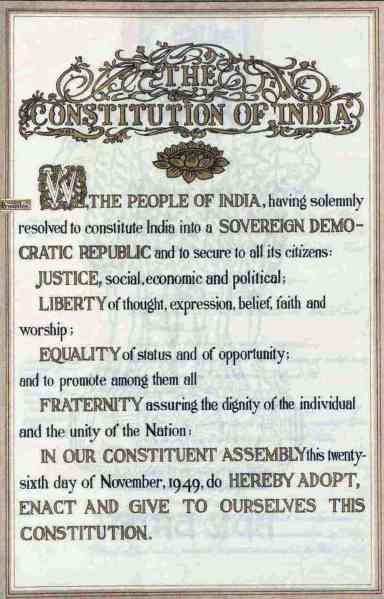
The constitution of India says “THE PEOPLE OF INDIA, having solemnly resolved to constitute India into a SOVEREIGN DEMO

CRATIC REPUBLIC and to secure to all its citizens: JUSTICE, social, economic and political;

LIBERTY of thought, expression, belief, faith and

worship; EQUALITY of status and of opportunity; and to promote among them all FRATERNITY assuring the dignity of the individual and the unity of the Nation;

IN OUR CONSTITUENT ASSEMBLY this twenty sixth day of November, 1949, do HEREBY ADOPT, ENACT AND GIVE TO OURSELVES THIS CONSTITUTION”.

POPULATION AND ITS EXPLOITATION

POPULATION:
Population typically refers to the number of people in a single area, whether it be a city or town, region, country, continent, or the world. A population is the complete set group of individuals, whether that group comprises a nation or a group of people with a common characteristic. In everyday use the word population refers a group of people or a group of living beings.

Population definition in statisticians perspective:
In statistics, a population is the pool of individuals from which a statistical sample is drawn for a study. Thus, any selection of individuals grouped by a common feature can be said to be a population. A sample may also refer to a statistically significant portion of a population, not an entire population. For this reason, a statistical analysis of a sample must report the approximate standard deviation, or standard error, of its results from the entire population. Only an analysis of an entire population would have no standard error.
Statisticians refer to whatever group they are studying as a population. Statisticians and researchers prefer to know the characteristics of every entity in a population to draw the most precise conclusions possible. This is impossible or impractical most of the time, however, since population sets tend to be quite large.
the term world population is often used to refer to the total number of humans currently living, and was estimated to have exceeded 7.9 billion as of November 2021. It took over two million years of human prehistory and history for the human population to reach one billion and only 207 years more to grow to 7 billion.

POPULATION EXPLOSION:
There has been a rapid growth of the human population in the last century due to the difference in the birth rate and the mortality rates. In the next one decade, the population of the world is expected to grow by another billion. The impact of uncontrolled population growth impacts not just a section of the society, but the entire population suffers from its infinite impact on the economy and the environment.

REASON FOR POPULATION EXPLOSION:
The human overpopulation or population explosion is caused when the ecological footprint of humans in a particular region crosses the actual carrying limit of the place with regards to space and the resources available. A place is considered to be overpopulated if the existing population in the area can no longer be maintained due to the constant depletion of the non-renewable resources or the natural resources leading to a degradation of the environment. However, a change in the lifestyle and the consumption and the use of renewable resources can help reverse the effects of population explosion without an actual or substantial decrease in the population.
The population of the world has increased exponentially in the past few decades. Around the year 1810, the population of the world was 1 billion. Just about a century later the population doubled to 2 billion, it increased to 4 billion in the next 45 years (1975) and by January 2019 the current population has reached 7.7 billion. The carrying capacity of the earth is 4 billion to 16 billion. It can be said that population explosion or human overpopulation may have already occurred on the Earth. According to the recent estimates, the world population would have reached somewhere around 10-11 billion between the years 2014 and 2050.

EFFECTS OF POPULATION EXPLOSION:
The effect of population explosion is multi-layered. It not only impacts the environment and the availability of resources but it also impacts the health of individuals within the population.
Natural resources are depleting constantly with the increasing demand and consumption. Fossil fuel which is the primary source of energy that drives the technology-driven world is fast depleting. Which poses a very important question on what do we depend on once this natural resource has exhausted. Although there is growing awareness on the use of renewable energy like biofuels, solar, wind and tidal energy and others there is still a long way to go where these renewable resources can actually replace the use of fossil fuels.
With the increasing population and the rising demand, there is an increased level in the air, water and soil pollution. This is not only impacting the lives of humans but has also affected the lives of many animals resulting in the endangering of many species and the extinction of many. The high levels of pollution have resulted in contamination of water and soil that has rendered many patches of land and water bodies unfit for use. Drinking water is fast becoming inadequate to support the needs of millions of people. With the increase the demand for crops to meet the global food requirements there has been an increase in deforestation to provide for agricultural land. This has led to a significant contraction in the biodiversity of many regions. Deforestation, on the other hand, has serious repercussions on the climatic condition of the planet. It leads to an increased level of carbon dioxide which is one of the contributing factors to global warming.
Apart from the environmental effects there is a huge socio-economic impact as the countries resources become inadequate to support the needs of a growing population. Countries with high population have high unemployment percentages as well which means that a greater number of people live in poverty, incapable to support the needs for sanitation and health care. It not only means malnutrition but it also leads to increased incidences of epidemics and pandemics.
Living conditions become increasingly compact and crowded which is detrimental to a thriving society and good mental health. It breeds crime and antagonism and higher mortality rates. Overpopulation impacts the entire biosphere as it impacts the environment in multiple levels.

CONTROL OF POPULATION:
The most important way to control a steady rise in population is by education and empowerment. The impact of population rise awareness should be created among the people.Awareness about the available sources and its consumption, also its concern about providing a quality life to the current and future generations. Birth control and family planning is the first step that needs to be taken to ensure a gradual decline in the growth rate of the population. About 40% of worldwide pregnancies are unintentional which can be avoided by the use of oral contraceptives or other birth control devices like condoms or intrauterine device. About 350 million women in the developing countries of the world are unaware of birth control options or the possibilities for family planning. Educating these women and making access to the birth control devices affordable can help in not only controlling the population growth but also help to improve the quality of life for these women and their children. Many countries promote small size families limiting the number of children per family to two or fewer. Male sterilization is also promoted to help in birth regulations. This has been made effective in a number of countries and a positive impact has been seen in the growth rate of the population of those countries.
Urbanization is another proposed method to help combat over population. According to the United Nations Human Settlements Program (UN-Habitat), urbanization may be an effective option for controlling the population growth. It suggested that cities tend to concentrate human activity with a limited area thus substantially reducing the breadth of environmental damage that is caused by a growing population. This can be achieved by efficient urban planning and proper maintenance of city services assuring an acceptable quality of life to its dwellers.

CONCLUSION:
The overpopulation may exploit the extraterrestrial settlements or space habitats that could support life forms.It is our responsibility to save,protect and provide our future generations a better life so we need to control the poluation in order to reduce the overusage of resources.

What is real estate?

What is real estate?

You must have overheard agents attempting to sell homes, condos, vacant land, etc. Real estate includes all of the aforementioned. The real estate industry is quite large and expanding rapidly. By 2030, financial analysts in India predict that the real estate market would be worth $1 trillion.

What are the major areas in real estate industry?

Real estate industry have 6 major areas. They are development, sales and marketing, brokerage, property management, real estate lending and professional services.

DEVELOPMENT – Real estate development includes purchasing barren land, rezoning, construction,etc. Mostly developers add value to the land. 

SALES AND MARKETING –Sales and marketing firm involves selling the buildings they created and earns a good amount of profit from it.

BROKERAGE –Brokerage firm employs brokers who will help in transaction between seller and buyer of property.

PROPERTY MANAGEMENT –Property management team helps the owner to rent out the units in their apartment. They collect rent, and check upon the maintenance of the property.

REAL ESTATE LENDERS-  Lenders are those who help in financing the property. They include banks, private lender or government institutions.

PROFESSIONAL SERVICES – There are various professionals other than lenders or brokers who are involved in this industry. They can be advocates, contractor, labourers etc.

Examples of real estate – 1 bhk building , 2 bhk building , flats, apartments, portable house, villas, Hut etc.

CAREERS IN REAL ESTATE –

1) Real estate attorney – advocates in real estate .

2)Loan underwriter – analyses the creditworthiness of borrower.

3)Home inspector- inspects the quality of property.

4) commercial brokers – creates link between buyer and seller.

5) agent -sales agent.

TYPES OF REAL ESTATE –

1) Land- Vacant barren land is first base of any real estate property.  Developers rezone the area and increase it’s value and sell it.

2) Residential – It includes buildings, apartments, villas etc . Developers construct the buildings over the land and sell it.

3) Commercial- Many companies use the property for their purpose.

4) Industry – Industries use to make factories are included in real estate.


Real Estate crisis in China.

China’s real estate sector has a debt problem. Large property developers like the embattled company Evergrande have racked up massive amounts of debt, leading to construction stoppages and lots of angry homebuyers.

Amid the turmoil, buyers across China have banded together and threatened to stop paying mortgages on over three hundred unfinished housing projects. Hundreds of thousands of homebuyers have begun a mortgage boycott, refusing to pay their mortgage for unfinished or stalled housing projects.

As of previous month, homebuyers in 80 cities and 200 projects had threatened to stop mortgage payments. Home sales have collapsed by nearly 60% compared to a year ago, and the current constant decline of sales (11 months) is pegged to be the worst in China’s history. Analysts expect property sales to have dropped 25% from January to June, amidst China’s Zero Covid Cases strategy. Numerous developments in China have halted as property developers have run out of capital to finish construction.

Across China, real estate developers are getting desperate – attempting to sell homes by whatever means possible, even going as far as accepting down-payments in wheat, garlic, watermelons and peaches to cater to farmers.

The real estate industry has an oversized impact on the economy. When related sectors like construction and property services are included, real estate accounts for more than a quarter of Chinese economic output, by some estimates. About 70 per cent of household wealth is stored in property, along with 30-40 per cent of bank loan books, while land sales account for 30-40 per cent of local government revenues, according to sources. The worsening crisis will test authorities’ ability to minimise the fallout. In case the situation is not being handled strategically by Chinese authority, then the consequences of such crises may spread all across asia and globe as well.

Real Estate crisis in China.

China’s real estate sector has a debt problem. Large property developers like the embattled company Evergrande have racked up massive amounts of debt, leading to construction stoppages and lots of angry homebuyers.

Amid the turmoil, buyers across China have banded together and threatened to stop paying mortgages on over three hundred unfinished housing projects. Hundreds of thousands of homebuyers have begun a mortgage boycott, refusing to pay their mortgage for unfinished or stalled housing projects.

As of previous month, homebuyers in 80 cities and 200 projects had threatened to stop mortgage payments. Home sales have collapsed by nearly 60% compared to a year ago, and the current constant decline of sales (11 months) is pegged to be the worst in China’s history. Analysts expect property sales to have dropped 25% from January to June, amidst China’s Zero Covid Cases strategy. Numerous developments in China have halted as property developers have run out of capital to finish construction.

Across China, real estate developers are getting desperate – attempting to sell homes by whatever means possible, even going as far as accepting down-payments in wheat, garlic, watermelons and peaches to cater to farmers.

The real estate industry has an oversized impact on the economy. When related sectors like construction and property services are included, real estate accounts for more than a quarter of Chinese economic output, by some estimates. About 70 per cent of household wealth is stored in property, along with 30-40 per cent of bank loan books, while land sales account for 30-40 per cent of local government revenues, according to sources. The worsening crisis will test authorities’ ability to minimise the fallout. In case the situation is not being handled strategically by Chinese authority, then the consequences of such crises may spread all across asia and globe as well.

Print Media as Oldest Mean Of Communication

 Print Media as Oldest Mean of Communication

We all know that communication is one of the essential part of our life. We can communicate with masses through different mass medium. There are different types of mass media that we are accustomed to in this day and age. Whether it’s a child, young people, or adults, we all have our share of media-related exposure every day.

Mass media refers to communication devices, which can be used to communicate and interact with a large number of audiences in different languages. Whether it is the pictorial messages of the early ages, or the high-technology media that are available today, one thing that we all agree upon is that mass media is an inseparable part of our lives. Entertainment and media always go hand in hand but in addition to entertainment, mass media are an effective medium for communication, dissemination of information, advertising, marketing, and expressing and sharing views, opinions, and ideas. 

Print media is one of the oldest mean of mass communication which helps the public to get in touch with everything happening in their surrounding. Before the arrival of electronic media people used to have habit of reading newspaper daily. It was one of the mandatory thing for people with their morning tea. It encompasses mass communication through printed material. It includes newspapers, magazines, booklets and brochures, house magazines, periodicals or newsletters, direct  mailers, handbills or flyers, billboards, press releases, and books.

Newspapers

Newspapers enjoyed the position of the most preferred medium to reach a wider audience until electronic communication emerged on the media scene. In the early days, newspapers were the only medium that the masses at large depended on, for daily news. A newspaper carries all kinds of communication-related to a variety of topics like politics, socialism, current affairs, entertainment, finance, stocks, etc.

Magazines

Magazines are another type of popular culture print media. They usually cater to a specific type of audience who is looking for information based on a particular subject. Magazines cover a plethora of topics, like current affairs, business, finance, consumers, gadgets, self-help, luxury, lifestyle, beauty, fashion, entertainment, travel, etc.

Booklets and Brochures

Booklets and brochures are a part of the promotional literature of a product or an organization.

Direct Mailers

Direct mailers are small pamphlets, which are devices for direct advertising and marketing. Usually, they arrive at our doorstep through the postal mail. Direct mails are a relatively cheaper option of marketing as bulk advertising is cost-effective through the post. Most of them include colorful advertisements, discount and gift coupons, pre-approved credit card offers, automobile, realtor, and political promotions.

Handbills or Flyers

 Handbills or flyers is a form of communication, which is printed on a small paper. It is easy to carry, colorful and attractive.  These are useful mainly for restaurants, hotels, nightclubs, political campaigns, rallies, political campaigns, etc. 

Billboards

Billboards or hoardings are huge advertisements that are put up at a height in strategic locations to fetch more attention. They usually attract the targeted audience by their bold colors, attention-grabbing headlines, creativity, designs, special effects, etc.

Books

Last but not the least, books are a significant medium of mass communication as they have a large reader base. The expressions and opinions of the writer are taken to the readers in the form of a compiled book.


The printed form of communication was popular earlier. However, with the advent of electronic media, print media has taken a backseat. Although, it is said that the electronic, or new age media have replaced the print media, there exists a majority of audience who prefer the print media for various communication purposes. 

ECONOMIC DEVELOPMENT

What is Economic development? Economic developmentis a process through which the overall education, well-being, health, income and living standards of the general population improves. This is where the economy will gradually grow, change and become advanced.
Economic development is the priority of local, state and federal government as it will lead towards an upgrading in innovation and new ideas, higher literacy rates, creation of jobs, improved environment, creation of higher wealth, labor support and better quality of life.

Development economic is the study of economic development.

Difference between Economic development and Economic Growth

Economic Growth:
Economic Growth is all about expanding the size of the economy bigger.
Here GDP is the sum of all economic activity in a nation over a specific period.

Economic Development:
Economic Development look into how the citizens are affected in a country.Apart from the living standards it also look into the freedom to enjoy their living standards.
Here GDP is divided by the total population.

Important perspectives in Economic development are:
*Average life expectancy
*Education Standards
*Literacy rates
*Environmental standards
*Availability of houses for living and their quality
*Health care. It also includes the number of doctors available and the affordable medicines for their treatments.
Income per capitaEconomic growth is a crucial condition for development. However, just growth is not enough because it cannot guarantee development.
Amartya Kumar Sen, an Indian economist and philosopher, who received the Nobel Memorial Prize in Economic Sciences, once said:
“Economic development is about creating freedom for people and removing obstacles to greater freedom. Greater freedom enables people to choose their own destiny.”
“Obstacles to freedom, and hence to development, include poverty, lack of economic opportunities, corruption, poor governance, lack of education and lack of health.”

Policies of Economic development:
It can be encompass into three major cases:
• Governments undertaking to meet broad economic objectives such as price stability, high employment, and sustainable growth. Such efforts include monetary and fiscal policies, regulation of financial institutions, trade, and tax policies.
• Programs that provide infrastructure and services such as highways, parks, affordable housing, crime prevention, and K–12 education.
• Job creation and retention through specific efforts in business finance, marketing, neighborhood development, workforce development, small business development, business retention and expansion, technology transfer, and real estate development. This third category is a primary focus of economic development professionals.
Contractionary monetary policy is a tool used by central banks to slow down a country’s economic growth. An example would be raising interest rates to decrease lending. In the United States, the use of contractionary monetary policy has increased women’s unemployment.
One growing understanding in economic development is the promotion of regional clusters and a thriving metropolitan economy.
International trade and exchange rates are a key issue in economic development. Currencies are often either under-valued or over-valued, resulting in trade surpluses or deficits. Furthermore, the growth of globalization has linked economic development with trends on international trade and participation in global value chains (GVCs) and international financial markets. The last financial crisis had a huge effect on economies in developing countries. Economist Jayati Ghosh states that it is necessary to make financial markets in developing countries more resilient by providing a variety of financial institutions. This could also add to financial security for small-scale producers .

Organisations of Economic Development:
Economic development has evolved into a professional industry of highly specialized practitioners. The practitioners have two key roles: one is to provide leadership in policy-making, and the other is to administer policy, programs, and projects. Economic development practitioners generally work in public offices on the state, regional, or municipal level, or in public–private partnerships organizations that may be partially funded by local, regional, state, or federal tax money. There are numerous other organizations whose primary function is not economic development that work in partnership with economic developers. They include the news media, foundations, utilities, schools, health care providers, faith-based organizations, and colleges, universities, and other education or research institutions.

Economic Indicators: An economic indicator is a metric used to assess, measure, and evaluate the overall state of health of the macroeconomy. Economic indicators are often collected by a government agency or private business intelligence organization in the form of a census or survey, which is then analyzed further to generate an economic indicator. Financial analysts and investors keep track of macroeconomic indicators because the economy is a source of systematic risk that affects the growth or decline of all industries and companies
Primary Economic Indicator:
Gross Domestic Product (GDP)
The Gross Domestic Product (GDP) is widely accepted as the primary indicator of macroeconomic performance. The GDP, as an absolute value, shows the overall size of an economy, while changes in the GDP, often measured as real growth in GDP, show the overall health of the economy.

Main Indicators of economic development:
1) National Income Index
Economic development takes place if real national income increases over time.
2)Per Capita Income Group
The national income indicator does not reflect the true picture of the development of the economy.
3)Physical Quality of Life Index
In many developing countries despite economic development, no improvement has taken place in the quality of life.
The physical quality of life index into consideration the non-income elements of life.
The country has a high life expectancy, the lowest infant mortality and the highest literacy is considered to be superior to other countries.
This index of development is superior to the per capita income index because it reveals the end result of the use of National Income in the country concerned.
4)Basic Needs Approach
ccording to this indicator of economic development, the development of an economy is judged in terms of the extent to which the basic needs of the masses are satisfied.
The components of basic needs are food, pure drinking water, sanitation, health, and education, etc.
The index of development is useful especially from the common man’s point of view as he is more concerned with his basic needs rather than the total production in the country.
5)Human Development Index: This index of economic development has been prepared by the United Nations called the Human Development Index (HDI).
It consists of per capita income, educational attainment, and life expectancy. The index does not measure the absolute level of human development. It ranks countries in relation to one another.
The index is superior to other indicators of economic growth as it takes into consideration both income and non-income factors.


Indian army

The Indian Army does not need any introduction, we all have love, respect and appreciation for our soldiers and the Indian Army.As we all know that the Indian Army has a long and glorious history, therefore, it is difficult to talk about everything in such a confined space.The Indian Army is a land-based unit, while the Indian Air Force works in air defense and the Indian Navy is a naval unit.Our Indian Army is the second largest army in the world with about 1.23 million personnel on active rolls and another 9.6 lakh in reserves.The Indian Army is primarily responsible for defending the country against land-based attacks.It also helps other agencies to deal with terrorism, to deal with emergency situations in the country and to save people in case of natural disasters like floods, earthquakes etc.The current Chief of Army Staff (COAS) is General Bipin Rawat (as of 2018). As the Indian Army is very large, it is divided into regiments.
Some important regiments are Punjab Regiment, Madras Regiment, Rajputana Rifles, Sikh Regiment etc.It also has its own intelligence unit, abbreviated as “military intelligence” or “MI”.The Indian Army (under British rule) participated in World War I and II before independence. After independence, it has fought several full-fledged wars like Kargil War (1999), Bangladesh Liberation War (1971), India-Pakistan War (1965), Indo-China War (1962) and First Kashmir War (1947).
Apart from these, the Indian Army has also handled some minor conflicts like Siachen struggle (1984), Operation Polo (1948), Indo-China conflict (1967) etc.
There is no doubt that our Indian Army is one of the best armies in the world.

The main role of the Indian Army is to protect our country from external and internal threats, it has proved its subtly many times.It has fought five major wars since independence and has successfully handled many smaller conflicts and won wars even when enemies had better weapons.For example, in 1965 there were Patton tanks (gifted to them by the US) in Pakistan, it was considered invincible at the time.India had nothing that could compete with those Patton tanks, but the Indian Army was able to defeat the Pakistani tanks in the Battle of Asal North.
Hawaldar Abdul Hameed mounted his jeep and destroyed six Pakistani tanks with a rifle in the back and was killed in an attempt to destroy the seventh.
For this he was awarded India’s highest military honor – Paramveer Chakra. It is believed that the Americans came to India to learn the methods and equipment by which their invincible Patton tanks were destroyed.It is believed that India rejected his request.The Indian Army also successfully handled many riots, for example the Godhra riots, 1992 Mumbai riots, 1984 riots etc.It is also currently dealing with terrorism in Jammu and Kashmir and some North Eastern state currently has around 1.23 million people on active rolls, while others have 9.6 lakh rupees.It has also produced many notable sports persons, who have brought it to our country. Some of them are Milkha Singh, Rajyavardhan Rathore, Vijay Kumar, and Major Dhyanchand etc.The Indian Army is one of the best armies in the world. It has the capability to handle any external and internal threat. Overall, we can say that the Indian Army is the soul of our country.


“There will be no withdrawal
without written orders and
these orders shall never be
issued.”

-Field Marshal Sam Manekshaw as core Commander in 1962.

Business software and its types

 What is Business Software?

Business software is software that is used for business purposes. It helps businesses to accomplish goals through the applied principles with software support. Using the software is not a digital trend, it’s a need and mandatory because software is designed to increase productivity, create innovations and solve customers’ problems faster.

Types of business software

1. Inventory Control System

The inventory management system monitors stock, updates, turnover rates and automates cycle counts. This software application eliminates the need to assign employees to count, record, and cross-examine stocks across multiple locations, saving time and money.

2.  Communication software

Communication software exchanges data which companies need to ensure the communication throughout all departments and locations is streamlined.

3. Human Resouce Information System (HRIS)

HR is one the most important sector in any business implementing human resource software programs can streamline clerical tasks. Recruitment, training, and record-keeping can all be monitored and automated through HRIS, which handles digital documentation.

4. Schedule Management System

Modern software allows business managers to access and alter employee schedules from anywhere at any time. Schedule management software also handles labour budget and payroll to monitor pay cycles and identify top performers.

5. Reservation Software

With a cloud competing reservation system, appointment-based businesses such as medical offices, salons, and restaurants can consolidate in-person and online reservations.

6. Demand Forecasting Software

When integrated with POS and inventory systems, demand forecasting software can shift through historical and real times sales and stock due to project future customer demand. The data can be automatically consolidated and generated into detailed reports and analyses.

7. Accounting Software

Accounting software helps financial advisors monitor business performance by tracking great time expenses, revenue and the bottom line.

There are different types of software available to fulfil various needs of a company’s size or industry.

Everything you need to know about Real Estate

 Everything you need to know about Real Estate


What is Real Estate?


Real estate is a real property in the form of buildings, land, and houses along with water, minerals, and crops. It is different from personal property, which is not permanently attached to the land such as jewelry, vehicle, furniture, etc. Real estate can be bought and sold, and it can be owned by the government, an individual, or an organization. 

Importance of Real Estate

The real estate sector plays a very important role in the economy by contributing 6-7% to GDP. It is a large sector to generate employment. It is very beneficial to invest which includes passive income, stable cash flow, diversification, and tax advantage.

Types of Real Estate

There are mainly five types of real estate:


Residential
Residential real estate includes any property which people call home. This includes single-family homes, apartments, condos, co-ops, or any other type of residence. It can be newly constructed or the resale of existing homes.

Commercial
Commercial real estate is any property that is used for commercial or business purposes like retail stores, offices, restaurants, shopping malls, hospitals, etc. Apartment buildings also fall under this category because they produce commercial income for their owners.

Industrial
Industrial real estate includes factories, mines, oil fields, power plants, warehouses, or any other property used to research, develop, manufacture, produce, store or distribute goods and services. 

Special purpose
Special purpose real estate includes property used by the public. It may include government-owned property such as federal or municipal buildings, parks, and public schools, it also includes houses of worship, cemeteries, and other public spaces.

Land
In terms of real estate, land refers to a large area of the property including vacant land, timberland, or any land used for agricultural purposes such as farms, ranches, or orchards. 

How to buy Real Estate?

You can buy Real Estate by finding the property you want to buy by determining your budget. Then you need to offer the price to the seller after inspection of the property and then the property is yours after all the documentation.

How does Real Estate work?

1. Development

It is a process that involves the purchase of raw land, construction and renovation of buildings, and sale or lease of the finished product to end users. Developers earn a profit by adding value to the land and taking the risk of financing a project. 

2. Sales and marketing

Sales and marketing firms work with developers to sell the buildings and units they create. These firms earn a commission for creating all marketing material and using their sales agents to sell the inventory of completed units.

3. Brokerage

It is a firm that employs a team of real estate agents who help facilitate a transaction between the buyers and sellers of property.

4. Property management

These firms help real estate owners rent out the units in their buildings. Their jobs include collecting rent, showing units, fixing deficiencies, performing repairs, and managing tenants. 

5. Real estate lending

Lenders play a major role in the industry as virtually all properties and developments use leverage to finance their business. Lenders can include banks, credit unions, private lenders, and government institutions.

6. Professional services

There are a variety of real estate professionals who work in the industry and help make it function. The most common examples are accountants, lawyers, interior designers, stagers, general contractors, construction workers, etc. 


Thus, if you are looking for investing your money in the right platform, then real estate can be one of them. You can earn good money by investing once because the prices of properties are increasing day by day and it can be beneficial for you to invest for your future.

Future of digital marketing


Future of digital marketing 

Marketing is changed nowadays by digital marketing. In 2020 when covid came all things are going online. In 2020 we came to know the online world very closely because before that everything is in an offline system. Everyone enjoys doing things online. They talk online, they shop online, and they find it easy to do and yes it is less time-consuming. Many of us switch offline to the online world because it helps us in different ways and it is less time-consuming. You can relax at home and do your work, you can start it from your comfort etc. 

The process of digital media marketing is making the companies surge with demands and supply the products to their customers.

Digitization

Everything is becoming digitised and it will be more improved and advanced in the coming days. If people choose to connect with the internet then digital marketing companies and agencies will make their way to get better results. 

Increase demand

The upcoming years are going to see the customers getting excited and prosperous for online things. Then the competition will be more tough compared to now. People will search for more products and services. This will make companies have additional hard work to do for their online products which can be available to the customers with great speed without any hassle.

Network

The network is the main thing behind all these. With more and more networks coming up there will be no problem with networks. The network will be stronger than ever before then things will be quick, easy and effective. When network access will be at high speed then digital marketing will be the only way to reach customers.

Voice search

Earlier most people preferred to go to the market and buy their products or if someone buys any product on an E-commerce website then they will be above 25-30 years old but today small children and teenagers also buy from an e-commerce website and they love to do so. They opt for service via the voice search method. Digital marketing companies need to focus on long-tail keywords and have deep knowledge of the target audience.

Interactive content

Digital marketing companies need very good content for their websites because they have to make their customers not only visit their websites but to purchase products from their website. They make sure to not only make customers purchase products, but they also give them vouchers and rewards, online quizzes, taking surveys, interaction via polls and many more. Digital marketers had to do very hard work not only to create content but to do their web design. They also have to take care of their audience for the content they have given for matching their needs.

Conclusion 

All things are changing very fast in the world. MNCs are now becoming more aware of the trends that people follow and they do their surveys and analysis to know even better what they need to do for improvement. This world has become now digitised in every manner. We have many good students in digital marketing companies or digital marketers who are trained by professionals that are working on live projects with leading MNCs.

What is Real Estate and its types?

 What are Real Estate and its types?

What is Real Estate?


Real Estate refers to any real or physical property which consists of land, buildings, fixtures, and roads. these structures can be both above and under the ground. for a business it refers to purchasing, producing, and selling property

types of Real Estate:

  • Land
  • Residential
  • Commercial
  • Industrial

1: Land:-


The land is a baseline for any real property. basically land refers to that property that is either underdeveloped or vacant. the land is used by developers for assembling it with some other properties so they can increase its value and the density of the property

you can buy land (real estate ) who don’t have any building or structure in it. if you purchase land then you can build or develop it at your convenience while following all the rules & regulations connected with it.

2: Residential:


Residential real estate consists of properties used by individuals, families, and groups of people for a living purpose. it is the most familiar or common form of the estate which people know about under Residential estate there can be single-family homes, apartments, and other types of living arrangements.  
people usually buy this estate for living purposes with their families but if already have your home so you can use it as an investment for the future and whenever you find you need the money just renovate it and then sell it at a higher price. you can even give it on rent and can earn monthly rent on it.    

3: Commercial:-

Commercial properties are those which is used by a business to carry out its operations. it includes lands & buildings. the commercial estate is usually used for providing business services as it doesn’t use for living purposes.

Businessmen can earn money through this property in two ways first by holding it till its value or piece increases in the market and selling it at a higher price and secondly by providing it on lease and getting rent on  it

examples- shopping malls, office buildings, hotels, parking slots, etc. 

4: Industrial:-

Industrial properties are those which are used for carrying out industrial business or activities. such as factories, construction, transportation, logistical, and warehousing.
industrial properties are very pricy but it has huge value, especially in malls where people come so they expect everything should show to them easily so it is in demand.

A career in Real Estate :

  • Analyst
  • Appraiser
  • Agent
  • Building Inspector 
  • Commercial Broker
  • Director of Real estate
  • loan underwriter
  • Mortgage underwriter


Need for Disaster Management

 Need for Disaster Management in every country 

A disaster whether natural or human induced, it is an event that results widespread human loss. It is accompanied by loss of livelihood. It will also cause disruption in the normal functioning of our society. It is a big blow to our countries economy. Disaster can be categorized based on the speed. Slow onset Disaster that prevails for many days, months and years. Some of the examples are drought, famine, environmental degradation etc. Rapid onset disaster they are triggered by an instantaneous shock. The impact of these kind of disasters are long term. They include cyclone, earthquake , flash flood, volcanic eruption etc.

Disaster management covers wide range of activities which are specially designed to maintain control over disasters or emergency situations. It provide a proper framework and help citizens of each country to avoid and reduce the effect of disaster that they face. It also offer an immediate recovery from the impact of a disaster. These activities include mitigation, emergency response, recovery and relief. It may be conducted during , before or after the disaster occurs. When a disaster strikes a place , immediate response and relief activities are carried out by government, non governmental organizations (NGO’s), and various other religious bodies in the society. It include search and rescue of the affected sections of the society. They are provided clothing, provision of food, shelter medicine and first aid facilities needed. After that rehabilitation and reconstruction measures are taken which help the affected sections of society to come back to their normal life. These activities help to restore their living conditions and encourage and facilitate necessary adjustments caused by disaster. These include building up of permanent roads, improvised power and communication networks should be established and restored. It also include economic rehabilitation for those people who have lost their livelihood.

Long and short term measures are taken up in order to reduce the impact of disasters, various structured and non- structured initiatives are taken up to ensure the safety of the society. These measures include construction of disaster resistant buildings, raising embankments beside the rivers etc. These are the structural measures. The non- structural measures include creating awareness and preparation plans in locality and society levels in order to prepare and face better for upcoming problems and disasters. These measures are also known as mitigation measures. Each and every society and country should be prepared with effective measures in order to reduce the impact of disasters upon the community. So in order to safeguard and preserve its citizens and country as a whole from disasters it is vital that we should be equipped with an effective, efficient and powerful disaster management system. We all have to respond rapidly to every situation and have to cope up with them effectively for our countries survival.

5 Easy Ways To Improve The SEO Of A Blog & Boost Traffic

 5 easy ways to improve the SEO of a blog

A blogger needs to know at least the basics of SEO. For this, you don’t need to be an SEO expert but you need to know the minimum so that your posts are well indexed in the search engines.

The phrase “Content is King” is one of the widest spread Internet memes being used by so many bloggers with the idea that you should focus on having quality content, while the rest isn’t that important. This is not true. Quality content is essential, but bloggers shouldn’t focus only on this matter. Besides producing quality content, your text needs to be optimized for the search engines.

improve seo, seo tips, boost traffic
Boost traffic & increase SERP visibility with SEO

5 Easy Ways to Improve the SEO of a Blog

Now, let’s get to know the basics that any blogger needs to learn about SEO, as well as other simple SEO techniques. Below are 5 easy tips to improve the SEO of your blog:

1. Define the keyword

When you write a post, it is recommended to choose the right SEO keyword for your text. Your purpose is to make this keyword – or term – to be searched on Google, and then get your post among the top. For this, you need to use this keyword a few times in the text.

For example, here the keyword could be SEO, but this term is too common and I could hardly get in the top for this search. Then, I’ll work with a phrase or a long tail keyword, so that this post will rank for the term “easy ways to improve the SEO of a blog“. I will use this keyword a few times, but without overdoing it.

2. Use the keyword in the post title

Now that I have defined the keyword, I will use it in the post title. This step is very important, and certainly will help you to get a better SEO rank. For instance, the post title contains the easy ways to improve the SEO of a blog keyword, along with other words to form an attractive and optimized title for SEO.

3. Use the keyword in H2 tags

You must also use heading tags (h2, h3) in your posts. Here, we added the “easy ways to improve the SEO of a blog” keyword in a H2 heading. Do this always as it will help you rank well in the search results. If you don’t know or don’t understand what are the heading tags, I would suggest to do a further research on this topic.

4. Use the keyword in the text

Include the chosen keywords throughout the text. Especially in the first paragraph (please note that I have repeated the title in italics in the first sentence). But be careful when doing this, there is a maximum and minimum limit for that. A good keyword density is between 1.5% to 4.5% for best results. Less than that will have no effect and more can alert the search engines and your text might be considered spam.

5. Publish Posts with 300 words or more

Posts under 300 words have little chance to be among the top results in search engines. Of course, you will be able to rank for multiple keywords that are less popular with less than 300 words, but for the most competitive keywords that have the potential to bring a greater number of visits, it will be nearly impossible.

Thus, it is recommended to write posts with more than 300 words. It’s not hard when you really understand the topic you’re talking about.

Conclusion

As you can see, with some simple SEO techniques you can improve the traffic coming to your blog from the search engines. I hope you enjoyed these 5 easy ways to improve the SEO of a blog!