STEPS TAKEN TO BOOST EXPORTS OF PROCESSED FOOD

 The efforts being made by Government for promoting exports of processed food products include:

(i) A comprehensive “Agriculture Export Policy” has been introduced to harness export potential of Indian agriculture.

(ii) Products Specific Export Promotion Forums set up by Agricultural and Processed Food Products Export Development Authority (APEDA) to give impetus to the export of potential products as well as to remove the bottlenecks in the supply chain.

(iii) APEDA has also formed Export Promotion Forums (EPFs) for the products, viz., Grapes, Onions, Mango, Banana, Pomegranate, Floriculture, Rice, Dairy Products and Nutri cereals.

(iv) A Farmer Connect Portal has been set up for providing a platform for farmers, Farmer Producer Organizations (FPOs) and cooperatives to interact with exporters.

(v) Assistance provided through several other schemes to promote exports, including food products export, viz. Trade Infrastructure for Export Scheme (TIES), Market Access Initiatives (MAI) Scheme, Remission of Duties and Taxes on Exported Products (RoDTEP), Export Promotion schemes of Agricultural and Processed Food Products Export Development Authority (APEDA)& Marine Products Export Development Authority (MPEDA), etc.

(vi) District as Export Hubs (DEH) scheme is being implemented using ODOP(One District One Product) approach with an objective of converting each District of the country into a Manufacturing and Export Hub by identifying products with export potential in the district.

(vii) Under the Production Linked Incentives (PLI) scheme for food products, marketing and branding support is provided by Ministry of Food Processing Industries for enhancing global visibility of Indian food products.

Mandatory Verification of Social Media Accounts

 Government’s objectives are aimed at ensuring Open, Safe & Trusted and Accountable internet for its users.The Government is aware of the risk and danger posed by growing phenomena of misinformation, bots, criminality and users harms in general.

To ensuring Open, Safe & Trusted and Accountable internet for its users, the Government has notified the Information Technology (Intermediary Guidelines and Digital Media Ethics Code) Rules, 2021 (“IT Rules 2021”). As per the rule 4(7) of the said Rules, the significant social media intermediaries shall enable users to voluntarily verify their accounts and such users’ accounts shall be provided with visible marks of verification.

INS Sumedha visits Bali, Indonesia

 As part of the Indian Navy’s Long Range Deployment in the South Eastern Indian Ocean, INS Sumedha, is on a visit to Port Tanjung Benoa, Bali, from 04 Aug to 06 Aug 2022. The ship is en route to Perth, Australia, to coincide with India’s Independence Day and celebrations of Azadi Ka Amrit Mahotsav. The visit to Bali is aimed at strengthening bilateral ties, enhancing military cooperation and improving interoperability with the Indonesian Navy. During her stay at Bali, the ship’s crew will engage in professional interactions, cross-deck visits and sports fixtures with their Indonesian Navy counterparts.

https://static.pib.gov.in/WriteReadData/userfiles/image/INS_Sumedha_at_Bali__IndonesiaLOEU.jpg

Prior to entering Bali, the ship undertook a Maritime Partnership Exercise with KRI Sultan Hasanuddin, a Sigma class corvette of the Indonesian Navy on 02 August 2022. The exercise which included seamanship evolutions, tactical manoeuvres and communication procedures provided an opportunity for sharing professional experiences and strengthening maritime cooperation between the two navies.

INS Sumedha is an indigenously built Naval Offshore Patrol Vessel and is deployed for multiple roles independently and in support of fleet operations. She is part of the Indian Navy’s Eastern Fleet based at Visakhapatnam and functions under the operational command of the Flag Officer Commanding-in-Chief, Eastern Naval Command.

***********

Production of Defence Products

 Government has taken several steps to enhance self-reliance in indigenous design, development and manufacturing of defence products. Three Positive Indigenisation lists comprising of 310 (101, 108 and 101 respectively) items have been promulgated by Department of Military Affairs (DMA), Ministry of Defence on 21st August 2020, 31st May, 2021 and 07th April 2022, respectively with the timelines indicated against them beyond which the items would be procured from indigenous sources. The products have been offered to the industry to come forward for design & development.

Further, in continuous pursuit of self-reliance in defence manufacturing and to minimize import by DPSUs, Department of Defence Production, Ministry of Defence has notified two Positive Indigenisation Lists (PILs) of sub-systems/assemblies/sub-assemblies/components on 27th December, 2021 and 28th March, 2022. The 1st list contains 2500 items, which are already indigenized and 351 items which have been taken up for indigenisation. The 2nd list consists of 107 strategically important Line replacement units/major sub-assemblies. The list of these items and their details are available on SRIJAN portal for Industry to show their interest. The items are notified with a timeline beyond which there would be an embargo on their import. Till date, 154 items out of 235 items from the 1st Positive Indigenisation List and 4 items out of 107 items from the 2nd Positive Indigenisation List have already been indigenized.

With focus of Government on indigenisation and procurement of defence products from the domestic resources, the expenditure on defence procurement from foreign sources has reduced from 46% to 36% in the last 4 (four) years i.e. from 2018-19 to 2021-22. Moreover, the Government, in the last four years i.e. from 2018-19 to 2021-22, has accorded Acceptance of Necessity (AoN) to 162 proposals worth Rs 2,51,130 crore approximately, under various categories of Capital procurement from domestic sources.

Further, the timelines for embargo on imports has been spread from December, 2020 to December 2028, so the assessments of savings on foreign exchange and opportunities for employment cannot be done at this stage.

Tejas Fighter Aircraft

 Hindustan Aeronautics Limited (HAL), a Defence PSU under the Ministry of Defence responded to a Request for Information (RFI) received from Royal Malaysian Air Force (RMAF), Malaysia in February, 2019 for LCA class aircraft. Subsequently, Hindustan Aeronautics Limited responded in October, 2021 to Request for Proposal (RFP) issued against tender released by Royal Malaysian Air Force, Malaysia for 18 nos of Fighter Lead In Trainer – Light Combat Aircraft (FLIT – LCA) and HAL offered LCA Tejas twin seater variant. Other countries which have evinced interest in LCA aircraft are: Argentina, Australia, Egypt, USA, Indonesia, and Philippines.

The Government has taken several policy initiatives in the past few years and brought in reforms to encourage indigenous design, development and manufacture of defence equipment in the country, thereby expanding their production. These initiatives, inter-alia, include:

  • According priority to procurement of capital items from domestic sources under Defence Acquisition Procedure (DAP)-2020.
  • The announcement of 18 major defence platforms for industry led design & development in March, 2022.
  • Notification of three ‘Positive Indigenisation Lists’ of total 310 items of Services and two ‘Positive Indigenisation Lists’ of total 2958 items of the Defence Public Sector Undertakings (DPSUs), for which there would be an embargo on the import beyond the timelines indicated against them.
  • Simplification of Industrial licensing process with longer validity period.
  • Liberalisation of Foreign Direct Investment (FDI) policy allowing 74% FDI under automatic route.
  • Simplification of Make Procedure.
  • Launch of Innovations for Defence Excellence (iDEX) scheme involving start-ups & Micro, Small and Medium Enterprises (MSMEs).
  • Implementation of Public Procurement (Preference to Make in India) Order 2017.
  • Launch of an indigenisation portal namely SRIJAN to facilitate indigenisation by Indian Industry including MSMEs.
  • Reforms in Offset policy with thrust on attracting investment and Transfer of Technology for Defence manufacturing by assigning higher multipliers.
  • Establishment of two Defence Industrial Corridors, one each in Uttar Pradesh and Tamil Nadu.
  • Opening up of Defence Research & Development (R&D) for industry, start-ups and academia with 25 percent of defence R&D budget earmarked to promote development of defence technology in the country; and
  • Progressive increase in allocation of Defence Budget of military modernisation for procurement from domestic sources, etc.

Application of Science and Technology in Defence Sector

 The Government has undertaken a number of policy initiatives for indigenous manufacturing of state-of-the-art defence products by utilising the applications of science and technology in defence sector. These initiatives, inter-alia, include: –


  • In order to promote indigenous design and development of defence equipment ‘Buy {Indian-IDDM (Indigenously Designed, Developed and Manufactured)}’ category has been accorded top most priority for procurement of capital equipment.
  • An innovation ecosystem for Defence titled Innovations for Defence Excellence (iDEX) has been launched in April, 2018. iDEX is aimed at creation of an ecosystem to foster innovation and technology development in Defence and Aerospace by engaging Industries including Micro, Small & Medium Enterprises (MSMEs), Start-ups, Individual Innovators, Research & Development (R&D) institutes and Academia and provide them grants/funding and other support to carry out R&D which has potential for future adoption for Indian defence and aerospace needs.
  • To enable adoption of Artificial Intelligence in defence, Defence AI Council (DAIC) and Defence AI Project Agency (DAIPA) has been created. Further, an AI roadmap has also been finalized.
  • Specific provisions have been introduced in DAP-2020under ‘Buy and Make (Indian)’ and ‘Buy (Global – Manufacture in India)’ category, wherein indigenous production is carried out with Transfer of Technology (ToT) from foreign OEM.
  • Discharge of offset obligations by foreign OEMs through ToT to Indian enterprises including government institutions has been incorporated. 
  • Government has notified the ‘Strategic Partnership (SP)’ Model which envisages establishment of long-term strategic partnerships with Indian entities through a transparent and competitive process, wherein they would tie up with global Original Equipment Manufacturers (OEMs) to seek technology transfers to set up domestic manufacturing infrastructure and supply chains.
  • Defence Research & Development (R&D) has been opened up for industry, start-ups and academia with 25 percent of defence R&D budget earmarked, to promote development of defence technology in the country.
  • Defence Research and Development Organisation (DRDO) identified nine thrust areas for focused research, namely Platforms, Weapon System, Strategic Systems, Sensors & Communication Systems, Space, Cyber Security, Artificial Intelligence & Robotics, Material &Devices and Soldier Support.
  • Technology Development Fund (TDF) Scheme also funds industries, especially – Start-ups and MSMEs up to an amount of Rs. 10 Crore, for innovation, research and development of defence Technologies in the field of defence and Aerospace.


As a result of these initiatives, many State-of-the-art products including 155mm Artillery Gun system ‘Dhanush’, Light Combat Aircraft ‘Tejas’, Surface to Air Missile system ‘Akash’, Main Battle Tank ‘Arjun’, T-90 Tank, T-72 Tank, Armoured Personnel Carrier ‘BMP-II/IIK’, Su-30 MK1, Cheetah Helicopter, Advanced Light Helicopter, Dornier Do-228, High Mobility Trucks, INS Kalvari, INS Khanderi, INS Chennai, Anti-Submarine Warfare Corvette (ASWC), Arjun Armoured Repair and Recovery Vehicle, Bridge Laying Tank, Bi-Modular Charge System (BMCS) for 155mm Ammunition, Medium Bullet Proof Vehicle (MBPV), Weapon Locating Radar (WLR), Integrated Air Command and Control System (IACCS), Software Defined Radios (SDR), Lakshya Parachute for Pilotless Target Aircraft, Opto Electronic Sights for Battle Tanks, Water Jet Fast Attack Craft, Inshore Patrol Vessel, Offshore Patrol Vessel, Fast Interceptor Boat, Landing Craft Utility, 25 T Tugs, etc. have been produced in the country during the last few years.

The Unmanned Aerial Vehicle designed and developed by DRDO, has been successfully tested in fully autonomous mode. This flight marks a major milestone in terms of proving critical technologies towards the development of future unmanned aircraft and is a significant step towards self-reliance in such strategic defence technologies.


Performance and Efficiency Audit of Armed Forces

 The Government has set up an apex committee to conduct “performance and efficiency” audit of the armed forces. The members of the committee include the Defence Secretary as Chairman, Vice Chiefs of the three Services, Secretary Defence (Finance)/FA(DS), Chief of Integrated Staff Committee (CISC), Controller General of Defence Accounts (CGDA), Director General (Acquisition) and other senior officials of Ministry of Defence and Defence Research and Development Organisation (DRDO). Performance /Efficiency Audit will be aimed at providing valuable inputs to the Top Level Management by way of providing reliable, objective and independent information, highlighting shortcomings in planning, implementation, systems affecting outputs/outcomes in specific and quality of expenditure/management in general.

The mandate to carry out Performance and Efficiency Audit was given to CGDA on 14th July, 2022. The broad areas that have been identified for the conduct of this Audit include Defence Capital Procurements, provisioning, logistics, inventory levels, maintenance of platforms/assets, role and performance of Authority Holding Sealed Particulars (AHSP) etc. The Apex committee can also recommend any other specific area for Performance and Efficiency Audit. This will constructively promote economy, effectiveness and efficiency in governance by creating the necessary environment of accountability and transparency in the organization and ensure that the operations are effectively carried out through continuous improvement.

Modernization of Defence Armed Forces involves the acquisition of new state-of-the-art platforms, technologies and weapon systems to upgrade and augment Defence capabilities and is a continuous process based on threat perception, operational necessities and technological changes to keep the Armed Forces in a state of readiness to meet the entire spectrum of security challenges. Government attaches highest priority to ensure that the Armed Forces are sufficiently equipped to meet any operational requirement which is achieved through induction of new equipment and technological upgradation of capabilities.

The equipment requirements of the Armed Forces are planned and progressed through a detailed process which includes Ten Years Integrated Capability Development Plan (ICDP), Five Years Defence Capability Acquisition Plan (DCAP) and Annual Acquisition Plan (AAP) and deliberations by the Defence Acquisition Council chaired by the Raksha Mantri.

Government is pursuing a large number of initiatives to achieve higher levels of indigenization and self-reliance in the defence sector by harnessing the capabilities of the public and private sector industries in the country. These measures include according priority and preference to procurement from Indian vendors and liberalization of the licensing regime.

The Defence Acquisition Procedure (DAP)- 2020 has been driven by the tenets of Defence Reforms announced as part of the Aatmanirbhar Bharat Abhiyan of the Government of India by promoting indigenous design, development and manufacturing of defence equipment, platforms, systems and sub-systems. DAP 2020 accords the highest priority to Buy Indian (Designed, Developed and Manufactured) (IDDM). To encourage production of these weapons/platforms in India, lists of weapons/platforms for ban on import have been notified. A new category of Buy (Global-Manufacture in India) has been introduced to enable ab-initio indigenization of spares. This category encourages Foreign Original Equipment Manufacturers (OEMs) to set up ‘Manufacturing/ maintenance entities’ through its subsidiary in India. The definition of Indian Vendor has also been aligned to the new FDI policy. The Government has introduced Make II & Make III categories with the objective of self-reliance by involving greater participation of Indian industrial eco-system including private sector. The simplified Make-II procedure has been notified for Industry funded development projects. Reservation on Orders up to Rs. 100 Crores/ year for MSMEs and Small Shipyards has been provided. Government has also promulgated the policy on Strategic Partnership in the Defence Sector to encourage broader participation of the private sector in manufacture of major defence platforms and equipment.


Defence Research Institutes

 As on date, there are 46 Labs/Estts including five Young Scientists Laboratories of DRDO in the country. The Government has taken following initiatives for promoting research in the defence sector:


  • Creation of five Young Scientists Laboratories (DYSLs) to motivate youth for newer innovations- DRDO has created five DRDO Young Scientists Laboratories (DYSLs) to attract young Scientists/Engineers to join DRDO and provide R&D environment in emerging engineering fields and advanced technologies such as Artificial Intelligence, Quantum Technologies, Cognitive Technologies, Asymmetric Technologies and Smart materials and provide adequate freedom to young scientists to prove their talent.
  • DRDO has introduced a scheme of Research Fellowships to provide opportunity to bright, young scientists/Engineers to carry out research work leading to earning of higher qualification or for acquisition of research experience.  Further, other schemes like Grants-in-Aid Scheme by Extramural Research & Intellectual Property Rights (ER&IPR), various Schemes/MOUs under Research Boards, Exhibitions, inter school and inter college level competitions etc. have also been initiated by DRDO to generate interest in Defence Technologies among school and college students.
  • Paid Apprenticeship Scheme, Internship to B. Tech/ M.Tech/ M.Sc Students, Exhibitions, inter-college level competitions etc. have also been initiated by DRDO to generate interest in Defence Technologies among school and college students.
  • Defence Industry Academia Centre of Excellence (DIA-CoE): DRDO is providing financial support through the DIA-CoE in IITs/Universities to undertake science and technology projects and to create special tests facilities in theses DRDO funded centres. Currently, 10 such DIA-CoE have been established so far by DRDO.
  • Cyber and Artificial Intelligence (AI) Courses: DRDO has conducted certified courses in AI & Machine Learning (ML) and so far more than 1000 professionals have been trained in these domains.
  • Collaboration between higher educational institution and DRDO through fellowships sponsored under Ministry of Human Resource Development funded institutions: Under this scheme, 500 students have been sponsored for PhD programmes in AICTE/Centrally Funded Technical Institutes under the Ministry of Human Resource Development to work on various DRDO projects thereby attracting young research scholars and provide them working exposures to state-of-the-art Defence technologies, high end research and development activities of DRDO.  Under this scheme, students get the opportunities to have first-hand experience of the ongoing R&D project in niche technology area.
  • Directorate of Technology Development Fund (TDF): TDF was created for projects under Technology Development Scheme.  The scheme encourages participation of public/private industries especially MSMEs and Start-ups, so as to create an eco-system for enhancing cutting edge technology capability for defence application.


The details of funds spent during the last five years by the Department of Defence Research & Development (DD R&D) is as under:-


(Rs. in crore)

Year

DD R&D Exp

2017-18

15203.04

2018-19

17049.01

2019-20

17375.13

2020-21

15706.98

2021-22

18290.98

Research and Development in Defence Manufacturing

 The steps taken by the Government to enhance Research and Development in defence manufacturing are as follows:

  • DRDO has introduced a policy on selection of the Development cum Production Partner (DcPP) for DRDO developed systems, which ensures involvement of industries from the beginning of development cycle and lead to reduction in the time-frame of the development-to-induction cycle.
  • DRDO has promulgated new Transfer of Technology (ToT) policy and procedure with ‘Nil’ ToT fee for its industry partners Development cum Production Partners (DcPP)/ Production Agency (PA) and ‘Nil’ royalty for supply to Indian Armed Forces and Govt. Deptt. This will enhance capabilities and competitiveness of Indian industries in global market. This will also provide further boost to Indian industries in defence manufacturing sector to achieve higher self-reliance.
  • DRDO has promulgated new patent policy to facilitate Indian industries to get free access to use DRDO patents. This will provide an access to Indian industries to the innovations carried out by DRDO to further boost up their R&D and develop new technologies.
  • DRDO has launched Technology Development Fund (TDF) which provides financial support to the Indian industries including MSMEs & Startups for design & development of innovative defence products. It provides funding through the means of grants-in-aid to design & develop technologies for the systems, components and weapons utilized by Armed Forces. TDF contributes towards shaping an enabling environment for nurturing innovation and boosting the development of indigenous defence manufacturing ecosystem.

The details of projects and amount sanctioned for utilisation under various R&D projects at DRDO during the last three years are as follows:

       (Rs in crore)

Year

No of Projects sanctioned

Amount

2019

81

4895.86

2020

88

4031.7

2021

74

19978.90

Jan 2022 – Till date

39

9078.91

Total

282

37,985.37


The Government has taken several policy initiatives in the past few years and brought in reforms to encourage indigenous design, development and manufacture of defence equipment, thereby promoting self-reliance in defence manufacturing & technology in the country. Some of the important steps are as follows:

  • According priority to procurement of capital items from domestic sources under Defence Acquisition Procedure (DAP)-2020. The announcement of 18 major defence platforms for industry led design & development in March 2022.
  • Notification of three ‘Positive Indigenisation Lists’ of total 310 items of Services and two ‘Positive Indigenisation Lists’ of total 2958 items of Defence Public Sector Undertakings (DPSUs) for which there would be an embargo on the import beyond the timelines indicated against them.
  • Simplification of Industrial licensing process with longer validity period.
  • Liberalisation of Foreign Direct Investment (FDI) policy allowing 74% FDI under automatic route.
  • Simplification of Make Procedure, Launch of Innovations of Defence Excellence (iDEX) scheme involving startups & micro, small and medium enterprises (MSMEs).
  • Implementation of Public Procurement (Preference to Make in India) Order 2017.
  • Launch of an Indigenization portal namely SRIJAN to facilitate indigenisation by Indian Industry including MSMEs.
  • Reforms in Offset policy with thrust on attracting investment and transfer of Technology for Defence manufacturing by assigning higher multipliers.
  • Establishment of two Defence Industrial Corridors, one each in Uttar Pradesh and Tamil Nadu.
  • Opening up of Defence Research& Development (R&D) for industry, startups and academia with 25 percent of defence R&D budget.
  • Progressive increase in allocation of Defence budget of Military modernisation for procurement from domestic sources, etc.

‘Badhe Chalo’Movement under Azadi ka Amrit Mahotsav begins

 With the objective of connecting with the youth of the nation, and to instil a deeper sense of patriotism among them, the Ministry of Culture, has decided to create a youth centric activation for greater outreach of Amrit Mahotsav named ‘Badhe Chalo’. It is designed to involve the youth of the country encouraging them to come forward and imbibe the true spirit of our democracy and celebrate 75 years of India’s independence with youthful fervour.


‘Azadi Ka Amrit Mahotsav’ is an initiative of the Government to celebrate and commemorate 75 years of progressive India and the glorious history of its people, culture and achievements. Ministry of Culture is responsible for promoting art and cultural heritage in India and it has taken many initiatives under the aegis of ‘Azadi Ka Amrit Mahotsav’.

Through this mass movement or ‘Jan Bhagidari’ initiative,the Ministry of Culture also intends to amplify and support the ‘Har Ghar Tiranga’ movement. This movement has been initiated by the Honourable Prime Minister and Home Minister and it calls upon every Indian to hoist a Tiranga in their homes between August 13th– 15th, 2022.

To connect and to bring the youth and people together from across the country on one platform,Badhe Chalowill featureFlash Dances, wheredancers will performon a specially created ‘Youth Anthem’. The energetic foot-tapping anthem has been specially written and composed on the theme of ‘Badhe Chalo’ and it encourages everyone to come forward and hoist a Tiranga in their homes. This trendy and youthful activation will feature Flash Dances happening across 75 cities,at prime locationsall over India. Through these Flash Dances the Ministry aims to spread the message and spirit of the Amrit Mahotsav in an entertaining and enthusiastic manner.

Badhe Chalo is being held across 10 cities every day from 5th August to 11th August, 2022. These events will culminate with a Grand Finale on 12th August, 2022at Talkatora Stadium in New Delhi. This spectacularstar-studded eventwill feature performances by the Indian Idol stars Pawandeep Rajan and Arunita Kanjilal.

Badhe Chalo took off today at national level starting with ten locations that include Lal Chowk in Srinagar, Jammu & Kashmir, Ashtley Hall in Dehra Dun, Uttarakhand, Akashdeep Market in Itanagar, Arunachal Pradesh, Central Mall in Patna, Bihar, Telibandha Talab in Raipur, Chhattisgarh, CMR Mall in Vishakhapatnam, Andhra Pradesh, Gaurav Tower in Jaipur, Rajasthan, The Maharaja Sayajirao University of Baroda, Gujarat, Keshav Vatika in Kanpur, Uttar Pradesh, & Alpha One Mall in Ahmedabad, Gujarat,  energising the youth of our nation and creating connect with them on a patriotic plane.

Badhe Chalo is sure to rekindle the fire of patriotism in one and all, while encouraging us to hoist a Tiranga in our homes with swelling national pride in our hearts, and our heads held high.

***

Ministry of Culture and Google kick starts ‘India ki Udaan’

 Ministry of Culture and Google kick started   the initiative, India ki Udaan’ to celebrate the  unwavering, undying, spirit of India and its achievements in past 75 years. This celebration  started today in New Delhi, with a special ceremony. This event is a continuation of decade -long partnership between Ministry of Culture and Google. This joint venture was organised under the aegis of Azadi ka Amrit Mahotsav.

Mr Amit Sood, Director – Google Arts & Culture, unveiled a very special exhibit which team Google has created to honour the achievers and game changing moments of the last 75 years. The showcase displayed India’s biggest achievements using ground-breaking augmented reality technology, including Indian handicrafts and also the stories of India’s women achievers.

On the occasion G Kishan Reddy said, “India today is in the middle  Digital, Data and Disintermediation revolution. Digital Revolution coupled with Ease of Doing Business has allowed common Indian citizens to avail of services in a faceless, presence less and cashless manner. India has made available data at one of the lowest rates to users due to a proactive Government policy ushering in competition in the Telecom sector and the disintermediation revolution has removed middle-men making India’s small businesses competitive and export ready”.

The minister further said tm“Today, I am privileged to be a part of this initiative ‘India ki Udaan’ which is a celebration of the unwavering and undying spirit of India. India and Google have a lot to benefit from each other in this partnership. It is often believed that a company that builds for India, builds for the world and the best example of this is the Google payment platform built in India using the Government of India’s Unified Payments Interface (UPI)”.

 “I would like to appreciate the efforts of Google in working with the Ministry of Culture to come together and celebrate Azadi ka Amrit Mahotsav. I am glad that Google will be supporting the Ministry of Culture in amplifying the various initiatives of Azadi ka Amrit Mahotsav. I would also request the Google team to be a part of the Har Ghar Tiranga event and encourage its employees to hoist the flag in their homes. I would urge the Google leadership to be involved in other initiatives of the Ministry of Culture and Ministry of Tourism and be a partner in the Government’s transformation journey” he added.

The event also witnessed an exciting performance by Divyansh and Manuraj, winners of India’s Got Talent 2022, and a special performance by Clinton Cerejo and team, who brought to life the diverse sounds of India with performers from different parts of the country showcasing the culture and sounds of their regions and bringing it together to create a unified “Sound of India”.

******

Common registration Facility of ration cards launched on pilot basis in 11 States/UTs

 The Secretary, Department of Food and Public Distribution, Shri Sudhanshu Pandey today launched a ‘Common Registration Facility’ on pilot basis for 11 States/UTs i.e. Assam, Goa, Lakshadweep, Maharashtra, Manipur, Meghalaya, Mizoram, Nagaland, Punjab, Tripura and Uttrakhand.

This Web based facility will enable these 11 States/UTs to collect data of persons desirous of registering for inclusion under NFSA, including migrants residing in other states. This facility will help States/UTs in expeditiously identifying and verifying the eligible beneficiaries for coverage under NFSA as per their established inclusion and exclusion criteria, subject to the ceiling limit of NFSA of the State/UT and thus achieving the rightful targeting of benefits.

While addressing media persons here, Shri Pandey said, “This portal is only an enabler for States/UTs to complete their inclusion exercise under NFSA.” He emphasisied that the portal will help in streamlining data management while providing a platform to the States/UTs to help inclusion of beneficiaries.

The National Food Security Act, 2013 (NFSA) provides food security coverage for a maximum of 81.35 Crore persons in the country. 

State/UT-wise total number of persons being covered under NFSA (including AAY families) has been clearly defined under the Targeted Public Distribution System (Control) Order, 2015 of this Department issued under the National Food Security Act, 2013 (NFSA). The present NFSA coverage at the national level is about 79.74 Crore against the total ceiling limit of 81.35 Crore.

All States/UTs are being continuously advised to identify maximum eligible and left-out persons (presently not covered under NFSA) through special camps, identification drives, etc. and bring them under NFSA coverage (AAY/PHH) as per their eligibility and up to the respective ceiling limits and also to regularly weed out the ineligible beneficiaries from the coverage.

***

“Grand Onion Challenge” thrown open to young professionals

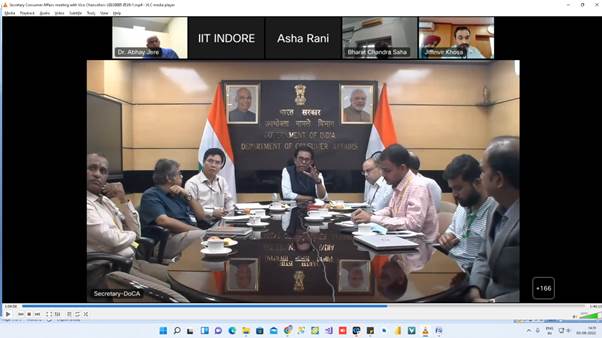
 The Department of Consumer Affairs conducted a Video Conference regarding “Grand Onion Challenge” today with Heads of Educational Institutions, Vice Chancellors, Professors, Deans of eminent institutions, Senior Academicians, executives of the startups, scientists from BARC, officers of the Department of Atomic Energy, Ministry of Education, DPIIT and professionals working in the field of Agriculture, Horticulture and Food Processing.

This challenge seeks ideas from young professionals, professors, scientists in product designs and prototypes for improving pre-harvesting techniques, primary processing, storage, and transportation of post harvested onions in the country. The challenge also seeks ideas for modernization of technology in dehydration, valorization of onions and onion food processing domain.

The Grand Onion Challenge instituted by Department of Consumer Affairs has been thrown open from 20.7.2022-15.10.2022 seeking ideas in all the above domains from the best brains in the country.  More information on the challenge is available on the Department website doca.gov.in/goi


The grand onion challenge registration webpage has received 122 registrations so far and some of the participants have submitted their ideas.  The Department will select 40 good ideas in the four verticals wherein improvements and technology innovations are sought and therefore, departments and organizations concerned in the country are urged to submit ideas so that cost effective solutions in saving losses in pre-harvesting, primary processing, storage and transportation of onions can be developed and Atma Nirbhar Bharat programme is supported in the process.

During the VC, Shri Shri Yogesh Patil, IAS, Assistant Secretary, Department of Consumer Affairs made a brief presentation on current challenges faced by the country in storage, processing and transportation of onions. It is expected that post the challenge, the losses in onion storage can be reduced by 5-10% due to innovative ideas.

Dr. Abhay Jere, Chief Innovation Officer, Innovation Cell, Ministry of Education explained in detail the three stages of participation in the challenge and urged everyone to participate in the said challenge.

Dr. S. Gautam, Scientist, Bhabha Atomic Research Centre, Department of Atomic Energy explained the effect of irradiation in increasing the shelf life of stored onions based on studies undertaken, which brought to light the benefits of technology in reducing losses drastically.

Scientists and professors from various organizations/universities presented many unique ideas to reduce the losses occurring during storage and transportation of onions.

More than 282 participants from different institutions, universities, research organizations and private sector startups participated in the virtual meeting from across the country.

The Secretary, DoCA, Shri Rohit Kumar Singh urged everyone to participate in the challenge so that low cost and easily replicable technology solutions to reduce post harvested onion losses could be developed for farmers and sustainably used in the country.

*******

Reduction in EMF Emissions

 Electromagnetic Field (EMF) emissions from Mobile towers are non-ionizing Radio frequencies having very minuscule power and are incapable of causing any adverse environmental impact. The International EMF Project of World Health Organisation (WHO) has published an information sheet in 2005 on effect of EMF emissions on animals, insects, vegetation and aquatic life and has concluded that the exposure limits in the Non-Ionizing Radiation Protection (ICNIRP) guidelines for protection of human health are also protective of the environment.

The present norms for Electromagnetic Field (EMF) emissions from mobile towers in India are already ten times more stringent (even lower) than the safe limits prescribed by ICNIRP and recommended by WHO. These limits prescribed in India are:

  Frequency Range

E-Field Strength   (Volt/Meter)

H-Field Strength (Amp/Meter)

Power Density (Watt/Sq.Meter)

400MHz  to 2000MHz

0.434f ½

0.0011f ½

f/2000

2GHz to 300GHz

19.29

0.05

1

             (f is frequency in MHz)

Government has put in place a well-structured process and mechanism for monitoring any violation, so that Telecom Service Providers adhere to the prescribed norms including submission of self-certificate before commercial start of Base Transceiver Station (BTS) site. The field units of Department of Telecommunications regularly carry out the EMF audit upto 10% BTS Sites annually on random basis. DoT also imposes financial penalty on Telecom Service Providers (TSPs) whose BTSs are found exceeding the prescribed EMF emission limits.

In addition to above, if emission levels of such non-compliant BTSs are not brought within prescribed limits within 30 days, the same is liable to be shut down as per prescribed procedure.

TSPs have to adhere to these conditions prescribed by Government. As such, fund allotment from Government is not necessary.

Public Advisory on frauds related to installation of Mobile Tower

 Department of Telecommunications, Ministry of Communications, Government of India has issued a Public Advisory on frauds related to installation of Mobile Tower.

It has come to the notice of Department of Telecommunications (DoT) that some unscrupulous companies/ agencies/ individuals cheat general public and collect money by promising them hefty monthly rental etc. in the name of installation of Mobile Towers.

In this regard the public at large is hereby informed that:-

  1. DoT/ TRAI is not directly or indirectly involved in leasing/renting the premises for installation of mobile towers.
  2. DoT/ TRAI or its officers do not issue any “No Objection Certificate” for the installation of mobile towers.
  3. The updated list of Telecom Service Providers (TSPs) and Infrastructure Providers (IP-1), authorized to install mobile towers, is available on DoT website i.e. https://dot.gov.in and https://dot.gov.in/infrastructure-provider.
  4. Public is hereby cautioned to be extra careful and verify the credentials of the company, in case any company/agency/individual asks for money for installation of mobile tower. The association of TSPs and IP-1s have confirmed that their members do not ask any money for installation of Mobile Towers.
  5. If any person comes across any such fraudulent activity, then he/ she may report the incident to local police authorities.
  6. In addition, the local field units of DoT may also be contacted whose contact details are available on DoT website at https://dot.gov.in/relatedlinks/director-general-telecom .

*******