IMF’s Chief praises India’s economic growth.

India has emerged as “a bright light” at a time when the world is facing imminent prospects of a recession, the chief economist of the International Monetary Fund (IMF) said on 12 October, noting that the country, however, needed key structural reforms in order to achieve the ambitious target of being a USD 10 trillion economy.

Pierre-Olivier Gourinchas, chief economist of the IMF said: “Well, India is, I want to say, sort of bright light. The Indian economy has been doing reasonably well.”   In its World Economic Outlook, the IMF projected a growth rate of 6.8 per cent in 2022 as compared to 8.7 per cent in 2021 for India.

The projection for 2023 slides down further to 6.1 per cent, he noted.

Responding to a question on the ambitious goal of India becoming a USD 10 trillion economy, Gourinchas told PTI that he certainly believes this is achievable.

“Inflation is still above the central bank target in India. We expect India’s inflation at 6.9 per cent in 2022-23, which is likely to come down to 5.1 per cent next year. So, the overall stance of the policy we think that fiscal and monetary policy should be probably on the tightening side,” Gourinchas said.

IMF's Chief praises India's economic growth.

India has emerged as “a bright light” at a time when the world is facing imminent prospects of a recession, the chief economist of the International Monetary Fund (IMF) said on 12 October, noting that the country, however, needed key structural reforms in order to achieve the ambitious target of being a USD 10 trillion economy.

Pierre-Olivier Gourinchas, chief economist of the IMF said: “Well, India is, I want to say, sort of bright light. The Indian economy has been doing reasonably well.”   In its World Economic Outlook, the IMF projected a growth rate of 6.8 per cent in 2022 as compared to 8.7 per cent in 2021 for India.

The projection for 2023 slides down further to 6.1 per cent, he noted.

Responding to a question on the ambitious goal of India becoming a USD 10 trillion economy, Gourinchas told PTI that he certainly believes this is achievable.

“Inflation is still above the central bank target in India. We expect India’s inflation at 6.9 per cent in 2022-23, which is likely to come down to 5.1 per cent next year. So, the overall stance of the policy we think that fiscal and monetary policy should be probably on the tightening side,” Gourinchas said.

What is Neighbourhood Planning


What is neighbourhood planning?


Neighbourhood planning gives your community the opportunity to plan for your local area, to decide what the place you live in should look like and define how your neighbourhood should grow and change in the future.

Neighbourhood planning gives your community the opportunity to set out proposals such as:

  • developing a shared vision for your neighbourhood
  • choosing where new homes, shops, offices, and other development should be built
  • identifying and protecting local green spaces
  • having a say on what new buildings should look like

While neighbourhood planning gives your community the opportunities to develop you own area, any neighbourhood plan must align with national planning policies as well as policies contained in our local plans for that area. It is important to mention that neighbourhood plans cannot block development already agreed through the council’s local plan or development which has already been agreed.

Who can start neighbourhood planning activity?

Anyone can identify the need for neighbourhood planning. However, only the relevant parish or town council can initiate this and in doing so, they will be responsible for the progression of the work required, in consultation with us.

In the absence of a parish or town council, you can create a neighbourhood forum (a community organisation) to carry out this role. The same measures for neighbourhood planning activity apply to both designated neighbourhood forums and parish / town councils. Its membership is open to:

  • anyone living in the neighbourhood area concerned
  • anyone working there
  • elected members of the county council, whose area falls within the geographic area concerned

Groups can either work individually or jointly in which case a lead authority would need to be nominated. For the purposes of this web page, we refer to all bodies undertaking neighbourhood planning activities as ‘neighbourhood planning groups’.

Types of neighbourhood planning activity

There are three types of neighbourhood planning that your community may wish to do:

  • Neighbourhood plan
  • Neighbourhood development order
  • Community right to build order

Neighbourhood plan

In addition to existing planning policies for your area, your neighbourhood planning group can develop further policies relating to the future development and use of land in your neighbourhood. This can include general or site specific policies.

Whilst our development plan for your area sets out the broad policies which neighborhood planning activity must conform with, your neighbourhood plan can provide greater detail. Future planning applications will be judged against a neighbourhood plan as well other relevant statutory plans. 

Neighbourhood plans have to meet particular tests (known as ‘basic conditions’) before they can be brought into force. You can find out more about basic conditions at Top tips on Neighbourhood Planning: Understanding the Basic Conditions. Before a neighbourhood plan can be brought into force it must pass an independent examination and gain support from a majority of residents through a referendum. Once a plan is in force, planning decisions for that area will take into account its policies as well as those set out in the current local plan. 

Neighbourhood development order

Neighbourhood development orders allow your community to identify development proposals which can go ahead without having to go through the formal planning application process.. Examples are:

  • extensions of a certain size or type
  • major development schemes
  • new houses (including affordable)
  • a new shop or pub
  • employment units

Community right to build order

Community right to build orders allow you to grant planning permission for your local community to build small-scale housing developments, community facilities or shops. Any benefit from this should stay within your community, for example providing or maintaining a playground, village hall or delivering affordable housing.

Any local community organisation can create a community right to build order, not just parish and town councils or a neighbourhood forum.

What neighbourhood plans cannot do

Neighbourhood plans cannot block development already agreed through our local plan, or development that has already been granted planning permission.


The Position of Women In India

 The women have held different status and
position at different times in India. She was regarded as mentally inferior to
man. Manu was of the view that the females should not enjoy any freedom in any
walk of life. They should ever remain under the strict control of their father
during girlhood; of their husband during their married life and of their sons
during widowhood.

The women could freely participate in the
religious and public life during the Vedic Period. The couple jointly performed
the sacrifices. A son’s birth always gave greater joy than daughter’s birth.
The brotherless married girls enjoyed the right of inheritance. The women could
attend the social gatherings and freely meet and converse with strangers. The
bride was most heartily welcomed. She reigned supreme over the household. The
could chant the Vedic Mantras. A window could remarry her own brother-in-law at
her sweet will. She stood high in the public. Even if she overstepped moral
laws she was judged mildly and with sympathy. She was her husband’s helpmate in
all the domestic affairs. The society was tolerant. Even the sons of a maiden
were accepted by the society. The son was known as the boat of salvation but
all the performances remained incomplete without the woman’s participation.

Later on she lost her place in the
religious sphere. The daughter’s birth was despised. Social laws and customs
stamped her with a sort of mental deficiency. The luckless girl was treated as
an intruder and was killed in certain tribes even in infancy. She was strictly
confined to home and domestic cares. She was not to be relied upon in matters
of serious concern. She had no free hand in expenditure.

Need to transform agriculture to advanced farming and maintain continuity

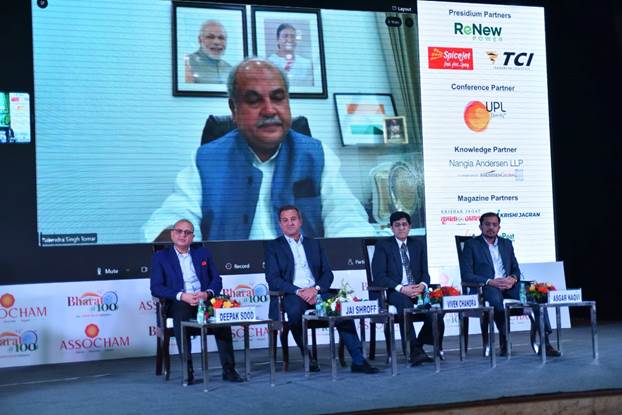
 The Union Minister for Agriculture and Farmers Welfare, Shri Narendra Singh Tomar has said that the Agriculture sector is the backbone of our country and our rural economy and agriculture have such strength that the country can easily overcome even the adverse situations. The Indian Agriculture sector has shown this during the Covid pandemic. The Government of India provided food security to 800 million people of the country, as well as helped friendly countries. Today we are in the first or second place in the world in terms of most of the agricultural produce. Despite this, there are some challenges before the Agriculture sector. There is a need to work in this direction to transform agriculture into advanced farming, technology should be used in agriculture and its continuity should be maintained.

Shri Tomar said this in his virtual address to the National Conference on Enhancing Agricultural Productivity on the topic “Integration of Improved Seeds and Agri Inputs”, organized by the Associated Chamber of Commerce and Industry of India (ASSOCHAM) in New Delhi today. Shri Tomar said that the stronger and more profitable the Agriculture sector is, the stronger the country will be. There is a need to consider the challenges facing Agriculture today. In spite of all the favourable conditions, the area under farming and its profit and loss depend a lot on the nature. People’s curiosity and attachment towards agriculture should increase, agriculture should be attractive for the next generation and farmers can be retained for farming, more work needs to be done in this direction. Shri Tomar said that the government is working to reduce the gap between farmers and the market, providing infrastructure in rural areas and eliminate the role of middlemen. He said that the number of small farmers in the country is more, who have small acreage and do not have money for investment; for such farmers, the Central Government is setting up 10,000 new FPOs, for which a provision of Rs 6,865 crore has been made and small farmers are being mobilized. It is the effort of the government that farmers should do group farming, so that the input costs can be reduced, production quality improves and small farmers can shift to remunerative crops and get the price for their produce on their own terms. FPOs can also process products. For this, the government has extended loans up to Rs. 2 crore without guarantee.

Shri Tomar said that to reduce import dependence in oilseeds, the Oil Palm Mission has been started with a provision of Rs.11,000 crore. 28 lakh hectares of land in the country is suitable for oil palm cultivation. The prospects are high in the Northeast. Provision of Rupees One lakh crore Agri Infra Fund has been made for creation of infrastructure in the villages. Provision has also been made for special packages for Animal Husbandry, Fisheries and Medicinal Farming. Shri Tomar said that the Government of India is also working on the Digital Agriculture Mission, in which farmers, banks and other institutions will be linked, crop assessment made, data collected and crop losses will also be assessed with technology. Mapping will be done in such a way that farmers across the country can be advised through the State Governments as to where and which consumption is there, accordingly profit can be earned by producing as much needed. There will be no panic and there will be no loss. The Government has also emphasized on Natural Farming, in this direction we all need to work ahead. ASSOCHAM members including Secretary General Shri Deepak Sood, Shri Asghar Naqvi and Shri Jai Shroff were present in the programme. A knowledge paper was released on the occasion.

***