

Day: October 29, 2022
DIWALI 2022- DELHI'S AIR POLLUTION INDEX
On Tuesday, the day after Diwali, Delhi’s air quality was the finest in seven years (October 25). This includes the epidemic years of 2020 and 2021. According to statistics from the Central Pollution Control Board, the AQI (air quality index) was 303 on Tuesday (CPCB). On Monday, Diwali, the temperature was 312. This signifies that the air quality was very bad on both days. An AQI of 301 to 400 is considered very poor. According to CPCB statistics, last year saw the worst post-Diwali air quality in Delhi since 2015, with an AQI of 462 recorded on the day after Diwali. This classified air pollution as ‘severe.’ Last year on Diwali, the AQI was 382. In four of the eight years since 2015, Delhi’s air quality has deteriorated to ‘severe’ the day after Diwali.
REASON BEHIND THE CLEAN AIR?
On Diwali, it was windy, and Gufran Beig, SAFAR’s original project director, noted that the wind speed helped reduce the collection of pollution. Furthermore, because Diwali fell early this year, the air is not yet chilly enough to trap pollution in the lower levels. Crop residue burning has also contributed nothing so far this year in Punjab and Haryana. The wind direction in Delhi, which has been westerly-southwesterly since Monday, has not been favourable for transporting stubble-burning smoke from the northwest, according to him.
According to a SAFAR forecasting system update, the percentage of stubble burning to PM2.5 levels in Delhi was approximately 5.6% on Tuesday. According to SAFAR statistics, the contribution of stubble burning to Delhi’s air on Diwali day (November 4) last year was 25%, and 36% on the day following Diwali.
Anumita Roychowdhury, executive director of research and advocacy at the Centre for Science and Environment, identified many variables. “Diwali occurred early, with milder weather and before the strong inversion conditions set in.” Wind speeds have been lower in comparison, and crop fires have not been as violent. “It’s tough to say whether or not there were fewer firework emissions,” she added.
What Indians worry about most, read the survey report by ‘Ipsos’.

Urban Indians are most worried about unemployment (39 per cent), financial and political corruption (27 per cent), crime and violence (25 per cent), poverty, social inequality (22 per cent) and climate change (22 per cent) in the month of October, revealed Ipsos What Worries the World survey.
At least 2 in 10 urban Indians were worried about inflation (21 per cent), and India was placed last among 29 markets in its worry around inflation.
Ipsos in India said, “India is still reeling under the collateral impact of the prolonged coronavirus and global slowdown of the economy due to the war in Ukraine, which are impacting jobs, leading to rising in corruption, crime and social inequality. Even the inflation impact is manifesting itself though India is better placed than its global counterparts due to the government’s steps to keep the fuel prices in check. Floods and adverse climate impacts are making urban Indians worry about climate change. These issues need to be addressed by the government first.
What Indians worry about most, read the survey report by 'Ipsos'.
Urban Indians are most worried about unemployment (39 per cent), financial and political corruption (27 per cent), crime and violence (25 per cent), poverty, social inequality (22 per cent) and climate change (22 per cent) in the month of October, revealed Ipsos What Worries the World survey.
At least 2 in 10 urban Indians were worried about inflation (21 per cent), and India was placed last among 29 markets in its worry around inflation.
Ipsos in India said, “India is still reeling under the collateral impact of the prolonged coronavirus and global slowdown of the economy due to the war in Ukraine, which are impacting jobs, leading to rising in corruption, crime and social inequality. Even the inflation impact is manifesting itself though India is better placed than its global counterparts due to the government’s steps to keep the fuel prices in check. Floods and adverse climate impacts are making urban Indians worry about climate change. These issues need to be addressed by the government first.
What are the five essential features of a smart city
Smart City Features
-
Some typical features of comprehensive development in Smart Cities are described below.
- Promoting mixed land use in area based developments–planning for ‘unplanned areas’ containing a range of compatible activities and land uses close to one another in order to make land use more efficient. The States will enable some flexibility in land use and building bye-laws to adapt to change;
- Housing and inclusiveness – expand housing opportunities for all;
- Creating walkable localities –reduce congestion, air pollution and resource depletion, boost local economy, promote interactions and ensure security. The road network is created or refurbished not only for vehicles and public transport, but also for pedestrians and cyclists, and necessary administrative services are offered within walking or cycling distance;
- Preserving and developing open spaces – parks, playgrounds, and recreational spaces in order to enhance the quality of life of citizens, reduce the urban heat effects in Areas and generally promote eco-balance;
- Promoting a variety of transport options – Transit Oriented Development (TOD), public transport and last mile para-transport connectivity;
- Making governance citizen-friendly and cost effective – increasingly rely on online services to bring about accountability and transparency, especially using mobiles to reduce cost of services and providing services without having to go to municipal offices. Forming e-groups to listen to people and obtain feedback and use online monitoring of programs and activities with the aid of cyber tour of worksites;
- Giving an identity to the city – based on its main economic activity, such as local cuisine, health, education, arts and craft, culture, sports goods, furniture, hosiery, textile, dairy, etc;
- Applying Smart Solutions to infrastructure and services in area-based development in order to make them better. For example, making Areas less vulnerable to disasters, using fewer resources, and providing cheaper services.
New technology for retrofitting non-earthquake-resistant buildings can prevent major damage in old settlements
Researchers have found a solution for retrofitting old non-earthquake-resistant buildings with a technology that can prevent major damage to such buildings from earthquakes without compromising on their strength.
The technology called semi-confined unreinforced brick masonry (SC-URBM) can resolve the problem of spread of settlements in earthquake-prone areas with constructions that have been built without following earthquake-preventive building codes.
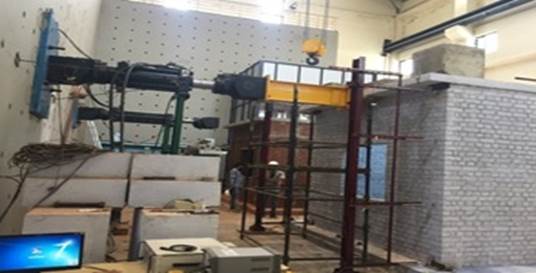
Historically, most buildings, technically called unreinforced masonry (URM), were not built using modern building codes. Thus they are much more likely to experience damage or collapse during an earthquake. URM buildings have traditionally been widely adopted worldwide due to inexpensive and locally available construction materials.
Just like in most developing countries located in earthquake-prone regions unreinforced brick masonry (URBM) has been a common practice in urban, semi-urban, and rural areas of India. Considering that major parts of India are under seismic zone III or above and most of the URBM buildings are old and structurally deficient, strengthening of URBM buildings located in earthquake-prone areas is extremely important.
Researchers from Indian Institute of Technology, Kanpur, have explored the extent to which retrofitting old buildings with SC-URBM technology can solve the problem. They found that SC-URBM can significantly enhance the energy dissipation capacity and ductility of the retrofitted building without compromising its strength. Hence such buildings would have resulting superior performance in comparison to URBM buildings during earthquakes.
The idea of the technology emerged from confined masonry, an earthquake-resistant construction system where the masonry walls are built first, and the concrete columns and beams are poured in afterward to enclose (confine) the wall. SC-URBM technology has a similar concept but does not need to be implemented at the construction stage. It involves embedding of reinforced concrete (RC) bands through the partial thickness of the wall and can be implemented or retrofitted in old buildings.
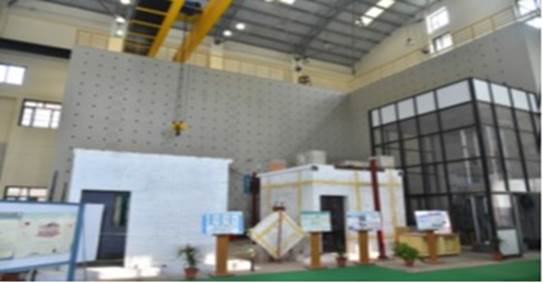
The researchers, Lakshmi Latha, Samit Ray-Chaudhuri, Suparno Mukhopadhyay, and Kunwar Bajpai, conducted experiments on two identical full-scale single-story brick masonry buildings — a completely unreinforced (URBM), and the other retrofitted with semiconfining horizontal and vertical reinforced concrete (RC) elements (SC-URBM).
The two buildings were subjected to a test called reverse slow-cyclic quasi-static loading protocol to quantify the improved seismic performance of the SC-URBM building compared to the URBM building. A Pseudo Dynamic Testing Facility (PDTF) for affordable experimental evaluation of earthquake resistance of full prototype structural systems developed with the guidance of Professor Durgesh C Rai under the Fund for Improvement of S&T Infrastructure (FIST) programme of the Department of Science and Technology (DST), Government of India was used for the tests. They proved that the technology provides better integral action of the confining elements and load-bearing walls to achieve enhanced seismic performance. The results were published in the ASCE Journal of Structural Engineering.
This technology for strengthening existing URBM buildings is not only architecturally aesthetic but can also be implemented easily by manpower available locally (masons).
Publication Link: https://ascelibrary.org/doi/10.1061/%28ASCE%29ST.1943-541X.0003460
 Eduindex
You must be logged in to post a comment.