How is digital currency different from UPI.

The Reserve Bank of India (RBI) on December 1, 2022, began the much-awaited trial run of India’s first retail central bank digital currency (CBDC) or ‘e-rupee’ in four cities—Mumbai, Delhi, Bengaluru, and Bhubaneswar—through eight participating banks.

CBDC is not expected to replace India’s premier instant payment solution, Unified Payment Interface (UPI), instead, it is touted to replace physical cash.

Experts pointed out that to carry out payments through UPI, individuals need to have a bank account and often a functioning debit card, but for accessing the e-Rupi wallet, there will be no need to have such a bank account.

UPI transactions are backed by physical currency. This means the payment will not go through if the user’s bank account does not have enough funds. The e-rupee, however, can be used for digital payments in lieu of currency/cash. “The e-rupi is issued by RBI and is a legal tender in itself. It need not necessarily be backed by physical currency.

How is digital currency different from UPI.

The Reserve Bank of India (RBI) on December 1, 2022, began the much-awaited trial run of India’s first retail central bank digital currency (CBDC) or ‘e-rupee’ in four cities—Mumbai, Delhi, Bengaluru, and Bhubaneswar—through eight participating banks.

CBDC is not expected to replace India’s premier instant payment solution, Unified Payment Interface (UPI), instead, it is touted to replace physical cash.

Experts pointed out that to carry out payments through UPI, individuals need to have a bank account and often a functioning debit card, but for accessing the e-Rupi wallet, there will be no need to have such a bank account.

UPI transactions are backed by physical currency. This means the payment will not go through if the user’s bank account does not have enough funds. The e-rupee, however, can be used for digital payments in lieu of currency/cash. “The e-rupi is issued by RBI and is a legal tender in itself. It need not necessarily be backed by physical currency.

Users are getting advertisements based on their phone conversations

Today we are living in an era in which there is constant surveillance on us through various sources. Among these, there are satellites and various other electronic equipment that we use daily. Some of those apps collect our data in the background.

The Internet has oven us many things but along with that, there are also some scary consequences. Among those consequences, there is also a breach of our privacy. Especially, smart devices are the main culprits that help in such breaches of trust. We are using them daily. We are also giving consent to various apps to access our microphones as well as our contact list as a whole. This data is then sold to advertising companies, who then show advertisements relevant to us on our devices.

These findings have been proved recently by some recent research. During the research, the users were asked whether they see advertisements based on their conversations or not. In return, several users admitted to getting ads based on their conversations, during phone calls. Several users even admitted to getting emails with the relevant products of their choice. On the other hand, some users did not see any such advertisements. Then some users had no opinion on such matters and some did get such ads some and some very times.

https://unsplash.com/photos/XIVDN9cxOVc

The above problem now needs some strict rules or regulations. This can only happen when the government will pass the Personal Data Protection Bill 2019. Once this will gets passed then people will have control over their privacy. The bill will also ensure that the apps need to specify the data which they are accessing. There also needs to be some clarification about the collection of data and their transactions with third parties.

These changes will make sure that the companies whose apps we are using are alert to the way our data is being used by them. They will also need to be careful with the way they handle our data. Then our data will get some protection om the wrong hands. These changes will also bring about some much-needed changes in the data field. The companies will focus more on the protection of the privacy of data. The data will also need some serious protection from outer elements. It is because various attacks are happening nowadays which are affecting various big organizations. In recent times, AIIMS servers were also hacked and there is a demand for 200 crore rupees in cryptocurrencies from hackers to give back control of servers to the major medical organization.

The recent attacks on the data of such major organizations are also asking for some data-related laws in the country. The changes will pave way for the implementation of some better rules for future generations so that their privacy remains in their own hands. These data-related issues will also safeguard the future of the country. Nowadays, data is the real gold. Data now paves the way for development shortly as technology is getting more dependent on the data being collected from users like us.

Cost of living index by EIU.

All over the world, the cost-of-living crisis is continuing to bite. According to the Worldwide Cost of Living Index, which is run by Economist Intelligence Unit (EIU), the average cost of living is up by 8.1 percent – largely thanks to the Russian war in Ukraine and the long-term consequences of the pandemic.

However, the crisis is much worse in some places than others – and that’s highlighted by this year’s Worldwide Cost of Living Index. Taking into account changes in the price of everyday goods in 172 cities around the world, the Index has come out with a ranking of the world’s most expensive cities right now. 

Top was a tie between New York and Singapore, with New York topping the poll for the first time. Both knocked Tel Aviv down to third, with the Israeli city having been named the most expensive city in the world in the EIU’s 2021 rankings.

Down the other end of the list, the least expensive cities in the world are apparently Damascus in Syria, Tripoli in Libya and the Iranian capital, Tehran. Damascus and Tripoli were also named the least expensive cities in last year’s list.

Cost of living index by EIU.

All over the world, the cost-of-living crisis is continuing to bite. According to the Worldwide Cost of Living Index, which is run by Economist Intelligence Unit (EIU), the average cost of living is up by 8.1 percent – largely thanks to the Russian war in Ukraine and the long-term consequences of the pandemic.

However, the crisis is much worse in some places than others – and that’s highlighted by this year’s Worldwide Cost of Living Index. Taking into account changes in the price of everyday goods in 172 cities around the world, the Index has come out with a ranking of the world’s most expensive cities right now. 

Top was a tie between New York and Singapore, with New York topping the poll for the first time. Both knocked Tel Aviv down to third, with the Israeli city having been named the most expensive city in the world in the EIU’s 2021 rankings.

Down the other end of the list, the least expensive cities in the world are apparently Damascus in Syria, Tripoli in Libya and the Iranian capital, Tehran. Damascus and Tripoli were also named the least expensive cities in last year’s list.

Investors reward well-governed corporates: NFRA Chairperson

 Speaking at the conference on “Financial Reporting and Corporate Governance in the Corporate Sector”, Dr Ajay Bhushan Prasad Pandey, Chairperson, NFRA, said here today that Sound Corporate Governance is bedrock of corporate sector that contributes to the sustainable growth and development of the Nation as whole. He further said that investors reward the well-governed corporates.

Dr Pandey mentioned about a number of path breaking reforms initiated by Indian Policy Makers during last few years, both for enabling growth and development of business sector and society such as Digital Reforms like Aadhar, UPI, GST and Tax Reforms. He also mentioned about several institutional building reforms like NFRA, IBC, NCLT etc. 

Dr Pandey said need of the hour for the Finance Community and Directors is to take measures to prevent frauds and failure of internal financial controls such as developing Case Study of Register of Frauds. Perhaps it is time to go Back to Basics of Internal Financial Controls as not all the corporate frauds were committed by very sophisticated designs but by age old methods of fictitious sales and loans and advances, over invoicing of purchases, related party transactions and due to failure of basic internal controls.

In relation to building trust and meeting stakeholders expectations, Dr Pandey mooted idea of crowdsourcing of risk related matters and matters of emphasis for auditor consideration. He also suggested consideration of UK Brydon report recommendation of publication of Directors Risk Report before the audit scope is decided by The Audit Committee which can evaluate stakeholders inputs on that Risk Report.

On the Sustainability Reporting Standards, he said it is better to align with those of International Sustainability Standards Board of IFRS Foundation.

****

National Anti-Doping Agency of India is developing App to assist athletes verify medicines

 Key highlights:

  • Inclusion Conclave was attended by participants from India and 20 countries
  • Tokyo2020 Paralympics High Jump medal winner Sharad Kumar shared his experience of serving a two-year ban for an inadvertent anti-doping violation

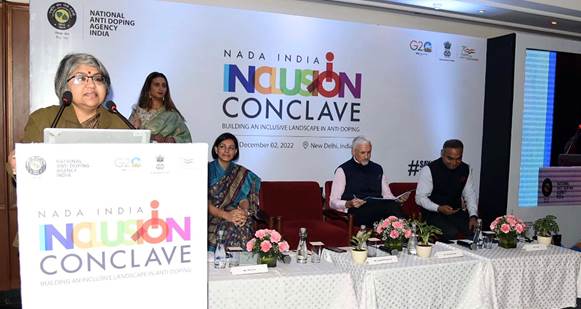
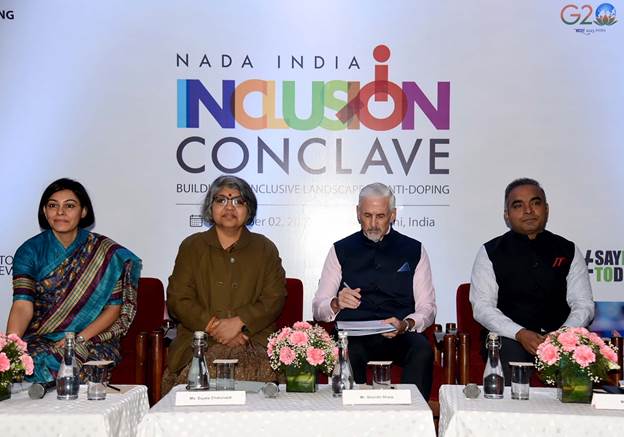
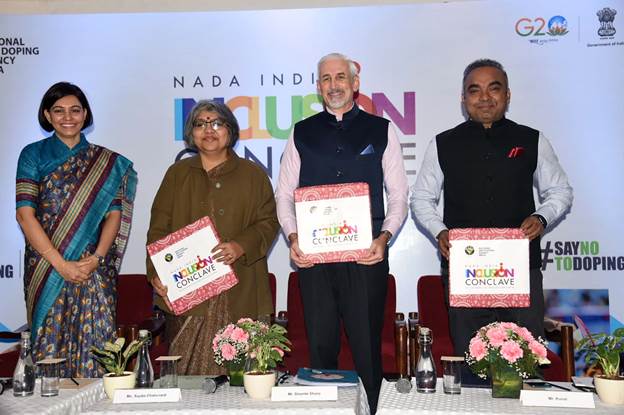
“All aspects of the anti-doping programme are important even as India is making rapid strides towards excellence in sport. NADA would make all attempts to spread awareness towards making Indian sport, including sport for Athletes with Disabilities, dope-free.” Secretary (Sports), Ministry of Youth Affairs & Sports, Government of India Smt. Sujata Chaturvedi said this while delivering the keynote address at the Inclusion Conclave conducted by the National Anti-Doping Agency India (NADA) today in New Delhi. Inclusion Conclave was attended by participants from India and 20 countries.


Speaking on the occasion Secretary Sports Smt. Sujata Chaturvedi said that it is a good time to be in Indian sport, where under the Prime Minister Shri Narendra Modi’s leadership, initiatives like Khelo India have given sport a fillip. “We cannot ignore anti-doping while striving for excellence in sport. The National Anti-Doping Act is a step in that direction”, she said.


Mr. Shombi Sharp, United Nations Resident Coordinator, India also addressed the gathering. “The inclusion of persons with disabilities is a central promise of the 2030 Agenda for Sustainable Development – to leave no one behind,” he said. He further added “Indian athletes with disabilities have not only shown incredible grit and determination by beating all the odds – they have also brought – and continue to bring – great pride to the nation.”

NADA Director-General and CEO Ritu Sain said the Conclave was a step towards ensuring that anti doping program is inclusive and athletes with disabilities remain at core and are not left behind.

 “We have to reach out to the Athletes with Disabilities keeping their needs in mind. Engaging them with content in print, audio, Braille and sign language in keeping with Universal Design of Learning (UDL) principles is a priority,” she said.

Ms Sain said NADA India is in process of sensitising 20 Dope Control Officers to specialise in collecting samples of Athletes with Disabilities in keeping with the different needs. She also said NADA would equip itself with assistive devices in Doping control process to facilitate athletes with disabilities in lines with the World Anti-Doping Code and Standards.


She said NADA India is developing Apps to spread awareness and address queries of athletes and support personnel as well as to help them recognise if any medicine they were being prescribed contains prohibited substances. “We are developing credible content that will overcome geographical, language and disability barriers,” she said.

Tokyo2020 Paralympics High Jump medal winner Sharad Kumar shared his experience of serving a two-year ban for an inadvertent anti-doping violation. He said the levels of education of Athletes with Disabilities prevented many from taking short cuts. “The anti-doping lessons are best learnt from the experience of those who tested positive,” he said.

Sharad Kumar also said that athletes who dope must realise that it leaves an impact on their bodies and minds. “Those who dope and have not tested positive cannot think they have escaped. They are guilty in their own minds and caught in their own trap,” he said, exhorting athletes not to chase popularity and rewards at the risk of their own health.

Institute of National Anti-Doping Organisations (iNADO) CEO Jorge Leyva, Asian Paralympic Committee Anti-Doping Sub-Committee Chairman Dr. Badrul Rashid, University of Birmingham’s Prof. Ian Bradley and International Inclusion and Para Sports expert Dr. Halim Jebali headline the panelists from overseas also joined an array of Indian experts.

Related links:

https://www.pib.gov.in/PressReleasePage.aspx?PRID=1880292

https://pib.gov.in/PressReleaseIframePage.aspx?PRID=1866802


*******

National Awards for outstanding work towards empowerment of persons with disabilities on International Day of Persons with Disabilities on 3rd December

 The President of India, Smt. Droupadi Murmu will be the Chief Guest at an esteemed ceremony to celebrate the ‘International Day of Persons with Disabilities’ to  be organized by the Department of Empowerment of Persons with Disabilities (Divyangjan), Union Ministry of Social Justice & Empowerment, on December 3, 2022 at Vigyan Bhawan in New Delhi. President Smt. Droupadi Murmu will confer the annual National Awards on individuals, institutions, organizations and state/district, etc., for their outstanding achievements and work towards the empowerment of Persons with Disabilities (PwDs).

Union Minister for Social Justice & Empowerment Dr. Virendra Kumar will preside over the function, while Union Ministers of State for Social Justice & Empowerment Shri Ramdas Athawale, Shri A. Narayanaswamy and Ms. Pratima Bhoumik will also grace the occasion.

On the occasion of the International Day of Persons with Disabilities i.e. 3rd December, the Department of Empowerment of Persons with Disabilities (Divyangjan), Ministry of Social Justice and Empowerment confers National Awards on Individuals, Institutions, Organizations, State/District etc for their outstanding achievements and work done towards empowerment of Persons with Disabilities every year.

National Awards for the Empowerment of Persons with Disabilities for the year 2021 and 2022, are being given under following categories :-

  1. Sarvshresth Divyangjan;
  1. Shresth Divyangjan;
  1. Shresth Divyang Bal/Balika;
  1. Sarvshrestha Vyakti – Divyangjano Ke Sashaktikaran Ke Liye Karyarath;
  1. Sarvshrestha Punarvas Peshevar (Rehabilitation Professional/worker) – Divyangatha Ke Kheshtra Mein Karyarath;
  2. Sarvshrestha Anusandhan/Navpravartan /UtpadVikas –Divyangatha Ke Sashaktikaran Ke Kheshtra Mein;
  3. Divyang Sashaktikaran Hetu Sarveshrestha Sansthan (Private organization, NGO);
  4. Divyango Ke Liye Sarvshrestha Niyoktha (Govt. organisation/ PSEs/ Autonomous bodies/ Pvt.Sector);
  5. Divyango Ke Liye Sarvshresth Placement Agency – excluding Govt./State Govt./Local Bodies;
  6. Sugamya Bharat Abhiyan Ke Karyanvayan/Badhamukta varan Ke Srijan Mein Sarvshrestha Rajya/UT/Zila;
  7. Sarvshrestha Sugamya Yatayat ke Sadahan/Soochana Evem Sanchar Prodyogiki (Govt./Private organization);
  8. Divyangjano Ke Adhikar Adhiniyam/UDID Evem Divyang Sashaktikaranki Anya Yojanaon ke Karyanvayan Mein Sarvshrestha Rajya/UT/Zila;
  9. Divyangjano Ke Adhikar Adhiniyam, 2016 Ke Apne Rajya Mein Karyanvayan Mein Sarvshrestha Rajya Aayukta Divayngjan.
  10. Punarvasan Peshewaron Ke Vikas Mein Sanlangn Sarvshrestha Sangathan

Till 2017, the Award Scheme was governed under the National Awards Rules, 2013 which provided 7 categories of disabilities as per the Persons with Disabilities Act, 1995. However, with the coming into force of the Rights of Persons with Disabilities Act, 2016 w.e.f. 19th April 2017, the number of specified disabilities increased from 7 to 21 under the new Law. Accordingly, all the 21 disabilities have been included under the National Award Guidelines which have been notified in the Extraordinary Gazette of India dated 2nd August, 2018.

Ministry of Social Justice & Empowerment, Department of Empowerment of Persons with Disabilities (Divyangjan) writes to the State Governments/Union Territory Administrators and Central Ministries/Departments calling nominations for National Awards in various categories. Advertisement is also published in the national/regional language daily newspapers to give wide publicity of the Awards. The detailed scheme of National Awards as also the advertisement issued for calling applications is displayed in the website of the Department (www.disabilityaffairs.gov.in) in a downloadable format.

An advertisement inviting applications for the year 2021 and 2022 from persons belonging to all the 21 specified disabilities as also individuals/intuition working for empowerment of persons with disabilities (Divyangjan) was published in the leading newspapers on 19th August, 2022 with the last date for submission of applications through online mode only on the centralized portal of Ministry of Home Affairs (www.awards.gov.in) as 15th July, 2022 to 28th August, 2022 which was subsequently extended to 04.09.2022. Copy of the advertisement was also uploaded on the website for the Department besides writing letters to States/Union Territories to give wide publicity. For the year 2021 total 844 and 1210 applications for the year 2022 were received. The selection process consisted of examination of documents and records submitted by the applicants. These applications were screened and shortlisted by the Screening Committees constituted by the Department.

   MG/DK/RK/MPW


*****

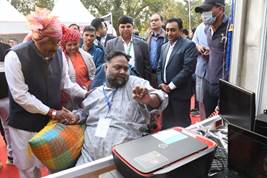
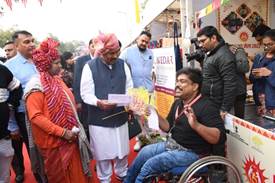
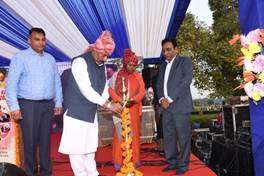
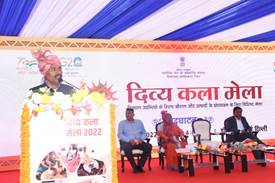
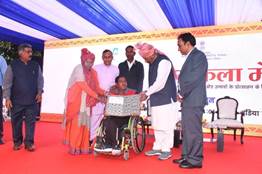
'Divya Kala Mela' starts for the first time on Kartavya Path

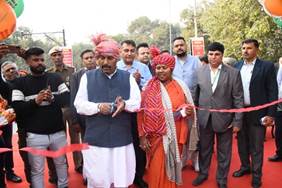
 Union Minister for Social Justice and Empowerment Dr. Virendra Kumar inaugurates the Divya Kala Mela in Kartavya Path at India Gate, Delhi. Minister of State for Social Justice and Empowerment Sushri Pratima Bhowmik was also present on the occasion. The Divya Kala Mela will be held from 2nd to 7th December and it’s aims to provide a great platform for the products and craftsmanship of Divyang artisans, craftsmen and artisans from across the country. On this occasion, Union Minister for Social Justice and Empowerment Virendra Kumar said that the objective of the fair is to bring self-reliance in the lives of Divyangjan, he said that this type of event will provide a big platform to the Divyangjans as well as display and sale of their products and in future Will also provide an opportunity to connect with big businessmen. With this, he said that Divya Kala Mela will now be organized across the country. The four finance corporations under this ministry, NHFDC, NBCFDC, NSFDC and NSKDFC k provide financial assistance under term loan schemes and micro finance schemes to the artisans through various channel partners.

The ambitious plan of P M Modi, P.M. is Training in skill upgradation and skill development under Daksh is also important for our target group of corporates as the group is mostly engaged in traditional economic activities which require continuous improvement of their skills as per the market requirement. Therefore, to make the economic activities of the target groups compatible with market competition, emphasis is also being laid on skill up gradation. They just need to identify their needs and potential and training and match it with their access to government resources and soft loans. PM Rs 495 crore has been distributed to more than 5 lakh trainees under Daksh.

 The event will provide an exciting experience to the visitors to see vibrant products, handicrafts, handlooms, embroidery work and packaged food items, etc. from different parts of the country including Jammu & Kashmir and North Eastern States. Around 200 Divyang artisans, artists and entrepreneurs from 22 states and union territories will showcase their products and skills in the fair. The fair showcased products from the categories of home decor & lifestyle, clothing, stationery & eco-friendly products, packaged food, organic products, toys & gifts, personal accessories-jewellery, clutch bags, a fair for all’ Vocal for Local’ and will provide an opportunity to see and buy products made by Divyang artisans through their additional resolution, the six-day Divya Kala Mela will open from 11.00 am to 8.00 pm. It will host a range of cultural activities including performances by differently-abled artists and eminent professionals. Visitors can also relish their favorite food from different regions of the country at the event.


********

'Divya Kala Mela' starts for the first time on Kartavya Path

 Union Minister for Social Justice and Empowerment Dr. Virendra Kumar inaugurates the Divya Kala Mela in Kartavya Path at India Gate, Delhi. Minister of State for Social Justice and Empowerment Sushri Pratima Bhowmik was also present on the occasion. The Divya Kala Mela will be held from 2nd to 7th December and it’s aims to provide a great platform for the products and craftsmanship of Divyang artisans, craftsmen and artisans from across the country. On this occasion, Union Minister for Social Justice and Empowerment Virendra Kumar said that the objective of the fair is to bring self-reliance in the lives of Divyangjan, he said that this type of event will provide a big platform to the Divyangjans as well as display and sale of their products and in future Will also provide an opportunity to connect with big businessmen. With this, he said that Divya Kala Mela will now be organized across the country. The four finance corporations under this ministry, NHFDC, NBCFDC, NSFDC and NSKDFC k provide financial assistance under term loan schemes and micro finance schemes to the artisans through various channel partners.

The ambitious plan of P M Modi, P.M. is Training in skill upgradation and skill development under Daksh is also important for our target group of corporates as the group is mostly engaged in traditional economic activities which require continuous improvement of their skills as per the market requirement. Therefore, to make the economic activities of the target groups compatible with market competition, emphasis is also being laid on skill up gradation. They just need to identify their needs and potential and training and match it with their access to government resources and soft loans. PM Rs 495 crore has been distributed to more than 5 lakh trainees under Daksh.

 The event will provide an exciting experience to the visitors to see vibrant products, handicrafts, handlooms, embroidery work and packaged food items, etc. from different parts of the country including Jammu & Kashmir and North Eastern States. Around 200 Divyang artisans, artists and entrepreneurs from 22 states and union territories will showcase their products and skills in the fair. The fair showcased products from the categories of home decor & lifestyle, clothing, stationery & eco-friendly products, packaged food, organic products, toys & gifts, personal accessories-jewellery, clutch bags, a fair for all’ Vocal for Local’ and will provide an opportunity to see and buy products made by Divyang artisans through their additional resolution, the six-day Divya Kala Mela will open from 11.00 am to 8.00 pm. It will host a range of cultural activities including performances by differently-abled artists and eminent professionals. Visitors can also relish their favorite food from different regions of the country at the event.


********

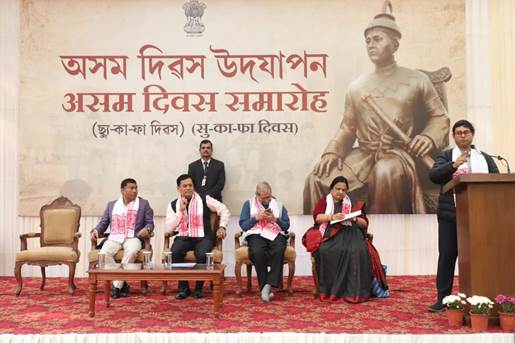
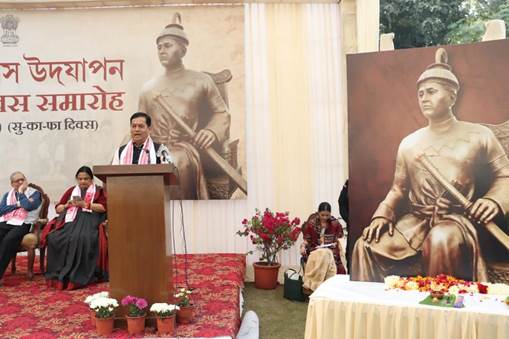
Delhi celebrates Assam Day as eminent scholars light up role of the Ahom King Sukapha – the Great Unifier


WhatsApp Image 2022-12-02 at 5.24.58 PM.jpeg

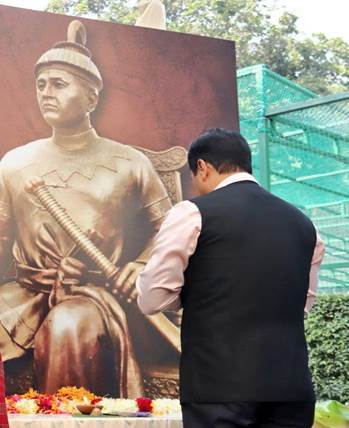
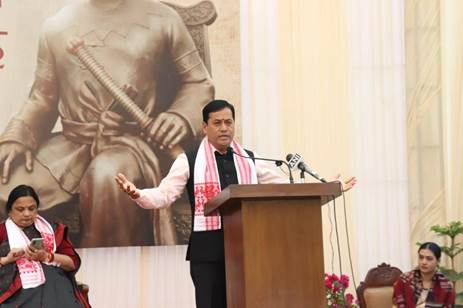
New Delhi, 2 December, 2022: On the pious occasion of Assam Day, the Union Minister of Ports, Shipping & Waterways and Ayush, Sarbananda Sonowal participated in a thought provoking meeting organised at his official residence here today. Leading luminaries, thought leaders of Indian history, prominent academicians including renowned Historian & Senior Journalist, Hindol Sengupta; Vice Chancellor of JNU, Shantishree Dhulipudi Pandit; Eminent Academician, Authority of Indian Intellectual Tradition, Former Chancellor, Mahatma Gandhi Antarashtriya Hindi Vishwavidyalaya, Wardha, Former Chairperson, Indian Studies of Advanced Studies, Shimla, Former Pro Vice Chancellor, JNU, Prof Kapil Kapoor; along with the Chairman, Special Centre for the Study of Northeast India, JNU, Prof Vinay Kumar Rao shared their views on Assam and its role in building the idea of India – from a historical as well as contemporary context.

WhatsApp Image 2022-12-02 at 5.24.58 PM (1).jpeg

Setting the context to the top of the line discussion on the role of Assam and Northeast, the Union Minister Sarbananda Sonowal said, “Today on the pious occasion of Assam Day, we pay our sincere homage to the great unifier & the founder of the great Ahom dynasty in Assam, Swargadeo Saulung Sukapha. The priceless contribution of this great soul to unify the various communities to build the greater Assamese society remains the cornerstone of our identity. Swargadeo Sukapha is a symbol of unity, good governance, bravery for every Asomiya to draw inspiration from. The great king & founder of the Ahom dynasty displayed a rare combination of intellect, valour, visionary, unifier which helped him to become one of the greatest leaders of Assam ever. Under his stewardship, the Assamese society worked to become Atmanirbhar as it started manufacturing various weapons, tools, goods that made the society an invincible military power. This strategic genius empowered us to regularly thwart any foreign invasion including the multiple ones by the Mughals. The vision and value system that the great Swargadeo Sukapha ingrained while building the greater Assamese society still helps us – the Assamese society – to represent our society and Assam at the national as well as International stage with great pride.”  

The Vice Chancellor of Jawaharlal Nehru University (JNU), Prof. Shantishree Dhulipudi Pandithighlighted the forgotten dynasties of India that immensely contributed to protect and enrich the nation. She talked about the Ahoms, Cholas, Mauryas and others. JNU, as one of the leading universities of India, is always ready to welcome new ideas that would contribute to highlight the brave warriors and the history of Assam as well as the entire North East region, remarked Prof Pandit.

WhatsApp Image 2022-12-02 at 5.24.58 PM (2).jpeg

Prof.Kapil Kapoorspoke about the great Ahoms& how it protected the entire the Northeast region from brutal invasions. Prof Kapoor also spoke about the ancient historical connections  that the people of the Northeast shared with the central India. He gave references of Mahabharata and other important treaties that carries witnesses of the Pan-Indian approach of the Kings of North-East.

The Chairman of the Special Centre for the Study of Northeast India, Prof Vinay Kumar Raospoke about the journey of the Ahom kingdom. He touched upon the role of Ahom dynasty in giving the contemporary cultural as well as geographical shape of Assam. Prof Rao also stressed on the importance of preserving the monuments that represent the glorious years of Ahom kingdom.

WhatsApp Image 2022-12-02 at 5.24.57 PM.jpeg

Leading intellectual & eminent historian Hindol Sengupta focused on the distortion of Indian History, from where many names of the brave warriors of India including the Ahoms were erased in order to colonise the Indian minds. To further elaborate on this, he said that such colonisation made people unaware about many notable historical occasions like the rise of Ahom dynasty and how Sukapha played a pivotal role in building a formidable foundation in Assam.His words emphasised on the importance of the resurrection of true Indian history, where the Indians will read about their victories, not about their defeats.

The thought provoking meet was attended by intellectuals and thought leaders from different streams including Professors, Head of Departments from different faculties of JNU as well as Delhi University; intellectuals from leading think tanks; academicians, technocrats as well as senior bureaucrats from the Assamese society based in Delhi NCR, representatives from Assam Association Delhi (AAD), Assam Association Gurgaon (AAG) and Assam Association NOIDA among other senior officials of various ministries were present on the occasion.

******

MJPS

StartUp cum public outreach and incentivising the research as well as Inter and Intra collaboration among the frontier DBT institutes

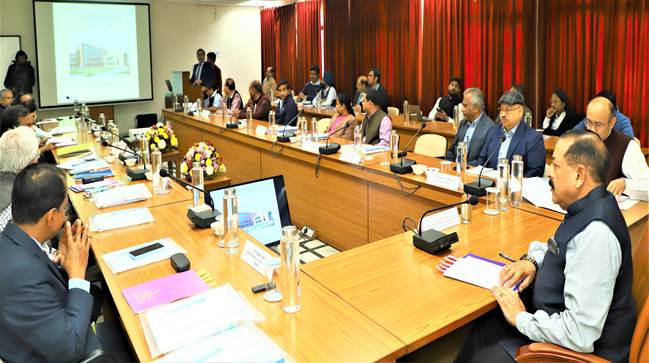
 Union Minister of State (Independent Charge) Science & Technology; Minister of State (Independent Charge) Earth Sciences; MoS PMO, Personnel, Public Grievances, Pensions, Atomic Energy and Space, Dr Jitendra Singh today called for incentivizing the research and public outreach as well as Inter and Intra collaboration among the frontier DBT institutes for cutting-edge and translation research for the overall benefit of society and the country.

Speaking after two-day comprehensive review of 14 Autonomous Institutions of the Department of Biotechnology at National Institute of Immunology, Dr Jitendra Singh gave the mantra of “Strive for Excellence & Innovate for the Future” to all the 14 institutes.
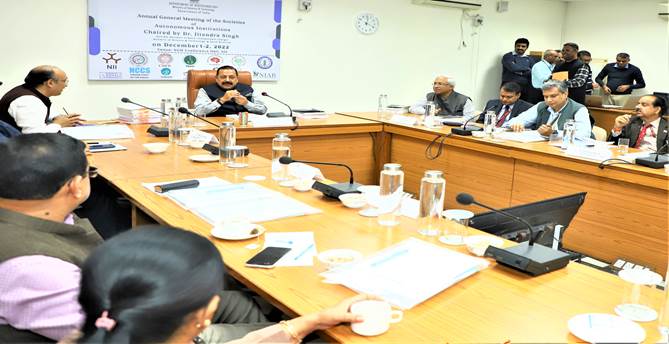
Dr Jitendra Singh said, in era of rapid innovations and transformative changes, Biotech Institutes should focus on its core competency and strive hard to bring research and product development at par with global standards. He said, though National Institute of Immunology (NII) has been pioneering in deciphering the molecular basis and host response to infectious diseases like tuberculosis, malaria and viral diseases including Dengue and COVID, but its recent breakthrough in evaluating the intranasal Covid-19 vaccine in phase 3 clinical trial for its immunological effectiveness is noted by all.

Dr Jitendra Singh pointed out that DBT-National Agri Food Biotechnology Institute (NABI), Mohali identifies priority cereal and fruit crops with focused traits to implement genome editing approaches. He said, these new initiatives will be co-developed along with industries to streamline its operations and thereby providing impetus to Indian agriculture.

Similarly, Translational Health Science and Technology Institute (THSTI), Faridabad has a strong mother and child health research program. Its research on immediate Kangaroo mother care has resulted in a new recommendation by WHO for preterm babies. THSTI is developing therapeutic molecules against tuberculosis, dengue and non-alcoholic fatty liver disease. It has contributed to covid-19 vaccine and is currently developing a pan beta corona virus vaccine, the Minister added.

Dr Jitendra Singh informed that Rajiv Gandhi Centre for Biotechnology (RGCB)’s HPV vaccine efficacy studies of 10 years have resulted in establishing a single dose of HPV vaccine for 9 to 18 years children sufficient to prevent infection. RGCB is also doing vaccine efficacy studies for the first indigenously developed HPV vaccine and the above has now been adopted by WHO for immunization strategy.
The achievements of National institute of animal biotechnology, (NIAB) Hyderabad has been underlined for the development of LSDV vaccine candidates through immunoinformatic, first report on complete genome sequence of LSDV (Andhra isolate), Electrochemical based Lateral Flow Assay for Japanese Encephalitis Virus and Toxoplasma Gondai.

Dr Jitendra Singh was given presentation by Institute for Stem Cell Science and Regenerative Medicine (inStem) in Bengaluru as the institute is carrying out cutting edge research using stem cells to understand blood and cardiovascular diseases and brain disorders. Using human genetics and human stem cell technology from human clinical samples they have generated a large resource of stem cells under collaborative programs, to understand why some individuals might be prone to developing mental illness. inStem’s Centre for Stem Cell Research (CSCR) at CMC Vellore is leading efforts on musculoskeletal regeneration and gene therapy for blood disorders like hemophilia, beta-thalassemia and sickle cell disease. Being India’s first stem cell institute inStem is also regularly carrying out extensive outreach, and highly sophisticated stem cell training for capacity building in stem cells and regenerative biology.

Director of the National Institute of Biomedical Genomics (NIBMG) has informed the Minister that they have identified the genomic changes which mark transition from precancer to frank oral cancer. They have conducted the first genome wide study in the GARBH-Ini cohort to identify genomic and epigenomic markers of preterm birth and also spearheaded the Indian SARS-CoV-2 Genomics Consortium, INSACOG, which provided valuable information on the emergence and spread of viral variants for public health management during the pandemic

Institute of Life Sciences (ILS), Bhubaneswar is working on several research programs in the areas of Infectious Disease Biology, Cancer Biology, and Plant and Microbial Biotechnology the research programme of ILS strategically plans to address issues on infectious disease biology in experimental as well as human models.

National Brain Research Centre (NBRC) Manesar is mandated to study brain function at different levels and apply the knowledge for societal benefit. We operate the MEG facility in collaboration with AIIMS to serve patients at a subsidized rate. In the past one year we developed a new method to estimate brain metabolites as an early indicator of dementia. We also showed that coordination between different brain centers remain invariant even though the peak alpha frequency is slowed with aging. In the next year they plan to expand our research in the areas of autism and epilepsy by utilizing the state-of-the-art MRI facilities on campus. They also aim to increase collaborations with clinicians through joint internship and MD programmes.
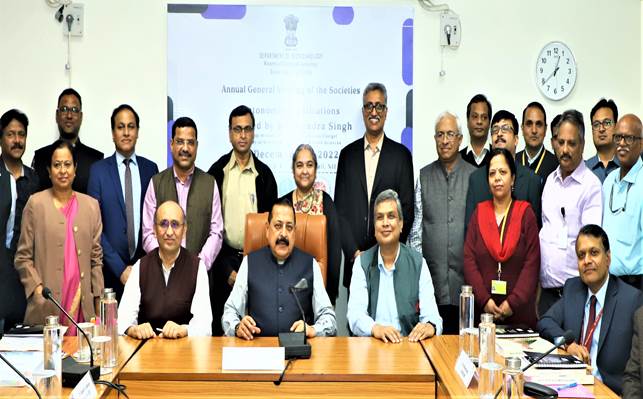
Heads and Directors of Rajiv Gandhi Centre for Biotechnology (RGCB), Thiruvananthapuram, Centre for DNA Fingerprinting & Diagnostics, (CDFD), Hyderabad, Institute of Life Sciences (ILS), Bhubaneswar, National Institute for Plant Genome Research, (NIPGR), New Delhi, Institute of Bioresources& Sustainable Development (IBSD), Imphal National Institute of Immunology (NII), New Delhi, National Agri-Food Biotechnology Institute (NABI), Mohali, Punjab, Center of Innovative and Applied Bioprocessing (CIAB), Mohali, Punjab, National Brain Research Centre (NBRC), Manesar, Haryana, Translational Health Science and Technology Institute (THSTI), Faridabad. National Centre for Cell Science (NCCS), Pune, National Institute of Animal Biotechnology (NIAB), Hyderabad, Institute for Stem Cell Biology and Regenerative Medicine (InStem), Bangalore, National Institute of Bio Medical Genomics (NIBMG), Kalyani took part in the review meeting.


 

New low cost ‘Powerless Heating System’ activated with water can heat food in remote areas

 A new low-cost heating system which can be activated by plain water anytime anywhere and does not require any fuel or electricity to heat or power it, can act as a heating solution in any location.

Lack of heating sources at remote places with no access or uncertain access to power sources is an inconvenience faced by many, especially in remote areas like the North East. 

Dr. Sumer Singh, Associate Professor, Department of Design, IIT Delhi along with his research team addressed this with a technology that works on chemical energy. It is called ‘Powerless Heating Technology’.


The active heating element consists of a mixture of eco­ friendly minerals and salts, which generates exothermic energy resulting in heat on contact with water. This provides enough energy to raise the temperature of any food or beverage by 60 to 70 degree Celsius. The weight of the heater is only 50 grams, and after every heating, the by-product (natural mineral rock) inside the heating pad can be disposed of. The rock helps in improving the fertility of the soil and is 100 % biodegradable.

With this technology, users can heat ready-to-eat food, make instant noodles, and any beverage like tea, coffee, etc. The by-product of the heating process is a natural mineral that easily integrates into the soil without any toxic effects.

North East Center for Technology Application and Reach (NECTAR), an autonomous body under the Department of Science Technology, Govt. of India, supported Dr. Singh and his team to develop a food box and a liquid container that can be integrated with the Powerless Heating Technology. They have used it to develop containers which can heat food or & beverages on demand.

These products will be of great use to military personnel, tourists, and office-goers in the northeast. This Powerless Heating Technology eliminates the need for burning forest wood for heating purposes, thus also reducing forest fires, which is a major problem in the North­ Eastern parts of the country. The prototypes were successfully developed and tested. Several FMCG companies are keen to launch it in the market.

Anchiale Technologies, a Gurgaon-based spin-off start-up, is scaling up this technology and has started supplying it to the Indian Navy and some food manufacturing companies. A patent for the technology has been filed. A nondisclosure agreement (NDA) has been signed with the Indian Tobacco Company (ITC) for integration of this technology in their food products.
 

*****


Recruitment to Indian Railway Management Service (IRMS) to be done through a specially designed examination (IRMS Examination)

 Ministry of Railways, in consultation with UPSC and DoPT, has decided that recruitment to Indian Railway Management Service (IRMS) will be done through a specially designed examination (IRMS Examination) to be conducted by the UPSC from the year 2023 onwards.

The IRMSE will be a two-tier examination- a Preliminary Screening Examination, followed by a Main Written Examination and Interview.

For screening suitable number of candidates for the 2nd stage of the Examination, viz, IRMS (Main) Written Examination, all eligible candidates shall be required to appear in Civil Services (Preliminary) Examination and suitable number of candidates will be screened for IRMS (Main) Examination.

The IRMS (Main) Examination will consist of 4 papers of conventional essay type in the subjects set out below:

  1. Qualifying Papers

Paper A– One of the Indian Languages to be selected by the candidate from the Languages included in the Eighth Schedule to the Constitution.            – 300 marks

Paper B –  English                                                                 – 300 marks

  1. Papers to be counted for merit

Optional Subject ‐ Paper 1                                                    – 250 marks

Optional Subject ‐ Paper 2                                                    – 250 marks

  1. Personality Test                                                          – 100 marks

List of optional subjects from which a candidate is to choose only one optional subject

  1. Civil Engineering,
  2. Mechanical Engineering,
  3. Electrical Engineering
  4. Commerce and Accountancy.

The syllabi for the aforesaid qualifying papers and optional subjects will be same as those for the Civil Services Examination (CSE).

The common candidates of Civil Services (Main) Examination and IRMS (Main) Examination may opt for any of the aforesaid optional subjects for both these examinations or choose separate optional subjects for these Examinations (one for the CSE (Main) and one for the IRMSE (Main) as per the schemes of these two examinations).

The language medium and scripts for the qualifying papers and optional subjects (for question papers and writing answers) will be same as those for the CSE (Main) Examination.

The age limits and number of attempts for various categories will be same as those for the CSE.

Minimum Educational Qualification – Degree in Engineering / Degree in Commerce/ Chartered Accountancy, from a University incorporated by an Act of the Central or State Legislature in India or other Educational Institutes established by an Act of Parliament or declared to be deemed as University under Section 3 of the University Grants Commission Act, 1956.

An indent for IRMSE (150 nos) is being placed on UPSC which will consist of following numbers from the four optionals; Civil (30) Mechanical (30) Electrical (60) and Commerce and Accountancy (30).

Declaration of Results – UPSC will draw and declare one list of finally recommended candidates from the four disciplines in order of merit.

Since the proposed examination scheme envisages utilizing the Civil Services (P) Examination for screening of candidates for the IRMS (Main) Exam and further envisages common qualifying language papers and some optional subjects papers of CSE for IRMSE, both the Preliminary part and the Main written part of both these examinations will be held simultaneously. The IRMSE will be notified simultaneously with the CSE.

As per the Annual Programme of the Examination of the UPSC for the year 2023, the Civil Services (P) Examination – 2023 is scheduled to be notified and held on 01.02.2023 and 28.05.2023 respectively. Since the CSP Exam – 2023 will be utilized for screening the candidates for IRMS (Main) Examination also, the IRMS Examination -2023 will be notified following the same schedule.

*****

Ministry of Power issues order for waiver of ISTS charges on transmission of electricity generated from new hydro-power

 In a further step to realise the Government of India’s commitment to achieve its power requirement from renewable energy sources, Ministry of Power has issued an order for the waiver of Inter-State Transmission system (ISTS) charges on transmission of electricity generated from new hydro-power projects. The said waiver is already available to solar and wind power projects.

Government has set an ambitious plan to have 500 GW of generation capacity from non-fossil energy based sources by 2030. Hydro power projects, being clean, green and sustainable will be of paramount importance in our clean energy transition journey. They are also essential for the integration of solar and wind power, which are intermittent in nature.

In acknowledgement of the aforesaid inherent qualities of hydro-power, Government of India declared hydro power projects as the renewable source of power in March, 2019, However, waiver of inter-state transmission charges, provided to solar and wind projects had not been extended to hydro power projects.

In order to remove this discrepancy and to provide a level playing field to hydro projects, Ministry of Power in Government of India has now decided to extend the waiver of ISTS Charges on the transmission of power from new hydro power projects, for which construction work is awarded and PPA is signed on or before 30.06.2025.

ISTS charges shall be levied for transmission of power from Hydro Power Projects where construction work is awarded and PPA is signed after 30.06.2025 as per the following trajectory:


S. No.

Award of construction work + Signing of PPA
 

ISTS charges

1.

01.07.25 to 30.06.26

25% of applicable ISTS charges

2.

01.07.26 to 30.06.27

50% of applicable ISTS charges

3.

01.07.27 to 30.06.28

75% of applicable ISTS charges

4.

from 01.07.28

100% of applicable ISTS charges


The waiver/or concessional charges as shown in table above shall be applicable for a period of 18 years from the date of commissioning of the hydro power plants. The waiver shall be allowed for Inter-state transmission charges only and not losses. The waiver would be made applicable from prospective date.

This step is expected to provide a boost to the hydro sector, which will also help improve India’s water security and bring development benefits to hilly states namely North Eastern States, Uttrakhand, Jammu and Kashmir, Himachal Pradesh etc. where most of the hydro potential is located.

***