
Marked Reduction in Aggregate Technical and Commercial losses of DISCOMs in FY22

 Aggregate Technical and Commercial Loss (AT&C Loss) and ACS-ARR Gap are key indicators of DISCOM performance. In the last 2 years, the AT&C loss of the DISCOMs of the country was hovering at 21-22%.  Ministry of Power instituted a number of measures to improve the performance of utilities.  Preliminary analysis of data for FY2022 of 56 DISCOMs contributing to more than 96% of input energy, indicates that the AT&C losses of DISCOMs have declined significantly to ~17% in FY2022 from ~22% in FY2021.

Reduction in AT&C losses improves the finances of the utilities, which will enable them to better maintain the system and buy power as per requirements; benefitting the consumers.  The reduction in AT&C losses has resulted in reduction in the Gap between Average Cost of Supply (ACS) and Average Realizable Revenue (ARR).  The ACS-ARR Gap (on subsidy received basis, excluding Regulatory Income & UDAY Grant) has declined from Rs. 0.69/kWh in FY2021 to Rs. 0.22/kWh in FY2022.

The decline of 5% in AT&C losses and 47 paise in the ACS-ARR Gap in one year is the result of a number of initiatives taken by the Ministry of Power. On 04th September 2021, the Ministry of Power revised the prudential norms of PFC and REC, the lending agencies for the power sector to provide that loss making DISCOMs will not be able to avail financing from PFC and REC until and unless they draw up an action plan for reducing the losses within a specific timeframe and get their State Government’s commitment to it.  The Ministry of Power also decided that any future assistance under any scheme for strengthening of the distribution system by the DISCOMs will be available to a DISCOM which is making losses only if it undertakes to bring its AT&C losses / ACS-ARR Gap down to specified levels within a specific timeframe and gets their State Government’s commitment to it.  The Revamped Distribution Sector scheme lays down that funding under the scheme will be available only if the DISCOM commits to an agreed loss reduction trajectory. The Ministry of Power made a series of presentations before the 15th Finance Commission as a result of which 15th Finance Commission provided for an additional borrowing window to States contingent on their taking steps to reduce to their DISCOMs losses.  The Ministry of Power issued Regulations on 07th October 2021 providing for mandatory energy accounting and energy auditing for all DISCOMs.  On 03rd June 2022, the Ministry of Power issued Late Payment Surcharge Rules which provide that unless the Distribution companies promptly pay for the power drawn from the ISTS, their access to the power exchange will be cut off.  While putting all these in place; the Ministry of Power also worked with the distribution companies to provide the necessary finances under the RDSS for undertaking the loss reduction measures.

The above improvement is a result of the concerted efforts of the Ministry of Power, the State Governments as well as Distribution companies to implement the reforms and adoption of best practices. As a result – the viability of the power system has improved. This was necessary because the demand for power has been growing and further investments will be necessary for the power sector to expand to meet the growing demand; and the investments will only come if the power sector remains viable.

***
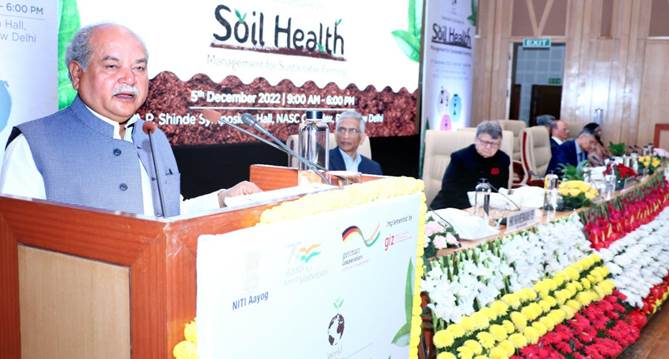
National Conference on Soil Health Management for Sustainable Farming

 Union Agriculture and Farmers Welfare Minister, Shri Narendra Singh Tomar today inaugurated the National Conference on Soil Health Management for Sustainable Farming. On this occasion, Shri. Tomar said that due to chemical farming and other reasons, soil fertility is getting eroded and climate change is going to be a big concern for the country as well as the world. He said Prime Minister Shri Narendra Modi has concerns about climate change and from time to time prepares plans and keeps working on these plans. He said Prime Minister Shri Modi is committed towards achieving the Sustainable Development Goals (SDGs).

On the occasion of Azadi Ka Amrit Mahotsav and World Soil Day, NITI Aayog in collaboration with GIZ affiliated to the Federal Ministry for Economic Cooperation and Development (BMZ), Germany, Chief Guest Shri Tomar said that the lack of organic carbon in the soil is a serious concern for us. To meet this serious challenge and for better soil health, we have to promote natural farming, which is beneficial for the environment. He said that to promote natural farming, the Government of India under the leadership of Prime Minister Shri Modi is working with the States. The Government has re-adopted the Indian Natural Farming System for Agriculture. Natural Farming System is an ancient technique used by farmers for farming and at that time people also knew how to live in harmony with the nature, he added. States like Andhra Pradesh, Gujarat, Himachal Pradesh, Odisha, Madhya Pradesh, Rajasthan, Uttar Pradesh, Tamil Nadu etc. have made many innovations to promote natural farming. During the last year, an additional area of 4.78 lakh hectares has been brought under natural farming in 17 States. To promote natural farming, the Central Government has approved the National Mission on Natural Farming as a separate scheme with an expenditure of Rs. 1,584 crores, Shri Tomar said. Under the Namami Gange programme, the project of natural farming is going on along the banks of the Ganges, while the Indian Council of Agricultural Research (ICAR) and all Krishi Vigyan Kendras (KVKs), Central and State Agricultural Universities and Colleges are making all-round efforts to promote natural farming.

Shri Tomar said that the Government of India is also working through Soil Health Card. In two phases, more than 22 crore Soil Health Cards have been distributed to farmers across the country. Infrastructure development is also being done by the Government under the Soil Health Management Scheme, in which there is a provision to set up different types of Soil Testing Laboratories. So far, 499 permanent Soil Testing Laboratories, 113 Mobile Soil Testing Laboratories, 8,811 Mini Soil Testing Laboratories and 2,395 Village-level Soil Testing Laboratories have been established. He said that there was a time when the policies were production-oriented, due to chemical farming, agricultural yield increased, but now the situation has changed, and with climate change, keeping soil health intact is a big challenge. He said that if an attempt is made to exploit the earth contrary to the principles of nature, the consequences can be dangerous. Today, due to chemical farming, the soil’s fertility is being eroded, the country and the world should avoid this and fulfill our environmental responsibility.

In the conference, Vice Chairman of NITI Aayog, Shri Suman Berry, Member Prof. Ramesh Chand, CEO Shri Parameswaran Iyer, Senior Advisor Ms. Neelam Patel, Central Agricultural University Vice Chancellor of Jhansi, Dr. A.K. Singh and Mr. Drik Steffis, along with several scientists, policymakers and other stakeholders were present. Various technical sessions were addressed by experts at the conference.

*****

India as a key Global Player in the Space sector

 Union Minister of State (Independent Charge) Science & Technology; Minister of State (Independent Charge) Earth Sciences; MoS PMO, Personnel, Public Grievances, Pensions, Atomic Energy and Space, Dr Jitendra Singh today described India as a key Global Player in the Space sector and reiterated that under Prime Minister Narendra Modi, India is keen to take its Space cooperation with the United Arab Emirates (UAE) to newer heights.

Addressing the Opening Ceremony of the UAE summit, “Abu Dhabi Space Debate”, Dr Jitendra Singh acknowledged the presence of the UAE President, Sheikh Mohamed Bin Zayed at the Opening Ceremony and conveyed PM Modi’s warm greetings to him and the people of UAE.


Dr Jitendra Singh is leading the official Indian delegation to United Arab Emirates (UAE) at the “Abu Dhabi Space Debate”, a 2-day international meet. Apart from Sheikh Mohamed bin Zayed Al Nahyan, President of Israel, Isaac Herzog, and Diplomats from several countries attended the opening ceremony.

Dr Jitendra Singh greeted the people of the United Arab Emirates on the occasion of the celebration of 51 years of the formation of this great country on behalf of the people of India. He said, another laudable achievement for the UAE this year is completion of the silver jubilee of its space odyssey with several golden milestones.

Dr Jitendra Singh said, development of the Space sector is one of the priority areas for the leaders of both India and the UAE and added that India started its space journey seven decades back from a scratch and is today acknowledged to be a leading space power. He said, the highlight of India’s journey has been its thrust on indigenous development through dedication and hard work of its scientists guided by the commitment of the leaders.


Dr Jitendra Singh said, the indigenously developed Space sector of India and the fast-growing Space sector of the UAE have a lot of complementariness that can be harnessed. He said, if we want to ensure that the Space remains a sector to serve our shared humanity, it is important to bring all the stakeholders together to discuss and deliberate about the Space and in this regard, this platform has the potential to shape the future of the Space sector.

The Minister said, the Indian space industry today is renowned across the globe for two things – reliability and economy. India is proud to have the maximum success ratio in the world for its flagship space launching vehicle – Polar Satellite Launch Vehicle or PSLV. Just a few weeks back, India’s PSLV launched 36 satellites including for countries from both the developed and developing world.

Dr Jitendra Singh said, the list of achievements of India’s Space industries is quite long and informed that Indian Space Research Organization or ISRO has launched more than 100 satellites so far and has immense in-house satellite building capabilities for GSAT, Earth Observation Satellites and Space based Satellite Navigation Systems. He proudly stated that India has also developed its own GPS, which we call the Indian Regional Navigation Satellite System or IRNSS. Besides the successful launch of India’s Mars orbiter mission in 2013, India has twice attempted to send its Mission to the moon known as Chandrayaan 1 and Chandrayaan 2. The third satellite mission to the moon, the Chandrayaan 3 will be launched next year, thr Minister informed.

Dr Jitendra Singh said, India’s other flagship space programmes also include Human Space Flight Centre or what we call in India as Gaganyaan project under which we are planning to send our first crewed flight in space in 2024.

Dr Jitendra Singh said, in the light of the Indian philosophy of Vasudeva Kutumbakam which means – the World is one family, India wants to share the fruits of space development to reach all countries and bring closer cooperation between governments and private entities in the space sector. He said, with this idea, India has recently brought landmark reforms leading to policy initiatives to tap the best of our research potential as well as participation of the private sector.


The Minister said, India is also keenly promoting development of start-ups in the space sector to facilitate entry of foreign government and private sector entities. In this regard, India has established a dedicated organisation called Indian Space Promotion and Authorisation Centre or IN-SPACe which is tasked with the objective of hand-holding our nascent private entities in the Space sector, he added.

Dr Jitendra Singh recalled that among the several pioneering initiatives of His Highness Sheikh Mohamed bin Zayed is the Abu Dhabi Space Debate which reflects his commitment and vision for the Space sector. He said that much of this vision has already become a reality with the UAE sending a space mission to Mars orbit, thereby becoming the sixth such country demonstrating its prowess in the space sector and on top of that, the UAE became the only second country, other than India, to successfully launch a Mars orbiter in its very first attempt.

The Minister also congratulated the UAE for planning its second human space mission next year by sending four astronauts in space for six months. The launch of Rashid Rover, UAE’s Moon Mission in the near future, and creation of the Space fund are milestones which reflect the commitments and determination of the UAE to excel in the Space sector. He shared that India’s active space partnership with the UAE dates back to 2017, when our PSLV launched UAE’s first nanosatellite – ‘Nayif-1’ meant for collecting environmental space data.

Dr Jitendra Singh appreciated the thrust of the Abu Dhabi Space Debate for building the role of Governments in empowering space business and technology. He said, the list of discussions in ADSD on the role of the space sector to solve the climate issues, bringing accountability to environmental commitments, threats to and from space to the political discourse and making the presence of private sector and space innovation people driven that serve humankind; are very relevant to our time and are eye-opening topics, setting apart this initiative from any other such gathering in Space sector in the past.

Dr Jitendra Singh concluded by saying that he is confident that the Abu Dhabi Space Debate will grow in stature in the coming years and become a pre-eminent platform for discussions in space related matters and take India-UAE space cooperation into an entirely different and much higher spatial orbit. Lastly, as India assumed the chairmanship of G-20 on Dec 1, the Minister once again welcomed the UAE to the G-20 Summit and G-20 meetings in the period of India’s chairmanship.

Top 5 fastest growing states by GSDP.

After witnessing unprecedented challenges due to the covid-19 pandemic, India’s states are well on their way to recovery, according to the Reserve Bank of India’s Handbook of Statistics on Indian States released last week. Almost every state economy has already surpassed its pre-pandemic size and state finances are looking up even as concerns over elevated fiscal deficit remain. Rural wage growth, however, has failed to keep pace with average retail inflation, which may become a cause of decline in spending. 

Gujarat is the fastest-growing state for the last nine years (from FY12 to FY21), according to the latest data released by RBI. Gujarat’s Gross State Domestic Product (GSDP) at the constant price has increased at compounded annual growth rate (CAGR) of 8.2 per cent.

Karnataka is the second fastest-growing major state economy, with a CAGR of 7.3 per cent. At the third spot is Haryana. With a CAGR of 6.7 per cent, Madhya Pradesh is ranked fourth in the list of fastest-growing states. Madhya Pradesh is followed by Andhra Pradesh which has registered an annual GSDP growth rate of 6.5 per cent.

Top 5 fastest growing states by GSDP.

After witnessing unprecedented challenges due to the covid-19 pandemic, India’s states are well on their way to recovery, according to the Reserve Bank of India’s Handbook of Statistics on Indian States released last week. Almost every state economy has already surpassed its pre-pandemic size and state finances are looking up even as concerns over elevated fiscal deficit remain. Rural wage growth, however, has failed to keep pace with average retail inflation, which may become a cause of decline in spending. 

Gujarat is the fastest-growing state for the last nine years (from FY12 to FY21), according to the latest data released by RBI. Gujarat’s Gross State Domestic Product (GSDP) at the constant price has increased at compounded annual growth rate (CAGR) of 8.2 per cent.

Karnataka is the second fastest-growing major state economy, with a CAGR of 7.3 per cent. At the third spot is Haryana. With a CAGR of 6.7 per cent, Madhya Pradesh is ranked fourth in the list of fastest-growing states. Madhya Pradesh is followed by Andhra Pradesh which has registered an annual GSDP growth rate of 6.5 per cent.

India’s first gold ATM launched in Hyderabad.

India’s first Gold ATM began its operations in Hyderabad and now users can purchase pure gold coins from the ATM using their debit and credit cards. According to the sources, the first Gold ATM was inaugurated at Raghupathi Chambers in Begumpet, Hyderabad. Telangana women commission chairperson Sunitha Lakshmareddy inaugurated the gold ATM centre.

Users can purchase gold coins from 0.5 grams to 100 grams and the customers will also get a certificate stating their purity and weight. Gold ATMs will be available for 24 hours. It is said that the officials will set the Gold ATMs at Guljar House, Secunderabad and Abids in Hyderabad and Peddapalli, Karimnagar and Warangal.

India's first gold ATM launched in Hyderabad.

India’s first Gold ATM began its operations in Hyderabad and now users can purchase pure gold coins from the ATM using their debit and credit cards. According to the sources, the first Gold ATM was inaugurated at Raghupathi Chambers in Begumpet, Hyderabad. Telangana women commission chairperson Sunitha Lakshmareddy inaugurated the gold ATM centre.

Users can purchase gold coins from 0.5 grams to 100 grams and the customers will also get a certificate stating their purity and weight. Gold ATMs will be available for 24 hours. It is said that the officials will set the Gold ATMs at Guljar House, Secunderabad and Abids in Hyderabad and Peddapalli, Karimnagar and Warangal.

Know about the new rule in North Korea regarding the names given to children.

North Korea has ordered parents to give their children patriotic names including the likes of ‘bomb’ and ‘gun’ – as the dictatorship clamps down on using gentler, more uplifting monikers.

Previously, Pyongyang had allowed people to use names that ended on softer vowels such as A Ri (loved one) and Su Mi (super beauty), more like South Korea. 

But now the country has demanded that people with softer names change theirs and those of their children’s to more ideological and militaristic ones if they are not ‘revolutionary’ enough. 

They want people to give their children names with a final consonant and are threatening fines to those who do not comply. Suitable names include Chong Il (gun), Chung Sim (loyalty), Pok Il (bomb) and Ui Song (satellite). 

Know about the new rule in North Korea regarding the names given to children.

North Korea has ordered parents to give their children patriotic names including the likes of ‘bomb’ and ‘gun’ – as the dictatorship clamps down on using gentler, more uplifting monikers.

Previously, Pyongyang had allowed people to use names that ended on softer vowels such as A Ri (loved one) and Su Mi (super beauty), more like South Korea. 

But now the country has demanded that people with softer names change theirs and those of their children’s to more ideological and militaristic ones if they are not ‘revolutionary’ enough. 

They want people to give their children names with a final consonant and are threatening fines to those who do not comply. Suitable names include Chong Il (gun), Chung Sim (loyalty), Pok Il (bomb) and Ui Song (satellite). 

India jumps to 48th place in international aviation safety ranking : DGCA.

India has jumped to the 48th position — its highest ever spot — in the global aviation safety ranking by the International Civil Aviation Organization (ICAO), the Directorate General of Civil Aviation (DGCA). Four years ago, the country was ranked at the 102nd position.

In the ranking, Singapore is at the top, followed by the UAE and South Korea at the second and third positions, respectively, the officials said.

The International Civil Aviation Organisation (ICAO) had last month audited the Indian Directorate General of Civil Aviation (DGCA) to check its effective implementation (El) of critical safety elements.

The higher ranking means that India has improved its air safety processes. Better aviation safety in home skies also allows Indian carriers to expand faster in overseas markets as permissions for new services are easier to get.

India jumps to 48th place in international aviation safety ranking : DGCA.

India has jumped to the 48th position — its highest ever spot — in the global aviation safety ranking by the International Civil Aviation Organization (ICAO), the Directorate General of Civil Aviation (DGCA). Four years ago, the country was ranked at the 102nd position.

In the ranking, Singapore is at the top, followed by the UAE and South Korea at the second and third positions, respectively, the officials said.

The International Civil Aviation Organisation (ICAO) had last month audited the Indian Directorate General of Civil Aviation (DGCA) to check its effective implementation (El) of critical safety elements.

The higher ranking means that India has improved its air safety processes. Better aviation safety in home skies also allows Indian carriers to expand faster in overseas markets as permissions for new services are easier to get.

How is digital currency different from UPI.

The Reserve Bank of India (RBI) on December 1, 2022, began the much-awaited trial run of India’s first retail central bank digital currency (CBDC) or ‘e-rupee’ in four cities—Mumbai, Delhi, Bengaluru, and Bhubaneswar—through eight participating banks.

CBDC is not expected to replace India’s premier instant payment solution, Unified Payment Interface (UPI), instead, it is touted to replace physical cash.

Experts pointed out that to carry out payments through UPI, individuals need to have a bank account and often a functioning debit card, but for accessing the e-Rupi wallet, there will be no need to have such a bank account.

UPI transactions are backed by physical currency. This means the payment will not go through if the user’s bank account does not have enough funds. The e-rupee, however, can be used for digital payments in lieu of currency/cash. “The e-rupi is issued by RBI and is a legal tender in itself. It need not necessarily be backed by physical currency.

How is digital currency different from UPI.

The Reserve Bank of India (RBI) on December 1, 2022, began the much-awaited trial run of India’s first retail central bank digital currency (CBDC) or ‘e-rupee’ in four cities—Mumbai, Delhi, Bengaluru, and Bhubaneswar—through eight participating banks.

CBDC is not expected to replace India’s premier instant payment solution, Unified Payment Interface (UPI), instead, it is touted to replace physical cash.

Experts pointed out that to carry out payments through UPI, individuals need to have a bank account and often a functioning debit card, but for accessing the e-Rupi wallet, there will be no need to have such a bank account.

UPI transactions are backed by physical currency. This means the payment will not go through if the user’s bank account does not have enough funds. The e-rupee, however, can be used for digital payments in lieu of currency/cash. “The e-rupi is issued by RBI and is a legal tender in itself. It need not necessarily be backed by physical currency.

Users are getting advertisements based on their phone conversations

Today we are living in an era in which there is constant surveillance on us through various sources. Among these, there are satellites and various other electronic equipment that we use daily. Some of those apps collect our data in the background.

The Internet has oven us many things but along with that, there are also some scary consequences. Among those consequences, there is also a breach of our privacy. Especially, smart devices are the main culprits that help in such breaches of trust. We are using them daily. We are also giving consent to various apps to access our microphones as well as our contact list as a whole. This data is then sold to advertising companies, who then show advertisements relevant to us on our devices.

These findings have been proved recently by some recent research. During the research, the users were asked whether they see advertisements based on their conversations or not. In return, several users admitted to getting ads based on their conversations, during phone calls. Several users even admitted to getting emails with the relevant products of their choice. On the other hand, some users did not see any such advertisements. Then some users had no opinion on such matters and some did get such ads some and some very times.

https://unsplash.com/photos/XIVDN9cxOVc

The above problem now needs some strict rules or regulations. This can only happen when the government will pass the Personal Data Protection Bill 2019. Once this will gets passed then people will have control over their privacy. The bill will also ensure that the apps need to specify the data which they are accessing. There also needs to be some clarification about the collection of data and their transactions with third parties.

These changes will make sure that the companies whose apps we are using are alert to the way our data is being used by them. They will also need to be careful with the way they handle our data. Then our data will get some protection om the wrong hands. These changes will also bring about some much-needed changes in the data field. The companies will focus more on the protection of the privacy of data. The data will also need some serious protection from outer elements. It is because various attacks are happening nowadays which are affecting various big organizations. In recent times, AIIMS servers were also hacked and there is a demand for 200 crore rupees in cryptocurrencies from hackers to give back control of servers to the major medical organization.

The recent attacks on the data of such major organizations are also asking for some data-related laws in the country. The changes will pave way for the implementation of some better rules for future generations so that their privacy remains in their own hands. These data-related issues will also safeguard the future of the country. Nowadays, data is the real gold. Data now paves the way for development shortly as technology is getting more dependent on the data being collected from users like us.

Cost of living index by EIU.

All over the world, the cost-of-living crisis is continuing to bite. According to the Worldwide Cost of Living Index, which is run by Economist Intelligence Unit (EIU), the average cost of living is up by 8.1 percent – largely thanks to the Russian war in Ukraine and the long-term consequences of the pandemic.

However, the crisis is much worse in some places than others – and that’s highlighted by this year’s Worldwide Cost of Living Index. Taking into account changes in the price of everyday goods in 172 cities around the world, the Index has come out with a ranking of the world’s most expensive cities right now. 

Top was a tie between New York and Singapore, with New York topping the poll for the first time. Both knocked Tel Aviv down to third, with the Israeli city having been named the most expensive city in the world in the EIU’s 2021 rankings.

Down the other end of the list, the least expensive cities in the world are apparently Damascus in Syria, Tripoli in Libya and the Iranian capital, Tehran. Damascus and Tripoli were also named the least expensive cities in last year’s list.