

Indian princess who married a Korean King – Heo hwang ok

Source: BBC News

 Ayodhya is best known for being the birthplace of the Hindu god Ram. However, the city has special significance for some South Koreans, as many believe they can trace their ancestors back to it. This belief is based on several historical Korean stories about an Indian princess named, Suriratna who married a South Korean king and established a dynasty.

According to legend, Princess Suriratna, also known as Heo Hwang-ok, travelled to Korea in 48 AD, approximately 2000 years ago, and founded the Karak dynasty by marrying a local king. According to some Chinese-language texts, the then-King of Ayodhya had a dream in which God told him to send his 16-year-old daughter to South Korea to marry King Kim Suro.

According to Samguk Yusa (Memorabilia of the Three Kingdoms), a popular South Korean book of fables and historical stories, Queen Hwang-ok was the princess of the “Ayuta” kingdom. The royal couple was a success. They had 12 sons and lived to be more than 150 years old. While children in Korea usually take their father’s surname, the queen was disappointed that her children would not be able to use her surname. As a result, King Suro granted her name (Heo) to two of their sons, which is still used today.” Historians estimate that the couple’s descendants number more than six million, accounting for nearly 10% of the South Korean population.

People from the Karak dynasty have also preserved the rocks that are said to have been used by the princess during her sea voyage to Korea to keep her boat stable.

An anthropologist named Kim Byung-mo Ayuta appeared to confirm the widely held belief that Ayuta was actually Ayodhya, as the two names are phonetically similar.

How this connection has impacted the modern ties?

In the year 2000, an agreement was signed to develop Ayodhya and Gimhae as sister cities. 

Then in 2001, more than 100 historians and government representatives, including the North Korea ambassador to India, unveiled Queen Hwang-ok’s memorial on the west bank of the River Saryu in Ayodhya.

In 2016, a Korean team presented the Uttar Pradesh Government with a proposal to expand the memorial. On the eve of Diwali, South Korean first lady Kim Jung-sook lay the foundation stone for the enlargement and beautification of the current memorial on November 6, 2018. She paid her respects at the Queen Heo Memorial, attended a ground-breaking ceremony for the memorial’s upgrade and beautification, and joined the current Chief Minister of Uttar Pradesh, Yogi Adityanath, at an elaborate Diwali celebration in Ayodhya that included cultural shows and the lighting of 300,000+ lights on the banks of the Saryu River.

As per reports, every year, hundreds of South Koreans visit Ayodhya for paying homage to their legendary queen Heo Hwang-ok.

Prof Kim Do-young, a Korean studies expert based in Delhi, claims that this shared history began to be recognised in India “after the diplomatic and economic relationship” between the two countries developed.

“Whether it is history or legend – based on it – mental or spiritual gap [between the people] is reduced and a common cultural ground is made,” he adds, pointing out that it’s interesting that there maybe a “ancient bond” between the two nations.

The story of Queen Hwang-ok has been and can continue to be the “foundation for building better relations” between South Korea and India.

FACT Devices; Statcom & its working

FACT is an abbreviation for Flexible
AC transmission system. It is a system composed of static equipment used for

the alternating current (AC) transmission of electrical energy and is
a power electronics based system.

Series compensation – In this we connect
the fact devices in series with power system. Here, the line impedance is
modified, that means net impedance is decreased and increasing the
transmittable active power.

Shunt compensation – It is used to
improve the power factor. In this we connect the fact devices in parallel with
power system. It also works as a controllable for the current source. Eg-
Statcom (Static synchronous Compensator) and SVC (Static VAR compensator). They
are further classified into two types –

  1. Shunt capacitive compensation: This method is used to
    improve the power factor. Whenever an inductive load is connected to
    the transmission line, power factor lags because of lagging load current.
    To compensate, a shunt capacitor is connected, which draws the current
    leading to the source voltage. The net result is an improvement in
    power factor.
  2. Shunt inductive compensation: This method is used
    either when charging the transmission line, or when there is a very
    low load at the receiving end. Because of very low, or no load–very low current
    flows through the transmission line. Shunt capacitance in the transmission
    line causes voltage amplification (Ferranti effect). The receiving end
    voltage may become double the sending end voltage (generally in case of
    very long transmission lines). To compensate, shunt inductors are
    connected across the transmission line. 

A few advantages of FACT devices
are:
• Helps in improving power transfer capability
• Used for transient and dynamic stability improvement.
• Used for damping of power system oscillations.
• For better voltage regulation.
• For flexible operation and control of the system.

What
is a Statcom?

The STATCOM (or SSC) is a
shunt-connected reactive-power compensation device that can generate and/ or
absorbing reactive power and in which we can vary the output to control the
specific parameters of an electric power system. It is a solid-state switching
converter capable of generating or absorbing independently controllable real
and reactive power at its output terminals when it is fed from an energy source
or energy-storage device at its input terminals. Voltage-source converter that,
from an input of the voltage, produces a set of 3-phase AC-output voltages,
each in phase with and coupled to the corresponding AC system voltage through a
relatively small reactance.

How
does a statcom work?

Now suppose we have a load connected
to the grid; the load takes the power as P + jQ, where P is active power and Q
is reactive power. Now we have to make the Q= 0. So that the power factor is
always unity (PF = 1). For that, we connect statcom at the load, so that the
reactive power is supplied by the statcom and active power is given by the
Grid. This is how a statcom works for reactive power compensation.

The different softwares in which we
can simulate and analyze FACT devices are:
• MATLAB
• PSCAD
• ETAP

Noise Pollution- Causes, & Preventive Measures

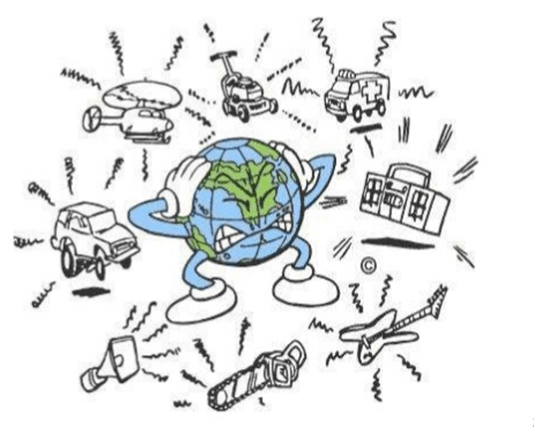
 Noise is usually defined as unwanted sound or a sound without value that causes discomfort to the listener. Noise is usually measured in units of decibels and is denoted by dB.

1. On human beings:-

Mental health

Exposure to intense levels of noise can cause personality changes and violent reactions. Noise has also been shown to be a factor that attributed to violent reactions. 
Psychological health effects from noise include depression and anxiety stress. Individuals who have hearing loss, including noise induced hearing loss, may have their symptoms eased with the use of hearing aids. Individuals who do not seek treatment for their loss are 50% more likely to have depression than their aided peers. These psychological effects can lead to detriments in physical care as reduced self-care, work-tolerance, and increased isolation.

Physical health

Exposure to loud sound or longer exposure causes threshold shift. Noise-induced threshold shifts are seen as a notch on an audiogram from 3000 to 6000 Hz, but most often at 4000 Hz.
Exposure to loud noises, either in a single traumatic experience or over time, can damage the auditory system and result in hearing loss and sometimes tinntius as well. Noise induced hearing loss is sometimes unilateral and typically causes patients to lose hearing around the frequency of the triggering sound trauma.

2. On animals:-

Marine animals

Two main reasons that make an environmental impact of noise in marine life a grave are – 1. Noise travels much more in water, covering greater distances than it would do on land while travelling though air, and secondly because the marine life is extremely sensitive to noise pollution and an absence of any mechanism to safeguard them against it, underwater noise pollution disrupts marine life in more serious ways.

The deaths can occur because of haemorrhages, changed diving pattern, migration to newer places, and damage to internal organs and an overall panic response to the foreign sounds. There is also a disruption in normal communication between marine animals because of underwater noise pollution. This means animals prone to noise pollution cannot call their mates, look for food or even make a cry for help under such circumstances.

Birds

Anthropogenic noise, emitted from the oil and gas compressors, is becoming a global issue. The idea of the study was to measure the stress levels of the birds compared to the distance they were nesting with the oil and gas compressors.

So much so that they were showing Post Traumatic Stress Disorder-like (PTSD) symptoms. In the birds, their corticosterone levels were relatively low. And that isn’t exactly what you would expect to see in a high-stress situation. This is likely to be what was happening with the birds. It triggered health defects such as stunted growth, issues with their reproduction, and fewer feathers on the birds. Their ability to hear predators also seemed to be jeopardised because of the noisy surroundings.

Preventive measures to reduce noise pollution

  • Factories should be established away from the settlements.
  • Settlements should be located 20 kms away from the mining areas and coal areas.
  • Explosives should be not used in mountainous, forest and mining areas.
  • Use of horn in public places should be banned.
  • The sound of musical instruments should be controlled to desirable limits.
  • The use of sound amplifiers of high power should be banned in religious events.
  • The use of sound absorber tiles should be encouraged in the construction of multi-storeyed buildings.
  • In industrial, commercial and hospital buildings, adequate soundproof systems should be installed.
  • Intensive plantation should be made in the entire building complex.
  • Planting green trees along the roadside reduces the intensity of noise pollution.
  • Protective tools should be provided for workers.
  • Legal provisions should set limits on noise and control over noise pollution.

8 High Impact Ways You Can Help the Environment

Go beyond turning off lights or using reusable bags. Make a real impact and help the environment with these high impact efforts.

Keyword(s): help the environment

Anchor Text: best solar installation company

Recycling a single aluminum can help save enough energy to run a television for 3 hours. Small changes to the way you live can make a bigger impact than you might expect.

While you may know that recycling and reducing electricity usage can be good for the environment, there are many ways to do your part in saving the planet. Certain habits and lifestyle changes can make a high impact on the environment and can allow you to feel better about the way you live.

Here are 8 high impact ways that you can help the environment.

1. Take Your Recycling to the Next Level

The first step to helping the environment is to start recycling. When you recycle properly, you’ll help to reduce waste and the amount of trash that goes to a landfill.

You may choose to add a simple recycling bag to your home and recycle plastic and paper, but you can also take things further. It can be useful to recycle metal, electronic devices, batteries, and appliances as well. 

In addition to this, it can be a good idea to do some upcycling as well. Making trash such as plastic bottles into works of art or items you can use can be a great way to protect nature as well.

2. Avoid Using Plastic

Anything you can do to start using fewer plastic products and more reusable products can make a big impact on the environment. 

While reusing grocery bags is a great place to start, there are many ways that you can cut down on plastic use. Using reusable straws, avoiding the use of plastic silverware, and buying package-free fruits and vegetables can be helpful. 

To further reduce your use of plastic, you may want to invest in more stainless steel water bottles and dishes and use them instead of plastic options. 

3. Start Composting

Getting into the habit of composting can also make a big impact on the environment as well. 

When composting, you’ll have something to do with your leftover food scraps. This can allow you to reduce waste in your everyday life. 

In addition to this, you’ll be able to put the compost to use in your garden and start growing fresh vegetables at home. Composting can help to improve soil quality. It can allow you to help the environment while also reducing your consumption as well.

4. Shop Used Items

Another thing that you can do to make a big impact on the environment is to buy secondhand items more often. When you shop at thrift stores, yard sales, online auctions, and other places where you can buy secondhand items, you’ll be helping to recycle materials and consumer goods.

As a result, you’ll be helping to conserve resources and help extend the lifecycle of a product. This can make a positive impact on the environment and can minimize your consumption and use of goods.

5. Change Your Transportation

Cutting down on your driving time is also a high-impact action that you can take for the environment. This is especially true if you have a car that runs on gas rather than on electric power.

You may want to come up with some ways to get around that don’t require a personal vehicle. Spending your commute or certain trips taking a walk, riding a bike, going on public transport, or carpooling can be very helpful.

Changing your transportation habits can help to reduce your use of fossil fuels and can be great for the environment.

6. Reduce Utility Usage

One of the things that you can do to help the environment is to cut down on any utilities that you use. Conserving electricity and water can be beneficial for the environment and can allow you to do your part in going green.

While changing your habits when using your utilities is one part of the puzzle, you should also consider installing new fixtures and appliances. If you currently have older appliances, water fixtures, or lights, consider making some energy-efficient replacements to easily improve your usage.

It can also be helpful to make the switch to solar power. If you’re in Arkansas, be sure to learn more about the best solar installation company now.

7. Avoid Household Chemicals

Many homeowners use household and yard care chemicals that can actually be harmful to the environment as well as to human health.

It’s a good idea to avoid using anything that has chemicals in it and opt for all-natural products instead. Consider making switches in lawn and garden care, beauty and hygiene products, and cleaning products you use in and around your home.

Opting for natural options will sometimes be more expensive but could end up improving the health of your family and the environment.

8. Reduce Meat Consumption

While it may not be for everyone, one of the most high-impact ways that you can help the environment is to eliminate or reduce your meat consumption.

Going vegan, or at least going vegetarian, can go a long way in helping curb the harmful effects of animal agriculture on the planet. Animal agriculture leads to forest loss with the expansion of farmland. Producing meat also creates a lot of carbon dioxide when compared to farming vegetables and grains.

Cutting out meat and dairy completely or at least reducing your consumption by a bit can have a bigger impact on the health of the planet than you might expect.

Understanding How You Can Help the Environment

If you want to go green and help the environment, then you should aim to use some of the tricks and strategies above. Making some simple changes to your habits can go a long way in protecting the planet.

Need more helpful environmental tips and advice? Find more useful articles about sustainable living by browsing our blog now.

Structure of the Earth

 The earth’s interior is divided into three layers: crust, mantle, and core. The crust is the earth’s outermost layer, and the core is the earth’s innermost layer, located at a depth of 2900 kilometers. This article provides a brief overview of the earth’s three interior layers.

Core

The core is the source of the Earth’s internal heat. This is due to the presence of radioactive materials, which emit heat as they degrade into more stable materials. The core is located at the center of the Earth. It has two layers –
  • Inner core
  • Outer core

Inner Core – The inner core can reach temperatures of up to 4000°C, while the outer core can reach temperatures of up to 3600°C. The Lehmann Discontinuity is a liquid-solid boundary that exists between these two layers. This is the most intense part of the core. It’s as hot as the Sun’s surface!

The inner core is approximately 1216 km thick. It’s made of solid iron and nickel. These heavy metals would have sunk to the centre of the young Earth. The liquid outer core rotates around the solid inner core.

Outer Core – The outer core is approximately 2270 km thick. It’s made of liquid iron and nickel. Because it is under less pressure than the inner core, it is liquid. This layer is also electrically conductive. This produces the electrical currents that make up the Earth’s magnetic field.

Mantle

The mantle is located above the core. The mantle is composed of two layers of hot, dense, semi-solid rock. The mantle, like the core, has two layers – 

  • Lower Mantles
  • Upper Mantles

These are approximately 2885 km thick. This layer is so massive that it accounts for approximately 84% of the total volume of the Earth! The mantle’s temperature is lower than the core’s. It only gets to about 3000°C. The material becomes less dense as you move from the lower to upper mantle.

A transition zone exists between the lower and upper mantles. It is located 400-660 kilometers beneath the Earth’s surface.

The upper mantle is located above the transition zone. This zone extends from 400 km below the Earth’s surface to the crust layer. The asthenosphere is the uppermost part of the upper mantle. The asthenosphere is composed of fluid, soft rock.

Crust 

The crust is our planet’s solid, rigid outer layer. The crust is not a continuous layer of rocks, but consists of large masses called plates, which are free to drift slowly on top of the asthenosphere. It ranges in thickness from 5 to 80 km. The lithosphere is made up of the upper asthenosphere and the crust. 
The ocean floor contains the thinnest parts of the crust. It contributes to the formation of the oceanic crust. This section of the crust may be as thin as 5 km.
The continents contain the thickest parts of the Earth’s crust. It contributes to the formation of the continental crust. This layer of the crust can be up to 80 kilometers thick.
The crust closest to the mantle has a temperature of about 500°C. The temperature of the crust near the Earth’s surface is roughly the same as the temperature of the air.