History of Paris

Paris, the capital of France, is a city with a long and rich history dating back over 2,000 years. The city was originally founded by a Celtic people called the Parisii in the 3rd century BC and was known as Lutetia. It became a major city during the Roman Empire when it was known as Lutetia Parisiorum.

During the Middle Ages, Paris became the center of the French monarchy and the Catholic Church. The city grew in size and power, with the construction of famous landmarks such as Notre-Dame Cathedral and the Louvre Palace. In 987 AD, Hugh Capet was crowned King of France in the Notre-Dame Cathedral, which became a symbol of French royalty and power.


Source – Wikipedia

In the 14th century, the Hundred Years’ War between France and England began, and Paris was occupied by the English for several decades. However, it remained an important cultural and intellectual center, with the establishment of the Sorbonne University in 1257.

The Renaissance saw Paris become an important center of art and culture, attracting artists and writers from all over Europe. The reign of Louis XIV, known as the Sun King, saw the development of many grand buildings and the establishment of the French Academy of Sciences. The Palace of Versailles, located just outside Paris, became the center of royal power and extravagance.

During the 18th century, Paris became a center of Enlightenment thought and revolutionary ideas. The French Revolution of 1789 began in Paris, with the storming of the Bastille prison. The Revolution saw the overthrow of the monarchy and the establishment of the First French Republic. Many famous figures of the Revolution, such as Maximilien Robespierre and Georges Danton, were from Paris.

In the 19th century, Paris underwent major changes with the construction of wide boulevards, public parks, and the Eiffel Tower, which was built for the 1889 World’s Fair. The city became a center of the arts, with artists such as Claude Monet and Edgar Degas living and working in the city.

During World War I, Paris was heavily damaged by German artillery, but the city was quickly rebuilt after the war. In 1940, Paris was occupied by Nazi Germany, and many of the city’s landmarks and cultural treasures were threatened with destruction. However, the city was liberated by Allied forces in August 1944, and the Resistance played a key role in the city’s liberation.

Today, Paris is a major global city and a center of art, culture, and fashion. It is known for its iconic landmarks, such as the Eiffel Tower and the Arc de Triomphe, as well as its museums, such as the Louvre and the Musée d’Orsay. It is also a center of international diplomacy and home to many international organizations, including the United Nations Educational, Scientific and Cultural Organization (UNESCO).

Paris has a long and fascinating history, with each era leaving its mark on the city’s architecture, art, and culture. From its origins as a Celtic settlement to its role as a center of the Enlightenment and the French Revolution, Paris has been at the forefront of European history for centuries. Today, it remains a vibrant and dynamic city, beloved by visitors from around the world.

Book review of The Hobbit

The Hobbit, written by J.R.R. Tolkien, is a classic novel that has captivated readers of all ages for decades. The book tells the tale of a hobbit named Bilbo Baggins, who embarks on an adventure with a group of dwarves to reclaim their treasure from a dragon named Smaug. The story is set in a fantasy world called Middle Earth, which is inhabited by a host of fascinating creatures, including elves, wizards, and trolls.
One of the most remarkable aspects of The Hobbit is Tolkien’s masterful use of language. His descriptions of Middle Earth are so vivid that readers can almost feel themselves transported to this magical world. The characters are also well-developed and memorable, with Bilbo being the star of the show. He is initially hesitant to leave the comfort of his home and embark on an adventure, but as the story progresses, he grows in courage and resourcefulness.
The plot of The Hobbit is exciting and engaging, with plenty of twists and turns to keep readers hooked. From the moment Bilbo sets out on his adventure, the story takes on a fast-paced and thrilling tone, filled with danger and excitement. Tolkien’s use of humor also adds a lightness to the story, making it enjoyable for readers of all ages.
Overall, The Hobbit is a timeless classic that is sure to delight readers of all ages. With its engaging plot, vivid descriptions, and well-developed characters, it is no wonder that it has remained popular for so many years. Anyone who loves fantasy and adventure should definitely add this book to their reading list.

Online registrations for Yuva Sangam (Phase II) commences for participation of 1000 youth from 23 States and UTs


1st round of Yuva Sangam concludes with an overwhelming participation of 1200 youngsters visiting 22 States of India through 29 tours

The Registrations for Yuva Sangam (Phase II) started today through an online portal. It envisages participation of 1000 youngsters from 23 States and UTs of India. Under this initiative,  the exposure tours will be conducted in the months of April and May 2023. They will travel in a group of 45 to 50 to the paired State. It will provide an immersive, multidimensional experience of various facets under five broad areas of Paryatan (Tourism), Parampara (Traditions), Pragati (Development), Prodyogik (Technology)and Paraspar Sampark (People-to-people connect).Through the course of the program, students will interact with each other in the areas of language, literature, cuisine, festivals, cultural events and tourism. In short, they will get a first- hand experience of living in a completely different geographical and cultural scenario.

Interested youth in the age group of 18-30 years may register on the portal exclusively developed for the purpose at https://ebsb.aicte-india.org/

The first round of Yuva Sangam was recently concluded with an overwhelming participation of approximately 1200 youngsters visiting 22 States of India through 29 tours with main focus on North Eastern Region during February-March 2023.The participants have had an enriching experience which brought out the spirit of EK BHARAT SHRESHTHA BHARAT in its true sense.

An initiative of ‘Yuva Sangam’ under Ek Bharat Shreshtha Bharat has been conceptualized as a collaborative effort of various ministries with an aim to strengthen people to people connect and build empathy among youth across the nation. The initiative is inculcating common spirit of understanding among thousands of youth participating in the program, which shall resonate throughout the country and contribute immensely towards building a truly Shreshtha Bharat.

Young Authors’ Conference on" Civilizational Dialogue Among SCO Member States”

 The two-day Shanghai Corporation Organization (SCO) Young Authors’ Conference on” Civilizational Dialogue Among SCO Member States” with delegates from SCO Member Nations concluded on 13 April 2023.

Minister of State for External Affairs & Education, Shri Rajkumar Ranjan Singh presided as the Chief Guest at the Valedictory Ceremony of the SCO Young Authors’ Conference today. The Conference was organised by the Ministry of Education on 12-13 April 2023 at the Leela Palace, New Delhi with National Book Trust, India as the Implementing Agency.

Shri Rajkumar Ranjan Singh said that India has been actively taking part in all the cooperation activities of the organisation and is a highly valued member of the organisation. The focus on shared civilizational linkages at the SCO Young Authors’ Conference is the true reflection of the people of the region and the conference was a testimony of our commitment to contribute to the success of the organisation.   
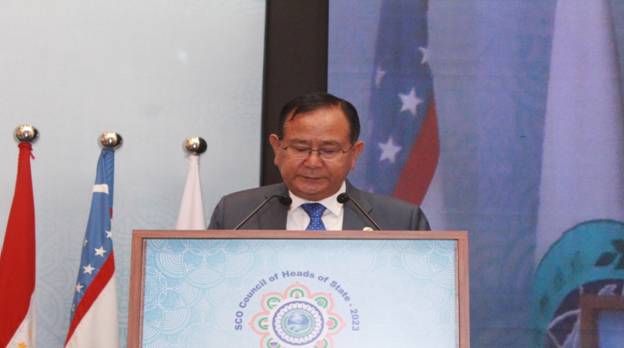
Prof. Govind Prasad Sharma, Chaiman, NBT in his address said that Dialogue is the basic medium to keep any human society and civilization alive. The conference brought forth the connection youth have not only with their own society but also with neighboring countries, as well as the vision that they have to further deepen inter-cultural cooperation.

Shri Yuvraj Malik, Director, NBT while delivering the vote of thanks said that conference was an enriching experience witnessing the exchange of perspective and ideas. The dialogue shed light on the interdependence between human beings and society and explored language as a social tool that facilitates interaction between various communities promoting the advancement of knowledge.

The SCO Youth Conference was centered on the theme “Civilizational Dialogue Among SCO Member States” with six sessions focussing on History & Philosophy, Economy, Religion, Culture, Literature and Science & Medicine, respectively. The first session on History and Philosophy focussing on ‘Shared Civilizational Links and its impact on Modern Ethical Behaviour’ was chaired by Dr. Yuthika Mishra with Ms. Ekatherina S. Manoylo from the Russian Federation and Dr. Ayesha Gautam from India as the panelists. The session was moderated by Prof. Ajoy Karnati. The speakers delved into the commonalities that exist between the SCO nations, the need for dialogue and cooperation by looking back at historical exchanges that facilitate understanding, the relation between morality and traditions and the conditions that gave rise to thought systems which travelled between the countries. The discussants, Dr. Aarshi Dua, Dr. Ruchi Verma and Mr. Fahad Nahvi enriched the session with their detailed comments and questions.

The second session was on the sub-theme Economy, focusing on ‘Trade and Commerce Linkages’. Dr. Sunil Ashra was the Chair for the session with Ms. Anastacia V. Volodina from the Russian Federation and Dr. Pravesh Kumar Gupta from India as the speakers. The session was moderated by Mr. Kumar Vikram. The speakers delved into the connection between the film and the book industry in a fresh take on the different sides of the economy, the history of trade between India and Central Asian countries and how trade routes evolved over the ages. The discussants, Dr. Ritika Joshi and Dr. Tasha Agarwal contributed to the discussion with their insightful observations.
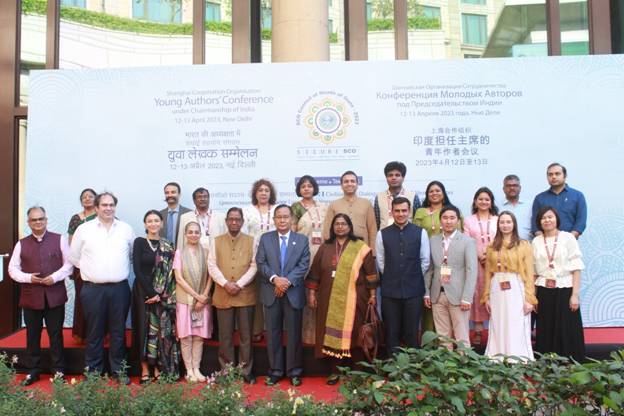
The third session dealt with the topic of Religion with emphasis on ‘Movement of Religious Ideas and Thoughts in the SCO Regions’. The session was chaired by Mr. Chamu Krishna Shastri and moderated by Ms. Deepa Singh. The panelists for the session were Ms. Nurlan Kyzy Begaiym from the Kyrgyz Republic, Dr. Pranshu Samdarshi from India and Ms. Ainur Akhmetova from Kazakhstan. The panelists spoke about the existence of multi-religious, syncretic societies in their countries, the centrality of spirituality, the ancient inter linkages between the SCO countries and the need to use this cooperative spirit to expand the concept of dialogue. The discussants, Dr. Aarshi Dua and Dr. Ritika Joshi continued the discussion with their perspectives on the role of storytelling and social media in the propagation of religious ideas.

Session four revolved around Culture, with an emphasis on ‘Civilizational Roots of Contemporary Cultures’. Dr. J.K. Bajaj was the Chairperson for the session and Ms. Neera Jain was the Moderator. Dr. Rashmini Koparkar from India, Mr. Erkanat Khuatbekuly from Kazakhstan and Ms. Anastacia V. Volodina were the speakers. The panel spoke about how in this era of rapid development, culture helps us preserve our identity and heritage. India and the Central Asian countries have been witness to exchange of ideas, commerce and language since time immemorial which has enabled the emergence of a shared cultural heritage. The discussants, Ms. Ivy Handique and Mr. Mayank Singh Singh took forward the dialogue with their comprehensive commentary.

The fifth session of the Conference took place on the sub-theme of Literature with focus on ‘Translation and Interpretation of Literary Texts’. The session was chaired by Prof. Badri Narayan and was moderated by Mr. Kumar Vikram. The panelists for the session were Ms. Ekatherina S. Manoylo from the Russian Federation, Ms. Tanvi Negi from India, Ms. Ainur Akhmetova from Kazakhstan and Dr. Sonu Saini from India. The speakers delved into the rich corpus of literature that exist in all SCO nations, translation as a mediation between cultures and languages and the complexities behind it. The discussants for the session, Ms. Anagha Gopal and Mr. Sumant Salunke facilitated the discussion with comments and insightful questions.

The last session of the two-day SCO Young Authors’ Conference was on the theme Science & Medicine, with special focus on ‘Perspectives on Science and Medicinal Knowledge Systems of SCO Member States’. The esteemed panellist of the session included Dr Aditya Kolachana from India and Ms Nurlan Kyzy Begaiym from Kazakhstan. Mr Maxim A. Zamshev from the Russian Federation was the Chairperson and Ms Neerja Anand was the moderator of the same. The panel highlighted the role of medicine in the 21st century and the need to strike a balance between traditional and modern medicinal practices. India has been successful in making traditional practices of medicine like Ayurveda, licensed practice of science. It was also highlighted that these traditional medicinal knowledge systems are evidenced in both Kyrgyz and India’s epics. The session was taken forward by discussant, Ms Damini Roy, who initiated a question and answer round with her perceptive points.

The Conference provided fresh perspectives from the participating delegates, scholars and speakers exploring the mutual and distinct characteristics in our cultures and heritage at the same time acknowledging the role of literature in aiding the connection between cultures.

*****

2-Day SCO Young Authors’ Conference Concludes Successfully

 The two-day Shanghai Corporation Organization (SCO) Young Authors’ Conference on” Civilizational Dialogue Among SCO Member States” with delegates from SCO Member Nations concluded on 13 April 2023.

Minister of State for External Affairs & Education, Shri Rajkumar Ranjan Singh presided as the Chief Guest at the Valedictory Ceremony of the SCO Young Authors’ Conference today. The Conference was organised by the Ministry of Education on 12-13 April 2023 at the Leela Palace, New Delhi with National Book Trust, India as the Implementing Agency.

Shri Rajkumar Ranjan Singh said that India has been actively taking part in all the cooperation activities of the organisation and is a highly valued member of the organisation. The focus on shared civilizational linkages at the SCO Young Authors’ Conference is the true reflection of the people of the region and the conference was a testimony of our commitment to contribute to the success of the organisation.   

Prof. Govind Prasad Sharma, Chaiman, NBT in his address said that Dialogue is the basic medium to keep any human society and civilization alive. The conference brought forth the connection youth have not only with their own society but also with neighboring countries, as well as the vision that they have to further deepen inter-cultural cooperation.

Shri Yuvraj Malik, Director, NBT while delivering the vote of thanks said that conference was an enriching experience witnessing the exchange of perspective and ideas. The dialogue shed light on the interdependence between human beings and society and explored language as a social tool that facilitates interaction between various communities promoting the advancement of knowledge.

The SCO Youth Conference was centered on the theme “Civilizational Dialogue Among SCO Member States” with six sessions focussing on History & Philosophy, Economy, Religion, Culture, Literature and Science & Medicine, respectively. The first session on History and Philosophy focussing on ‘Shared Civilizational Links and its impact on Modern Ethical Behaviour’ was chaired by Dr. Yuthika Mishra with Ms. Ekatherina S. Manoylo from the Russian Federation and Dr. Ayesha Gautam from India as the panelists. The session was moderated by Prof. Ajoy Karnati. The speakers delved into the commonalities that exist between the SCO nations, the need for dialogue and cooperation by looking back at historical exchanges that facilitate understanding, the relation between morality and traditions and the conditions that gave rise to thought systems which travelled between the countries. The discussants, Dr. Aarshi Dua, Dr. Ruchi Verma and Mr. Fahad Nahvi enriched the session with their detailed comments and questions.

The second session was on the sub-theme Economy, focusing on ‘Trade and Commerce Linkages’. Dr. Sunil Ashra was the Chair for the session with Ms. Anastacia V. Volodina from the Russian Federation and Dr. Pravesh Kumar Gupta from India as the speakers. The session was moderated by Mr. Kumar Vikram. The speakers delved into the connection between the film and the book industry in a fresh take on the different sides of the economy, the history of trade between India and Central Asian countries and how trade routes evolved over the ages. The discussants, Dr. Ritika Joshi and Dr. Tasha Agarwal contributed to the discussion with their insightful observations.

The third session dealt with the topic of Religion with emphasis on ‘Movement of Religious Ideas and Thoughts in the SCO Regions’. The session was chaired by Mr. Chamu Krishna Shastri and moderated by Ms. Deepa Singh. The panelists for the session were Ms. Nurlan Kyzy Begaiym from the Kyrgyz Republic, Dr. Pranshu Samdarshi from India and Ms. Ainur Akhmetova from Kazakhstan. The panelists spoke about the existence of multi-religious, syncretic societies in their countries, the centrality of spirituality, the ancient inter linkages between the SCO countries and the need to use this cooperative spirit to expand the concept of dialogue. The discussants, Dr. Aarshi Dua and Dr. Ritika Joshi continued the discussion with their perspectives on the role of storytelling and social media in the propagation of religious ideas.

Session four revolved around Culture, with an emphasis on ‘Civilizational Roots of Contemporary Cultures’. Dr. J.K. Bajaj was the Chairperson for the session and Ms. Neera Jain was the Moderator. Dr. Rashmini Koparkar from India, Mr. Erkanat Khuatbekuly from Kazakhstan and Ms. Anastacia V. Volodina were the speakers. The panel spoke about how in this era of rapid development, culture helps us preserve our identity and heritage. India and the Central Asian countries have been witness to exchange of ideas, commerce and language since time immemorial which has enabled the emergence of a shared cultural heritage. The discussants, Ms. Ivy Handique and Mr. Mayank Singh Singh took forward the dialogue with their comprehensive commentary.

The fifth session of the Conference took place on the sub-theme of Literature with focus on ‘Translation and Interpretation of Literary Texts’. The session was chaired by Prof. Badri Narayan and was moderated by Mr. Kumar Vikram. The panelists for the session were Ms. Ekatherina S. Manoylo from the Russian Federation, Ms. Tanvi Negi from India, Ms. Ainur Akhmetova from Kazakhstan and Dr. Sonu Saini from India. The speakers delved into the rich corpus of literature that exist in all SCO nations, translation as a mediation between cultures and languages and the complexities behind it. The discussants for the session, Ms. Anagha Gopal and Mr. Sumant Salunke facilitated the discussion with comments and insightful questions.

The last session of the two-day SCO Young Authors’ Conference was on the theme Science & Medicine, with special focus on ‘Perspectives on Science and Medicinal Knowledge Systems of SCO Member States’. The esteemed panellist of the session included Dr Aditya Kolachana from India and Ms Nurlan Kyzy Begaiym from Kazakhstan. Mr Maxim A. Zamshev from the Russian Federation was the Chairperson and Ms Neerja Anand was the moderator of the same. The panel highlighted the role of medicine in the 21st century and the need to strike a balance between traditional and modern medicinal practices. India has been successful in making traditional practices of medicine like Ayurveda, licensed practice of science. It was also highlighted that these traditional medicinal knowledge systems are evidenced in both Kyrgyz and India’s epics. The session was taken forward by discussant, Ms Damini Roy, who initiated a question and answer round with her perceptive points.

The Conference provided fresh perspectives from the participating delegates, scholars and speakers exploring the mutual and distinct characteristics in our cultures and heritage at the same time acknowledging the role of literature in aiding the connection between cultures.

*****
