
Range Countries to strengthen conservation efforts for migratory birds and their habitats in the Central Asian Flyway (CAF)

 The Ministry of Environment, Forest and Climate Change  in collaboration with the United Nations Environment Programme/ Convention on Migratory Species (UNEP/CMS) had organized a meeting of Range Countries to strengthen conservation efforts for migratory birds and their habitats in the Central Asian Flyway (CAF) from 2nd to 4th May, 2023 in New Delhi.

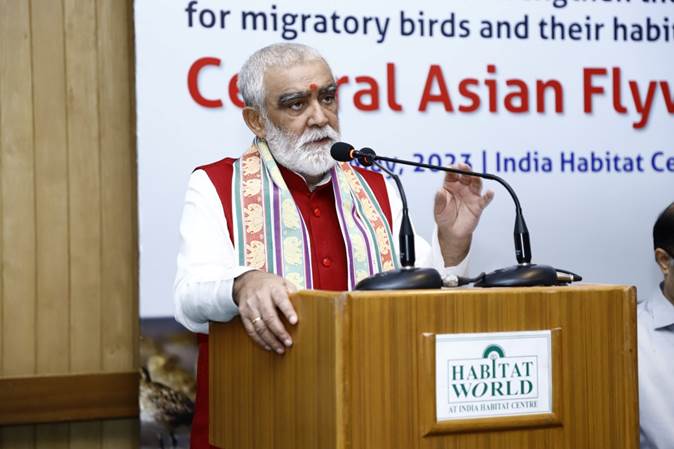
Union Minister of State for Environment, Forest and Climate Change, Government of India, Shri Ashwini Kumar Choubey inaugurated the meeting. In his inaugural address the Minister  while echoing the Prime Minister’s call to adopt LIFE (Lifestyle for environment for environmental protection) made at COP-26 in Glasgow  mentioned that :

“…It gives us immense satisfaction that we have taken concrete steps towards his vision with this meeting of the range countries of the Central Asian Flyway to frame an Action Plan. Additionally, adopting a sustainable lifestyle that allows for the co-existence of all life forms, including migratory birds, is critical to ensure their continued existence in the years to come. This aligns with  Prime Minister’s LiFE movement, which calls for a Lifestyle for Environment for environmental protection, and serves as a reminder of our responsibility towards the planet. Through this meeting, we are taking a significant step towards achieving the common goal of conservation and sustainable development in the Central Asian Flyway….”
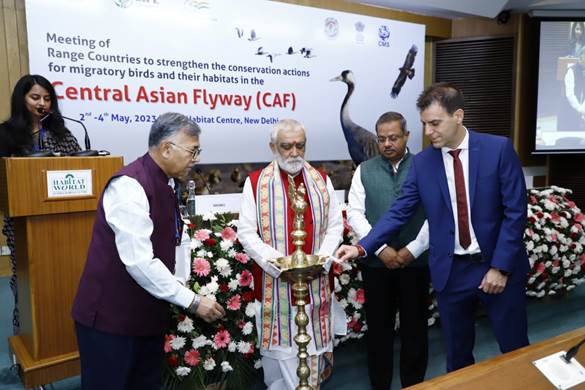


The meeting was attended by the eleven countries of CAF region including Armenia, Bangladesh, Kazakhstan, Kyrgyzstan, Kuwait, Mongolia, Oman, Saudi Arabia, Tajikistan, and Uzbekistan, besides the Secretariats of CMS, AEWA and Raptors MOU, and  representatives of Chief Wildlife Wardens of States, scientific institutions in India, international and national non governmental organizations, and subject experts.

The delegates deliberated and agreed on an institutional framework for the Central Asian Flyway, discussed priority areas for implementation, and agreed on a draft roadmap for updating the CMS CAF Action Plan. The meeting was a critical opportunity for CAF Range States to collaborate and exchange ideas and best practices to ensure the sustainable conservation of migratory birds and their habitats.

The discussions during the meeting also led to the modalities of an institutional framework mechanism with the aim of developing a coordinated approach to the conservation of migratory birds and their habitats. There was an overall consensus in the meeting for  further strengthening and formalizing  this initiative. The formalization of the Central Asian Flyway initiative, was seen as a significant step towards the conservation of migratory birds and their habitats.

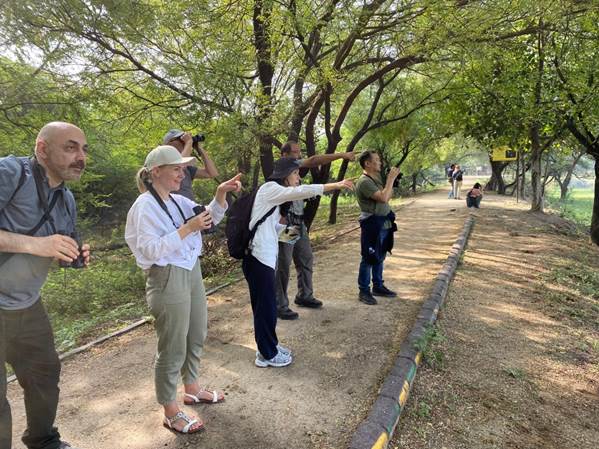
The delegates also undertook a field visit to the Sultanpur National Park, Gurugram, Haryana, to understand the management of bird sanctuary and learn the best practices being adopted in India for management of bird sanctuaries.  
****

TACTICAL RESCUE OPERATION FROM SUDAN BY IAF C-17 NON-STOP OPERATION OF NEARLY 24 HOURS

 In the midnight hours of 03 – 04 May 23, an Indian Air Force C-17 Globemaster aircraft airborne from Hindan, flew through the night to land in the early morning hours at Jeddah, Saudi Arabia. The aircraft refuelled at Jeddah to undertake a nonstop flight from Jeddah, via war torn Sudan and back to India. The aircraft took excess fuel from Jeddah to avoid a situation of non-availability of fuel and refueling delays in Sudan. The mission was one of a kind, with the aircraft carrying 192 passengers, mostly ladies, children and elderly persons, who either were NRIs, foreign nationals or OCIs (Overseas Citizens of India). These people could not be taken to Jeddah, and hence were required to be flown directly to India in a nonstop flight by the heavy jet.

At Sudan, the aircraft carried out an overhead steep tactical arrival followed by an assault approach to land the heavy jet. During the entire duration of the ground operations, the aircraft engines were kept running in readiness of a quick exit from the airfield, in case of such a need arising.

The crew encountered another unplanned emergency when one of the passengers became unconscious during the flight. This situation was immediately and proficiently handled by the crew who administered him 100% Oxygen to stabalise him.

The aircraft landed at Ahmedabad late in the evening on 04 May 23 late in the evening and then at the home base of Hindan late in the night on the same day. The crew thus flew through extended duty periods of nearly 24 hrs to get some of the last stranded countrymen back to India.

***

President of India Graces 12th Convocation of Maharaja Sriram Chandra Bhanja Deo University

 The President of India, Smt Droupadi Murmu graced and addressed the 12th convocation of Maharaja Sriram Chandra Bhanja Deo University at Baripada, Odisha today (May 6, 2023). 

Speaking on the occasion, the President said that Maharaja Sriram Chandra Bhanja Deo University has made a unique identity in the field of higher education and research in a short span of its history.

The President appreciated the University for establishing the ‘Sacred Grove’ in its campus with the aim to preserve the bedrock of tribal practices and cultural traditions. She said that the ‘Sacred Grove’ is important for the conservation of environment and local biodiversity. It is also one of the best examples of community-based management of natural resources.

The President said that the world is facing huge challenges of global warming and climate change. India has set an example for the world to adopt a nature-friendly lifestyle, which is called Lifestyle for the Environment or LiFE. In our tradition, it is believed that trees, plants, mountains, rivers all have life and not only humans but also all living beings are children of nature. Therefore, it is the duty of all human beings to live in harmony with nature. She said that the Similipal National Park located in this region holds a globally important place in terms of biodiversity. She expressed confidence that the students and teachers of the university would find a way to protect biodiversity through their research and innovation.

Addressing the graduating students, the President said that receiving degree does not mean that education process has been completed. Education is a continuous process. She said that after getting higher education some of them would do a job, some would do business and some would also do research but thinking of giving a job is better than thinking of doing a job. She was happy to note that this University has set up an Incubation Centre and provides assistance to the students, alumni and common people in setting up start-ups.

The President said that competition is an inevitable side of life. One has to face competition in every walk of life. She said that students should always keep trying to succeed in the competition and for that they should keep acquiring higher skills and move towards greater efficiency. They can turn the impossible into possible with their will-power. 

The President said that competition is a natural side of life, but cooperation is the beautiful side of life. She told students that while moving forward in life, when they would look back, they would find that some people of the society are not very capable of competing with them. She advised students to hold the hands of deprived ones and bring them forward. She said that a healthy society can be built through generosity and cooperation. She urged students to think not only of their own happiness and interest but also about the welfare of the society and country.

***

Conference Proceedings Publication with ISBN


Conference proceedings publication with ISBN (International Standard Book Number) is a common practice in academic and research communities. It involves publishing the papers presented at a conference in the form of a book or a collection of papers, which are assigned a unique ISBN number. This enables the papers to be easily cited and referenced, and provides a permanent record of the research presented at the conference.

The process of publishing conference proceedings usually involves the following steps:

Call for papers: The conference organizers issue a call for papers, inviting researchers to submit their papers for consideration.

Review process: The papers are reviewed by a panel of experts, who assess their quality and relevance to the conference theme.

Acceptance and revision: Papers that meet the criteria for acceptance are selected for inclusion in the conference proceedings. Authors may be required to revise their papers based on feedback from the reviewers.

Editing and formatting: The papers are edited and formatted for publication in a book or a collection of papers.

Publication and distribution: The proceedings are published and distributed to the conference attendees and other interested parties, such as libraries and academic institutions.

The use of ISBN numbers for conference proceedings is important because it ensures that the proceedings are easily accessible and can be referenced in academic publications. It also provides a measure of quality control, as only papers that meet certain standards are accepted for publication.

Overall, the publication of conference proceedings with ISBN numbers is a valuable way to disseminate research and promote academic exchange, as well as to provide a lasting record of the research presented at a conference.

<

p style=”text-align: justify”>Contact us: Send mail to editor@pen2print.org or editor@edupub.org for getting Conference Proceedings published with ISBN or Conference Proceedings in IJR Journal

Top Ten Popular Arts of India

Top Ten Popular Arts of India

India is known for its rich cultural heritage and diversity, which is reflected in its traditional arts and crafts. Here are the top ten popular arts of India:
Madhubani painting – A style of painting native to the Mithila region of Bihar, known for its intricate and colorful depictions of nature and mythology.
Kalamkari – A type of hand-painted or block-printed cotton or silk textile from Andhra Pradesh, known for its beautiful patterns and vibrant colors.
Warli art – A tribal art form from Maharashtra, known for its simple yet beautiful depictions of daily life and nature, usually painted in white on a red ochre background.
Pattachitra – A type of traditional painting from Odisha, known for its intricate details and bright colors, often depicting Hindu mythology and folklore.
Phulkari – A type of embroidery from Punjab, known for its colorful floral patterns and intricate stitching.
Pottery – India has a rich tradition of pottery, with different regions known for their unique styles and techniques, such as Blue Pottery from Rajasthan, Terracotta from West Bengal, and Khurja pottery from Uttar Pradesh.
Kondapalli toys – Wooden toys from Andhra Pradesh, known for their intricate carving and vibrant colors, depicting a wide range of themes, including animals, mythology, and daily life.
Chikankari – A type of embroidery from Lucknow, Uttar Pradesh, known for its delicate and intricate needlework, usually done on white cotton or muslin fabric.
Meenakari – A type of metalwork from Rajasthan, known for its intricate enamel work and colorful patterns.
Kathak – A classical dance form from North India, known for its graceful movements, intricate footwork, and expressive storytelling.
These popular arts and crafts of India not only reflect the country’s rich cultural heritage but also represent the skill and creativity of its people. They are essential cultural assets that have been passed down through generations and continue to thrive and evolve in contemporary times.