Awareness Campaign and Training of Trainers for the Elimination of Sickle Cell Anaemia

 Union Minister of Tribal Affairs, Shri Arjun Munda  launched the ‘Awareness Campaign and Training of Trainers’ as a part of the ‘Mission for Elimination of Sickle Cell Anaemia’ in New Delhi today. The programme envisages training of grassroot level functionaries so as to create awareness in this direction among the masses, especially in tribal regions.
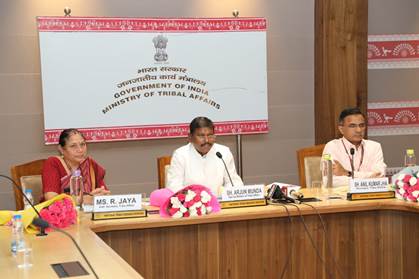
In a recent announcement, the Government declared a Mission to eliminate Sickle Cell Anaemia by 2047 in the budget of 2023-24. This Mission will entail awareness creation, universal screening of 7 crore people in the age group of 0-40 years in affected tribal areas, and counselling through collaborative efforts of central ministries and state governments. The Mission was formally launched by the Prime Minister Shri Narendra Modi, on 1st July, 2023 in Shahdol District of Madhya Pradesh. 

Speaking to the media after the launch, the Minister said that the initiative would take forward Prime Minister, Shri Narendra Modi’s vision of a sickle cell disease free India by ensuring community participation. Under his inspirational leadership, the Ministries of Health and Family Welfare and Tribal Affairs are collaborating to launch awareness generation initiatives for the Mission for the Elimination of SCD, Shri Munda added.
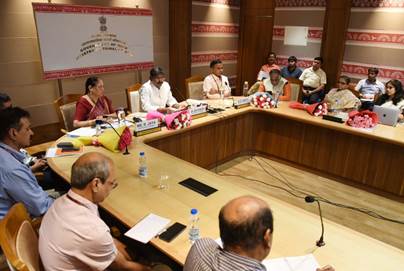
 

The Minister further identified the challenges and opportunities in making this initiative a success. The fundamental challenge, he said, would be to make the mission a grassroot level movement by ensuring Jan Bhagidari. It would require countering misconceptions among masses and bring them on board to develop a truly participative ecosystem for eliminating the disease. The Minister cited the importance of creating a healthcare database of the affected population, which in turn would help in research and finding a lasting solution. Only then it would be possible to stop the transmission of this disease and save the coming generations, he added.

Shri Munda expressed happiness to note the response of the State Governments in nominating a large number of tertiary care medical practitioners as the master trainers at the State level. Medical professionals are working with tribal communities to promote understanding of the disease, its symptoms, and its agony while preventing misinformation about the illness and eradicating its stigma. As a result, he said, in order to guarantee that the correct information is sent to the public, the Ministry of Tribal Affairs constituted a Committee of experts, including medical professionals, patient support organisations, and other stakeholders, to publish a module on awareness generation and on counselling of the stakeholders. He added that these modules were released at the launch event of the Mission.

The Minister explained that the mammoth initiative of awareness generation is being undertaken and training module at various levels is being planned to reach the last mile. The Minister informed that it is planned to engage the leaders at community level who would further ensure wide participation of the masses in the mission. He further added that in an unprecedented step, the awareness campaigns are being translated into tribal languages so as to ensure deep penetration of the message at the grassroots level.
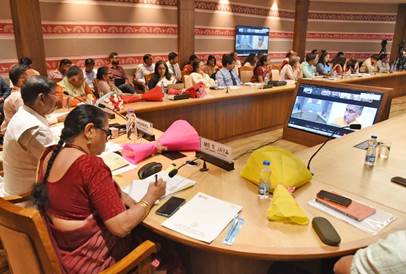
Speaking on the occasion, Secretary (Tribal Affairs), Shri Anil Kumar Jha informed that to ensure that the people are motivated enough to approach us for diagnostic testing, we are implementing a three-layer training programme at the State, District, and Village levels.Additionally, state governments have designated tertiary care physicians as master trainers at the state level, with district-level trainers training local influencers and opinion makers.

Ms. R Jaya, Additional Secretary, stated that the event marked the commencement of the awareness campaign. Further, she stated that the Ministry was engaging with all the stakeholders in the sector, so as to ensure that the Mission becomes a people’s movement. She requested the master trainers to ensure that they take the training forward and train district- level master trainers who would in turn take the message to the local- village level. There is a necessity to involve all stakeholders at all levels so as to reach the last mile. Further, the Ministry also intends to conduct regional workshops and promotional campaigns to raise awareness, and utilize online resources like Swasthya and Sickle Cell Corner.
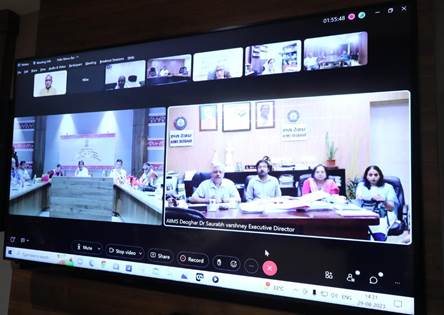
Three technical sessions were held on (i) ‘Awareness modules and its importance as a preventive measure’ by Dr Deepti Jain, Rtd. Professor, Nagpur Medical College, Maharashtra and Chairperson of the Committee; (ii) ‘Diagnosis in Sickle Cell is critical’ by Dr Anupam Sachdeva, Head of Department, Pediatric Hematology and Oncology, Sir Ganga Ram Hospital, Delhi and the (iii) ‘Role of health workers in the prevention and management of the Sickle Cell Disease by Dr Nita Radhakrishnan, Associate Professor, SSPGI, Noida.

Dr. Naveen Thacker, President at The International Pediatric Association (IPA), Dr Saurabh Varshney, Director AIIMS Deoghar, other medical experts, various other stakeholders and all Committee Members shared their views on the occasion. 
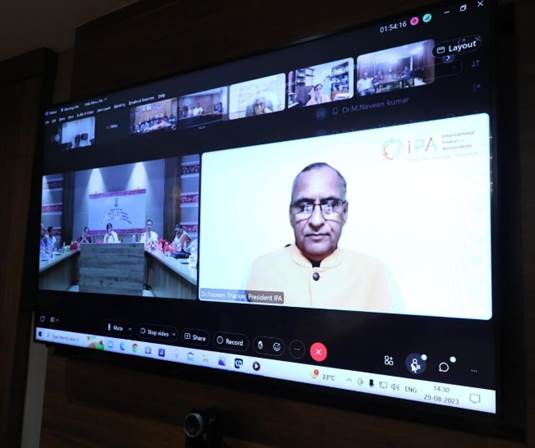
Shri Asit Gopal, Commissioner- NESTS, Dr. Naval Jit Kapoor, Joint Secretary, Shri Biswajeet Das, DDG, Smt. Vineeta Srivastava, Health Advisor and other officials of the Ministry of Tribal Affairs were also present in the event.

***
Centre approves Startup Guidelines dedicated to Technical Textiles

 The Ministry of Textiles has approved the Startup Guidelines for Technical Textiles – Grant for Research and Entrepreneurship across Aspiring Innovators in Technical Textiles (GREAT) providing grant-in-aid upto INR 50 Lakhs for upto a period of 18 months, informed Shri Rajeev Saxena, Joint Secretary Textiles during a press conference held here today on the important developments in the National Technical Textiles Mission (NTTM).

With a strong emphasis on developing the Startup Ecosystem in Technical Textiles, the guidelines focus on supporting individuals and companies to translate prototype to technologies & products including commercialization. The GREAT Guidelines provides thrust in Technical Textiles’ application areas including Agro-textiles, Building-textiles, Geo-textiles, Home-textiles, Medical-textiles, Mobile-textiles, Packaging- textiles, Protective-textiles, Sports-textiles; Development of High-performance fibres and composites; Sustainable and Recyclable Textile materials; Smart Textiles using Artificial Intelligence, Internet of Things, 3D/4D Printing, and Rapid Prototyping; and Development of indigenous Machinery/Equipment/Instruments, among others.

To incentivize the incubators, Ministry to additionally provide 10% of total grant-in-aid to incubators. To strengthen authenticity and commitment towards the project, a minimum investment of 10% of the funding from the incubatee in two equal installments is mandated. The Startup Guidelines (GREAT) to provide much needed impetus for the development of technical textiles startup ecosystem in India, especially in niche sub-segments such as Bio-degradable and Sustainable textiles, High-performance & Specialty fibres, Smart textiles, among others.

Ministry also gave the nod to 26 institutes for upgrading their laboratory infrastructure and training of trainers in the application areas of technical textiles. Ministry has approved the applications of 26 institutions for development and introduction of technical textile courses/ papers in the key departments/specializationsas well as introducing new degree programme in technical textiles.

Total value of INR 151.02 Crores was approved wherein 15 applications valuing INR 105.55 Crores are from Public Institutes and 11 applications valuing INR 45.47 Crores are from Private Institutes.

Some of the premier institutes to be funded under the scheme include IIT Delhi, NIT Jalandhar, NIT Durgapur, NIT Karnataka, NIFT Mumbai, ICT Mumbai, Anna University, PSG College of Technology, Amity University,among others.

Notably, majority of the funding to be provided for upgradation of existing courses including Departments related to Textile Technology & Fibre Sciences to upgrade courses in all application areas of technical textiles including specialty fibres; Departments related to Design/Civil Engineering to upgrade courses in Geotextiles & Building textiles; Departments related to Fashion Technology/Design to upgrade courses in Smart Textiles, Protective Textiles, Sports Textiles, Home Textiles, Cloth Textiles; Department of Mechanical Engineering to upgrade courses in Mobile Textile, Industrial Textiles; and a New Degree Programme in Technical Textiles with predominant emphasis on all application areas of Technical Textiles.

In addition, Ministry to re-open the Guidelines for Enabling of Academic Institutes in Technical Textiles’ Education in India (Round II) under NTTM with relatively eased parameters and wider coverage including NBA score of 750 and above, NAAC rating of A+/3.26 or above or top 200 NIRF ranked institutes as eligible private institutes under the Education Guidelines 2.0. The guidelines have been in-principally approved and target the inclusion of new courses/papers in the curriculum of academic year 2025-26.

On the quality and regulation aspect of technical textiles, Ministry already notified 02 QCOs for 31 Technical Textiles products including 19 Geotextiles and 12 Protective Textiles, which will come in-effect from 7th October 2023 onwards. Besides, QCOs for 28 products including 22 Agrotextiles and 06 Medical Textiles are also in the final stages of issuance and likely to be issued in September 2023.

Furthermore, additional 28 items are also considered for QCOs including Building textiles, Industrial textiles, Ropes & Cordages, among other. To cover the comprehensive impact of the QCOs on the economy, industry and society at large, Ministry is proactively conducting multiple stakeholder consultations with Industries.

****

PM Ujjwala Yojana consumers

 In a move that will bring respite to households across the nation, the Government led by Prime Minister Sh. Narendra Modi, has announced a substantial reduction in the price of cooking gas. Effective 30.08.2023, the price of a 14.2 Kg LPG cylinder will be reduced by Rs 200 in all markets across the country. In Delhi for instance, the decision will bring down the cost of a 14.2 Kg cylinder from the existing Rs 1103 per cylinder to a more affordable Rs 903 per cylinder. Prime Minister Narendra Modi said, “This is a gift to crores of my sisters of the country on the occasion of Raksha Bandhan. Our Government will always do everything possible that improves people’s quality of life and benefits the poor and middle class.”

This reduction is in addition to the existing targeted subsidy of Rs 200 per cylinder to PMUY households, which will continue. For PMUY households therefore, the effective price in Delhi after this reduction will be Rs 703 per cylinder.

It may be noted that there are more than 31 Cr domestic LPG consumers in the country including 9.6 Cr PMUY beneficiary families and this reduction will help all LPG consumers in the country. To clear pending PMUY applications and to provide deposit free LPG connection to all eligible households, Government will shortly start distribution of PMUY connections to 75 lacs women from poor households who do not have an LPG connection. This will increase the total number of beneficiaries under PMUY from 9.6 cr to 10.35 cr.

These decisions come as part of the Government’s ongoing efforts to ease the financial burden on citizens and promote the welfare of households. The reduction in cooking gas prices reflects the Government’s commitment to prioritize the well-being of its citizens and ensure access to essential commodities at reasonable rates.

Sh. Hardeep Singh Puri, Minister of Petroleum and Natural Gas, expressed his happiness with the decision, stating, “We understand the challenges faced by households in managing their budgets. The reduction in cooking gas prices is aimed at providing direct relief to families and individuals, while also supporting Government’s larger goal of ensuring affordable access to essential items.”

The reduction in cooking gas prices is expected to have a positive impact on the cost of living for a wide spectrum of society. Government’s proactive step is projected to save significant expenses for households, making an appreciable contribution to the disposable income of citizens.

The Government has been taking various steps to ease the burden of the people and this reduction in cooking gas prices is a testament to the Government’s responsiveness to the needs of the people and its unwavering dedication to their welfare.

***

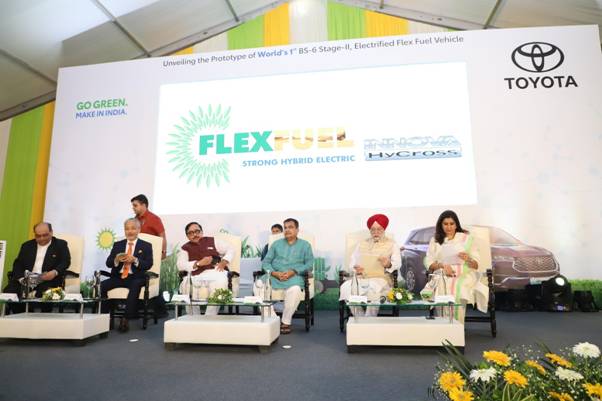
‘Electrified Flex fuel vehicle’ launched today

 Highlighting the potential of Flex Fuel Vehicle Technologies in energy and automobile industry Shri Hardeep Singh Puri, Minister of Petroleum & Natural Gas and Housing & Urban Affairs, said that these vehicle technologies provide opportunity of greater substitution of petrol by Ethanol as it is capable of using any of the higher blends of ethanol mix beyond 20%.

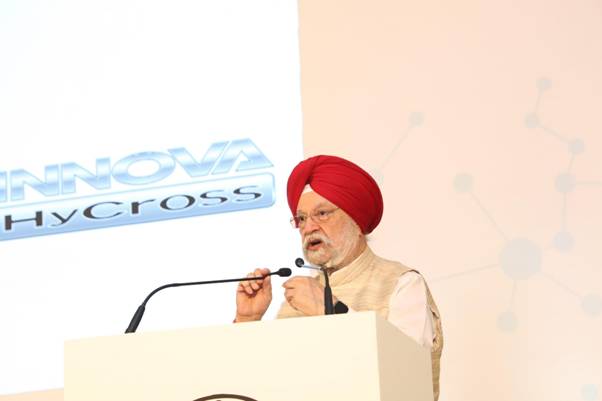
The Union Minister for Petroleum & Natural Gas was speaking at the unveiling of the Prototype of World’s 1st BS-6 Stage-II, Electrified Flex fuel vehicle, developed by Toyota Kirloskar Motor. Elaborating on this, he said that this initiative by Toyota is particularly important as it introduces the world’s first BS 6 (Stage II) Electrified Flex Fuel vehicle prototype, which has both the flex fuel engine as well as an electric powertrain, thereby offering higher use of ethanol combined with better fuel efficiencies. “With Industry and Government collaboration, we see India becoming a global hub for cleaner technologies and achieving self-reliance in energy soon”, he added further.

Shri Nitin Gadkari, Minister of Road Transport and Highways of India who was the chief guest at the event , expressing his views on the launch of world’s first prototype of the BS 6 Stage II ‘Electrified Flex Fuel Vehicle’,  stated that this innovative vehicle is based on the Innova Hycross and is engineered to adhere to India’s stricter emission standards, marking it as the first-ever BS 6 ( Stage II) Electrified Flex Fuel Vehicle prototype globally. He mentioned that the forthcoming stages for this prototype encompasses meticulous refinement, homologation, and certification processes.

Shri Hardeep Singh Puri during his address said that India has huge Ethanol potential, much beyond E20 mix.  This excess potential can be utilised by the country by promoting Flex Fuel vehicle (FFVs) and Flex Fuel Strong Hybrid Electric Vehicle (FFV-SHEV) / Electrified Flex Fuel Vehicle.

An Electrified Flex Fuel Vehicle has both a Flexi Fuel engine and an electric powertrain. This gives it ability to provide dual benefit of higher ethanol use and much higher fuel efficiency as is in case of a Strong Hybrid Electric Vehicle (SHEV), which can provide 30-50% higher Fuel Efficiency as it can run 40-60% in EV mode with engine shut off.

The Petroleum & Natural Gas Minister contended that various high-level bodies like National Green Tribunal (NGT), Energy Transition Advisory Committee (ETAC) have strongly recommended promotion of all green technologies including SHEVs & Electrified Flex Fuel Vehicle etc for hastening the shift away from fossil fuel and faster decarbonization. He noted that as technologies including SHEVs & Electrified Flex Fuel Vehicle etc. As Electrified Flex Fuel Vehicle uses minimal advanced chemistry batteries, it also guards against possible Geo-political risks of battery raw material supplies.

Shri Hardeep Singh Puri also mentioned the steps taken by the Government to fulfil Prime Minister’s vision to achieve ‘Atmanirbharta’ in energy by 2047 and lead the global fight against climate change. He apprised that with the huge efforts made by the Government and the industry, in a short span of 8 years, the Ethanol blending in India has increased by over 8 times. It has increased from 1.53 % in 2014 to around 11.5 % (Mar ’23) leading to savings in the import bills and also lowering of carbon emissions.

Noting the efforts made by all the stakeholders, Shri Puri said that we have advanced the target for E20 blending to 2025 (5 years ahead of earlier planned schedule), from the original plan of 2030. He noted that with the strong efforts made by all the stakeholders, we will achieve this target. He said that E20 fuel is being dispensed at more than 3300 fuel stations across the country and shall be available pan India by April 2025. With E20 implementation by April 2025, expected import bill savings may be around Rs 35000 cr annually, oil import displacement will be 63 million barrels of gasoline (in EY 2024-25).

Minister of Heavy Industries Shri Mahendra Nath Pandey, MD & CEO, Toyota Kirloskar Motor, Shri Masakazu Yoshimura and Chairperson and Managing Director, Kirloskar System Pvt Ltd, Smt Geetanjali Kirloskar also attended the event.

**

Government fostering a conducive business environment and accelerating growth in Indian Auto sector

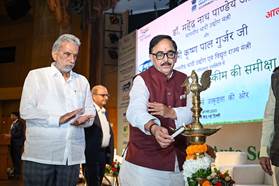
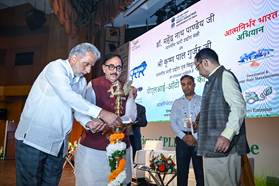
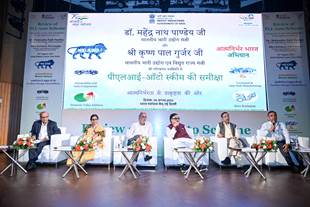
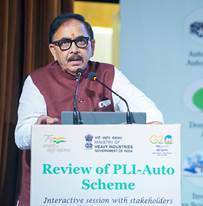
 Ministry of Heavy Industries (MHI) organised a meeting for “Review of PLI-AUTO Scheme” under the Chairmanship of  Union Minister for Heavy Industries Dr. Mahendra Nath Pandey, here today. The objective of the meeting  was to ascertain the problem or difficulties faced by OEMs and component companies under the PLI-AUTO scheme. Industry leaders  were encouraged to come forward and share their problems and views. The meeting  was organised in line with the vision of the  Prime Minister, Shri Narendra Modi, to make India a global hub for manufacturing. Minister of State for Heavy Industries, Shri Krishan Pal Gurjar, Secretary, MHI,   Shri Kamran Rizvi, Addl. Secretary, MHI and other senior officials were present in the meeting.

The event witnessed participation from approved applicants under the scheme, officials from MHI, NITI Aayog, IFCI (Project Management Agency for the Scheme), Testing Agencies of MHI viz. ARAI, ICAT, GARC & NATRAX, Automobile Associations viz. SIAM & ACMA and media professionals.

MHI has taken various initiatives to promote Cleaner Mobility and to develop an ecosystem of Innovation and Technology. The Production Linked Incentive Scheme for Automobile and Auto Component Industry (PLI-AUTO) with an outlay of ₹25,938 crore is a key initiative to drive the supply chain of Advanced Automotive Technology (AAT) products.


Delivering the keynote address at the event, Dr. Pandey called for  industry’s feedback and collaborative engagement to shape the policies, procedures and effectiveness of the PLI scheme. He  said that the government is committed to fostering a conducive business environment and accelerating growth in the Indian Automotive sector.

 The Minister mentioned that the PLI-AUTO scheme incentivizes only those eligible AAT products for which minimum 50% Domestic Value Addition (DVA) is achieved and has been certified by Testing Agencies (TAs) of MHI. This criterion shall reduce imports, facilitate deep localization for AAT products and enable creation of domestic as well as global supply chain.


  Speaking on the occasion, Shri Krishan pal Gurjar said that  Auto Industry  contributes 7% to country’s GDP and PLI scheme will further enhance the competitiveness of the sector and will create more employment opportunities.

In his address, Secretary, MHI,   Shri Kamran Rizvi said that automotive industry is a major economic contributor in India. The PLI-AUTO scheme will make the Indian automotive industry more competitive and will enhance globalization of the Indian automotive sector and incentivize emergence of global supply chain for Advanced Automotive Technologies (AAT) in India. He further stated that the scheme  will herald a new age in higher technology, more efficient and green automotive manufacturing, he added.

Attendees included giants of automotive sector such as Tata Motors, Mahindra & Mahindra, OLA electric, Ashok Leyland, Hyundai Motor, Bosch, Toyota Kirloskar Auto Parts, Minda Industries, Delphi-TVS, among others. Their presence ensured a diverse range of perspectives and fostered an environment of knowledge-sharing and networking. Key executives from these companies, along with government officials were actively involved in a collaborative open discussion and Q&A sessions throughout the event.

A comprehensive presentation highlighting the progress and performance under the PLI scheme was made. The investment as reported by the applicants (till 30th June 2023) is ₹ 10,755 crore. To facilitate ease of doing business (EODB) in the scheme, MHI published Standard Operating Procedure (SOP) for DVA certification on 27th April 2023. Thereafter, two applicants namely Tata Motors and Mahindra & Mahindra have received DVA certification, and four more applicants have applied for DVA certification. Further, another 23 applicants are expected to apply for DVA certification by the end of September 2023. A detailed SOP is being framed for verification and processing incentive claims and stakeholder consultations for the same shall be initiated shortly.

                                                         ***

Sagar Parikrama Phase VIII in Southern Districts of Tamil Nadu

 Union Minister for Fisheries, Animal Husbandry and Dairying Shri Parshottam Rupala and Minister of State Dr L Murugan will jointly launch Sagar Parikrama Phase-VIII on 31st August in Thengapattanam Fishing harbour in Kanyakumari district. This phase of Sagar Parikrama will be covering four coastal districts of Tamil Nadu including Kanyakumari, Tirunelveli, Thoothukudi, and Ramanathapuram.

The Tamil Nadu leg of Sagar Parikrama will begin on the 31st and will end on the second of September with the foundation laying stone of the Integrated Seaweed Park at Valamavur in Thondi, Ramanathapuram district. A Tamil song on Sagar Parikrama will also be launched during the event.

Sagar Parikrama Yatra is an outreach program intended to reach out fisher community across the coastal belt. The initiative has been launched to better understand the issues, experiences, and aspirations of fishermen, as well as to examine the scope of seafood exports and popularise programs available to fishermen in coastal areas.

Union Fisheries Ministers Shri Purushottam Rupala along with Minister of State Dr L. Murugan along with the State fisheries Department Tamilnadu, District officials and Senior officials from Department of Fisheries, Government of India and from State Government, National Fisheries Development Board, Indian Coast Guard, Fishery Survey of India, National Institute of Fisheries Post Harvest Technology and Training, Central Institute of Fisheries Nautical & Engineering Training and fishermen will participate in the Sagar Parikrama awareness campaign for three days.

Fishermen representatives, fish-farmers, entrepreneurs, fishermen cooperative society leaders, professionals, scientists, and other stakeholders in the four districts of Tamil Nadu will participate in the events.

Tamil Nadu has 1,076 km long coastline, which is the second largest in the country. The state is enriched with marine, brackish water and inland fisheries resources amenable for capture and culture fisheries. Marine fish production (2021-22) of the State stood at 5.95 lakh MT, of which 1.14 lakh MT, valued at Rs.6,559.64 crore was exported. The fisheries industry supports the livelihood of 10.48 lakh marine fishers through 5,830 mechanised and 45,685 traditional fishing crafts which are actively engaged in fishing and 4,41,977 marine fisherfolk enrolled in Tamil Nadu Fishermen welfare Board.

The rich fisheries biodiversity of Tamil Nadu provides livelihood opportunities to more than a million people directly and in the ancillary activities. During the year 2021-22, the sector’s contribution to the State agriculture GDP is 5.78%. The State’s contribution from fisheries sector in the foreign exchange is Rs.6,559.64 crore by exporting 1.14 lakh metric tonnes of fish and fishery products during the year 2021-22.

During the Sagar Parikrama journey across four coastal district of Tamil Nadu, Certificates/sanctions relating to the Pradhan Mantri Matsya Sampada Yojana (PMMSY), Fisheries and Aquaculture Infrastructure Development Fund (FIDF), Kisan Credit Card (KCC), and State Schemes shall be distributed to progressive fishermen, particularly coastal fishermen and fish farmers, young fisheries entrepreneurs. Literature on the PMMSY scheme, State schemes, e-shram, FIDF, KCC, will be widely disseminated through print media, electronic media, videos, and a digital campaign using jingles among fishermen to promote the schemes for their awareness and benefits.

The first seven phases of Sagar Parikrama has covered 3600 km in 8 Western Coastal states/UTs including Gujarat, Diu & Daman, Maharashtra, Goa, Karnataka, Kerala, Puducherry, and Andaman & Nicobar. The journey signifies an evolutionary initiative of the Government of India demonstrating solidarity with fisher folk, fish farmers, and other concerned stakeholders across the coastal belt. Aiming to resolve the challenges faced by the fishing community and facilitate their economic upliftment through various fisheries schemes and programs implemented by the government, such as the Pradhan Mantri Matsya Sampada Yojana (PMMSY) and the Kisan Credit Card (KCC) and to disseminate information about various fisheries related schemes and programs, promoting responsible fisheries with a focus on sustainable balance, and protection of marine ecosystems.

***

Animal Husbandry and Dairying

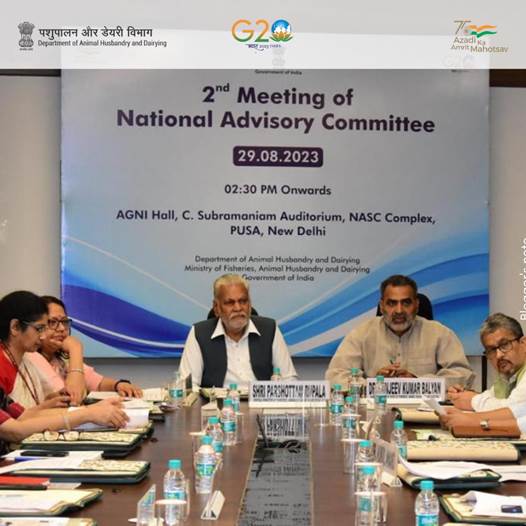
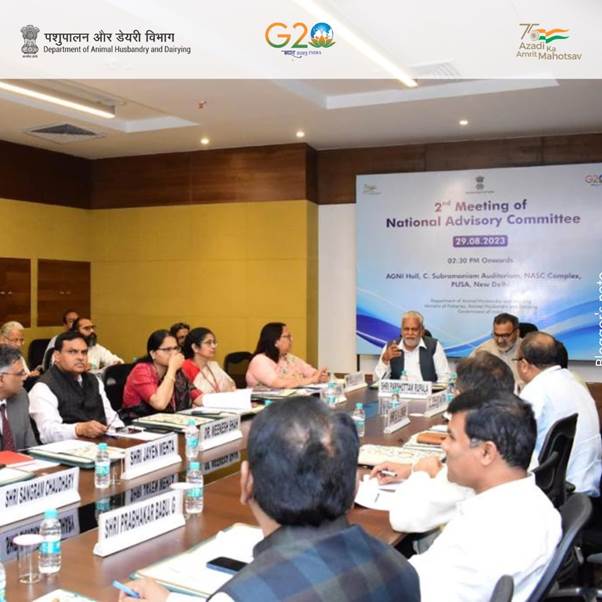
 Minister of Fisheries, Animal Husbandry and Dairying, Shri Parshottam Rupala chaired the 2nd National Advisory Committee meeting for Animal Husbandry and Dairying formed under the Department of Animal Husbandry and Dairying. Minister of State, FAHD, Dr. Sanjeev Kumar Balyan, Secretary DAHD, Smt. Alka Upadhyaya, and distinguished members of National Advisory Committee were also present in the meeting.

The Minister, FAHD took stock of the decision taken during 1st National Advisory Meeting and highlighted that the Ministry is committed to work with all stakeholders for creating rural Entrepreneurship and help in creating better livelihood opportunity for unemployed youth and livestock farmers in the Cattle, Dairy, poultry, sheep, goat, piggery, feed and fodder sector paving the way towards AtmaNirbhar Bharat. MoS, FAHD Dr. Sanjeev Kumar Balyan emphasised that the realigned schemes will bring a sharp focus on entrepreneurship development and breed improvement in rural poultry, sheep, goat and piggery including feed and fodder development. The Government is implementing various schemes/programmes to enhance poultry productivity, milk and meat production, for attaining nutritional security, employment generation and economic prosperity for the country.

At the outset, Secretary, DAHD, Smt. Alka Upadhyaya welcomed all members of the committee and explained the purport of the constituted committee for animal husbandry and Dairying. Minister, FAHD invited suggestions from Stakeholders in respect of the existing Policies/Programme/Schemes/Acts/ Rules/SoPs so that the same could be revised/modified based on ground realities.

In the meeting, key discussions were held on various aspects of animal husbandry. Dr. Mukul Anand emphasized strategies for promoting goat milk farms and ensuring the long-term sustainability of commercial goat farms under NLM. Shri Prabhakar Babu G addressed the importance of quality fodder seeds. Vaccination concerns for sheep and goat populations were raised by Shri Vinayak Narawade. Several members discussed topics such as animal welfare, PCA act amendments, and feed industries. The meeting covered a broad spectrum, including breeding technologies, disease surveillance, and entrepreneurship, aiming to advance the animal husbandry sector.

Formed in July, 2022, the National Advisory Committees serve as a platform for all stakeholders to come together and deliberate and discuss on key issues pertaining to Animal Husbandry and dairying. The first meeting of National Advisory Committee under the Chairmanship of Minister of State for Fisheries, Animal Husbandry and Dairying, Dr. Sanjeev Kumar Balyan was held on 28 October 2022 in New Delhi. Setting the context, Secretary DAHD, Smt. Alka Upadhyaya highlighted that Livestock Sector grew at a Compound Annual Growth Rate (CAGR) of 7.67% (at constant prices) from 2014-15 to 2021-22. The contribution of livestock in total agriculture and allied sector Gross value added (GVA)(at constant prices) has increased from 24.32 per cent (2014-15) to 30.47 per cent (2021-22). Livestock sector contributed 4.75 per cent of total GVA in 2021-22 (at constant price).

***

The Heaven & Earth Grocery Store: A Novel Kindle Edition by James McBride

Review
Praise for The Heaven & Earth Grocery Store:

“I keep thinking every time I read one of his books, ‘That’s his best book.’ No. THIS is his best book.” —Ann Patchett
“This is one of those novels that becomes a part of you. It’s a great book. Every character is rich; every detail is rich. I can’t recommend this one highly enough. He’s a great author and I think this is his best work.” —Harlan Coben
“With this story, McBride brilliantly captures a rapidly changing country, as seen through the eyes of the recently arrived and the formerly enslaved . . . And through this evocation, McBride offers us a thorough reminder: Against seemingly impossible odds, even in the midst of humanity’s most wicked designs, love, community and action can save us.” —The New York Times Book Review
“The Heaven & Earth Grocery Store is one of the best novels I’ve read this year. It pulls off the singular magic trick of being simultaneously flattening and uplifting.” —NPR
“[A] tour de force . . . [a] mesmerizing, moving, almost magical tale . . . [McBride] writes sentences and paragraphs that swing like jazz melodies.” —The Associated Press
“Classic McBride: He doesn’t shy away from bold statements about the national catastrophes of race and xenophobia, and he always gives us a spoonful of sugar to help the medicine go down. The sugar is McBride’s spitfire dialogue and murder-mystery-worthy plot machinations; his characters’ big personalities and bigger storylines; his wisecracking, fast-talking humor; and prose so agile and exuberant that reading him is like being at a jazz jam session. . . . Reading McBride just feels good—we are comforted and entertained, and braced for the hard lessons he also delivers.” —The Atlantic
“Sharp and nimble and warm as a wool hat, James McBride’s prose seems to transcend all earthly concerns, allowing him to write with compassion, humor and authority.” —The Philadelphia Inquirer
“A story of community, care, and the lengths to which we’ll go for justice, McBride’s tale is a wondrous ode to the strength of humanity in a small town.” —Time Magazine
“Enchanting . . . [a] rich, carefully drawn portrait of a Depression-era community of African Americans and Jewish immigrants as they live, love, fight, and, of course, work.” —The Boston Globe
“McBride . . . would never advance any of his books as candidates for the Great American Novel. . . . I’d like to make a case, though, for Deacon King Kong and, now, The Heaven & Earth Grocery Store as better contenders for the 21st-century GAN than many other, more vaunted specimens. . . . In the words of Walt Whitman (an American writer McBride often brings to mind), they contain multitudes.” —Slate
Amazon.com Review
An Amazon Best Book of August 2023: In Deacon King Kong, James McBride spun a story of a Brooklyn neighborhood filled with beguiling and booze-filled characters that showed just how vital communities can be—and he’s done it again with The Heaven & Earth Grocery Store. Except this time, we’re in Chicken Hill, a small town in Pennsylvania, where Black, Jewish, and European immigrants, rich and poor, old and young, collide—defending, fighting, entertaining, feeding, and sheltering one another. This cacophonous melody of characters with all of their schemes and dreams reveal how home is where you make it—and how all of these “outsiders” are anything but. With spunky detail, McBride masterfully makes you feel like you’re part of the neighborhood, that these are your neighbors, your friends, and enemies, drawing you in, so that you, too, know the secrets they keep, the grudges they hold, and kindness they offer. Chock full of the social, racial, and ethnic politics of a small town, The Heaven & Earth Grocery Store is another irresistible stand-out from McBride.—Al Woodworth, Amazon Editor –This text refers to the hardcover edition.
Review
Praise for The Heaven & Earth Grocery Store:
“I keep thinking every time I read one of his books, ‘That’s his best book.’ No. THIS is his best book.” —Ann Patchett
“This is one of those novels that becomes a part of you. It’s a great book. Every character is rich; every detail is rich. I can’t recommend this one highly enough. He’s a great author and I think this is his best work.” —Harlan Coben
“With this story, McBride brilliantly captures a rapidly changing country, as seen through the eyes of the recently arrived and the formerly enslaved . . . And through this evocation, McBride offers us a thorough reminder: Against seemingly impossible odds, even in the midst of humanity’s most wicked designs, love, community and action can save us.” —The New York Times Book Review
“The Heaven & Earth Grocery Store is one of the best novels I’ve read this year. It pulls off the singular magic trick of being simultaneously flattening and uplifting.” —NPR
“[A] tour de force . . . [a] mesmerizing, moving, almost magical tale . . . [McBride] writes sentences and paragraphs that swing like jazz melodies.” —The Associated Press
“Classic McBride: He doesn’t shy away from bold statements about the national catastrophes of race and xenophobia, and he always gives us a spoonful of sugar to help the medicine go down. The sugar is McBride’s spitfire dialogue and murder-mystery-worthy plot machinations; his characters’ big personalities and bigger storylines; his wisecracking, fast-talking humor; and prose so agile and exuberant that reading him is like being at a jazz jam session. . . . Reading McBride just feels good—we are comforted and entertained, and braced for the hard lessons he also delivers.” —The Atlantic
“Sharp and nimble and warm as a wool hat, James McBride’s prose seems to transcend all earthly concerns, allowing him to write with compassion, humor and authority.” —The Philadelphia Inquirer
“A story of community, care, and the lengths to which we’ll go for justice, McBride’s tale is a wondrous ode to the strength of humanity in a small town.” —Time Magazine
“Enchanting . . . [a] rich, carefully drawn portrait of a Depression-era community of African Americans and Jewish immigrants as they live, love, fight, and, of course, work.” —The Boston Globe
“McBride . . . would never advance any of his books as candidates for the Great American Novel. . . . I’d like to make a case, though, for Deacon King Kong and, now, The Heaven & Earth Grocery Store as better contenders for the 21st-century GAN than many other, more vaunted specimens. . . . In the words of Walt Whitman (an American writer McBride often brings to mind), they contain multitudes.” —Slate –This text refers to the audioCD edition.

Product details

  • ASIN ‏ : ‎ B0BPNP7YQB
  • Publisher ‏ : ‎ Riverhead Books (August 8, 2023)
  • Publication date ‏ : ‎ August 8, 2023
  • Language ‏ : ‎ English
  • File size ‏ : ‎ 1898 KB
  • Text-to-Speech ‏ : ‎ Enabled
  • Screen Reader ‏ : ‎ Supported
  • Enhanced typesetting ‏ : ‎ Enabled
  • X-Ray ‏ : ‎ Enabled
  • Word Wise ‏ : ‎ Enabled
  • Sticky notes ‏ : ‎ On Kindle Scribe
  • Print length ‏ : ‎ 400 pages
  • Page numbers source ISBN ‏ : ‎ 1399620401

    About the author

    James McBride is the author of the award-winning New York Times bestseller, The Color of Water. A former reporter for The Washington Post and People magazine, McBride holds a Masters degree in journalism from Columbia University and a B.A. from Oberlin College.

    Warehousing Development Regulatory Authority (WDRA)

     The Warehousing Development and Regulatory Authority (WDRA) under the Department of Food and Public Distribution, Government of India organized an outreach programme on “registration of warehouses with WDRA” on 28.08.2023 at Baba Jitto Kisan Kendra, Directorate of Agriculture, Gole Pully, Talab Tillo, Jammu to promote registration of warehouses with WDRA.

    Shri Arun Kumar Shrivastava, Member, WDRA highlighted that the produce stored in WDRA registered warehouses has greater security compared with unregistered warehouses. He said that electronic negotiable warehouse receipt is safer compared with paper receipts especially as chances of fraud against paper receipts are very high. e-NWR is a negotiable instrument backed by the WDRA Act 2007. He also outlined the benefits of WDRA registered warehouses including various insurances, periodic inspections, scientific storage with SOP, etc. to safeguard the interest of depositors and bankers.

    He further said that Govt bodies such as FCI, NAFED and National Horticulture Board have already issued guidelines that Central Pool Stock should be kept in WDRA registered warehouses. Elaborating on the value chain of WDRA registered warehouse eco-system, he said that the direct beneficiaries of the WDRA ecosystem are farmers/warehouseman/ traders and requested participant specially owners of warehouses to register their warehouses with WDRA.

    During Open House significant suggestions were made in further improving the registration process and pledge finance system of WDRA.

    Shri Vikas Sharma, Director, Horticulture Planning and Marketing, Jammu & Kashmir in his welcome address appreciated the unique role of WDRA in ensuring scientific storage of food grains and pledge finance to the farmers through e-NWR ecosystem. Shri H K Dabas, Under Secretary, WDRA briefed about the Warehousing Act and Rules. Shri Brijendra Pratap Yadav, Assistant Director, WDRA explained about the registration process of WDRA for warehouseman and warehouses.

    Representatives from NABARD, FCI, Department of Food, Civil Supplies Consumer Affairs, Industries and Commerce, SIDCO, SICOP, various banks, department of Agriculture and Horticulture, Jammu,  J & K Agro Corporation, President CA  Stores Association Kashmir, Maajid Wafai and various CA Stores owners, owners of warehouses, Farmers, FPOs etc. attended the conference.  

    ****

    Different Between H-Index and Impact Factor

     The h-index and impact factor are two measures of research quality. The h-index evaluates a researcher’s or an author’s scientific productivity based on the number of published research papers and their citations. The impact factor evaluates the total number of articles cited within the Journal during the previous two years1. The h-index is the largest number h, so h articles have at least h citations each. It has been argued that the H index outperforms the impact factor for evaluation purposes.

    That’s a very interesting question. The journal impact factor and h index are different in their fundamental design: The former is used to measure journal prestige, while the latter is used to measure researcher impact. Therefore, the two cannot be compared. Let me explain.

    The journal impact factor measures the average number of citations received by articles published within a journal over a two-year period. It can be a reliable measure of journal reputation but does not measure the impact of individual articles or researchers.

    On the other hand, the h index is designed to measure the scientific output of a researcher by considering a combination of the number of papers the researcher has published and the number of citations those papers have received. Thus it measures both your publication record and its impact.

    Do you now see how the impact factor and h index cannot be compared because they serve different purposes?

    Your colleagues are right though. As a researcher, it is more useful for you to calculate your h index than to use the journal impact factor as a measure of prestige. The h index can especially work to your advantage if you have published many papers. I understand that it is troublesome and time consuming to calculate your h index because it requires you to maintain a record of all your published papers and the citations they have received through timely searches on multiple databases. But this would be time and effort well spent because the h index is gaining popularity and is increasingly being considered by grant and tenure committees.

    However, like the journal impact factor, even the h index has its limitations, and it is advisable for you to mention a combination of citation metrics—the impact factor of journals in which you have published, your h index, and other article-level metrics—on your grant applications or statements of purpose, so as to give people a holistic view of your impact as a researcher. 

    USAID Youth Well-Being Prize Competition (Up-to $5,000 Grants)

    USAID Youth Well-Being Prize Competition (Up-to $5,000 Grants)

    Are you a young person between the ages of 10 and 29 with an idea of how digital tools can be used to help improve other young people’s well-being? Do you have ideas about how we could creatively use technology to increase young people’s knowledge around issues that impact them? The United States Agency for International Development (USAID) is looking for creative innovators with solutions to pressing issues around well-being. Is this you? If so, apply today for the Youth Well-Being Prize Competition!

    The Youth Well-Being Prize Competition aims to increase young people’s access to information and ensure their leadership and engagement in creating information campaigns and awareness products around the issues that affect their well-being.

    The Youth Well-Being Prize Competition is looking for young change makers with innovative ideas for protecting young people’s well-being, keeping youth safe, and making a positive impact on the lives and communities of themselves and their peers.

    USAID is seeking solutions created by young people, for young people, and these solutions should recognize the diverse identities of young people in the areas of mental health, digital harm, safeguarding, gender-based violence, and climate change:

    • Mental health: Ideas that focus on the mental health of children and youth. Competitors interested in mental health, personalized care, psychotherapy, or any interventions that help reduce stress and improve the lives of young people should apply here. The innovation should aim to enhance individual, interpersonal, and/or overall well-being for youth.
    • Digital Harm: Innovations in this category should relate to use of digital platforms (such as social media) and safety. Competitors interested in reducing digital harm as caused by online platforms and/or digital use, including digital harm done offline for children and youth should apply in this category. Digital harm can include any of the following: hate speech, cyberbullying, doxing, deep fakes of people without their consent, nonconsensual explicit content, misinformation and disinformation, etc.
    • Safeguarding: Innovations in this category should relate to prevention and/or response to child and/or youth abuse, exploitation, neglect, and violence including prevention and/or response to sexual exploitation, abuse, and violence. Competitors interested in protection from and elimination of all forms of violence against children and young people should apply in this category.
    • Gender-Based Violence: Innovations in this category should work against harmful actions or threats that target individuals or groups based on their actual or perceived sex, gender, gender identity, gender expression, sex characteristics, sexual orientation, or how they challenge traditional ideas of masculinity and femininity. Competitors interested in gender equality, equity, and preventing, mitigating, and responding to gender-based violence should apply in this category.
    • Climate Change: Innovations in this category should relate to building climate awareness, improving climate education, promoting sustainable lifestyles, conserving nature, supporting renewable energy, adopting environmentally friendly practices, and/or implementing climate adaptation and mitigation projects. Those interested in youth-led and children-led climate mitigation efforts and reduction in high levels of climate anxiety and grief among children and young people should apply in this category.
    Prize Details
    • Total cash prizes: $50,000
    • Prizes will be awarded to 1st, 2nd, and 3rd place winners in the categories of digital harm, mental health, safeguarding, gender-based violence, and climate change for a total of 15 prizes.
      • Digital Harm
        • 1st Place: $5,000
        • 2nd Place: $3,000
        • 3rd Place: $2,000
      • Mental Health
        • 1st Place: $5,000
        • 2nd Place: $3,000
        • 3rd Place: $2,000
      • Safeguarding
        • 1st Place: $5,000
        • 2nd Place: $3,000
        • 3rd Place: $2,000
      • Gender-Based Violence
        • 1st Place: $5,000
        • 2nd Place: $3,000
        • 3rd Place: $2,000
      • Climate
        • 1st Place: $5,000
        • 2nd Place: $3,000
        • 3rd Place: $2,000
    Eligibility Requirements
    • To enter the Youth Well-Being Prize Competition, please see the below eligibility requirements:
      • You must be between the ages of 10 and 29 and/or be a youth-led organization.
      • You have an idea to improve youth well-being in mental health, digital harm, safeguarding, gender-based violence, or climate change.
      • This is a global call for solutions.
      • No prior professional or academic experience in any particular field or topic is necessary.

    Application Deadline: 29-Sep-23

    Click Here to Apply

    Export of Basmati rice to prevent exports of Non-Basmati white rice

     To check the domestic prices and to ensure domestic food security, the Government has been taking measures to restrict export of rice from India. The export of non-basmati white rice was prohibited on 20th July 2023.

    It has been noticed that despite restriction on certain varieties, rice exports have been high during the current year. Up to 17th August 2023, total exports of rice (other than broken rice, export of which is prohibited) were 7.33 MMT compared to 6.37 MMT during the corresponding period of previous year, registering an increase of 15.06%. There has been a spurt in the export of parboiled rice and Basmati rice; both of these varieties did not have any restriction on exports. While the export of parboiled rice has grown by 21.18% (3.29 MMT during the current year compared to 2.72 MMT during previous year), export of Basmati rice has increased by 9.35% (1.86 MMT during the current year compared to 1.70 MMT during previous year). Export of non-basmati white rice, which had an export duty of 20% since 9th September 2022 and has been prohibited w.e.f. 20th July 2023, has also registered an increase of 4.36% (1.97 MMT compared to 1.89 MMT during previous year). On the other hand, as per third Advanced Estimate of Department of Agriculture & Farmers Welfare, during the Rabi Season 2022-23, the production was only 158.95 LMT against 184.71 LMT during Rabi Season of 2021-22 i.e., there was a decline of 13.84%.

    Internationally, due to strong demand from Asian buyers, production disruptions registered in 2022/23 in some major producing countries like Thailand, and fears of possible adverse effect of the onset of El Nino, international rice prices have also been rising continuously since last year. The FAO Rice Price Index reached 129.7 points in July 2023; its highest value since September 2011, registering an increase of 19.7% over past year levels. As the prices of Indian rice are still cheaper than the international prices, there has been a strong demand for Indian rice, resulting in record exports during 2021-22 and 2022-23. 

    The Government has received credible field reports regarding misclassification and illegal export of non-basmati white rice, export of which has been prohibited with effect from 20th July 2023. It has been reported that non-basmati white rice is being exported under the HS codes of parboiled rice and Basmati rice.

    As the Agricultural & Processed Food Products Export Development Authority (APEDA) is responsible for regulation of export of Basmati rice and already has a web-based system in place for the purpose, the Government has issued following instructions to APEDA to introduce additional safeguards to prevent the possible illegal exports of white non-basmati rice in the garb of Basmati rice:

    1. Contracts for Basmati exports with the value of USD 1200 per MT only and above should be registered for issue of Registration – cum – Allocation Certificate (RCAC).
    2. Contracts with the value of below USD 1200 per MT may be kept in abeyance and may be evaluated by a committee to be set up by the Chairman, APEDA, for understanding the variation in prices and use of this route for export of non-Basmati white rice. It has been noted that there has been large variation in the contract price of Basmati being exported with lowest contract price being USD 359 Per MT in backdrop of average export price of USD 1214 per MT during the current month. The Committee should submit its report within a period of one month, whereafter a decision on lower price exports of Basmati planned by industry can be taken appropriately.
    3. APEDA should hold consultations with trade to sensitize them about the matter and work with them to discourage any use of this window for export of non-basmati white rice.

    ***

    MSDE organizes a workshop with sending organizations to expand Japan Operations

     To facilitate a comprehensive dialogue and promote knowledge sharing amongst the stakeholders responsible for mobility of skilled candidates to Japan under Technical Intern Training Program (TITP) and Specified Skill Workers (SSW) program, the Ministry of Skill Development and Entrepreneurship (MSDE), organized a brainstorming workshop with Sending Organizations (SOs), empaneled by National Skill Development Corporation (NSDC).The workshop was chaired by Shri Atul Kumar Tiwari, Secretary, MSDE. Additional Secretary, MEA, Shri Anurag Bhushan also participated in the workshop along with other senior ministry officials.

    The workshop provided a platform to the stakeholders to identify and address challenges faced by Sending Organizations and students, share on-ground experiences related to the respective programs, explore effective student monitoring practices, and engage in solution driven discussions.

    Shri Atul Kumar Tiwari, Secretary, Ministry of Skill Development and Entrepreneurship said the TITP and SSW programs play a pivotal role in forwarding Prime Minister, Shri Narendra Modi’s vision of making India the Skill Capital of the World. India and Japan share age old cultural and religious connect and collaboration as such between the two countries further help promote international cooperation and strengthen the bond between the two countries.

    He further said that organizing workshops like these are important for sharing of relevant insights that help to create effective roadmaps for the future. The discussion today has been extremely fruitful in terms of the inputs shared by everyone. He hoped that the next steps will further solidify MSDE’s efforts towards training the segment of the Indian workforce as per the demands of the job market in Japan.

    Shri Anurag Bhushan, Additional Secretary, Ministry of External Affairs said that the emigration, spanning decades, has evolved into a powerful catalyst, enriching skill development, bolstering soft power and fostering livelihood opportunities. As our diaspora grows, it not only fuels remittances but also serves as a conduit for knowledge transfer, technology, and skill acquisition that immensely benefit Indian companies to leverage global exposure for their growth. It can be leveraged through the convergence of demography, democracy and diversity that propels emigration. It is evident in strategic agreements like comprehensive Migration Motivating Partnership Agreement with Germany and Mauritius. In the realm of Japanese market, a nuanced approach is paramount to tap into the opportunities. Equipping the workforce with the necessary linguistic skills, building robust language training frameworks, strengthening immigration policy ecosystem, and embracing digital advancements can help in utilizing the talent of young workforce, he added.

    The workshop was successful in generating valuable insights from the sending organizations and basis these inputs, National Skill Development Corporation International (NSDCI) under the aegis of the Ministry and Skill Development and Entrepreneurship would align their efforts towards creating a framework that links MSDE, MEA and other ministries, which in turn, will enhance the effectiveness of workforce mobility under the two programs, between the two countries. From an implementation perspective, it was deemed important for creating a larger pool of high skilled Japanese language trainers in the country, while expanding the learning facilities with the help of concerned Ministries and incentivizing the Skill India International Centres. Further, collaborating with companies in Japan and companies from Japan in India would be a necessary step for demand aggregation and alignment of skill training in the respective sectors basis the knowledge of the demand.

    *****

    Student Scientist Connect Program Event


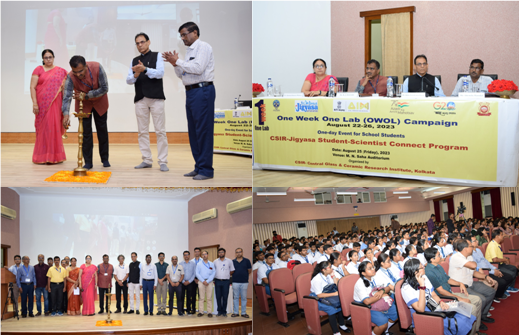
    Under the “One Week One Lab” Campaign CSIR-Central Glass and Ceramic Research Institute (CGCRI), Kolkata conducted a school connect programme on 25th August, 2023. It was intended to promote scientific temper among school students and encourage them to pursue research in different scientific domains. Dr S.K. Mishra, Director CSIR-CGCRI welcomed the participants. The Chief Guest Dr. K. J. SreeramDirector of CSIR-Central Leather Research Institute highlighted the role of CSIR in nation-building activities, and the Guest of Honour Dr. Arun Bandyopadhyay, Director of CSIR – Indian Institute of Chemical Biology inspired the students to pursue science for the best interest of the nation. This event was attended by around 295 students and 28 teachers from 7 schools. Participant schools included Kendriya Vidyalaya, Dumdum, St. Xaviers Institution, Laxmipat Singhania School, Silver Point School, Mukul Bose Memorial School, Jadavpur High School, and The Summit School. The school participants in this program enjoyed different scientific activities, including popular lectures, live interactive sessions, different product demonstrations of CSIR-CGCRI, scientific Quizzes, virtual lab platforms, and many more. Scientists working in different fields showcased CGCRI’s various advanced technologies.

    Legend (clockwise from left): Lighting of the lamp; dignitaries on the dais; the audience during the popular lecture session; group photo with dignitaries and team

    ****