International Lesson Learning Workshop of Infrastructure for Climate Resilient Growth program

 Minister of State for Rural Development and Consumer Affairs, Food & Public Distribution, Sadhvi Niranjan Jyoti inaugurated International Lesson Learning Workshop of the Infrastructure for Climate Resilient Growth program yesterday. Secretary (Rural Development), Shri Shailesh Kumar Singh, the British High Commissioner to India, Shri Alex Ellis, the Resident Representative of UNDP, Shri Isabelle Tschan, Joint Secretary (Mahatma Gandhi NREGA), Shri Amit Kataria and Director (Mahatma Gandhi NREGA), Shri Dharmvir Jha were also present on the occasion. Sadhvi Niranjan Jyoti, along with all notable guests jointly unveiled a book showcasing 75 success stories of climate resilience. This compendium, compiled by UNDP, highlights the significant role of the Mahatma Gandhi NREGScheme program in strengthening the climate resilience of vulnerable communities.

In her address, Sadhvi Niranjan Jyoti highlighted the nation’s unwavering commitment to building climate-resilient infrastructure for sustainable development. A shining example of this is the Mahatma Gandhi NREGA scheme, which is leading the way in conserving water and bridging vital gaps. Secretary, Shri Shailesh Kumar Singh praised the efforts of State Governments, acknowledging that without their support, the program would not succeed in integrating climate resilience into the planning and implementation of the Mahatma Gandhi NREGScheme. During the event, a recorded message of the Minister of State for Indo-Pacific, Government of United Kingdom, Ms. Anne-Marie Trevelyan was relayed. In her message, she underscored the deepening trust and partnership between the two Nations in the realm of climate resilience, emphasizing their commitment to working together.

The British High Commissioner to India, Shri Alex Ellis conveyed that India’s climate action plans and development agenda place great importance on Adaptation and Resilience, making them a key focus area of the India-UK partnership. The technical assistance programme ‘Infrastructure for Climate Resilient Growth’ (ICRG), which was jointly conceived by the Ministry of Rural Development, Government of India and Foreign, Commonwealth and Development Office, Government of United Kingdom, added value to the Mahatma Gandhi NREGScheme by way of integrating climate change considerations into the planning and implementation of the Scheme. The Resident Representative of UNDP, Shri Isabelle Tschan underlined that during the implementation of ICRG programme, UNDP used approach of building capacities of the key stakeholders including the rural communities and engaged them in planning and implementing Mahatma Gandhi NREGS. The efforts have showcased the success of this concept and approach to building resilience of the rural poor.

During his welcome note, Joint Secretary, Shri Amit Kataria highlighted the ICRG program as a demonstration of how climate-informed planning of Mahatma Gandhi NREGA infrastructure can contribute to resilient livelihoods through initiatives such as groundwater recharge, micro-irrigation, soil and water conservation, and plantations. During the workshop, the states of Bihar and Odisha, where the ICRG program was implemented, shared valuable insights on how MGNREGS has facilitated more effective investment in natural resource management (NRM) infrastructure. These insights focused on supporting resilient livelihoods, particularly in the agricultural sector.

The workshop saw participation from various national and international experts who covered a range of topics related to climate resilient growth. Lessons from Climate Resilience and Information and Systems Planning (CRISP-M tool) implementation were also shared by from International Institute of Environment and Development (IIED), United Kingdom. IIED discussed the innovative use of GIS and climate information for planning water conservation and harvesting. This approach aims to achieve long-term drought proofing and enhance flood resilience, showcasing the potential of technology in addressing water-related challenges in the context of climate change. Riya Rahiman from the Coalition for Resilient Infrastructure (CDRI) presented on the importance of early action and early warning systems in building climate and disaster resilience. She also shared case studies from Small Island Developing States (IRIS), highlighting practical examples of resilience-building efforts in vulnerable island communities.

Chief of Social Policy at UNICEF India, Shri Hyun Hee Ban discussed the opportunities for MGNREGS to contribute to child, gender, and shock-responsive social protection. During the presentation, Shri Hyun Hee Ban highlighted how MGNREGS can be utilized to address the unique requirements of children, advance gender equality, and offer assistance during periods of shocks and crises. The focus was on maximizing the program’s potential to provide targeted support and social protection for vulnerable groups in such circumstances. Dr. Luigi Di Sarno from the University of Liverpool provided insights on low carbon and sustainable engineering solutions for durable and resilient constructions. The briefing covered innovative approaches and technologies that can contribute to the development of environmentally friendly and resilient infrastructure.

An advisor from FCDO Nairobi, Shri David Kinyua shared insights and learnings from the Hunger Safety Net Programme in Kenya. This involved discussing strategies and approaches implemented in the program to address food insecurity and build resilience among vulnerable populations in Kenya. Shri Vivek Coelho Programme Policy Officer (DRR/DRM) from the UN World Food Programme – India, presented on international experiences from the World Food Programme by sharing insights and lessons learned from the organization’s work in various countries, highlighting effective approaches to disaster risk reduction and management in the context of food security.


*****

National Pension System (NPS) and Atal Pension Yojana (APY)

 The number of subscribers under the National Pension System (NPS) and Atal Pension Yojana (APY) together have grown to more than 6.62 crore and the total Asset Under Management (AUM) has reached Rs. 10 lakh crore (Rs. 10,00,000 crore).

The segment wise status of the NPS and APY as on 25.08.2023:

Sector

AUM (In Rupees)

Central Government

2,40,902.87

CAB

42,246.13

State Government

4,36,071.72

SAB

63,133.73

Corporate

1,35,218.06

All Citizen Model

47,663.36

NPS Lite

5,157.12

APY

30,051.28

Total

10,00,444.26


The Pension Fund Regulatory and Development Authority (PFRDA) regularly carries various initiatives to enhance financial education, empowering subscribers to make well-informed decisions and leverage the advantages of the formal financial sector while maintaining a clear understanding of associated risks and trade-offs.

About NPS

The National Pension System (NPS) has been implemented for all Government Employees (except armed forces) joining Central Govt. on or after 1st January 2004. Most of the State/UT Governments have also notified the National Pension System (NPS) for their new employees. NPS has been made available to every Indian Citizen from 1st May 2009 on a voluntary basis. Further, from 1st June 2015, the Atal Pension Yojana, has been launched which has given the much-required impetus to the social security schemes.

About National Pension System Diwas (NPS Diwas)

In pursuit of the objective to promote pension and retirement planning, PFRDA annually celebrates October 1st as “National Pension System Diwas (NPS Diwas)”. This initiative contributes to the financial self-sufficiency of Indian citizens in their post-retirement phase. In observance of NPS Diwas this year, PFRDA has a planned a month-long sequence of digital media and publicity initiatives. These endeavours are strategically designed to commemorate NPS Diwas and effectively communicate the importance of pension planning to the subscribers as well as to the general public.


****

NB/VM/KMN

Literacy Week from 1st to 8th September 2023 under ULLAS: Nav Bharat Saaksharta Karyakram


The Government of India has decided to organise a literacy week from 1st September to 8th September 2023 to celebrate International Literacy Day for generating awareness among all the stakeholders/ beneficiaries/ citizens about the ULLAS- Nav Bharat Saaksharta Karyakram. The week-long literacy campaign shall enable mass participation to inculcate a sense of Kartavyabodh and Janbhagidari in each and every citizen of the nation. This vision would popularise the scheme and help us attain the goal of making India fully literate. The literacy week would encompass a spectrum of activities (given below) followed by the celebration of International Literacy Day on 8th September 2023.Another main objective will be to increase the number of registrations for learners and volunteers on the ULLAS mobile app. Students of Govt./aided schools,CBSE affiliated Schools,NVS, KVS, Teacher Training Institutions under NCTE, HEIs (Degree colleges/Technical institutions) under a University/AICTE, Scouts and Guides, NYKS, NCC, NSS Volunteers, Anganwadi Workers, Gram Panchayats, Farmers, Women, Retired Employee etc.Retired Employees, ICDS/ One Stop Centres, Members of Schools Management Committees, Self Help Groups (SHGs), Neo-literates, Non-literates, etc. and citizen of country are going to partake in the campaign.

A Centrally Sponsored Scheme ULLAS- Nav Bharat Saaksharta Karyakram on Education for All (erstwhile termed as Adult Education), was approved by Government of India for implementation during FYs 2022-27 in alignment with National Education Policy (NEP) 2020. The Scheme has five components, namely (i) Foundational Literacy and Numeracy, (ii) Critical Life Skills, (iii) Basic Education, (iv) Vocational Skills, (v) Continuing Education. The logo, slogan/tagline-Jan Jan Sakshar and popular name- ULLAS (Understanding of Lifelong Learning for All in Society) of Nav Bharat Saksharta Karyakram has been launched by the Union Education Minister Shri Dharmendra Pradhan on 29.07.2023 in New Delhi during the celebration of 3rd anniversary of National Education Policy (NEP) 2020.

S.No.

Event/Activity

1

Meetingsby District Education Officers and District Literacy Mission Authority for sensitization of ULLAS- Nav Bharat Saaksharta Karyakram.


2

Meetings at Gram panchayats involving Panchayat Raj Institutions (PRIs) on ULLAS-Nav Bharat Saaksharta Karyakram

3

Rallies/ Cycle Rallies/ Prabhat Ferries/ Nukkad Nataks etc. by studentsand teachers with banners and placards about ULLAS-Nav Bharat Saksharta Karyakram


4

Workshop/conferences/seminars on awareness about ULLAS Nav Bharat Saksharta Karyakram


5

Radio jingles and short films

6

Awareness through posters, pamphlets like displayon public places like wall paintings, posters, etc.

7

Tree plantation drive, debate anddiscussion about environment awareness, cleanliness drives by Stakeholders.


*****

NCERT as Deemed-to-be-University

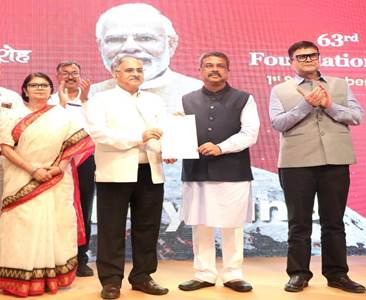
 Union Minister for Education and Skill Development & Entrepreneurship Shri Dharmendra Pradhan attended the 63rd Foundation Day Celebration of NCERT today in New Delhi. The Minister also inaugurated a new Information and Communication Technology (ICT) laboratory of the CIET on the occasion. Secretary, Department of School Education & Literacy, Ministry of Education, Shri Sanjay Kumar; Director, NCERT, Prof. Dinesh Prasad Saklani; Chancellor, NIEPA, Shri Mahesh Chandra Pant, and senior officials of the Ministry of Education, NCERT, Kendriya Vidyalaya Sangathan, Navodaya Vidyalaya Samiti and CBSE were also present.

Speaking on the occasion, Shri Pradhan informed that NCERT has been given the status of a Deemed-to-be-University. NCERT has established a formidable presence in research, actively shaped school education, teacher training, and adult literacy. NCERT on becoming a research university will offer opportunities for global collaborations and contributions to the global educational landscape, he added.

The Minister further said that Jadui Pitara- -a play-based learning-teaching material tailored for children between the age group of 3-8 years developed by NCERT will come up as a instrument of change that will benefit 10 crore children of the country, he stressed.

Shri Pradhan also emphasized developing content in mother tongue. He suggested setting up Augmented Reality, Virtual Reality and Artificial Intelligence labs in all 7 regional centres of NCERT. To make India the global hub of research and innovation these centres should be equipped with the latest technologies from around the world with future-ready infrastructure, he added. He also urged NCERT to standardize the Teachers’ training curriculum to NCERT in its ECCE.

Shri Pradhan also mentioned that children of the country should be ready for the Industrial Revolution 4.0. He suggested developing small booklets on varied subjects that will provide the facts on the subjects like India’s COVID-19 management, Chandrayaan 3, etc. The new generations must be taught of the latest developments as well as Indian values and ethos, he emphasized.

Shri Sanjay Kumar praised the efforts made by NCERT in developing learning materials in line with the suggestions of NEP2020. He stressed on the importance of bringing all the streams like art, science, vocational studies etc. into one platform to provide holistic learning to the children. He also informed NCERT will be developing educational material in all 22 languages with the help of software like Anuvadini.

During the event, the students of the Regional Institute of Education, Bhopal, also presented a skit on Jadui Pitara along with song performed in 22 languages. A short film was showcased during the function that highlighted several significant initiatives and achievements of NCERT.

****

International Aerospace Conference jointly organized by MoCA and CII

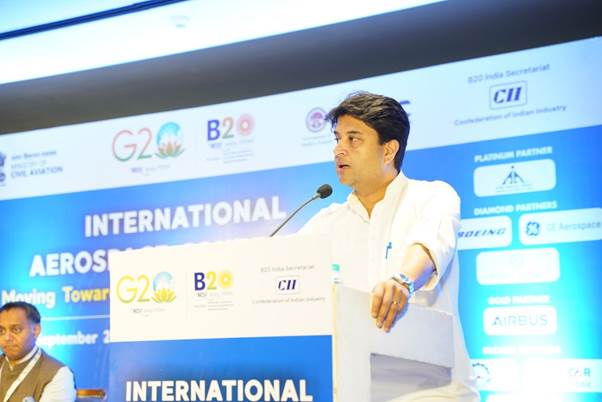
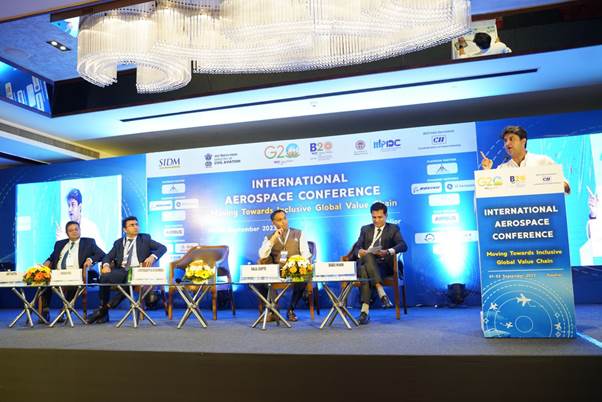
 Shri Jyotiraditya M Scindia, Union Minister for Civil Aviation & Steel today inaugurated the ‘International Aerospace Conference: Moving Towards Inclusive Global Value Chains’. It is being jointly organised by the Ministry of Civil Aviation and Confederation of Indian Industry (CII) on 1st and 2nd September 2023 in Gwalior, Madhya Pradesh.

Image

The International Aerospace Conference is a G20 initiative in the aerospace sector under G20 and B20 priority, focusing on developing inclusive global value chains for Global trade and Investment and aims to promote and strengthen trade and investment among the G20 countries.

In his inaugural address, Shri Jyotiraditya M Scindia said that now it is time for global aerospace industry players to supplant themselves to India and there are multiple reasons for it: A) Development of Infrastructure: Indian civil aviation sector had only 74 airports nine years ago; now it has moved to 148 airports including heliports and water aerodromes. And the government is committed to take this number upwards of two hundred in coming three to five years;  B) Availability of aircrafts: Earlier there were 400 planes in 2014 now this number has reached almost 700 and nearly 1000 more on order; C) Ecosystem Development: The disinvestment of Air India has brought about a transformation in civil aviation industry in the country, not only for passengers, not only airports, but also for MROs, for manufacturing sector, and for cargo. The huge orders of aircraft placed by Air India and Indigo and the emergence of new players like Akasha is another example of the changes that are taking place in Indian civil aviation industry;  D) Thrust on Regional Connectivity: UDAN has given birth to 4 new regional airlines in the country. The hub and connectivity network we have been talking about for decades is a reality in India today.

Image

Talking about the aviation infrastructure in the city of Gwalior, Shri Scindia assured that the development of the new integrated domestic terminal of the Gwalior Airport will be completed within shortest record-breaking time of fifteen month. He also assured greater and consistent support from the government for the holistic growth of aerospace manufacturing in India.

During interaction with the dignitaries, the Minister emphasized that under the leadership of Prime Minister Shri Narendra Modi, we believe in being monumental in our approach rather than being incremental and this stands true for the civil aviation sector as well, where liberalized drone policy & Production Linked Incentive Scheme for drone and its components, implementation of DigiYatra, New MRO Guidelines, and helicopters for last mile connectivity – have made the sector more accessible for its customers.

In the conference, panels of luminaries will be discussing a range of issues pertaining to global value chains and how to make them all-inclusive. The conference involves five sessions covering the following issues:

  • Spawning Global Value Chains in Design & Robust Aerospace Manufacturing: Importance of MSMEs
  • Integrated Global MRO Services
  • Women in Aviation: Fireside chat
  • Advanced Technologies in Aerospace & Air Mobility: Changing Skill Sets
  • Building Scale in Aerospace Manufacturing

In the last couple of decades, there has been a mammoth increase in Global Value Chains which has transformed the global economy. Over these years, GVCs have worked as an engine of growth and driven economic growth, technological innovation, and job creation. This event will further contribute to preparing India towards matching the challenges that the global supply chain offers.

***

Launch of the warship Mahendragiri in Mumbai


The launch of Mahendragiri is a significant milestone in our maritime history. It is the last of the seven warships of the Nilgiri-class stealth frigates built under Project 17A. Last month, Hon’ble President, Smt. Droupadi Murmu ji launched ‘Vindhyagiri’, the sixth frigate and the predecessor of this ship, which was built by Garden Reach Shipbuilders & Engineers Ltd. in Kolkata, the City of Joy.

A pleasant coincidence, a year ago, we had attained a new milestone. On 2nd September 2022, Hon’ble Prime Minister, Shri Narendra Modi ji had commissioned the country’s first indigenous aircraft carrier INS Vikrant at Cochin Shipyard Limited. It was just a year ago. Reflecting the aspirations of new Bharat, Vikrant stands as a symbol of indigenous potential, indigenous skills and our ambitions to ride over high-tides.

Let me share another accomplishment today that makes us all proud. It reflects our technological promise and deep penetration. UPI recorded over 10 billion transactions worth Rs. 15 trillion as of August 30, according to data issued by National Payments Corporation of India. Friends, this will make all of us very proud. Indeed a phenomenal feat that epitomises a big change taking place all over India.

The launch of a warship – Mahendragiri – is some kind of record, this indicates the best of progress we are having in this country, and this will mean five launches of the same class of warships in about 15 months- a feat that makes us all proud.

The warship Mahendragiri, named after a mountain peak in Eastern Ghats located in Odisha, is an engineering marvel, with state-of-the-art features and cutting-edge technologies. This majestic warship is a remarkable symbol of our nation’s strength and maritime prowess. A testament to the unwavering commitment and indomitable spirit of the Indian Navy that has ever made us proud in all kinds of situations.

The speed of manufacturing warships has improved ever since the new method of “integrated construction” has been adopted and this has yielded geometric results for the nation’s welfare.

The Nilgiri-class warships have been designed in-house by the Indian Navy’s Warship Design Bureau, the pioneer organisation for all warship design activities. Friends, this was not without many that the Naval Chief said ‘Made in India, Made for India, Made by India.’ And that is something which you could not object or contemplate a few decades ago. This is a great moment of joy for all of us.

Aligning with the country’s resolute commitment to ‘Aatma Nirbharata’, a substantial 75% of the orders for equipment and systems of the Nilgiri class have been made to indigenous firms. This is an important, but what is more important, what is more significant, the greatest impactful situation is that this job has been given to small, micro and medium enterprises; their contribution in this state of art Mahendragiri is commendable, which speaks about inclusive growth and involvement of our small enterprises.

The launch of Mahendragiri is an apt testament to the incredible progress our nation has made in building a self-reliant naval force. Amid evolving power dynamics in the Indian Ocean Region (IOR), this launch gains added strategic importance. India’s recent phenomenal economic rise and global ascendancy imperatively call for a modern Navy to protect its maritime interests and shoulder additional responsibilities, particularly in the current geo-political and security situation that prevails in the Indian Ocean region. It is soothing to note that the issue is being very well attended by the Government and the Navy.

Congratulations to all officials, engineers, workers and all other small and micro enterprises that have fructified this great occasion today. It is only apt that this symbol of India’s growing maritime power is being unveiled here in Mumbai.

The docks with a rich history of 250 years, will make anyone proud in the world and the journey of 250 years has been negotiated, traversed by the skill, hard work, dedication of the human resource and the competent leadership that has resulted in this great day. Therefore, it is very apt, befitting, and imminently stable that this is taking place in Mumbai. The docks with a rich history of a social and economic trajectory of the Diamond City and of the nation.

There is no city in the world as vibrant as Mumbai. Mumbaikars are never in complaint mode. They are always in gear to perform. This is one such testimony.

Friends, not many countries have the kind of history which we have. Our civilization dates back to thousands of years but when it comes to the maritime past, oceanic influence has been there for 2000 years.

Since the time of Indus Valley Civilization, we have been a seafaring nation. One of the earliest docks in the world was at Lothal– which connected the city to an ancient course of the Sabarmati River on the trade route between Harappan cities in Sindh and the peninsula of Saurashtra. Today, our nation stands at the cusp of remarkable growth.

The Naval Chief focused that we are going to be the third largest global economy. In September, 2022, we became the fifth largest global economy and in the process we all took over our colonial rulers; they ruled us for 200 years. उनको  पछाड़ कर, पांचवे पायदान पर आना, हर भारतीय के लिए गर्व का मौका है और ये हमने तब हासिल किया जब कुछ दशकों पहले इसकी कल्पना नहीं की जा सकती थी । The credit goes to the Government, the leadership, the vision, and every Indian who has contributed to this great growth.

Friends, by all consideration India will be the third largest global economy by the end of this decade. Now, when the economy grows, when trade grows, what we are doing today has great relevance. A growing economy means higher volumes of trade. Over 90% of the India’s trade by volume and over 68% by value, moves through maritime routes at present. This further underlines the importance of Navy and what we are doing today. हर भारतीय आज एक बात देख रहा है कि दुनिया में जो भारत का नाम है वो परकाष्ठा पर है। भारत के पासपोर्ट की क्या कीमत है, भारतीय होने में क्या अभिमान है, वो हम अपनी आँखों से देख रहे है । In such a situation, our eyes are well set for Bharat@2047 – the centenary celebration of its independence. I have no doubt some of us may not be around but youngsters will be around, Bharat will surely emerge as a global leader and a stabilizing force.

India’s maritime strength is quintessential for our economic and strategic upsurge. It is heartening to note that the stealth frigates of Project 17 Alpha have over 75% indigenous content. This is a significant contribution towards Prime Minister, Shri Narendra Modi ji’s vision of Make in India & ‘Aatma Nirbhar Bharat’. These are not empty slogans, these slogans have resulted in mega big ticket infrastructure projects in this country, what we have is at par with the best in the world today.

It shows the steadfast dedication to foster and believe in our own skilled people, their technique, their contribution, their innovation, and this is taking place in different sectors as well. The multi-mission frigates of this series would be capable of dealing with all kinds of threats to our maritime interests. The threats are multiplying and the role of India is increasing. The world is looking at us to secure these areas and it is gratifying to note Bharat has risen to the challenge, Indian navy has risen to the challenge, Mazagon Dock builders has risen to the challenge and that is why our country will ever be on the rise. The rise is unstoppable.

The Government of India has created an enabling policy architecture to promote the domestic defence sector. Go to Uttar Pradesh and Tamil Nadu you’ll see the defence corridors, they are functional, they indicate the times that are being seen by us.

It is indeed a matter of pride that the value of defence production in India has crossed the figure of Rs. One lakh crore for the first time ever during the financial year 2022-23 on our home front which is bound to geometrically increase. I have no doubt about it.

The Government had launched the Innovations for Defence Excellence (i-DEX) scheme to involve Start-ups, research institutions and academia in designing innovative solutions for our defence sector. This has resulted in big impactful development. More than 300 Start Ups have been engaged through i-DEX. Each of them will be contributing qualitatively in a significant area.

I congratulate the Indian Navy that they have the Directorate of Indigenisation – with the motto ‘Ideate, Innovate, indigenize’. This is an impactful step in the right direction. This motto very captures what Bharat is today.

Friends, when there is increased capability, when there is growth, when the world looks up to you, when you become a real global power, the challenges are not far behind. The challenges pursue you, they call upon you to be ever prepared to sustain the place and enhance your position.

India has emerged as a Net security provider in the Indo-Pacific region. Thanks to the capability of our naval force and its infrastructure. Today, we are an important global player to secure and ensure a peaceful, Rule-Based Maritime Regime across the nations. When there is something in the ocean, it becomes very imperative to ensure there is Rule-Based Maritime Regime, which is under stress at the moment, which is challenging at the moment. Therefore, what we are doing today is a step in the right direction to sustain, generate, and evolve a wholesome mechanism of Rule-Based Maritime Regime.

The security in the Indian Ocean Region, and the larger Indo-Pacific has diverse challenging aspects. That is known to all connected with the geopolitics of the region. This has attracted global attention also, as it has an element of strategic and economic aspects. These encompass concerns like piracy, smuggling of narcotics, human trafficking, illegal migration and natural disasters. All these are up to the Navy to perform, and the good part is that our Navy has vindicated in an exemplary fashion, thanks to the commitment of the Human Resource involved therein.

The discharge by the Indian Navy of the mandate to protect, preserve, and promote India’s maritime interests, could not have been more able. It is at the highest peak. I congratulate our naval force, I have full confidence that they will keep improving themselves for the security of the world at large.

Friends, like our country, like our civilizational ethos, like our belief that the world is one family, we stand for peace, harmony and global development. Our Navy has been a vehicle of peace and goodwill during the crisis. As Governor, state of West Bengal, I can tell you, I had first-hand experience of seeing the performance of our Navy and Coast Guard. There was not a single mortality on the high seas, when we had a number of cyclones. The damage to property was also absolutely limited.

Under the overarching vision of SAGAR (Security and Growth for All in the Region), India is cooperating with multiple partners to ensure economic growth & security in the region while also tackling threats.

Ladies and gentlemen, going beyond cutting-edge technology, the key asset that gives the Indian Navy an edge over others is our rich human resource. Their courage, competence and commitment make them the Navy’s true force multiplier. Other things can be there, but if there is no spinal strength of human resource, things can’t be productive. We as a nation are lucky that our human resources are dedicated, competent, skilled and quick to learn, we are proud of it.

We are also proud of the significant and laudable role that the women are playing in our defence forces. A few decades ago, when I was elected to the Parliament in 1989, this was unthinkable, I am a product of Sainik School, Chittorgarh, but it was beyond our contemplation that women would be playing such a significant role. Look at where we have come now. With a strong presence of over ten thousand women across the army, navy, and air force, the Indian armed forces have made considerable strides in gender equality.

We are an example to the developed world, with the kind of assignment that women are handling. Notably, women are now actively serving in combat roles in all branches, underlining their capabilities and commitment to serving the nation. The cementing of women’s position in the Indian Navy showcases a remarkable timeline: from the establishment of Short Service Commission in 1992, to June 2023, which saw the integration of women into all branches, cadres, and specializations of the Navy and other defence forces. Today, women are ably taking up roles on-board warships. This is a qualitative change because we are having involvement of 50% humanity. This is a turning point.

The launch of the warship today carries the clear message that India will continue to invest in her maritime power. It was a proud moment for me as Rajya Sabha Chairman, when the Hon’ble Defence Minister responded, “When it comes to the Defence budget, we do not go by the percentage of budget spending, we go by what is needed & it shall be done”. That was a Policy statement, reflecting the attitude of our government that our defence aspects are always a Priority and shall never be compromised.

This will further the nation’s strategic reach while ensuring safe and prosperous maritime order for all. I am sure that Mahendragiri, once commissioned, will proudly fly the Tiranga across the oceans, as an ambassador of India’s maritime might. When it comes to Tiranga, when it comes to Shiv Shakti point, you know what we saw recently, we stamped these two very important aspects even on the moon, something the world has never seen before.

Once again, congratulations to the Indian Navy, MDL, the designers, engineers, workers and everyone involved in the construction of this magnificent warship. Bharat is really proud of all those who have toiled hard to bring this ship to reality.

May Mahendragiri prove – Jalameva Yasya Balameva Tasya! (जलमेव यस्यबलमेव तस्य)- जिसका समंदर पर कब्जा है वही सबसे बलवान है!

मेरे मन में कोई शंका नहीं हैहजारों साल पहले जहां भारत थाविश्व की पराकाष्ठा पर थाविश्व का Economic Giant थाज्ञान का भंडार थादुनिया हमारी तरफ देखती थी. अब बदलाव आ गया हैजो लोग हमको राय दिया करते थेवह हमसे आज राय लेते हैंवह दिन दूर नहीं है… We will be at Number-1, and that will be the best that can happen to this planet because we stand for peace, prosperity, harmony and growth of all and treat world as one family.

Jai Hind!

*****

10th convocation of Guru Ghasidas Vishwavidyalaya

 The President of India, Smt Droupadi Murmu graced and addressed the 10th convocation of Guru Ghasidas Vishwavidyalaya at Bilaspur, Chhattisgarh today (September 1, 2023).

Speaking on the occasion, the President said that in the modern world, the individuals, institutions and countries should remain ahead in innovation and adopting science & technology for greater progress. She added that for the development of science and technology, appropriate facilities, environment and encouragement are needed. She was happy to note the establishment of Accelerator Based Research Centre at the Guru Ghasidas Vishwavidyalaya. She expressed confidence that this Centre would make its mark through useful research.

Speaking about the recent success of Chandrayaan-3 mission, the President said that behind that success was not only the ability acquired through years of hard work and dedication, but also the commitment of moving forward without getting discouraged by the obstacles and failures. She urged the Guru Ghasidas Vishwavidyalaya to organize knowledge-enhancing programs and competitions on this historic achievement which would help in developing scientific temper in the society.

The President said that today India is a respected member of the Nuclear Club and the Space Club on the strength of hard work and talent of our scientists and engineers. She added that the example of ‘High Science’ at ‘Low Cost’ presented by India is appreciated in the country and abroad. She said that by attaining high level competence, students of this university can participate in important decisions of society, state and country. She added that creating opportunities amid challenges is an effective way to achieve success.

The President said that Guru Ghasidas had spread the immortal and living message that all human beings are equal. About 250 years ago, he advocated for the equality of underprivileged, backward and women. She said that youth can build a better society by following these ideals.

The President noted that there are a large number of tribals in the area around the Guru Ghasidas Vishwavidyalaya. She said that students can learn life values like sensitivity towards nature, sense of equality in community life and participation of women from the tribal community.

Please click here to see the President’s Speech – 

***