Amendments to streamline Food Safety and Standards Regulations

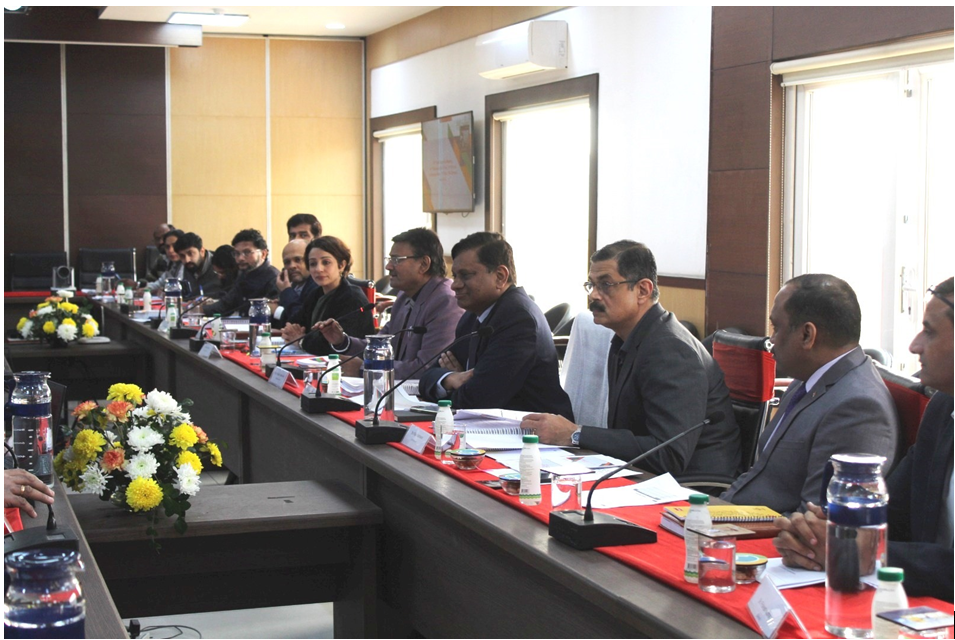
 In a move that would facilitate ease of doing business through the concept of ‘One Nation, One Commodity, One Regulator’, the Food Safety and Standards Authority of India (FSSAI) in its 43rd meeting held recently  in New Delhi under the chairmanship of Union Health Secretary, Shri Apurva Chandra, approved various amendments to streamline food safety and standards regulations.

WhatsApp Image 2024-02-05 at 5.jpeg

Various amendments across different Food Safety and Standards Regulations were approved in the meeting to do away with Bureau of Indian Standards (BIS) or AGMARK certification for food products. After the amendments are finalised, food businesses would not have to go to different authorities for mandatory certification with only FSSAI certification being made mandatory for food products.

Other approvals include standards of Mead (Honey wine) and Alcoholic Ready-to-drink (RTD) beverages, revision of standards of milk fat products, standards for Haleem etc.

The Food Authority also approved a first-of-its-kind and comprehensive manuals of methods of analysis for ensuring regulatory compliance of the food products.

The amendments across different Food Safety and Standards Regulations were approved in the meeting for draft notification to invite stakeholder comments before finalisation. These regulations included the revision of standards of Milk Fat Products, as part of which the fatty acid requirements for Ghee will also be applicable for other milk fat products.

The Food Authority is also going to set standards for ‘Haleem’ as part of standards for meat products. Haleem is a dish made of meat, pulses, grains and other ingredients, which currently don’t have any set standards.

Shri G. Kamala Vardhana Rao, CEO, FSSAI; officials from the Ministry of Health and Family Welfare, Ministry of Commerce, Ministry of Consumer Affairs, Food and Public Distribution, Ministry of Law and Justice, Ministry of Micro, Small and Medium Enterprises; States and Union Territories attended the meeting. Representatives from industry associations, consumer organizations, research institutes and farmers’ organisations were also present in the meeting.

****

National Dental Commission

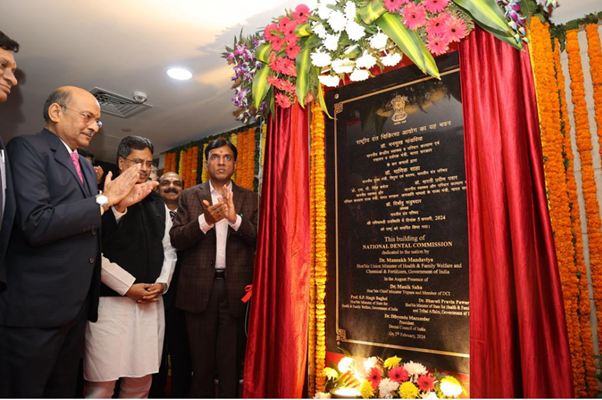
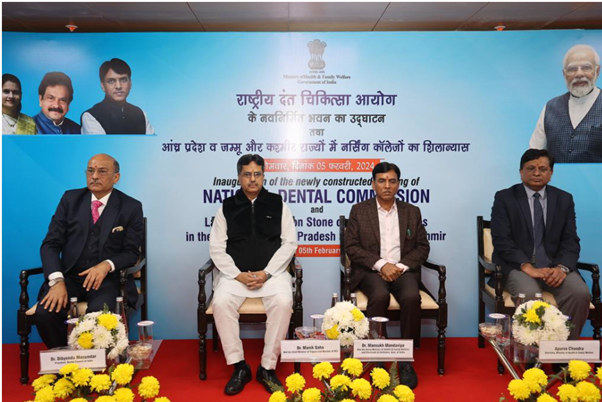
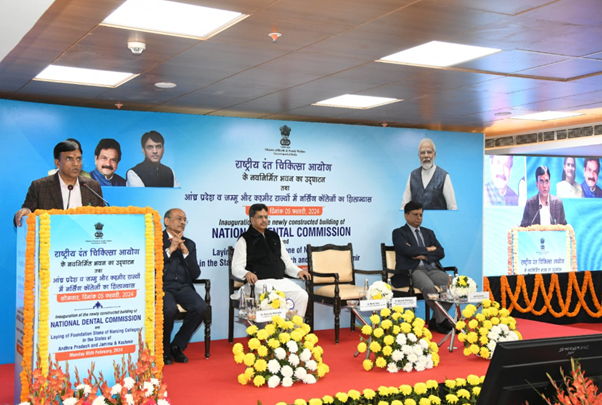
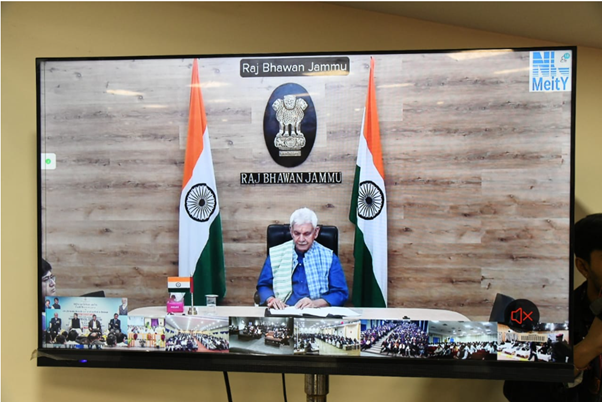
 In a significant step towards dental healthcare, the Union Minister of Health and Family Welfare Dr. Mansukh Mandaviya inaugurated the new headquarters of the National Dental Commission (NDC) and laid the foundation stones for three Nursing Colleges in Andhra Pradesh and one in Jammu and Kashmir virtually, here today. Additionally, Dr. Mandaviya presided over the MoU between the Dental Council of India and Quality Council of India for the assessment and rating of undergraduate dental colleges and launched the National Dental Register under the National Health Digital Mission. Dr. Mandaviya was joined by Dr. Manik Saha, Chief Minister of Tripura and Shri Manoj Sinha, Lieutenant Governor of Jammu and Kashmir joined virtually.

Dr. Mandaviya stated “the advent of Dental Commission heralds marking a new era in dental education and administration.” He further added “Through the Dental Commission Act, the government has made an effort to make dental education more practical, affordable and bring transparency in the entire system, simultaneously providing patients with affordable and good treatment.” Dr. Mandaviya declared “It is imperative to create awareness regarding oral hygiene enabling us to tap into the immense opportunities in this domain benefitting our nation.” Praising the vision of the Prime Minister, Shri Narendra ModiDr. Mandaviya lauded the proactive approach to health underscoring the magnitude of change ushered in for the benefit of all enhancing the accessibility and availability of healthcare services.

Addressing the gathering, the Union Health Minister emphasized with the launch of National Dental Register (NDR) created under One Nation One Register, the people of the country will get the identity and qualification of dentist in a transparent manner. He further added “NDR will provide Unique Identification (DCI ID) to all dentists practicing in India after verification from the respective State Dental Council. The NDR will also help citizens identify dentists verified by state dental councils.”

Highlighting the government’s commitment to strengthen the nursing workforce and mitigate healthcare disparities across regions, Dr. Mandaviya stated “this ceremony is a part of government’s scheme to establish 157 new nursing colleges co-located with existing medical colleges.” He further added “the advancements made in the sphere of health and medical infrastructure will provide quality and affordable healthcare and open many opportunities in the healthcare sector, vastly benefitting the nation.” He further added “with the increasing demand of trained Indian nurses abroad, the government has incorporated foreign language courses in medical education institutes providing an additional advantage to the students in capturing opportunities abroad citing the example of the foreign language course in Japanese that has been initiated in two of the nursing colleges in Assam.

Shri Manik Saha applauded the transformation taking place in the health sector and stated “the establishment of these institutions will benefit the common man enabling easy accessibility of affordable healthcare services.”

Addressing the gathering, Lieutenant Governor of Jammu and Kashmir, Shri Manoj Sinha, emphasized the pivotal role of nurses in healthcare delivery and stated that the establishment of nursing colleges is a significant step towards building qualified human resources in healthcare, aligning with national mandate for universal healthcare.

The event was attended by­­­­­­­­­­­­­­­­ Shri Apurva Chandra, Secretary, Ministry of Health and Family Welfare, Dr. Vipul Aggarwal, Joint Secretary, Ministry of Health and Family Welfare, senior government officials, Padmashri (1992), Padma Bhushan (2005) (HONY) BRIG. Dr. Anil Kohli, Padmashri Dr. R.K Bali, Dental Council of India, Dr. Dibyendu Majumdar, Chairman of Dental Commission of India, Dr. Montu M. Patel, President, Pharmacy Council of India, Dr. T Dileep Kumar, Indian Nursing Council, faculty and students of Sardar Patel PG Institute of Dental and Medical Science, Raj Bhawan Jammu, Buddha Dental Institute of Dental Sciences, Jammu and Kashmir Nursing College, Manchilpatam Nursing College Andhra Pradesh, Dental College, RIMS, Ranchi, Saveetha Dental College, Chennai, Siksha ‘O’ Anusandhan (IDS).

****

28th Session of the UN Climate Change Conference (COP28)

 An Inter-Ministerial delegation from India had attended the 28th Session of the UN Climate Change Conference (COP 28) held in Dubai, United Arab Emirates from 30th November 2023 to 13th December 2023.

 The subjects discussed at COP 28 included the First Global Stocktake, Global Goal on Adaptation (GGA), Loss and Damage Fund, Operationalisation of work programme on Just Transition pathways, Santiago Network for Loss and Damage and matters related to Article 6 of the Paris Agreement.

The First Global Stocktake (GST) decision calls on Parties to contribute in a nationally determined manner, taking into account the Paris Agreement and their different national circumstances, pathways and approaches to, inter alia, transition away from fossil fuels in energy systems, in a just, orderly and equitable manner, accelerating efforts towards the phase-down of unabated coal power, accelerating efforts globally towards net zero emission energy systems, utilizing zero- and low-carbon fuels well before or by around mid-century and to triple renewable energy capacity globally and double the global average annual rate of energy efficiency improvements by 2030. The decision commits to accelerate action on the basis of the best available science, reflecting equity and the principle of common but differentiated responsibilities and respective capabilities in the light of different national circumstances. The decision recognises the need to peak global emissions by 2025, and that time frames for peaking may be shaped by sustainable development, poverty eradication needs and equity and in line with different national circumstances. The decision stressed that Global Carbon budget is now small and rapidly depleting, and historical cumulative net carbon dioxide emissions already account for about four-fifths of the total carbon budget. The First GST also decided that any Unilateral measure should not constitute a means of arbitrary or unjustifiable discrimination or a disguised restriction on international trade. Developed countries have been asked to provide financial resources to the Developing countries for their climate actions. They have also been urged to fulfil the commitment of USD 100 billion per year through 2025.

In line with the mandate under the Paris Agreement to develop Global Goal for Adaptation, COP28 finalised the ‘Emirates Framework for Global Climate Resilience’, which gave Global targets in the areas of potable water supply, climate-resilient food and health services, resilient human settlement and culture. The targets also include the vulnerability assessment and establishment of multi hazard early warning systems.

The decision on the operationalization of the new funding arrangements, including a Fund, for responding to loss and damage,  promised at COP27, was adopted. The new fund is to be hosted by the World Bank for an initial period of four years. 19 countries made commitments totalling $792 million towards the fund and funding arrangements related to loss and damage.

COP28 delivered a Just Transition Work Programme. This programme will drive ambitious, equitable implementation across all pillars of the Paris Agreement. It encompasses pathways that include energy, socioeconomic, workforce and other dimensions.

On Santiago Network for Loss and Damage, the consortium of United Nations Office for Disaster Risk Reduction (UNDRR) and the United Nations Office for Project Services (UNOPS) were selected for hosting of the Santiago network secretariat for an initial term of five years.

Under the Article 6 decision, development of UNFCCC web-based platform for non-market approaches has been discussed. Parties will undertake identification, development and implementation of their non-market approaches once the UNFCCC web-based platform becomes fully operational.

This information was given by Union Minister of State for Environment, Forest and Climate Change Shri Ashwini Kumar Choubey in a written reply in the Lok Sabha today.

***

Compensation for Wild Animals Attacks

 Incidences of wild animal attacks have been reported from various parts of the country including from the state of Kerala. The steps taken by Government for protection of wildlife and management of human-wildlife conflict include the following:

A network of Protect Areas namely viz., National Park, Sanctuaries, Conservation Reserves and Community Reserving covering important wildlife habitat have been created all over the country under the provisions of the Wild Life (Protection) Act, 1972 to conserve wild animals and their habitats.

The Central Government provides financial assistance to State/Union Territory Governments under the Centrally Sponsored Schemes ‘Development of Wildlife Habitats, ‘Project Tiger’ and ‘Project Elephant’ for management of wildlife and its habitat in the country. The activities supported under the scheme include construction/erection of physical barriers such as barbed wire fence, solar powered electric fence, bio-fencing using cactus, boundary walls etc. to prevent the entry of wild animals into crop fields;

An advisory on dealing with human-wildlife conflict has been issued by the Ministry in February 2021. The Advisory recommends coordinated interdepartmental action, identification of conflict hot spots, adherence to Standard Operating Procedures, establishment of rapid response teams, formation of State and District level committees to review the quantum of ex-gratia relief, issuing guidance/instructions for expedited payments, and provision of adequate funds for suitable portion of ex-gratia relief to be paid within 24 hours to the affected persons in the case of death and injury to persons.

The Ministry of Environment, Forest and Climate Change has also issued Guidelines to States/UTs on 3rd June, 2022 on managing Human Wildlife conflict including damage to crops. It includes promotion of crops in forest fringe areas which are unpalatable to wild animals, agro forestry models which include cash crops like chillies, lemon grass, khus grass etc. suitably mixed with tree/shrub species. It also includes preparation and implementation of comprehensive long-term plan for alternate cropping by the state Agriculture/Horticulture Department under different schemes in vulnerable areas.

The Wild Life (Protection) Act, 1972 provides regulatory functions for dealing with human wildlife conflict situations.

The Ministry has provided financial assistance to Kerala under the Centrally Sponsored Schemes of Development of Wildlife Habitats for better protection of wildlife and improvement of habitat including for activities to curb human wildlife conflict. The details of funds released to Kerala under this scheme during last five years is as follows:

 (Rs. in lakh)


Name of the State/UTs

2019-20

2020-21

2021-22

2022-23

2023-24

Kerala

845.026

731.2845

295.7737

224.4735

921.0361


The States/Union Territories pay compensation as per their norms. The details of the number of persons who got injured or lost their lives due to attacks by wild animals and details of compensation provided by State Governments are not collated at the level of the Ministry.

The Ministry has recently, increased the ex-gratia payment in case of Human-Wildlife conflict. The revised rates of relief under ex-gratia are as follows:


S. No.

Nature of damage caused by wild animals

Amount of ex-gratia relief

(a)

Death or permanent incapacitation to human beings

10 lakh

(b)

Grievous injury

₹ 2 lakh

(c)

Minor injury

Cost of treatment upto Rs 25000/-per

(d)

Loss of property/crops

State /UT Government may adhere to the cost norms prescribed by them.


This information was given by Union Minister of State for Environment, Forest and Climate Change Shri Ashwini Kumar Choubey in a written reply in the Lok Sabha today.

***

Black-necked Crane

 The Wildlife Institute of India and the Zoological Survey of India have been carrying out assessment of the black-necked cranes. As per the survey conducted by Wildlife Institute of India in 2016-2017 in Ladakh region, the population size of black necked crane was around 66-69 individuals.In Arunachal Pradesh, a small population of approximately 11 individuals arrives during winter months.

The important steps taken to protect bird species include:

  1. The Black-necked Crane (Grus nigricollis) is listed in Schedule I of the Wild Life (Protection) Act, 1972, thereby according them the highest degree of protection.
  2. The species is also listed in Appendix I of Convention on International Trade in Endangered Species of wild fauna and flora and the Convention on conservation of Migratory Species.
  3. The important habitats of Black-necked Crane have been notified as a Protected Areas, for example, Changthang Sanctuary, Ladakh.
  4. The Tso Kar Wetlands Complex, an important foraging and breeding ground for Black-necked Crane has been designated as a Ramsar Site in December 2020.
  5. The National Wildlife Action Plan (2017-2031) released by the Ministry in October 2017 provides for specific Chapters and priority actions on various aspects of wildlife conservation like,  conservation of threatened species, mitigating human wildlife conflict, conservation of inland and coastal and marine ecosystems, landscape level conservation, etc.
  6. The Central Government provides financial assistance to State/Union Territory Governments under the Centrally Sponsored Schemes ‘Development of Wildlife Habitats’ for management of wildlife and its habitat in the country.
  7. In accordance with provisions contained under Section 33 of the Wild Life (Protection) Act, 1972, the Ministry has issued guidelines for the process of management planning for Protected Areas.
  8. The Government of India has initiated Mission LiFE (Lifestyle for Environment) programme, that aims to generate public awareness about the environment, and conservation.
  9. Important days such as World Wildlife Day,  Wetlands Day, Migratory Bird Day, etc. and  Wildlife Week are celebrated to bring in more awareness on wildlife and biodiversity among the public.


This information was given by Union Minister of State for Environment, Forest and Climate Change Shri Ashwini Kumar Choubey in a written reply in the Lok Sabha today.

***

Air quality grant to million plus cities

 The details of funds utilized under the Air Quality Grant sanctioned by 15th Finance Commission to Million Plus Cities/ Urban Agglomeration as aimed by the National Clean Air Program (NCAP) for performance-based grants for improvement in air quality for the period 2020-21 to 2025-26, city-wise;

The details of funds utilized under the 15th Finance Commission to support the implementation of City Specific Action Plans (CAPs) for improvement of Air Quality under the National Clean Air Programme along with the details for non-utilization of funds by non-attainment cities; and

The details of mobilization of City Specific Action Plans through the convergence of resources for Swachh Bharat Mission (Urban), Atal Mission for Rejuvenation and Urban Transformation (AMRUT), Smart City Mission, Sustainable Alternative Towards Affordable Transportation (SATAT), Faster Adoption and Manufacturing of Hybrid and Electric Vehicle – II (FAME), and other schemes?

Under the 15th Finance Commission air quality performance grant, an amount of Rs. 16539 crores has been allocated to 42 Million Plus Cities (MPCs) (including 7 Urban Agglomerations (UAs)) during FY 2020-21 to FY 2025-26 to implement city action plans to take measures to improve air quality. The details of city-wise utilization are provided at Annexure –I.

131 cities under NCAP have been requested to mobilize resources through convergence of various schemes for the implementation of city action plans. Action plans of all targeted cities under NCAP were approved under Swachh Bharat Mission 2.0 (Urban) for processing of solid waste, construction and demolition waste, remediation of legacy waste and procurement of mechanical sweepers. 107 cities have availed resources from the AMRUT 2.0 for developing green spaces, parks and non-motorised urban transport. 13,11,681 number of electric vehicles have claimed the benefit under FAME II in 20 States/UTs. Under SATAT, 27 Compressed Bio-gas (CBG) plants with the capacity of 146 TPD have been commissioned in NCAP cities.

Annexure-I


Details of release and utilisation of funds to Million Plus Cities under 15th Finance Commission- Air Quality Grant during FY 2020-21 to 2022-23


(amount in ₹ crore)


Sr. No.

City

Amount released

Amount utilisation

1

Vijayawada UA

124.35

27.61

2

Visakhapatnam UA

129.25

0.00

3

Patna UA

288.60

158.26

4

Durg Bhilainagar UA

112.35

31.66

5

Raipur UA

119.35

51.39

6

Ahmadabad UA

359.54

317.91

7

Rajkot UA

83.10

64.61

8

Surat UA

255.18

257.47

9

Vadodara UA

98.18

82.22

10

Faridabad UA

73.53

15.99

11

Dhanbad UA

63.09

53.21

12

Jamshedpur UA

116.85

38.14

13

Ranchi UA

93.50

48.25

14

Bruhat Bangalore UA

535.10

0.00

15

Bhopal UA

173.85

167.42

16

Gwalior UA

92.64

58.31

17

Indore UA

191.75

166.64

18

Jabalpur UA

112.25

108.65

19

Aurangabad UA

68.10

51.36

20

Greater Mumbai (GM) UA

929.09

604.64

21

Nagpur UA

132.60

17.71

22

Nashik UA

91.35

19.03

23

Pune UA

261.85

81.29

24

Vasai-Virar City UA

72.35

20.26

25

Amritsar UA

67.25

60.92

26

Ludhiana UA

91.75

54.94

27

Jodhpur UA

74.34

57.12

28

Jaipur UA

319.85

257.18

29

Kota UA

95.25

59.45

30

Chennai UA

367.00

367.51

31

Madurai UA

72.44

54.85

32

Tiruchirappalli UA

50.35

46.36

33

Hyderabad (HY) UA

443.50

377.35

34

Agra UA

166.47

130.52

35

Allahabad UA

171.33

132.93

36

Ghaziabad UA

136.25

114.57

37

Kanpur UA

239.89

211.48

38

Lucknow UA

376.38

226.26

39

Meerut UA

139.19

93.39

40

Varanasi UA

219.74

107.25

41

Asansol UA

67.60

42.55

42

Kolkata (K) UA

681.25

628.83


Total

8357.63

5465.49


This information was given by Union Minister of State for Environment, Forest and Climate Change Shri Ashwini Kumar Choubey in a written reply in the Lok Sabha today.

***

Closure of Pollution emitting Industries

 The Central Pollution Control Board (CPCB) has devised a ‘Standard Protocol for Conducting Inspections, Report Preparation and Action’. The action against violators is taken based on the guidelines prescribed in this protocol.

In general, for minor non-compliances, show-cause notice is issued to unit, in line with the principles of Natural Justice and to give an opportunity to the unit, before issuance of closure directions under Section 5 of the Environment (Protection) Act, 1986. However, closure directions under Section 5 of the Environment (Protection) Act, 1986 are issued directly to the unit if it is found grossly non-complying with regard to prescribed environmental standards and other shortcomings which have potential to cause grave injury to the environment. Some of such gross non-compliances include the following:

  1. Any bypass discharge of partially treated or untreated effluent and emission observed.
  2. Injection of treated or untreated water or both into ground water (reverse boring).
  3. Operating unit having defunct Effluent Treatment Plant (ETP) or Air Pollution Control Device (APCD) and/or operating without installation of ETP or APCD.
  4. Unauthorized disposal or dumping of hazardous waste likely to cause grave injury to the Environment.

 Based on Online Continuous Effluent/ Emission Monitoring Systems (OCEMS), CPCB has inspected 215 industrial units since 2020, out of which 83 units were found non-complying with environmental norms. Based on the severity of violations, closure directions were directly issued to 7 units without issuance of show-cause notice. All these 7 units have later complied with prescribed environmental norms. The list of 7 units to which closure directions were issued directly by CPCB is as below:

S. No.

Name of the unit

Sector

1

M/s. Mithila Dugdh Utpadak Sahkari Sangh Limited (Samastipur Dairy), Samastipur, Bihar

Dairy

2

M/s Hema laboratories, Raichur, Karnataka

Pharmaceutical

3

M/s Niox Speciality Paper Mill, Mehsana, Gujarat

Pulp & paper

4

Jagruti Sugar & Allied Industries Ltd, Devni, Maharashtra

Sugar

5

Dharashiv Sakhar Karkhana Ltd., Osmanabad, Maharashtra

Sugar

6

Astik Dyestuff Pvt Ltd, Ankleshwar, Gujarat

Dye & Dye Intermediate

7

M/s Athani Sugars Ltd., Maharashtra

Sugar


This information was given by Union Minister of State for Environment, Forest and Climate Change Shri Ashwini Kumar Choubey in a written reply in the Lok Sabha today.

***

Smart Food Grain Storage System transferred to Industry

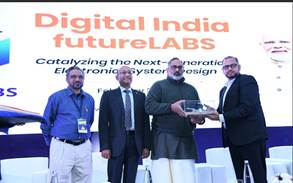
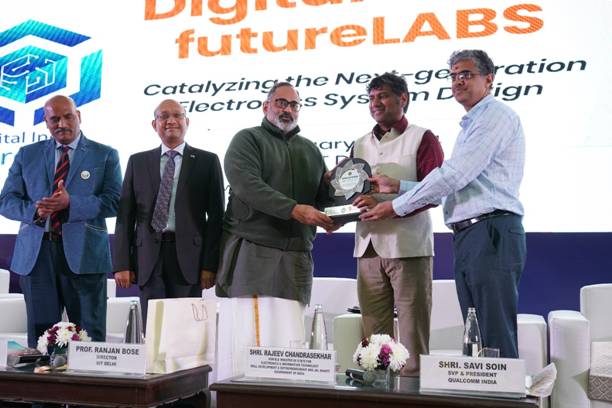
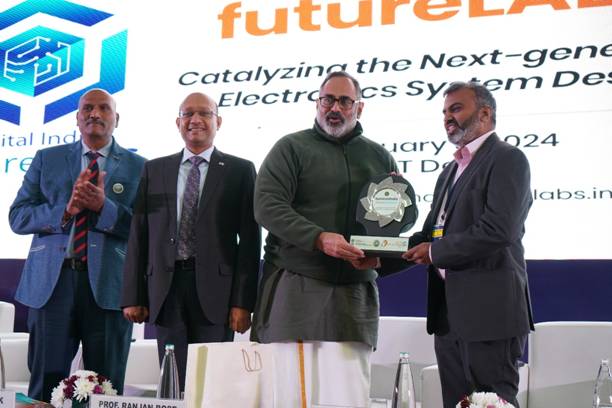
 During the launch event of “Digital India FutureLABS Summit 2024” held at IIIT- Delhi, the technology for Smart Food Grain Storage System (SAFEETY) which includes conveyorized loading & unloading of grain bags having RFID for traceability, online weight and moisture measurement with Radio Frequency Based Removal of Moisture from Grain has been developed by SAMEER under the aegis of MeitY. The technology has been transferred to M/s Paras Defense and Space Technology Ltd for manufacturing and supply of the systems. The system has capacity to handle almost one truckload (approx. weight: 28 tons) of grains in 40 minutes.

The exchange of technology transferred documents were made in the presence of Minister of State for Electronics & Information Technology, Skill Development & Entrepreneurship and Jal Shakti, Shri Rajeev Chandrasekhar; Smt Sunita Verma, GC R&D in E⁢  Dr P. H. Rao, DG-SAMEER; Shri Rajesh Harsh, CI, SAMEER, Mumbai; Dr Om Krishan Singh, Scientist ‘D’, MeitY; Shri Amit Mahajan, Director Paras Defense and Space Technologies Ltd and the Senior officials in Government.

Inauguration of Smart Food grain Storage System

Transfer of proto model of SAFEETY system by Hon’ble Minister of State, MeitY Shri Rajeev Chandrasekhar to Shri Amit Mahajan, Director, Paras Defense and Space Technologies Ltd

*****

futureDESIGN start-up companies under SemiconIndia Design Linked Incentive (DLI) Scheme

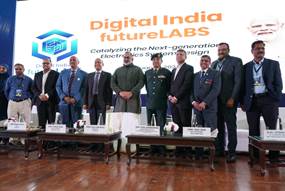
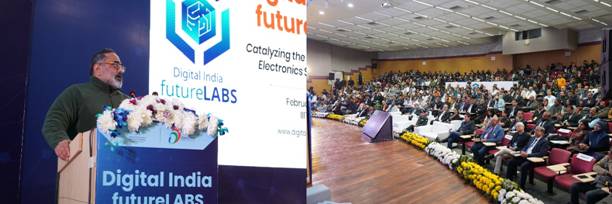
 An announcement on two futureDESIGN semiconductor fabless companies under the Semicon India Design Linked Incentive (DLI) scheme was made by Minister of State for Electronics & IT, Skill Development and Entrepreneurship, and Jal Shakti, Shri Rajeev Chandrasekhar during the launch of “Digital India FutureLABS” at IIIT Delhi. The Digital India FutureLABS Summit 2024 also witnessed announcement of 20 MoUs with Industry for implementation of the futureLABS in 6 verticals – Automotive, Compute, Communication, Strategic Electronics, Industrial Electronics/ IoT and Design & innovation.

A group of people in a roomDescription automatically generated

These two Karnataka based futureDESIGN semiconductor fabless companies announced for financial support under the DLI Scheme has been providing range of chipsets and solutions for communication and med-tech sectors.

Parag Naik, founder, Saankhya Labs, mentioned that – “Saankhya Labs is a wireless communication and semiconductor solutions company, designing a full spectrum of next-gen communication solutions for the present and the future. This includes products and solutions for broadband, satellite and broadcast applications including 5G NR, Direct to Mobile (D2M) Broadcast, rural broadband connectivity, satellite communication modems for IoT applications and multi-standard DTV modulators and demodulators.”

A group of men standing around a tableDescription automatically generated

Vijay Muktamath, founder, Sensesemi Technologies mentioned that – “As part of the DLI Scheme, Sensesemi will be developing the SoC for IoMT and IoT devices, that shall have MCU and wireless IP integrated with ultra-low power analog front end with AI inferencing IP. Sensesemi aims to drive India’s semiconductor capabilities by providing connected SoC for everything from smart wearables, med-tech sector and other connected devices.”

A group of men standing togetherDescription automatically generated

Earlier the ChipIN Centre setup at C-DAC under the SemiconIndia DLI Scheme announced the following support for state-of-the-art chip design tools from global companies-

  1. Support to academic institutions:
    1. EDA tools for academia from Synopsys to ‘pan-India academic institutions’, Cadence Design Systems to ‘150 institutions and Siemens-EDA & Ansys to ‘120 institutions’. At present, thousands of researchers & faculty members at 100+ academic institutions across the country are using these tools from ChipIN Centre to design their semiconductor chips.
    2. FPGA Hardware Boards from Xilinx to 100 academic institutions.
    3. Tapeout support to academia & start-ups for fabricating their designs at SCL foundry & overseas foundries.
  2. Support to start-ups: EDA tools for pan-India startups from Synopsys, Cadence Design Systems and Siemens-EDA to design their semiconductor chips.

In addition to these global companies, ChipIN is exploring to engage with other leading design & solution companies like- Keysight technologies & Silvaco for CAD/ EDA solutions and Qualcomm & NXP Semicondcutors for startup mentorship & support and enabling a global platform to start-ups. Engaged with over 125 academic instituions and 15 start-ups at present, ChipIN intends to become the one-stop center for chip designers across the country.

The Digital India futureLABS, coordinated by C-DAC, aims to tap into the trillion-dollar opportunity presented by the Electronics System Design and Manufacturing (ESDM) sector. The initiative seeks to move up the value chain, fortify domestic R&D, and create a collaborative ecosystem for the development of IPs, standards, and the next-generation Electronics System Design in the country.

Digital India futureLABS initiative announced by Minister Shri Rajeev Chandrasekhar combined with SemiconIndia futureDESIGN and futureSKILLS will define the #IndiaTechade and make India #ElectronicsProductNation and SemiconductorProductNation”.

***

two-day ULLAS Mela in New Delhi

 Union Minister of Education and Skill Development & Entrepreneurship, Shri Dharmendra Pradhan will inaugurate the two-day ULLAS Mela on 6th February 2024 at the National Bal Bhavan, New Delhi. Union Minister of State for Education Smt. Annpurna Devi will also be present as the Special Guest.

To achieve the target of 100% literacy by 2030, the Government of India is implementing a centrally sponsored innovative scheme called Nav Bharat Saksharta Karyakram or New India Literacy Program for the period of FYs 2022-2027. The scheme is popularly known as ULLAS: Understanding of Lifelong Learning for All in Society, upholding the motto “Jan-Jan Sakshar”. The scheme is targeted at all non-literates of age 15 years and above. The scheme, in line with NEP 2020, targets adults (aged 15 and above) who could not go to school or attain formal education. It focuses on imparting Foundational Literacy and Numeracy (FLN), through critical life skills, such as Digital Literacy, Financial Literacy, Legal Literacy, Environmental Literacy, Health & Hygiene, etc. Implemented in a hybrid mode, States/UTs have flexibility in offline, online, or combined approaches.

The scheme consists of five components: (i) Foundational Literacy and Numeracy; (ii) Critical Life Skills; (iii) Basic Education; (iv) Vocational Skills; and (v) Continuing Education. ULLAS is to be implemented through VOLUNTEERISM, encouraging citizen participation, emphasizing DUTY or Kartavya Bodh towards nation-building. The scheme contributes to India’s growth, by making India जन जन साक्षर. The ULLAS App has been developed to register learners, volunteers and also containing teaching learning material for them. The learners are certified as literate by way of twice-a-year assessments in September & March.

There have been substantial activities carried out under ULLAS in most of the States/UTs. Department of School Education and Literacy, Ministry of Education is organising ULLAS Mela on 6th-7th February, 2024 in collaboration with CNCL, NCERT to showcase various National and State level activities under ULLAS- Nav Bharat Saksharta Karyakram. The event will comprise various activities including felicitation of Neo-literates from the States/UTs who have successfully certified in the Foundational Literacy Numeracy Assessment Test (FLNAT), the launch of the ULLAS Concise Primers of the states/UTs in local languages, sessions on ‘Best Practices’, panel discussion, Prize distribution to the winners of poster-making competition held during the International Literacy Week. Seven hundred participants from various States/UTs along with more than 100 dignitaries from the Ministry of Education, States/UTs and various organizations will be participating in the event.  

The live broadcast links for both days are:

1. Live Streaming Link: 6th Feb 2024: https://www.youtube.com/watch?v=ySaBTI9jumE

2. Live Streaming Link: 7th Feb 2024: https://www.youtube.com/watch?v=cDvXqM4jh94

***

G20 Education Working Group Meeting under Brazilian Presidency

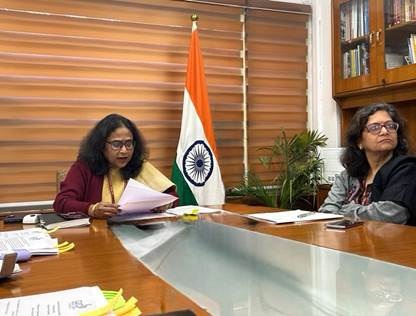
 Day one of the first Education Working Group (EdWG) meeting under Brazilian G20 Presidency was held virtually today wherein, the Indian delegation reiterated the government’s commitment to enhance the global education agenda.  The delegation highlighted the importance of capacity building for educational professionals, innovative teaching-learning processes and emerging trends and on making tech-enabled learning more inclusive, qualitative and collaborative at every level and highlighted the crucial role of education in achieving SDGs, particularly through LiFE (Lifestyle for Environment) initiative.


Sharing inputs on the priorities, the Indian delegation of senior Ministry officials highlighted India’s best practices on the identified priorities as guided by the National Education Policy 2020. Initiatives included SWAYAM, SWAYAM PRABHA, Academic Bank of Credit, SAMARTH,  National Professional Standards for Teachers, 4-year Integrated Teacher Education Programme, DIKSHA, NISHTHA, Malviya Mission Teacher Training Programme,  National Mission for Mentoring, industry collaboration for training courses and equipping educators in emerging technologies.

As part of the EdWG track, Brazil has identified  the following 3 priorities for the meeting deliberations:

    1. Valuing and Building Capacity of Education Professionals: what can we collectively do?
    2. Connecting Managers of Digital Resource Platforms: the sharing of education material on Education for Sustainable Development.
    3. The G20 Award for School-Community Engagement


The first EdWG discussions will continue on  day two of the meeting to be held on 6th February 2024.  Discussion will centre on the second and third priority that is, digital resource platforms and award for school-community engagement.


***

DoNER organises ‘North – East Sammelan’

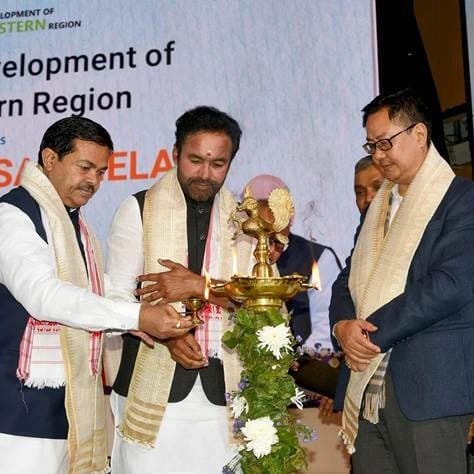
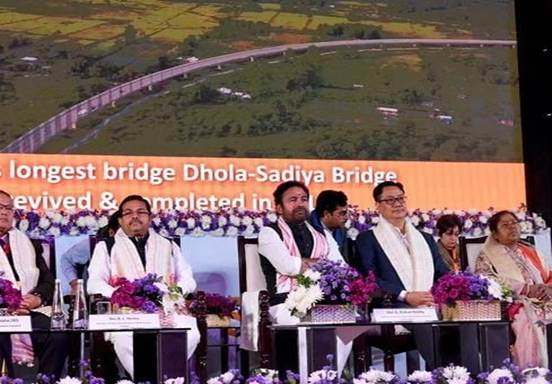
 Ministry of DoNER organized a North East Sammelan on February 4th, 2024 at Ambedkar International Centre, New Delhi. Minister for DoNER, Tourism and Culture Shri G. Kishan Reddy was the chief guest for the event and virtually laid foundation stone of the North Eastern Cultural and Social Institute in Dwarka built at the cost of Rs 116.38 crore and inaugurated the Barak Hostel at JNU, New Delhi, worth Rs 28.67 crore, in presence of Minsiter for Earth Science Shri Kiren Rijiju ji, Minister of State DoNER Shri B.L. Verma, Minister of State for Social Justice and Empowerment Km. Pratima Bhoumik and Minister of State for External Affairs and Education, Shri Rajkumar Ranjan Singh and other dignitaries.

The event garnered the presence of esteemed dignitaries, including Union Ministers, Members of Parliament from the North East, and MLAs from the North Eastern States. Noteworthy attendance comprised officers representing various cadres in the North East region, alongside officers from diverse backgrounds. The gathering, comprising an audience of 1000, notably included a substantial contingent of students from the North East studying in institutions across Delhi. The distinguished presence of Smt. Sangkhumi Bualchhuak, a recipient of the Padma Shri award for her commendable efforts in women empowerment, added a significant dimension to the occasion.

The North Eastern Cultural and Social Institute in Dwarka, with a budget of Rs. 116.38 crore, will feature diverse amenities, including an auditorium, a library-cum-reading room focused on materials related to the North Eastern Region, an Art Gallery showcasing the region, an exhibition hall, research center, sale outlets and a Guest House. The center will also house facilities like a State Handloom Display, a food court, and exhibition spaces. Concurrently, the construction of Barak Hostel for North-East Students at JNU, New Delhi, with an estimated cost of Rs. 28.675 Crore, featuring 214 rooms for both genders equipped with modern amenities, aims to enhance hostel accommodations for a larger population of North-East students.

During the unveiling ceremony of the two projects, Shri G. Kishan Reddy expressed that these initiatives have been long-awaited and will serve as focal points for cultural and regional integration. He emphasized that the North Eastern Cultural and Social Institute in Dwarka is anticipated to facilitate extensive discussions, meaningful discourse, and constructive exchanges aimed at promoting the holistic development of the North Eastern Region.

During his address at the Sammelan, the Union Minister for Development of North Eastern Region, Culture, and Tourism, Shri G Kishan Reddy, highlighted the North East Sammelan as a remarkable platform to spotlight the abundant opportunities and rich cultural diversity inherent in the North Eastern Region. He emphasized the unprecedented growth and development witnessed over the last decade, transforming the region from a neglected area to the Ashtalakshmi of Bharat

Shri Reddy underscored the significant investments made, amounting to over Rs. 5 Lakh Crores since 2014, driving comprehensive and inclusive development across the region. He also lauded the remarkable progress in maintaining peace and security, evident in the notable reduction of insurgency incidents and civilian casualties, reflecting the government’s steadfast commitment to fostering stability.

Furthermore, Shri Reddy highlighted the establishment of state-of-the-art cancer hospitals catering to the healthcare needs of the populace, underscoring the government’s dedication to enhancing healthcare infrastructure. Shri Reddy emphasized the substantial financial infusion into the region over the past decade, ensuring unhindered development. He noted a considerable increase of approximately 233% in expenditure, from Rs. 24,819 Crores in 2014-15 to Rs. 82,690 Crores in 2022-23, allocated by 54 Central Ministries to the North Eastern Region under 10% GBS (Gross Budgetary Support).

Union Minister for Earth Sciences, Shri Kiren Rijiju in his address said that he extended his heartfelt congratulations to the people of the North East as we witness the significant launch of Barak Hostel at JNU for NE students and the foundation stone laying of the North Eastern Culture and Social Institute in Dwarka, New Delhi. Shri Kiren Rijiju, further added that North East Region is witnessing a transformative phase of development be it physical infrastructure, connectivity with rest of India or emotional and cultural integration. He added that the government ensures monthly visits of union ministers to different States of NER to ensure that the grievances and issues are addressed at the highest level. He further said that the Government, under the visionary leadership of PM Shri Narendra Modi Ji is taking forward the developmental activities on the vision of ‘Ek Bharat Shreshtha Bharat’. He underscored the vital link between peace and Northeast development and highlighted the pivotal role of youth and emphasized that genuine progress in the region can only occur through people-led development, underscoring the critical need for sustained peace in the area.

Addressing the audience at the North East Sammelan, Union Minister of State Shri B.L. Verma highlighted that Prime Minister Shri Narendra Modi Ji has not only recognized but also underscored the crucial role of the North-East in the Nation’s development, setting the stage for comprehensive national prosperity. This emphasis signifies a dedicated commitment to uplifting the region and fostering inclusive growth for the entire country especially commending effective governance and initiatives for the Ashtalakshmi’s over all development.

The dignitaries inspected the stalls and exhibitions put up by PSUs of DoNER North Eastern Regional Agricultural Marketing Corporation (NERAMAC), North Eastern Handicrafts and Handloom Development Corporation (NEHHDC) showcasing the initiative sand achievements towards welfare of farmers and artisans of the region. A stall by the North Eastern Development Finance Corporation Ltd was also put up which showcased the milestones achieved in promoting SHGs, Small and micro enterprises and young entrepreneurs. The Ministers took the opportunity to engage with artisans and entrepreneurs present.

The Sammelan featured special videos that showcased PM Shri Narendra Modi Ji’s vision for roadmap and development for North Eastern Region. The event also featured videos highlighting the following achievements in the North-Eastern Region over the past decade.

The event concluded with a well-received cultural performance showcasing diverse traditional dances. Today’s initiatives collectively channel Government of India’s efforts to unlock the unparalleled potential of the North-East. The achievements outlined are not merely milestones but a testament to the Government’s commitment to a brighter and more prosperous future for the region.

***

DRDO carries out successful flight trials of High-speed Expendable Aerial Target ‘ABHYAS’

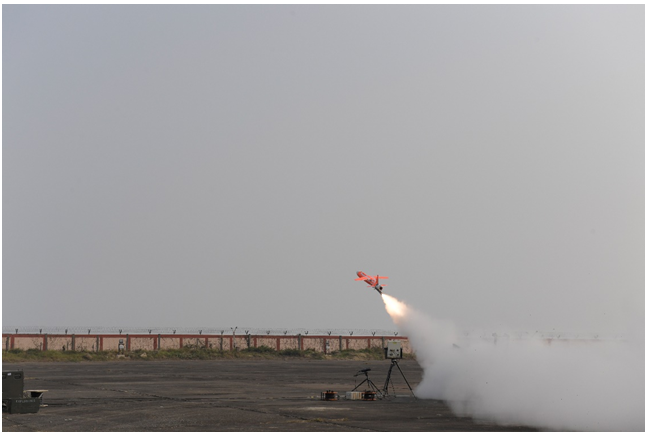
 Four flight trials of High-speed Expendable Aerial Target (HEAT) – ABHYAS were successfully carried out by Defence Research & Development Organisation (DRDO) from the Integrated Test Range, Chandipur in Odisha during January 30 to February 02, 2024. The trials were conducted with four different mission objectives in a revised robust configuration using a single booster designed by Advanced Systems Laboratory, Hyderabad to provide reduced launch acceleration.

The objectives like safe release of booster, launcher clearance and attaining the required end of launch velocity were achieved. During the flight trials, various parameters like required endurance, speed, manoeuvrability, altitude and range were successfully validated.

Designed by DRDO’s Aeronautical Development Establishment (ADE), ABHYAS offers a realistic threat scenario for practice of weapon systems. It is designed for autonomous flying with the help of an auto pilot indigenously made by the ADE. It has Radar Cross Section, Visual and Infrared augmentation system required for weapon practice. It has a laptop-based Ground Control System with which the aircraft can be integrated and pre-flight checks, data recording during the flight, replay after the flight and post-flight analysis can be carried out. ABHYAS requires minimum logistics and is cost effective compared to imported equivalents.

The systems tested recently were realised through Production Agencies – Hindustan Aeronautics Limited (HAL) and Larsen & Toubro (L&T) Defence. With identified production agencies, ABHYAS is ready for production. The system has export potential and can be offered to friendly countries.

Raksha Mantri Shri Rajnath Singh has congratulated the DRDO, the Armed Forces and the Industry for the successful flight trial of ABHYAS. The development of this system will meet the requirements of aerial targets for the Armed Forces, he said.

Secretary, Department of Defence R&D and Chairman DRDO Dr Samir V Kamat appreciated the efforts of the teams associated in the design, development and testing of the system.

***

MERA GAON MERI DHAROHAR

 The Government of India has decided to map and document all villages under Mera Gaon, Meri Dharohar (MGMD) Programme.  A web portal on MGMD has also been launched on 27.07.2023.  The MGMD seeks to compile comprehensive information detailing the life, history, and ethos of Indian villages and to make the same available to virtual and real-time visitors. Under the MGMD, information is collected under seven broad categories as given below-

  • Arts and Crafts Village
  • Ecologically Oriented Village
  • Scholastic Village linked with Textual and Scriptural Traditions of India
  • Epic Village linked with Ramayana, Mahabharata and/or Puranic legends and oral epics
  • Historical Village linked with Local and National History
  • Architectural Heritage Village
  • Any other characteristic that may need highlighting such as fishing village, horticulture village, shepherding village etc.

The Ministry of Culture is implementing a Scheme of Financial Assistance for Promotion of Art and Culture consisting 08 components through which cultural organizations are given financial assistance for the promotion of art and culture. The details of the Schemes, through which cultural organizations are given financial assistance under scheme of Financial Assistance for Promotion of Art and Culture are placed at Annexure-I.

Financial outlay of Rs.353.46 Crores is approved under the scheme of Financial Assistance for Promotion of Art and Culture consisting 08 scheme components for a period of five financial years w.e.f 2021-2022 to 2025-2026.

Government of India decided to celebrate Azadi Ka Amrit Mahotsava in befitting manner at national and international level during 15th August 2022 to 15th August 2023. Azadi ka Amrit Mahotsav has been formally launched on 12th March, 2021 viz 75 weeks prior to 15th August 2022.  Under the “Azadi Ka Amrit Mahotsav”, Govt. of India celebrated Janjatiya Gaurav Diwas, vide which, the contribution of Tribal freedom fighters was highlighted, and commemorations were held in remembrance of freedom fighters.

      Through the campaigns Qila aur Kahaniya and Wonder Caves, the contribution of India’s forts and caves to the freedom struggle were highlighted. Through Janjatiya Gaurav Diwas, the contribution of Tribal freedom fighters was also highlighted, and commemorations were held in remembrance of freedom fighters.

      Centenary of Jallianwala Bagh massacre commemorated from 13.4.2019 to 13.4.2020. A tribute paying ceremony on 13.4.2019 was led by Hon’ble President at the Memorial site where commemorative coin and postage stamp were released. Memorial has been renovated. Museum and Light & Sound show has been set up. Inauguration ceremony of renovated Jallianwala Bagh National Memorial, Amritsar was presided over by Hon’ble Prime Minister on 28.8.2021. 

     Government of India commemorated 125th birth anniversary of Netaji Subhash Bose from 23rd January, 2021 to 23rd January, 2023.  To mark the 125th Birth Anniversary of Netaji Subhash Chandra Bose, on September 8, 2022, Hon’ble PM unveiled Netaji Subhas Chandra Bose’s 28ft jet black granite statue near India Gate. Government of India also declared 23rd January as Parakram Divas.

ANNEXURE – I


A. SCHEME OF FINANCIAL ASSISTANCE FOR PROMOTION OF ART AND CULTURE:   The scheme consists of the following scheme components:


  1. Financial Assistance to Cultural organizations with National Presence

            The objective of the scheme component is to provide financial assistance  to reputed cultural organizations with national presence (‘not-for-profit’ organizations, NGOs, Societies, Trusts, Universities, etc.) with a view to disseminate and propagate art & culture by organizing various cultural activities at National/International level for promotion of art and culture of the country. This grant is given to such organizations which has a properly constituted managing body, registered in India having an All India Character with National Presence in its operation, adequate working strength and have spent Rs. 1crore or more during any 3 of the last 5 years on cultural activities. The Quantum of assistance under this scheme is up to Rs. 1 Cr.


  1. Cultural Function & Production Grant (CFPG)

            The objective of this scheme component is to provide financial support to NGOs/ Societies/ Trusts/ Universities etc. for Seminars, Conference, Research, Workshops, Festivals, Exhibitions, Symposia, Production of Dance, Drama-Theatre, Music etc.  The maximum grant provided under CFPG is Rs.5 Lakh which can be increased to Rs. 20 Lakh under exceptional circumstances.


  1. Financial Assistance for the Preservation & Development of Cultural Heritage of the Himalayas

            The objective of this scheme component is to promote and preserve the cultural heritage of the Himalayas through research, training and dissemination through audio visual programmes. The financial support is provided to the organizations in the States falling under the Himalayan Region i.e. Jammu & Kashmir, Himachal Pradesh, Uttarakhand, Sikkim and Arunachal Pradesh.  The quantum of funding is Rs. 10.00 lakhs per year for an organization which can be increased to Rs. 30.00 lakhs in exceptional cases.


  1. Financial Assistance for the Preservation & Development of Buddhist/Tibetan Organization

            Under this scheme component financial assistance is provided to the voluntary Buddhist/Tibetan organizations including Monasteries engaged in the propagation and scientific development of Buddhist/Tibetan Cultural and tradition and research in related fields. The quantum of funding under scheme component is Rs. 30.00 lakhs per year for an organization which can be increased to 1.00 crore in exceptional cases.

  1. Financial Assistance for Building Grants including Studio Theatres

            The objective of this scheme component is to provide financial support to NGO, Trust, Societies, Govt. Sponsored bodies, University, College etc. for creation of Cultural infrastructure (i.e. studio theatre, auditorium, rehearsal hall, classroom etc.) and provision of facilities like electrical, air conditioning, acoustics, light and sound systems etc. Under this scheme component, the maximum amount of grant is up to Rs.50 Lakh in metro cities and up to Rs.25 Lakh in non- metro cities.

(vi)       Financial Assistance For Allied Cultural Activities

The objective of sub-component is to provide financial assistance to all eligible  organizations  for  creation  of  assets  for  enhancing  the  audio-visual spectacle  for  allied  cultural  activities  to  give  firsthand  experience  of  live performances  on  regular  basis  and  during  festivals  in  open/closed areas/spaces  where  large  numbers  of  tourists/visitors  come  regularly  and during major events/festivals the number of visitors swells to lakhs. Grants are given to projects for procurement of audio-video equipment etc. Maximum  assistance  under  the  scheme  component,  including applicable duties & taxes and also Operation & Maintenance (O&M) costing for  five  years,  will  be  as  under:- (i)  Audio: Rs.1.00  crore;  (ii)  Audio+Video: Rs. 1.50 crore.

(vii)      Scheme for Safeguarding the Intangible Cultural Heritage:

This  scheme  was  launched  by  the  Ministry  of  Culture  in  2013  for safeguarding the intangible cultural heritage and diverse cultural traditions of the  country  with  the  objective  of  reinvigorating  and  revitalizing  various institutions, groups, NGOs, etc. so that they may engage in activities/projects for  strengthening,  protecting,  preserving  and  promoting  the  rich  intangible cultural heritage of India.

B.        Domestic Festivals and Fairs

The objective of this scheme is to provide assistance for holding the ‘Rashtriya Sanskriti Mahotsavs’ organized by Ministry of Culture.

This information was given by Union Minister for Culture, Tourism And Development of North Eastern Region Shri G.Kishan Reddy in Lok Sabha today.

***

FUNDS TO MAKE HERITAGE BUILDINGS ACCESSIBLE

 All ancient monuments and archaeological sites and remains declared as national importance are accessible to public.

So far as provisions for disability are concerned the activity of Archaeological Survey of India (ASI) are regulated by provisions of the Ancient Monuments and Archaeological Sites and Remains Act, 1958 considering feasibility, scope and norms to maintain original character of the monument Various facilities are provided at protected monuments, details thereof are at Annexure.

There is no separate provision for the said activities. However, the expenditure is met out from overall budget of ASI allocated for the conservation and maintenance. The expenditure incurred on the same including providing amenities during last 5 years is as under:

                                    (Amount in  Crore)

Year

Expenditure

2018-19

406.38

2019-20

435.61

2020-21

260.90

2021-22

270.00

2022-23

392.71


The Right of Persons with Disabilities Act, 2016 provides provision for the same.


DETAILS OF AMENITIES / FACILITY AVAILABLE FOR DIFFERENTLY ABLED-PERSONS (DIVYANG) AT PROTECTED MONUMENTS

SL.

NO.

STATE/UT

RAMP

WHEEL CHAIR

DIFFERENTLY ABLED (DIVYANG) TOILETS

SIGNAGE IN BRAILLE

AUDIO GUIDE

PATHWAY WITH TACTILE STRIP


Andhra Pradesh

3

8

10


Assam

3

5

6

2


Bihar

2

5

4

2

2

1


Chhattisgarh

1

3

10

2

1


Daman & Diu, Dadar Nagar Haveli (UT)

1


Goa

12

5

3


Gujarat

6

15

12

5


Haryana

4

6

5


Himachal Pradesh

3

3

2

1

1


Jammu & Kashmir (UT)

2

13

4

6


Jharkhand

1

4


Karnataka

21

40

25

13

1

1


Kerala

8

29

7


Ladakh (UT)

1

2

1


Madhya Pradesh

14

33

5

27

2

8


Maharashtra

4

14

13

3

25

1


Manipur

1

1


Mizoram

1

1

1


NCT Delhi

6

41

10

7

1

1


Odisha

11

8

9

7


Punjab 

3

7

4


Rajasthan

27

13

9

1

4


Tamil Nadu

27

47

38

22

9


Telangana

6

11

4


Tripura

3

3

2

6


Uttar Pradesh

14

31

31

20

1


Uttarakhand

20

25

10

11

2


West Bengal

7

30

10

27

11


Total

211

403

235

154

34

47

This information was given by Union Minister for Culture, Tourism And Development of North Eastern Region Shri G.Kishan Reddy in Lok Sabha today.

***