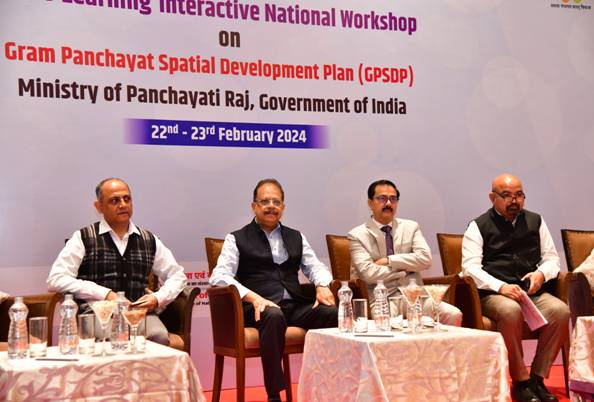
Cross Learning Interactive National Workshop on Gram Panchayat Spatial Development Plan at Bhopal, Madhya Pradesh

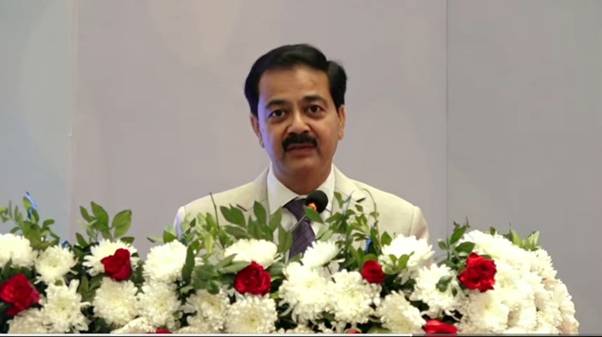
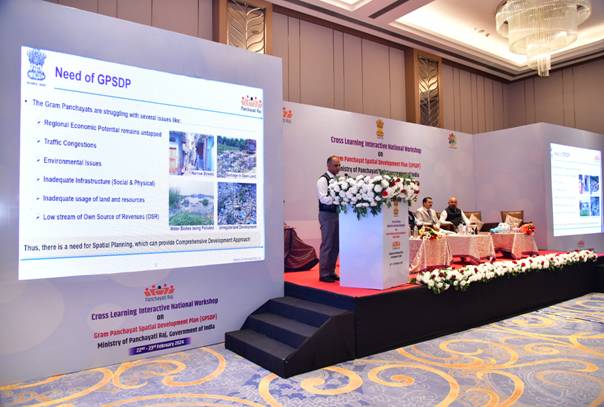
 Secretary, Ministry of Panchayati Raj Shri Vivek Bharadwaj inaugurated the Cross Learning Interactive National Workshop on Gram Panchayat Spatial Development Plan (GPSDP) at Bhopal, Madhya Pradesh today. Shri Malay Shrivastava, Additional Chief Secretary, Department of Panchayat & Rural Development, Government of Madhya Pradesh, Shri Alok Prem Nagar, Joint Secretary, Ministry of Panchayati Raj, and Prof. (Dr.) Kailasa Rao M, Director, School of Planning and Architecture, Bhopal were also present on the occasion.


In his address, Secretary emphasized the pivotal role of Gram Panchayats, partner institutions and key stakeholders in developing selected Gram Panchayats as Model Gram Panchayats, setting an example for others to follow. He stressed the importance of expediting efforts for reconstructing Panchayats with a spatial approach, contributing to the development of India. Shri Bharadwaj underlined the need for a well-thought-out and well-planned spatial development plan, coupled with strong determination and dedication for its implementation.

Shri Vivek Bharadwaj highlighted the importance of leveraging available resources and mobilizing the necessary support to translate vision and initiative of Gram Panchayat Spatial Development Plan into action effectively. By promoting systematic and synergistic interventions, any gaps in resource mobilization can be addressed, further facilitating the successful implementation of spatial planning initiatives in Gram Panchayats, added Shri Bharadwaj. Shri Bharadwaj emphasized upon spatial approach and importance of coordinated actions and collaborative efforts among various stakeholders to effectively execute spatial plan and ensure sustainable development at the grassroots level. Highlighting the significance of the Gram Panchayat Spatial Development Plan, Shri Vivek Bharadwaj urged participants to earnestly commit to its implementation within a defined timeframe, fostering sustainable rural development. Secretary called upon Gram Panchayats, partner agencies and stakeholders to seize opportunity of Amrit Kaal for advancing concerted action towards implementing spatial planning at grassroots level and ensuring its regular monitoring.

Shri Vivek Bharadwaj expressed hope that the two-day National Workshop will serve as a forum to provide a clear framework and direction towards advancing this crucial initiative, ensuring the empowerment and development of Gram Panchayats across the nation.

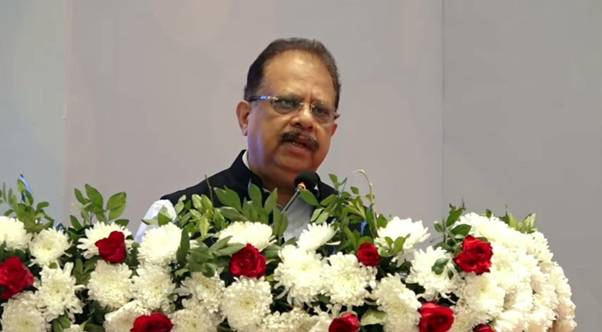
Shri Malay Shrivastava, Additional Chief Secretary, Department of Panchayat & Rural Development, Government of Madhya Pradesh called for the convergence of resources and a symphony of efforts to implement the Spatial Development Plan in Gram Panchayats.

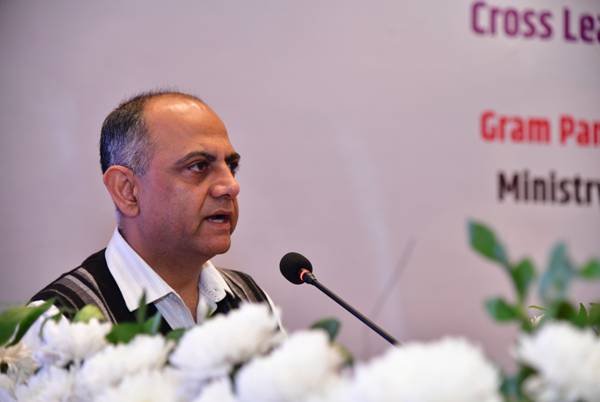
Addressing the National Workshop on Gram Panchayat Spatial Development Plan Shri Alok Prem Nagar, Joint Secretary, Ministry of Panchayati Raj made a comprehensive presentation on Spatial Planning for Rural Areas and the Way Forward, and provided valuable insights into the workshop’s objectives and initiatives. Shri Alok Prem Nagar highlighted the need for spatial planning interventions and initiatives taken by Ministry of Panchayati Raj.


Prof. (Dr.) Kailasa Rao M, Director, School of Planning and Architecture, Bhopal, extended a warm welcome to all the participants and delegates, and shared an overview of the current status and roadmap of the spatial planning process.

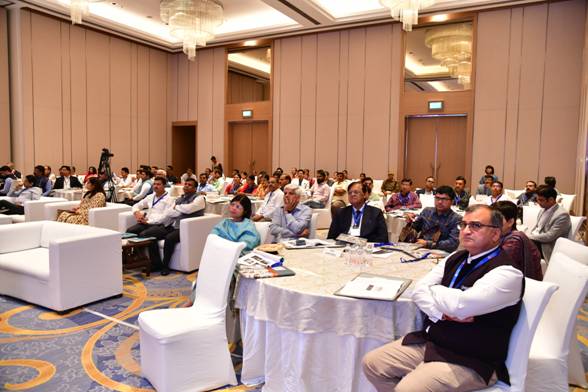
The National Workshop, organized by the Ministry of Panchayati Raj in collaboration with the School of Planning and Architecture, Bhopal, witnessed the participation of distinguished delegates from various State Departments of Panchayati Raj, planning and architecture institutes, industry experts, Smart City Mission leaders, financial institutions, and government agencies.

Presentations were made about the spatial development plans created in the States of Madhya Pradesh, Karnataka, Odisha, Uttar Pradesh, Chhattisgarh, Maharashtra and West Bengal. The officers from the Town and Country Planning Departments also explored the best options for inserting planning in rural areas. Discussions also delved into the utilization of GIS-based technology in Smart Cities and the implementation of Rural Area Development Plan Formulation and Implementation (RADPFI) guidelines. The workshop aims to conclude with significant takeaways and learnings for Gram Panchayats and State-level institutes, fostering long-term planning solutions for India’s villages.


****

Transformative Portals for a Modernized Media Landscape

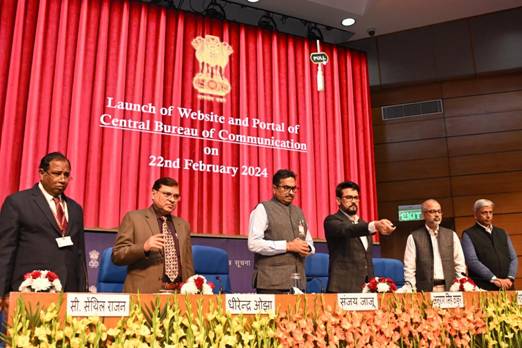
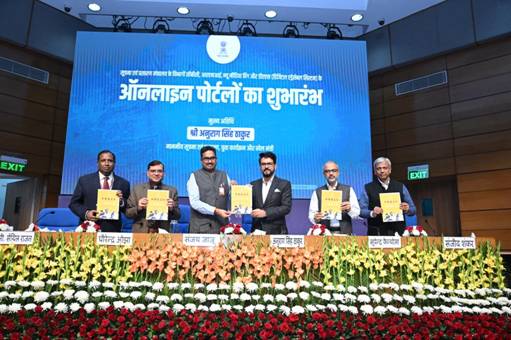
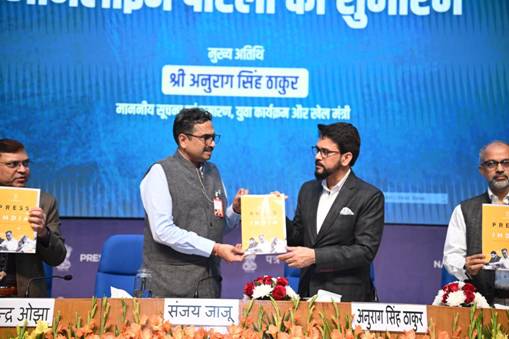
 The Minister of Information and Broadcasting Shri Anurag Singh Thakur, today launched four transformatory portals that promise to revolutionize the media landscape in India. These initiative is aimed at ensuring ease of doing business by fostering a more conducive business environment for Newspaper publishers and TV channels, enhance transparency and efficiency in government communication, provide easy  access to authentic Government videos and create a comprehensive database of Local Cable Operators (LCOs) enabling the Government to streamline regulatory processes in the cable television sector in future.

Addressing the audience present on the occasion, the Minister remarked that Today, India is viewed as an attractive destination for investment, with global companies eager to establish businesses there. He recalled Prime Minister Narendra Modi’s emphasis on transformative governance and economic reforms has greatly improved the ease of doing business in India and added that This has led to increased investment from both existing businesses and new entrepreneurs. The startup ecosystem, in particular, has flourished, with a significant increase in the number of startups and unicorns, he stated.

Elaborating on recognition of Government’s achievements towards improving ease of doing business, Shri Thakur said that these have been recognized globally, as evidenced by its improved rankings in international indices like the World Bank’s Ease of Doing Business Index and the Logistic Performance Index.

He further said that the success of platforms like the Government e-Marketplace (GeM) reflect the government’s efforts to create a level playing field for MSMEs and small businesses. He added that Prime Minister Modi’s leadership has not only focused on economic reforms but also on fostering a mindset transformation, recognizing entrepreneurs as partners in national development. This approach has led to increased wealth creation, job opportunities, and higher incomes, benefiting the country’s overall welfare and development.

Earlier, Secretary, Ministry of I&B. Shri Sanjay Jaju during his remarks said that these initiatives will help us streamline and increase our engagement with the media. These will foster not just transparency and innovation and help improve the functioning of the departments.

Press Sewa Portal: Streamlining Newspaper Registration The Press Sewa Portal, developed under the Press and Registration of Periodicals Act, 2023 (PRP Act, 2023) by the Press Registrar General of India (PRGI – erstwhile RNI), is a monumental step towards complete automation of the process for newspaper registration and other related processes. This portal, designed under the PRP Act 2023, aims to simplify the cumbersome registration procedures that were prevalent under the colonial PRB Act, 1867.

Key features of the Press Sewa Portal include:

  • Online Application: Publishers can file applications for title registration online, using Aadhar-based e-signatures.
  • Probability Meter: Indicates the likelihood of title availability.
  • Real-time Tracking of applications status: Accessible through an intuitively designed dashboard.
  • Dedicated DM Module: Enables District Magistrates to manage applications received from publishers in a centralized dashboard.

New Website: Along with the portal, the website offers easy access to relevant information, featuring an AI-based chatbot for user-friendly interactions.

Benefits of Automation: Online services for Title Registration, paperless processes with e-sign facilities, integration of a Direct Payment Gateway, QR code-based digital certificates, module for Press Keepers/owner enabling online intimation about Printing press, efficient tracking of newspaper registration, and quick grievance resolution through a chatbot-based interactive Grievance Resolution Software.

Transparent Empanelment Media Planning and eBilling System: Revolutionizing Media Planning In addition to the Press Sewa Portal, the Ministry is introducing the Transparent Empanelment, Media Planning and eBilling System for Central Bureau of Communication. CBC provides comprehensive 360 degree media and communication solutions to Ministries, Departments, PSUs, and autonomous bodies.  The new system of CBC is designed to enhance transparency and efficiency in media planning processes, and provide an end-to-end ERP solution for the media industry for doing business in a paperless and faceless environment. Key features include:

  • Streamlined Empanelment Process: An online system for empanelment of newspaper, periodicals, TV, Radio and digital media to ensure transparency and efficiency.
  • Automated Media Planning: Enhanced tools and features for online generation of media plans with minimal manual intervention, resulting in drastic reduction in time in preparing the media plan.
  • Automated Billing: Integration of an eBilling processing system for seamless and transparent bill submission, verification and payment.
  • Mobile App: A comprehensive mobile app for partners with tamper proof timestamp and geo tagging functionality for organised monitoring.
  • Reliable and Intelligent Solution: The portal is integrated with latest technology to assist in making real-time analytical reports and enable organisation to take data-driven decisions.
  • Promoting Ease of Doing Business: The online transparent system ensures faster empanelment, hassle-free business environment, automated compliance and swifter payment thereby significantly increasing the ease of doing business.
  • Dedicated IVR Helpdesk for Quick Issue Resolution: CBC has established a dedicated IVR support team stationed at CBC with dedicated helpline numbers to provide quick query and issue resolution services for clients and partners.


NaViGate Bharat Portal: National Video Gateway of Bharat

The ‘NaViGate Bharat’ portal i.e., the National Video Gateway of Bharat, developed by the New Media Wing of the Ministry, is a unified bilingual platform which hosts videos on the entire gamut of Government’s development-related and citizen welfare-oriented measures.

‘NaViGate Bharat’ empowers citizens by providing a single platform with an interactive user interface to search, stream, share, and download videos related to various Government schemes, initiatives, and campaigns, with filter-based advanced search option.

The portal eliminates the hassle of searching for official and reliable information from multiple sources, providing a one-stop platform for media and the general public.

‘NaViGate Bharat’ connects the last person standing in the queue with the Government’s welfare schemes and measures, ensuring that no one is left behind in understanding the initiatives shaping our nation’s future as it moves ahead on the path of becoming a Viksit Bharat.

 Key Features of ‘NaViGate Bharat’ Portal:

– Dedicated Pages for Ministries, Sectors, Schemes, Campaigns

NaviGate Bharat offers dedicated pages for Ministries, Sectors, Schemes, and Campaigns. With detailed descriptions for all videos, these pages provide a holistic view of Government initiatives.

– Easy Navigation & Search

Easy access for users to find the videos they are looking for

– Categorization & Tagging

Categories or tags that will allow users to search for videos by topic/keyword

– Seamless Video Playback & Streaming

Video player and Streaming capabilities for seamless viewing experience

– Download & Sharing Options

Users will be allowed to download and share videos with others through social media platforms

– Advanced Search Functionality

Filter-based Advanced Search functionality on the Home page and on each section of the portal

National Register for LCOs: Strengthening Cable Sector National Register for Local Cable Operators (LCOs) is the first step to bring registration of LCOs currently with Post Offices spread across the country under a Centralised Registration System. A web form has been designed to collect information from local cable operators for the purpose of National Register. The National Register for LCOs has also been published online and is being updated regularly. This promises a more organized cable sector with a National Registration Number for an LCO, making it easier to formulate new policies for responsible service and convenience for cable operators. A Centralised portal for online registration is in the process of development. The LCO National Register facility opens new possibilities for the cable sector, aligning with the vision of a developed India.

These initiatives collectively mark a significant leap towards a digitized and modernized media landscape in India. The Ministry of Information and Broadcasting reaffirms its commitment to fostering innovation, transparency, and progress in the media sector.

Background

The Press and Registration of Periodicals Act, 2023

The Press and Registration of Periodicals Act, 2023 (PRP Act, 2023) revolutionizes the registration process for periodicals, introducing a seamless online system for title allotment and registration without the need for physical submissions. This efficient approach, particularly advantageous for small and medium publishers, eliminates the requirement to file multiple declarations with District Magistrates. Instead, publishers will now submit a single online application through the Press Sewa Portal, streamlining the entire process that previously involved eight steps. Notably, the 2023 act also marks a significant shift towards decriminalization as compared to the stringent provisions of the Press and Registration of Books Act, 1867. These changes collectively aim to modernize and simplify the registration landscape, fostering an environment conducive to the swift and efficient initiation and running of publications.

The PRP Act has received the Presidential assent in December 2023 and is likely to be notified in near future. The Act will replace the existing PRB Act 1867. Under the act Rregistrar of Newspapers for India office will be replaced by the office of Press Registrar General of India.

Central Bureau of Communication (CBC) is a vital unit within the Ministry of Information and Broadcasting, established on December 8, 2017, through the amalgamation of the erstwhile Directorate of Advertising and Visual Publicity (DAVP), Directorate of Field Publicity (DFP), and Song & Drama Division (S&DD).

Headquartered in New Delhi, with its 23 Regional Offices (ROs) and 148 Field Offices (FOs), CBC provides comprehensive communication solutions to Ministries, Departments, PSUs, and autonomous bodies of Government of India, through various media verticals including Print, TV, Radio, Outdoor, Websites, Social Media and Emerging Digital Platforms.

Central Bureau of Communication partners with around 1100 client Ministries/Departments/PSUs/Institutions funded by Central Governments for their 360 degree solutions to their media and communication needs.

 More than 7000 publishers (newspapers/periodicals), nearly 551 Television Channels,  388 Private FM channels and around 360 Community Radio Stations are currently empanelled with CBC and do regular business with the Government body.

***

Empowering Nature, Nurturing Growth: Coal Sector Transforming Landscapes Through Sustainable Greening Initiatives for the Benefit of Coal Communities

 Coal/Lignite PSUs under the guidance and supervision of Ministry of Coal not only increased their production levels over time to meet the growing energy demands of the nation but have also demonstrated their commitment to the local environment by implementing a range of mitigation and sustainable measures. As part of sustainable greening initiative, extensive plantation programs with native species are undertaken by Coal/Lignite PSUs across various sites, including overburden (OB) dumps, haul roads, mine peripheries, residential colonies, and available land outside the lease area. Collaborations with scientific institutions ensure that plantation efforts are backed by expertise, facilitating the development of eco-restoration sites and the implementation of multi-tiered plantation schemes.

The plantation program adopts a diverse approach, encompassing shade-giving trees, species for forestry purposes, medicinal and herbal plants, fruit-bearing trees, timber value trees, and ornamental/avenue plants. Fruit-bearing species, along with medicinal plants, not only contribute to biodiversity conservation but also provide additional socio-economic benefits to local communities. Fruit bearing species such as Jamun, Imli, Ganga Imli, Bel, Mango, Sitaphal etc., Medicinal/Herbal Plants such as Neem, Karanj, Aonla (Amla), Arjun, etc., Timber Value Trees such as Sal, Teak, Shivan, Ghamar, Sissoo, Kala Sirus, Safed Sirus, Bamboo, Peltoforam, Babool, etc., Ornamental / Avenue Plants such as Gulmohar, Kachnar, Amaltas, Peepal, Jharul, etc. Moreover, close collaboration with state forest departments and corporations ensures that the best-suited species are selected for plantation, ensuring the success and sustainability of reclamation efforts.

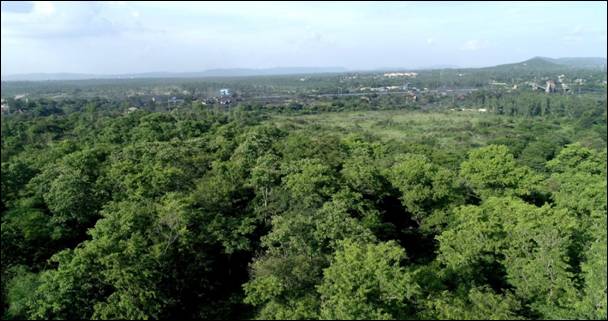
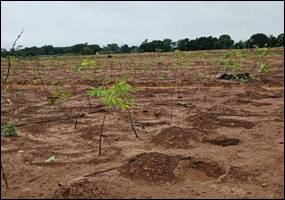
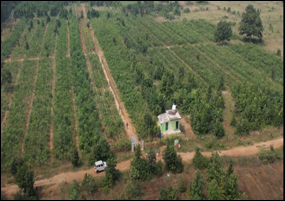
Plantation at NK Area, CCL

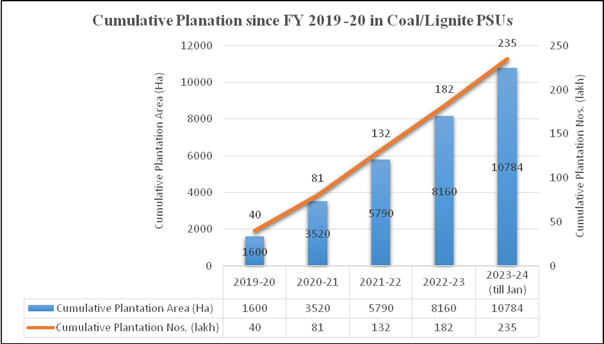
Over the past five years (FY 2019-20 to FY 2023-24 till January), Coal/Lignite PSUs have planted more than 235 lakh saplings over an area exceeding 10,784 Ha, thus enhancing the carbon sink significantly. To monitor reclamation performance, Coal/Lignite PSUs employs satellite surveillance.

Plantation by Coal/Lignite PSUs since FY 2019-20

Recently, Coal/Lignite PSUs have adopted the Miyawaki plantation method in its suitable command areas. The Miyawaki technique is a distinctive approach to afforestation and ecological restoration, pioneered by Japanese botanist Dr. Akira Miyawaki. Its primary goal is to enhance green cover within a limited area. This innovative method aims to establish a dense forest in just 10 years, a process that typically requires a century. It involves cultivating multi-layered forests that exhibit rapid growth and replicate the natural biodiversity found in native forests. Implementation of the Miyawaki technique entails planting two to four varieties of indigenous trees per square meter. Notably, the selected plant species are largely self-sustaining, eliminating the need for regular maintenance such as fertilization and watering. Within this method, trees achieve self-sustainability, reaching their height within a remarkable three-year timeframe. The interdependence among plants supports growth each other, promoting overall health and vitality. As a result, trees exhibit a growth rate much faster than conventional methods and contribute for creating a heightened carbon sink.

MCL adopted Miyawaki method in Kulda OCP of MCL at Subalaya village at Sundergarh range. DFO, Sundergarh is undertaking Miyawaki technique of plantation in 2 patches at 10 Ha at a density of 8000 saplings per Ha. Species planted in miyawaki forest in Kulda OCP is such as Arjun, Asan, Phasi, Sal, Bija, Karanj, Dhauda, Gamhar, Mahogany, Ashok, Patali, Chhatian, Dhuranj, Harra, Bahera, Amla, Guava, Mango, Jackfruit, etc. Further, Coal/Lignite PSUs have taken up about 15 Ha of Miyawaki plantation in and around coal mines in the current fiscal year.


Miyawaki Plantation in MCL

The plantation initiatives not only mitigate the ecological impact of mining activities but also contribute to the restoration of biodiversity, enhancement of ecosystem services, creating carbon sinks, providing livelihood opportunities for local communities and promotion of sustainable development. By leveraging scientific expertise, community engagement, and innovative methods like Miyawaki plantation, Coal/Lignite PSUs are creating a legacy of green, resilient landscapes for future generations.

****

Inauguration of International Maritime Seminar – MILAN 2024

 I am happy to be with you in Eastern Naval Command which has played a very crucial role in India’s maritime history and earned laurels for the country. I extend warm greetings to all our friends, who have come together from several countries to participate in the International Maritime Seminar of MILAN 2024.Those of my friends who are from abroad, Milan is a hindi word.Milan means a sublime meeting of mind, heart and soul. This seminar undoubtedly will exemplify the same.


Soothing to find that editions of MILAN are continually getting productive and in some ways defining way forward stances. It is one of its kind impactful platform for sharing best practices and expertise as also a crucible of involved interaction much
beyond surface scratching.

With modest beginning in 1995 to the participation of more than 15 warships and 51 delegations, MILAN is certainly turning out to be a delivery platform for meaningful dialogue and deliberations for participating Navies.

Friends-Disruptive technologies of all kinds have made deep inroads in our lives. These offer both challenges and opportunities. I am sure there will be an occasion for you all to deliberate on this aspect as well.

Milan 2024 aims to strengthen global cooperation and maritime security-an ever evolving challenge. Its object is to foster interoperability and understanding between participating navies.This august assemblage of domain experts serves as a testament to the shared commitment of nations towards ensuring the much needed maritime safety and Security.

Proactive collaboration key and if I may say so only key to shared peace & prosperity. Milan 24 indeed has an apt theme “Partners Across Oceans: Collaboration, Synergy,Growth”. This is of contemporaneous
relevance, noticing emerging challenges and reflecting the spirit of unity that transcends geographical boundaries.

Friends, it is in the fitness of things that India, home to one sixth of humanity and largest functional vibrant democracy, with rising economy is playing its due role in catalysing partnerships, Collaboration, Synergy Across Oceans and issues concerning maritime Security.

Given the challenges we face, it imperative for nations to come together, share experiences and develop collaborative strategies to ensure the safety, security and sustainability of our oceans.

The stakeholders would certainly avail the opportunity of sea exercises that would enhance interoperability, enable exchange of best practices and will certainly boost confidence so as to undertake missions together in the future, to tackle common challenges. Protection of Global Supply Chains,Avoiding Deeper Regional Tensions and exploitation of blue economy are global concerns that can no longer be ignored.

Observance of maritime order is quintessential to peace and harmony of the region as also for maintenance of supply chains and promotion of trade and Commerce. Oceans have played an important part in India’s history right from the time of the Indus Valley Civilization going back to thousand of years.

Global dependence on the seas for trade and commerce necessitates the protection of the sea lines of communication.
And which is huge that involves everyone on the planet.This global dependence necessitates protection of the seas, lines of communication.

Maritime domain is also very vital for blue Economy.The ancient Indian philosophy emphasizes the interconnectedness of all life and the imperative to work together for the greater good.That has been essence of our civilisational ethos ably reflected during our presidency of G-20 that had the motto “One Earth One Family One Future”

Keeping this in mind thoughtfully in 2015-SAGAR – an acronym for ‘Security and Growth for all in the Region’ was initiated.It emphasizes inclusivity and growth for all.

The focus of SAGAR is on concerted cooperative measures for sustainable use of oceans and provides a framework for a safe, secure and stable maritime domain in the region.

In 2019, at the East Asia Summit, this initiative was further enhanced and elaborated through the Indo-Pacific Oceans’ Initiative (IPOI) with a focus on seven pillars of maritime security including Maritime Ecology,Maritime Resources, Capacity Building and Resource Sharing, Disaster Risk
Reduction and Management, Science, Technology and Academic Cooperation, Trade Connectivity and Maritime Transport.

You all will agree, these are fundamental to the concept for which you are here. It resonates profoundly with the challenges and opportunities that define our contemporary maritime landscape.

Implementing a collaborative strategy is challenging.Varied situations have to be conversed, this challenging task is to be achieved, accomplished by your thought process in this seminar. It requires maritime agencies to improve interoperability, share intelligence and agree on a regional rules based order.

I need not indicate to this august assemblage, challenge to the rule based order is at peak at the moment.Its resolution is an unavoidable necessity, this seminar I am sure would find a way out.

In recent years, we have seen formidable security challenges in the maritime domain and these have acquired a new, menacing dimensions having potential to endanger peace, not to speak of unsettling supply chains. If you unsettle supply chains, the impact is geometric, cascading on the lives of ordinary people and therefore it is according to me a prime obligation of people here to find a sustainable way out so that supply chains are kept intact.

Friends, India our nation stands at the cusp of remarkable growth – we are the fifth largest global economy. By the turn of the decade, India will be the third largest ahead of Japan and Germany. In terms of purchasing power we are third globally.

We have set our eyes to be a fully developed nation by 2047- Viksit Bharat. India’s maritime strength will be critical to our marathon to 2047.

Friends, our oceans rather than separating us are pathways to connect us and I would say they are pleasant pathways to connect us.

These are vital to global trade, the exchange of ideas and the sustenance of life itself. You all have the advantage of seeing life very differently. Those of us who do not venture into the sea like you are deprived of that kind of life which you have the occasion to see. For us, who are not a part of this domain, it is a tourist attraction for you it is a challenge to see that it survives, it sustains.

It is imperative that we approach the seas as a shared resource,acknowledging our collective responsibility to protect and preserve but let us help it flourishes and blossoms.

This shared past holds immense value in establishing and furthering diplomatic dialogue even today. It is because of the benign nature of the maritime connect, that one finds the great Indian Epic of Ramayana, continues to be an intrinsic part of the South East Asian culture.

Friends! It is soothing to find that as President of the UN Security Council in 2020 India provided dynamic leadership and direction in envisioning a global roadmap on enhancing maritime security that will go a long way in shaping the contours of emerging world order.

It was the first time that the UN Security Council Open Debate on “Enhancing Maritime Security: A Case for International Cooperation”, was held in August 2021 and it was presided over by Prime Minister Narendra Modi. It was momentous being the first time that maritime security was deliberated in a “holistic manner as an exclusive agenda item” in such a high-level global forum.

Diverse aspects of maritime security call for not isolated not concerted but deeply concerted endeavours so as to protect and support legitimate maritime activities, while countering traditional and non-traditional threats in the maritime domain that is the shared heritage of the mankind.

This heritage perceptionally is undervalued.People need to recognize its depth and worth. Indian engagement regional organizations such as the Indian Ocean Commission (IOC), the Indian Ocean Rim Association (IORA), the Bay of Bengal Initiative for Multi-Sectoral Technical and Economic Cooperation (BIMSTEC) and the Colombo Security Conclave (CSC) reflects our commitment to a cooperative approach towards maritime affairs.

These regional initiatives provide a platform for dialogue, cooperation and collective action, recognizing that the
challenges faced in the maritime domain are not confined by borders.

I need not indicate to this august assemblage that you’re being present here interacting with each other on the sidelines, it is also very significant. It paves the way for innovation, it helps you to chalk out a strategy to deal with challenges and I am sure your interactions will be highly productive.

The interconnectedness of our oceans demands a collaborative effort to address common concerns, including as I indicated earlier and which is of supreme need of the hour–Security.Security is no longer a writing on the wall, people who are not directly concerned are also aware of it. Safety– Another important aspect, hardly a month passes when this issue is not on the center stage of media and sustainable development.

Maritime boundaries are not mere lines on a map, these are the lifelines of nations, channels through which commerce flows, connecting economies and fostering growth.

I need not indicate to this august assemblage that technological import, the connectivity that you sustain, A lapse in that will be highly debilitating for the economing world. Bharat recognizes the significance of respecting these boundaries and fostering a rule based maritime order.

It is consistent stance of our leadership and our Prime Minister has gone on record that these are not the times of expansion and all issues need to be resolved through dialogue and diplomacy. The planet needs it, there is no other alternative.

We believe that adherence and I would say scrupulous adherence to international law, including the United Nations Convention on the Law of the Sea (UNCLOS), is imperative, essential and the only way for the peaceful coexistence and sustainable use of maritime Resources.  In the present times, I am sure nobody will disagree.This aspect is severely strained and compromised.

Unilateral actions and disregard for international law can have far-reaching consequences, jeopardizing the stability and security of the entire region. And if not well contained in time, it can go beyond regional disputes.

With a history of maritime excellence, the Indian Navy is dedicated to upholding the principles of freedom of navigation, promoting regional stability and responding to emerging challenges in the maritime domain.

The Indian Navy has been instrumental in fostering regional cooperation through initiatives like MILAN, providing a meaningful platform for navies from around the to be on the same page, share experiences and nurture enduring partnerships.

Friends, as we engage in discussions, let us collectively explore avenues for deeper cooperation, exchange of ideas and best practices to address the evolving challenges in the maritime domain.

As a person not directly connected with your domain I can say, the challenges can come from anywhere, your challenges can emanate anytime. Your preparedness will have to be 24 X 7.  I extend my gratitude to all the participants for their commitment to this cause and look forward to fruitful deliberations during MILAN 24.

To my foreign delegates you are in the land of culture. A civilisational depth of more than 5000 years, I am sure you will have cherished moments in this country and this city.

Thank you! Jai Hind!

***

2024 Commonwealth Masters Scholarship tenable in the United Kingdom

 The Commonwealth Scholarship is a program that offers financial support to students from Commonwealth countries to pursue postgraduate studies in member countries. These scholarships are aimed at promoting educational exchange and collaboration among Commonwealth nations.

Key features of Commonwealth Scholarships for Masters programs may include:

  1. Eligibility Criteria:

    • Applicants must be citizens of a Commonwealth country.
    • Typically, candidates should have completed their undergraduate education and hold a bachelor’s degree or its equivalent.
    • Some programs may have additional requirements based on the specific field of study.
  2. Fields of Study:

    • Commonwealth Scholarships cover a wide range of academic disciplines, allowing students to pursue master’s degrees in various fields such as science, technology, engineering, humanities, social sciences, and more.
  3. Host Country:

    • Commonwealth Scholarships are often tenable in Commonwealth member countries. In the case of the United Kingdom, the Commonwealth Scholarship Commission in the UK (CSCUK) is responsible for managing and awarding these scholarships.
  4. Application Process:

    • Interested candidates typically need to apply directly to the relevant scholarship program or commission. The application process may include submitting academic transcripts, letters of recommendation, a personal statement, and proof of citizenship.
  5. Selection Process:

    • Applications go through a rigorous selection process, including academic assessment and interviews. Successful candidates are chosen based on their academic achievements, potential impact in their home countries, and the relevance of their proposed studies to the development goals of their home nations.
  6. Financial Support:

    • Commonwealth Scholarships usually cover full or partial tuition fees, living expenses, travel expenses, and other allowances. The exact financial support may vary depending on the specific scholarship program.
  7. Duration of Scholarship:

    • Scholarships are typically awarded for the duration of the master’s program, which is usually one or two years.

To obtain the most accurate and up-to-date information on the “2024 Commonwealth Masters Scholarship” or any other Commonwealth Scholarship program, I recommend checking the official website of the Commonwealth Scholarship Commission in the UK or contacting relevant authorities in your home country responsible for managing Commonwealth Scholarships.

How to apply

Applications for Commonwealth Master’s scholarships for the 2024/25 academic year are now closed.

Applications to the CSC must be made using the CSC’s online application system.

The CSC is unable to accept any applications or documentation not submitted via the online application system.

Applicants are advised to complete and submit applications as early as possible, as the online application system will be very busy in the days leading up to the application deadline.

As well as applying to the CSC, applicants must apply to a nominating agency.

There are two types of nominating agency for Master’s scholarships:

Nominating agencies put forward candidates to the CSC for consideration. The CSC does not accept direct applications for these scholarships.

Each nominating agency oversees its own selection process and may have additional eligibility criteria. Applicants must check with the nominating agency for their specific advice and rules for applying, and their own eligibility criteria.

Look for More Scholarships https://cscuk.fcdo.gov.uk/scholarships-filter-search/