AWPO SUMMIT 2024 – CONVERGING REQUIREMENTS OF BUSINESSES & INDUSTRY WITH VETERANS

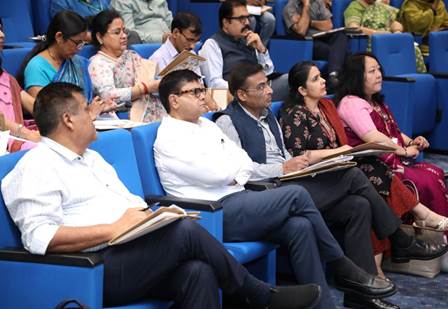
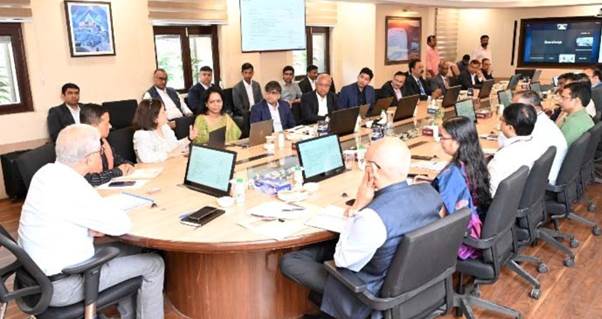
 The Army Welfare Placement Organisation (AWPO) today, organised the AWPO Summit 2024 in Manekshaw Centre, New Delhi. The Summit witnessed convergence of notable personalities from various sectors to include veteran entrepreneurs, veterans leading in the field of businesses and industry, corporate entities, representatives from government and social sector. 

The aim of the Summit was to bring together different stakeholders on a common platform, to bridge the gap between requirements of enterprise and core competencies possessed by the veterans. While the demand for a skilled and experienced workforce exists at the industry end, a disciplined human resource pool of veterans with adequate experience and unique skill sets exit from active service each year. Such a resource pool provides an opportunity to the industry to absorb this workforce. The Summit was an endeavour to synergise the two converging requirements. The AWPO Summit assisted in strengthening the linkages of the veteran community with the industry, PSUs and Quasi Government organisations. The presence of Corporate Heads, representatives of Industry, Start Ups, Ministry and Government Officials in the Summit, underscored this facet.

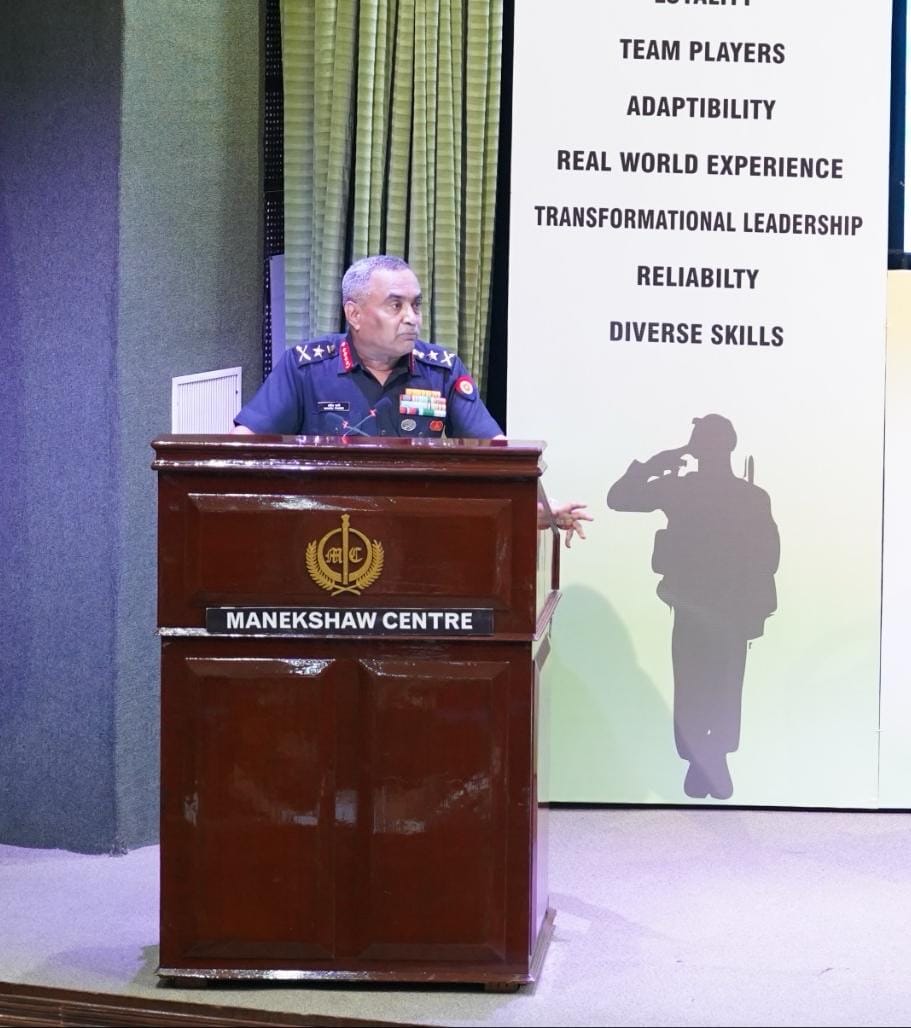
General Manoj Pande, Chief of the Army Staff (COAS), in his remarks, emphasised the invaluable contributions of veterans to the nation’s prosperity and reiterated the commitment of the Indian Army to facilitate their integration into various sectors. He said that veterans bring with them, a unique set of qualities and experiences that can be harnessed by the industry. He acknowledged the opportunities provided by several corporate houses and enterprises to veterans and added that veterans bring with them a unique set of qualities and experiences. The COAS mentioned that services to the nation by the veterans do not end when they bid farewell to military life, instead it transitions into a new chapter or second innings of dedication and commitment to the society and nation building. He urged all to recognize the potential of the words – ‘भूतपूर्व सैनिक, अभूतपूर्व योगदान’.

The COAS underscored that Indian Army has undertaken the process of holistic skill certification, as per the core competency of each individual, in collaborative efforts with the Ministry of Education and Ministry of Skill Development and Entrepreneurship. He also mentioned that initiatives such as Project KAUSHALVEER help serving personnel in acquiring certification for skill sets as per established industry standards thereby meeting the requirements of both stakeholders. He mentioned that the veterans, with diverse knowledge, experience, managerial acumen and adaptability can contribute in fields such as entrepreneurship, HR consultancy, mentorship, education, crisis management, infrastructure development, healthcare etc.

The COAS further highlighted that Veer Naris also bring with them unparalleled determination and resilience and urged the entrepreneurs to integrate them as part of their initiatives on human capital intake, from the ‘uniformed community’. He emphasised that the Veer Naris also possess vocational skills, entrepreneurship acumen and aptitudes in many professional domains.

This Summit was an endeavour in Indian Army’s pursuit to evolve an institutionalised support eco-system for the veterans. Insightful perspectives were put forth by panelists from different fields on the entire landscape of avenues, potential, challenges and initiatives with respect to absorption of veterans into new roles. Veterans who have established themselves into a successful second career, also shared their experiences and success stories. The subjects were discussed across three main themes, aimed at fostering synergy between veterans and various sectors with an important role in nation building.

Theme 1: Harnessing Veterans’ Potential & Experience.  The panel for Theme 1 included distinguished Veteran Entrepreneurs such as Major V P Sharma (Retired) from Gratitude Farms, Colonel Subhash Deswal (Retired), the Carrot King of India, Naik Shivaji Dole (Retired), who took initiative to revive Venkateshwara Co-operative which practices agro farming, organic farming and water conservation, and Naik Daljinder Singh (Retired), an entrepreneur and established businessman. The discussion was moderated by Major General Ajay Singh Chauhan, Managing Director, AWPO and Brigadier Vikas Bhardwaj from the Directorate of Indian Army Veterans. The session focussed on veterans’ potential as entrepreneurs, success stories of achievers and the way ahead. The panelists delved into their inspiring journeys, challenges faced, and the roadmap ahead. Key points discussed were the unexplored potential of veterans in innovative sectors and strategic entrepreneurship that align with national growth imperatives.

Theme 2: Skills Required to Meet Public and Private Sector Needs.   Addressing the need for skilled workforce integration, the session highlighted the significance of the Skilling & Training Ecosystem. The panel for the theme included Colonel Sunil Prem (Retired) from Brisk Olive, Lieutenant Colonel Iqbal Singh (Retired) from Google India and Major Md Ali Shah (Retired). The discussion was moderated by Major General Deepak Sapra (Retired). The session focussed on skills needed in corporate/ industry and strengthening capabilities for veterans in the emerging industrial landscape. The panelists explored avenues, challenges, and strategies to effectively harness the unique skills and experiences veterans bring to the table. They underscored the essential role veterans play in bridging the skills gap in both public and private sectors and deliberated on the road map to explore the veterans’ potential.

Theme 3: Unveiling Opportunities for Veterans in India’s Growth Story.  This session explored the diverse skill sets of veterans, widows, and dependents, showcasing their potential in emerging sectors of both the public and private sectors. The panel for the theme included Major General Rajesh Jha (Retired), Director NEEPCO, Colonel RS Bhatia (Retired), Chairman & MD Bharat Forge Ltd, Mr Gurdeep Singh, CMD of NTPC and Ms Anuradha Prasad, Founder & CEO of India Leaders for Social Sector (ILSS). The session was moderated by Major General Ajay Singh Chauhan (Retired), MD, AWPO. The discussions centred around strategies to enhance veterans’ potential and opportunities in the social sector. This comprehensive dialogue addressed the multifaceted contributions and tremendous capacities of veterans in furthering India’s social and economic frameworks.

The Summit has been a catalyst for dialogue, collaboration and inspiration, spotlighting vital role of veterans in India’s progress. It is crucial for all industries to recognise and utilise unique strengths and skill sets of the veterans by having matching policies for their smooth transition into civilian roles. The nation’s growth hinges on nurturing the veterans, whose ongoing contributions are essential for sustained progress and collective wellbeing. Assimilation of skilled and disciplined resource pool of veterans into industry and services sectors will be a win- win situation for both and a game changing venture.

***
National Archives of India Acquires the private paper collection of Late Shri Rafi Ahmad Kidwai

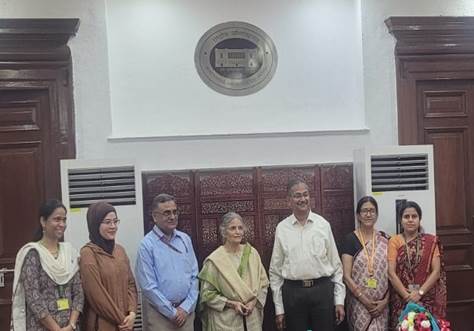
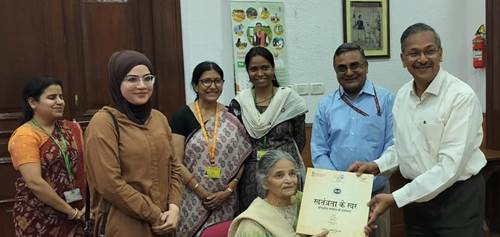
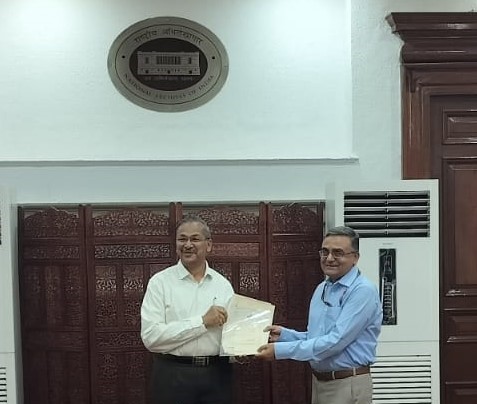
 National Archives of India (NAI) has acquired the private paper collection of Late Shri Rafi Ahmad Kidwai, comprising original correspondences of Shri Kidwai with other eminent leaders like Pt. Nehru, Sardar Patel, Shyama Prasad Mukherjee, P.D. Tandon etc. These papers were handed over to D.G. NAI by Shri Faiz Ahmad Kidwai (IAS), Additional Secretary, Ministry of Agriculture and Farmers Welfare, in the presence of Smt. Tazeen Kidwai, daughter of Late Shri Hussain Kamil Kidwai, youngest brother Shri Rafi Ahmad Kidwai and Ms. Sarah Manaal Kidwai.

National Archives of India is the custodian of the non-current records of the Government of India and holds them in trust for the use of administrators and researchers as per the provision of Public Record Act 1993. As a premier archival Institution, National Archives of India plays a key role in guiding and shaping archival consciousness. Apart from the vast collection of public records, NAI has a rich and ever-growing collection of private papers of eminent Indians from all walks of life, who have made significant contributions to our nation.

Shri Rafi Ahmad Kidwai was a man of vivacity, brilliance and charm who is known for his ceaseless efforts towards Independence of our country and for refuting communalism and superstitions of every type. Born on February 18, 1894, in Masauli, Uttar Pradesh, he hailed from a middle-class zamindar family. His political journey began in 1920 with his involvement in the Khilafat Movement and the Non-Cooperation Movement, leading to imprisonment. Kidwai served as the Private Secretary to Motilal Nehru and later held significant positions in the Congress Legislative Assembly and the United Provinces Congress Committee. His political acumen led him to become a Minister in Pandit Govind Ballabh Pant’s cabinet, where he managed Revenue and Jail portfolios. Post-independence, he served as India’s first Minister for Communications in Jawaharlal Nehru’s cabinet, launching initiatives like the “own your telephone” service and night air mail. In 1952, he took charge of the Food and Agriculture portfolio, successfully tackling food rationing challenges with his administrative skills.

Kidwai’s dedication to liberating India and strengthening the nation remained unwavering throughout his political career. His contributions were recognized with the creation of the Rafi Ahmed Kidwai Award by the Indian Council of Agricultural Research in 1956. Kidwai’s tenure as Communication Minister earned him a reputation for innovation and effectiveness, while his leadership in the Food Ministry was hailed as a triumph over adversity, earning him the moniker of a magician and a miracle man. Rafi Ahmed Kidwai indeed embodied action and dedication in his pursuit of Indian independence and later in his administrative roles. His ability to swiftly address crises and implement innovative solutions highlights his remarkable leadership qualities. His contributions to various sectors, from communications to agriculture, left a lasting impact on the nation’s development. His legacy as a committed freedom fighter and a skilled administrator continues to inspire generations.

***

DoT in first-of-its-kind initiative brings together 15 startups, academia on "Telecom Design Collaboration Sprint"

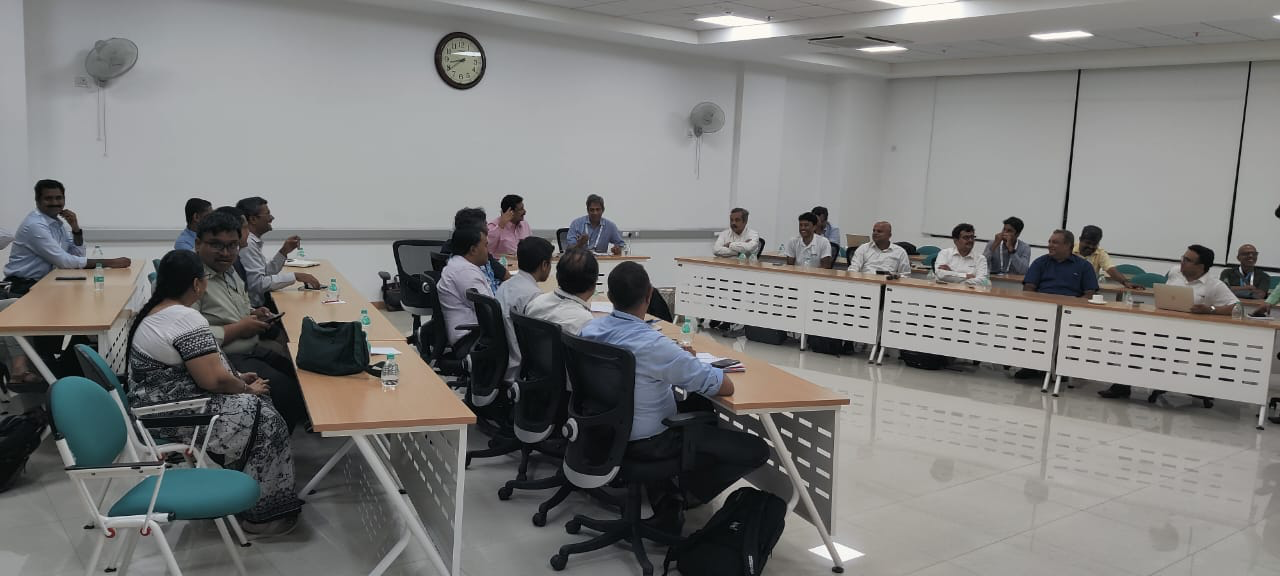
 In a novel initiative, the Department of Telecommunications (DoT) brought together start-ups/MSMEs, academia and research institutions under the “Telecom Design Collaboration Sprint”. This Sprint was organised by DoT at IIIT, Bangalore. Fifteen leading startups/MSME in the Radio Access Network (RAN), Core ecosystems, esteemed institutions such as IIT Madras, C-DOT, IIT Delhi and other network entities participated.

This collaboration engaged in deep-Tech rapid ideation and innovative solution towards developing a comprehensive and future-ready telecom stack encompassing comprehensive 5G solution and setting the stage for future advancements to 6G. The Sprint was driven by three primary objectives:


  1. Leveraging Collective Strengths: The Sprint enabled startups to combine expertise in critical 5G infrastructure areas, fostering innovation and speeding up a common telecom stack development.
  2. Fostering Holistic Solutions: Through collaboration, startups aim to create comprehensive 5G solutions, addressing industry needs and preparing for future advancements.
  3. Creating Market Opportunities: By aligning efforts, it seeks to unlock market potential, empowering startups to compete and grow in the telecom landscape.


After in-depth and extensive discussions during the sprint event, outcome-based focused groups were formed to address gaps in the Indian telecom ecosystem and get ready for 6G and other upcoming technologies. These groups will concentrate on areas like core infrastructure, distribution units (DUs), radio units (RUs), central units (CUs) and others elements with an objective to bridge current gaps and provide solutions that are suited to meet future needs. Two working groups were also formed.

The participants expressed appreciation for this pioneering initiative, marking it as a first-of-its-kind endeavour in the industry. They also expressed interest in close collaboration and urged the DoT to continue with such initiatives.

The Sprint underscores DoT’s commitment to nurturing innovation and fostering industry collaboration to propel India’s telecommunications sector towards global leadership in the 5G era and beyond. Bringing together unique strengths and competence of start-ups and MSMEs, together with academia and industry, the DoT aims at creating a robust and forward-looking mobile telecom stack with an emphasis on advancing towards 6G technology.

*****

Two-day conference on jointness & integration of Armed Forces on 9-10 May

 In light of the imminent Theaterization, the Indian Armed Forces are intent on giving momentum to the ongoing Jointness and Integration initiatives amongst the three services.

“Parivartan Chintan”, a pioneering conference for the heads of all Tri-services Institutes, aimed at generating novel reformative ideas & initiatives, was conducted on 08 Apr 2024. Parivartan Chintan – Il, chaired by Chief of Defence Staff General Anil Chauhan, is planned over a period of two days on 09-10 May 2024 in New Delhi.

Members from all the sub-committees of the apex Chiefs of Staff Committee; the CDS as its permanent Chairman and the three Service Chiefs, shall review the progress made in multiple domains, and ideate on the necessary reforms to achieve the desired end state towards transformation through jointness and integration.

****

Two-day National Symposium & Industry Meet on ‘Emerging Technologies in Infrastructure Development’ in New Delhi

 A National Symposium and Industry Meet on ‘Emerging Technologies in Infrastructure Development’, organised by Defence Research and Development Organisation (DRDO), was inaugurated by Defence Secretary Shri Giridhar Aramane in New Delhi on May 09, 2024. The two-day event, with the participation from the Armed Forces, academia, industry and DRDO, aims to foster dialogue, exchange knowledge and explore innovative approaches to address the challenges and opportunities presented by emerging technologies in infrastructure development in line with the vision of ‘Aatmanirbhar Bharat’.

In his address, the Defence Secretary emphasised on the need to achieve self-reliance in every field to deal with future challenges. He stated that India is a country with a significant percentage of young population, and self-reliance will ensure gainful employment to them.

Underlining the importance of achieving ‘Aatmanirbharta’ in defence, Shri Giridhar Aramane asserted that there is no trusted trend in geopolitics, and India cannot depend on other countries for its security & safeguarding national interests. He stressed that self-reliance will help the country take giant strides on the path of becoming a developed nation by 2047.

Highlighting the emphasis being laid by the Government on infrastructure development along the borders, the Defence Secretary exhorted the infrastructure firms to contribute in further strengthening the apparatus. He added that while the Armed Forces personnel are being provided with latest weapons/equipment, the private sector should contribute in bolstering the infrastructure set-up in the border areas. He referred to the Vibrant Villages Programme which aims to motivate people to stay in their native locations in border areas, and urged the firms to set up a separate section, within their respective organisations, which focuses on development in far-flung areas.

Shri Giridhar Aramane stated that the DRDO is extending support to the private sector in Research & Development, and together they can come up with new innovations to build faster & better in the times to come. He called upon the industry to walk hand-in-hand with the government, and focus more on the mass production of quality products in a time-bound manner. He also urged the industry to collaborate with the academia to enhance the skills of the workforce, which can help realise a technology into a product.

Speaking on the occasion, Secretary, Department of Defence R&D and Chairman DRDO Dr Samir V Kamat emphasised on the importance of infrastructure in the development of a nation. He stated that India is witnessing a phenomenal growth in the field of technical infrastructure, which is required to maintain the country’s strategic deterrence.

The DRDO Chairman added that technology is evolving rapidly, and the necessity of sustainable infrastructure and green infrastructure is now becoming a part of technical domain. “It’s time to explore ways to incorporate the latest technologies in our technical infrastructure. We have made a good start, but work needs to be done to catch up with the best practices,” he said.

Director General, Resource & Management Shri Purushottam Bej said the symposium, being attended by over 500 delegates with five technical sessions, will deliberate upon varying topics on emerging technologies in infrastructure development being expounded by experts from the users, industry, academia and scientists from DRDO. This will go a long way in igniting the minds of users, planners, designers, architects and ultimately the executives in realising the vision of the government and proving to be the stepping stone for a glorious future for the infrastructure development in the country at large.

The Defence Secretary also inaugurated the industry-partner exhibition, organised on the sidelines of the event, showcasing latest technologies and products developed by the various industry partners. The event also includes student competition from IITs, NITs and other Engineering colleges. A symposium souvenir and Research & Development Construction Establishment Work Procedure 2024 were also released during the event.

****

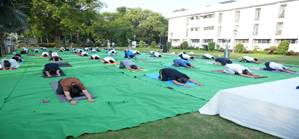
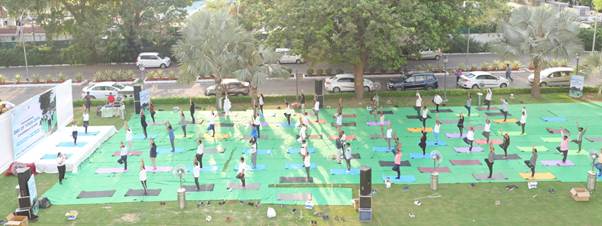
International Day of Yoga -2024 at Vigyan Bhawan Annexe, New Delhi

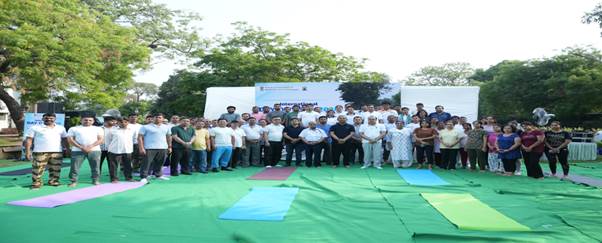
 In anticipation of the upcoming International Day of Yoga, the Ministry of Development of North Eastern Region (MDoNER) organized a countdown event at VigyanBhawan Annexe in New Delhi. Secretary and officers/officials of MDoNER and CISF officers and staff posted in VigyanBhawan Annexe, activelyparticipated under the guidance of Yoga Instructor and Demonstrators from MDNIY highlighting the timeless benefits of yoga deeply ingrained in Indian heritage.


The event featured dynamic yoga practices aimed at nurturing holistic well-being. Secretary DoNER emphasized yoga’s role in promoting physical, mental, and spiritual health

As MDoNER hosts the countdown to this transformative day, it reaffirms India’s commitment to nurturing a culture of health and wellness through yoga. The event at Vigyan Bhawan serves as a reminder of yoga’s universal appeal and its enduring relevance in addressing contemporary challenges.

A group of people doing yogaDescription automatically generated

Yoga, with its roots in ancient Indian tradition, has been widely recognized for its positive impact on physical, mental, and spiritual health. MDoNER’s event highlights the importance of incorporating yoga into daily life for a healthier and more balanced lifestyle.

A group of people standing in front of a bannerDescription automatically generated

****

Early Childhood Care & Education (ECCE)

 Secretary, School Education & Literacy, Ministry of Education, Shri Sanjay Kumar, chaired a meeting for achieving the broader objectives of Early Childhood Care & Education (ECCE), at Ambedkar International Centre, New Delhi today. The representatives of the Ministry of Women & Child Development (MoWCD), States, and Autonomous bodies of the Department of School Education & Literacy (DoSE&L) attended the meeting. As envisioned under the National Curriculum Framework-Foundational Stage (NCF-FS) a continuum of pre-school education and School education is required for seamless transition and quality ECCE.

Speaking on this occasion Shri Sanjay Kumar set the context of the meeting and highlighted the importance of every stakeholder in quality ECCE. Shri Kumar reiterated that it was heartening to see various initiatives taken by MoWCD and various States/UTs.

The need to have three Balvatikas for 3 to 6-year-olds for pre-primary in all CBSE and Kendriya Vidyalayas having Class 1 was emphasised during the meeting. Co-locating Anganwadis with primary schools in villages was recommended in coordination with WCD, in a decentralised manner to get a proper preschool education and smooth transition to Grade 1.

It was also suggested to use Jaadui Pitara at the Government schools with pre-primary classes for a well-rounded learning experience. It was suggested that NCERT can work with state officials to assess existing learning toys, ensuring alignment with NCF-FS goals.

It was also suggested that MoE and WCD should collaborate to link Poshan Tracker and UDISE+ data to track pre-primary to Class-1 transitions. States can define parameters and use Requests for Proposals (RFPs) for Jaadui Pitara materials to ensure transparency and efficiency in procurement.

Discussions were also held on the standardization of branding for programs such as NIPUN Bharat, Jaadui Pitara, e Jaadui Pitara and Vidya Pravesh across states to enhance visibility and recognition.

It was suggested that the adopted and adapted version of Jaadui Pitara should correspond with the prescribed learning outcomes curated by NCERT for Jaadui Pitara. NCERT should support SCERTs in following the designated Learning Outcomes.

The need for proper training of preschool teachers and Anganwadi Worker (AWW) was also discussed at length during the meeting.


***

Workshop on ‘State of Artificial Intelligence in Banks’ with representatives from 12 Public Sector Banks and other financial institutions under DFS

 Dr. Vivek Joshi, Secretary, Department of Financial Services (DFS), chaired a workshop on the ‘State of Artificial Intelligence in Banks’ as part of its lecture series, in New Delhi, today. The NASSCOM made a presentation during the workshop to provide banks and financial institutions with insights into best practices for AI adoption and risk mitigation. 

The event featured several industry experts who shared their experiences and insights on the AI. Besides, DFS Secretary, attendees included senior officials from the DFS, CEOs, MDs, CTOs, and CDOs from 12 Public Sector Banks (PSBs), as well as MDs and CEOs from various financial institutions under administrative control of DFS and delegates from NASSCOM.

The workshop served as a platform for participants to learn about various case studies and strategies for implementing AI in the banking sector. By leveraging the expertise of industry leaders, the workshop aimed to enhance the understanding of AI technologies and their potential impact on the financial services industry. The industry experts discussed how AI can be used to enhance customer service, make better decisions regarding credit, detect fraud and defaults, manage risks early, and boost employee productivity and efficiency.

The workshop also addressed the emerging challenges of AI in terms of data governance, cybersecurity, transparency and compliance.

****

IREDA Global Green Energy Finance IFSC Limited

 Indian Renewable Energy Development Agency Ltd. (IREDA) has incorporated a wholly owned subsidiary in the International Financial Services Centre (IFSC) located in GIFT City, Gujarat. Named “IREDA Global Green Energy Finance IFSC Limited,” the subsidiary was officially incorporated on 7th May, 2024. Earlier, on 8th February, 2024, the Reserve Bank of India gave its No Objection letter to set up the finance company in IFSC GIFT City.

Commenting on the development, Chairperson & Managing Director of IREDA Shri Pradip Kumar Das, said that IREDA’s presence in GIFT City signifies a momentous step in its mission to pioneer innovative approaches to green financing. “This subsidiary not only positions IREDA to extend its global reach but also acts as an offshore platform for securing competitive funding to drive the renewable energy sector’s growth, aligning with the Government of India’s ambitious ‘Panchamrit’ targets.”

The CMD added that IREDA’s entry into the IFSC is anticipated to unlock fresh business prospects and establish its global footprint in the renewable energy sector. “This strategic step is in line with IREDA’s vision of facilitating sustainable development through renewable energy investments, both domestically and internationally. With IREDA’s presence in the IFSC, we anticipate greater access to innovative financing alternatives and enhanced collaboration with international investors, encouraging the advancement of renewable energy projects in the country and abroad.”

***

India’s Technical Textiles market has huge potential backed by a significant growth rate of 10%:

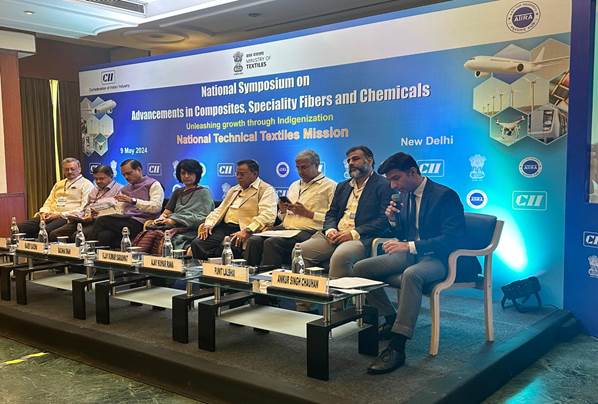
 The Ministry of Textiles in partnership with Confederation of Indian Industry (CII) and Ahmedabad Textiles Industries’ Research Associations (ATIRA) organized a National Symposium on Advancements in Composites, Speciality Fibres and Chemicals here in New Delhi today.

India’s Technical Textiles market has a huge potential backed by a significant growth rate of 10% and placement as the 5th largest technical textiles market in the world, said Mrs Rachna Shah, Secretary, Ministry of Textiles while addressing the symposium.

She further said that that composites has distinct structural and physical features, which make them suitable for specific applications across various sectors. For example, in infrastructure development, aerospace, automotive sector, Military and Defence sector, medical devices, composite materials, among others. She highlighted the significance and importance of institutional buyers, user Ministries and industries in the adoption of technical textiles and products made out of specialty fibres and composites.


A collaborative approach among stakeholders including industry representatives, policymakers, researchers, and investors is imperative to address the cost implications in the field of composites and specialty fibres and work together in increasing awareness and education for wider adoption by the larger community for the growth of the sector, she added.

Dr Vijay Kumar Saraswat, Member, NITI Aayog, highlighted that the specialty fibres are the building blocks of the advanced composites and its choice is a strategic decision on a blend of performance requirements and cost consideration.

He mentioned that specialty fibres like aramids, carbon fibre, zylon, ultra-high molecular weight polyethylene (UHMWPE), glass fibre, ceramic fibre can be tailored for diverse applications and strategic needs, such as Fire Retardant fabrics, Bullet Resistant Jackets, ropes and cables, windmills (renewable energy) and in gas and chemical filtration respectively. He highlighted the top trends in composite materials including but not limited to high performance resins and adhesives, carbon fibre based materials light weighting advanced polymer composites, biomaterials, nanocomposites, intelligence design and manufacturing.

He elucidated the advancements in material science are not just about creating stronger or lighter materials, but also about ensuring their sustainable use through material circularity. He also stressed that the demand for bio-composites is increasing due to growth in its adoption by construction, furniture industry and increased compatibility in medical applications.

Dr Saraswat also said advanced composites and specialty fibres are continuously evolving with research, pushing the boundaries of fibre performance. Future developments will include fibres with even greater strength and stiffness, enhanced thermal properties and even self-healing capabilities. He also emphasised that although composite materials have been around for many years, the industry is still amid innovation and evolution. There is a need to adopt sustainable practices which will be a key feature of the composites industry going forward.

Shri Ajay Kumar Rana, Director General, RDSO during his address talked about the use of geotextiles and geo-composites in the railways sector. He highlighted the use of geotextiles, geogrids, pre-fabricated vertical drains (PVDs) for load bearing applications, slope erosion protection control application, drainage, separation, filtration etc. He also stated RDSO is actively working in developing new guidelines and standards for use of geo-composites in railways sector, in association with BIS.

Shri Rajeev Saxena, Joint Secretary, Ministry of Textiles suggested technical textiles is one of the fastest growing segment with a strong global demand. The technical textiles industry holds immense potential to drive productivity, efficiency, cost-effectiveness, and innovative solutions across engineering and general applications. He highlighted that NTTM is a flagship mission with a view to position India as the Global Leader in Technical Textiles. During his speech, Shri Saxena elucidated various guidelines under the NTTM mission related to Research & Innovation, Start-up, machinery development, internship, education and skilling.

While deliberating on the importance of composites, he stated that textile composite materials are replacing the conventional materials in several fields.

Shri Nilesh M Desai, Director, Space Applications Centre (SAC/ISRO) said that SAC is the second largest research centre of ISRO with a long association with ATIRA. He said that space and aerospace is going to be a major area for composites applications, due to its light weight and durable properties. CFRP and Asto glass fibres are majorly used nowadays in space and aerospace sector.

Around 150 participants attended the conference including Officials and Representatives from Central Ministries, user Departments of Central and State Governments, industry leaders, scientific experts, researchers, and professionals related to technical textiles.


***

Union Public Service Commission announces written results of National Defence Academy and Naval Academy Examination, (I) 2024

 On the basis of the result of the written part of the National Defence Academy and Naval Academy Examination, (I) 2024 held by the Union Public Service Commission on 21st April, 2024, candidates with the under mentioned Roll Nos. have qualified for interview by the Services Selection Board (SSB) of the Ministry of Defence for Admission to Army, Navy and Air Force Wings of the National Defence Academy for the 153rd Course and for the 115th Indian Naval Academy Course (INAC) commencing from 2nd January, 2025. The result is also available at Commission’s website www.upsc.gov.in.

2. The candidature of all the candidates, whose Roll Nos. are shown in the list is provisional. In accordance with the conditions of their admission to the examination, “candidates are requested to register themselves online on the Indian Army Recruiting website joinindianarmy.nic.in within two weeks of announcement of written result. The successful candidates would then be allotted Selection Centers and dates, of SSB interview which shall be communicated on registered e-mail ID. Any candidate who has already registered earlier on the site will not be required to do so. In case of any query/ Login problem, e-mail be forwarded to dir-recruiting6-mod[at]nic[dot]in.”

“Candidates are also requested to submit original certificates of Age and Educational Qualification to respective Service Selection Boards (SSBs) during the SSB interview.” The candidates must not send the Original Certificates to the Union Public Service Commission. For any further information, the candidates may contact Facilitation Counter near Gate ‘C’ of the Commission, either in person or on telephone Nos. 011-23385271/011-23381125/011-23098543 between 10:00 hours and 17:00 hours on any working day. In addition for SSB/Interview related matter the candidates may contact over telephone no. 011-26175473 or joinindianarmy.nic.in for Army as first choice, 011-23010097/ Email: officer-navy[at]nic[dot]in or joinindiannavy.gov.in for Navy/ Naval Academy as first choice and 011-23010231 Extn. 7645/7646/7610 or www.careerindianairforce.cdac.in for Air Force as first choice.

3. The mark-sheets of the candidates will be put on the Commission’s website within fifteen (15) days from the date of publication of final result. (After concluding SSB Interviews) and will remain available on the website for a period of thirty (30) days.

Click here for Complete Result.

***

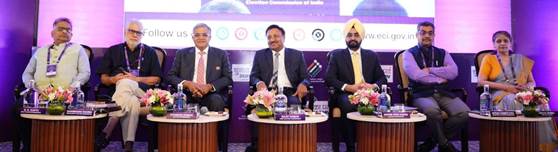
75 delegates from 23 countries witness the poll process first-hand in 6 States as part of IEVP

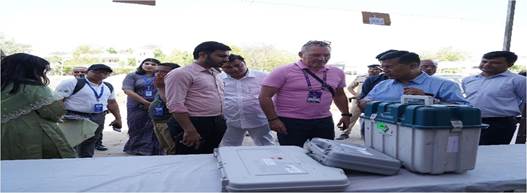
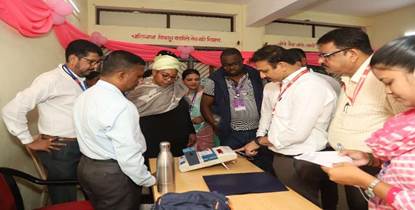
 International delegates have expressed their happiness at having witnessed the polling process first-hand in General Election 2024. While some of the delegates appreciated transparency others termed ECI’s initiatives such as Green Polling Stations as inspirational. Delegates also appreciated the use of technology at scale in the elections including during randomization of EVM-VVPATs. Some of the delegates also said that they were particularly struck by the unwavering faith and commitment of Indian voters towards strengthening democratic ideals. Overall, there was unanimity among the visiting members of the Election Management Bodies of these countries that the election process in India was a peaceful, inclusive and accessible and takes place in a festive mood.

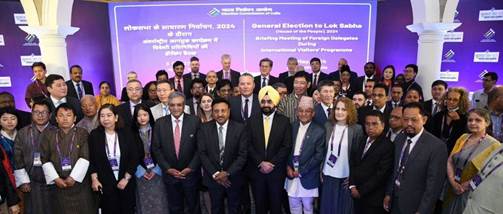
These reactions came after largest ever contingent of international delegates experienced India’s General Elections first-hand in the recently concluded third phase of the elections as part of the International Election Visitors’ Programme (IEVP).

Polling was held in 93 Constituencies across 11 States/UTs in the third phase and the delegates watched the polling in 6 States/UTs including the preparatory work that goes into making what is arguably the largest logistical exercise involving movement of men and machinery in the world.

IEVP 2024 experiences from ground


Karnataka

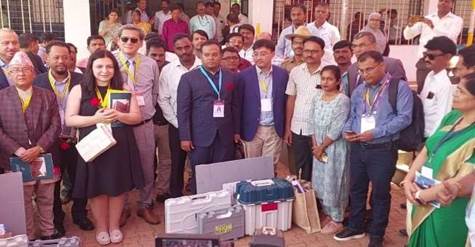
Delegates from Cambodia, Tunisia, Moldova, Seychelles, and Nepal visited Belgaum Parliamentary constituency in Karnataka and interacted with polling officers and presiding officers inside the polling station, witnessed mock poll, visited command control center, media monitoring facilities. The delegates appreciated the transparency as underscored by mock poll, presence and involvement of candidates’ representative inside the polling station.


Goa

Delegates from Bhutan, Mongolia and a media team from Israel witnessed polling and related arrangements in both the constituencies in Goa. They were also exposed to mock poll, command control center, media monitoring facilities and dispatch centers. CEC Bhutan and Electoral officials of Bhutan & Mongolia appreciated transparency in involving political parties, media, candidates’ representative inside the polling station in conduct of elections. Admiration and surprise was expressed to see PwD managed Polling stations, and Pink Polling stations by the visiting delegates. Delegates appreciated the use of software for randomization of EVM-VVPATs.


Madhya Pradesh

A 11-member international team comprising delegates from Sri Lanka and Philippines visited polling stations across Bhopal, Vidisha, Sehore, and Raisen constituencies, gaining firsthand insights into the electoral process of the Lok Sabha elections. Interacting with voters, they observed the enthusiasm and active participation of Indian citizens in the democratic process. Reflecting on their experiences, the delegates expressed admiration for the vibrant democracy they witnessed in India. They were particularly struck by the unwavering faith and commitment of Indian voters towards strengthening democratic ideals.


Uttar Pradesh

Delegates from Chile, Georgia, Maldives, Namibia, Papua New Guinea and Uzbekistan witnessed the polling on 7th May, 2024 in Fatehpur Sikri and Agra Parliamentary constituency in Uttar Pradesh. Visiting dignitaries were taken to see architectural marvel of Taj Mahal and the Fatehpur Sikri falling in these two constituencies. They were exposed to the various arrangements/activities on the poll day and the day before the polling day. There was unanimity among the visiting members of the Election Management Bodies of these countries that the election process in India was a peaceful, inclusive and accessible.


Gujarat

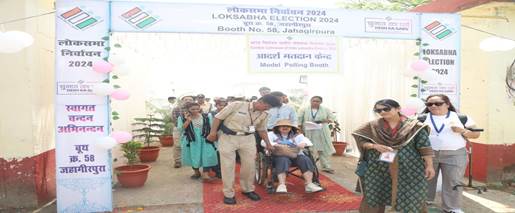
Delegates from Fiji, Australia, Russia, Madagascar, Kyrgyz Republic witnessed pre- poll arrangements and polling process for the General Elections to the Lok Sabha, 2024 in Ahmedabad. The delegation was impressed with strong room(s) having double lock system and deployment of armed police personnel ensuring effective security for EVMs. Female managed polling stations in Assembly Constituency of Sanand in Ahmedabad East PC was also drew appreciation and invited comments that they boost confidence in women and increase their participation. Facility of ramp and wheelchairs in all places along with volunteers to help elderly voters was also highly appreciated. The concept of Braille ballot paper for blind voters was also liked as a good initiative to help blind people.


Maharashtra

Representatives from the Election Management Bodies of Bangladesh, Sri Lanka, Kazakhstan and Zimbabwe visited Raigad parliamentary constituency in Maharashtra and witnessed the pre-poll arrangements, dispersal of polling parties and other logistics. The group interacted with the District Election Officer, Returning Officer, Presiding Officers and other election related officials about the various facets of the Indian Elections. The delegates were impressed with the transparency measures at polling stations.


Background

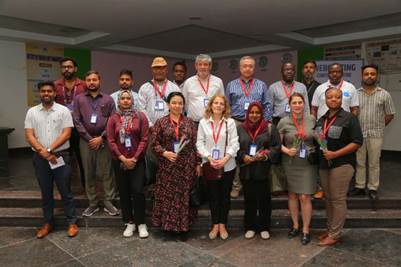
Delegates from 23 countries namely Australia, Bangladesh. Bhutan, Cambodia, Chile, Fiji, Georgia, Kazakhstan, Kyrgyz Rep, Madagascar, Maldives, Mongolia, Moldova, Namibia, Nepal, New Guinea, Philippines, Russia, Seychelles, Sri Lanka, Tunisia, Uzbekistan, Zimbabwe arrived at New Delhi to witness the Elections in the third phase of polling on the 5th May 2024. They interacted with the Election Commission of India in the inaugural session presided over by the Chief Election Commissioner Sh. Rajiv Kumar along with Election Commissioners Shri Gyanesh Kumar and Dr. Sukhbir Singh Sandhu. Thereafter the delegates were divided into 6 smaller groups to visit different states viz. Karnataka, Maharashtra, Gujarat, Uttar Pradesh, Goa and Madhya Pradesh and visited polling stations in 13 constituencies for this purpose. The CEOs of the States organized the visit of the groups to see the poll preparedness, logistics and webcasting arrangements as well as engaging with polling officers and presiding officers on pre-poll day and to witness the mock poll, actual polling and to interact with voters on election day i.e.7th May 2024.

.

*****

Copy Editing: A Comprehensive Overview

Daily writing prompt
What public figure do you disagree with the most?

Copy editing is a crucial stage in the preparation of manuscripts, encompassing a detailed review and correction process to ensure clarity, coherence, accuracy, and consistency in texts. This editing phase bridges the gap between writing and publishing, focusing on the mechanics of language, factual correctness, and the fine details that enhance the readability and professionalism of a document.

1. Purpose and Importance of Copy Editing

Copy editing serves several key purposes:

  • Enhances Clarity and Readability: Refines language to ensure clear communication.
  • Ensures Accuracy: Checks for factual errors, logical inconsistencies, and typographical mistakes.
  • Maintains Style Consistency: Aligns the document with specific style guides or internal consistency.
  • Improves Grammar and Syntax: Corrects grammatical mistakes and enhances sentence structure.
  • Legal and Ethical Assurance: Helps prevent plagiarism and ensures that sensitive content is handled appropriately.

2. Elements of Copy Editing

Copy editing involves meticulous attention to various elements of the text:

  • Grammar and Punctuation: Ensures correct use of language mechanics.
  • Spelling and Typographical Errors: Identifies and corrects misspellings and inadvertent keystroke errors.
  • Style and Tone: Adapts the voice of the text to suit the intended audience and purpose, often adhering to specific style guides like APA, MLA, or Chicago.
  • Structure and Flow: Modifies awkward phrasing and ensures sentences flow smoothly into one another, improving the overall readability of the text.
  • Fact-Checking: Verifies the accuracy of dates, names, citations, and other factual information.
  • Consistency: Checks for uniformity in terminology, numerals, fonts, and layout.

3. The Copy Editing Process

The typical copy editing process includes several steps:

  • Initial Assessment: The copy editor reviews the text to understand its content, structure, and the amount of editing required.
  • Detailed Editing: The editor goes through the text line by line, correcting grammatical errors, improving syntax, and ensuring style consistency.
  • Interaction with Authors: Copy editors may query authors to clarify ambiguous points or suggest significant changes.
  • Final Review: After initial edits, the text is reviewed again to catch any remaining issues and ensure all changes improve the text.
  • Formatting: Final adjustments are made to align the document with required formatting standards.

4. Tools and Resources for Copy Editors

Copy editors use a variety of tools to aid their work:

  • Digital Tools: Software like Microsoft Word (Track Changes), Google Docs, and Adobe Acrobat are common for making and tracking edits.
  • Style Guides: Resources such as The Chicago Manual of Style, AP Stylebook, or specific academic style guides provide standards for consistent formatting.
  • Grammar Checkers: Tools like Grammarly or ProWritingAid offer preliminary checks for grammar and style but do not replace human judgment.
  • Dictionaries and Encyclopedias: Essential for verifying spelling and factual information.

5. Skills Required for Effective Copy Editing

  • Strong Command of Language: Expertise in the language of the text is crucial.
  • Attention to Detail: Ability to spot minor errors and inconsistencies that others might overlook.
  • Good Judgment: Knowing when to make changes and when to consult the author.
  • Technical Knowledge: Understanding of typesetting, formatting, and publishing processes.
  • Communication Skills: Effective interaction with authors to make necessary changes without altering the intended meaning.

6. Challenges in Copy Editing

  • Maintaining Voice: Keeping the author’s original voice while making necessary edits.
  • Handling Complex Content: Working with texts that require specialized knowledge.
  • Time Constraints: Meeting publishing deadlines while ensuring thorough editing.

Conclusion

Copy editing is an indispensable part of the publishing process that significantly enhances the quality of written work. Whether it’s a book, academic paper, or online content, effective copy editing ensures that the final product is polished, accurate, and ready for publication. By focusing on the finer details of language and consistency, copy editors play a pivotal role in the success of any written material.

Dubai to Abu Dhabi how NFTS are used in the UAE

  Non-fungible tokens (NFTs) are still in high demand in the area. They are employed by projects in several ways, despite the United Arab Emirates (UAE) continuing to offer a friendly legal environment for blockchain-based technology. To read more about Encryption and Decryption in cryptocurrency visit the page.

NFTs make it easier for doctors to get data about gamers

Photo by Jonathan Borba on Pexels.com

Researchers of Bitcoin smart may now utilize NFTs to obtain funds and data thanks to a project still in progress at Dubai’s Jumeirah Village Circle. Dmitry Mikhailov, an artificial intelligence expert from Farkana Laboratories, spoke with Cointelegraph about his organization’s use of NFTs in research during the recent AIBC Dubai symposium in Festival City.

NFT tickets from BnB Chain infiltrate a party concert in Abu Dhabi Ultra Abu Dhabi, an underground electronic dance music (EDM) extravaganza including appearances by well-known DJs like Calvin Harris and Skrillex, Fellaz, and Taste of Web3. The race was staged on Yas Island, home to several attractions, including Ferrari World and the Yas Marina Circuit, where the Formula One Abu Dhabi Grand Prix has been held annually since 2009.

NFT incentives are important for the charity.

The UAE has a strong tradition of civic engagement and philanthropic giving. The nation’s leaders lead several programs, and the government oversees social, philanthropic, and humanitarian activities inside and beyond the UAE. 

What are NFTs?

If you have been keeping up with recent technological advances, you have likely heard about NFTs or non-fungible currencies. Still, it might be difficult to grasp for someone with little or no technical experience. Here are my few bits on NFTs. This digital asset denotes ownership of an original piece of writing or material.

Consider it the digital equivalent of a collectible object like a rare baseball card or one-of-a-kind artwork.

The value of an NFt stems from its rarity and uniqueness, much like with these real works of art.

How are NFTs being adopted all over the world?

The United States, China, South Korea, and Japan are some of the nations that use NFTs in a significant way. Artists, singers, and even sports are utilizing NFTs in these nations to monetize their work and interact with their audience.

For its acceptance, the USA has seen a considerable increase in launching numerous NFT marketplaces & platforms. These nations are all leading the NFT revolution and advancing its growth and development.

NFTs adoption in Dubai, Abu Dhabi, or UAE at large:

As every nation has joined the NFT bandwagon or is about to, a significant global economic hub like the UAE, whose core economy is dependent on oil, doesn’t want to fall behind in the NFT adoption race. In the UAE, especially in Dubai & Abu Dhabi, there is a surge in the usage of NFTs. Individuals, companies, and governmental organizations are adopting this cutting-edge technology at an increasing rate.

Role of government & Industries in promoting the Usage of NFTs in UAE

Through several initiatives, including “The Dubai Future Foundation,” which is leading the Global Cryptocurrency Challenge and inviting start-ups and innovators to come up with solutions using blockchain and NFTs to address general challenges, the government of Dubai is actively encouraging the adoption of NFTs and blockchain technology. 

Some sectors in the UAE are already investigating the use of NFTs. For instance, the Dubai-based art marketplace Artify allows artists to sell their non-traditional works on its website, giving them a new method to reach a worldwide audience and profit from their works. Seeing the potential of NFTs, the UAE’s sports sector has introduced NFT collections for football clubs & leagues, giving fans a new opportunity to interact with their personal favorites & players.

The Abu Dhabi government is investigating the use of NFTs in the real estate industry with intentions to digitize land registration and issue NFTs as ownership verification. Such actions by the UAE government would undoubtedly increase its ability to compete in the global economy.

Conclusion:                                                          

In conclusion, the UAE’s ambitious goal and intention to become a major center for NFTs adoption through distributed ledger technology & innovation has fueled the acceptance of NFTs in the country, notably in Dubai & Abu Dhabi. 

3 Tokens to turn your $1 into $30 in a 2023 check

  Multiplying your dollar into a hundred dollars is everything that we need as investors. We turn saving into investments to generate a heavy flow of income. Acquiring profits by investing in cryptos is an easy way of intelligent earning. We long to invest more of our savings into places that potentially generate income In addition, you may improve your trading skills by using a reputable trading platform like www.immediateconnect-se.com

Photo by Jonathan Borba on Pexels.com

Yet, most of the middlemen infuse her wealth for unproductive purposes rather than inducing for their well-being. A general spread of awareness has to be attained to avoid this behavior. Enouage to save and invest in the best legitimate sources of earning should be an investor’s target. 

Cakes with a sweet frosting require more effort and time. Similarly, more returns might often take longer time but the wait is worthwhile. So, grab your cake in advance and enjoy your frosting when the trends shoot your way high. 

Let’s seize the golden chance to turn your dollar into thirty dollars by investing in the best-rated cryptos. There is no better opportunity to do so and build up your portfolio. Here are the 3 most incredible cryptos paving a new way of meaning opportunity: 

  1.  RenQ Finance (RENQ)

RENQ is a bridge to isolated blockchains on a decentralized Finance DeFi platform. Its mission is to resolve the ever-raging problem of liquidity. Innovation is the key intention of the platform and has placed it on its platter very precisely. 

Apart from the liquidity concept, it further emphasizes several other features. One of which is the scalability concept. The scalability is refurbished to promote a swift mode of transactions in a short time. Furthermore, its low transaction fees make RENQ the best choice for traders and investors. 

The wallet system is purely centralized with decentralized security set up to maintain transparency and uniformity. It further slaves the complexity issues that traders come across while dealing with DeFi exchanges. If you’re a trader of a basic level and have the least experience in managing DeFi networks then this is a perfect pick. 

It is a user-friendly platform that builds investors’ trust by resolving their issues. Traditional platforms have infused the scalability and liquidity concept but had a backlog in balancing the two. 

  • Shiba Inu (SHIB) 

Shiba Inu token is an inspiration from a dog breed that has a whole community-driven ecosystem. The meme crypto started its journey in the year 2020 in August. SHIB has a decentralized blockchain base that has come under the limelight recently. 

According to the resorts of the portal, the SHIB token is flaring remarkably. The initial price of one SHIB token in 2020 was $0.00000001 which has touched beyond the sky to $0.00001088. The reason behind this is the innovation and technology the model inhabits. 

The growth trajectory to Shiba Inu is bound to shoot up with no stop signs visibility. The meme coin is also framed as the “Dogecoin KIller” as it has been replacing it and setting its significant position. The SHIB token predictions reveal it will touch $30 by 2023 from a dollar investment to thirty. 

  • Cardano (ADA) 

The Cardano portal addresses interoperability on its front base. Additionally, it also aids the scalability issues by accessing faster transactions than Bitcoin and Ethereum. The blockchain platform aims at sustainability and an energy-efficient structure in its framework. To bring this into its model it runs on proof-of-stake consensus. 

On the other hand, well-known cryptos like BTC and ETH have a proof-of-work consensus. By market cap, Cardano ADA has touched the seventh-largest position in the galaxy of cryptos. Cardanoo has taken a steady climb from $0.18 in March 2020 to $3.10 in September 2021. 

The current price of Cardano is running at $0.414. Positive trends are favoring the Cardano portal which has highly friendly indications for its length as well as short-term investors. If ADA sets to rise at the same velocity then it is certainly bound to achieve $30.

Let us switch in to buy these cryptos and strengthen your portfolio and enhance your presence in the crypto industry.     For crypto trading and investment log onto Bitcoin smart