Basics of Research Methodology- Writing and Publication by Dr. Kavita Dehalwar

Daily writing prompt
What is your favorite genre of music?

The journey of research is both challenging and exhilarating, marked by the pursuit of knowledge and the quest to uncover new truths. For young researchers and newly enrolled PhD scholars, embarking on this journey can be an overwhelming experience, replete with complex methodologies, rigorous writing standards, and the daunting task of publication. This book, Basics of Research Methodology: Writing and Publication, is crafted with the intent of serving as a comprehensive guide and companion for those at the nascent stage of their academic careers. Research is a dynamic and evolving process, requiring a solid foundation in methodological principles and an ability to communicate findings effectively. This book aims to demystify the intricacies of research methodology, offering a structured approach to planning and executing research projects. From formulating research questions to selecting appropriate methods, we cover the essential steps required to build a robust research framework. The emphasis is on clarity and simplicity, ensuring that even complex concepts are accessible to readers without extensive prior experience. Writing is an integral part of the research process, serving as the medium through which discoveries are shared with the broader academic community. This book provides practical advice on developing a clear and concise academic writing style, tailored to meet the expectations of various scholarly audiences. Whether you are drafting your first research paper, preparing a thesis, or writing a dissertation, the principles outlined in these pages will equip you with the skills necessary to produce high-quality academic work. We delve into the nuances of writing different sections of a research paper, from the introduction to the conclusion, highlighting the purpose and structure of each component.


The publication process, while rewarding, can often seem like a labyrinth to those unfamiliar with its intricacies. This book offers a step-by-step guide to navigating the world of academic publishing, from selecting the right journal to understanding the peer review process. We provide tips on how to respond to reviewers’ comments, handle rejections, and ultimately succeed in getting your work published. The aim is to empower you with the knowledge and confidence needed to disseminate your research effectively, contributing to the advancement of your field and establishing your presence as a scholar. Throughout this book, we draw upon the experiences of seasoned researchers and successful academics, providing insights and practical examples that illustrate the real-world application of the concepts discussed. We recognize the diversity of research disciplines and strive to present information that is broadly applicable while acknowledging the unique requirements of different fields. Our goal is to create a resource that not only educates but also inspires, encouraging you to approach your research with curiosity, diligence, and a passion for discovery. As you embark on your research journey, we hope this book will serve as a valuable resource, guiding you through the challenges and helping you to achieve your academic and professional aspirations. Remember, research is a continuous learning process, and each step you take brings you closer to making a meaningful impact in your field. We wish you success and fulfillment in your endeavors, and look forward to the contributions you will make to the world of knowledge.

Link to Buy Print Copy

Link to Download Free eBook 

Book Details

Publisher: Edupedia Publications Pvt Ltd
ISBN: 9789392585937
DOI:

https://doi.org/10.5281/zenodo.12654218
Binding: Paperback (Perfect Binding)
Year: 2024
Genre: Reference (Research Methodology)
Pages: 346
Dimensions: 6.00″x9.00”

Australia-India Strategic Research Fund

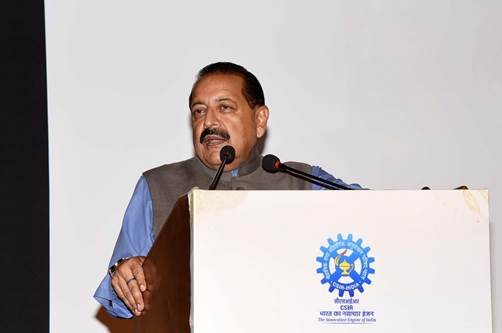
 The Union Minister of State (Independent Charge) for Science and Technology, Minister of State (Independent Charge) for Earth Sciences, MoS PMO, Department of Atomic Energy and Department of Space and MoS Personnel, Public Grievances and Pensions, Dr. Jitendra Singh unveiled the results of the 15th round of the Australia-India Strategic Research Fund (AISRF).

The successful projects that have been awarded funding under the prestigious program were announced today through a press note.

The Australia-India Strategic Research Fund (AISRF) is a bilateral program that supports collaborative research projects between Australia and India. It aims to strengthen the scientific relationship between the two countries and address common challenges through joint research efforts.

This year, the AISRF has awarded funding to five projects across various disciplines, including artificial intelligence and machine learning, biotechnology, urban mining and electronic waste recycling, ultralow-cost solar and clean hydrogen technologies. These projects were selected through a rigorous evaluation process, ensuring they meet the highest standards of scientific excellence and have the potential for significant impact.

The selected projects reflect the diverse and cutting-edge research being conducted by Australian and Indian scientists. These initiatives are expected to yield valuable insights and solutions that will benefit both countries and the wider global community.

Union Minister of State (Independent Charge) for Science and Technology, Minister of State (Independent Charge) for Earth Sciences, MoS PMO, Department of Atomic Energy and Department of Space and MoS Personnel, Public Grievances and Pensions Dr. Jitendra Singh emphasised the importance of international collaboration in research and innovation. He said, “I feel collaboration is crucial in this modern era to address critical global challenges and in fostering sustainable development. The AISRF is a testament to the enduring partnership between India and Australia. I am sure the projects which emerged out of collaboration would result in significant scientific discoveries and technological advancements in areas of mutual interest. While reinforcing our commitment to build a vibrant innovation ecosystem with Australia, I congratulate all the researchers involved with these projects for a prosperous and sustainable future.”

Ed Husic, Minister for Industry and Science, Australia added, “The world isn’t short of complex issues, with collaboration between nations playing an essential role in delivering scientific breakthroughs that will make a difference. From tougher strains of bacteria to e-waste and AI, our bilateral research partnership puts Australia’s brightest minds to creating better solutions for the world’s ongoing and emerging challenges. The Australia-India Strategic Research Fund has delivered more than 360 collaborative research projects in the past 18 years, ensuring our nation’s universities and research institutions have remained at the forefront of global research.”

Funding for this year focused on:

  1. Creating an AI-driven platform for monitoring soil carbon sequestration.
  2. Eco-friendly recovery of essential metals from obsolete mobile devices.
  3. Cost-effective solar thermal desalination by systems design with nanomaterials.
  4. Harnessing the immune system’s power to combat antimicrobial resistance.
  5. Advanced diagnostics and innovative therapeutics to detect and combat microbial infections.


The Indian recipients are the Punjab Remote Sensing Centre, Ludhiana; IIT Delhi, IIT Bombay, IISc Bangalore and AbGenics Life Sciences Pvt. Ltd. Pune.

****

World to witness 1st Indian in Space and other Indian in Deep Sea by 2025

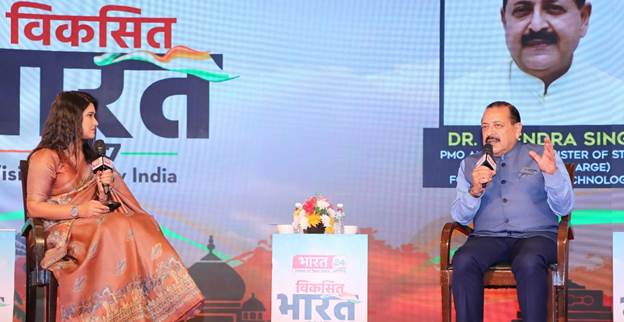
 World to witness 1st Indian in Space and other Indian in Deep Sea by 2025, says Union Minister Dr. Jitendra Singh on the stage of Bharat 24 News network during his address here today.

Speaking on India’ s progress in Space and Marine sector, Dr. Jitendra Singh shared that four astronauts-three Group Captains and one Wing Commander have been selected for India’s 1st Human Space Mission- Gaganyaan. Similarly, he also shared that India’s Deep-Sea mission will send three Indians to deep sea in 2025.

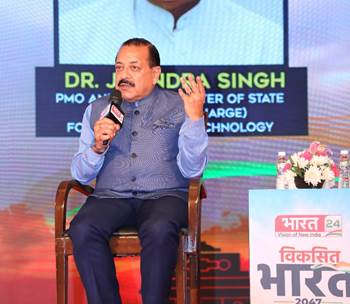
Union Minister Dr. Jitendra Singh at the programme hosted by Bharat 24 News network

During his address highlighting the Development in the Northeast India, Union Minister of State (Independent Charge) for Science and Technology, Minister of State (Independent Charge) for Earth Sciences, MoS PMO, Department of Atomic Energy and Department of Space and MoS Personnel, Public Grievances and Pensions Dr. Jitendra Singh said Infrastructure overhaul in Northeast India in the last decade is the role model of PM Modi’s development.” Going further he recalled the new airports made operational in Northeast. Increase in network of all-weather roads and highways along with remote connectivity. The railways operating trains from Itanagar and new waterways that have been opened. He categorically mentioned that not only in terms of Infrastructure but also in human resources development is commendable as recruiters in the hospitality and aviation industry are now visiting these states for talent acquisition. Going further he stated that Prime Minister is fond of the region and preferred Mizoram to establish a ‘Citrus Fruit Park- A Centre of excellence’ in Mizoram due its favorable conditions.

Dr. Jitendra Singh when asked about the progress of Jammu Kashmir in the last decade said “Record number of tourists visiting Kashmir nearly 2.5 crore in the last season is the testimony of development and peace in the region.” He also added that 1 lakh people have already arrived for Amarnath Yatra which also highlights boom in domestic tourism. He also mentioned that terrorism is in its last phase.

The media group congratulated Dr. Jitendra Singh for making a hattrick by winning from Udhampur constituency and also being the Minister for the 3rd time. The Science and Technology Minister recalled the recent progress and shared the path of India’s vision. He said “Space sector is limited to launch rockets and satellites but it will also propel growth and positively impact agriculture, infrastructure, communication, healthcare etc. Land Record management, new geospatial policy, new space policy, and initiatives such as soil health card, DBT, land mapping etc. will boost farmer productivity,”

He said, “In 2022 we had just one space Startup and in 2024 after opening the space sector for private participation we have nearly 200 startups and many among them have global capacity. He also shared that in just few months 1000 crore of Private sector investment has come into Space sector.

Dr. Jitendra Singh said, “India is among the frontline nations in terms quantum technologies as we have National Quantum Mission”. He also highlighted India’s Vast resources which are untapped such as Himalayan resources, Marine Resources of 7500km long coastline. The minister also shared that the government is successful in bringing agriculture and entrepreneurship together by Aroma Mission which promotes lavender cultivation and empowers farmers economically with the help of technology.

*****

1stCentury would be of Asia with India leading

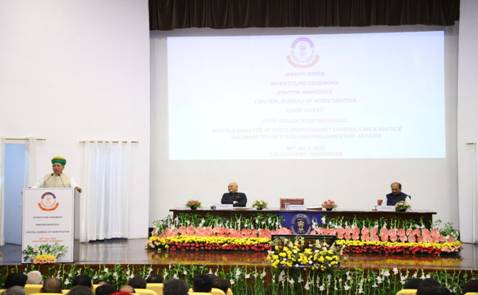
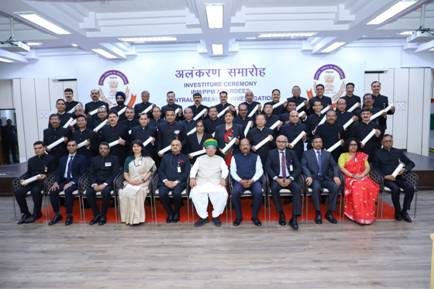
 The Central Bureau of Investigation today organised an Investiture Ceremony at CBI Academy, Ghaziabad (Uttar Pradesh). On this occasion, Shri Arjun Ram Meghwal, Union Minister of State (Independent Charge), Ministry of Law & Justice and Minister of State for Parliamentary Affairspresented the President’s Police Medal (PPM) for Distinguished Service and Indian Police Medal (IPM) for Meritorious Service to 39 CBI officers/officials. Congratulating the medal winners and their familiesShri Meghwal said that it is a proud moment for all of us to have recognized their service rendered to the nation. He added that this also acts as a source of inspiration for all service officials to excel in their job. Appreciating CBI in its role, he observed that not only CBI’s importance is being recognized in the society but also its investigation is the best, which is reflected in high conviction rate in cases investigated by CBI. Shri Meghwal emphasised CBI is rightly regarded as the best investigating agency which is reflected in demand for CBI probe every now and then in complex and sensitive cases by various stakeholders.

WhatsApp Image 2024-07-04 at 3.16.12 PM (1).jpeg

Delving on the new Criminal Laws which has been implemented with effect from 1st July, 2024, Shri Meghwal asserted that these laws will bring in ease of living in a big way for citizenry. These laws will expedite delivery of justice and save crucial time of all the stakeholders spent during litigation. The Minister stressed that this will prove highly productive for the nation as the energies would be channelised towards the process of development of the society and eventually lead to higher progress. Referring to India recently galloping to fifth largest economy in the world from the 11th position few years ago, he underlined that reforms/ improvements in judicial process will also contribute to the endeavour and goal of taking India to 3rd position in the coming few years.

Shri Meghwal underscored the significance of India’s progress as envisioned by Prime Minister Shri Narendra Modi that India would play pivotal role in the 21stcentury on a global scale.Tracing the 19th century with regards to progress as that of Europe, led by England; 20th century that of America led by United States of America (USA), he expressed confidence that 21st century would be of Asia led by India. Reminiscing Swami Vivekananda’s forecast, he said that India is set for the landmark by its varied parameters inter alia democratic setup of the society, progressive growth in the sphere of economy and technology, family value system and family setup, India’s helpful gestures in world arena and roles taken up on international platforms,  growing role of citizenry, environmental initiatives, strategic lead in the sphere of Yoga, Ayurveda, Space etc. have placed India in a leadership position world over.

98ffe62f-a865-4753-9c69-ff43f24174ae.jpg

In his welcome address, Shri Praveen Sood, Director, CBI complimented the medal recipients and stated that they have achieved the laurels due to their professional hard work, resilience and fortitude which have earned CBI great esteem. He further congratulated the recipient’s family members. On this occasion, Shri Sood emphasised that CBI and Law Ministry are working in synergetic and collaborative environment to prioritise more efficient prosecution along with investigation. Director CBI stressed that CBI’s role has been evolving with the passage of time, from handling primarily anti-corruption cases in the beginning to special/ economic crimes, cybercrimes, bank frauds, etc. Shri Praveen Sood also said that CBI is working with Ministry of Law & Justice with regards to successful implementation of three new Criminal Laws informing that CBI has started implementing these laws. He offered that CBI is geared to handhold States and other stakeholders in helping them in implementation of these laws.

Swami Vivekananda: A Detailed Biography

 Early Life and Education

Birth and Family
Swami Vivekananda was born as Narendranath Datta on January 12, 1863, in Kolkata (then Calcutta), British India. His father, Vishwanath Datta, was an attorney at the Calcutta High Court and his mother, Bhuvaneshwari Devi, was a devout housewife with strong spiritual inclinations. The family was well-off and deeply respected in the community.

Education and Youth
Narendranath was a bright student with a keen intellect and an insatiable curiosity. He attended the Metropolitan Institution, where he excelled in his studies, particularly in philosophy and literature. Later, he enrolled at the Scottish Church College in Calcutta, where he studied Western logic, philosophy, history, and social sciences. His interest in spirituality and religion was nurtured during this time, influenced by a variety of philosophical texts, including the Vedas and Upanishads.

Spiritual Quest

Meeting Ramakrishna
Narendranath’s spiritual journey took a decisive turn when he met Sri Ramakrishna Paramahamsa, a revered mystic and saint, in 1881. Initially skeptical of Ramakrishna’s teachings, Narendranath was deeply influenced by his profound spirituality and intense devotion. Ramakrishna’s simple yet profound teachings on the unity of all religions and the direct experience of God greatly impacted Narendranath.

Becoming a Disciple
Under Ramakrishna’s guidance, Narendranath underwent a transformative spiritual journey, embracing the ideals of renunciation and service to humanity. He became one of Ramakrishna’s most dedicated disciples, adopting the name Vivekananda, meaning “the bliss of discernment.”

Monastic Life and Wanderings

Ramakrishna’s Death and Formation of the Ramakrishna Order
After Ramakrishna’s death in 1886, Vivekananda and other disciples took monastic vows, forming the Ramakrishna Order. Vivekananda embarked on a life of renunciation, traveling extensively across India to understand the plight of the common people and the diverse spiritual practices of the land.

Wandering Monk
From 1888 to 1893, Vivekananda traveled across India as a wandering monk. He visited historical and spiritual sites, engaged with scholars and laypeople, and observed the conditions of the masses. His travels deepened his understanding of India’s strengths and weaknesses, and he developed a vision of upliftment through spiritual awakening and social reform.

World Parliament of Religions

Journey to the West
In 1893, with the encouragement of his followers, Vivekananda traveled to the United States to represent Hinduism at the World Parliament of Religions in Chicago. He faced numerous challenges, including financial difficulties and cultural barriers, but his determination and faith sustained him.

Chicago Address
On September 11, 1893, Vivekananda delivered his historic address at the Parliament, beginning with the words, “Sisters and brothers of America.” His speech, which emphasized the universality of all religions and the need for mutual respect and understanding, received a standing ovation and established him as a prominent spiritual leader in the West.

Contribution to the West

Lectures and Establishment of Vedanta Societies
Following the Parliament, Vivekananda spent several years lecturing across the United States and Europe. He established Vedanta Societies in New York and London, where he introduced Western audiences to the principles of Vedanta and the practical aspects of spirituality.

Influence on Western Thought
Vivekananda’s teachings had a profound impact on Western thinkers and intellectuals. He emphasized the practical application of spiritual principles in everyday life and promoted the idea of religious harmony. His interactions with leading figures of the time, including Nikola Tesla and William James, influenced the development of Western spiritual and philosophical thought.

Return to India and Later Life

Return to India
Vivekananda returned to India in 1897, where he received a hero’s welcome. He embarked on a mission to revitalize Indian society through education, social service, and spiritual upliftment. He established the Ramakrishna Mission in 1897, dedicated to social service and the promotion of Vedanta.

Educational and Social Initiatives
Vivekananda emphasized the importance of education in empowering the masses. He founded schools and colleges, promoted scientific and technical education, and worked towards the upliftment of the poor and marginalized. His efforts in promoting women’s education and social equality were particularly noteworthy.

Final Years and Legacy
Vivekananda spent his final years focusing on the consolidation of the Ramakrishna Mission and its activities. He continued to inspire people through his teachings, writings, and personal example. Swami Vivekananda passed away on July 4, 1902, at the age of 39, leaving behind a legacy of spiritual and social transformation.

Philosophical and Spiritual Contributions

Vedanta and Universal Religion
Vivekananda’s teachings emphasized the universal nature of spiritual truth and the essential unity of all religions. He advocated for the Vedantic philosophy, which holds that the soul is divine and the ultimate goal of life is to realize this divinity through self-discipline, service, and devotion.

Practical Vedanta
He introduced the concept of “Practical Vedanta,” which advocates applying spiritual principles to solve real-world problems. He encouraged individuals to see God in every person and to work for the welfare of humanity as a form of worship.

Empowerment and Social Reform
Vivekananda believed in the potential of every individual to achieve greatness. He championed the cause of social reform, advocating for the upliftment of the poor, the education of women, and the eradication of social evils like caste discrimination. His teachings inspired a generation of social and political leaders, including Mahatma Gandhi and Subhas Chandra Bose.

Legacy

Global Impact
Swami Vivekananda’s legacy extends far beyond India. His teachings continue to inspire individuals and organizations worldwide. The Ramakrishna Mission and Vedanta Societies established by him remain active in promoting education, healthcare, and spiritual growth.

Cultural Renaissance
In India, Vivekananda is revered as a key figure in the country’s cultural and spiritual renaissance. His message of self-confidence, national pride, and social responsibility resonates with people across generations. National Youth Day is celebrated in India on his birthday to honor his contributions and inspire the youth.

Philosophical Contributions
Vivekananda’s philosophical writings, including his works on Vedanta, Raja Yoga, and Karma Yoga, remain influential texts in the study of Indian philosophy and spirituality. His teachings continue to be a source of inspiration for seekers of truth and practitioners of various religious traditions.

Swami Vivekananda’s life and teachings continue to inspire millions across the globe, promoting a message of unity, peace, and selfless service. His vision of a spiritually awakened and socially responsible humanity remains as relevant today as it was during his lifetime.


Further Reading and Resources

  1. Books

    • “The Complete Works of Swami Vivekananda” – A collection of his lectures, writings, and letters.
    • “Swami Vivekananda: A Biography” by Swami Nikhilananda.
  2. Online Resources

    • The Ramakrishna Mission official website: www.ramakrishna.org
    • The Vedanta Society websites in various countries provide information and resources on Vivekananda’s teachings.