

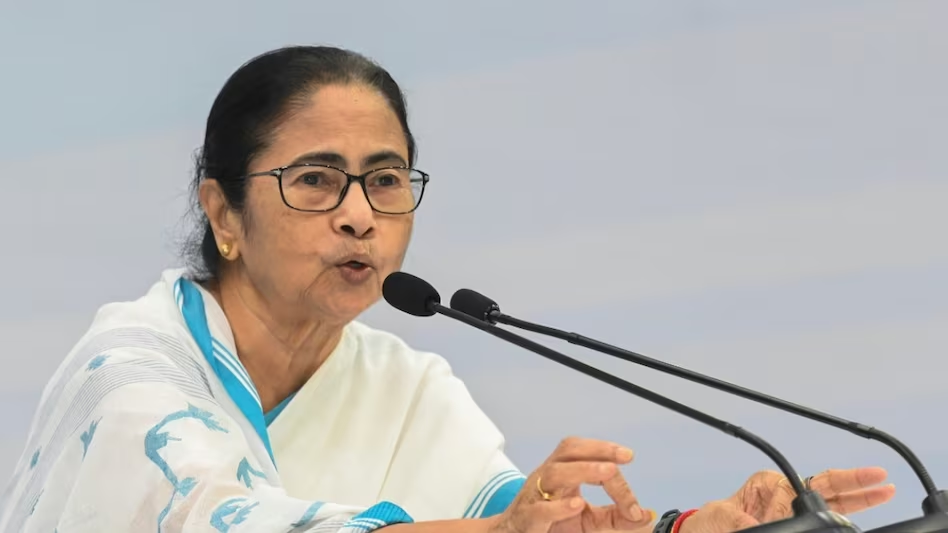
Mamata Banerjee is a prominent Indian politician and the current Chief Minister of West Bengal, a state in eastern India. Known for her dynamic leadership style and distinctive political approach, Banerjee has played a significant role in shaping West Bengal’s contemporary political landscape. Her journey from grassroots activism to becoming one of India’s most influential political figures is marked by both substantial achievements and controversies.
Early Life and Education
Mamata Banerjee was born on January 5, 1955, in Kolkata (then Calcutta), West Bengal. Her father, Promileswar Banerjee, was a freedom fighter and a follower of the Gandhian principles, which deeply influenced Mamata’s ideological framework. Her mother, Gayatri Devi, was a homemaker.
Banerjee pursued her early education in Kolkata. She completed her Bachelor’s degree in History from the Jogamaya Devi College, followed by a Master’s degree in Islamic History from the University of Calcutta. She also earned a Bachelor’s degree in Education (B.Ed.) and later an M.Phil. in Islamic History. Her academic background provided her with a broad understanding of Indian history and social issues.
Political Career Beginnings
Mamata Banerjee’s political journey began in the early 1970s. Initially, she was associated with the Indian Youth Congress and was an active participant in student movements. Her early involvement in politics was influenced by her mentor, the late Subhas Chandra Bose, and she became known for her grassroots activism and oratory skills.
Banerjee’s significant political breakthrough came in 1984 when she was elected to the Lok Sabha (the lower house of India’s Parliament) as a member of the Indian National Congress (INC) from the Jadavpur constituency. At 29, she was the youngest woman ever to be elected to the Lok Sabha. Her rise was rapid; she was appointed the Minister of State for Human Resource Development and later, Minister of State for Youth Affairs and Sports.
Formation of the Trinamool Congress (TMC)
Despite her initial success with the Indian National Congress, Banerjee became increasingly disillusioned with the party’s central leadership and its handling of West Bengal’s issues. In 1997, she founded the All India Trinamool Congress (TMC) as a splinter group from the Congress Party. The TMC was established with the goal of addressing local issues more effectively and to challenge the ruling Communist Party of India (Marxist) (CPI(M)) in West Bengal.
The TMC quickly emerged as a significant political force in West Bengal. Banerjee’s leadership was instrumental in building the party’s base, especially among the rural and urban poor, and in challenging the long-standing dominance of the CPI(M) in the state.
Chief Minister of West Bengal
Mamata Banerjee’s relentless efforts culminated in a historic victory in the 2011 West Bengal Assembly elections. The TMC, under her leadership, ended the 34-year rule of the CPI(M) in the state. This victory marked a significant political shift in West Bengal and established Banerjee as a powerful regional leader.
Key Achievements and Policies:
- Development Initiatives: Banerjee’s tenure as Chief Minister has been marked by various development initiatives, including infrastructure projects, industrialization efforts, and improvements in the education and healthcare sectors.
- Social Welfare Schemes: Her government has introduced numerous welfare schemes, such as Kanyashree Prakalpa (a scheme to support the education of girls) and Sabuj Sathi (a program to distribute bicycles to school students).
- Land Reforms: Banerjee has been known for her focus on land reforms and rural development, although her policies in this regard have sometimes been met with criticism.
Controversies:
- Political Violence: Her tenure has faced criticism for alleged instances of political violence and law and order issues. The TMC has been accused of encouraging or failing to prevent violence against political opponents.
- Economic Management: There has been criticism regarding the state’s economic performance under her leadership, with allegations of poor handling of economic development and industrial growth.
Electoral Successes and Challenges
Mamata Banerjee has been re-elected as the Chief Minister of West Bengal in subsequent elections (2016, 2021), showcasing her enduring political appeal. Her leadership was instrumental in the TMC’s victory in the 2021 West Bengal Assembly elections, where the party retained power despite significant challenges from the Bharatiya Janata Party (BJP), which had made substantial inroads into the state.
National and International Presence
Beyond West Bengal, Mamata Banerjee has sought to position herself as a national leader. She has been vocal on various national issues and has occasionally expressed her ambitions for a larger role in Indian politics. Her political stance often aligns with a progressive and regionalist outlook, advocating for more autonomy for states and focusing on social justice issues.
Personal Life
Mamata Banerjee is known for her personal simplicity and austere lifestyle. She is an avid writer and has published several books in Bengali, covering a range of topics including politics, literature, and history. Her personal and professional life is closely intertwined with her political career, and she remains a significant and polarizing figure in Indian politics.
Conclusion
Mamata Banerjee’s career is a testament to her resilience and political acumen. From her early days as a student activist to her current role as the Chief Minister of West Bengal, her journey reflects both her strengths and the challenges she has faced. Her impact on West Bengal’s political and socio-economic landscape is profound, and her continued influence on Indian politics is likely to be significant in the years to come.

 Eduindex
You must be logged in to post a comment.