

Early Life and Education: Arvind Kejriwal was born on August 16, 1968, in Siwani, Haryana, India. He grew up in a middle-class family and displayed an early interest in academics and social issues. Kejriwal pursued his schooling in Haryana and later moved to Delhi for higher education. He attended the Indian Institute of Technology (IIT) Kharagpur, where he earned a degree in Mechanical Engineering. His academic excellence and analytical skills were notable during his time at IIT.
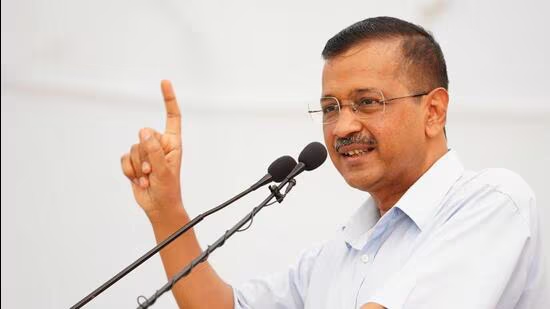
Career Before Politics: Before venturing into politics, Kejriwal had a successful career in the Indian Administrative Service (IAS). He joined the Indian Revenue Service (IRS) in 1995, serving as a Joint Commissioner in the Income Tax Department. During his tenure, he was involved in several high-profile cases and earned a reputation for his dedication and integrity.
Social Activism: Kejriwal’s transition from a bureaucrat to an activist was marked by his involvement in various social and anti-corruption movements. In the early 2000s, he became actively involved in the anti-corruption movement led by social activist Anna Hazare. The movement aimed to fight against corruption and promote transparency in governance through the Jan Lokpal Bill. Kejriwal’s leadership and efforts in this movement gained him significant public recognition and laid the groundwork for his entry into politics.
Political Career:
- Founding of the Aam Aadmi Party (AAP): In 2012, Arvind Kejriwal and other like-minded activists, including Kumar Vishwas, Manish Sisodia, and others, founded the Aam Aadmi Party (AAP). The party was established with the mission to address issues of corruption, transparency, and governance, aiming to provide an alternative to the traditional political system in India.
- 2013 Delhi Assembly Elections: AAP made a remarkable debut in the 2013 Delhi Assembly elections, winning 28 out of 70 seats and emerging as the second-largest party. Kejriwal, as the Chief Ministerial candidate, formed a minority government with the support of the Indian National Congress (INC). His tenure as Chief Minister was marked by a focus on issues such as electricity tariffs, water supply, and anti-corruption measures.
- Resignation and Return: In February 2014, Kejriwal resigned from his position as Chief Minister after 49 days in office, citing the lack of support from the Congress Party for the passage of the Jan Lokpal Bill. His resignation led to fresh elections.
- 2015 Delhi Assembly Elections: In the 2015 Delhi Assembly elections, AAP secured a landslide victory, winning 67 out of 70 seats. Kejriwal was re-elected as Chief Minister, and his government focused on several key areas, including education reform, healthcare, and improving public services. The party’s performance was seen as a significant political achievement, showcasing the appeal of its anti-corruption and governance-centric agenda.
- 2020 Delhi Assembly Elections: AAP continued its success in the 2020 Delhi Assembly elections, winning 62 out of 70 seats. Kejriwal’s second term was characterized by further efforts in urban development, health care, and educational reforms. His government implemented several initiatives aimed at improving the quality of life for Delhi’s residents, including enhanced public health services and infrastructure projects.
Key Policies and Achievements:
- Education: Kejriwal’s government has been recognized for its focus on improving Delhi’s public education system. This includes the construction of new classrooms, hiring of more teachers, and the implementation of various schemes to improve school infrastructure and quality of education.
- Healthcare: The AAP government has invested in expanding and upgrading healthcare facilities. Initiatives such as Mohalla Clinics provide free primary health care services to Delhi residents, making healthcare more accessible.
- Anti-Corruption: Kejriwal has been a strong advocate of anti-corruption measures. His tenure saw the introduction of various transparency initiatives, including the implementation of the Delhi Jan Lokpal Act to address corruption.
- Public Services: The government has worked on improving public services, including providing subsidized electricity and water. Efforts have also been made to enhance the efficiency and transparency of public service delivery.
Challenges and Criticisms:
- Administrative Hurdles: Kejriwal’s tenure has faced challenges related to the administrative and legislative powers of the Delhi government, often resulting in conflicts with the central government and the Lieutenant Governor of Delhi.
- Political Criticisms: Critics have accused Kejriwal of focusing too much on political theatrics and not delivering on some of his promises. There have been allegations of confrontational politics and strained relationships with other political entities.
- Governance Issues: Despite significant achievements, Kejriwal’s administration has faced criticisms related to governance, including delays in implementing certain policies and handling of public protests.
Personal Life: Arvind Kejriwal is married to Sunita Kejriwal, an IRS officer. The couple has two children. Kejriwal is known for his simple lifestyle and commitment to public service, often engaging in grassroots activities and direct interactions with the public.
Conclusion: Arvind Kejriwal has emerged as a significant political figure in India, known for his focus on anti-corruption, transparency, and governance reforms. His journey from a social activist to the Chief Minister of Delhi reflects a unique approach to Indian politics, emphasizing grassroots involvement and accountability. Despite facing various challenges and criticisms, Kejriwal’s contributions to Delhi’s political landscape and governance are noteworthy.

 Eduindex
You must be logged in to post a comment.