



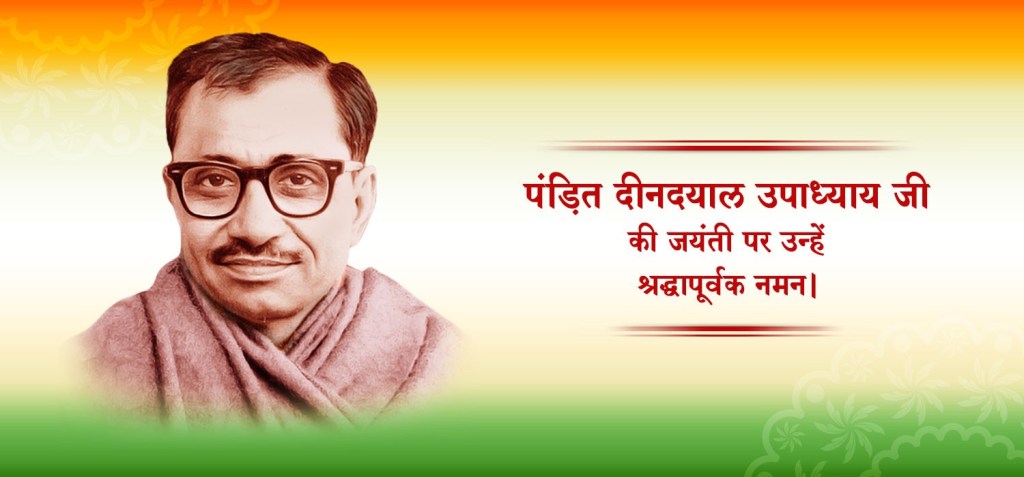
Pandit Deendayal Upadhyaya (1916–1968) was an Indian politician, philosopher, economist, and thinker, who played a significant role in shaping the political and ideological framework of modern India. He was a key leader in the Bharatiya Jana Sangh (the precursor to the Bharatiya Janata Party, or BJP) and is best known for his formulation of the concept of “Integral Humanism”—a philosophy that sought to define India’s political and socio-economic direction post-independence.
Early Life and Education
Deendayal Upadhyaya was born on September 25, 1916, in the small town of Chandrabhan (now renamed Deendayal Dham) in Mathura district, Uttar Pradesh. His early life was marked by tragedy, as he lost his parents at a young age, and he was raised by his maternal uncle. Despite financial hardships, Upadhyaya was an excellent student, excelling academically. He attended high school in Sikar, Rajasthan, where he earned a scholarship, and later completed his graduation from Sanatan Dharma College, Kanpur. He pursued further studies at St. John’s College, Agra.
However, despite excelling academically, Upadhyaya was drawn towards nationalist politics and social work, influenced by the ideas of Rashtriya Swayamsevak Sangh (RSS), a Hindu nationalist volunteer organization that focused on nation-building and social welfare.
Political Career
Pandit Deendayal Upadhyaya’s formal political journey began when he joined the RSS in the late 1930s. Deeply committed to the cause of Hindutva (Hindu nationalism), he worked as a full-time “pracharak” (propagator) for the RSS. His dedication to nationalist ideals was evident as he worked tirelessly to expand the influence of the organization in different parts of India.
In 1951, when Syama Prasad Mookerjee founded the Bharatiya Jana Sangh (BJS), Deendayal Upadhyaya was one of its key founding members. He became the party’s General Secretary, a post he held for nearly two decades, contributing to the growth of the party. He was instrumental in defining the ideological framework of the Jana Sangh, emphasizing a vision of India rooted in its indigenous culture, values, and self-reliance.
Integral Humanism
The most important contribution of Pandit Deendayal Upadhyaya to Indian political thought is his doctrine of “Integral Humanism” (Ekatma Manav Darshan). Delivered as a series of lectures in 1965, Integral Humanism was proposed as an alternative to both Western capitalism and socialism. According to Upadhyaya, both these systems were incompatible with Indian culture and failed to meet the holistic needs of human beings.
Core principles of Integral Humanism:
- Holistic Development of Human Beings: Upadhyaya believed that human development must address both material and spiritual needs. Western ideologies focused too much on material prosperity, neglecting the spiritual and cultural aspects of human life.
- Socio-Economic Model Based on Indian Traditions: Upadhyaya advocated for an economic model rooted in Indian values, emphasizing decentralized governance and self-reliance (Swadeshi). He was against the blind adoption of Western economic policies and called for a system that balanced economic growth with ethical living.
- Harmony between Individual and Society: He stressed that individual aspirations should align with the well-being of society as a whole. He argued for a balance between individual rights and societal duties, avoiding both excessive state control and extreme individualism.
- Focus on Indigenous Solutions: Upadhyaya’s vision was fundamentally based on the cultural and spiritual ethos of India. He believed that India must evolve a political and economic system that is not an imitation of the West but instead arises from its own traditions, culture, and spiritual heritage.
Integral Humanism continues to serve as the ideological foundation of the BJP today, which sees it as a guiding principle for national development and governance.
Political Leadership and Influence
Deendayal Upadhyaya’s leadership in the Bharatiya Jana Sangh was marked by his focus on organizational discipline and ideological clarity. Although he was not a mass leader like some of his contemporaries, his influence lay in his intellectual contributions and behind-the-scenes work in strengthening the party structure. He became the President of the Bharatiya Jana Sangh in 1967, but his tenure was tragically short-lived due to his untimely death.
Despite the challenges faced by the Jana Sangh in competing with larger political entities like the Congress, Upadhyaya’s vision helped solidify the party’s role as the voice of Hindu nationalism and cultural conservatism in Indian politics. His emphasis on a politics of ethics, discipline, and indigenous values resonated with many, laying the groundwork for the later rise of the BJP.
Mysterious Death
Pandit Deendayal Upadhyaya’s life was cut short under mysterious circumstances. On February 11, 1968, his body was found near the railway tracks in Mughal Sarai (now Deendayal Upadhyaya Junction) under suspicious circumstances. The circumstances of his death remain unclear to this day, leading to various theories and speculations. His untimely death was a great loss to Indian politics, as many believe he had much more to offer in terms of thought leadership and political guidance.
Legacy
Pandit Deendayal Upadhyaya’s legacy lives on through the political ideology he helped shape. The Bharatiya Janata Party (BJP), which emerged from the Bharatiya Jana Sangh, regards him as a key figure in its ideological foundation. His thoughts on Integral Humanism continue to influence Indian politics, particularly in the realm of governance, self-reliance, and national identity.
Several institutions, programs, and initiatives have been named in his honor, reflecting the continued relevance of his ideas. The government of India, especially under the leadership of BJP, has launched numerous schemes bearing his name, including Deen Dayal Antyodaya Yojana (for poverty alleviation) and Deen Dayal Upadhyaya Grameen Kaushalya Yojana (for rural employment).
Conclusion
Pandit Deendayal Upadhyaya was a thinker and politician who left an indelible mark on Indian political thought through his advocacy of a distinctive Indian philosophy, Integral Humanism. His ideas continue to inspire contemporary political discourse in India, especially within the Hindutva movement and the broader framework of Indian governance. His focus on the integration of material and spiritual development, as well as the promotion of an indigenous economic and political system, makes him a key figure in the intellectual history of modern India.

 Eduindex
You must be logged in to post a comment.