

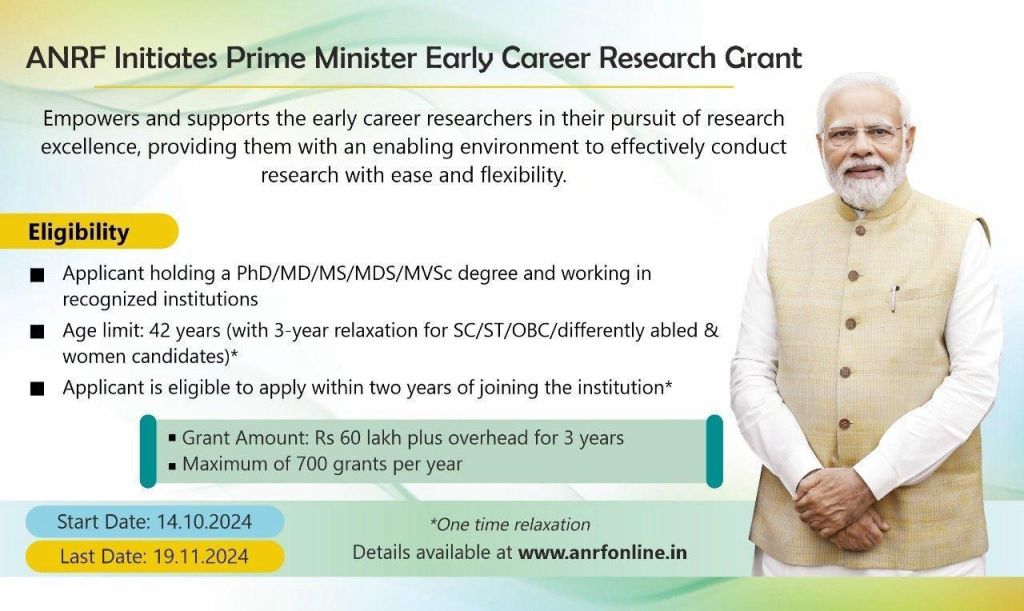
The Prime Minister’s Early Career Research Award (PMECRA) is a prestigious grant designed to support young researchers in India, encouraging them to pursue innovative and groundbreaking research in various fields of science, technology, and other disciplines. The program was introduced as part of the Indian government’s broader effort to promote research and innovation, especially among early-career scientists and academicians.
Objectives of the PMECRA:
1. Promote Young Talent: PMECRA aims to recognize and support young researchers with strong academic credentials and innovative ideas, providing them the necessary financial resources to carry out cutting-edge research.
2. Encourage Independent Research: The program enables early-career scientists to establish themselves as independent researchers, free from the constraints of traditional academic hierarchies, and fosters self-driven innovation.
3. Boost Research Capacity in India: The program is part of a larger national strategy to bolster research output in India, contributing to India’s standing as a global hub of scientific and technological advancement.
4. Support Interdisciplinary Research: PMECRA encourages interdisciplinary research that has the potential for high societal impact, covering a broad range of fields such as biotechnology, environmental sciences, information technology, and more.
Eligibility Criteria:
1. Age Limit: The applicant must generally be below the age of 40 years.
2. Academic Qualifications: Applicants should have a Ph.D. or equivalent degree in their respective fields of research.
3. Employment: The researcher must hold a regular academic or research position in a recognized university, institute, or laboratory in India.
4. Experience: Early career typically refers to researchers with 2–8 years of post-Ph.D. experience.
5. Research Focus: The applicant’s research proposal must align with the scientific priorities of the government, focusing on high-impact research areas with potential applications.
Funding and Benefits:
Research Grant: PMECRA offers substantial funding, typically ranging from ₹25 lakhs to ₹1 crore, depending on the scope of the research project. This grant can be used for various research-related activities such as purchasing equipment, hiring research assistants, covering travel expenses, and publishing research results.
Duration: The funding is usually provided for a period of three to five years, allowing researchers adequate time to develop their ideas and produce meaningful results.
Flexibility: The fund supports both basic and applied research, giving researchers flexibility in their approach while focusing on areas of national importance.
Selection Process:
1. Call for Proposals: The program typically invites research proposals annually. Interested candidates must submit detailed proposals outlining their research objectives, methodologies, expected outcomes, and budget estimates.
2. Evaluation: Proposals are evaluated by a panel of experts from various academic and scientific fields. The evaluation criteria include the novelty of the research, its feasibility, the researcher’s track record, and the potential impact of the project on society or industry.
3. Interview: Shortlisted candidates may be called for an interview, where they will present their research ideas to a panel of experts.
4. Final Selection: Based on the review process, a select number of candidates are awarded the grant, which is disbursed in installments depending on the research progress.
Importance of PMECRA:
Empowering Early Career Researchers: PMECRA provides a vital platform for early-career researchers to establish themselves in the competitive academic world, gain visibility, and build a solid foundation for future research opportunities.
Addressing National Challenges: By supporting research in areas of national importance, PMECRA helps address key challenges faced by India in sectors such as healthcare, agriculture, energy, and environmental sustainability.
Promoting Innovation and Creativity: The grant fosters a culture of innovation by encouraging researchers to explore new ideas, technologies, and methodologies that can lead to significant scientific breakthroughs or technological innovations.
Challenges:
Competition: Due to its prestigious nature, PMECRA is highly competitive, with only a small percentage of applicants receiving funding.
Grant Utilization: Managing large grants and ensuring that funds are used efficiently for research purposes can be a challenge, especially for those with limited administrative experience.
Conclusion:
The Prime Minister’s Early Career Research Award is a pivotal initiative aimed at fostering the next generation of researchers in India. By providing financial resources, mentorship, and independence, the PMECRA program serves as a cornerstone in shaping India’s future scientific and technological landscape. The award not only benefits individual researchers but also contributes to the broader goal of making India a leader in innovation and research on the global stage.
 Eduindex
You must be logged in to post a comment.