Leap in Rural School Enrollment

Daily writing prompt
Who are your favorite people to be around?

The Annual Status of Education Report (ASER) 2024 is a nationwide rural household survey that reached 649,491 children in 17,997 villages across 605 rural districts in India. Further, ASER surveyors visited 15,728 government schools with primary sections. 8,504 were primary schools and 7,224 were schools which also had upper primary or higher grades.

Photo by Fox on Pexels.com

Key Findings for Pre-primary (age group 3-5 years)

  1. Enrollment in pre-primary institutions
  • Among children aged 3-5 years, enrollment in some type of pre-primary institution (Anganwadi centre, government pre-primary class, or private LKG/UKG) has improved steadily between 2018 and 2024.
  • Among 3-year-olds, enrollment in pre-primary institutions increased from 68.1% in 2018 to 77.4% in 2024GujaratMaharashtraOdisha, and Telangana have achieved near-universal enrollment for this age group.
  • Among 4-year-olds, the all-India figure for enrollment in pre-primary institutions increased from 76% in 2018 to 83.3% in 2024. In 2024, enrollment rates in pre-primary for this age exceed 95% in states like Gujarat, Maharashtra, Karnataka, Tamil Nadu, and Odisha.
  • Among 5-year-olds, this figure also showed big increases, rising from 58.5% in 2018 to 71.4% in 2024. The states with enrollment exceeding 90% in pre-primary institutions for this age include Karnataka, Gujarat, Maharashtra, Kerala, and Nagaland.
  1. Type of pre-primary institution
  • Anganwadi centres continue to be the biggest provider of services in pre-primary age group in India.
  • Approximately one-third of all 5-year-olds attend a private school or pre-school in 2024. This figure was 37.3% in 2018, fell to 30.8% in 2022, and returned to 37.5% in 2024.
  1. Age of entry to Standard (Std) I
  • The proportion of children who are “underage” (age 5 or below) is decreasing over time. In 2018, this figure was 25.6%, in 2022 it stood at 22.7%, and in 2024, nationally the percentage of underage children in Std I was at its lowest ever at 16.7%. On average, this proportion has either declined or remained stable across all states in India.

Key Findings for Elementary (age group 6-14 years)

  1. Enrollment
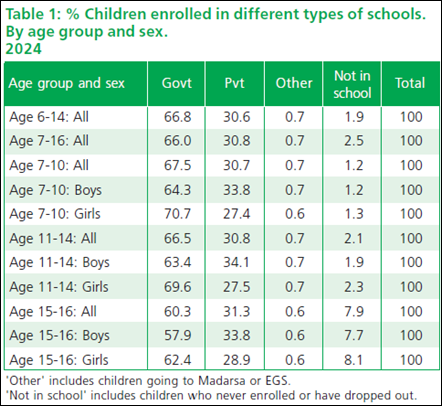
  • Overall school enrollment rates among the 6-14 age group have exceeded 95% for close to 20 years. This proportion has stayed almost the same, from 98.4% in 2022 to 98.1% in 2024. Across all states, enrollment in this age group is above 95% in 2024.
  • In 2018, 65.5% of children in the 6-14 age group in India were enrolled in government schools. By 2024, the all-India figure increased to 66.8%.
  1. Reading
  • Std III: The percentage of Std III children able to read Std II level text was 20.9% in 2018. This figure increased to 23.4% in 2024. The improvement in government schools is higher than the corresponding recovery for private schools. Following a decline in Std III reading levels in government schools in most states in 2022, all states have shown a recovery in 2024. States with more than a 10-percentage point increase in this proportion between 2022 and 2024 in government schools include Himachal Pradesh, Uttarakhand, Kerala, Uttar Pradesh, Haryana, Odisha, and Maharashtra.
  • Std V: Reading levels improved substantially among Std V children, especially for those who are enrolled in government schools. The proportion of Std V children in government schools who can read a Std II level text fell from 44.2% in 2018 to 38.5% in 2022 and then recovered to 44.8% in 2024. In 2024, Mizoram (64.9%) and Himachal Pradesh (64.8%) had the highest proportions of Std V children in government schools able to read Std II level text. States with over a 10-percentage point increase in this proportion in government schools include Uttarakhand, Uttar Pradesh, Gujarat, and Tamil Nadu.
  • Std VIII: Reading levels increased among children enrolled in Std VIII in government schools, which fell from 69% in 2018 to 66.2% in 2022 but then rose to 67.5% in 2024. Government schools in states such as Gujarat, Uttar Pradesh, and Sikkim show notable improvements.
  1. Arithmetic
  • Std III: The all-India figure for children in Std III who are able to do a numerical subtraction problem was 28.2%. This figure has increased to 33.7% in 2024. Among government school students, this figure went from 20.9% in 2018 to 27.6% in 2024. For private school students, this number showed a smaller improvement since 2022. Government schools across most states have shown gains since 2022, with over 15-percentage point increases recorded in states like Tamil Nadu and Himachal Pradesh.
  • Std V: At the all-India level, the proportion of children in Std V who can do a numerical division problem has also improved. This figure was 27.9% in 2018 and then rose to 30.7% in 2024. This change is also driven mainly by government schools. States with the showing most improvement (more than 10-percentage points) in government schools include Punjab and Uttarakhand.
  • Std VIII: The performance of Std VIII students in basic arithmetic remains similar to earlier levels, going from 44.1% in 2018 to 45.8% in 2024.

Key Findings for Older children (age group 15-16 years)

  1. Enrollment
  • The proportion of 15-16-year-old children who are not enrolled in school dropped sharply from 13.1% in 2018 to 7.9% in 2024 at the all-India level.
  1. Digital literacy
  • Access to smartphones is close to universal among the 14-16 age group. Almost 90% of both girls and boys report having a smartphone at home. More than 80% report knowing how to use a smartphone.
  • Of the children who could use a smartphone, 27% of 14-year-olds and 37.8% of 16-year-olds reported having their own phone.
  • 82.2% of all children in the 14-16 age group reported knowing how to use a smartphone. Of these, 57% reported using it for an educational activity in the preceding week while 76% said that they had used it for social media during the same period. While the use of a smartphone for educational activities was similar among girls and boys, girls were less likely than boys to report using social media (78.8% of boys as compared to 73.4% of girls). Kerala stands out in this respect, with over 80% children who reported that they used the smartphone for educational activity and over 90% using it for social media.
  • Among children who used social media, knowledge of basic ways to protect themselves online was relatively high62% knew how to block or report a profile, 55.2% knew how to make a profile private, and 57.7% knew how to change a password.
Key Findings of School Observations

  1. Foundational Literacy and Numeracy (FLN) activities
  • Over 80% of schools had received a directive from the government to implement Foundational Literacy and Numeracy (FLN) activities with Std I-II/III, both in the previous as well as in the current academic year. A similar proportion had at least one teacher who had received in-person training on FLN.
  • More than 75% schools had received Teaching Learning Material (TLM) and/or funds to make or purchase TLM for FLN activities.
  • More than 75% schools reported implementing a school readiness program for students prior to entering Std I, in both the previous and the current academic year.
  • More than 95% schools reported having distributed textbooks to all grades in the school, a substantial increase over 2022 levels.
  1. Student and teacher attendance
  • Student and teacher attendance in government primary schools show small but consistent improvements since 2018. Average student attendance increased from 72.4% in 2018 to 75.9% in 2024.
  • Average teacher attendance increased from 85.1% in 2018 to 87.5% in 2024. This trend is largely driven by changes in teacher and student attendance in Uttar Pradesh.
  1. Small schools and multigrade classrooms
  • The proportion of government primary schools with less than 60 students enrolled shows a sharp increase, rising from 44% in 2022 to 52.1% in 2024More than 80% primary schools in these states are small schools: Jammu and Kashmir, Himachal Pradesh, Uttarakhand, Nagaland, and Karnataka. Himachal Pradesh has the highest proportion of small Upper primary schools at 75%.
  • Two-thirds of Std I and Std II classrooms in primary schools were multigrade, with students from more than one grade sitting together.
  1. School facilities
  • Nationally, all Right to Education-related indicators included in ASER have shown small improvements between 2018 and 2024 levels. For example, the fraction of schools with useable girls’ toilets increased from 66.4% in 2018 to 72% in 2024.
  • The proportion of schools with drinking water available increased from 74.8% to 77.7%, and the proportion of schools with books other than textbooks being used by students increased from 36.9% to 51.3% over the same period.
  • Sports-related indicators remain at close to the levels observed in 2018. For example, in 2024, 66.2% schools have a playground, similar to 66.5% in 2018.

References

Leap in Rural School Enrollment

*********

Pariksha Pe Charcha 2025

Daily writing prompt
Tell us about your favorite pair of shoes, and where they’ve taken you.

On 10th February 2025, Prime Minister Shri Narendra Modi interacted with students at Sunder Nursery, New Delhi, during the first episode of the 8th edition of Pariksha Pe Charcha (PPC). In this informal yet insightful session, the Prime Minister engaged with students from across the country, discussing a variety of topics. The 36 students present learned from the Prime Minister valuable lessons on Nutrition and Wellness; Mastering Pressure; Challenging Oneself; The Art of Leadership; Beyond Books – 360º Growth; Finding Positives and more. This interactive session provided students with valuable insights and practical strategies to navigate academic challenges with confidence and a growth mind set.

Today, renowned actor and mental health champion Deepika Padukone participated in the second episode of the 8th edition of Pariksha Pe Charcha. Around 60 students attended the interactive session.

Deepika shared how addressing mental health challenges can be empowering and spoke about the valuable lessons she learned from her own struggles. Sharing her stress management strategies, she emphasized the importance of getting enough sleep, spending time outdoors in natural sunlight and fresh air, and maintaining a healthy daily routine to effectively reduce stress. She further emphasized that self-confidence and a positive mind set are key to success. Encouraging students to see failures as learning opportunities, she inspired them to keep moving forward with determination.

Reiterating Prime Minister Shri Narendra Modi’s message—”Express, Never Suppress”—Deepika stressed the importance of seeking help when needed. She engaged with students in an interactive activity, where they wrote down their strengths and pinned them on a board on the stage, reinforcing the significance of self-awareness and recognizing one’s strengths. She conducted a live grounding session through an activity called 54321, demonstrating a technique to improve concentration during exams.

Students physically present at the program posed their queries, and Deepika responded by drawing from her personal experiences, offering valuable insights and practical advice. Additionally, a student from an international CBSE school also had the opportunity to ask a question, further enriching the discussion with a wider perspective.

The 8th edition of PPC had set a new benchmark. With over 5 crore participation, this year’s program exemplifies its status as a Jan Andolan, inspiring collective celebration of learning. For the episode with the Prime Minister, 36 students from all State and UT were selected from State/UT Board Government schools, Kendriya Vidyalaya, Sainik School, Eklavya Model Residential School, CBSE and Navodaya Vidyalaya. Pariksha Pe Charcha 2025 will feature additional six insightful episodes, bringing together renowned personalities from diverse fields to guide students on essential aspects of life and learning. Each episode will address key themes:

Link to watch the 1st episode: https://www.youtube.com/watch?v=G5UhdwmEEls

Link to watch the 2nd episode: https://www.youtube.com/watch?v=DrW4c_ttmew

*****

‘GYAN BHARATAM MISSION’ TO PRESERVE OVER 1 CRORE MANUSCRIPTS

Daily writing prompt
Tell us about your favorite pair of shoes, and where they’ve taken you.

Union Minister for Education Shri Dharmendra Pradhan lauded the Budget 2025-26, emphasizing it as a budget that takes everyone together and prioritizes welfare, well-being, and empowerment of all citizens while firmly placing India on the path to achieving the goal of developed India by 2047. The Minister expressed his gratitude to the Prime Minister Shri Narendra Modi and Finance Minister Smt. Nirmala Sitharaman for a visionary and futuristic Budget.

Shri Dharmendra Pradhan said that this Budget is aiming to cater to the comprehensive requirements, right from childhood to youth, who would be leading from the front in realizing the Viksit Bharat agenda in 2047 and beyond.

Photo by Pixabay on Pexels.com

He further stated that the Budget announcements encompass today’s entire youth demographic, who will lead the nation for the next 25 years. This will strengthen the Bhartiya Gyan Parampara within our education system and foster a global community, he added.

The Minister highlighted that the Budget 2025-26 emphasizes investing in people and facilitating all-round development of India’s human capital. He noted that with “Gareeb, Yuva, Annadata, and Naari” as the pillars, this budget would uplift sentiments of the poor and middle class, accelerate spending, catalyze investments, and spur growth. He emphasized that it would remove regional imbalances, build rural prosperity, nurture research, innovation and entrepreneurship, invigorate the education and skilling landscape, and lead to employment-led development.

The Minister expressed gratitude for continuing with bigger and bolder investments in education, skilling, research, and innovation, stating that this budget represents another big leap towards empowering India’s population with more opportunities for world-class education and building capacities of human capital.

The Minister informed that the total budget allocation for the Ministry of Education has reached ₹128,650 crore, marking a 6.22% increase over BE 2024-25.

Union Education Minister informed that Fifty thousand Atal Tinkering Labs (ATL) will be set up in Government schools in next 5 years to cultivate the spirit of curiosity and innovation, and foster a scientific temper among young minds. With this, students of all Government secondary schools will have access to ATL. The Union Budget also proposes to provide Broadband connectivity to all Government secondary schools and primary health centres in rural areas under the BharatNet project, he added.

Shri Pradhan informed that the total number of students in 23 IITs has increased 100 per cent from 65,000 to 1.35 lakh in the past 10 years. Additional infrastructure will be created in the 5 IITs started after 2014 to facilitate education for 6,500 more students. Hostel and other infrastructure capacity at IIT, Patna will also be expanded, he further added.

Shri Pradhan said that with the aim to help students understand their subjects better, it is proposed to implement a Bharatiya Bhasha Pustak Scheme to provide digital-form Indian language books for school and higher education.

The Union Minister also informed that five National Centres of Excellence for skilling will be set up with global expertise and partnerships to equip youth with the skills required for “Make for India, Make for the World” manufacturing. The partnerships will cover curriculum design, training of trainers, a skills certification framework, and periodic reviews.

Shri Pradhan highlighted that the fourth AI Centre of Excellence in Education, envisioned in the Budget 2025-26, aims to revolutionize India’s educational system from pre-primary to professional and research levels. By harnessing artificial intelligence, it seeks to address disparities and inefficiencies, ensuring equitable and high-quality education across the nation. This Centre of Excellence in Artificial Intelligence for Education will be established with a total outlay of ₹500 crore, he added

The Minister informed the allocation of Rs 20,000 crore to implement private sector driven Research, Development and Innovation. In the next five years, under the PM Research Fellowship scheme, provision of ten thousand fellowships for technological research in IITs and IISc with enhanced financial support is also proposed in the Budget, he added.

The Minister informed that a Gyan Bharatam Mission for survey, documentation and conservation of our manuscript heritage with academic institutions, museums, libraries and private collectors will be undertaken to cover more than 1 crore manuscripts. A National Digital Repository of Indian knowledge systems for knowledge sharing will also be set up.

D/o School Education & Literacy

  • The Budget Allocation for the FY 2025-26 of ₹ 78572 Cr is the highest ever for the Department of School Education & Literacy.
  • There has been an overall increase of ₹ 5074 Cr (7%) in the Budget Allocation of Department of School Education and Literacy in the FY 2025-26 from BE 2024-25. As compared to RE of FY 2024-25, there has been an increase of ₹ 11,000 Cr (16.28 %).
  • The highest ever Budget Allocation may be seen in the Autonomous Body of Kendriya Vidyalaya Sangathan (KVS) at Rs. 9,503 Cr. Allocation in KVS has increased by ₹ 201.17 Cr as compared to Budget allocation of FY 2024-25. There has been an increase of ₹ 776 Cr (9%) as compared to RE of FY 2024-25.
  • Budget Allocation of FY 2025-26 in Flagship Schemes have increased i.e Samagra Shiksha (by ₹ 3750 Cr), PM-POSHAN (by ₹ 32 Cr) and PM-SHRI (by ₹ 1450 Cr) with respect to Budget Allocation (BE) of FY 2024-25. As compared to RE 2024-25, allocation in Samagra Shiksha has increased by ₹ 4240 Cr (11%), allocation in PM-POSHAN has increased by ₹ 2500 Cr (25 %) and allocation in PM-SHRI has increased by ₹ 3000 Cr (66%).
  • Out of the overall Budget Allocation in FY 2025-26 of ₹ 78,572 Cr, the Scheme allocation is ₹ 63,089 Cr and Non-Scheme Allocation is ₹ 15,483 Cr.
  • Increase in Scheme Allocation in BE 2025-26 is ₹ 5284 Cr (9.14 %) as compared to BE 2024-25. As compared to RE 24-25, increase in Scheme Allocation is ₹ 10248 Cr (19%) and non-Scheme allocation has increased by ₹ 752 Cr (5%) in BE 2025-26.
  • Fifty thousand (50,000) Atal Tinkering Labs (ALT) will be set up in Government schools in next five years to cultivate the spirit of curiosity and innovation, and foster a scientific temper among young minds.
  • Broadband connectivity will be provided to all Government secondary schools under BharatNet project in the next three years.

Department of Higher Education, Ministry of Education

  • The overall Budget Allocation in FY 2025-26 is Rs. 50077.95 Cr out of which Scheme allocation is Rs. 6990.88 Cr and Non- Scheme allocation is Rs. 43087.07 cr.
  • There has been an overall increase of Rs. 2458.18 Cr (5.16%) in the Budget Allocation of Department of Higher Education in the FY 2025-26 with respect to FY 2024-25.

Allocations to Major Autonomous Bodies under Higher Education

  • The total Allocation of Autonomous Bodies in 2025-26 increased to Rs. 42732 Cr from Rs. 39777.40  in 2024-25. There is increase of 7.42%
  • Allocation in Central Universities has been kept at Rs. 16691.31 Cr, against Rs. 15928 Cr in 2024-25 which is  Rs 763.31 Cr more i.e.  4.79 % increase.
  • UGC has been allocated Rs.3335.97 Cr in 2025-26, against Rs. 2500 Cr in 2024-25 which is Rs. 835.97 Cr more i.e. 33.44 % increase.
  • IITs have been allocated Rs. 11349.00 Cr in 2025-26, against Rs. 10324.50 Cr in 2024-25 which is Rs. 1024.50 Cr more i.e. 9.92% increase.
  • For NITs, Rs.5687.47 Cr has been allocated in FY 2025-26, against Rs.5040 Cr in 2024-25 increasing the allocation by Rs. 647.47 Cr i.e. 12.85% increase.
  • Deemed Universities have been allocated Rs.604 Cr in 2025-26, against Rs.596 Cr in 2024-25 increasing the allocation by Rs. 8 Cr i.e. 1.34% increase.
  • IIMs have been allocated Rs.251.89 Cr in 2025-26, against Rs. 212.21 Cr in 2024-25 increasing the allocation by Rs. 39.68 Cr i.e. 18.70% increase.
  • IIITs have been allocated Rs.407.00 Cr in 2025-26, against Rs.315.91 Cr in 2024-25 increasing the allocation by Rs. 91.09 Cr i.e 28.83 % increase.
  • Grants for Promotion of Indian Languages have been allocated Rs.347.03 Cr in 2025-26, against Rs.310.10 Cr in 2024-25 increasing the allocation by Rs. 36.93 Cr i.e. 11.91% increase.                                                                                 

*****