

Prof Shankar Chatterjee, Hyderabad
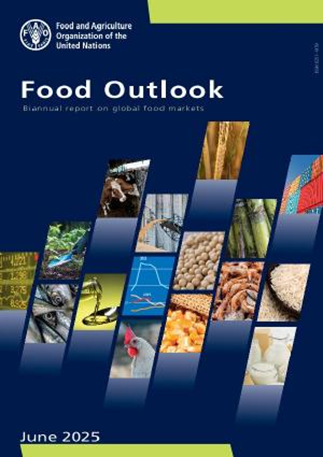
Food is essential for the survival of all human beings. After the birth of a baby, the mother offers her milk. Food aids the body in building bones, maintaining muscle function and growth, facilitating breathing, producing energy, synthesizing hormones, and processing information in the brain. Everyone needs food, oxygen, and water for life. A few information from the “Food Outlook – Biannual report on global food markets published by the Food and Agriculture Organization (FAO), 2025”, are presented here so that academicians, research scholars, policy makers, and other stakeholders can use for academic activities.
The Food Outlook is a biannual publication (issued in June and November) that focuses on developments affecting global food commodity markets. FAO’s latest assessments indicate a relatively optimistic outlook for food commodity markets, with production and trade of all commodities, except sugar, anticipated to increase. However, this growth will have different impacts on stock recovery, influenced by the delicate balance between supply and demand. Global food commodity production remains vulnerable to weather conditions. Additionally, ongoing geopolitical tensions, uncertainties in policy developments, and potential retaliatory actions could negatively affect the trade outlook. In addition to market assessment, each edition contains a set of special features and market indicators.
A) Cereals: Forecast at 2,911 million tonnes, world cereal production (including rice in milled equivalent) is expected to reach a record level in 2025, surpassing the 2024 output by 2.1 percent. Production of all major cereals is anticipated to rise, with the most significant year-on-year increase (in percentage terms) forecast for maize and the smallest for wheat. Maize, rice, and sorghum outputs are all predicted to reach new record highs. World cereal utilization is forecast to increase by 0.8 percent in 2025/26, reaching 2,898 million tonnes. Global food consumption of cereals is predicted to grow by 0.9 percent from 2024/25, while feed use is forecast to expand by 0.5 percent, with increases expected for all major cereals. Other uses of cereals are projected to rise by 1.0 percent, primarily driven by increased demand for wheat and rice. With world cereal production expected to exceed utilization in 2025/26, world cereal stocks are predicted to expand by 1.0 percent (8.4 million tonnes) above their opening levels to 873.6 million tonnes.
B) Meat and meat products: World meat production is forecast to expand in 2025, albeit at a slower pace than in recent years, increasing by 0.6 percent year on year to reach 380 million tonnes (carcass weight equivalent). This growth will be primarily driven by an expected expansion in poultry meat output, while production of pig and ovine meats is expected to register only marginal increases. Global pig meat output is forecast to rise slightly, reflecting modest herd expansions. The global meat trade is forecast to grow by 1.3 percent in 2025, reaching 43 million tonnes —a significant slowdown compared to the estimated 4.7 percent growth in 2024.
C) Fish and other aquatic products: Output from fisheries and aquaculture is projected to rise by 2.9 million tonnes, or 1.5 percent, to 196.6 million tonnes in 2025, year-on-year. Aquaculture is forecast to expand by 2.6 percent to 104 million tonnes, mainly driven by recent harvests of warm-water shrimp and carp. The volume of capture fisheries is expected to edge up by only 0.3 percent to 92.6 million tonnes. Although the fishmeal supply has stabilized after strong catches of Peruvian anchoveta, fish oil supplies remain tight. The value of world trade in aquatic animal products is forecast to rise by 1.7 percent to USD 183.8 billion in 2025, while trade volumes are expected to increase by only 0.5 percent.
D) Milk and milk products
World milk production is forecast to reach 992.7 million tonnes in 2025, representing a 1.0 percent year-over-year increase and marking a second consecutive year of modest growth. Increases in Asia are expected to drive the global growth, driven by continued herd expansion and gradual productivity gains in Bangladesh, India, and Pakistan.
Since the article is based on the FAO’s report, the data can be used in research papers as a credible source.

 Eduindex
You must be logged in to post a comment.