Multidisciplinary Education and Research improvement in Technical Education (MERITE) Scheme

The Union Cabinet chaired by the Prime Minister, Shri Narendra Modi, has approved the proposal for implementation of the ‘Multidisciplinary Education and Research Improvement in Technical Education’ (MERITE) Scheme in 275 technical institutions comprising 175 engineering institutions and 100 polytechnics. The objective of the scheme is to improve the quality, equity and governance in technical education covering all States/UTs by implementing interventions aligned with the National Educational Policy-2020 (NEP-2020).
Photo by Pixabay on Pexels.com

It is a ‘Central Sector Scheme’ with total financial implication of Rs.4200 crore for a period from 2025-26 to 2029-30. Out of Rs.4200 crore, there will be an external assistance of Rs.2100 crore from World Bank as loan.

Benefits:

An estimated 275 Government/ Government-aided technical institutions are expected to be selected and supported under the scheme. This will include selected National Institutes of Technology (NITs), State Engineering Institutions, Polytechnics and Affiliating Technical Universities (ATUs). Apart from this, the State/ UT departments handling technical education sector will also be supported through MERITE scheme. Further, About 7.5 Lakh Students will be benefitted from the Scheme.

Impact, including employment generation:

The major outputs/ outcomes expected from the scheme are:

  1. Digitalization strategies in participating States/ UTs,
  2. Development of guidelines for multidisciplinary programs among technical courses,
  3. Increase in learning and employability skills of students,
  4. Increase in transition rate of students across student groups,
  5. Strengthened research and innovation environment,
  6. Better quality assurance and governance mechanisms resulting in long term benefits,
  7. Increase in accreditation and better Technical Education Institution – level Quality Assurance,
  8. Relevant, labour market-aligned curriculums and blended courses developed and rolled out and
  9. Development of future academic administrators especially women faculty.

Implementation strategy and targets

The scheme will be implemented in government engineering institutions and Polytechnics in all States/ UTs. The interventions are aligned with NEP-2020 and are aimed at enhancing the quality, equity and governance of the participating institutions. It will be implemented as a Central Sector Scheme and will have the facility of funds transfer from the Central Government to participating entities through a Central Nodal Agency.

Eminent educational institutions like the IITs and IIMs and regulatory bodies in the higher education sector such as the AICTE, NBA etc. will also play a significant role in the scheme implementation. 

Employment Generation:

The initiative emphasizes enhancing students’ skills to improve their employability through a comprehensive, multi-faceted approach. Key interventions include offering internship opportunities, updating curricula to align with industry requirements, organizing faculty development programs, and setting up research hubs. Additionally, support will be provided to incubation and innovation centers, skill and maker labs, and language workshops. These measures aim to boost the employability of fresh graduates, leading to higher placement rates and ultimately helping to reduce unemployment among engineering students in the States and Union Territories.

Background:

Sustainable and inclusive growth of the country depends largely on technological advancements which require persistent efforts to upgrade academic and research standards. Research fosters innovation which is fundamental to addressing modern day challenges and creates a long lasting positive impact. It is with this approach that MERITE scheme has been formulated in collaboration with the World Bank. The reforms envisioned in the higher education sector in the National Education Policy-2020 are the basis of interventions designed for the scheme.

The major reform areas in the policy include revamping curriculum, pedagogy, assessment, multidisciplinary programs among technical courses, strengthening research ecosystem, development of future academic administrators, faculty skill upgradation, addressing gender gaps in technical education and reducing digital divide etc.

The participating States/ UT are important stakeholders. They have a major role to play in the implementation of the scheme and their views and feedback received during several meetings and consultations have been duly considered while designing the interventions.  

***
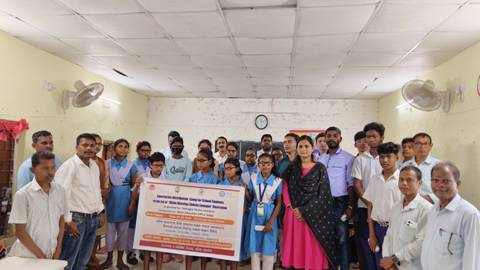
Children with Special Needs (CwSN) conducted under Samagra Shiksha to commemorate 5 Years of NEP 2020

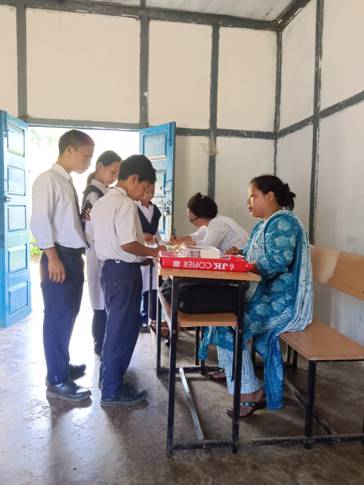
The Government of India, under the Inclusive Education (IE) component of Samagra Shiksha, successfully conducted a nation-wide week-long campaign of Mega Assessment and Distribution Camps for Children with Special Needs (CwSN) at block and district levels from 29th  July 2025, as part of the 5th Anniversary celebrations of the National Education Policy (NEP) 2020 during the Akhil Bhartiya Shiksha Samagam (ABSS) 2025.

The National Education Policy (NEP) 2020 places strong emphasis on equitable and inclusive education for all, and is in complete consonance with the provisions of the Rights of Persons with Disabilities (RPwD) Act, 2016 and endorses all its recommendations with regard to school education.

The Inclusive Education (IE) component under Samagra Shiksha ensures full equity and inclusion so that all children are able to fully participate in inclusive schools in a continuum from pre-school to class XII. It also mandates for early identification and assessment support of CwSN wherein States/UTs may organize up to four camps per block per year for elementary and secondary levels with support of upto ₹10,000/- per camp.

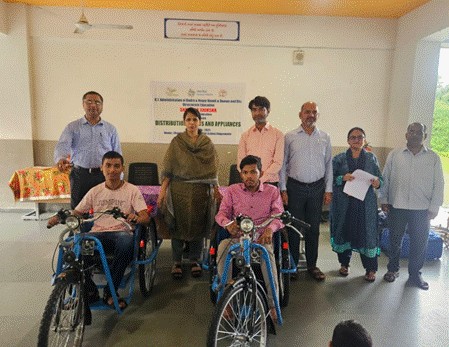
As a crucial step for mainstreaming CwSN, the Department of School Education & literacy (DoSEL) in collaboration with the Department for Empowerment of Persons with Disabilities (DEPwD) is implementing Scheme of Assistance to Persons with Disabilities for purchase/Fitting of Aids/Appliances (ADIP Scheme) in convergence with Samagra Shiksha Abhiyan (SSA) for distribution of Aids/Appliances to CwSN.

Under ADIP SSA, activity funds are shared between DEPwD and DoSEL in the ratio of 60:40 wherein assessment/distribution of Aids/Appliances is undertaken through Artificial Limbs Manufacturing Corporation of India (ALIMCO) across the country in coordination with State SSA Authorities.

As part of the commemoration of the 5th Anniversary of NEP 2020 through the Akhil Bhartiya Shiksha Samagam (ABSS) 2025, DoSEL launched a nation-wide week-long campaign for Mega Assessment and Distribution Camps for CwSN under the Samagra Shiksha at the block and district level, starting from 29th July, 2025. Directions and guidance were issued by DoSEL to State/UTs to plan and execute the mega camps in convergence with all stakeholders. These camps were categorised as Screening and Identification of CwSN; Medical Assessment (including for UDID certification) and Assistive Device Assessment and Distribution and were aimed to ensure that services are brought closer to the child’s doorstep, especially in rural and remote areas.

The week-long campaign saw wide-ranging stakeholder participation from line departments/ agencies such as Rashtriya Bal Swasthya Karyakram (RBSK) teams, District Health Department, Panchayati Raj, ALIMCO etc. for mobilizing medical teams and necessary logistics. The mega camps were graced by several dignitaries and senior government functionaries.

This significant step witnessed active participation from the community and served as an impetus for delivering on-ground interventions for CwSN across the country. It underscored the government’s commitment to practical, impactful measures that align with the broader goals of inclusive education. Key Achievements of the Mega Camps are as under:

No. of Children CoveredNo. of Children provided assistive devicesNo. of Districts coveredNo. of Block coveredNo. of Professionals (Doctors/Special educators/Rehabilitation personnel etc.) deployed
1,58,66928,8376694,8847,282

States/UTs shared district and block wise details highlighting widespread efforts across various States and UTs to identify and provide tangible support to such children. Maharashtra has reported the highest number of children covered 50,905 and 3,187 children were provided with assistive devices covering 286 districts engaging 2,758 Rehabilitation Professionals. Uttar Pradesh follows covering 25,737 children and Bihar also made significant progress, with 17,570 children covered.

Smaller territories also contributed in this national event as well—Puducherry covered 4,229 children with 548 getting devices, while Meghalaya assessed 6,041 children and provided devices to 191. Some states like Himachal Pradesh and Sikkim had smaller numbers but focussed heavily on specialized deployment, including doctors, psychiatrists, audiologists, and special educators.  States/UTs executed this massive logistical exercise overcoming challenges of terrain and monsoon and set an example of successful convergence on ground.

This week-long campaign ensured participation of parents/guardians, ground level functionaries in the assessment process through awareness and mobilization by school media platforms, website of education department, and notice board of schools, local media..

*******

Sakura Science Programme at Japan

The National Education Policy (NEP) – 2020, while emphasizing the importance of Curriculum and Pedagogy in Schools, endorses that “Learning should be Holistic, Integrated, Enjoyable and Engaging in itself. Furthermore, the NEP-2020, states that in all stages, experiential learning will be adopted as standard pedagogy within each subject, and with explorations of relationships among different subjects.

In this context, educational trips and excursions to places of historical, cultural, social, scientific and technological importance are of paramount importance. Japan, as a developed and friendly nation known for its technological advancements, is also a preferred destination for educational exposure. Therefore, visiting a country like Japan is always enriching and provides an opportunity for exploration of innovative practices.

To broaden the intellectual horizons and foster scientific exploration among young learners, the Japan Science and Technology Agency (JST) has been implementing the ‘Japan-Asia Youth Exchange Program in Science,’ also known as the ‘Sakura Science Programme,’ since 2014. India was included in the Sakura Program in 2016. Under this programme, students are invited for short-term visits to Japan, providing them with the opportunity to experience Japan’s cutting-edge science and technology as well as its rich culture.

India participated in the program for the first time in April 2016. So far, 639 students along with 93 supervisors have visited Japan under this programme. The most recent batch visited Japan in June 2025.

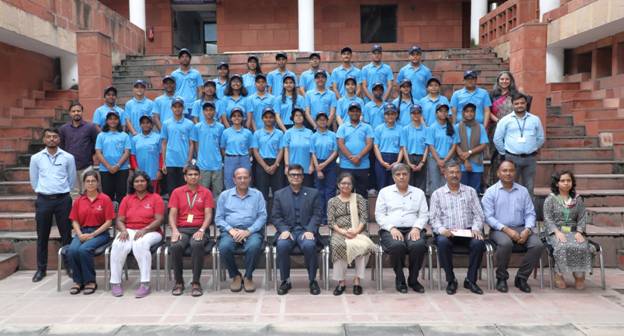
For the upcoming Sakura Programme 2025, JST has invited 34 school students and 3 supervisors from India, alongside participants from six other countries (Egypt, Ghana, Kenya, Nigeria, South Africa and Zambia), for the period between August 17th to August 23rd, 2025. These 34 students (13 boys & 21 girls) are from Government Schools of Andhra Pradesh, Bihar, Delhi, Himachal Pradesh, Lakshadweep, Odisha, Puducherry, West Bengal and Demonstration Multipurpose Schools of RIEs-NCERT at Ajmer (Rajasthan), Bhopal (Madhya Pradesh), Bhubaneswar (Odisha) and Mysore (Karnataka).

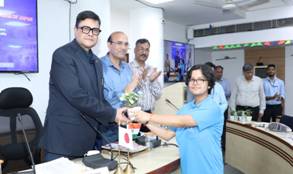
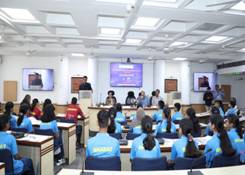
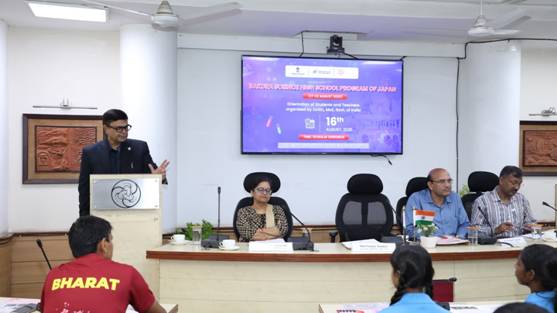
The enthusiastic students were flagged off in a ceremony at NCERT, New Delhi, organized by the Department of School Education & Literacy (DoSEL), Ministry of Education (MoE), Government of India. The flagging-off ceremony for the Sakura Science Program was conducted by Sh. Sanjay Kumar, Secretary, Department of School Education & Literacy, Ministry of Education, Government of India, Prof. Prakash Chandra Agrawal, Joint Director, NCERT, and Smt. Archana Sharma Awasthi, Joint Secretary, Department of School Education & Literacy, Ministry of Education, Government of India.

During the event, Sh. Sanjay Kumar offered inspiring words to the students and the supervisor teachers, emphasizing that the program presents a golden opportunity for them to explore a developed nation like Japan. He conveyed that immersing themselves in Japan’s highly advanced system is short of a blessing. He further stressed the imperative for all students and their accompanying teachers to fully appreciate the immense importance of this Sakura Science journey, recognizing its profound impact on shaping future innovators and strengthening bilateral ties.

Mr Sanjay Kumar highlighted the importance of our country’s language by saying that Indian students should greet by Namaste as the entire world now knows this Indian greeting thanks to our Prime Minister NarendraModi.

He mentioned that we should know the fact that Japanese are famous for their punctuality and we must learn it from there, as there’s a famous saying “time and tide wait for none”.

He highlighted that Japan’s history and their economic growth is something to study about and we can take Japan as an example and take India forward with the same approach.

He mentioned that Japan is known for their culture and even tea. The way they behave is also a part of their culture and they take it very seriously. We, Indians also have our great culture and we should take pride in it.

Japanese Cherry blossom is a sight to behold and they keep their environment clean. The 34 students going to Japan are the young ambassadors of India, so make friends, observe, learn and adopt from them as much as you can.

****

IIT Delhi students to drive innovation for Atmanirbhar Bharat

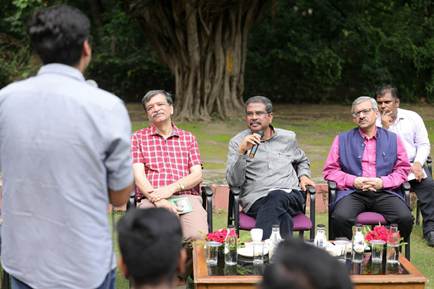
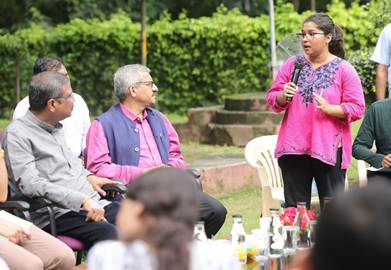
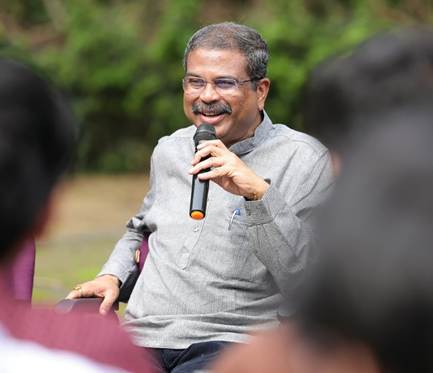
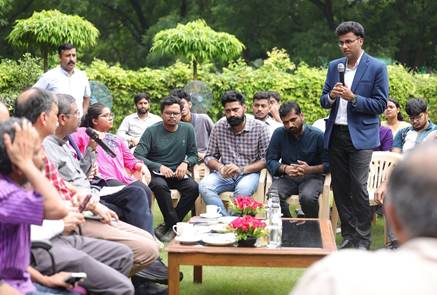
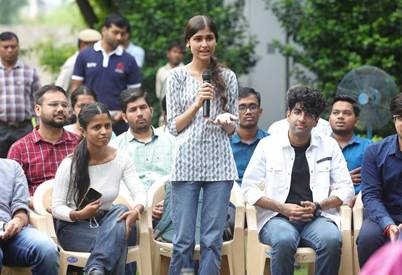
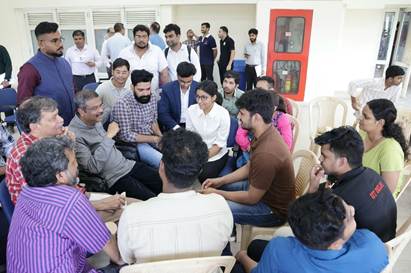
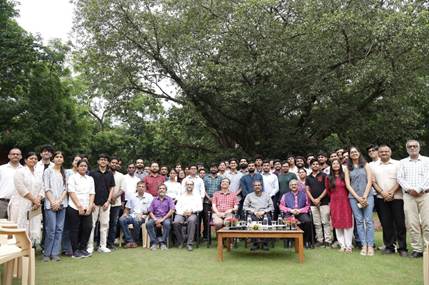
Union Minister for Education, Shri Dharmendra Pradhan, visited the Indian Institute of Technology (IIT) Delhi today, where he interacted with undergraduate, postgraduate and doctoral students, as well as innovators and researchers. Secretary, Department of Higher Education Dr. Vineet Joshi; Director, IIT Delhi, Prof. Rangan Bannerjee; and senior officials of the Ministry of Education and IIT Delhi were present on the occasion.

During the interaction, the Minister underlined the importance of self-reliance in line with the vision of the Prime Minister Shri Narendra Modi in his Independence Day address, this year. He stressed that the present moment offers a unique opportunity to to emphasize on the need for achieving self-reliance, ignite collective action for driving national priorities and fulfilling the vision of ‘Samridhh Bharat’ by 2047.

Image
A person holding a microphone in front of a group of peopleAI-generated content may be incorrect.

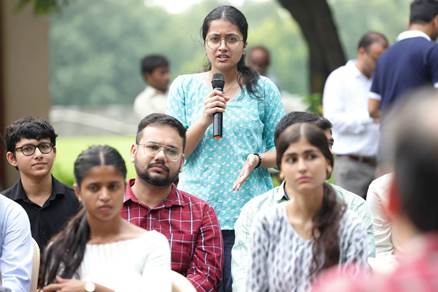
The Minister engaged with students to learn more about their dreams, aspirations, areas of research, the technological challenges they are currently pursuing, and their perspectives on the challenges and opportunities outlined by the Prime Minister. He also shared his views on enhancing capabilities and expanding the spirit of innovation.

The Minister encouraged the students to bring forward their innovative ideas, work on the challenges and keep hustling until we achieve self-reliance in every sphere.

He stated that the Government stands shoulder to shoulder with India’s innovators and researchers for shaping a brighter future for our coming generations and also for establishing India as a global hub of solutions.

A person speaking to a group of peopleAI-generated content may be incorrect.
A person holding a microphoneAI-generated content may be incorrect.

Sharing his thoughts on the occasion, the Minister his confidence that the talent, tenacity and resolve of our youth coupled with the pursuit of self-reliance will pave the way for strengthening Bharat’s capabilities as well as enhancing her technological and economic sovereignty.

He highlighted the crucial role of IITs as the bedrock of a self-reliant India. Backed by the rock solid support of PM Shri Narendra Modi, the talented YuvaShakti are going to rewrite the rules of technology, innovation and entrepreneurship and build a ‘Samridhh and self-reliant Bharat’.

A person speaking into a microphone in front of a group of peopleAI-generated content may be incorrect.
A person speaking to a group of peopleAI-generated content may be incorrect.
A group of people sitting in chairsAI-generated content may be incorrect.

The Minister also informed that he would revisit the Institute to review the innovations being developed by the students.

Speaking on the occasion, Secretary, Department of Higher Education, Dr. Vineet Joshi reiterated the Prime Minister’s Independence Day message on the role of youth in making the country self-reliant. He underlined that the Department is extending all possible support to higher education institutions in advancing innovation, strengthening research capacities and addressing national challenges in line with the vision of Atmanirbhar Bharat. He expressed confidence that IIT Delhi, through its students and faculty, will continue to play a leading role in developing technologies and solutions of global relevance.

A group of people standing in a fieldAI-generated content may be incorrect.

**********