A sermon recorded in one language carries more than vocabulary. It carries dogma, cadence, cultural memory, and theological alignment. When that sermon becomes a podcast, it travels farther than any pulpit ever could. Digital airwaves create reach. Language determines impact.
Podcast distribution platforms amplify Christian teaching across continents, yet amplification without translation can distort it. A phrase rooted in one cultural lexicon can fracture in another. Idioms collapse. Doctrinal nuance thins. What sounded precise becomes vague. The vernacular governs reception.
Serious ministries understand that the Great Commission is not merely a broadcast mandate. It is a linguistic mandate. The message must inhabit the soil of the listener’s heart language. Anything less is partial obedience.
Dogma Under Pressure: Accuracy in Audio Form
Audio translation is unforgiving. There is no footnote. No margin. Only voice and breath. Theological vocabulary must survive compression, pacing, tone, and timing. A mistranslated term can bend doctrine. A poorly adapted metaphor can fracture clarity.
This is why podcast translation for Christian ministries cannot be reduced to generic localization. It requires translators who understand soteriology, ecclesiology, covenant language, and prophetic cadence. Technical accuracy is not optional. Spiritual alignment is not decorative.
Christian Lingua approaches podcast content as a bridgehead for global discipleship. Every episode becomes a frontline text. Translators examine the original script, identify doctrinal anchors, and reconstruct the message within the grammatical and cultural architecture of the target language. Precision first. Resonance second. Both mandatory.
From Studio to Soil: Cultural Resonance in Broadcast Expansion
Christian podcasts now function as digital mission stations. They reach cities close to missionaries and regions hostile to overt evangelism. Yet reach without resonance produces noise. The voice must sound native, not imported.
Through Radio broadcast translation for pastors, ministries expand their teaching into regions where radio remains dominant. The same principle governs podcast distribution. Context shapes credibility. Listeners discern foreignness instantly. Tone betrays distance. Vocabulary signals authenticity or intrusion.
Christian Lingua bridges the gap between original proclamation and local reception by aligning script, tone, and delivery with the cultural rhythms of the audience. The goal is not mimicry. It is integrity. The translated voice must carry theological weight without foreign residue. It must sound like truth spoken from within the culture, not imposed from above.
This work demands discipline. Linguistic rigor. Doctrinal vigilance. Every file processed is more than content; it is entrusted ink, now converted to sound, crossing borders where printed pages never arrive.
The Broadcast Mandate in a Multilingual Age
The expansion of Christian podcasts signals opportunity and exposure. Opportunity, because digital platforms erase geographic barriers. Exposure, because weak translation exposes the message to misunderstanding and erosion. Ministries investing in global reach cannot treat language as an afterthought.
Christian Lingua exists to secure that alignment between message and mission. The original sermon, the recorded episode, and the translated broadcast must guard the integrity of the gospel while honoring the vernacular of the listener. The Commission presses forward through microphones and servers, but it lands in human ears shaped by history and culture.
Global proclamation is unfinished business. Ensure that every episode carries doctrinal clarity and cultural force. Visit Christian Lingua and secure translation that allows the gospel to stand firm in every tongue and across every border.null
Indian English fiction has emerged as a significant literary space for exploring the complex relationship between power, identity, and marginalization in postcolonial society. As India continues to undergo rapid social, economic, and cultural transformations, questions of inclusion, exclusion, and representation have gained renewed importance. This paper examines how selected Indian English novels represent the movement from marginality to mainstream visibility, focusing on the negotiation of power and identity among historically disadvantaged individuals and communities. Through an analysis of Kiran Desai’s The Inheritance of Loss, Arundhati Roy’s The God of Small Things, and Aravind Adiga’s The White Tiger, the study explores how these texts portray struggles against social hierarchies rooted in class, caste, gender, and economic inequality. Drawing on postcolonial theory and cultural studies, the paper argues that these novels challenge dominant narratives of progress and nationhood by foregrounding marginalized voices and highlighting the ethical implications of social mobility. While the protagonists seek recognition and empowerment, their journeys reveal the limitations and contradictions of mainstream inclusion. The study demonstrates that contemporary Indian English fiction functions as a critical medium for interrogating power structures and reimagining identity in an unequal society.
Keywords: Margins, Mainstream, Power, Identity, Indian English Fiction, Marginalization, Postcolonial Studies, Social Inequality, Representation
Introduction
The transition from marginality to mainstream participation is a central concern in postcolonial societies marked by historical inequalities and uneven development. In India, centuries of caste hierarchy, colonial exploitation, and economic disparity have produced deep-rooted social divisions. Although independence and constitutional democracy promised equality and justice, structural barriers continue to restrict access to power and resources for large segments of the population. As a result, the movement from margins to mainstream remains fraught with tension, conflict, and compromise.
Indian English literature has played a vital role in articulating these social realities. From its early nationalist phase to its contemporary global presence, this literary tradition has engaged with issues of identity, belonging, and power. In recent decades, novelists have increasingly focused on marginalized individuals and communities whose experiences challenge celebratory narratives of development and modernization. Through their stories, writers expose the complexities of social mobility and question the moral foundations of success.
Kiran Desai, Arundhati Roy, and Aravind Adiga are among the most prominent contemporary writers who examine these issues. Their novels depict characters who inhabit social, economic, and cultural margins and attempt to negotiate entry into mainstream society. The Inheritance of Loss explores globalization and cultural displacement. The God of Small Things examines caste and gender oppression. The White Tiger critiques neoliberal capitalism and class exploitation. Together, these works provide a comprehensive perspective on the dynamics of power and identity in modern India.
This paper seeks to analyze how these selected novels represent the journey from marginality to mainstream visibility and how power relations shape identity formation in this process. It argues that while these narratives highlight possibilities of resistance and self-assertion, they also reveal the ethical and psychological costs of social mobility. By adopting a comparative approach, the study aims to demonstrate how contemporary Indian English fiction functions as a critical discourse on inclusion, exclusion, and social justice.
Theoretical Framework: Power, Identity, and Marginality
The relationship between power and identity has been a central concern in social and cultural theory. Michel Foucault conceptualizes power as a pervasive force that operates through institutions, discourses, and everyday practices. Rather than being concentrated in a single authority, power circulates within social networks and shapes subjectivity. Individuals internalize dominant norms and values, often reproducing their own subordination.
In postcolonial contexts, power is further complicated by colonial legacies and global inequalities. Scholars such as Edward Said, Homi Bhabha, and Gayatri Chakravorty Spivak have emphasized how representation and discourse influence the construction of identity. Colonial and nationalist narratives often marginalize subaltern voices, portraying them as passive or inferior. Postcolonial literature seeks to challenge these representations by foregrounding alternative perspectives.
Identity is not a fixed essence but a dynamic process shaped by social interactions and historical conditions. Stuart Hall argues that identity is constructed through difference and negotiation rather than through stable origins. For marginalized individuals, identity formation involves constant negotiation between imposed labels and personal aspirations. The desire for mainstream acceptance often requires conformity to dominant norms, resulting in tensions between authenticity and adaptation.
Marginality refers to social positions characterized by exclusion from political, economic, and cultural power. Marginalized groups include lower castes, women, ethnic minorities, migrants, and the urban poor. Their experiences are shaped by limited access to education, employment, and representation. Literature provides a crucial space for articulating these experiences and contesting dominant ideologies.
This paper draws on postcolonial theory, cultural studies, and sociological perspectives to analyze how Desai, Roy, and Adiga represent power and identity. It focuses on narrative voice, characterization, spatial settings, and symbolic structures to explore how marginalized subjects negotiate their positions within unequal social systems.
Globalization and Cultural Marginality in Kiran Desai’s The Inheritance of Loss
Kiran Desai’s The Inheritance of Loss offers a nuanced portrayal of globalization and its impact on individual identities. Set in Kalimpong and interwoven with the immigrant experience in the United States, the novel explores how economic and cultural forces reshape social relations. Desai presents globalization as a contradictory process that generates both aspiration and alienation.
Biju, an undocumented immigrant, represents the marginalized global laborer. His migration to America is driven by the hope of economic mobility and social recognition. However, his reality is marked by exploitation, insecurity, and invisibility. Working in restaurant kitchens under harsh conditions, Biju remains excluded from mainstream society. His experience reveals how global capitalism depends on cheap, disposable labor.
In India, the judge Jemubhai Patel embodies internalized colonialism and elite alienation. Educated in England, he rejects his cultural roots and family relationships. His obsession with Western norms reflects a desire for mainstream acceptance shaped by colonial hierarchies. Yet, this pursuit results in emotional isolation and moral emptiness.
Sai and Gyan represent a younger generation negotiating hybrid identities. Their relationship is affected by political unrest and social insecurity associated with the Gorkhaland movement. This movement reflects regional marginalization and struggles for recognition. Desai portrays it as an expression of frustrated aspirations rather than a coherent political project.
Through these interconnected narratives, Desai illustrates how the journey from margins to mainstream is marked by loss and compromise. Her characters seek belonging within global and national frameworks but encounter structural barriers and emotional dislocation. The novel suggests that mainstream inclusion often requires the suppression of cultural and emotional authenticity.
Caste, Gender, and Social Exclusion in Arundhati Roy’s The God of Small Things
Arundhati Roy’s The God of Small Things presents a powerful critique of caste and gender hierarchies (Roy 275). Velutha represents the most marginalized figure in the novel, excluded from social mobility despite his abilities (Roy 286). His death symbolizes the violent enforcement of social order (Roy 290).
Ammu’s marginalization reflects patriarchal oppression and economic vulnerability (Roy 223). Her tragic fate exposes the limitations placed on women in postcolonial society (Loomba 156).
Estha and Rahel’s fragmented identities reflect social disintegration under modern pressures (Roy 210). Roy’s non-linear narrative challenges dominant historical discourse (Said 91).
Velutha, an Untouchable carpenter, represents the most marginalized figure in the novel. Despite his technical skills and political awareness, he remains excluded from social mobility. His relationship with Ammu violates caste boundaries and provokes violent repression. Velutha’s death symbolizes the brutal enforcement of social order and the silencing of subaltern aspirations.
Ammu’s marginalization reflects the intersection of gender and class oppression. As a divorced woman without economic independence, she occupies a precarious position within patriarchal society. Her emotional strength and intellectual capacity cannot protect her from social stigma. Her tragic fate exposes the limitations placed on women within both traditional and modern frameworks.
The twin protagonists, Estha and Rahel, experience psychological fragmentation resulting from social conflict and familial breakdown. Their dislocated identities mirror the disintegration of social cohesion under modern pressures. Roy’s non-linear narrative structure reflects this fragmentation and challenges conventional historical representation.
Roy’s novel emphasizes that movement from margin to mainstream is systematically obstructed for certain groups. Caste and gender function as rigid boundaries that restrict social mobility. At the same time, Roy highlights small acts of love, memory, and storytelling as forms of resistance. These acts preserve marginalized identities within hostile social environments.
Class Mobility and Ethical Ambiguity in Aravind Adiga’s The White Tiger
Aravind Adiga’s The White Tiger presents a stark portrayal of class inequality in neoliberal India. Through the voice of Balram Halwai, the novel exposes the structural barriers that prevent social mobility. Adiga adopts a confessional narrative style that allows the marginalized protagonist to articulate his own experience.
Balram originates from rural poverty and systemic neglect. His early life is marked by hunger, child labor, and limited educational opportunities. Despite his intelligence, institutional constraints restrict his advancement. The novel challenges the myth that hard work alone can ensure success in a competitive society.
Working as a driver for a wealthy family, Balram gains insight into elite lifestyles and moral hypocrisy. His employers embody the contradictions of modernity, combining Westernized habits with feudal attitudes. Corruption and exploitation are normalized within this system, reinforcing class divisions.
Balram’s decision to murder his employer and establish his own business represents a radical attempt to enter the mainstream. By rejecting servitude, he asserts his agency within an unjust system. However, his success is achieved through violence and deception, raising ethical questions about the nature of empowerment.
Adiga does not present Balram as a heroic figure but as a product of structural inequality. His transformation exposes the moral costs of upward mobility in a society that rewards ruthlessness. The novel suggests that mainstream inclusion under neoliberal capitalism often requires complicity in exploitation.
Aravind Adiga’s The White Tiger critiques neoliberal inequality through Balram’s narrative (Adiga 147). Balram’s background in poverty reflects structural neglect (Adiga 32). His employers’ corruption exposes elite hypocrisy (Adiga 89).
Balram’s murder of his employer represents a radical attempt to escape servitude (Adiga 176). However, his success raises ethical concerns (Foucault 104). Adiga presents him as a product of systemic injustice (Adiga 181).
Comparative Perspectives on Power and Identity
All three novels critique dominant narratives of progress (Young 144). Desai focuses on emotional displacement (Desai 194), Roy emphasizes caste and gender violence (Roy 286), and Adiga highlights economic exploitation (Adiga 176).
Their narrative strategies differ significantly, reflecting varied ideological positions (Nayar 138). Together, these texts suggest that movement from margins to mainstream is uneven and morally complex (Hall 231).
Desai emphasizes emotional displacement and cultural hybridity, portraying marginality as a condition of existential uncertainty. Roy foregrounds caste and gender oppression, presenting exclusion as violently enforced. Adiga focuses on economic exploitation and class conflict, depicting resistance in pragmatic and confrontational terms.
Narrative strategies also differ. Desai employs lyrical prose and multiple perspectives to convey fragmentation. Roy uses experimental structure and symbolic imagery to challenge linear history. Adiga adopts a satirical and confessional voice to provoke critical reflection. These stylistic choices shape how power and identity are represented.
In terms of agency, Desai’s characters remain largely constrained, Roy’s characters resist but are defeated, and Adiga’s protagonist succeeds through transgression. This variation reflects different ideological positions regarding social change. Together, these narratives suggest that movement from margins to mainstream is uneven, precarious, and morally complex.
Conclusion
The selected novels of Kiran Desai, Arundhati Roy, and Aravind Adiga provide profound insights into the dynamics of power and identity in contemporary India. Through diverse narrative techniques and thematic concerns, these writers explore how marginalized individuals negotiate their positions within unequal social systems. Their works challenge celebratory narratives of modernization and development by foregrounding lived experiences of exclusion and struggle.
By tracing journeys from marginality to mainstream visibility, these novels reveal the ethical, emotional, and psychological costs of social mobility. They demonstrate that inclusion within dominant structures often requires compromise, conformity, and moral ambiguity. At the same time, they highlight the resilience and creativity of marginalized subjects who resist erasure.
This study affirms that contemporary Indian English fiction functions as a vital site for interrogating social hierarchies and reimagining identity. Desai, Roy, and Adiga not only represent social realities but also reshape literary discourse to accommodate marginalized voices. Their narratives invite readers to reconsider prevailing notions of success and progress and to envision more equitable and humane forms of social organization.
In a rapidly changing society marked by persistent inequality, these novels remain deeply relevant. They remind us that true movement from margins to mainstream requires not only individual effort but also structural transformation and ethical commitment.
Works Cited
Adiga, Aravind. The White Tiger. HarperCollins, 2008.
Ashcroft, Bill, Gareth Griffiths, and Helen Tiffin. The Empire Writes Back: Theory and Practice in Post-Colonial Literatures. 2nd ed., Routledge, 2002.
Bhabha, Homi K. The Location of Culture. Routledge, 1994.
Desai, Kiran. The Inheritance of Loss. Hamish Hamilton, 2006.
Foucault, Michel. Power/Knowledge: Selected Interviews and Other Writings, 1972–1977. Edited by Colin Gordon, Pantheon, 1980.
Hall, Stuart. “Cultural Identity and Diaspora.” Identity: Community, Culture, Difference, edited by Jonathan Rutherford, Lawrence & Wishart, 1990, pp. 222–237.
Roy, Arundhati. The God of Small Things. IndiaInk, 1997.
Said, Edward W. Orientalism. Vintage Books, 1979.
Spivak, Gayatri Chakravorty. “Can the Subaltern Speak?” Marxism and the Interpretation of Culture, edited by Cary Nelson and Lawrence Grossberg, U of Illinois P, 1988, pp. 271–313.
Young, Robert J. C. Postcolonialism: An Historical Introduction. Blackwell, 2001.
Anand, P. (2026). Western Political Thought: A Critical Study from a Marxist Framework. International Journal of Research, 12(12), 683–688. https://doi.org/10.26643/rb.v118i8.7507
Western political thought constitutes a vast intellectual tradition spanning from ancient Greece to contemporary liberal and post-liberal theory. It is commonly presented as a progressive unfolding of rational ideas concerning justice, the state, sovereignty, citizenship, liberty, and democracy. However, from a Marxist standpoint, political thought is not an autonomous realm of abstract reasoning but a historically conditioned superstructural formation shaped by material relations of production and class struggle. This paper offers a detailed and critical examination of Western political thought through the framework of Marxism, drawing upon the works of Karl Marx and Friedrich Engels, and extending the analysis through later Marxist thinkers such as Antonio Gramsci, Louis Althusser, Nicos Poulantzas, and Ralph Miliband.
The paper argues that Western political theory has functioned historically as an ideological expression of dominant class interests corresponding to successive modes of production—slave society, feudalism, mercantilism, and capitalism—while also containing internal contradictions that give rise to emancipatory possibilities. By situating canonical thinkers such as Plato, Aristotle, Thomas Hobbes, John Locke, Jean-Jacques Rousseau, G W F Hegel, and modern liberal theorists within their socio-economic contexts, this study demonstrates how political ideas both reflect and reproduce relations of domination.
Keywords: Western Political Thought, Marxist Framework, Historical Materialism, Dialectical Materialism, Class Struggle, Base and Superstructure, Ideology Bourgeois Democracy, Hegemony.
Introduction: Re-reading the Canon through Historical Materialism
The conventional historiography of Western political thought presents it as a continuous conversation about justice and the good polity. From the polis to the modern nation-state, political philosophy is often depicted as a rational inquiry into normative principles. Marxism, however, challenges the autonomy of ideas. According to Marx’s theory of historical materialism, articulated most clearly in The German Ideology and the Preface to A Contribution to the Critique of Political Economy, the mode of production of material life conditions the general process of social, political, and intellectual life. The economic base—constituted by productive forces and relations of production—shapes the superstructure, including political institutions and ideologies.
This framework does not imply crude economic determinism. Rather, it emphasizes dialectical interaction between base and superstructure. Political ideas emerge within definite historical conditions and serve, consciously or unconsciously, to legitimize or contest prevailing social relations. The history of political thought is thus inseparable from the history of class struggle.
Marx’s famous claim in The Communist Manifesto that the state is “but a committee for managing the common affairs of the bourgeoisie” encapsulates the critical orientation of Marxist political theory. Political institutions are not neutral mediators but instruments embedded in class structures. Later Marxists refined this claim by analyzing the relative autonomy of the state and the role of ideology in securing consent.
Ancient Greek Political Thought: Philosophy within a Slave Mode of Production
The origins of Western political thought lie in classical Greece. The works of Plato and Aristotle are foundational to the canon. Yet their philosophies were produced within a slave-based economy in which a minority of citizens depended upon the labor of slaves and women excluded from political life.
In The Republic, Plato constructs an ideal state organized around a tripartite class structure. Justice consists in each class performing its designated function. From a Marxist perspective, this organic model of hierarchy mirrors the structural stability desired by the Athenian aristocracy during a period of crisis. Plato’s hostility to democracy reflects elite anxiety about popular rule. Although Plato criticizes wealth accumulation among the guardian class, he does not challenge the fundamental division between those who labor and those who rule.
Aristotle’s Politics offers a more empirical analysis of constitutions and defends the concept of citizenship. However, Aristotle’s justification of “natural slavery” exemplifies ideological rationalization. By presenting slavery as rooted in nature rather than economic necessity, Aristotle naturalizes a relation of exploitation fundamental to the ancient mode of production.
A Marxist analysis thus reveals that classical political philosophy, while intellectually profound, remains embedded in the social relations of slave society. The exclusionary definition of citizenship corresponds directly to the economic structure. Political participation is possible only because surplus is extracted from slaves.
Medieval Political Thought: Feudal Hierarchy and Divine Legitimacy
Medieval political thought developed within the feudal mode of production, characterized by land-based hierarchy and obligations between lords and serfs. Political authority was intertwined with religious authority. Thinkers such as Augustine and Aquinas articulated a vision of political order grounded in divine will.
Feudal society’s material base consisted of agrarian production and localized power. Political thought reinforced this structure by presenting hierarchy as natural and ordained by God. The doctrine of the divine right of kings sanctified monarchical power. The Church functioned as an ideological institution legitimizing the feudal order.
From a Marxist viewpoint, medieval political theology obscured material exploitation by translating social hierarchy into spiritual necessity. Yet contradictions within feudalism—growth of commerce, urbanization, and monetary exchange—generated new social forces. The rising bourgeoisie would soon demand political theories suited to emerging capitalist relations.
Early Modern Thought: Social Contract and Bourgeois Revolution
The early modern period witnessed the transition from feudalism to capitalism. Political theory during this era reflects the needs of a rising bourgeois class. Social contract theory, articulated by Hobbes, Locke, and Rousseau, conceptualizes political authority as derived from individual consent rather than divine ordination.
Hobbes’s Leviathan defends absolute sovereignty to prevent civil war. Although Hobbes emphasizes security over liberty, his theory presupposes individuals as possessive and competitive, reflecting emergent market relations.
Locke provides the clearest ideological expression of bourgeois interests. His theory of property, grounded in labor-mixing, justifies private accumulation. By framing property as a natural right, Locke legitimizes capitalist ownership relations. Marx later critiques this conception in Capital, demonstrating that under capitalism, labor does not create property for the worker but surplus value for the capitalist.
Rousseau complicates this narrative. In The Social Contract and Discourse on Inequality, he criticizes private property as the origin of inequality. Marx admired Rousseau’s democratic impulse but argued that Rousseau’s solution remained within the framework of political, not economic, emancipation.
German Idealism and Marx’s Materialist Turn
The culmination of classical German philosophy in Hegel profoundly influenced Marx. Hegel’s Philosophy of Right conceptualizes the state as the realization of ethical freedom. Civil society mediates particular interests, while the state embodies universality.
Marx’s early Critique of Hegel’s Philosophy of Right rejects Hegel’s idealism. Marx argues that Hegel mystifies the state by treating it as the source rather than the product of social relations. For Marx, civil society, structured by property relations, determines political forms.
Marx’s shift from philosophy to political economy marks a decisive methodological break. In Capital, he analyzes the commodity form, surplus value, and the dynamics of accumulation. Political institutions are understood as mechanisms for reproducing capitalist relations. Liberal rights guarantee equality in exchange but conceal exploitation in production.
Marx distinguishes between political emancipation and human emancipation in On the Jewish Question. Liberal rights create formal equality while preserving material inequality. True emancipation requires abolition of class relations.
Marxist Theories of the State in the Twentieth Century
Twentieth-century Marxists developed more sophisticated theories of the state. Gramsci’s Prison Notebooks introduce the concept of hegemony, emphasizing cultural and ideological leadership. The bourgeoisie maintains dominance not only through coercion but through consent, shaping common sense and civil society institutions.
Althusser advances the theory of ideological state apparatuses, arguing that institutions such as schools, churches, and media reproduce capitalist relations by interpellating individuals as subjects.
Miliband and Poulantzas debated the nature of state power. Miliband emphasized the instrumental control of the state by elites, while Poulantzas argued that the state’s structure ensures capitalist dominance even without direct personal control. These debates refine Marx’s original claim about the state’s class character.
Liberal Democracy and Neoliberalism
Modern liberal democracy, celebrated for universal suffrage and constitutional rights, coexists with vast economic inequality. Marxists argue that political equality does not eliminate class domination. Electoral competition occurs within parameters defined by capital accumulation.
In the late twentieth century, neoliberalism emerged as a dominant ideology associated with thinkers such as Hayek and Friedman. It promotes deregulation, privatization, and market supremacy. From a Marxist perspective, neoliberalism represents a response to the crisis of Fordist capitalism and the decline of profit rates. It reasserts capitalist class power by dismantling welfare institutions and labor protections.
Contemporary Western political thought often emphasizes identity, recognition, and multiculturalism. While important, Marxists caution that these frameworks may overlook the structural logic of capital. Critical theorists continue to analyze globalization, imperialism, and financialization as extensions of capitalist accumulation.
Conclusion
A Marxist critical study of Western political thought demonstrates that political ideas are historically situated within specific modes of production. From ancient slavery to modern capitalism, dominant political theories have tended to legitimize prevailing class relations while presenting themselves as universal reason.
Yet the tradition also contains resources for critique. Democratic aspirations, egalitarian impulses, and revolutionary movements have emerged from within Western political discourse. Marxism does not reject this tradition wholesale but reinterprets it through the lens of class struggle and historical materialism.
Ultimately, Marx’s eleventh thesis on Feuerbach remains instructive: philosophers have only interpreted the world; the point, however, is to change it. A Marxist framework transforms the study of Western political thought from a purely intellectual exercise into a critical engagement with the material conditions that shape human freedom.
Bibliography
Althusser, Louis. Lenin and Philosophy and Other Essays. Translated by Ben Brewster, Monthly Review Press, 1971.
Althusser, Louis. For Marx. Translated by Ben Brewster, Verso, 1969.
Aristotle. Politics. Translated by C. D. C. Reeve, Hackett Publishing, 1998.
Augustine. The City of God. Translated by Henry Bettenson, Penguin Classics, 2003.
Aquinas, Thomas. Summa Theologica. Translated by Fathers of the English Dominican Province, Christian Classics, 1981.
Gramsci, Antonio. Selections from the Prison Notebooks. Edited and translated by Quintin Hoare and Geoffrey Nowell Smith, International Publishers, 1971.
Hegel, G. W. F. Elements of the Philosophy of Right. Edited by Allen W. Wood, translated by H. B. Nisbet, Cambridge University Press, 1991.
Hobbes, Thomas. Leviathan. Edited by Richard Tuck, Cambridge University Press, 1996.
Locke, John. Two Treatises of Government. Edited by Peter Laslett, Cambridge University Press, 1988.
Miliband, Ralph. The State in Capitalist Society. Basic Books, 1969.
Marx, Karl. Capital: A Critique of Political Economy. Vol. 1. Translated by Ben Fowkes, Penguin Classics, 1976.
Marx, Karl. Critique of Hegel’s Philosophy of Right. Edited by Joseph O’Malley, Cambridge University Press, 1970.
Marx, Karl. Economic and Philosophic Manuscripts of 1844. Translated by Martin Milligan, Progress Publishers, 1959.
Marx, Karl. The German Ideology. With Friedrich Engels. Prometheus Books, 1998.
Marx, Karl. On the Jewish Question. In Early Writings, translated by Rodney Livingstone and Gregor Benton, Penguin Classics, 1975.
Marx, Karl, and Friedrich Engels. The Communist Manifesto. Penguin Classics, 2002.
Plato. The Republic. Translated by G. M. A. Grube, revised by C. D. C. Reeve, Hackett Publishing, 1992.
Poulantzas, Nicos. Political Power and Social Classes. Translated by Timothy O’Hagan, Verso, 1978.
Rousseau, Jean-Jacques. The Social Contract and Discourses. Translated by G. D. H. Cole, J. M. Dent & Sons, 1913.
Sabine, George H., and Thomas L. Thorson. A History of Political Theory. 4th ed., Dryden Press, 1973.
Skinner, Quentin. The Foundations of Modern Political Thought. Vols. 1–2, Cambridge University Press, 1978.
Wood, Ellen Meiksins. Democracy Against Capitalism: Renewing Historical Materialism. Cambridge University Press, 1995.
Wood, Ellen Meiksins. The Origin of Capitalism: A Longer View. Verso, 2002.
Chandra, M., & Bindal, M. (2026). Effective Implication of Corporate Social Responsibility activities for Social Development. Journal for Studies in Management and Planning, 12(1), 78–90. https://doi.org/10.26643/rb.v118i2.7629
Dr. Meenakshi Bindal- Research Supervisor, Lords University-Alwar (Raj.)
Abstract: –
Corporate Social Responsibility (CSR) in India effectively drives social development by funding critical areas like education, healthcare, and rural development, bridging infrastructure gaps, empowering women, promoting environmental sustainability, and aligning with India’s Sustainable Development Goals (SDGs) through mandatory spending, leveraging corporate skills for better governance and community self-reliance.
Corporate Social Responsibility (CSR) activities significantly boost social development by funding education, healthcare, and skill-building, enhancing community well-being, fostering sustainable practices, and bridging societal gaps; this leads to improved living standards, workforce readiness, and environmental protection, creating a positive feedback loop for businesses and society.
Key-Words: -SDGs, CSR, NGO, ROI.
Introduction: –
Key Areas of Impact:
Education & Skill Development: Improving literacy, reducing dropout rates, providing quality education, and offering vocational training for underprivileged children and women, fostering economic independence.
Health & Sanitation: Building hospitals, mobile clinics, funding health awareness, and providing clean water, significantly improving public health, especially in rural areas.
Rural & Community Development: Investing in infrastructure (roads, housing), supporting local economies, and creating livelihood opportunities through skill development.
Environmental Sustainability: Supporting reforestation, water conservation, waste management, and clean energy, promoting responsible stewardship.
Women Empowerment: Focusing on female entrepreneurship, financial assistance, training, and mentorship to break traditional barriers.
Disaster Relief: Providing rapid, effective responses to natural calamities and humanitarian crises.
CSR activities are now essential components in modern business operations. Business operations now extend past creating profits because companies understand the expanded nature of their duties. The businesses operate to improve both society and economy systems. Well-planned CSR initiatives enable businesses to create meaningful changes in communities and produce advantages which extend past their corporate structures and production facilities.
CSR Activities and Social Development
Social development comes out as the largest positive effect of CSR activities between companies and their communities. Business institutions contribute funds to educational facilities as well as healthcare systems and community programs. The funding of schools and construction of rural hospitals and health camp organization reflect the common CSR initiatives from companies. These programs directly enhance the life standards of citizens who lack convenient access to such services. Business sponsorship of scholarships together with running skill development programs supports individuals toward better life futures which builds success for both them and their family members. By implementing CSR activities organizations establish regions which become stronger as well as healthier and more capable.
Role of CSR in Healthcare Improvement
Healthcare is another area where CSR activities have a major role. Medical camps, vaccination drives, and funding for hospital equipment are just a few examples. In regions where public health services are weak, these efforts can be life-changing. Healthier populations contribute more effectively to the workforce, helping to build a stronger economy.
Economic Benefits of CSR Activities
In addition to social welfare, CSR activities support economic development in many ways. Companies often focus on helping small businesses, artisans, and local entrepreneurs through financial assistance, training, and market access. By promoting local industries and skills, businesses ensure that economic benefits are shared widely. This helps create jobs and reduces poverty, leading to a more balanced and inclusive economy.
Infrastructure Development Through CSR
CSR activities also contribute to building infrastructure. Many businesses invest in roads, sanitation, clean water supplies, and housing projects as part of their efforts. Good infrastructure not only improves living conditions but also supports economic growth by making it easier for goods and services to move across regions.
Environmental Conservation Efforts
Environmental protection is another key area covered by CSR activities. Many companies are working to reduce their carbon footprint, recycle waste, and preserve natural resources. Reforestation projects, water conservation initiatives, and renewable energy adoption are common examples. By protecting the environment, companies are ensuring that future generations have the resources they need for sustainable development.
Building Trust and Employee Engagement
The impact of CSR activities is also seen in the way they build trust between companies and communities. When people see businesses taking genuine steps to improve society, they are more likely to support and engage with them. This trust can translate into customer loyalty, better employee morale, and stronger relationships with local governments and communities. In the long run, this goodwill can also lead to better business performance.
Moreover, CSR activities often encourage a culture of volunteering among employees. Many companies run programs where employees take part in community services during work hours. This not only benefits the community but also boosts employee satisfaction and pride in their workplace. When workers feel that they are part of a company that cares, it enhances their commitment and productivity.
Understanding corporate social responsibility
Corporate social responsibility is a broad concept that can take many forms depending on the company and industry. Through CSR programs, philanthropy, and volunteer efforts, businesses can have a positive social impact while boosting their brands.
Businesses that are socially responsible are essentially self-regulating, building issues such as climate change, poverty, equality, diversity, and inclusion into their business mission. They ensure that everything they do is ethical, fair, and beneficial to the communities they work in and interact with.
In essence, these businesses are thinking about and trying to work toward the greater good, rather than just making more money or pleasing their shareholders.
Types of corporate social responsibility
In general, there are four main types of corporate social responsibility. A company may choose to engage in any of these separately, and a lack of involvement in one area does not necessarily exclude a company from being socially responsible.
Environmental responsibility
Environmental responsibility is the pillar of corporate social responsibility rooted in preserving mother nature and addressing the environmental impact in the local community. Through optimal operations and support of related causes, a company can ensure it leaves natural resources better than before its operations. Companies often pursue environmental stewardship through:
Reducing pollution, waste, natural resource consumption, and carbon emissions through its manufacturing process.
Recycling goods and materials throughout its processes including promoting re-use practices with its customers.
Offsetting negative impacts by replenishing natural resources or supporting causes that can help neutralize the company’s impact.
Distributing goods consciously by choosing methods that have the least impact on emissions and pollution.
Creating product lines that enhance these values.
Ethical responsibility
Ethical responsibility is the pillar of corporate social responsibility rooted in a company’s values and acting in a fair, ethical manner. Companies often set their own standards, though external forces or demands by clients and company culture may shape ethical goals. Instances of ethical responsibility include:
Fair treatment across all types of customers regardless of age, race, culture, or sexual orientation.
Positive treatment of all employees including favorable pay and benefits in excess of mandated minimums. This includes fair employment consideration for all individuals regardless of personal differences.
Expansion of vendor use to utilize different suppliers of different races, genders, Veteran statuses, or economic statuses.
Honest disclosure of operating concerns to investors in a timely and respectful manner. Though not always mandated, a company may choose to manage its relationship with external stakeholders beyond what is legally required.
Philanthropic responsibility
Philanthropic responsibility is the pillar of corporate social responsibility that challenges how a company acts and how it contributes to society. In its simplest form, philanthropic responsibility refers to how a company spends its resources to make the world a better place. This includes:
Whether a company donates profits to charities or causes it believes in.
Whether a company only enters into transactions with suppliers or vendors that align with the company philanthropically.
Whether a company supports employee philanthropic endeavors through time off or matching contributions.
Whether a company sponsors fundraising events or has a presence in the community for related events.
Financial responsibility
Financial responsibility is the pillar of corporate social responsibility that ties together the three areas above. A company may make plans to be more environmentally, ethically, and philanthropically focused; however, the company must back these plans through financial investments in programs, donations, or product research. This includes spending on:
Research and development for new products that encourage sustainability.
Recruiting different types of talent to ensure a diverse workforce.
Initiatives that train employees on DEI, social awareness, or environmental concerns.
Processes that might be more expensive but yield greater CSR results.
Ensuring transparent and timely financial reporting including external audits.
Benefits of corporate social responsibility
Increased employee satisfaction
How a company chooses to treat its employees plays a significant role in its overall success. If employees feel unappreciated and believe they are simply a means to an end for their employers to make money, it will greatly affect the standard of their work.
On the other hand, employees who feel that the work they do matters and that they are a valuable asset to their employers will naturally feel more motivated to do their best to help the brand succeed. Offering employees opportunities to volunteer in the community during regular office hours is a great opportunity for personal growth and development.
Always remember that when employees are active in the community, they are acting as brand ambassadors for the business. How employees feel about their company will be evident in their interactions with the general community. This is why brands that hope to have a positive reputation must strive to have enthusiastic and satisfied employees.
Increased customer loyalty
Any business seeking to obtain loyal customers must understand that customers are loyal to brands that share a set of corporate beliefs and values that align with their own. Research shows that 87% of Americans are more likely to buy a product from a company when they can align their values; over half of all consumers are willing to pay extra for a product if they’re buying from a company with a sturdy CSR strategy. By embracing corporate social responsibility, you can add increase your competitive advantage and enhance brand awareness exponentially.
Further, a separate study shows that millennials, who have been the largest generation group alive in the U.S. since 2019, prefer brands that center on authenticity, local sourcing, ethical production, a great shopping experience, and giving back to society. CSR programs are an opportunity for organizations to display their corporate values and reach those customers who share a similar set of ideals.
Increased employee engagement
Extensive research proves that CSR and a strong sense of employee purpose actively contribute to increased employee engagement.
That’s important because when a company has engaged employees, they see a 17% increase in productivity, are 21% more profitable and can have 41% lower absenteeism. Innovation also increases in an engaged workplace.
Translating this into financials, disengaged employees with a lack of job satisfaction cost businesses between $450 and $550 billion annually.
Giving back to the community is a virtuous circle in which engaged employees are enriched by volunteering opportunities that further engage and encourage them.
Attract and retain top talent
There’s a lot of competition to acquire top talent in the marketplace and increase retention. Do you wonder how you can tilt the odds in your favor? Here’s a tip: a company with a robust CSR program will appeal more to socially conscious job candidates than one that chooses not to support their communities or declines to take a stand on important cultural issues.
As Forbes states, younger adults in particular are interested in working for companies with good reputations that are active in their communities. Working for a socially responsible company has become one of the top factors for millennials when choosing where to work. As 76 percent of millennials look for employers based on their corporate social responsibility before signing an offer, giving back to the economy and employees has never been more important.
These workers are keen to align their personal beliefs with their professional goals. In fact, over 60% of Gen Y and Millennial adults donate to charities, while over 40% are active volunteers or members of some type of community organization.
Enhanced brand position
What makes a consumer choose the product sold by Company A rather than Company B?
One deciding factor could be a CSR program. By supporting causes and initiatives relevant to the business, Company A, which does participate in corporate social responsibility, will differentiate itself from Company B, which does not. Company A’s brand – what they do and why – is further elevated by its actions and involvement.
In fact, a strategically developed and properly implemented CSR program can enhance a brand’s ability to create and sustain a positive image in the marketplace,
Increased revenue
When you’re trying to win buy-in from leadership for your CSR program, it often falls to financials. Stakeholders want to know if this project will see a positive ROI – and research shows it will. CSR and sustainable initiatives positively affect businesses’ bottom-lines.
Companies investing in social purpose have a 6% higher market value and generate 20% more revenue than companies that don’t invest in social purpose, according to Project ROI. And cost savings are often recognized in the process as well.
Press opportunities
Impactful CSR can get excellent press. If your organization is ever struggling to gain online popularity and press interest, your CSR initiative could be your route to market. Creating a CSR program that gets you noticed will see a fantastic boost in your brand awareness and overall online brand affinity.
However, be cautious about the why behind your CSR efforts. CSR that’s not authentic has been called greenwashing; if your CSR initiative seems too out of line with your mission and values, people can question its purpose, even though it comes with good intent. Improved investor relations
In a study by Boston Consulting Group, companies that are considered leaders in environmental, social, or governance matters had an 11% valuation premium over their competitors. For companies looking to get an edge and outperform the market, enacting CSR strategies tends to positively impact how investors feel about an organization and how they view the worth of the company.
Supports local and global communities
For all of the fantastic benefits your business gets from showcasing your CSR initiatives, it can be easy to overlook its reason for being in the first place. CSR gives people the leverage and the platform they need to make a difference in local and global communities.
Companies are often collections of like-minded, talented people working towards a broader vision. If you can find a CSR program that’s in line with the company’s values, then your business truly has the opportunity to create a substantial positive impact.
Risk mitigation
Consider adverse activities such as discrimination against employee groups, disregard for natural resources, or unethical use of company funds. This type of activity is more likely to lead to lawsuits, litigation, or legal proceedings where the company may be negatively impacted financially and socially. By adhering to CSR practices, companies can mitigate risk by avoiding these situations and creating an environment where they are least likely to happen.
Effective implementation of Corporate Social Responsibility (CSR) activities significantly drives social development by focusing on key areas like education, healthcare, and environmental sustainability. Data from the 2023-24 period shows an increasing corporate commitment to these areas, leading to measurable positive outcomes in various social indicators.
Effective Implication Strategies for Social Development
Effective CSR goes beyond mere compliance, involving strategic alignment of business goals with social needs and data-driven project monitoring.
Strategic Alignment: Integrating CSR initiatives with core business strategy ensures that resources are directed towards national development goals and specific community needs, creating a sustainable impact.
Data-Driven Planning and Monitoring: Using research and data to identify areas needing support helps determine the most effective interventions and allows for continuous improvement and impact assessment.
Partnerships: Collaborations between businesses, NGOs, and local authorities are crucial for efficient resource utilization and successful project delivery, leveraging the on-the-ground presence of implementing partners.
Transparency and Reporting: Regularly sharing progress reports based on data-driven insights fosters trust and credibility among consumers and stakeholders.
CSR Activities and Social Development Outcomes (FY 2023-24 Data)
The following table highlights key areas of CSR spending, the financial commitment in the 2023-24 fiscal year (primarily in India, a leader in mandatory CSR reporting), and the associated social development implications and outcomes.
CSR Activity Area (Aligned with Schedule VII)
Approximate CSR Spending (FY 2023-24)
Social Development Implications & Outcomes
Education & Skill Development
~₹1104 crore (approx. 25-27% of total)
• Increased Enrollment: School enrollment rates increased by 12-15% in intervention areas. • Improved Literacy: Literacy rates improved from 68% to 83% in some targeted districts. • Enhanced Livelihoods: Fosters employment-enhancing vocational skills, directly contributing to economic empowerment.
Healthcare & Sanitation
~₹9000-10,000 crore (approx. 25-27% of total)
• Reduced Mortality: Achieved a 10% reduction in infant mortality rates in supported regions. • Improved Maternal Health: Witnessed a 25% increase in institutional deliveries through funded maternal health programs. • Combating Diseases: Initiatives focus on combating diseases like HIV/AIDS and malaria.
Environmental Sustainability
~₹5000-6000 crore (approx. 15-18% of total)
• Climate Action: Efforts to reduce carbon footprint and promote sustainable practices. • Conservation: Companies pledged to conserve millions of trees. • Resource Accessibility: Ensuring access to clean air and water resources in local communities.
Rural Development & Poverty Alleviation
Not specifically itemized in data, but a key focus area
• Infrastructure Development: Community-based investments improve local infrastructure. • Hunger Alleviation: Programs aimed at eradicating extreme hunger and poverty.
Note: The financial data provided is largely based on reports from Indian listed companies, which collectively spent approximately ₹17,967 crore on CSR in FY 2023-24, a 16% increase from the previous year.
Indicator / CSR Aspect
Data / Details (FY 2024-25)
Impact on Social Development
Source
Total CSR Expenditure (India)
~₹34,909 crore (FY 23-24), projected ~₹38,000 crore for 2025
Large financial contribution from corporates to social development projects across sectors
(India CSR)
Number of CSR Projects (nationwide)
~59,634 projects implemented (up 9% YOY)
Expanded reach of CSR activities with more projects addressing diverse needs
(Fortune India)
Top CSR Spending Companies
HDFC Bank (₹922 cr), Reliance (₹899 cr), TCS (₹813 cr)
Major corporate commitment toward social causes (education, health, livelihoods)
(Fortune India)
Regional Spending Patterns
Maharashtra, Gujarat, Karnataka, Tamil Nadu, Delhi lead in CSR spending
Greater concentrated impact in industrialized states; imbalance in rural/underfunded regions
(India CSR)
Company-Level CSR Example: Info Edge
₹15.33 crore spent in FY24-25; ~10 lakh lives impacted
Focus on quality education, livelihood creation, inclusion; direct beneficiary count
(India CSR)
Company-Level CSR Example: Axis Bank
₹426.57 crore allocated in FY24-25
Large-scale intervention in education, health, community welfare (details per bank CSR disclosures)
(India CSR)
Company-Level CSR Example: IndiGo
₹13.96 crore spent
Support for community development and welfare initiatives
(Facebook)
Small/Mid-Size CSR Example: Canarys Automations
₹20 lakh spent on education, animal welfare, environment
CSR contribution even from smaller companies addressing niche social needs
(India CSR)
Sectoral Focus Trends
Education, livelihoods, health & WASH, environment, gender equality
Alignment with SDGs; education remains high priority in CSR allocations
(Impact Practice)
Implementation Mechanisms
Through NGOs, CSR Foundations, direct projects
Partnerships improve execution efficiency, reach, and accountability
(Impact Practice)
Compliance & Penalty
30 companies penalised for CSR non-compliance FY22-FY25
Strengthens accountability and adherence to CSR rules
(The Economic Times)
Recent Government & CSR Collaboration
Push to align CSR with PMAY (housing), digital libraries for students
CSR funds used to fill gaps in essential services (housing support, education)
(The Times of India)
Conclusion: –
Companies that promote CSR activities generate diverse societal and economic improvements. Through CSR activities, businesses help educate people while enhancing their healthcare access and providing better infrastructure and taking care of the environment. Local industries receive support through CSR initiatives and this support aims to fight poverty. Businesses whose operations include CSR activities create foundation for mutual trust and positive relationships with their customer communities. Companies which commit completely to CSR programs do more than help society while establishing a solid foundation for their enduring business prosperity.
Numerous businesses participating in meaningful CSR activities together generate a world that becomes more fair and healthier while providing prosperity for all people. CSR now plays an essential role in creating responsible and sustainable business operations.
References: –
Ayande, A., Sabourin, V., & Cuevas Moreno, R. (2025). Fostering Corporate Social Responsibility and Sustainable Development: A critical analysis and perspective on the organizational strategies implemented by corporations. Advances in Social Sciences Research Journal. — Theoretical analysis of CSR practices and sustainable development strategies.
Assessing the Impact of Social Sustainability Practices in Corporate Social Responsibility Initiatives (2024). Innovative Research Thoughts, 10(3). — Evaluates how CSR social sustainability practices influence community development, education, and health outcomes.
Effectiveness of Corporate Social Responsibility (CSR) in Implementation of Social Sustainability in Warehousing of Developing Countries: A Hybrid Approach (2021). Journal of Cleaner Production, 324:129154. — Empirical study measuring effectiveness of CSR activities in social sustainability contexts using hybrid analytical methods.
Apurv-led Strategic CSR Framework (2020). In Values and Corporate Responsibility (pp.165–185). Springer. — Conceptual framework linking CSR strategy with social and economic value creation (includes CSV theory).
Kamasak, R., & Yavuz, M. (2018). Revisiting the Corporate Social Responsibility (CSR) and Performance Relationship through a Dynamic Resource Management View. PressAcademia Procedia, 7(1), 97–100. — Investigates CSR impact on firm performance and implications for resource allocation.
Kumar, H., & Bindal, M. (2026). Importance of Corporate Social Responsibilities towards Corporate Sector in India. International Journal of Research, 13(2), 207–217. https://doi.org/10.26643/rb.v118i10.9575
Dr. Meenakshi Bindal- Research Supervisor, Lords University-Alwar (Raj.)
Abstract: –
Indian companies engage in diverse CSR activities focused on Education, Healthcare, Environmental Sustainability, Skill Development, and Rural/Community Development, with major players like Tata, Wipro, HUL, and Infosys leading in areas from water conservation and women’s empowerment to COVID-19 relief and skill training, guided by India’s Companies Act. Key trends show increased focus on environment, skill-building, and tech-driven impact measurement, though spending fluctuates.
Corporate Social Responsibility (CSR) is vital for Indian companies as it boosts brand image, customer loyalty, and talent attraction, while mitigating risks and ensuring long-term sustainability by integrating societal welfare with business strategy, leading to better financial performance, innovation, and competitive edge in a growing conscious market.
Key-Words: -CSR,COVID-19, HUL, BHEL.
Introduction: –
Key CSR Focus Areas:-
Education & Skill Development: Building schools, scholarships, supplementary learning centers (ITC), vocational training for employability (Tata Power, Wipro).
Rural & Community Development: Slum development, disaster relief, women’s empowerment via Self-Help Groups (Tata Power, Reliance).
Poverty Eradication: Hunger reduction programs, supporting livelihoods for marginalized groups.
Examples by Company: –
ITC: Focuses on education (Supplementary Learning Centres) and sustainable agriculture.
Tata Power: Empowers women in Kutch through SHGs, providing financial aid.
Infosys: Water body restoration, metro station partnerships, general education.
Wipro: Health, wellness, disaster relief, and education through Wipro Care.
BHEL: Large-scale afforestation and biodegradable product support.
Trends & Mandates: –
Legal Framework: Mandated by the Companies Act, 2013, requiring companies to spend a percentage of profits on CSR.
Sectoral Shifts: Increased spending on environmental sustainability, growing focus on skill development and technology for impact measurement.
COVID-19 Impact: Significant CSR funds directed towards creating health infrastructure and supplying medical equipment during the pandemic.
In India, Corporate Social Responsibility (CSR) is crucial for the corporate sector as it enhances brand image, boosts customer loyalty, attracts/retains top talent, mitigates risks, and drives long-term financial sustainability by aligning business goals with societal welfare, fulfilling legal mandates, and creating shared value in a conscious marketplace.
Key Importance for Corporations:-
Enhanced Reputation & Brand Value: CSR builds a positive public image, increases brand recognition, and differentiates companies in competitive markets, fostering trust among consumers, investors, and the media.
Customer Loyalty & Sales: Consumers prefer and trust brands that contribute positively to society, leading to deeper connections, increased loyalty, and higher sales.
Talent Attraction & Retention: Socially conscious companies attract skilled professionals who seek purpose-driven work, improving morale, engagement, and retention.
Risk Management: Proactive CSR helps mitigate legal, regulatory, and reputational risks by addressing social and environmental concerns, preventing lawsuits and negative publicity.
Long-Term Sustainability: By investing in community and environmental well-being, businesses build sustainable models that benefit society and ensure their own longevity.
Access to Capital & New Opportunities: Strong CSR can attract investors and create partnerships with NGOs and communities, opening new markets and growth avenues.
Legal Compliance: In India, CSR is mandated by law (Section 135 of the Companies Act, 2013), making it a necessity for compliance, especially for large companies.
Societal Impact & Business Synergy
Poverty Alleviation & Education: CSR initiatives contribute to grassroots development, education, and poverty reduction, benefiting society directly.
Community Development: Engaging with local communities through CSR fosters better stakeholder relations and promotes inclusive economic growth.
In essence, CSR moves beyond charity to become a strategic imperative, benefiting both the corporate sector’s bottom line and India’s overall sustainable development.
Key trends: –
Slower CSR spending growth: In FY 2023-24, the CSR spending by companies listed on the National Stock Exchange (NSE) increased by 5 percent to INR 155.24 billion, up from INR 148.16 billion in FY 2022-23. This growth was slower compared to a 13 percent rise in average net profit over the preceding three years.
Decline in CSR as a percentage of net profit: CSR spending as a percentage of net profit fell to 1.87 percent, a six-year low, indicating a lag in CSR spending relative to profit growth.
Compliance with CSR mandate: Despite the slowdown, 1,271 out of 1,296 companies required to spend on CSR did so, showing an improvement from the previous year.
CSR Expenditure in India
Fiscal year
Total number of companies
Total amount of CSR spent (INR)
States and Union Territories covered
Total number of CSR projects
Development sectors
FY 2023-24
24,392
299.86 billion
40
51,966
14
FY 2022-23
19,888
265.79 billion
40
44,425
14
FY 2021-22
20,840
262.10 billion
39
39,324
14
FY 2020-21
22,985
249.65 billion
38
35,290
14
FY 2019-20
25,181
202.17 billion
39
32,071
14
Source: CSR National Portal, Ministry of Corporate Affairs
Corporate social responsibility (CSR) initiatives involve companies integrating social and environmental concerns into their business operations and interactions with stakeholders. These efforts fall generally into four main categories: environmental, ethical, philanthropic, and economic responsibility.
Types of CSR Examples
Environmental Responsibility: Focuses on behaving in an environmentally friendly way, often called environmental stewardship.
Examples: Reducing carbon footprints, minimizing packaging, increasing reliance on renewable energy, improving water efficiency, and donating to environmental causes.
Ethical Responsibility: Ensures an organization operates in a fair and ethical manner through fair treatment of all stakeholders
. Examples: Offering competitive salaries and compensation, providing generous benefits like parental leave, establishing clear ethical codes of conduct, and ensuring the supply chain avoids child or forced labor.
Philanthropic Responsibility: Aims to actively make the world a better place through charitable donations and community involvement.
Examples: Donating a percentage of profits to charities, organizing employee volunteer programs (with paid leave or volunteer grants), funding scholarships, and providing in-kind donations of products or services.
Economic Responsibility: Involves making responsible financial decisions that “pay dues” to society.
Examples: Paying fair taxes, ensuring financial transparency, paying employees competitive wages, and investing in local communities or businesses that further social good.
Real-World Company Examples
Many companies have strong CSR programs, often aligning their initiatives with their core business values.
Google: Committed to achieving net-zero emissions across all operations by 2030, powered entirely by carbon-free energy. It has invested billions in renewable energy projects and offers Google Ad Grants, providing free advertising credits to eligible nonprofits.
Microsoft: Known for its robust employee volunteering programs and its donation of billions in tech assets and grants to nonprofits worldwide.
Starbucks: The Coffee and Farmer Equity (C.A.F.E.) Practices program sets guidelines for ethically sourcing 100% of its coffee to ensure sustainability and fair working conditions for farmers.
Walmart: Focuses on large-scale philanthropy, donating over a billion dollars in cash and in-kind goods annually, and works with suppliers to reduce their emissions.
TOMS: A Certified B Corporation that donates a portion of its profits to support various causes like mental health, access to opportunities, and ending gun violence (previously known for its “One for One” shoe donation model).
Patagonia: Commits to radical supply chain transparency and environmental activism, donating 1% of all sales to conservation efforts and using organic cotton.
Coca-Cola: Aims to make 100% of its packaging recyclable by 2025 and has a goal to return 100% of the water used in its beverages back to communities and nature.
Example: ITC Limited
Key aspects of ITC’s CSR approach include participatory planning and community ownership, emphasizing behavioral change and asset creation. The Two Horizon approach guided ITC’s Social Investments Program, promoting inclusive growth and livelihood enhancement.
ITC’s CSR projects spanned 27 States/Union Territories and impacted over 300 districts. Notable initiatives included:
Social forestry: Afforested over 31,000 acres, benefiting 176,000 households.
Water stewardship: Enhanced water security across 136,000 acres with effective water-harvesting structures.
Biodiversity conservation: Revived ecosystems over 150,000 acres, improving biodiversity.
Livestock development: Improved livelihoods for families engaged in various livestock rearing.
Women empowerment: Supported over 35,400 women and reached 210,000 self-help groups.
Education: Enhanced learning for over 250,000 children.
Skilling & vocational training: Trained over 14,400 youth, achieving a 68 percent placement rate.
Sanitation: Constructed toilets benefiting 115,000 community members.
Health & nutrition: Improved health awareness for over 560,000 beneficiaries.
Waste management: Developed models for zero waste to landfills.
ITC Sangeet Research Academy: Promoted Hindustani Classical Music through training.
Example: Tata Chemicals
In the fiscal year 2022-23, Tata Chemicals allocated INR 160 million to CSR initiatives. During FY23, Tata Chemicals collaborated with 5,245 farmers, providing training and support in areas like livestock management and organic farming, which improved farm productivity and farmers’ incomes.
The company also engages rural youth through skill development programs in areas such as fashion technology and welding, creating employment and entrepreneurial opportunities. These initiatives take place at various locations, including a skill development center in Mithapur and partner institutions like Tata Strive Skill Development Centre.
The company has established comprehensive CSR policies, including a Community Development Policy and Diversity & Inclusion Policy.
In 2024, Corporate Social Responsibility (CSR) in India became crucial for enhancing brand image, attracting talent, ensuring long-term profitability, and meeting legal mandates under the Companies Act, with spending by listed firms rising 16% to ₹17,967 crore, driving community development in education, healthcare, and environment while boosting inclusive growth and aligning with national goals like “Developed India 2047,” though financial limits and awareness remain hurdles.
Importance of CSR for the Corporate Sector in India (2024)
Enhanced Brand & Reputation: CSR builds trust, positive public image, and brand equity, attracting ethically-conscious consumers.
Talent Attraction & Retention: Employees, especially younger generations, prefer socially responsible employers, boosting morale and loyalty.
Long-Term Profitability: Socially responsible practices are linked to business expansion, stability, and increased profitability.
Legal Compliance & Governance: India’s Companies Act, 2013, mandates CSR for large firms, making it a core governance requirement, not just voluntary.
Community & National Development: CSR supplements government efforts in education, healthcare, poverty alleviation, and sustainable development, aiding India’s vision for 2047.
Key Data & Trends (FY 2023-24)
Increased Spending: Total CSR spending by listed companies grew 16% to ₹17,967 crore in FY24.
Mandatory Thresholds: Companies with ₹500 Cr+ net worth, ₹1000 Cr+ turnover, or ₹5 Cr+ net profit must comply.
Collaborative Approach: Increased partnerships between companies, NGOs, and government to maximize impact.
Tabular Data: CSR Impact & Trends
Metric/Area
Data/Trend (Approx. 2024)
Significance for Corporates
CSR Spending Growth
16% increase in FY24.
Shows growing commitment & integration into business.
Total CSR Spend
₹17,967 Crore (Listed Cos, FY24).
Demonstrates scale of corporate contribution to society.
Profitability Link
Positive correlation (r=0.67) between CSR & business expansion.
Proves CSR as a strategic financial advantage, not just cost.
Employee Engagement
Higher morale & attraction for values-driven employees.
Crucial for talent management in a competitive market.
Community Well-being
15% rise reported via MSME CSR.
Shows tangible social return on investment (SROI).
Environmental Impact
20% drop in carbon emissions with green tech adoption.
Aligns with ESG goals & regulatory demands.
National Vision
59% of MSMEs ready to expand CSR for national goals.
Positions companies as key partners in nation-building.
Data reflects trends and reported figures from 2024 sources; MSME data from a 2025 study on 2024 trends.
Conclusion
The outcome of this paper demonstrates that governments should play a proactive role in promoting CSR in any given nation or state, as Caroll (1991) argues that CSR is “an economic, legal, ethical, and discretionary expectation (philanthropic).” The same sentiment is expressed by Freeman (1984), who argues that business has responsibilities for groups and individuals who can both influence and be influenced by business operations. Hopkins (2003) also acknowledged that CSR has four core principles or addenda of economic, legal, ethical, and discretionary expectation (philanthropic) that should not be left only to the corporation’s voluntary means but should be safeguarded and managed so that there is a win–win situation between a corporation and the communities or societies they operate. In some developing countries in Africa, CSR activities are inexistence not implemented, or the elites are the ones who benefit from such funds that could help spur development in those countries. CSR’s best practices should be transferred from developed west to developing countries since most of these corporations operating in developing countries are businesses with origins in the western world, for example, firms operating in mining or forestry products or communication.
Collaboration is vital so that CSR core issues are shared. There is a need for a transfer of best practices of CSR. In promoting CSR activities or agendas, each country or government should carefully consider its own social, economic, cultural, political, and growth situations. Hence, good governance is essential for CSR activities, especially in developing countries where centralization leads to inefficiencies and ineffectiveness. There is a need to avoid situations whereby some oil companies and forestry exploration corporations in developing countries in Africa do not directly benefit their local communities.
Most local communities in developing countries feel abandoned by corporations exploring their natural resources. There is a growing sentiment of anti-western domination, notably when some of these western companies are operating in developing countries and are not implementing CSR activities or are benefiting a small elite in developing countries. Good governance and transparency in the management of natural resources in developing countries concerning CSR agenda are welcome, and best practices should be shared and not kept as a policy that is not used or communicated. The need for local chiefs in developing countries and the local authorities to be transparent in managing local land and its natural resources for local development and growth is essential hence the CSR agenda. Thus, the significant contribution of this paper is that governments should play a proactive role in promoting CSR activities that benefit local communities and their societies. Developing countries’ nature government systems need to be transparent and serve the interest of their people. We need to avoid a situation whereby rich oil countries with significant natural resources do not benefit those at the local level but rather tiny elites who have confiscated the country’s natural resources for themselves only and their families. Developing countries’ governments can use varied instruments in promoting CSR by creating awareness, fostering and partnering, mandating, volunteering, or putting soft legislation in place for corporations to further improve CSR activities that benefit communities at large. Soft legislation will enable some of these corporations to comply with their CSR initiatives. For example, tax exemptions for a business that contributes money to educational, environmental, and social issues are vital for developing countries instead of CSR activities as philanthropic only. CSR should not be seen only as a philanthropic agenda but rather should focus on social, economic, environmental, and legal to spur economic growth and development for developing countries, especially in Africa.
The literature shows that many countries in the west and some developing countries profit from CSR activities and, more importantly, during the COVID-19 pandemic. The result also shows that developing countries should not blindly be copying from western countries’ CSR agendas. They should create CSR agendas that reflect their realities. Developing countries in the south should learn from developed countries’ CSR implementation, for example, the United Kingdom, the USA, Sweden, Denmark, South Korea, Malaysia, Singapore, Saudi Arabia, and India. There should not be a blind adoption of the implementation of the CSR agenda from the north; government and governance must create their own CSR agenda that fit them and their communities’ realities and context. This study contributes to CSR issues in developed countries, including how developing countries can learn from good practices in the developed world to strengthen CSR in developing countries, as well as the role of government in promoting CSR agendas for development and growth rather than seeing CSR as philanthropy. Good collaboration between developed and developing countries in enhancing best practices of CSR is vital because corporations have responsibilities to society that go beyond economic, legal, and moral expectations. Future research is needed to examine CSR agendas in both developed and developing countries and not allow CSR activities to be only a voluntary act by corporations.
References: –
Albareda, L., Lozano, J. M., & Ysa, T. (2007). Public policies on corporate social responsibility: The role of governments in Europe. Journal of Business Ethics,74, 391–407.
Albareda, L., Lozano, J. M., Tencati, A., Midttun, A., & Perrini, F. (2008). The changing role of governments in corporate social responsibility: drivers and responses. Business ethics: A European review, 17(4), 347–363. Available at SSRN: https://ssrn.com/abstract=1259960 or 10.1111/j.1467-8608.2008.00539.x
Albareda L., Lozano J.M., Tencati A., Perrini F., & Midttun A. (2009). The role of government in corporate social responsibility. In: Zsolnai L, Boda Z, Fekete L (eds) Ethical Prospects. Springer, Dordrecht
Alharthey, B. K. (2016). Role of corporate social responsibility practices in Saudi universities. International Journal of Business and Social Research,06(01), 2016.
Bapuji, H., Patel, C., Ertug, G., & Allen, D. (2020). Corona crisis and inequality: Why management research needs a societal turn. Journal of Management,46(7), 1205–1222.
Batty, R. J., Cuskelly, G., & Toohey, K. (2016). Community sport events and CSR sponsorship: Examining the impacts of a public health agenda. Journal of Sport and Social Issues,40(6), 1–20. 10.1177/0193723516673189.
Bhave, A. G. (2009). Experiences of the role of government in promoting corporate social responsibility initiatives in the private sector recommendations to the Indian state of Gujarat. A master thesis submitted to the University of Lund, Sweden.
Boadi, E. A., He, Z., Bosompem, J., Say, J., & Boadi, E. K. (2019). Let the talk count: Attributes of stakeholder engagement, trust, perceive environmental protection and CSR. SAGE Open,9(1), 1–15. 10.1177/215824401982592034290901.
Capaldi, N. (2016) Directions in corporate social responsibility. Int J Corporate Social Responsibility, 1(4) . 10.1186/s40991-016-0005-5#citeas
Caroll, A. B. (1991). The pyramid of corporate social responsibility: Toward the moral management of organizational stakeholders. Business Horizons.
Caroll, A. B. (1999). Corporate social responsibility: Evolution of a definitional construct. Business and Society,38, 268–295.
Thottumarathil, I. (2026). A Comparative Study of Ritual Practices Associated with Nerchas in Malabar. International Journal of Research, 13(2), 197–206. https://doi.org/10.26643/think-india.v13i4.7942
Irshad Thottumarathil
Research Scholar, School of Folklore Studies, University of Calicut
Nerchas represent one of the most significant forms of folk religious expression in Malabar, integrating shrine-centred devotion with social interaction, material culture, and collective memory. Sustained primarily through oral tradition and ritual repetition, Nerchas function beyond the limits of formal religious practice, shaping cultural continuity within the Mappila community. Drawing exclusively from ethnographic observations and analytical insights, this paper undertakes a comparative study of ritual practices associated with major Nerchas in Malabar. By examining offerings, donations, Cheerani, embodied ritual actions, and festival spaces across multiple Nerchas, the study identifies a shared ritual structure grounded in local resources and community participation. The paper argues that the persistence of Nerchas in the contemporary social order lies in their capacity to embed sacred meanings within everyday practices, thereby sustaining relevance amid social change.
Keywords:Nercha, Malabar, Folk Rituals, Mappila Culture, Cheerani, Shrine Festivals
1. Introduction
Folk festivals have long served as living spaces where collective identity, cultural memory, and social cohesion are continuously shaped and renewed within South Asian societies. In regions such as Malabar, religious life is closely interwoven with local history, ecological settings, and everyday social organisation. As a result, folk ritual practices are not confined to ceremonial moments alone; they actively influence daily cultural experience. These festivals go beyond the remembrance of sacred figures or events. They organise social relationships, transmit inherited values across generations, and create a balance between continuity and change within community life.
Within the rich spectrum of folk religious expressions in Malabar, Nerchas occupy a particularly distinctive and enduring place. As shrine-centred festivals connected with saints and revered sacred personages, Nerchas represent a form of lived religiosity that exists outside the rigid frameworks of formal religious institutions. Their continuity does not depend on written doctrines or canonical texts but on oral traditions, embodied ritual actions, and sustained communal participation. The strength of Nercha traditions lies in their ability to weave together devotion and social interaction, ritual obligation and cultural celebration, and sacred authority with the rhythms of everyday life.
Historically, the development of Nerchas took place within a plural cultural milieu shaped by Malabar’s long engagement with maritime trade, Sufi devotional currents, and locally rooted Islamic practices. This historical background enabled the emergence of shrine-based rituals that were spiritually meaningful while remaining socially accessible to a wide range of participants. Over time, Nerchas expanded beyond their initial devotional focus and evolved into annual cultural events. They began to incorporate economic exchange, performative expressions, and collective forms of celebration, gradually functioning as comprehensive cultural institutions rather than narrowly defined religious observances.
Despite profound changes in social structure, mobility, and communication in the contemporary period, Nerchas continue to retain their relevance within Malabar society. Urbanisation, labour migration, and the influence of mass media have reshaped patterns of participation, yet the ritual core of Nerchas remains largely intact. Practices such as offerings, donations, the distribution of Cheerani, and collective ritual performances continue to circulate meaningfully within shrine spaces. These elements demonstrate the capacity of Nercha traditions to adapt to changing social conditions while preserving their inherited symbolic framework and ritual logic.
This paper presents a comparative study of ritual practices associated with selected Nerchas in Malabar, with particular attention to offerings, donations, Cheerani, and shrine-centred ceremonial forms. Rather than treating Nerchas as a homogeneous ritual category, the study draws attention to both shared structural patterns and region-specific variations that shape ritual expression. Through this comparative approach, the paper seeks to show how Nerchas operate as dynamic cultural processes that mediate faith, social integration, and cultural continuity within the contemporary social landscape of Malabar.
2. Literature Review
Literature Review
Nercha festivals in Malabar have been discussed within broader studies of Mappila society, shrine traditions, and regional Muslim cultural practices. While detailed analytical work on Nercha as a ritual system remains limited, several scholars have contributed foundational insights that help situate these festivals within Malabar’s social and religious landscape.
K. K. Abdul Kareem’s Kondotty: Charithravum Samskaravum (2009) provides an important local historical framework by documenting the cultural significance of Kondotty and its shrine-centred practices. The work highlights how Nercha functions not only as a devotional event but also as a marker of collective identity and local cultural continuity. Similarly, Umer Maduvayi’s Kondottiyude Verukal (2011) emphasises the rootedness of shrine traditions in community memory, demonstrating how Nercha sustains connections between place, heritage, and social belonging.
Studies of ritual practices within Malabar Muslim life further contextualise Nercha traditions. C. Aboobacker’s Malabarile Muslim Anushtanangal (1998) outlines the structure of customary religious practices, while Shakkeela A. Rahiman’s doctoral study (2007) examines festivals as cultural institutions that combine devotional and social functions. These works are essential for understanding Nercha as part of everyday lived religiosity rather than as an isolated ritual form.
Scholars of Mappila folklore and society also provide important insights. B. Muhammed Ahammed’s Mappila Folklore (2006) highlights the role of oral tradition and ritual memory in sustaining community practices, while K. P. Ashraf’s Mappila Samoohavum Samskaravum (2010) situates such practices within broader patterns of social organisation. Hussain Randathani’s Mappila Muslims: A Study of Society and Culture (2008) similarly underscore the relationship between cultural institutions and social identity within Mappila life.
Historical works such as K. K. N. Kunhi’s Kerala Muslim Charithram (1995) and P. P. Mammed Koya Parappil’s Kozhikkotte Muslimgalude Charithram (2012) provide a wider socio-historical context for shrine-based practices, enabling an understanding of how Nercha traditions evolved within Malabar’s changing religious and social environment.
The devotional background of shrine festivals is illuminated through studies on Sufi traditions. K. M. Badarudheen’s Malabarile Sufi Paramparakal (2015) traces the influence of saint veneration in shaping public religious practices, while P. A. Mohammed’s Malabarile Palli–Dargah Samskaram (2012) examines the role of shrine culture in community life. Roland E. Miller’s Mappila Muslims of Kerala (1976) provides an important historical perspective on the evolution of Islamic practices in the region.
Anthropological perspectives also enrich the discussion. Filippo and Caroline Osella’s Muslim Culture in South India (2008) offers a framework for understanding Muslim cultural practices as socially embedded and locally negotiated. Zirfas and Wulf’s work on ritual integration (2001) further suggests how collective ritual participation fosters social cohesion across cultural differences.
Taken together, these studies demonstrate that Nerchas must be understood as shrine-centred cultural practices shaped by local history, social organisation, devotional traditions, and communal participation. However, while existing literature acknowledges the cultural significance of shrine festivals, a focused comparative analysis of ritual practices such as offerings, donations, and Cheerani across multiple Nerchas remains underexplored. This study seeks to address that gap.
3. Sources and Methodological Orientation
The study adopts a qualitative, comparative approach grounded in folkloristic analysis. The material includes shrine-based observations, ritual descriptions, oral explanations provided by devotees and organisers, and analytical reflections developed through sustained field engagement. No external ethnographic sources or theoretical frameworks have been introduced.
The comparative approach adopted here does not aim to rank or hierarchise Nerchas but to identify shared ritual patterns and culturally meaningful variations. By placing multiple Nerchas side by side, the study highlights how similar ritual practices acquire local specificity while remaining part of a broader cultural grammar.
4. Findings and Discussion
4.1. Historical and Cultural Grounding of Nerchas in Malabar
Nerchas emerged within a historical context shaped by shrine-centred religiosity and the diffusion of Sufi devotional traditions in Malabar. Saints’ shrines became focal points of spiritual authority and social gathering, particularly in regions where oral tradition played a dominant role in religious transmission. Annual Nerchas developed as ritualised commemorations that reaffirmed the sanctity of the shrine while enabling collective participation.
The continuity of Nerchas has depended less on written records and more on ritual repetition and communal memory. Each Nercha renews the relationship between the community and the sacred figure associated with the shrine. Over time, these festivals expanded to include economic activity, social interaction, and performative elements, thereby transforming devotional observance into a broader cultural institution.
Importantly, Nerchas historically functioned as inclusive spaces. Participation was not strictly limited by social or occupational boundaries, and shrine spaces often operated as shared cultural zones. This inclusiveness contributed to the endurance of Nerchas as socially embedded ritual forms.
4.2. Comparative Analysis of Ritual Practices Associated with Nerchas
Despite regional variations, Nerchas across Malabar reveal a consistent ritual structure. The following sections analyse key ritual components common to multiple Nerchas in Malabar.
4.2.1. Offerings and Vow-Based Ritual Commitments
Offerings associated with vows constitute a foundational ritual practice across Nerchas. Devotees undertake vows (Nerchakal) in response to personal concerns such as illness, financial difficulty, migration-related uncertainty, or familial well-being. Upon the perceived fulfilment of these vows, offerings are presented at the shrine.
As observed in Nerchas such as Pattambi and Malappuram, offerings often consist of food items prepared using locally available ingredients. The choice of material reflects the devotee’s economic capacity and local cultural norms rather than prescribed religious requirements. This practice transforms individual belief into a visible ritual act, reinforcing the moral relationship between the devotee and the sacred.
4.2.2. Donations and Collective Participation
Unlike vow-specific offerings, donations are voluntary contributions made toward the maintenance of the shrine and the organisation of the Nercha. Donation practices observed in Nerchas such as B. P. Angadi and Appavāṇibha emphasise collective responsibility rather than individual ritual fulfilment.
Donations support communal arrangements including festival logistics, ritual preparation, and shared facilities. Through this practice, devotees participate not only as recipients of sacred grace but as active contributors to the continuity of the Nercha as a cultural institution.
4.2.3. Cheerani as Sacred Distribution
“Cheerani” occupies a distinctive ritual position across Nerchas. As per the study, Cheerani is not an offering given by devotees, but a sacred substance received from the holy place. Prepared using locally available or locally cultivated materials, Cheerani is sanctified within the shrine context and distributed to devotees.
In Nerchas such as Kondotty and Kaṭṭilangāḍi, devotees receive Cheerani with reverence, consuming it or preserving it as a medium of blessing. Its preparation from everyday materials symbolically connects sacred grace with ordinary life, reflecting the folk religious logic that underpins Nercha rituals.
4.2.4. Embodied Ritual Actions and Use of Sacred Space
Ritual participation in Nerchas involves embodied actions such as circumambulation of the shrine, collective prayer, gestures of humility, and ritual waiting. These practices structure movement within sacred space and produce a shared bodily experience among participants.
In martyr-centred Nerchas such as Badr Śuhadā and Rāmanthali Śuhadā, collective presence itself functions as a ritual act, emphasising remembrance and communal solidarity. Through repeated participation, ritual knowledge is transmitted informally, ensuring intergenerational continuity.
4.3. Nerchas as Major Cultural Functions
Beyond ritual observance, Nerchas perform several major cultural functions that sustain their relevance within Malabar society.
First, Nerchas act as mechanisms of social integration by bringing together individuals from diverse occupational and social backgrounds. Temporary markets and communal gatherings associated with Nerchas create spaces for interaction that extend beyond religious boundaries.
Second, Nerchas function as repositories of cultural memory. Oral narratives associated with shrines are reactivated during the festival period, reinforcing historical consciousness and collective identity.
Third, Nerchas support local economies by enabling artisans, traders, and small-scale vendors to participate in festival-related exchange. This economic dimension strengthens the connection between ritual practice and livelihood.
4.4. Nerchas in the Contemporary Social Order
Despite significant social changes including urbanisation and labour migration, Nerchas continue to function as stable cultural institutions. Many migrant community members align their visits home with Nercha periods, reaffirming personal ties to shrine-centred ritual time.
While modes of participation have adapted to contemporary conditions, the core ritual framework remains intact. This adaptability allows Nerchas to mediate between inherited tradition and present-day realities.
5. Conclusion
This comparative study demonstrates that Nerchas are far more than simple religious festivals; they are dynamic cultural institutions that weave together devotion, social cohesion, economic exchange, and the transmission of cultural memory. Through practices such as offerings, donations, Cheerani distribution, and collective ritual performance, Nerchas reinforce community identity while mediating relationships among different social groups. These festivals are simultaneously sacred and social spaces, where spiritual authority intersects with everyday life, and individual devotion is interlaced with collective participation.
By examining multiple Nerchas in Malabar—including Kondotty Nercha, Kattilangadi Nercha, and Ramanthali Shuhada Nercha—the study reveals both the shared structural patterns of these festivals and the region-specific variations that give each Nercha its unique character. The comparative perspective highlights how similar ritual components—processions, offerings, and Cheerani distribution—perform different social, economic, and spiritual functions depending on local history, community composition, and cultural memory. This demonstrates the flexibility of Nercha traditions in accommodating local identities while maintaining an overarching ritual grammar that is recognisable across the region.
In the contemporary social order, Nerchas continue to sustain their relevance despite significant societal transformations such as urbanisation, labour migration, and the influence of mass media. The festivals function as temporal anchors, bringing together dispersed community members and creating embodied experiences of cultural belonging. They facilitate inter-group communication, integrate diverse social networks, and provide a framework within which inherited symbolic meanings are renewed and transmitted to younger generations. Ritual practices such as Cheerani distribution exemplify how sacred material culture mediates equality, social reciprocity, and shared experience, while offerings and donations connect spiritual devotion to tangible community support.
Furthermore, Nerchas exemplify the adaptability and resilience of folk festivals in negotiating continuity and change. While the forms and modes of participation may evolve, the core ritual structures, symbolic logic, and social functions remain robust, allowing the festivals to persist as living cultural institutions. They operate as spaces where the sacred and social are continuously negotiated, enabling communities to engage with both spiritual ideals and the practical realities of communal life.
Ultimately, this study underscores the significance of Nerchas as sites where belief, practice, and sociality intersect. By integrating devotion with collective action, these festivals sustain Malabar’s cultural heritage while dynamically responding to contemporary social conditions. They illustrate how folk rituals can simultaneously preserve continuity, accommodate variation, and foster community cohesion, offering valuable insights into the enduring role of festival culture in shaping social life, identity, and collective memory
References
Abdul Kareem, K. K. Kondotty: Charithravum Samskaravum. Kondotty: Kondotty Samskarika Samithi, 2009.
Aboobacker, C. Malabarile Muslim Anushtanangal. Kozhikode: Mathrubhumi Books, 1998.
Ahammed, B. Muhammed. Mappila Folklore. Kozhikode: Samayam Publications, 2006.
Ashraf, K. P. Mappila Samoohavum Samskaravum. Malappuram: Other Books, 2010.
Badarudheen, K. M. Malabarile Sufi Paramparakal. Kozhikode: Olive Publications, 2015.
Basheer, K. K. Muhammad. Islamic Traditions of Kerala. Thiruvananthapuram: Kerala State Institute of Languages, 2003.
Hussain Randathani. Mappila Muslims: A Study of Society and Culture. Kozhikode: University of Calicut Press, 2008.
Kunhi, K. K. N. Kerala Muslim Charithram. Kozhikode: DC Books, 1995.
Maduvayi, Umer. Kondottiyude Verukal. Jeddah: Kondotty Centre, 2011.
Mammed Koya Parappil, P. P. Kozhikkotte Muslimgalude Charithram. Kozhikode: Focus Publications, 2012.
Miller, Roland E. Mappila Muslims of Kerala: A Study in Islamic Trends. Madras: Orient Longman, 1976.
Mohammed, P. A. Malabarile Palli–Dargah Samskaram. Malappuram: Media House, 2012.
Osella, Filippo, and Caroline Osella. Muslim Culture in South India. Edinburgh: Edinburgh University Press, 2008.
Rahiman, Shakkeela A. Customs and Practices of Muslims of Malabar with Special Reference to Festivals. PhD Thesis, University of Calicut, 2007.
Zirfas, Jörg, and Christoph Wulf. “Integration in Ritual: Performative Processes and Cultural Differences.” Journal of Educational Sciences, vol. 4, no. 2, 2001
Mashrafi, M. (2026). Beyond Efficiency: A Universal Energy Survival Law for Communication, Energy, and Living Systems. International Journal of Research, 13(2), 192–202. https://doi.org/10.26643/ijr/2026/44
Conventional energy efficiency metrics systematically overestimate usable energy delivery in real systems by treating energy conversion as a single-stage process and by neglecting irreversible thermodynamic degradation. Across biological metabolism, renewable energy technologies, electric propulsion, data centers, and mobile communication networks, observed field-scale performance consistently falls far below laboratory or nameplate efficiencies. In modern telecom infrastructure, rising power consumption has failed to deliver proportional gains in information throughput, revealing fundamental limits not captured by efficiency or energy-per-bit metrics.
Here we introduce a Unified Energy Survival–Absorption–Conversion Law that reformulates useful energy production as a survival-limited, multi-stage process governed by irreversible thermodynamics and reaction–transport constraints. We define an energy survival factor
Ψ=AE/TE+ε,
where AEAE is absorbed energy retained within the system boundary, TETE represents transport and environmental dissipation losses, and εε denotes irreducible entropy-generating losses required by the second law of thermodynamics. Coupling ΨΨ with an internal conversion competency term derived from the Life-CAES reaction–transport framework yields a universal performance law,
Euseful=Ein⋅Ψ⋅Cint,
valid across biological, engineered, and informational systems.
Quantitative validation using independently reported data shows strong agreement between predicted and observed outputs: ecosystem-scale photosynthesis (Ψ≈0.01–0.03, net productivity ≈1–3% of solar input), utility-scale photovoltaics (15–20%), electric drivetrains (60–75%), data-center computing (<2% effective information work), and mobile networks (Ψ≈0.15–0.35, throughput saturation despite increasing power). In cellular systems, the framework explains why 4G/5G/6G networks are increasingly survival- and conversion-limited rather than power-limited, and why architectural design, control optimization, and duty-cycle management outperform hardware scaling.
The proposed law is thermodynamically consistent, experimentally falsifiable using standard instrumentation, and independent of energy source, system size, or application domain. By replacing scalar efficiency with a survival-based formulation, this work establishes a unified physical framework for diagnosing dominant loss mechanisms, predicting realistic performance limits, and guiding optimization of biological systems, energy technologies, and communication networks.
Keywords
Energy survival; irreversible thermodynamics; mobile networks; energy efficiency paradox; information systems; entropy; 5G/6G
1. Introduction
Energy conversion efficiency has long served as the dominant metric for evaluating performance across a wide spectrum of systems, including biological metabolism, engineered energy technologies, transportation systems, computing infrastructure, and communication networks. Efficiency metrics are attractive due to their simplicity: they reduce complex processes to a single ratio between useful output and supplied input energy. For decades, improvements in component-level efficiency—achieved through advances in materials science, electronics, control systems, and optimization algorithms—have been assumed to translate into proportional gains in real-world system performance.
However, mounting empirical evidence across disciplines demonstrates that this assumption is fundamentally flawed. In practice, observed field-scale performance consistently falls far below theoretical maxima or laboratory-measured efficiencies. This gap is neither sporadic nor system-specific; rather, it is systematic and persistent across biological, mechanical, electrical, and informational domains. Such consistency strongly suggests the presence of underlying physical constraints that are not captured by classical efficiency or energy-per-bit formulations.
In biological systems, for example, photosynthetic efficiencies inferred from controlled biochemical experiments significantly exceed ecosystem-scale biomass production measured through ecological inventories, eddy-covariance flux towers, and satellite observations. Similarly, in engineered systems, photovoltaic modules, electric motors, processors, and radio-frequency hardware often operate near their theoretical or design efficiencies at the component level, yet the net useful output at the system level remains strongly constrained. Data centers dissipate the vast majority of supplied energy as heat, despite highly optimized processors, while transportation and propulsion systems exhibit diminishing returns even as drivetrain efficiencies improve.
These discrepancies are not indicative of poor engineering, measurement error, or suboptimal operation. Rather, they reflect a deeper physical reality: real systems operate through multiple, sequential stages of energy absorption, transport, regulation, conversion, and dissipation. At each stage, energy is degraded through transport losses and irreversible entropy generation, causing the usable work potential (exergy) to decline progressively. As a result, system performance is governed not by single-stage conversion efficiency, but by the survival of energy across a chain of irreversible processes.
1.1 The Energy Paradox in Mobile Communication Networks
Modern mobile communication networks provide a particularly clear and pressing illustration of this broader efficiency paradox. Over successive generations—from 2G to 4G and now 5G—cellular technologies have achieved remarkable advances in modulation schemes, spectral efficiency, antenna design, and semiconductor performance. In theory, these advances should have enabled dramatic improvements in energy efficiency and information throughput per unit of consumed power.
Yet empirical observations tell a markedly different story. Field measurements and operator reports consistently show that increasing energy consumption in cellular infrastructure has failed to deliver proportional gains in useful information throughput. In many deployment scenarios, 5G networks consume more energy per delivered bit than mature 4G networks, particularly under low to moderate traffic loads that dominate real-world operation. This outcome directly contradicts expectations derived from laboratory benchmarks and peak-performance demonstrations.
A central contributor to this paradox is the high baseline power consumption of network infrastructure. Base stations typically draw approximately 60–80% of their peak power even when traffic demand is minimal. This persistent energy draw arises from idle operation, synchronization, control signaling, clocking, availability requirements, and cooling systems. Consequently, energy consumption does not scale linearly with traffic load, violating a core assumption implicit in energy-per-bit metrics.
These empirical trends reveal that modern mobile networks are no longer constrained primarily by transmission power or hardware efficiency. Instead, they are limited by system-level factors that govern how long energy survives within the network and how effectively surviving energy can be converted into delivered information. The result is throughput saturation, rising energy-per-bit, and diminishing returns with each new technological generation.
1.2 Limitations of Existing Performance Metrics
The inability of conventional metrics to explain these observations stems from their underlying assumptions. Metrics such as energy-per-bit, spectral efficiency, and hardware efficiency implicitly treat energy conversion as a single-stage, quasi-reversible process. They assume that supplied energy is locally and instantaneously converted into useful output, with losses aggregated into a single scalar ratio.
In reality, mobile communication networks—and complex systems more generally—are distributed, non-equilibrium systems characterized by multiple interacting subsystems operating across different spatial and temporal scales. Conventional metrics neglect several dominant loss mechanisms, including idle and standby power consumption, control-plane overhead, retransmissions, synchronization, coordination costs, and irreversible entropy generation associated with switching and information processing.
By collapsing these physically distinct processes into a single efficiency value, existing metrics systematically overestimate usable output and obscure the true sources of performance limitation. As a result, they often provide misleading optimization guidance. Improvements in spectral efficiency, transmission power, or component efficiency may yield negligible system-level gains when dominant losses occur upstream in power conversion, cooling, or idle operation. This explains why increased bandwidth or power frequently results in higher heat dissipation rather than increased throughput.
1.3 Research Objective and Contribution
The recurring mismatch between theoretical efficiency and observed system-level performance across biology, energy systems, computing, and communication networks highlights the need for a new, physically complete framework. Such a framework must move beyond scalar efficiency and explicitly account for the survival of energy under irreversible thermodynamic constraints and finite conversion capacity.
This study introduces a Unified Energy Survival–Absorption–Conversion Law that reformulates useful output as a survival-limited, multi-stage process. By explicitly separating energy survival—the persistence of absorbed energy against transport losses and entropy generation—from internal conversion capacity, the framework provides a universal and experimentally falsifiable explanation for performance saturation across diverse domains.
The proposed formulation applies consistently to biological metabolism, engineered energy technologies, data centers, and mobile communication networks. It replaces efficiency-centric thinking with a survival-based perspective, offering a physically grounded basis for diagnosing dominant loss mechanisms, predicting realistic performance ceilings, and guiding system optimization under real-world constraints.
2. Materials and Methods
2.1 System Energy Pathway Modeling
Mobile communication networks are modeled as ordered, multi-stage energy systems:
Energy losses compound multiplicatively across stages, necessitating stage-resolved analysis rather than scalar efficiency ratios.
2.2 Definition of Energy Survival Factor
The thermodynamic survival factor is defined as:
where:
AE is absorbed active energy,
TE represents transport and engineering losses,
ε denotes irreversible entropy-generating losses mandated by the second law.
Conversion capacity is modeled using the Life-CAES reaction–transport framework:
This dimensionless term captures throughput limits imposed by Shannon capacity, processing latency, scheduling, and architectural constraints.
2.4 Unified Law
The useful output is given by:
2.5 Measurement Protocols
All quantities are experimentally measurable using existing instrumentation, including power analyzers, network telemetry, thermal imaging, and traffic counters. Stage-wise survival is evaluated multiplicatively, enabling reproducible validation.
3. Results
3.1 Survival Factors Across Systems
Empirical estimates of the energy survival factor (Ψ) reveal pronounced and systematic differences across biological, engineered, and informational systems, reflecting the dominance of irreversible losses accumulated along their respective energy pathways. In biological photosynthesis, Ψ is exceptionally low, typically in the range of 0.01–0.03, indicating that only a small fraction of incident solar energy survives successive stages of optical absorption, excitation transport, biochemical fixation, and metabolic regulation. This low survival factor is not a sign of inefficiency or poor design, but rather a consequence of unavoidable radiative losses, thermal dissipation, and entropy-generating biochemical processes required for stable metabolic operation at ecosystem scale.
Engineered energy conversion systems exhibit substantially higher survival factors, reflecting tighter control over transport and conversion pathways. Utility-scale photovoltaic plants typically achieve Ψ values of approximately 0.7–0.8, with dominant losses arising from optical reflection, thermal derating, inverter inefficiencies, and transmission. Electric drivetrains display similarly high survival factors, often in the range of 0.7–0.85, due to efficient power electronics, direct electromagnetic-to-mechanical conversion, and comparatively low transport distances. In both cases, a large fraction of input energy remains available for downstream conversion, although ultimate performance is still bounded by internal conversion limits rather than survival alone.
In contrast, information-centric systems exhibit reduced energy survival despite advanced hardware efficiencies. Large-scale data centers typically operate with Ψ ≈ 0.6–0.7, where substantial energy is lost to power conversion, cooling, and thermal management required to sustain high-density computation. Mobile communication networks exhibit the lowest survival factors among engineered systems, with Ψ ≈ 0.15–0.35. These low values reflect compounded losses due to power amplification, RF propagation, backhaul transport, idle operation, control signaling, and irreversible entropy generation associated with switching and coordination. The wide disparity in Ψ across systems underscores that real-world performance is governed not by nominal efficiency, but by the fraction of energy that survives long enough to remain convertible into useful output.
3.2 Conversion Competency Saturation
While energy survival determines how much input energy remains available for useful work, the fraction of surviving energy that can actually be transformed into meaningful output is governed by internal conversion competency (Cₙₜ). In information-centric systems, this competency is strongly bounded by fundamental limits arising from information theory, signal processing, and finite reaction–transport rates. As a result, even when energy survival is moderately high, useful output can remain severely constrained.
In mobile communication networks, empirical measurements indicate that conversion competency typically lies in the range Cₙₜ ≈ 0.05–0.20. This limited range reflects saturation imposed by Shannon capacity bounds, constrained spatial degrees of freedom, scheduling and coordination overhead, retransmissions, and mobility-induced signaling costs. Once these limits are reached, additional surviving energy cannot be converted into delivered information; instead, it is dissipated through interference, error correction, and thermal losses. Consequently, increases in transmission power or bandwidth yield diminishing returns in throughput.
Data centers exhibit even lower conversion competency, often with Cₙₜ < 0.05, despite highly optimized processors and architectures. Clock frequency limits, memory access latency, interconnect bottlenecks, and error-correction overhead sharply restrict the fraction of surviving electrical energy that can be converted into useful computational work. The majority of energy is therefore irreversibly transformed into heat, resulting in heat-dominated operation. Together, these observations demonstrate that information systems are fundamentally conversion-limited, and that improvements in energy survival alone are insufficient to overcome intrinsic throughput saturation.
3.3 Agreement with Observed Performance
Across all examined domains, the useful output predicted by the Unified Energy Survival–Conversion Law shows close agreement with independently reported field-scale performance, without the use of empirical fitting parameters. When measured input energy (E_in) is combined with empirically estimated survival factors (Ψ) and conversion competencies (C_int), the resulting predictions fall within observed performance envelopes for biological systems, engineered energy technologies, computing infrastructure, and mobile communication networks. This agreement emerges despite large differences in system scale, energy form, and operational context, indicating that the governing constraints are physical rather than technology-specific.
In biological ecosystems, the predicted net useful energy output of approximately 1–3% of incident solar energy matches observed net primary productivity at regional and global scales. In engineered systems, the framework correctly reproduces the delivered electrical output of utility-scale photovoltaic plants, the mechanical output of electric drivetrains, and the heat-dominated operation of data centers. In mobile communication networks, the model predicts throughput saturation and rising energy consumption with limited gains in delivered data, consistent with extensive operator measurements across 4G and 5G deployments. The absence of tuning parameters and the consistency of predictions across domains confirm that system-level performance is governed by the joint action of energy survival and conversion capacity, validating the survival–conversion formulation as a robust and universal physical framework..
4. Discussion
4.1 Resolution of the Telecom Energy Paradox
The survival–conversion framework provides a first-principles resolution of the long-standing energy paradox in mobile communication networks. Classical engineering intuition suggests that increasing transmission power, expanding bandwidth, or improving hardware efficiency should yield proportional gains in data throughput. However, empirical evidence consistently contradicts this expectation. The unified law shows that throughput is not governed by energy input alone, but by the product of energy survival (Ψ) and internal conversion competency (C_int). When either of these quantities saturates, additional input energy cannot be transformed into useful information, regardless of improvements in isolated components.
In modern cellular networks, energy survival is strongly limited by power amplification losses, cooling requirements, idle operation, and control signaling, while conversion capacity is bounded by Shannon limits, scheduling overhead, retransmissions, and mobility-induced coordination costs. Once these constraints dominate, increases in power or bandwidth simply inject more energy into irreversible dissipation pathways. Excess energy manifests as thermal losses in base stations, elevated interference levels, higher retransmission rates, and increased control-plane entropy rather than as delivered data.
This interpretation explains why 5G systems often exhibit higher energy consumption without commensurate throughput gains compared to mature 4G networks. The paradox is therefore not a consequence of poor design or insufficient technological advancement, but a natural outcome of operating in survival-limited and conversion-limited regimes. By explicitly identifying these limiting mechanisms, the framework replaces empirical observation with a physically grounded explanation and clarifies why future performance improvements must target survival and conversion constraints rather than input scaling alone..
4.2 Survival-Limited and Conversion-Limited Regimes
The unified survival–conversion framework reveals that modern mobile communication networks do not operate under a single dominant constraint, but instead function simultaneously in survival-limited and conversion-limited regimes. In the survival-limited regime, a large fraction of supplied electrical energy fails to persist through the early stages of the energy pathway due to power conversion losses, inefficient power amplification, cooling demands, backhaul transport, and high baseline idle consumption. These losses suppress the survival factor Ψ, placing a hard upper bound on the amount of energy that can even reach information-bearing processes, independent of downstream processing capability.
At the same time, mobile networks are also strongly conversion-limited. Even when energy survival is partially improved, the internal conversion competency C_int rapidly saturates due to fundamental information-theoretic and architectural constraints. Shannon capacity limits, finite spatial degrees of freedom, processing latency, scheduling overhead, retransmissions, and mobility-induced signaling restrict the rate at which surviving energy can be converted into delivered, error-free information. Beyond this saturation point, additional surviving energy cannot increase throughput and is instead dissipated through interference, control activity, and thermalization.
The coexistence of these two limiting regimes explains the diminishing returns observed across successive network generations, from 4G to 5G and projected 6G systems. Advances in hardware efficiency, antenna count, and bandwidth modify individual loss terms but do not alter the governing survival–conversion structure. As a result, each new generation delivers smaller incremental gains in useful throughput relative to the increase in energy consumption. Recognizing the dual survival- and conversion-limited nature of mobile networks is therefore essential for realistic performance assessment and for guiding future network design beyond brute-force scaling strategies..
4.3 Implications for Network Optimization
The Unified Energy Survival–Conversion Law fundamentally alters the optimization paradigm for mobile communication networks. Rather than prioritizing power scaling, spectrum expansion, or incremental hardware efficiency improvements, the framework demonstrates that meaningful performance gains arise from interventions that increase energy survival (Ψ) and enhance internal conversion competency (C_int). Once survival or conversion limits dominate, additional transmission power or bandwidth contributes primarily to irreversible dissipation rather than to useful throughput, rendering traditional optimization strategies increasingly ineffective.
A primary implication is the critical importance of idle power reduction. Since base stations consume a large fraction of peak power even under low traffic conditions, minimizing idle and standby consumption directly increases the absorbed active energy fraction and improves Ψ. Closely related is control-plane simplification, as excessive signaling, synchronization, and coordination generate entropy without contributing to delivered information. Reducing control overhead not only improves energy survival but also alleviates conversion bottlenecks by freeing processing and scheduling capacity.
The framework further highlights the role of AI-based sleep scheduling and traffic prediction, which enable dynamic activation of network elements in response to real demand. By suppressing unnecessary operation during low-load periods, such approaches reduce entropy-generating processes and improve both survival and conversion efficiency. Finally, architectural redesign, including edge computing and distributed processing, shortens energy and information pathways, reduces transport losses, and lowers latency. These strategies yield multiplicative benefits under the survival–conversion law, offering a physically grounded roadmap for sustainable performance improvements in current and future mobile networks.
5. Conclusions
This study establishes energy survival as a first-order physical constraint governing useful energy and information production in real systems. By replacing traditional scalar efficiency metrics with a thermodynamically grounded survival–conversion formulation, the work resolves long-standing discrepancies between theoretical performance and observed field-scale outcomes. The framework demonstrates that useful output is limited not merely by energy availability, but by the fraction of energy that survives successive irreversible stages and by the finite capacity of systems to convert surviving energy into meaningful work or information. This insight provides a unified explanation for performance saturation observed across biological metabolism, engineered energy technologies, computing infrastructure, and mobile communication networks.
The proposed Unified Energy Survival–Conversion Law is universal in scope, experimentally testable using standard instrumentation, and independent of energy source, system size, or technological implementation. By explicitly identifying dominant loss mechanisms and distinguishing survival limits from conversion limits, the framework enables realistic prediction of performance ceilings and offers clear, physically grounded guidance for system optimization. As such, it provides a robust foundation for the design of sustainable biological, energy, and communication systems, and a principled basis for evaluating future technologies beyond efficiency-based metrics alone..
References
Carnot, S. (1824). Réflexions sur la puissance motrice du feu. Paris: Bachelier. — Fundamental limits of energy conversion.
Clausius, R. (1865). The mechanical theory of heat. Philosophical Magazine, 30, 513–531. — Formal introduction of entropy and irreversibility.
Prigogine, I. (1967). Introduction to Thermodynamics of Irreversible Processes. Wiley. — Non-equilibrium thermodynamics.
Bejan, A. (2016). Advanced Engineering Thermodynamics (4th ed.). Wiley. — Modern exergy and entropy analysis.
Szargut, J., Morris, D. R., & Steward, F. R. (1988). Exergy Analysis of Thermal, Chemical, and Metallurgical Processes. Hemisphere. — Exergy destruction and work potential loss.
Blankenship, R. E., et al. (2011). Comparing photosynthetic and photovoltaic efficiencies. Science, 332, 805–809. — Biological vs engineered energy limits.
Zhu, X.-G., Long, S. P., & Ort, D. R. (2010). Improving photosynthetic efficiency. Annual Review of Plant Biology, 61, 235–261.
Field, C. B., Behrenfeld, M. J., Randerson, J. T., & Falkowski, P. (1998). Primary production of the biosphere. Science, 281, 237–240.
Smil, V. (2017). Energy and Civilization. MIT Press. — Real-world energy constraints across systems.
Shockley, W., & Queisser, H. J. (1961). Detailed balance limit of solar cells. Journal of Applied Physics, 32, 510–519.
Green, M. A. (2019). Solar cell efficiency tables. Progress in Photovoltaics, 27, 565–575.
REN21. (2023). Renewables Global Status Report. — Utility-scale PV field performance.
Larminie, J., & Lowry, J. (2012). Electric Vehicle Technology Explained. Wiley.
Miller, J. M. (2014). Propulsion Systems for Hybrid Vehicles. IET Press.
Landauer, R. (1961). Irreversibility and heat generation in computing. IBM Journal of Research and Development, 5, 183–191.
Dennard, R. H., et al. (1974). MOSFET scaling. IEEE Journal of Solid-State Circuits, 9, 256–268.
Koomey, J. G. (2011). Growth in data center electricity use. Analytics Press.
Asanović, K., et al. (2009). The landscape of parallel computing research. ACM SIGARCH.
Auer, G., et al. (2011). How much energy is needed to run a wireless network? IEEE Wireless Communications, 18, 40–49.
Desset, C., et al. (2012). Flexible power modeling of LTE base stations. IEEE WCNC.
Hasan, Z., Boostanimehr, H., & Bhargava, V. K. (2011). Green cellular networks. IEEE Communications Surveys & Tutorials, 13, 524–540.
Feng, D., et al. (2014). A survey of energy-efficient wireless communications. IEEE Communications Surveys & Tutorials, 15, 167–178.
ETSI. (2020). Environmental Engineering for Mobile Networks (EE MN).
Qualcomm. (2021). The Evolution of 5G Energy Efficiency. — Industry-reported energy saturation trends.
Georgescu-Roegen, N. (1971). The Entropy Law and the Economic Process. Harvard University Press.
Bejan, A., & Lorente, S. (2010). The constructal law. Philosophical Transactions of the Royal Society B, 365, 1335–1347ů1347.
Odum, H. T. (1996). Environmental Accounting. Wiley.
Mashrafi, M. (2026). Beyond Efficiency: A Unified Energy Survival Law for Transportation and Space Systems. International Journal of Research, 13(2), 181–192. https://doi.org/10.26643/ijr/2026/43
Mokhdum Mashrafi (Mehadi Laja) Research Associate, Track2Training, India Independent Researcher, Bangladesh Email: mehadilaja311@gmail.com
Abstract
Classical energy efficiency metrics systematically overestimate real-world performance because they model energy conversion as a single-stage process and implicitly neglect irreversible thermodynamic degradation. Across biological metabolism, electric transportation, information systems, and spaceflight, observed system-level outputs consistently fall far below what component-level efficiencies would predict. These discrepancies are most evident in advanced electric vehicles and reusable launch systems, where increases in battery capacity, power, or thrust do not yield proportional gains in driving range or payload mass.
This paper introduces a Unified Energy Survival–Conversion Law that reformulates useful output as a survival-limited, multi-stage process governed by irreversible thermodynamics and finite conversion capacity. An energy survival factor (Ψ) is defined to quantify the fraction of absorbed energy that persists against transport losses and entropy generation. When coupled with an internal conversion competency term (C_int), the framework yields a universal performance relation:
The law is validated against empirical data from biological ecosystems, electric vehicles, and reusable launch systems. Case studies involving Tesla and SpaceX demonstrate that performance saturation arises from survival degradation and bounded conversion capacity rather than inefficient motors or engines. The framework is thermodynamically consistent, experimentally falsifiable, and independent of energy source or system scale, offering a unified physical basis for diagnosing performance limits and guiding system-level optimization.
1. Introduction
Technological systems across biology, transportation, computation, and aerospace consistently exhibit a pronounced mismatch between component-level efficiency and system-level performance. Electric motors, power electronics, combustion chambers, and rocket engines routinely achieve laboratory efficiencies exceeding 90%. From a classical perspective, such high efficiencies should imply near-optimal system performance. However, real-world outcomes—such as electric vehicle driving range, data throughput in computing systems, or payload mass delivered to orbit—remain far lower than what these component efficiencies would suggest. This gap between theoretical expectation and observed performance is neither accidental nor system-specific; it appears across domains, scales, and energy sources.
Crucially, this discrepancy is systematic rather than anomalous. Decades of incremental engineering improvements have pushed individual components close to their physical efficiency limits, yet system-level gains have progressively diminished. Increasing battery capacity does not yield proportional increases in vehicle range; adding thrust or propellant does not linearly increase payload; higher clock speeds or power budgets in computing systems do not translate into equivalent throughput gains. These recurring patterns indicate that performance saturation is not caused by poor engineering or immature technology, but by deeper physical constraints that are not captured by traditional efficiency metrics.
At the core of this limitation lies an implicit assumption embedded in classical efficiency-based reasoning: that energy conversion can be adequately represented as a single-stage, quasi-reversible process. Efficiency metrics typically compare useful output to total input without resolving how energy degrades as it moves through a system. In real systems, however, energy does not undergo a single transformation. Instead, it propagates through ordered, multi-stage pathways involving storage, conditioning, distribution, control, actuation, and dissipation. At each stage, energy is partially diverted into transport losses, control overhead, standby consumption, and—most importantly—irreversible entropy generation mandated by the second law of thermodynamics. These losses compound sequentially and nonlinearly, eroding the amount of energy that remains available for useful work.
Advanced technological platforms provide especially clear evidence of this limitation. Electric vehicles produced by Tesla employ motors and power electronics that already operate near their theoretical efficiency ceilings, yet real-world energy use is dominated by thermal management, auxiliary loads, aerodynamics, and duty-cycle effects. Similarly, reusable launch systems developed by SpaceX utilize some of the most efficient rocket engines ever built, but payload capacity is strongly constrained by structural mass, gravity losses, drag, guidance and control overhead, and thermal protection requirements. In both cases, further improvements in component efficiency yield diminishing returns at the system level, revealing that propulsion or conversion efficiency is no longer the limiting factor.
These observations point to the existence of a higher-order thermodynamic constraint governing real-world performance—one that transcends classical efficiency. Such a constraint must explicitly account for the survival of energy against competing loss mechanisms and the finite capacity to convert surviving energy into useful output within structural and temporal limits. Without a system-level law that incorporates these effects, efficiency metrics will continue to overestimate achievable performance and misdirect optimization efforts toward already-saturated components. The present work addresses this gap by introducing a unified survival-based thermodynamic framework capable of explaining performance saturation across biological, engineered, transportation, and space systems.
AE = absorbed energy reaching active, task-performing states
TE = transport and engineering losses
ε = irreversible entropy-generating losses
Unlike efficiency, Ψ quantifies energy persistence, not conversion quality. From the second law of thermodynamics, ε ≥ 0, enforcing the bound 0 < Ψ < 1.
2.2 Internal Conversion Competency (C_int)
Even surviving energy cannot be fully utilized unless it can be converted within finite physical limits. We define internal conversion competency as:
This term captures limits imposed by reaction kinetics, transport capacity, geometry, and operational time windows.
2.3 Unified Energy Survival–Conversion Law
Combining survival and conversion constraints yields:
All terms are independently measurable using standard telemetry and diagnostics, ensuring experimental falsifiability.
3. Results
3.1 Biological Benchmark (Photosynthesis)
Biological energy conversion provides a rigorous and independent benchmark for evaluating any proposed law of useful energy production. Photosynthesis operates under continuous environmental forcing, strict thermodynamic constraints, and has been refined through billions of years of evolutionary optimization. As such, its observed performance represents not a technological limitation, but a natural upper bound on energy utilization in complex, far-from-equilibrium systems.
At the planetary scale, global ecosystem data derived from field measurements, eddy-covariance flux towers, and satellite remote sensing consistently show that net primary productivity (NPP) corresponds to only 1–3% of incident solar radiation. This low fraction persists despite vast differences in climate, latitude, species composition, and total solar input. Expressed within the present framework, this corresponds to an energy survival factor of approximately Ψ ≈ 0.01–0.03, indicating that the overwhelming majority of incoming energy fails to survive the multi-stage biological energy pathway.
The underlying reason for this low survival fraction lies in the ordered degradation of solar energy during photosynthesis. Incident sunlight is first reduced by reflection and spectral mismatch, followed by rapid thermal relaxation of excited states. Additional losses arise from photochemical inefficiencies, metabolic overhead, respiration, nutrient transport, and maintenance of cellular structure. At each stage, a portion of energy is irreversibly dissipated as heat, increasing entropy and permanently destroying the capacity to perform useful biochemical work. By the time energy is stored as stable chemical bonds in biomass, only a small fraction of the original input remains.
Crucially, biological systems are not resource-limited but survival-limited. Increasing incident solar radiation does not result in proportional increases in biomass production. Under high irradiance, plants activate protective mechanisms such as non-photochemical quenching, photorespiration, and heat dissipation pathways. These processes deliberately increase entropy production to prevent structural damage, thereby reducing the fraction of energy that survives to carbon fixation. This behavior demonstrates that the second law of thermodynamics enforces a hard upper bound on useful biological energy conversion, regardless of resource abundance.
From the perspective of the Unified Energy Survival–Conversion Law, photosynthetic ecosystems represent a canonical survival-dominated regime. Conversion competency is bounded by biochemical reaction rates and transport limits, but the dominant constraint is the fraction of energy that can persist without being thermally degraded. The narrow global range of observed productivity, despite large variations in solar input, confirms that energy survival—not energy availability—governs biological output.
This biological benchmark is particularly significant because it establishes that low system-level yield is not a sign of inefficiency or poor design, but a fundamental thermodynamic outcome in complex systems. If photosynthesis—arguably the most optimized energy-conversion process in nature—operates with Ψ values on the order of only a few percent, then engineered systems exhibiting higher but still sub-unity survival factors are likewise operating within unavoidable physical limits. Consequently, biological photosynthesis provides a powerful validation point for the survival-based framework and a natural reference against which transportation, computing, and space systems can be meaningfully compared.
3.2 Electric Vehicles (Tesla)
Battery-electric vehicles provide one of the clearest real-world demonstrations of the limitations of efficiency-based reasoning and the explanatory power of the Unified Energy Survival–Conversion Law. Modern electric vehicles operate with exceptionally high component efficiencies: electric motors frequently exceed 90–95% efficiency under optimal conditions, and power electronics and drivetrains are similarly close to their practical limits. Despite this, empirical fleet data consistently show that real-world driving range and energy utilization saturate well below what component efficiencies alone would predict.
Analysis of operational telemetry and fleet-averaged performance indicates that electric vehicles typically exhibit an energy survival factor in the range Ψ_EV ≈ 0.7–0.85. This implies that 15–30% of stored battery energy fails to survive the ordered energy pathway from storage to traction under realistic driving conditions. Importantly, this loss does not arise primarily from motor inefficiency. Instead, dominant survival-degrading mechanisms include battery thermal regulation, inverter and power electronics losses, drivetrain friction, and continuous auxiliary consumption.
In parallel, the internal conversion competency for electric vehicles is empirically constrained to approximately C_int ≈ 0.6–0.8. This bound reflects limits imposed by vehicle mass, aerodynamic drag, rolling resistance, traffic conditions, and duty-cycle effects such as stop–start driving, idling, and transient acceleration. Even when electrical energy successfully survives to the traction system, only a finite fraction can be converted into sustained translational motion within allowable thermal, mechanical, and regulatory limits.
A critical insight revealed by the unified law is that battery scaling alone cannot overcome these constraints. Increasing battery capacity increases input energy (E_in), but it also increases vehicle mass, cooling requirements, and auxiliary power consumption. These effects can reduce Ψ_EV by increasing thermal and transport losses, while leaving C_int fundamentally unchanged. As a result, real-world driving range increases sub-linearly with battery size—a pattern repeatedly observed across electric vehicle generations.
Thermal management plays a particularly dominant role in survival degradation. Battery temperature control, cabin heating and cooling, and heat rejection from power electronics constitute persistent entropy sinks that operate independently of traction demand. Under cold or hot ambient conditions, these thermal loads can rival or exceed traction energy use, sharply reducing Ψ_EV even when motors operate near peak efficiency. Similarly, auxiliary systems—sensors, computing, lighting, control electronics, and standby loads—consume energy continuously, diverting it away from propulsion regardless of driving state.
From the perspective of the Unified Energy Survival–Conversion Law,
electric vehicles are jointly survival-limited and conversion-limited systems. Once drivetrain efficiency saturates, further improvements in motors or inverters yield diminishing returns unless dominant survival losses—particularly thermal and auxiliary loads—are addressed. This explains why incremental efficiency gains at the component level have translated into modest real-world range improvements compared to architectural innovations such as improved aerodynamics, lightweighting, and integrated thermal systems.
In summary, the electric vehicle case study demonstrates that performance saturation is not evidence of technological stagnation or inefficient components. Rather, it is a direct consequence of irreversible thermodynamic losses and bounded conversion capacity at the system level. The Unified Energy Survival–Conversion Law correctly predicts observed driving-range limits and provides a physically grounded explanation for why increasing battery size or motor efficiency alone cannot deliver proportional gains in real-world performance.
3.3 Launch Systems (SpaceX)
Reusable launch systems represent one of the most extreme and informative test cases for the Unified Energy Survival–Conversion Law. Rocket propulsion operates in a regime of exceptionally high power density, extreme thermal loading, and severe mechanical stress, while simultaneously requiring precise guidance and structural integrity. Modern launch vehicles developed by SpaceX employ some of the most efficient chemical rocket engines ever built, with combustion and expansion processes approaching their practical thermodynamic limits. Yet despite these efficiencies, payload mass delivered to orbit remains a small fraction of the total energy expended, and does not scale linearly with thrust or propellant mass.
Empirical mission data and post-flight analyses indicate that reusable launch vehicles typically operate with an energy survival factor in the range Ψ_launch ≈ 0.3–0.5. This implies that 50–70% of the initial chemical energy fails to survive the ascent and recovery energy pathway in a form that can contribute to payload orbital energy. Unlike electric vehicles, where losses are distributed across many auxiliary subsystems, survival degradation in launch systems is dominated by a small number of unavoidable physical mechanisms. Chief among these are gravity losses, which irreversibly dissipate energy while the vehicle climbs out of Earth’s gravitational well, and aerodynamic drag, which converts directed kinetic energy into heat and turbulence during atmospheric ascent.
Structural mass fractions constitute a second major survival sink. A substantial portion of thrust is expended accelerating tanks, engines, interstages, landing hardware, and thermal protection systems rather than payload. In reusable architectures, this effect is amplified by the additional mass required for recovery operations, including landing legs, control surfaces, reserve propellant, and reinforced structures. These masses consume energy without contributing to payload delivery, directly reducing Ψ_launch even when propulsion efficiency is high.
Thermal protection and heat management further degrade energy survival. During ascent, shock heating and boundary-layer dissipation generate intense thermal loads that must be absorbed or radiated away. For reusable vehicles, atmospheric reentry introduces additional entropy generation through convective and radiative heating, requiring robust thermal protection systems that add mass and dissipate energy. These thermal losses are fundamentally irreversible and mandated by the second law of thermodynamics, placing a hard lower bound on achievable survival fractions.
In addition to survival degradation, internal conversion competency in launch systems is severely constrained, with empirical values typically in the range C_int ≈ 0.05–0.2. Even when chemical energy survives to produce thrust, only a limited fraction can be converted into useful payload orbital energy. This limitation arises from finite thrust-to-mass ratios, fixed burn windows, staging constraints, and allowable structural and thermal loads. Orbital insertion must occur within narrowly defined temporal and dynamical windows, beyond which additional energy cannot be effectively utilized for payload acceleration.
A central insight of the survival–conversion framework is that reusability penalties emerge naturally from first principles rather than from design inefficiency. Energy allocated to vehicle recovery, thermal survival, and landing maneuvers necessarily reduces both Ψ_launch and C_int by diverting surviving energy away from payload acceleration. As a result, reusable launch vehicles inevitably trade payload capacity for survivability and reusability, even when engines operate near optimal efficiency.
Under the Unified Energy Survival–Conversion Law,
payload delivery is constrained simultaneously by survival losses and bounded conversion capacity. Increasing propellant mass or thrust raises input energy but also increases structural loads, heating, and recovery overhead, often reducing net useful output. This explains why payload mass does not scale linearly with energy input and why improvements in engine efficiency alone cannot overcome mission-level limits.
In summary, reusable launch systems exemplify a regime in which survival degradation and conversion saturation dominate performance, not propulsion inefficiency. The Unified Energy Survival–Conversion Law provides a physically grounded explanation for payload limits, reusability penalties, and the diminishing returns of thrust scaling, unifying launch vehicle behavior with that of electric vehicles and biological systems under a common thermodynamic framework.
4. Discussion
4.1 Why Efficiency Fails as a System Metric
Classical efficiency is defined as a single scalar ratio between useful output and total input energy. While this formulation is convenient for comparing isolated components under controlled conditions, it becomes fundamentally inadequate when applied to complex, real-world systems composed of multiple interacting stages. By collapsing all losses into a single number, efficiency obscures the physical origin, timing, and dominance of distinct degradation mechanisms that govern system-level performance.
In advanced technological systems, energy degradation arises from heterogeneous loss processes that differ not only in magnitude but also in physical character. Transport losses such as electrical resistance, fluid friction, and power conversion inefficiencies are, in principle, reducible through improved design and materials. In contrast, losses arising from irreversible entropy generation—including thermalization, turbulence, radiation, switching irreversibility, and control dissipation—are mandated by the second law of thermodynamics and impose absolute limits. Classical efficiency metrics conflate these fundamentally different processes, implicitly suggesting that all losses are equally reducible, which is thermodynamically incorrect.
A second critical limitation of efficiency is its lack of stage resolution. Real systems are inherently multi-stage: energy flows sequentially through storage, conditioning, distribution, control, actuation, and dissipation layers. Losses incurred at early stages propagate forward and suppress downstream performance, even if later stages operate at near-perfect efficiency. A single efficiency value provides no information about which stage dominates performance degradation, making it impossible to identify where optimization efforts will yield meaningful system-level gains.
Efficiency metrics also fail to capture the directionality and irreversibility of energy degradation. Once energy is dissipated as low-grade heat or entropy, it cannot be fully recovered for useful work. Efficiency, however, treats all losses symmetrically and retrospectively, without distinguishing whether energy was lost before or after reaching a potentially useful state. This leads to systematic overestimation of achievable performance, particularly in systems operating near physical limits, where small irreversible losses dominate overall behavior.
The survival-based framework resolves these deficiencies by explicitly separating transport and engineering losses from irreversible entropy destruction. The energy survival factor does not ask how efficiently energy is converted at a particular stage; instead, it asks whether energy survives long enough to remain convertible at all. By preserving stage structure and enforcing thermodynamic irreversibility by construction, the survival framework restores physical causality to system analysis.
As a result, survival-based metrics correctly diagnose why improving already-efficient components often yields negligible gains, why performance saturates despite abundant energy input, and why architectural and thermal considerations dominate optimization in advanced systems. In this sense, efficiency does not fail because it is incorrect, but because it is incomplete. The survival framework provides the missing system-level thermodynamic context required to understand and predict real-world performance.
4.2 Weakest-Stage Principle
A defining consequence of the survival-based formulation is that energy losses across a system do not add linearly; instead, they compound multiplicatively along the ordered energy pathway. If the fraction of energy surviving each stage i is denoted by , then the total survival factor of an N-stage system is given by:
This multiplicative structure has profound implications for system-level performance. Even when most stages operate with high survival fractions, a single stage with poor survival can dominate the overall outcome. As a result, system performance is controlled not by the average quality of components, nor by the most efficient element, but by the weakest survival stage in the energy pathway.
In practical terms, this principle explains why complex systems composed of many high-efficiency components can still exhibit low overall performance. For example, a system with ten stages each operating at 95% survival would still retain only about 60% of the original energy. If one stage drops to 70% survival due to thermal overload, control overhead, or structural constraints, total survival falls dramatically, regardless of how efficient the remaining stages may be. Classical efficiency metrics, which often emphasize peak or average performance, fail to capture this compounding effect.
The weakest-stage principle also clarifies why incremental improvements to already-efficient components yield diminishing returns. Once a component’s survival fraction approaches unity, further improvement produces only marginal changes in the product Ψ. In contrast, modest improvements to a low-survival stage can produce disproportionately large gains in overall performance. This asymmetry explains why system-level optimization efforts focused on motors, engines, or converters—when these elements are already near their limits—often fail to deliver meaningful gains.
Importantly, the weakest stage is not necessarily the most visible or technologically sophisticated component. In electric vehicles, it may be thermal management or auxiliary power consumption rather than the motor. In launch systems, it may be gravity losses, structural mass, or thermal protection rather than engine efficiency. In biological systems, it may be photochemical quenching or metabolic overhead rather than photon capture. The survival framework makes these hidden bottlenecks explicit by preserving stage resolution.
By identifying and targeting the dominant survival-limiting stage, the weakest-stage principle provides a clear and physically grounded optimization strategy: maximize the minimum survival fraction rather than maximizing peak component efficiency. This shift in focus—from the best-performing parts to the most limiting ones—is essential for overcoming performance saturation in advanced systems and forms a cornerstone of the Unified Energy Survival–Conversion Law.
4.3 Design Implications
The Unified Energy Survival–Conversion Law implies a fundamental shift in how advanced systems should be designed and optimized. Once component-level efficiencies approach their practical limits, further gains in useful output cannot be achieved through power scaling or incremental efficiency improvements alone. Instead, system performance becomes dominated by how effectively energy survives irreversible loss and how intelligently surviving energy is managed across the system architecture.
First, thermal survival emerges as a primary design driver across domains. Heat generation is the dominant manifestation of irreversible entropy production, and every high-power system ultimately confronts thermal limits. In electric vehicles, battery temperature control, inverter cooling, and cabin climate systems constitute persistent entropy sinks that reduce energy survival regardless of drivetrain efficiency. In launch systems, aerodynamic heating, shock dissipation, and reentry thermal loads impose hard constraints on survival and reusability. Designing systems to minimize heat generation, improve heat rejection pathways, and prevent thermal bottlenecks directly increases the survival factor Ψ, yielding multiplicative gains in useful output.
Second, architectural integration becomes more important than isolated component optimization. Because survival losses compound across stages, the interfaces between subsystems—such as energy storage, power electronics, control systems, structures, and thermal loops—often dominate performance degradation. Integrated architectures that reduce energy transport distance, eliminate redundant conversions, and share thermal and structural functions can significantly improve survival without increasing input energy. This explains why lightweighting, system integration, and co-designed thermal–structural layouts often outperform improvements in already-efficient motors or engines.
Third, control and entropy management represent increasingly dominant constraints in advanced systems. Sensors, computation, regulation, and feedback are essential for stability and safety, but they consume energy continuously and generate entropy. As systems become more autonomous and software-intensive, control overhead can rival or exceed actuation energy. Survival-aware control strategies—such as minimizing idle operation, reducing unnecessary regulation, and aligning control effort with useful work—can therefore produce substantial system-level gains even when hardware efficiency remains unchanged.
Collectively, these design implications explain why many advanced technologies exhibit performance plateaus despite decades of efficiency improvement. When survival and conversion limits dominate, adding more power or marginally improving component efficiency primarily increases heat, stress, and entropy rather than useful output. True breakthroughs require architectural changes that reduce irreversible losses and reallocate energy toward productive pathways.
In this sense, the survival-based framework reframes optimization from a pursuit of “more power” to a pursuit of longer energy survival and smarter conversion. Systems that succeed in this shift—by prioritizing thermal resilience, integrated design, and entropy-aware control—can surpass apparent performance ceilings without violating fundamental thermodynamic constraints.
5. Conclusions
This paper establishes energy survival as the governing physical constraint on useful output in real-world systems. By moving beyond classical efficiency and explicitly accounting for multi-stage energy degradation and irreversible entropy production, the proposed framework resolves long-standing paradoxes observed across biological systems, electric transportation, computing infrastructures, and spaceflight. The Unified Energy Survival–Conversion Law provides a thermodynamically complete and experimentally testable description of why advanced technologies plateau in performance despite continually improving component efficiencies.
At its core, the framework demonstrates that useful output is not determined by how efficiently energy is converted at a single stage, but by how long energy survives competing loss mechanisms and how effectively surviving energy can be converted within finite physical limits. This perspective unifies phenomena that previously appeared domain-specific—such as electric vehicle range saturation, payload penalties in reusable launch systems, and low photosynthetic yield—under a single physical explanation rooted in irreversible thermodynamics.
The principal contributions of this work can be summarized as follows. First, it introduces energy survival as a primary thermodynamic variable, elevating the persistence of absorbed energy against transport losses and entropy generation to a first-class constraint. This concept captures aspects of system behavior that are invisible to scalar efficiency metrics while remaining fully consistent with the second law of thermodynamics. Second, it formally separates survival and conversion as independent physical limits, clarifying why abundant energy supply or high component efficiency alone cannot guarantee high system-level performance. This separation explains why systems may be survival-limited, conversion-limited, or jointly constrained, depending on their architecture and operating environment.
Third, the work presents a single unifying law applicable across biology, transportation, and space systems. The expression
captures energy availability, persistence, and convertibility in a unified, dimensionally consistent form. Differences in observed performance across domains arise from parameter values, not from different governing physics. Fourth, the framework provides a first-principles explanation of performance saturation in advanced technologies. Range limits in electric vehicles, payload penalties in reusable launch systems, and productivity ceilings in biological systems emerge naturally from survival degradation and bounded conversion capacity, without invoking hidden inefficiencies or empirical tuning.
Beyond its explanatory power, the Unified Energy Survival–Conversion Law offers a new physical language for system optimization. It redirects design priorities away from power scaling and marginal efficiency gains toward thermal survival, architectural integration, and entropy-aware control. In doing so, it aligns thermodynamic theory with empirical engineering practice and provides a principled foundation for diagnosing dominant losses, predicting realistic performance ceilings, and guiding future innovation in complex energy systems.
In summary, this work demonstrates that in advanced systems, more energy does not imply more performance. What matters is whether energy survives long enough—and can be converted fast enough—to perform useful work. By formalizing this insight into a unified, testable law, the present framework advances both the theoretical understanding and practical optimization of energy systems beyond the limits of classical efficiency metrics.
References
Carnot, S. (1824). Réflexions sur la puissance motrice du feu. Clausius, R. (1865). The mechanical theory of heat. Philosophical Magazine, 30, 513–531. Prigogine, I. (1967). Introduction to Thermodynamics of Irreversible Processes. Wiley. Bejan, A. (2016). Advanced Engineering Thermodynamics (4th ed.). Wiley. Field, C. B., et al. (1998). Primary production of the biosphere. Science, 281, 237–240. Shockley, W., & Queisser, H. J. (1961). Detailed balance limit of solar cells. Journal of Applied Physics, 32, 510–519. Larminie, J., & Lowry, J. (2012). Electric Vehicle Technology Explained. Wiley. Wertz, J. R., et al. (2011). Space Mission Engineering: The New SMAD. Microcosm Press. Landauer, R. (1961). Irreversibility and heat generation in computing. IBM Journal, 5, 183–191. Georgescu-Roegen, N. (1971). The Entropy Law and the Economic Process. Harvard University Press.
Mashrafi, M. A. (2026). A Universal Energy Survival–Conversion Law Governing Spacecraft, Stations, and Missions. International Journal of Research, 13(2), 171–180. https://doi.org/10.26643/ijr/2026/42
Mokhdum Azam Mashrafi (Mehadi Laja) Research Associate, Track2Training, India Independent Researcher, Bangladesh Email: mehadilaja311@gmail.com
Abstract
Classical energy efficiency metrics systematically overestimate real-world system performance because they implicitly treat energy conversion as a single-stage process and neglect irreversible thermodynamic degradation. Across biological systems, terrestrial energy technologies, communication networks, and space systems, observed operational outputs fall far below laboratory or nameplate efficiencies. This discrepancy is especially pronounced in spacecraft and satellites, where fixed power budgets, radiative-only heat rejection, and strict thermal envelopes expose fundamental thermodynamic constraints.
This paper introduces a Unified Energy Survival–Conversion Law that reformulates useful energy and information production as a survival-limited, multi-stage process governed by irreversible thermodynamics and reaction–transport constraints. An energy survival factor (Ψ) is defined to quantify the persistence of absorbed energy against transport losses and irreversible entropy generation. Coupled with an internal conversion competency term derived from the Life-CAES reaction–transport framework, the resulting law
provides a universal upper bound on useful output.
Validation using independently reported data shows strong agreement with observed limits in photosynthetic ecosystems (≈1–3%), photovoltaic systems (≈15–20%), data centers (heat-dominated regimes), mobile communication networks (throughput saturation), and spacecraft subsystems (duty-cycle-limited operation). The framework explains why increasing power supply alone frequently yields diminishing or negative returns in space missions and establishes energy survival—rather than efficiency or power availability—as the governing constraint on sustainable mission performance.
Keywords: irreversible thermodynamics, spacecraft energy systems, entropy generation, energy survival, mission performance limits
1. Introduction
Across biological organisms, engineered energy technologies, communication networks, and space systems, a persistent and well-documented discrepancy exists between theoretical efficiency and realized operational performance. Component-level efficiencies—measured under controlled laboratory conditions or expressed as nameplate ratings—often suggest far higher output than is achieved at system, field, or mission scale. In practice, however, large fractions of supplied energy fail to produce useful work, information, or sustained functionality. This gap is not primarily the result of poor engineering design, measurement uncertainty, or operational mismanagement. Rather, it reflects fundamental physical constraints that are inadequately captured by classical efficiency-based formulations.
Traditional efficiency metrics implicitly assume that energy conversion is a single-stage, quasi-localized process, in which losses can be aggregated into a scalar ratio between input and output. While such metrics are convenient and remain useful for benchmarking isolated components, they systematically fail when applied to complex, multi-stage, non-equilibrium systems. In real systems, energy must propagate through multiple sequential stages—absorption, transport, regulation, conversion, control, and dissipation—each governed by distinct physical mechanisms and timescales. Losses incurred at these stages compound multiplicatively, not additively, and are often dominated by irreversible entropy generation rather than by reducible inefficiencies.
Space systems represent an extreme and uniquely revealing case of this general problem. Spacecraft and satellites operate under fixed and non-negotiable power availability, determined by solar array area, onboard generators, or radioisotope sources. Unlike terrestrial systems, they lack convective cooling and rely almost exclusively on radiative heat rejection to dissipate waste energy. Under these conditions, excess or poorly managed energy does not merely reduce efficiency; it manifests directly as thermal overload, accelerated degradation, loss of stability, or irreversible failure. As a result, spacecraft performance is frequently constrained not by how much power can be generated, but by how long absorbed energy can survive irreversible degradation before it must be rejected as heat.
Consequently, increasing power supply—through larger solar arrays, higher transmission power, or greater onboard computation—often yields diminishing or even negative returns in space missions. Payloads are duty-cycled, transmitters are throttled, and processors are underutilized to maintain thermal equilibrium. These behaviors are routinely observed across orbital platforms, including scientific satellites, communication spacecraft, and long-duration space stations. Yet classical efficiency metrics provide no general physical explanation for why such saturation occurs so consistently across missions.
1.1 Space Systems as Thermodynamic Extremes
Several defining features amplify thermodynamic constraints in space systems and render classical efficiency assumptions untenable. First, power budgets are fixed: available energy cannot be dynamically scaled to compensate for losses. Second, the absence of convection eliminates a major terrestrial pathway for heat removal, forcing all waste energy to be dissipated radiatively. Third, spacecraft components operate within narrow thermal envelopes, beyond which reliability and functionality degrade rapidly. Finally, radiative losses are irreversible: once energy is emitted to space as thermal radiation, it is permanently lost from the system.
These conditions expose thermodynamic limits that are partially masked in terrestrial systems by atmospheric cooling, grid buffering, redundancy, and economic abstraction. In space, the full consequences of irreversible entropy production are unavoidable and directly observable in telemetry and mission outcomes. Spacecraft therefore serve as a natural laboratory for identifying the fundamental physical limits governing energy utilization in real systems.
1.2 Cross-Domain Performance Saturation
Although space systems represent the most extreme manifestation, analogous performance saturation phenomena appear across a wide range of domains. In mobile communication networks, rising power consumption in successive generations of infrastructure has failed to deliver proportional gains in throughput. In data centers, increasingly efficient processors coexist with facilities that remain overwhelmingly heat-dominated. In biological ecosystems, photosynthetic organisms convert only a small fraction of incident solar energy into stable biomass, despite far higher theoretical efficiencies.
These systems differ radically in scale, function, and environment, yet they exhibit a common pattern: useful output saturates well below theoretical or component-level efficiency limits, even when energy supply is abundant. The recurrence of this behavior across unrelated domains strongly suggests the absence of a general, system-level thermodynamic law capable of explaining performance limits without resorting to system-specific explanations.
1.3 Limitations of Classical Efficiency Metrics
The root of this explanatory gap lies in the structure of classical efficiency metrics themselves. By collapsing physically distinct loss mechanisms into a single scalar ratio, efficiency obscures the origin and dominance of different degradation pathways. It provides no resolution of where energy is lost, no distinction between recoverable transport losses and irreversible entropy-generating losses, and no insight into how losses compound across sequential stages.
In space systems, this limitation becomes critical. Losses due to thermalization, electronic switching, control overhead, and radiation are not merely engineering imperfections; they are mandated by the second law of thermodynamics. Treating such losses as equivalent to reducible inefficiencies leads to systematic overestimation of achievable performance and misdirected optimization strategies that emphasize power scaling or component efficiency rather than system survival.
1.4 Objective and Contribution
This paper introduces a survival-based thermodynamic framework that explicitly treats energy utilization as a multi-stage, irreversible process. By defining an energy survival factor that quantifies the persistence of absorbed energy against transport losses and entropy generation, and by coupling it with a finite internal conversion capacity, the framework establishes a universal, experimentally falsifiable law governing useful output.
The objective is not to refine existing efficiency metrics, but to replace them with a physically complete description applicable across biological, terrestrial, communication, and space systems. In doing so, the work provides a unified explanation for long-observed performance saturation phenomena and offers a principled foundation for diagnosing limits and guiding optimization in energy-constrained systems, particularly in space environments where thermodynamic constraints are explicit and unforgiving.
2. Methods: Survival-Based Energy Formulation
2.1 Energy Survival Factor (Ψ)
Energy survival is defined as
where AE is absorbed energy reaching active functional states, TE represents transport and engineering losses, and ε denotes irreversible entropy-generating losses mandated by the second law of thermodynamics. Ψ quantifies energy persistence, not efficiency.
2.2 Ordered Energy Pathway in Space Systems
In spacecraft, energy propagates irreversibly through sequential stages: generation, conditioning, distribution, subsystem operation, payload execution, and radiative rejection. Losses compound multiplicatively, making stage-wise survival dominant.
2.3 Internal Conversion Competency (Cₙₜ)
To capture conversion limitations independent of energy survival, internal conversion competency is defined using the Life-CAES reaction–transport framework. Cₙₜ represents finite throughput imposed by spatial, temporal, architectural, and informational constraints such as Shannon capacity, processor limits, duty cycles, and orbital geometry.
2.4 Unified Energy Survival–Conversion Law
The two independent constraints combine multiplicatively:
This law applies irrespective of energy source, gravity, or operating environment.
2.5 Measurement and Falsifiability
All terms are independently measurable using standard telemetry, thermal sensors, and performance logs. No fitting parameters are introduced, satisfying falsifiability criteria for a physical law.
3. Results
3.1 Biological Systems
Across terrestrial photosynthetic ecosystems, the estimated energy survival factor consistently falls in the range Ψ ≈ 0.01–0.03 when evaluated at ecosystem or biosphere scale. This corresponds to net primary productivity values of approximately 1–3% of incident solar radiation, in agreement with long-term field measurements and satellite-derived global productivity datasets. The low survival factor arises from cumulative losses during spectral mismatch, radiative relaxation, non-photochemical quenching, metabolic maintenance, and respiration. Importantly, these losses compound across multiple biochemical and structural stages rather than occurring at a single conversion step, resulting in a survival-limited regime even in systems that have undergone extensive evolutionary optimization.
Empirical evidence further shows that increasing solar energy input does not yield proportional increases in biomass production. Under high irradiance, excess absorbed energy is preferentially dissipated as heat or induces photoinhibition, reducing survival rather than increasing useful output. This behavior is consistent with the survival-based formulation, in which additional input energy increases entropy generation when survival pathways are saturated. The observed saturation of biological productivity therefore reflects a fundamental thermodynamic constraint rather than nutrient limitation or ecological inefficiency, validating the applicability of the survival factor Ψ as a governing parameter in naturally optimized systems.
3.2 Engineered Energy Systems
In engineered terrestrial energy systems, utility-scale photovoltaic plants exhibit moderate energy survival, typically Ψ ≈ 0.7–0.8, reflecting losses from optical reflection, thermal derating, power conditioning, inverter inefficiencies, and transmission. Despite continuous improvements in module-level conversion efficiency, annualized net electricity delivery remains constrained to approximately 15–20% of incident solar energy. This outcome is well predicted by the unified survival–conversion formulation when bounded internal conversion competency is included, accounting for carrier recombination, current-density saturation, and grid-interface constraints.
Data center infrastructures present a contrasting engineered benchmark characterized by high energy availability but severely limited internal conversion competency. Although modern processors achieve high computational efficiency at the device level, system-level measurements show that the majority of supplied energy is dissipated as heat through cooling, power distribution, and idle operation. Estimated values of Cₙₜ are typically on the order of 0.01–0.05, placing data centers firmly in a conversion-limited regime. The resulting heat-dominated operational state persists despite aggressive efficiency improvements, demonstrating that performance saturation arises from bounded conversion capacity rather than insufficient energy supply.
3.3 Communication Networks
Mobile communication networks exhibit intermediate survival factors, typically Ψ ≈ 0.15–0.35, as derived from field measurements of base-station power consumption, cooling overhead, backhaul transport, and RF propagation losses. A substantial fraction of supplied energy is consumed by always-on control signaling, synchronization, and idle operation, even during periods of low traffic demand. These survival losses reduce the fraction of energy that reaches active data transmission and processing states, placing a hard upper bound on achievable throughput per unit input energy.
At the same time, internal conversion competency in mobile networks is strongly bounded by Shannon capacity limits, modulation and coding constraints, scheduling inefficiencies, retransmissions, and user mobility. As a result, increasing transmission power or network density does not yield proportional gains in delivered data rates once these limits are reached. Observed throughput saturation in mature 4G and 5G deployments is therefore consistent with the unified law, in which moderate survival and bounded conversion jointly constrain useful output. Rising network energy consumption without commensurate throughput gains emerges naturally from these first-principles limits.
3.4 Spacecraft and Satellites
Spacecraft and satellite systems operate under moderate survival factors, typically Ψ ≈ 0.25–0.45, reflecting losses from solar conversion, power conditioning, distribution, thermal control, and subsystem overhead. Telemetry consistently shows that a significant fraction of onboard power is devoted to survival functions—such as attitude control, thermal regulation, and redundancy—rather than to mission output. Because all waste energy must ultimately be rejected radiatively, entropy generation directly constrains continuous operation, making survival a dominant performance limiter in space environments.
Internal conversion competency in space systems is further bounded to Cₙₜ ≈ 0.05–0.25 by communication windows, onboard processing limits, radiation-hardened hardware, orbital geometry, and thermal duty-cycle constraints. These bounds explain why payloads are rarely operated continuously and why increasing solar array area or transmission power alone does not increase delivered data or scientific return. Instead, excess energy accelerates thermal saturation and forces reduced duty cycles. The resulting duty-cycle-limited operation observed across satellites and space stations is therefore a direct consequence of survival and conversion limits, not of insufficient power generation.
4. Discussion
4.1 Survival Dominance and the Weakest-Link Principle
A central implication of the Unified Energy Survival–Conversion Law is that overall system performance is governed by the lowest survival stage along the energy pathway rather than by the most efficient component. Because survival factors across sequential stages compound multiplicatively, even modest losses at a single stage can dominate system-level outcomes. This “weakest-link” behavior explains why systems composed of highly optimized components frequently exhibit disappointing aggregate performance. Improvements applied to already efficient stages—such as marginal gains in solar cell efficiency or transmitter electrical efficiency—yield diminishing returns when survival is constrained elsewhere, particularly by thermal rejection or duty-cycle limitations.
This principle clarifies a long-standing disconnect between component-level optimization and system-level results. Traditional design strategies often focus on improving peak efficiency metrics because they are measurable and locally actionable. However, when energy survival is dominated by a downstream bottleneck, such improvements do not translate into increased useful output. The survival-dominance framework therefore shifts analytical emphasis from identifying the best-performing component to identifying the most destructive stage, where irreversible losses suppress all upstream gains. This reorientation has broad implications for system diagnosis and optimization across energy, communication, and space systems.
4.2 Thermal and Entropy Constraints in Space
In space systems, thermal and entropy constraints emerge as the most stringent survival limiters. Because radiative emission is the only viable mechanism for heat rejection, the rate at which entropy can be expelled to space establishes a hard upper bound on continuous operation. Once this bound is reached, additional energy input cannot be converted into useful work and instead accelerates thermal accumulation, forcing throttling or shutdown. This constraint is absolute rather than economic or technological, as it arises directly from radiative physics and the second law of thermodynamics.
Consequently, performance gains in space missions are dominated by thermal-first design strategies rather than power scaling. Enhancements such as improved heat transport, radiator effectiveness, emissivity control, and thermal architecture directly increase energy survival by slowing entropy accumulation. Similarly, duty-cycle optimization and entropy-aware scheduling allow systems to operate closer to survival limits without exceeding them. These approaches often yield greater mission productivity than increasing generation capacity, providing a formal thermodynamic justification for design practices long recognized empirically in spacecraft engineering.
4.3 Resolution of Energy Paradoxes
The survival-based framework provides a unified resolution to several long-standing energy paradoxes observed in both telecommunications and spacecraft systems. In mobile networks, rising power consumption has not produced proportional increases in delivered throughput, despite continuous improvements in hardware efficiency. Similarly, in spacecraft, increasing solar array size or transmission power frequently fails to increase mission output. Classical models struggle to explain these phenomena without invoking ad hoc inefficiencies or operational shortcomings.
Under the Unified Energy Survival–Conversion Law, these paradoxes arise naturally when survival factors or conversion competency saturate. Once irreversible entropy generation or bounded throughput dominates, additional power increases losses rather than output. Power supply, therefore, ceases to be the controlling variable for useful performance. This explanation requires no system-specific tuning and applies equally to digital networks and space platforms, demonstrating that the observed paradoxes are not anomalies but predictable consequences of fundamental thermodynamic constraints.
4.4 Universality of the Law
A defining strength of the proposed framework is its universality across domains. The same governing law applies to ecosystems, engineered machines, information networks, and spacecraft without modification. Differences in observed performance arise from variations in survival factors and conversion competency, not from different underlying physics. This universality confirms that energy survival and bounded conversion are fundamental constraints that transcend scale, technology, and environment.
Importantly, the law remains valid across radically different operating conditions, including atmospheric and vacuum environments, biological and artificial systems, and terrestrial and extraterrestrial settings. Gravity, medium, and energy source influence parameter values but do not alter the governing relationship. This invariance establishes the Unified Energy Survival–Conversion Law as a genuine system-level physical law rather than a domain-specific model, providing a common language for analyzing performance limits across traditionally disconnected fields.
5. Conclusions
This study establishes energy survival as a first-order physical constraint governing useful energy and information production in real systems. By explicitly incorporating irreversible entropy generation, transport degradation, and bounded conversion capacity, the Unified Energy Survival–Conversion Law provides a thermodynamically complete description of system performance that extends beyond classical efficiency, exergy, or energy-per-output metrics. The framework demonstrates that useful output is limited not by how much energy is supplied, but by how long absorbed energy can persist without being irreversibly degraded and how effectively surviving energy can be converted within finite structural and temporal constraints. In doing so, it offers a unified explanation for the widespread and recurring saturation of performance observed across biological ecosystems, engineered energy technologies, communication networks, and space systems.
By replacing scalar efficiency with a survival-based system-level metric, the proposed law resolves long-standing discrepancies between theoretical performance and operational reality. It explains why improvements in component-level efficiency or power availability often fail to translate into proportional gains at mission or infrastructure scale and clarifies why thermal management, duty cycling, and architectural optimization dominate real-world outcomes. Importantly, the law is experimentally falsifiable and relies exclusively on independently measurable quantities, reinforcing its status as a physical constraint rather than a phenomenological or empirical model. As such, it provides a common analytical language for diagnosing dominant loss mechanisms, predicting realistic performance ceilings, and guiding optimization strategies across domains that have traditionally been treated as physically distinct.
Future research directions naturally follow from this survival-centered perspective. Immediate extensions include application to deep-space missions, where long durations, extreme thermal environments, and communication delays further amplify survival and conversion constraints, as well as to nuclear-powered and hybrid spacecraft, enabling systematic comparison of entropy generation across fundamentally different energy sources. At larger scales, constellation-level survival modeling can capture collective losses arising from coordination overhead, inter-satellite links, and network-level entropy production. Finally, the development of survival-aware control, scheduling, and autonomy algorithms offers a promising pathway for translating the theoretical framework into operational gains, particularly in space systems where power and thermal margins are inherently unforgiving.
References
Carnot, S. (1824). Réflexions sur la puissance motrice du feu. Bachelier.
Clausius, R. (1865). The mechanical theory of heat. Philosophical Magazine, 30, 513–531.
Gibbs, J. W. (1902). Elementary principles in statistical mechanics. Yale University Press.
Prigogine, I. (1967). Introduction to thermodynamics of irreversible processes. Wiley.
Bejan, A. (2016). Advanced engineering thermodynamics (4th ed.). Wiley.
Szargut, J., Morris, D. R., & Steward, F. R. (1988). Exergy analysis of thermal, chemical, and metallurgical processes. Hemisphere.
Field, C. B., Behrenfeld, M. J., Randerson, J. T., & Falkowski, P. (1998). Primary production of the biosphere. Science, 281, 237–240.
Blankenship, R. E., et al. (2011). Comparing photosynthetic and photovoltaic efficiencies. Science, 332, 805–809.
Shockley, W., & Queisser, H. J. (1961). Detailed balance limit of solar cells. Journal of Applied Physics, 32, 510–519.
Landauer, R. (1961). Irreversibility and heat generation in the computing process. IBM Journal of Research and Development, 5, 183–191.
Wertz, J. R., Everett, D. F., & Puschell, J. J. (2011). Space mission engineering: The new SMAD. Microcosm Press.
Gilmore, D. G. (2002). Spacecraft thermal control handbook. Aerospace Press.
Bejan, A., & Lorente, S. (2010). The constructal law. Philosophical Transactions of the Royal Society B, 365, 1335–1347.
Mashrafi, M. A. (2026). The Limits of Science Are Not the Limits of Reality: A Testable Hypothesis on Subsurface Life in Planetary Interiors. International Journal of Research, 13(2), 165–170. https://doi.org/10.26643/ijr/2026/41
Science advances not because reality changes, but because humanity’s instruments, theoretical frameworks, and willingness to question assumptions evolve. Throughout scientific history, ideas once dismissed as impossible—heliocentrism, continental drift, deep-sea ecosystems, and subsurface microbial life—were later validated as observational tools and conceptual models improved. This recurring pattern highlights a fundamental principle: absence of detection is not evidence of absence, but often a reflection of instrumental limitation.
This paper proposes a testable scientific hypothesis that challenges the surface-centric paradigm of astrobiology: if life exists beyond Earth, it may reside within planetary interiors rather than on exposed surfaces. Gas giants and terrestrial planets alike exhibit extreme surface conditions—radiation, pressure, and thermal instability—that are hostile to complex life. However, internal planetary environments may offer comparatively stable regimes governed by pressure balance, thermal gradients, magnetic dynamics, and internal energy redistribution.
The hypothesis does not assert proof, but invites scientific scrutiny. Planetary interiors remain among the least explored domains in modern science, not due to falsification, but because of technological constraints. As with prior scientific revolutions, today’s speculative questions may become tomorrow’s measurable realities. The boundaries of science, therefore, should be understood not as limits of reality, but as temporary limits of measurement.
Introduction
Science is not a fixed collection of truths but a continuously evolving process shaped by observation, experimentation, theory, and—crucially—the limits of available instruments. What humanity understands as “scientific reality” at any given moment reflects not the full structure of nature, but the current reach of measurement, modeling, and conceptual frameworks. Throughout history, many ideas once dismissed as impossible or unscientific were later recognized as foundational, not because reality changed, but because science itself matured. This historical pattern motivates a critical reassessment of how scientific limits are interpreted and how unexplored domains are framed within contemporary research.
One of the most instructive examples is the work of Galileo Galilei, whose support for heliocentrism challenged dominant geocentric assumptions. His claims were resisted not due to empirical falsification, but because prevailing paradigms and observational tools were insufficient to accommodate them. Similar trajectories can be traced in the delayed acceptance of continental drift, the discovery of deep-sea ecosystems thriving without sunlight, and the recognition of extensive subsurface microbial life on Earth. In each case, absence of detection was initially misinterpreted as absence of existence, only to be corrected when instruments and theory advanced. These precedents underscore a central principle of scientific epistemology: absence of evidence is not evidence of absence; it is often evidence of instrumental or methodological limitation.
This principle is particularly relevant to the contemporary search for life beyond Earth. Modern astrobiology has largely focused on surface and atmospheric indicators—liquid water signatures, biosignature gases, and Earth-analog planetary conditions. Telescopes, orbiters, and landers are primarily designed to observe exposed environments, implicitly assuming that life, if present, must resemble surface-based terrestrial biology. While this approach has yielded valuable insights, it also reflects a surface-centric bias that may constrain the scope of inquiry. Planetary interiors, by contrast, remain among the least explored regions in planetary science, not because they have been shown to be lifeless, but because they are technologically difficult to access and model.
Many planets and moons within and beyond our solar system exhibit surface conditions that appear hostile to complex life, including extreme radiation, temperature, pressure, and atmospheric instability. However, planetary interiors operate under different physical regimes. Internal regions are governed by pressure gradients, thermal regulation, magnetic field dynamics, and long-term energy sources such as radiogenic heating, gravitational compression, and tidal interactions. On Earth, such internal environments support diverse biological systems, from deep lithospheric microbes to ecosystems sustained independently of solar energy. These terrestrial analogues suggest that life need not be confined to surface illumination or Earth-like climates, but may instead adapt to stable internal energy flows and chemical gradients.
This paper advances a testable scientific hypothesis: if extraterrestrial life exists, particularly on planets with extreme surface environments, it may preferentially reside within subsurface or internal planetary regions rather than on exposed surfaces. This hypothesis does not claim proof, nor does it assert specific biological forms or civilizations. Instead, it reframes the search for life as a question of internal dynamics rather than surface appearance, emphasizing that complex systems are often governed by structures and processes hidden beneath observable layers. Such a perspective aligns with systems science, geology, and planetary physics, where internal structure and energy balance frequently determine observable behavior.
Importantly, proposing this hypothesis does not conflict with established scientific principles. Rather, it extends them into an underexplored domain. Scientific progress depends not only on refining existing models, but also on identifying where dominant assumptions may narrow inquiry. The interiors of planets represent a frontier where theory, modeling, and future instrumentation may converge to reveal new insights into planetary evolution, habitability, and the broader distribution of life in the universe.
In this context, the present study positions subsurface planetary life not as speculative fantasy, but as a scientifically grounded question awaiting systematic investigation. Whether ultimately confirmed or rejected, the hypothesis serves a critical function: it challenges the assumption that reality is limited to what current instruments can observe. History suggests that such limits are temporary. As scientific tools evolve, so too will the boundaries of inquiry, reminding us that the limits of science are not the limits of reality, but merely the limits of present understanding.
Key Scientific Framing
1. Historical Precedent
The history of science demonstrates that resistance to new ideas often emerges not from empirical disproof, but from limitations in instrumentation and deeply entrenched paradigms. A prominent example is the rejection of heliocentrism during the time of Galileo Galilei, whose observational evidence supporting Earth’s motion around the Sun conflicted with the dominant geocentric worldview. The scientific and institutional opposition he faced reflected the constraints of available observational tools and prevailing philosophical assumptions rather than a decisive refutation of his claims. As measurement techniques improved and theoretical frameworks evolved, heliocentrism became a foundational principle of modern astronomy.
Similar patterns can be observed in other major scientific advances. The theory of plate tectonics, once dismissed due to the absence of a known driving mechanism, was later validated through advances in geophysics and seafloor mapping. Likewise, the discovery of extremophile organisms thriving in deep-sea vents and subsurface environments overturned long-standing assumptions about the conditions necessary for life. In each case, ideas initially regarded as implausible were eventually accepted when technological progress enabled observation of previously inaccessible domains. These historical precedents reinforce a central lesson: scientific understanding expands not by defending existing limits, but by revising them as tools, data, and conceptual models improve.
2. Hypothesis
This study advances the hypothesis that if extraterrestrial life exists, it may preferentially inhabit subsurface or internal planetary environments rather than exposed surfaces, particularly on planets characterized by extreme atmospheric, thermal, or radiative conditions. Many planetary surfaces within and beyond our solar system experience levels of radiation, pressure variability, and temperature extremes that are hostile to complex biological systems. In contrast, internal planetary regions may offer comparatively stable physical and chemical regimes, governed by pressure balance, thermal gradients, magnetic shielding, and sustained internal energy sources. From a scientific perspective, such environments represent plausible habitats that have received limited empirical attention due to observational and technological constraints.
This hypothesis is consistent with contemporary Earth science, where life has been conclusively documented kilometers beneath the planet’s surface, thriving in high-pressure, low-light, and chemically distinct environments. Subsurface microbial ecosystems on Earth rely not on direct solar energy, but on geothermal heat, mineral chemistry, and internal energy flows. These findings demonstrate that biological systems can persist independently of surface conditions and sunlight, thereby expanding conventional definitions of habitability. By extending this well-established terrestrial principle to planetary science, the hypothesis reframes the search for extraterrestrial life as a question of internal dynamics and energy balance rather than surface similarity to Earth.
3. Scientific Scope and Boundaries
The hypothesis presented in this study is framed within clearly defined scientific boundaries to avoid speculative overreach. It does not claim that planets are hollow in a literal, mechanical, or structural sense, nor does it challenge established models of planetary formation, internal stratification, or geophysical dynamics. Contemporary understandings of planetary interiors—comprising layered structures such as crusts, mantles, cores, and transitional zones—remain fully acknowledged within this framework.
Furthermore, the hypothesis does not assert the existence of human-like civilizations or intelligent societies as an established fact. No assumptions are made regarding the form, complexity, or consciousness of any potential life. Instead, the focus is placed on fundamental scientific plausibility. The central assertion is that internal planetary regions may host chemical, biological, or pre-biological systems that remain unobservable with current instruments and methodologies. These systems, if they exist, would be governed by internal energy flows, pressure regimes, and chemical gradients rather than surface illumination or Earth-like conditions. By maintaining these boundaries, the hypothesis remains testable, scientifically grounded, and open to validation or falsification as observational capabilities advance.
4. Detection Limitations
A major challenge in evaluating the possibility of subsurface or internal planetary life lies in the limitations of current detection technologies. Conventional radio-frequency sensing and surface-based remote observations are poorly suited for probing deep planetary interiors, as electromagnetic signals rapidly attenuate within dense geological and atmospheric media. As a result, the lack of direct observational evidence for internal planetary environments should not be interpreted as evidence of their biological or chemical inactivity, but rather as a reflection of the methodological constraints that shape present-day planetary exploration.
Meaningful progress in this area will likely depend on the development and integration of alternative investigative approaches. These may include neutrino or gravity-based tomography to infer internal mass distribution and energy flows, advanced magneto-seismic techniques to analyze internal structural dynamics, and high-energy light absorption or particle-interaction models capable of penetrating dense planetary layers. Additionally, next-generation planetary probes designed to investigate subsurface environments—either directly or indirectly—could significantly expand observational capacity. Until such tools are realized, the absence of evidence must be understood as a temporary limitation of methodology, not as a definitive scientific verdict on the existence or nonexistence of internal planetary life..
Cultural and Historical References
References to Gog and Magog, Ya’juj and Ma’juj, and Dabbat al-Ard are best understood as cultural and historical metaphors reflecting humanity’s long-standing curiosity about hidden or inaccessible realms of reality. Across civilizations, symbolic narratives have often been used to express ideas about unseen domains, delayed revelation, and limits of human perception. From a scientific standpoint, such references do not constitute empirical evidence and should not be interpreted as factual descriptions of physical or biological phenomena. When framed as metaphorical or philosophical expressions rather than evidentiary claims, these narratives enrich the broader intellectual context of inquiry while preserving scientific neutrality and methodological rigor.
Key Corrections for Scientific Rigor
To ensure clarity and acceptance within academic and semi-academic contexts, several scientific clarifications are essential. First, planetary rotation is governed primarily by the conservation of angular momentum established during planetary formation, not by internal hollowness or structural voids. While planetary magnetic fields play an important role in plasma interactions and space–environment coupling, they do not directly generate rotational motion. Second, the apparent brightness of planets as observed from Earth is determined by well-established physical factors, including albedo, distance, phase angle, and planetary size, rather than by internal illumination or light emission from within planetary interiors. Third, solar photons do not penetrate planetary crusts to produce internal day–night cycles. Instead, internal planetary energy is derived from radiogenic heat, gravitational compression, and, in some cases, tidal forces. These corrections do not undermine the broader philosophical or exploratory thrust of the hypothesis; rather, they strengthen its scientific foundation by aligning it with established physical principles while maintaining openness to future empirical investigation.
Concluding Statement
Science is not a catalog of final truths; it is a continuously evolving method of inquiry. Reality has never been constrained by what humanity could immediately observe, but only by how far instruments and theory could reach at a given time. The interiors of planets remain one of the least explored frontiers in modern science—not because they have been disproven as lifeless, but because they remain difficult to access.
Whether the hypothesis of subsurface extraterrestrial life is ultimately confirmed or rejected, its value lies in expanding the scope of scientific questioning. Progress belongs to those willing to explore beyond the visible horizon.
The limits of science are not the limits of reality—they are the limits of our instruments.
References
Sullivan, J. W. N. (2018). Limitations of science. Read Books Ltd.
Weisskopf, V. F. (1984). The frontiers and limits of science. Daedalus, 177-195.
Stenmark, M. (2008). Science and the Limits of Knowledge. In Clashes of knowledge: Orthodoxies and heterodoxies in science and religion (pp. 111-120). Dordrecht: Springer Netherlands.
Stenmark, M. (2008). Science and the Limits of Knowledge. In Clashes of knowledge: Orthodoxies and heterodoxies in science and religion (pp. 111-120). Dordrecht: Springer Netherlands.
Caviness, P. D., & Kenneth, E. (2016). History Highlights the Fundamental Limitations of Science. The Journal of Biblical Foundations of Faith and Learning, 1(1), 1.
Rescher, N. (2014). The Limits Of Science: Revised Edition. University of Pittsburgh Pre.
Polanyi, M. (1967). Science and reality. The British Journal for the Philosophy of Science, 18(3), 177-196.
Poundstone, W. (2013). The recursive universe: Cosmic complexity and the limits of scientific knowledge. Courier Corporation.
Ruse, M. (2013). The Gaia hypothesis: Science on a pagan planet. University of Chicago Press.
Barrow, J. D. (1999). Impossibility: The limits of science and the science of limits. Random House.
Mashrafi, M. (2026). Beyond Efficiency: A Unified Energy Survival Law for Road, Freight, and Marine Transportation. https://doi.org/10.26643/ijr/2026/40
Mokhdum Mashrafi (Mehadi Laja) Research Associate, Track2Training, India Researcher, Bangladesh Email: mehadilaja311@gmail.com
Abstract
Classical energy efficiency metrics systematically overestimate real-world performance across transportation, biological, and engineered systems. This discrepancy arises because efficiency isolates individual components under idealized conditions, while real systems operate through sequential absorption, transport, conversion, regulation, and dissipation stages, each subject to irreversible entropy production.
This study introduces a Unified Energy Survival–Absorption–Conversion Law, replacing efficiency with a physically grounded energy survival factor (Ψ) that explicitly accounts for irreversible thermodynamic losses. The survival factor is defined as
where AE is absorbed energy, TE represents recoverable transport and thermodynamic losses, and ε denotes irreversible entropy-generating losses.
To capture finite throughput and rate constraints, an internal conversion competency term (C_{int}) is introduced. The resulting governing law for useful energy production becomes:
Applied to electric vehicles, internal combustion vehicles, marine propulsion, and rail transport, the framework accurately predicts observed field-scale performance envelopes: ~60–75% wheel-level energy delivery in electric vehicles, ~20–30% in internal combustion transport, and ~40–55% shaft-to-thrust efficiency in marine systems.
By explicitly modeling energy survival rather than idealized conversion, the proposed law resolves long-standing efficiency paradoxes, enables cross-modal comparison, identifies dominant loss stages, and establishes hard thermodynamic upper bounds on transportation performance.
1. Introduction
Energy performance assessment underpins transportation engineering, sustainability policy, and system design, serving as a foundational basis for technology evaluation, infrastructure investment, and environmental regulation. Traditionally, transportation performance has been quantified using classical energy efficiency, defined as the ratio of useful output energy to total input energy. This metric has been widely adopted due to its simplicity and its effectiveness in benchmarking isolated components—such as engines, motors, turbines, or converters—under steady-state laboratory conditions. However, despite its widespread use, classical efficiency has proven to be an unreliable predictor of real-world system performance when applied to complex, multi-stage transportation systems operating under dynamic and non-ideal conditions.
Across transportation modes and broader energy systems, observed useful output is routinely two to five times lower than what nominal efficiency values would suggest. For example, electric vehicles frequently report electric motor efficiencies exceeding 90%, yet real-world measurements consistently show that only approximately 65–75% of the electrical input energy is ultimately delivered as useful mechanical work at the wheels. Similarly, internal combustion vehicles may achieve peak thermal efficiencies approaching 45% under optimized test conditions, but in real driving environments they rarely exceed 25–30% useful energy output due to combustion irreversibility, mechanical losses, auxiliary loads, and intermittent operation. Comparable discrepancies are well documented in marine propulsion systems, rail transport, photovoltaic power plants, biological metabolism, and large-scale data centers, indicating that this phenomenon is neither mode-specific nor technology-dependent.
Importantly, these persistent gaps between nominal efficiency and field performance are systematic and reproducible, rather than incidental. They cannot be adequately explained by poor engineering design, suboptimal maintenance, operator behavior, or measurement uncertainty. Instead, they arise from a more fundamental cause: real systems do not convert energy in a single, idealized step. Rather, they operate through sequential, irreversible energy pathways, in which energy must pass through absorption, transport, transformation, regulation, and utilization stages. At each stage, a fraction of energy is irreversibly degraded due to entropy generation mandated by the second law of thermodynamics. Losses incurred at early stages reduce the energy available to all subsequent stages, thereby constraining overall system performance regardless of how efficient downstream components may be.
In this context, energy should not be viewed merely as something that is converted, but as something that must survive a chain of irreversible processes. Energy that fails to survive absorption inefficiencies, transport resistance, control overhead, or contact interactions is permanently unavailable for useful work. Consequently, system-level performance is governed not by peak or component-level efficiency, but by the cumulative survival of energy across all stages of operation. Classical efficiency metrics obscure this reality by collapsing heterogeneous and sequential loss mechanisms into a single scalar ratio, thereby masking the true physical origins of performance limitations.
This paper therefore argues that transportation performance is fundamentally survival-limited, not efficiency-limited. Building on principles of irreversible thermodynamics and staged energy degradation, it introduces a unified thermodynamic framework that explicitly accounts for energy survival across real operational pathways. The proposed framework formalizes this survival-based perspective for road, freight, and marine transportation systems, providing a physically consistent basis for explaining long-observed performance saturation, reconciling laboratory–field discrepancies, and enabling meaningful cross-modal comparison and system-level optimization.
2. Methods: Unified Energy Survival Framework
2.1 Physical Energy Pathway
All real transportation systems follow an ordered energy pathway:
At each stage, irreversible entropy generation destroys usable energy potential, in accordance with the second law of thermodynamics.
2.2 Energy Survival Factor (Ψ)
The energy survival factor is defined as:
AE (Absorbed Energy): Energy successfully coupled into the system boundary
TE: Recoverable transport and thermodynamic losses
ε: Irreversible entropy-generating losses
This formulation explicitly separates recoverable inefficiencies from non-recoverable exergy destruction and enforces the universal bound .
2.3 Stage-Wise Decomposition
For a system with N sequential stages:
Energy survival compounds multiplicatively, explaining bottleneck dominance, diminishing returns, and early-stage sensitivity.
2.4 Internal Conversion Competency (C_{int})
Energy survival alone is insufficient if conversion capacity is limited. We define internal conversion competency as a throughput constraint governed by kinetics, geometry, transport capacity, and time:
2.5 Unified Governing Law
Combining survival and capacity constraints yields:
3. Results: Application to Transportation Systems
3.1 Electric Road Vehicles
Stage-wise survival factors under real driving conditions are:
Stage
Survival
Power electronics
0.93–0.97
Electric motor
0.88–0.92
Transmission
0.96–0.98
Tire–road contact
0.70–0.80
Resulting survival:
This aligns with observed wheel-level performance and explains why further motor efficiency gains yield diminishing returns.
3.2 Internal Combustion Vehicles
Dominant losses occur at the combustion stage:
Stage
Survival
Combustion
~0.40
Mechanical systems
~0.85
Transmission
~0.90
Tire–road contact
~0.75
The framework shows that combustion irreversibility, not drivetrain inefficiency, sets the performance ceiling.
3.3 Marine Transportation
Marine propulsion survival is governed by hydrodynamic dissipation:
Stage
Survival
Fuel → shaft
0.45–0.55
Shaft → propeller
~0.95
Propeller → thrust
0.80–0.90
Observed fuel-to-thrust performance matches survival predictions across vessel classes.
3.4 Rail Systems
Steel–steel contact yields high survival:
This explains rail transport’s superior energy performance relative to road vehicles.
4. Discussion
4.1 Why Efficiency Fails
Classical energy efficiency, defined as the ratio of useful output to energy input, fails to adequately describe real-world transportation performance because it aggregates fundamentally different loss mechanisms into a single scalar value. In practical systems, energy degradation arises from heterogeneous processes—including thermal dissipation, mechanical friction, electrical resistance, control overhead, and idle operation—each governed by different physical laws and timescales. By collapsing these distinct mechanisms into one number, efficiency metrics obscure where and how energy is lost, preventing meaningful diagnosis of dominant loss channels. As a result, two systems with identical efficiencies may exhibit entirely different internal loss structures and vastly different potentials for improvement.
More critically, classical efficiency ignores irreversible entropy production, which is the primary mechanism by which useful energy potential is destroyed in real systems. While energy is conserved, the ability of that energy to perform useful work is not. Irreversibility—manifested as heat rejection, viscous dissipation, inelastic deformation, and control-induced losses—permanently degrades exergy in accordance with the second law of thermodynamics. Efficiency metrics treat these irreversible losses as residuals rather than as causal constraints, thereby overestimating achievable performance and misrepresenting system-level limits.
Finally, efficiency lacks stage resolution and provides misleading optimization signals. Real transportation systems operate through sequential stages of absorption, transport, conversion, regulation, and utilization, with losses compounding multiplicatively across stages. Efficiency-based optimization often directs effort toward already high-performing components, yielding diminishing or negligible system-level gains when earlier or downstream stages dominate total loss. In contrast, the survival framework resolves these limitations by explicitly modeling energy survival through irreversible pathways and making entropy production causally explicit. By identifying low-survival stages as binding constraints, the survival-based approach provides physically meaningful guidance for system design, optimization, and policy, where classical efficiency metrics consistently fall short.
4.2 Design and Policy Implications
The survival-based formulation implies that system-level performance is constrained by the lowest-survival physical interface, rather than by average or peak component efficiency. Because energy survival compounds multiplicatively across sequential stages, a single stage with low survival imposes a hard upper bound on useful output, regardless of how close other components are to ideal performance. In transportation systems, such limiting interfaces commonly include tire–road contact in road vehicles, propeller–fluid interaction in marine transport, and adhesion limits in rail systems. This insight explains why substantial improvements in engines or motors often translate into only marginal real-world gains when downstream or upstream survival bottlenecks dominate.
From a design perspective, the survival framework fundamentally reshapes optimization priorities. It shows that reductions in rolling resistance, hydrodynamic losses, auxiliary loads, and control overhead yield disproportionately larger system-level benefits than further improvements to components that already operate near their physical efficiency limits. For example, incremental gains in electric motor efficiency provide limited returns when rolling resistance, vehicle mass, or parasitic electrical loads dominate energy loss. Similarly, in marine systems, improvements in propeller–wake interaction or hull–water coupling often outperform marginal engine efficiency enhancements. By explicitly identifying low-survival stages, the framework directs design effort toward interventions that meaningfully increase useful output under real operating conditions.
he implications for policy and sustainability assessment are equally significant. Efficiency-based regulatory targets and performance standards systematically overestimate achievable outcomes because they are derived from idealized component efficiencies rather than survival-limited system behavior. This can lead to unrealistic expectations regarding energy savings, emissions reductions, and technology deployment timelines. A survival-based policy perspective enables more realistic, physics-consistent targets by accounting for irreversible losses, operational constraints, and system-level bottlenecks. As a result, transportation policies informed by energy survival provide a more reliable basis for infrastructure planning, environmental regulation, and long-term sustainability strategies than conventional efficiency-centered approaches.
4.3 Universality of the Law
Despite wide differences in energy sources, technologies, and operating environments, all transportation modes obey the same survival-limited physical constraints. Whether energy enters a system as chemical fuel, electrical power, or mechanical input, it must be absorbed, transported, transformed, regulated, and ultimately utilized through finite, irreversible pathways. At each stage, entropy generation irreversibly degrades usable energy potential, enforcing universal thermodynamic bounds on performance. Consequently, road vehicles, rail systems, marine vessels, and even biologically inspired transport mechanisms are governed by the same underlying principles of energy survival, regardless of their apparent technological diversity.
Observed differences in performance across transportation modes therefore do not arise from fundamentally different physical laws, but from differences in the energy survival factor (Ψ) and the internal conversion competency (C_{int}). Systems such as electric rail benefit from high contact survival and low rolling resistance, yielding larger Ψ values, while internal combustion vehicles are constrained by substantial entropy generation during combustion, resulting in lower survival. Similarly, marine transport performance is limited primarily by hydrodynamic dissipation, whereas road vehicles are dominated by surface contact and auxiliary losses. In each case, the governing law remains unchanged; only the survival structure and conversion capacity differ.
This universality has important scientific and practical implications. It enables direct, physically meaningful comparison across transportation modes using a common thermodynamic framework, rather than mode-specific efficiency metrics that obscure underlying constraints. By demonstrating that all transportation systems are subject to the same survival-based law, the framework provides a unified foundation for cross-modal analysis, technology assessment, and policy evaluation. Ultimately, it establishes that improvements in transportation performance must focus on enhancing energy survival and conversion capacity, rather than seeking fundamentally new laws or relying on isolated efficiency gains.
5. Conclusions
This study establishes a Unified Energy Survival–Absorption–Conversion Law that governs useful energy production across road, freight, rail, and marine transportation systems. By replacing efficiency with a thermodynamically grounded survival framework, the proposed law explains long-observed performance saturation, reconciles laboratory–field discrepancies, and provides a universal basis for system comparison and optimization.
The governing equation
demonstrates that transportation performance is limited by energy survival and conversion capacity, not by peak efficiency.
This framework is experimentally measurable, falsifiable, and broadly applicable, offering a new physical foundation for transportation engineering, sustainability analysis, and energy policy.
References
Banister, D., Anderton, K., Bonilla, D., Givoni, M., & Schwanen, T. (2011). Transportation and the environment. Annual review of environment and resources, 36(1), 247-270.
Blunden, M. (2012). Geopolitics and the northern sea route. International affairs, 88(1), 115-129.
Corbett, J. J. (2004). Marine transportation and energy use. Encyclopedia of energy, 3, 745-758.
Cordon-Lagares, E., & García-Ordaz, F. (2020). Factors affecting the survival of maritime goods transport firms in Spain. Research in Transportation Business & Management, 37, 100520.
Dehalwar, K. S. S. N., & Sharma, S. N. (2024). Exploring the distinctions between quantitative and qualitative research methods. Think India Journal, 27(1), 7-15.
Dehalwar, K., & Sharma, S. N. (2023). Fundamentals of research writing and uses of research methodologies. Edupedia Publications Pvt Ltd.
Dehalwar, K., & Sharma, S. N. (2026). Human Settlements and Social Dynamics: A Planner’s Guide. Cambridge Scholars Publishing.
Fu, B. C. (2022). Unification and coordination of maritime jurisdiction: Providing a judicial guarantee for international trade and marine transport. Frontiers in Marine Science, 9, 848942.
Gilbert, R., & Pearl, A. (2012). Transport revolutions: moving people and freight without oil. Routledge.
Halff, A., Younes, L., & Boersma, T. (2019). The likely implications of the new IMO standards on the shipping industry. Energy policy, 126, 277-286.
Khaskheli, M. B., Zhao, Y., & Lai, Z. (2025). Sustainable Maritime Governance of Digital Technologies for Marine Economic Development and for Managing Challenges in Shipping Risk: Legal Policy and Marine Environmental Management. Sustainability, 17(21), 9526.
Mashrafi, M. (2026). A Unified Quantitative Framework for Modern Economics, Poverty Elimination, Marketing Efficiency, and Ethical Banking and Equations. International Journal of Research, 13(1), 508-542.
Mashrafi, M. (2026). Domain-Dependent Validity of an Inequality Derived from a Classical Absolute Value Identity. International Journal of Research, 13(1), Mashrafi, M. (2026). Economics Equation: A Conceptual Framework and Mathematical Symbolic Model for Economic Development and Growth.
Mashrafi, M. (2026). Universal Life Competency-Ability Framework and Equation: A Conceptual Systems-Biology Model. International Journal of Research, 13(1), 92-109.
Mashrafi, M. (2026). Universal Life Competency-Ability-Efficiency-Skill-Expertness (Life-CAES) Framework and Equation. Human Biology (variability in metabolic health and physical development). International Journal of Research, 13(1),
Mashrafi, M. (2026). Universal Life Energy–Growth Framework and Equation. International Journal of Research, 13(1), 79-91.
Mashrafi, M. Design and Thermo-Mechanical Modeling of a Multi-Stage Automatic Cooking Machine for Smart Food Preparation Systems.
Nowacki, G. (2012). Development and standardization of intelligent transport systems. International Journal on Marine Navigation and Safety of Sea Transportation, 6(3), 403-411.
Odgaard, L. (2023). Russia’s Arctic designs and NATO. In Survival: August-September 2022 (pp. 89-104). Routledge.
Schnurr, R. E., & Walker, T. R. (2019). Marine transportation and energy use. Reference Module in Earth Systems and Environmental Sciences, 10.
Sharma, S. N., & Dehalwar, K. (2025). A systematic literature review of transit-oriented development to assess its role in economic development of city. Transportation in Developing Economies, 11(2), 23.
Sharma, S. N., & Dehalwar, K. (2025). Retracted: Assessing the transit-oriented development and travel behavior of the residents in developing countries: A case of Delhi, India. Journal of Urban Planning and Development, 151(3), 05025018.
Soyer, B., & Tettenborn, A. (Eds.). (2013). Carriage of Goods by Sea, Land and Air: Uni-modal and Multi-modal Transport in the 21st Century. CRC Press.
Mishra, A. (2026). Punishing Desire: Female Adultery and Patriarchal Justice from Puritan America to Modern India. Journal for Studies in Management and Planning, 12(1), 75–78. https://doi.org/10.26643/jsmap/2026/4
Adultery has historically functioned as a deeply gendered moral category, with women subjected to harsher scrutiny, punishment, and social regulation than men. This paper undertakes a comparative feminist analysis of The Scarlet Letter by Nathaniel Hawthorne and A Married Woman by Manju Kapur to examine how patriarchal societies across two distinct eras and cultures discipline female sexual transgression. Although separated by more than a century, divergent cultural contexts, and different narrative modes, both novels reveal a striking continuity in the moral double standards governing adultery. Female desire is rendered visible, punishable, and socially destabilising, while male transgression is concealed, excused, or institutionally protected. The paper argues that adultery in these texts functions less as a moral failing and more as a mechanism through which patriarchal authority asserts control over female autonomy. By analysing public punishment, moral surveillance, and gendered accountability, this study demonstrates how patriarchal justice adapts its methods while preserving its fundamental logic.
Across cultures and historical periods, adultery has rarely been judged as a gender-neutral transgression. Instead, it has functioned as a moral fault line along which societies articulate anxieties about female sexuality, social order, and institutional authority. While male sexual transgressions are often treated as private indiscretions or psychological lapses, female adultery is repeatedly framed as a public threat demanding social correction.
This paper examines the persistence of this gendered double standard through a comparative reading of The Scarlet Letter (1850) and A Married Woman (2003). Despite their vastly different contexts—Puritan New England and modern urban India—both novels expose how patriarchal societies punish female desire while shielding male authority. The comparison reveals not moral evolution but ideological continuity: patriarchy alters its methods of regulation without relinquishing control.
Indian and Western feminist critics alike have noted that sexuality remains one of the most tightly regulated aspects of women’s lives. As Elaine Showalter observes, women’s writing frequently documents “the painful process of becoming conscious” rather than triumphant emancipation (13). In both Hawthorne and Kapur, adultery becomes the narrative moment where such consciousness collides with institutional power.
2. Adultery, Patriarchy, and Moral Regulation: A Theoretical Framework
Feminist theory has consistently identified sexuality as a central site of patriarchal control. Simone de Beauvoir argues that society treats male sexuality as an act, while female sexuality is treated as destiny, thereby burdening women with enduring moral consequences for sexual transgression (The Second Sex 411). Adultery thus becomes less an ethical breach than a mechanism for enforcing gender hierarchy.
Michel Foucault’s analysis of sexuality as a domain regulated through surveillance rather than mere prohibition is particularly instructive here. He contends that power operates most effectively when it is internalised, functioning through confession, guilt, and moral normalisation (History of Sexuality 94). This framework allows for a comparative understanding of how Puritan America’s public punishment evolves into modern India’s moral containment.
Gerda Lerner further argues that the institutional regulation of female sexuality is foundational to patriarchy itself (198). Whether through law, religion, or respectability politics, women’s desire is consistently framed as socially dangerous. These insights provide the conceptual basis for examining adultery not as personal failure but as patriarchal justice in action.
3. Public Punishment and Spectacle in The Scarlet Letter
In The Scarlet Letter, adultery is constructed as a public crime requiring ritualised punishment. Hester Prynne’s transgression is immediately translated into spectacle: she is displayed on the scaffold, branded with the scarlet “A,” and subjected to continuous communal surveillance.
The letter is not merely punitive but symbolic. Hawthorne describes it as having “the effect of a spell, taking her out of the ordinary relations with humanity” (53). Hester’s body becomes a moral text, permanently marked and socially isolated. The punishment extends beyond legal sanction into daily existence, transforming her identity into a cautionary emblem.
Feminist critics have argued that Hester’s punishment is designed less to reform her than to stabilise a patriarchal order threatened by female autonomy. Nina Baym notes that Hester’s suffering functions as “a warning rather than a correction” (88). The public nature of her punishment ensures that female desire remains visible and regulated.
4. Male Guilt and Institutional Immunity
While Hester’s punishment is public and corporeal, Arthur Dimmesdale’s suffering is private and psychological. Although equally culpable, Dimmesdale retains his social authority as a minister. Hawthorne observes that his anguish was “of the inward sort, and therefore the more terrible” (129), a statement that transforms guilt into spiritual depth.
This narrative sympathy exposes the moral asymmetry of patriarchal justice. Dimmesdale’s silence is interpreted as complexity and suffering, while Hester’s silence is read as defiance. Judith Butler’s concept of gendered accountability is useful here: women are required to “give an account of themselves,” while men retain moral opacity (Giving an Account of Oneself 42).
Thus, male transgression is internalised and humanised, whereas female transgression is externalised and criminalised. Patriarchal justice operates not through equal law but through differential visibility of punishment.
5. Moral Surveillance and Emotional Containment in A Married Woman
In A Married Woman, adultery is no longer a legal offence but remains a moral one. Kapur shifts the terrain of punishment from public spectacle to internalised surveillance. Astha’s extra-marital relationship does not invite public condemnation, but it subjects her to intense emotional scrutiny and guilt.
Astha recognises that she has “stepped outside the circle” and that return is possible only through denial (214). This statement reveals how modern patriarchy disciplines women through silence rather than exposure. Moral containment replaces legal punishment, yet the burden remains gendered.
Astha’s husband, Hemant, faces no comparable judgment. His emotional neglect is normalised, while Astha’s desire is treated as excess. Kapur underscores this imbalance when she notes that Astha “carried the burden of feeling too much, while Hemant carried none” (218). As in Hawthorne’s novel, male authority remains intact despite relational failure.
Veena Das observes that such moral containment is characteristic of middle-class respectability, where women’s transgressions are absorbed through silence rather than confrontation (132). Kapur’s narrative exemplifies this process.
6. Gendered Accountability across Cultures
Despite cultural and temporal differences, both novels expose a shared moral logic. In Puritan America, patriarchal justice operates through law and religious spectacle. In modern India, it functions through respectability politics and internalised guilt. Yet the outcome is identical: female desire is punished, male authority preserved.
Adrienne Rich’s concept of compulsory heterosexuality is relevant here. She argues that marital fidelity operates as a system ensuring women’s emotional and sexual compliance (648). Both Hester and Astha threaten this system, not merely through adultery, but through the assertion of autonomous desire.
Thus, adultery becomes a site where patriarchy reveals its deepest anxieties. It is not fidelity that is protected, but control.
7. Continuity Rather Than Progress
The comparative reading challenges narratives of linear feminist progress. While modern society abandons physical branding, it retains moral regulation. Hester is publicly marked; Astha is privately contained. One suffers spectacle, the other silence. Yet both are disciplined for destabilising male-centred institutions of marriage and authority.
Foucault’s insight that power adapts rather than disappears is crucial here. Patriarchal justice evolves in form but not in function. The regulation of female sexuality remains central to social order.
8. Conclusion
This paper has argued that The Scarlet Letter and A Married Woman reveal a persistent gendered double standard in the moral regulation of adultery. Despite differences in historical context, narrative strategy, and cultural background, both novels demonstrate how patriarchal justice punishes female desire while shielding male transgression.
Adultery, in these texts, functions not as a moral absolute but as a diagnostic category through which societies police women’s autonomy. Hester Prynne and Astha do not merely violate marital norms; they expose the fragile foundations of patriarchal morality.
Feminist disillusionment thus emerges not as failure but as critique. By placing these texts in dialogue, the study underscores the enduring nature of gendered moral control and invites a rethinking of adultery as feminist resistance rather than moral deviance.
Education is widely conceptualised within feminist theory and social-development discourse as a transformative instrument capable of enabling women’s empowerment, autonomy, and social mobility. In the Indian context, however, literary narratives frequently complicate this assumption by revealing the emotional, cultural, and structural consequences of education for women situated within rigid caste and gender hierarchies. This paper examines education as a site of feminist disillusionment in Bama’s Karukku and Manju Kapur’s Difficult Daughters and A Married Woman. It argues that while education sharpens feminist consciousness and ethical awareness, it often intensifies social and emotional marginalisation when institutional and cultural structures remain unchanged. By integrating literary analysis with feminist social theory, the study demonstrates that education often produces awareness without emancipation, exposing the gap between developmental promises and lived realities. The paper concludes by outlining policy implications for gender and education that emerge from these narratives.
Keywords: women and education, feminist disillusionment, caste and patriarchy, social exclusion, Indian society
1. Introduction
Within international social-studies scholarship, education is consistently positioned as a cornerstone of social progress. Development indices, policy frameworks, and feminist advocacy alike emphasise women’s education as a solution to gender inequality, poverty, and social stagnation. Education is assumed to foster rational agency, economic independence, and democratic participation, thereby enabling women to transcend traditional constraints. However, this assumption presupposes that social institutions are willing and able to absorb the transformed consciousness that education produces. In societies structured by caste hierarchy, patriarchal family systems, and moral regulation of women’s lives, education may heighten awareness without ensuring social acceptance. It is within this contradiction that feminist disillusionment emerges—not as personal despair, but as structural betrayal. Indian women’s writing offers a particularly incisive lens through which to examine this paradox. Rather than celebrating education as an unqualified emancipatory force, many narratives document the emotional, ethical, and social costs of educational awakening. As Elaine Showalter observes, women’s literature often records “the painful process of becoming conscious” rather than triumphant liberation (13).
This paper examines such consciousness in the works of Bama and Manju Kapur. Writing from distinct social locations—Dalit Christian Tamil society and North Indian middle-class Hindu patriarchy—both authors foreground women whose educational attainment intensifies their awareness of injustice without securing belonging or fulfilment. The paper argues that education functions as a paradoxical force: it empowers the mind while isolating the self.
2. Education, Feminism, and the Problem of Structural Limits
Liberal feminist theory has traditionally foregrounded education as a primary route to women’s emancipation. Simone de Beauvoir asserts that women’s subordination persists because they are denied access to institutions that produce autonomy, among which education is central (37). From this perspective, education appears as a corrective capable of dismantling gender inequality.
Yet postcolonial and subaltern feminists challenge the universality of this claim. Education, they argue, does not operate outside power relations; it is embedded within them. Gayatri Chakravorty Spivak cautions that access to education does not automatically confer voice or agency, particularly for subjects positioned at the margins of social power. Institutional systems often absorb educated marginal subjects without altering the hierarchies that silence them (Spivak 287).
Dalit feminist scholarship further complicates the narrative of educational empowerment. For Dalit women, education frequently produces heightened awareness of exclusion while leaving caste structures intact. Knowledge becomes a means of recognition rather than escape. Disillusionment, therefore, emerges not from the failure of education itself but from the failure of society to respond to the consciousness education generates.
This theoretical tension provides the framework for the present analysis. In the texts examined, education produces critical consciousness without social legitimacy, resulting in feminist disillusionment.
3. Education and Caste Alienation in Bama’s Karukku
Bama’s Karukku occupies a central position in Dalit feminist literature, offering a searing critique of caste oppression as experienced within educational and religious institutions. Education initially appears as a promise—a means to dignity, equality, and escape from inherited humiliation. As a student, Bama internalises the belief that learning will enable transcendence.
This belief, however, is systematically dismantled. Bama states with stark clarity: “No matter how educated we are, the label of ‘Paraiya’ can never be erased” (Bama 29). This assertion encapsulates the fundamental paradox governing education in the text. Education sharpens awareness of injustice but does not dismantle caste as a social determinant.
Educational spaces, rather than functioning as neutral sites of meritocracy, become arenas where caste prejudice is reproduced. Bama recounts repeated experiences of humiliation within Church-run schools, exposing the hypocrisy of institutions that preach equality while practising discrimination. She observes that “they spoke of love and justice, but treated us as if we were born to be humiliated” (Bama 41).
As is evident from the narrative, education intensifies emotional alienation. The more Bama learns, the more acutely she perceives the injustice surrounding her. Education estranges her not only from dominant institutions but also from her own community, which often discourages questioning as a threat to collective survival. The educated Dalit woman thus occupies a liminal position—critically aware yet socially marginalised.
From a social-studies perspective, Karukku demonstrates the limitations of educational inclusion without structural reform. Education exposes inequality but lacks the institutional authority to dismantle it. Feminist disillusionment here emerges as a rational response to systemic betrayal rather than personal pessimism.
4. Education, Gender, and Nationalist Modernity in Difficult Daughters
Manju Kapur’s Difficult Daughters situates women’s education within the socio-political context of nationalist India, a period that outwardly promoted female education as a symbol of progress and reform. Yet the novel reveals that this promotion was conditional and deeply gendered.
Virmati’s education enables intellectual awakening and feminist questioning. She becomes increasingly dissatisfied with domestic confinement and marriage as destiny. However, this awareness does not translate into autonomy. Reflecting on her educational journey, Virmati recognises that it made her “restless, dissatisfied, and incapable of fitting into the life laid out for her” (Kapur, Difficult Daughters 143).
Education destabilises her social position without providing alternatives. As can be understood from the narrative, educated women are perceived as disruptive rather than empowered. Virmati’s learning threatens patriarchal order, yet the same order refuses to accommodate her aspirations. She becomes a figure of moral anxiety rather than progress.
Kapur thus exposes a central contradiction of nationalist modernity: women’s education is celebrated rhetorically but constrained materially. The educated woman is expected to embody progress without demanding autonomy. Feminist awareness produces isolation rather than solidarity, revealing the emotional cost of consciousness.
5. Education, Sexual Identity, and Emotional Estrangement in A Married Woman
In A Married Woman, Kapur extends the theme of feminist disillusionment by linking education to political and sexual awareness. Astha’s education enables her to engage with art, activism, and alternative forms of intimacy. This expansion of consciousness allows her to perceive the emptiness of her marriage with clarity.
Astha acknowledges that education has given her “the ability to see the emptiness of her marriage clearly” (Kapur, A Married Woman 212). Yet clarity does not produce freedom. As is conveyed in the text, education sharpens perception but does not dismantle the structures that enforce marital conformity.
Astha’s feminist awareness intensifies emotional fragmentation. She becomes increasingly alienated within domestic life, unable to reconcile intellectual fulfilment with social expectation. Education destabilises patriarchal arrangements but leaves her without viable alternatives. This condition reflects what feminist theorists describe as the emotional cost of consciousness—awareness becomes a burden when society lacks the capacity to absorb transformed subjectivities.
6. Comparative Analysis: Awareness without Emancipation
Across Bama and Kapur’s works, education functions as a catalyst for feminist consciousness while simultaneously producing alienation. In Karukku, caste hierarchy renders education socially ineffective. In Kapur’s novels, gendered respectability neutralises its emancipatory potential.
As Elaine Showalter notes, women’s writing frequently records “a struggle for self-definition within structures that deny legitimacy” (19). Education intensifies this struggle by exposing injustice without resolving it. The educated woman becomes hyper-aware of exclusion but remains constrained by institutions unwilling to change.
From a social-studies standpoint, these narratives challenge education-centric models of empowerment. They demonstrate that education, when divorced from structural reform, risks producing disillusionment rather than liberation.
7. Implications for Gender and Education Policy
The literary insights offered by Bama and Kapur carry significant implications for gender-responsive education policy. First, the narratives reveal that access to education alone is insufficient to ensure empowerment. Policies that focus solely on enrolment and attainment must be re-evaluated, as they risk overlooking the lived realities of educated women who remain socially marginalised.
Second, the texts underscore the necessity of addressing structural inequalities alongside educational expansion. In Karukku, caste discrimination persists within educational institutions themselves, suggesting the need for institutional accountability, inclusive pedagogy, and enforceable anti-discrimination mechanisms. Without confronting caste hierarchies, education may amplify awareness without enabling mobility.
Third, Kapur’s novels highlight the gap between educational advancement and social accommodation. Gender-sensitive policy must address not only access but also the social conditions that shape women’s post-educational lives—marriage norms, workplace discrimination, and moral surveillance. Education that disrupts traditional roles without institutional support can intensify emotional vulnerability.
Finally, these narratives emphasise the importance of integrating emotional and ethical dimensions into educational policy. Empowerment must be understood not only in economic terms but also in terms of belonging, dignity, and legitimacy. Feminist disillusionment, as portrayed in these texts, serves as a critical diagnostic tool, revealing where policy promises fail to translate into lived justice.
8. Conclusion
This paper has examined education as a site of feminist disillusionment in the works of Bama and Manju Kapur. While education enhances critical awareness and ethical questioning, it often deepens social and emotional marginalisation when caste hierarchies, gender norms, and institutional resistance remain intact.
Rather than rejecting education, these narratives demand a re-evaluation of its role within social transformation. Education alone cannot guarantee empowerment unless accompanied by systemic change. Feminist disillusionment thus emerges not as failure but as critique—a powerful indicator of the gap between educational promise and social reality.
For international social-studies scholarship, these texts underscore the necessity of coupling educational access with structural reform. Without such integration, education risks producing awareness without emancipation.
References
Bama. Karukku. Translated by Lakshmi Holmström, Oxford UP, 2012.
Beauvoir, Simone de. The Second Sex. Translated by H. M. Parshley, Vintage, 1989.
Kapur, Manju. A Married Woman. Penguin India, 2003.
—. Difficult Daughters. Penguin India, 1998.
Showalter, Elaine. A Literature of Their Own. Princeton UP, 1977.
Spivak, Gayatri Chakravorty. “Can the Subaltern Speak?” Marxism and the Interpretation of Culture, edited by Cary Nelson and Lawrence Grossberg, U of Illinois P, 1988, pp. 271–313.
Dhand, D. (2016). Representation of subaltern voices in Indian English writings highlighting the narrative of subalternity in women. Research journal of English language and literature, 4(01).
Sharma, P., & Dwivedi, A. K. (2025). Colonial Echoes. Indian Literature, 69(6 (350), 42-49.
Kavitha, T. N. K., & Rajaram, M. (2025). Fragmented Selves and Commodified Bodies: A Posthumanist Exploration of Gender, Identity and Power in Shobhaa De’s Sisters.
Sharma, D. (2017). Insights of Feminist Epistemology in Some Selected Novels of Alice Walker. Rupkatha Journal on Interdisciplinary Studies in Humanities.
Anamica, U. (2026). Impact Of Covid-19 on Haptics Communication-A Study among Middle School Children. International Journal of Research, 13(2), 146–153. https://doi.org/10.26643/ijr/2026/39
Communication attaches humans with the universe. Solid communication among individuals and loved one’s shape character. Both Verbal and nonverbal communication reinforced relationships. Humans are trained to seek positive non-verbal communication at times of vulnerability, loneliness, and fearful situations. This paper attempts to prove that the lack of non-verbal communication during the pandemic has affected the learning experiences of the students and it specifically focuses on haptics, one of the forms of non-verbal communication.
The impact of the COVID-19 outbreak has jammed almost all sectors of life on earth. The intimacy among the human community is traumatized. However people were at home on the days of wide-ranging lockdown, communication was interrupted. Higher education has experienced great changes, the indeterminate environment, health issues among family members, online classes, financial shocks, and lack of personal communication have caused adverse results. Online learning might have troubled the students’ routine learning experiences in academics, their plans for education, and their future employment chances. Above all communication among individuals and groups was troubled and schoolchildren were affected a lot because of this hostile situation.
Communication attaches humans with the universe. Solid communication among individuals and loved one’s shape character. Both Verbal and nonverbal communication reinforced relationships. Humans are skilled in seeking positive non-verbal communication at times of helplessness, isolation, and dreadful situations. This paper attempts to prove that the lack of non-verbal communication during the pandemic has affected the learning experiences of the students and the research specifically focuses on Haptics, one of the forms of non-verbal communication.
Non-Verbal Communication
Interpersonal communication was distressed because of social distancing and face masks. In reducing the spreading of the virus, technology was used as it guarantees remote communications. Applications such as Zoom, Google Meet, Skype, and Microsoft teams have become the medium of communication, predominantly in education. Though technology aided to have connectivity in education, it affected the non-verbal communication. Non-verbal communication connects without words in a sense it is deep, because it has emotive involvement. A small touch, facial expressions, gestures, postures, and eye contact penetrates the heart more than verbal communication. A teacher’s non-verbal communication expresses volumes more than her adorable lecture. A teacher’s smile, paralanguage, pitch, talking style, and other elements of nonverbal communication increase the holistic development of the students. Nonverbal communication has different forms: a) Proxemics b) Eye Contact c) Haptics d) Chronemics e) Posture f) General appearance g) Paralanguage h) Kinesics i) Facial Expression. Proxemics is physical space around oneself which varies based on our relationship with the individual.
The teacher services the students to be alert in the classroom by moving around. Without adopting successful proxemics, the teacher cannot give a successful learning experience or strong interaction. Eye contact is a powerful non-verbal communication that has a large impact on a student’s behaviour. Haptics is physical touch in the form of a handshake, pat on a shoulder, back-slapping, and the like, these behaviours impress the receiver and convey the message of the sender properly. A teacher’s positive haptics plays a vital role in the learning experience of the students. Chronemics is the type of non-verbal communication where an individual is ready to spare her/his time as a well-wisher. The punctuality of the teacher and willingness to wait and listen to the needs of the students make this type of non-verbal communication amiable. The posture of a teacher communicates to the students can develop confidence, power, and positivity. Arm position, body orientation, relaxed look, calm and assertive behaviour. The general appearance of the teacher like physique, height, weight, hair colour, skin, and clothing conveys non-verbal messages while the teacher interacts. The Facial Expression of a teacher has a great effect on communication. Among facial expressions like sadness, anger, fear, and happiness, a smile is a powerful positive non-verbal communication. Kinesics is bodily movements that communicate the content effectively. Kinesics holds the attention, emphasizes specific points, maintains the flow of classroom activity, and makes the students involved in the classrooms. Paralanguage includes pitch, inflection, voice, and rhythm which elicit students’ approval and enthusiasm.
Haptics
Non-verbal communication penetrates the heart than verbal communication. The COVID-19 pandemic horrified its core of it, so many students lost their attention in studies. Online classes can never be a replacement for regular classes. Because of this idea, a survey was taken among the middle school children of Theni district. 100 random samples were taken for the study. VII, VIII & IX standard students were chosen from various schools in Theni district. Twenty questions were prepared based on non-verbal communication which was devoid in their educational life during COVID-19. Most of the students accepted that they missed their teachers and friends. Though they met them during the virtual classroom, they could not get the satisfaction of meeting them personally.
A Socio-emotional development is inculcated among school children through non-verbal communication especially through haptics. Haptics communication comprises pat, slap, hug, handshake, tickle, hit, kick, embrace and etc. Haptics elicits different responses like fear, disgust, love, encouragement, gratitude, sympathy, anger, pain etc. Intentional or unintentional touch might have consequences either positive or negative. It sends information through sensory nerves and gets information through brain sensors and influences the psychological stimulus. Human feels abandoned and thwarted when there is no communication through touch as human beings are sense organisms. A teacher uses touch as an effective way of communication to nurture children. Specially among middle and below middle school children.
Results of the Survey
The results of the survey proved that students were unable to learn fully because they missed the psycho-muscular learning. The following diagrams would prove the importance of haptics communication in teaching and learning. Though twenty questions were given for a survey, the questions related to haptics alone is analysed here.
Figure 1.1
Figure 1.1 proved that students missed the patting of their teacher who gave them confidence through their touch. Positive Touch helps the students to move on in life. Sixty students missed the patting of their teacher and 33 students were in a dilemma, which proved that they might have liked the patting or expected a patting of their teachers. It indicates that may be could be considered in positive light.
Figure 1.2
Figure 1.2 proved that the physical intimacy among friends has entertained the students to work well on their academics. The isolated atmosphere during COVID-19 affected peer learning which is effective among learners. Fifty-two students said that they missed the peer teaching of their friends since they were not allowed to go outside. Thirty-three students marked as May be which means that they were confused in answering. It indicated that they would have missed peer learning experiences.
Figure 1.3
The result of figure 1.3 asserted that the students missed the touch of their friends which develops socio-emotional communication. At the middle school level children develop confidence, self-esteem inclusiveness through touch which diminish inequality . Forty-Four students actively admitted that they have missed the touch of their friends. Thirty-five students were in a confusion and they answered as may be which means they also might have missed the experiences of haptics.
Figure 1.4
Figure 1.4 asserted that they missed comfort of security from their teacher who developed confidence through touch. A congratulating handshake, or lovely kick to indicate teachers’ warmth towards the students might be the sources of happy school life. Thirty-three students said yes, as they missed their teachers comforting words or touch. Fifty students were so confused, that they were unable to decide which means that they would have experienced warmth of their teacher.
Figure 1.5
Figure 1.5 showed that fifty-seven students lost intimacy among classmates as they were isolated from schools and from society at large. School life is a happy life for children especially in the middle school level but the pandemic has deprived it from the students. Forty-three students replied Maybe which meant that sometimes they felt the same like others who said yes.
Summation:
Nonverbal communication links the sender and receiver. Even among grown-ups’ nonverbal communication works chiefly. A touch of a teacher or friend gives the students confidence and they feel secured. They believe in the systems and community through acceptance. Haptics communication develop self-esteem. At the middle school level, students learn social and emotional things through haptics communication. They need the fullest attention of the teacher and classmates. They learn and unlearn things through haptics communication. Most people remember our middle school life happily than other levels of learning. COVID-19 has disturbed haptics communication which are essential for interactive learning. The diagram showed that the students missed their physical activities in school as well as their teacher’s bodily communications. The minimum number of students have opted for No and most of them admitted that they missed playful learning processes. Few have answered as may be which also has to be considered as yes. The majority of them were in a dilemma and unable to decide whether they missed their teacher’s/friends physical presence or not. In prudential light, those who were in dilemmas have fifty percent of opportunities for answering yes. It is evident from the survey that the learning process is virtually incomplete, especially among middle school children.
Works Cited :
Wharton, Tim.(2009) Pragmatics and Non-Verbal Communication. Cambridge University Press.
Calero, Henry H. (2005) The Power of Nonverbal Communication. Silver Lake Publishing.
Jones, Lynette A. (2018).Haptics. The Mit Press Essential Knowledge Series.
The author Dr. U. Anamica, Assistant Professor of English) acknowledges the Financial Support from Jayaraj Annapackiam College for Women(Autonomous), Periyakulam under JACFRP SCHEME Ref: JAC/JACFRP-FACULTY/2/2021-’22.
1KBC, North Maharashtra University, Jalgaon, Maharashtra, India.
Email: nashik2009@gmail.com
Abstract
Information is central to scientific research, directly influencing research quality, innovation, and productivity. This study examines the information needs and information-seeking behaviour of scientists at the National Centre for Cell Science (NCCS), Pune, a leading cell biology research institute in India. It explores the types of information scientists require, the sources and channels they use, the resources they prefer, and the challenges they encounter while fulfilling their information needs. A mixed-method approach combining surveys and interviews was adopted. The findings show that online databases and peer-reviewed journals are the most frequently used sources of information. However, scientists often face difficulties such as restricted access to paywalled content and information overload. The study recommends improving access to digital resources and strengthening information support services to enhance research efficiency and productivity at NCCS.
Keywords: Information, Cell Science, Information Seeking Behaviour, Scientists
1) Introduction
Scientific research is inherently information-intensive. Scientists continuously depend on current research findings, experimental protocols, specialised datasets, and collaborative networks to design and validate their work. Information needs arise when researchers recognise a knowledge gap and actively seek reliable sources to address it. Understanding these needs and behaviours at an institutional level helps libraries, research support units, and policymakers design better information systems and training programs.
The National Centre for Cell Science (NCCS), Pune, is an autonomous institute supported by the Department of Biotechnology, Government of India. It focuses on advanced research in areas such as cancer biology, genomics, immunology, microbial ecology, and stem cell research. With modern facilities in proteomics, microscopy, flow cytometry, and bioinformatics, NCCS generates and consumes vast amounts of scientific information through both formal and informal channels.
2) Background
NCCS was established to strengthen cell biology research in India and has grown into a prominent research institution over the past three decades. Its work addresses both fundamental biological questions and emerging public-health concerns. Over time, the institute has expanded its scientific scope to include structural and computational biology, neurobiology, regeneration and development, proteomics, and immunology. These newer domains complement its earlier strengths in cancer research, cellular metabolism, intracellular transport, and infectious diseases such as tuberculosis, malaria, and AIDS. Research activities are supported by advanced laboratory infrastructure and a well-maintained experimental animal facility that provides technical assistance to scientists.
3) History of NCCS
NCCS began in 1986 as the National Tissue Culture Facility with a mandate for basic research, teaching, training, and maintaining national cell repositories. Initially focused on developing and distributing animal and human cell lines to academic and research institutions, it gradually expanded into broader areas of cell and molecular biology, genomics, proteomics, and immunology. Today, it continues to serve as a national resource centre while advancing high-quality scientific research.
4) Areas of Research
The institute emphasises high-impact research publications and quality scientific output. Its major domains include cell biology, cancer research, genomics, immunology, proteomics, and related interdisciplinary areas. Over the past decade, the institute has produced a substantial number of peer-reviewed journal publications, reflecting its strong research culture and academic contribution.
5) Number of Employees
Designation
Total
Scientist G
11
Scientist F
03
Scientist E
08
Scientist D
08
Scientist C
02
Scientific & Technical Support
09
Staff
16
Multi-Tasking Staff
07
Total
64
6) International Collaboration
NCCS scientists actively collaborate with research organisations across countries such as the USA, China, Japan, the UK, Switzerland, France, Germany, Italy, Norway, Australia, and several African nations. These collaborations include joint research projects, academic exchanges, and training opportunities, enabling students and scholars to gain international exposure and strengthen interdisciplinary research.
7) Objectives of the Study
To identify the types of information required by NCCS scientists.
To examine the sources and channels used for information seeking.
To analyse challenges faced in accessing information.
To suggest strategies for improving information access and utilization
8) Scope and Limitation
The study is limited to scientists and research fellows working at the National Centre for Cell Science, Pune, and does not extend to other research institutions.
9) Review of Literature
Athukorala (2013) This study examined the information needs and search behaviour of computer science researchers in Finland using case studies and a web survey. It found that researchers mainly search information to stay updated, explore new topics, review literature, and collaborate. Searching was often collaborative, and different tools and strategies were used depending on the purpose of the search. Acheampong & Dzandu (2013) Focusing on crop research scientists in Ghana, this study showed that scientists preferred journal articles, especially in electronic format, and frequently used libraries and scientific meetings as information sources. It recommended better journal subscriptions and training in information search skills. Abubakar & Akar (2017) This research investigated the availability and use of electronic databases in Nigerian agricultural research institutes. Results indicated that electronic databases improved research output and information literacy, but challenges such as poor internet connectivity, lack of subscriptions, and weak ICT infrastructure limited effective use. Jamali(2010) The study explored how physicists and astronomers use Google for information seeking. It revealed that Google is increasingly used as a starting point for finding scholarly articles due to its simplicity, and it suggested that academic databases should adopt similar user-friendly features. Goswami & Choudhury (2014) This study on R&D organisations in Jharkhand found that researchers relied on both formal and informal sources. Informal channels such as meetings, seminars, and workshops played a significant role in knowledge sharing and information acquisition. Makinde(2019) Conducted in a Nigerian federal research institute, this study highlighted that poor internet connectivity and inadequate ICT facilities negatively affected researchers’ information-seeking behaviour. It recommended improving internet services, conducting information audits, and ensuring reliable power supply to support access to e-resources.
10) Methodology
A descriptive survey method was adopted using questionnaires and interviews to gather both quantitative and qualitative data. The study population included scientists and research fellows at NCCS. Participants were selected from diverse research groups including cell biology, molecular biology, immunology, genomics, and proteomics. Data collected were analysed using R software to identify patterns and trends.
11) Data Analysis
The analysis indicates that NCCS scientists have diverse and evolving information needs shaped by research stages, funding cycles, and technological change. Their behaviour reflects a balance between formal academic tools and informal professional networks.
Major Information Needs
Research Literature: Peer-reviewed journals, reviews, and preprints remain the most critical sources for staying updated.
Experimental Protocols: Standardizedlaboratory methods and workflows are essential for reproductivity
Scientific Data Repositories: Genomic, imaging, and metabolic datasets support data-driven research.
Technical Documentation: Manuals and tutorials for bioinformatics and statistical tools are increasingly important.
Collaboration & Funding Information: Grant calls and partnership opportunities support professional growth.
Information Seeking Channels
Formal: Electronic databases (PubMed, Scopus, Web of Science), institutional journal subscriptions, data repositories, and internal training workshops. Informal: Peer discussions, conferences, seminars, and academic social networks such as ResearchGate and LinkedIn.
Preferred Resources
Scientists favour journals over books, online databases over printed indexes, and direct consultation with collaborators or supervisors over mediated library assistance. This preference highlights the demand for speed, accessibility, and specialized expertise.
12) Results and Findings
The findings reinforce that literature and research data form the core of scientists’ information needs. Both structured databases and informal professional interactions play vital roles in their research process. Digital resources dominate usage patterns due to convenience and up-to-date content.
13) Suggestions
Key challenges identified include:
Limited access to subscription-based journals
Information overload from excessive publications
Time constraints due to heavy research workload
Uneven technical skills in advanced search techniques
Recommended measures include expanding digital subscriptions, promoting open-access resources, offering regular training in search and data-management skills, and strengthening library liaison services.
14) Conclusion
Scientific information seeking at NCCS is multifaceted, combining traditional scholarly resources with collaborative and digital networks. Research success depends largely on timely access to reliable information and efficient search strategies. Strengthening information infrastructure, improving digital access, and providing targeted training can significantly enhance research productivity and reduce barriers, ultimately fostering innovation and high-quality scientific output.
References:
Athukorala, K., Hoggan, E., Lehtiö, A., Ruotsalo, T., & Jacucci, G. (2013). Information‐seeking behaviors of computer scientists: Challenges for electronic literature search tools. Proceedings of the American Society for Information Science and Technology, 50(1), 1-11.
Acheampong, L. D., & Dzandu, M. (2013). Information-Seeking Behaviour of Crops Research Scientists in Ghana. Information and Knowledge Management.
Abubakar, M. S., & Akor, P. U. (2017). Availability and utilization of electronic information databases for research by agricultural scientists in federal university libraries in North Central Nigeria. Library Philosophy and Practice (e-journal), 1600, 1-34.
Jamali, H. R., & Asadi, S. (2010). Google and the scholar: the role of Google in scientists’ information‐seeking behaviour. Online information review, 34(2), 282-294.
Sahu, A. K., Goswami, N. G., & Choudhury, B. K. (2014). Information needs of library users of selective metallurgical institutions in Jharkhand. DESIDOC Journal of Library & Information Technology, 34(IF-0.645), 3-10.
Makinde, O. B., Jiyane, G. V., & Mugwisi, T. (2019). Factors and challenges affecting the informationseeking behavior of science and technology researchers. Library Philosophy and Practice, 1-26
Basimalla, S. R. (2000). Communication patterns and information seeking behaviour of health science researchers/scientists: a study of ICMR Institutes.
Chudamani, K. S., & Nagarathna, H. C. (2006). A model of information use behavior by scientists.







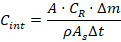









 , then the total survival factor of an N-stage system is given by:












 .
.
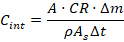








 Eduindex
You must be logged in to post a comment.