

By Shashikant Nishant Sharma
Head of Research, Track2Training, New Delhi, India
With the increasing use of digital communication and online payment systems, traffic challans are now commonly issued and delivered through electronic platforms. Many vehicle owners receive challan notifications through SMS, email, or mobile apps informing them about traffic violations and payment options. While this digital system has made enforcement and payment easier, it has also created opportunities for cybercriminals to exploit unsuspecting citizens. Fraudsters are increasingly sending fake traffic challan messages that look genuine but are designed to steal personal information or financial details.
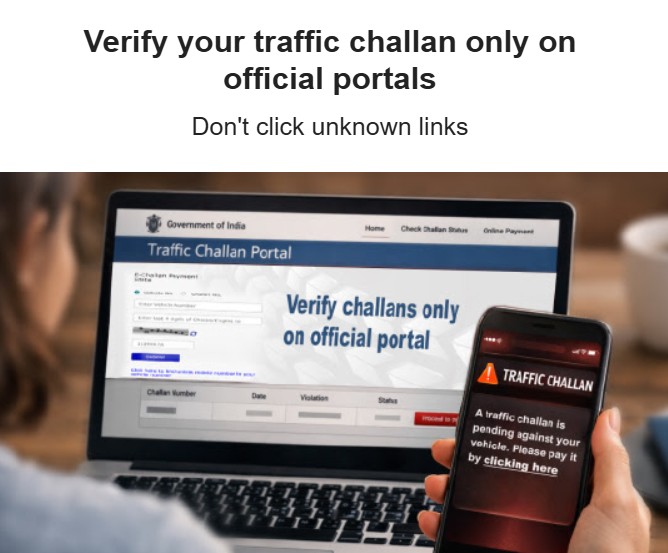
A traffic challan message received through email, SMS, or even WhatsApp may appear routine at first glance. The message might include details such as the vehicle number, a penalty amount, or a warning about legal consequences if payment is not made immediately. In some cases, these messages include links that direct users to websites that closely resemble official government portals. However, these links are often fraudulent and may lead to phishing websites that attempt to collect sensitive information such as debit or credit card numbers, CVV codes, PINs, and OTPs.
Understanding how these scams work is the first step in protecting yourself. Cybercriminals rely on urgency and fear to trick people into reacting quickly. A typical fake message might say that a challan has been issued against your vehicle and that failure to pay within a short time may lead to penalties, license suspension, or legal action. When users panic and click the link provided in the message, they may unknowingly land on a fake website designed to capture their personal and financial information.
To stay safe, it is essential to verify traffic challans only through authorised government websites. In India, the official portal for checking and paying traffic challans is https://echallan.parivahan.gov.in. This website is managed by the Ministry of Road Transport and Highways and provides a secure platform where vehicle owners can verify whether a challan has been issued against their vehicle. By entering details such as the vehicle number, challan number, or driving license number, users can safely check the status of any traffic violation and proceed with payment if required.
One of the most important safety precautions is to avoid clicking on unknown links received via SMS, WhatsApp, or email. Fraudulent messages often contain shortened or suspicious URLs that may look similar to official government websites but are actually controlled by scammers. Once a user clicks such a link, the site may prompt them to enter sensitive details or download malicious software. This can lead to identity theft, unauthorized bank transactions, or even complete compromise of the user’s device.
Another common trick used by cybercriminals is to persuade users to download apps through links shared in messages. These apps may claim to help users check or pay their traffic challans quickly. In reality, they may contain spyware or malware designed to monitor activity on the device and steal personal information. For this reason, users should never download apps from links received through SMS, messaging apps, or emails. If you need an application related to government services, always download it from trusted sources such as the Google Play Store or the Apple App Store.
Protecting your financial information is equally important. No legitimate government agency will ever ask you to share sensitive banking details such as your debit or credit card PIN, CVV number, or OTP over phone calls, messages, or emails. If you receive a message or call requesting such information in connection with a traffic challan, it is almost certainly a scam. These details should always remain private, and sharing them can lead to unauthorized transactions from your bank account.
It is also important to verify the sender of the message. Official traffic challan notifications typically come from verified government systems and do not request personal banking credentials. If a message asks you to provide sensitive financial details or urges you to make immediate payment through an unknown link, treat it as suspicious. Taking a few moments to verify the information through official channels can prevent significant financial loss.
Another helpful step is to regularly check your vehicle’s challan status directly on the official portal. Even if you have not received any notification, visiting the government website periodically allows you to confirm whether any fines are pending. This proactive approach reduces the risk of falling victim to fraudulent messages because you will already know the authentic status of your vehicle’s traffic records.
Public awareness plays a critical role in preventing such scams. Many victims fall prey to these frauds simply because they are unaware that such schemes exist. By sharing information with friends, family members, and colleagues, you can help others stay alert and avoid becoming victims. Elderly individuals and people who are less familiar with digital platforms are particularly vulnerable to such scams, so educating them about safe online practices is essential.
If you suspect that you have received a fraudulent traffic challan message, do not respond to it or click any links. Instead, report the message to the appropriate cybercrime authorities. In India, citizens can report online fraud through the National Cyber Crime Reporting Portal or by contacting local cybercrime cells. Reporting such incidents helps authorities track fraudulent activities and prevent others from being targeted.
Technology has made many aspects of daily life easier, including paying traffic fines online. However, it also requires users to remain vigilant and responsible while using digital services. By following simple precautions—such as verifying challans only through official portals, avoiding suspicious links, protecting personal financial information, and installing apps only from trusted sources—you can protect yourself from cyber fraud.
In conclusion, while receiving a traffic challan notification may appear routine, it is important not to act impulsively. Always verify the authenticity of the message before taking any action. The safest way to check and pay your traffic challan is by visiting the official government website https://echallan.parivahan.gov.in. Staying cautious and informed is the best defense against online scams, ensuring that your personal and financial information remains secure.
References
Bhatt, C., Arora, D., Kumar, G. R., Bhatt, P., & Singh, T. (2024, January). Paving the Way to Safety: An Automated Traffic Management and Challan Generation System. In 2024 International Conference on Intelligent and Innovative Technologies in Computing, Electrical and Electronics (IITCEE) (pp. 1-6). IEEE.
Srinath, R., Vrindavanam, J., Sumukh, Y. R., Yashaswini, L., & Chegaraddi, S. S. (2020, June). Smart Vehicle Recognition And E-Challan Generation System. In 2020 International Conference for Emerging Technology (INCET) (pp. 1-4). IEEE.
Kumar, R., Gupta, M., Shukla, S., & Yadav, R. K. (2021, September). E-challan automation for RTO using OCR. In 2021 third international conference on inventive research in computing applications (ICIRCA) (pp. 1-8). IEEE.
Deshmane, S., Raghatwan, J., Patil, S., Kirad, Y., & Gupta, S. (2024). Review of Smart Document Verification System for Traffic Rule Violation. Grenze International Journal of Engineering & Technology (GIJET), 10.
Sharma, S. N., & Dehalwar, K. (2025). A systematic literature review of pedestrian safety in urban transport systems. Journal of Road Safety, 36(4).
Talha, N., Iqbal, S., & Manan, S. A. (2023). Enhancing Traffic Management in Lahore: A Comprehensive Analysis of Drivers’ Perspectives on Interactions with City Traffic Police. Pakistan Journal of Humanities and Social Sciences, 11(04), 4107-4117.
Muley, R. R., Kethura, G. K., Lalitha, S., Yamini, B., & Kavya Sri, T. (2024, May). Intelligent Traffic Monitoring System Using Deep Learning: Triple Riding, Automatic License Plate Recognition, and Helmet Detection. In Doctoral Symposium on Computational Intelligence (pp. 391-402). Singapore: Springer Nature Singapore.
Asati, R. Fastag Fraud Detection: A Literature Survey. International Journal for Research in Applied Science and Engineering Technology.
Yadav, R., Korgaonkar, A., Yadav, S., Yadav, P., Shinde, V. D., & Sal, S. (2018). Traffic rules violation system using NFC card. International Research Journal of Engineering and Technology (IRJET).
Sharma, S. N. Traffic Signal Coordination for Effective Flow of Traffic. Track2Training, India
 Eduindex
You must be logged in to post a comment.