



Citation
Wankhade, A. M., & Kale, G. B. (2026). Preliminary Survey of Roadkill Cases of Some Animals in Buldhana District of Maharashtra, India. International Journal of Research, 13(13), 92–100. https://doi.org/10.26643/ijr/2026/s13/9
Aniket M. Wankhade¹*, G. B. Kale²
¹Research Student, ²Professor and Head, Department of Zoology,
G. S. Science, Arts and Commerce College, Khamgaon, District Buldhana Maharashtra, India
*Corresponding author: Aniket M. Wankhade (aniketw1095@gmail.com)
Abstract :
Roadkill is an increasing threat to wildlife due to expanding road networks and rising traffic intensity. The present study reviews and assesses roadkill incidents in Buldhana District of Maharashtra, India, an area that includes important wildlife habitats such as Lonar, Dnyanganga, and Amba Barwa Wildlife Sanctuaries. Roadkill surveys were conducted weekly over a three-month period from November 2025 to January 2026 along with 412 km of road network. Surveys were carried out during morning hours using field observations and photographic documentation. A total 42 road-killed animals belonging to 12 species and 12 families were recorded. The study highlights that roads significantly impact mammals, birds, and reptiles in the district. Species with ground-dwelling behaviour and frequent road crossings were found to be more vulnerable. The findings emphasize the need for basic mitigation measures such as speed regulation, warning signage, and road-planning strategies near forested areas to reduce wildlife mortality. This study provides baseline data that can support future conservation and road-safety planning in Buldhana District.
Keywords : Roadkill, wildlife mortality, biodiversity conservation, surveys, carrion, animals, Buldhana district, Maharashtra.
Introduction :
Road-kill animals are wild or domestic animals that are killed or injured due to collision with vehicles on roads and highways while crossing, feeding, or moving along road corridors, roads, power lines, and water channels are examples of linear infrastructures that shown to affect wildlife in a number of ways, including population decline, biodiversity loss and disturb wildlife habitat.
As of March 31, 2025, India’s total road infrastructure spans an extensive network of approximately 6,345,462 kilometres, solidifying its position as the second-largest road network in the world. This vast infrastructure is composed of: National Highways: 1,46,204 km, serving as the primary arterial network and representing a growth of nearly 60% since 2014.State Highways: 1,79,535 km, which connect major industrial and district centres within individual states. Other Roads: 6,019,723 km, a broad category encompassing rural roads (primarily under the Pradhan Mantri Gram Sadak Yojana), district roads, and urban municipal corridors.
Recent studies on roadkill indicate it is a significant, growing threat to global biodiversity, with millions of vertebrates killed annually due to increasing traffic volumes and habitat fragmentation. A 2025 study in the Western Ghats (India) estimated 5,490 animal deaths along a 50 km stretch annually, while a global dataset published in 2025 compiles over 200,000 records across 54 countries, identifying 126 threatened species at risk (Mongabay India Simrin Sirur, 2025). Roadkill studies worldwide have demonstrated their importance in identifying ecological corridors, vulnerable species, and mitigation priorities (Grilo et al., 2020). Wildlife mortality along National Highway corridors has also been reported in transit ecosystems of Maharashtra (Tayade, 2022). Despite such findings, Buldhana district remains under-studied, prompting the present investigation.
To observe and record roadkill animals in Buldhana District over a three‑month period (November to January). The purpose of this study is to generate preliminary data that can assist in wildlife conservation and road safety planning in Buldhana district because in Buldhana district have forest like Amba Barwa Wildlife Sanctuary, Dnyanganga wildlife Sanctuary and Satpura Range link to road highways.
Study Area :
The Buldhana district, located in Maharashtra, India, is approximately positioned between 19.51° to 21.17° N latitude and 75.57° to 76.59° E longitude, in the Western Vidarbha area. This district is a major tourist attraction owing to the ancient Lonar crater (Third largest in the world), declared a world heritage. National Highway 53 (formerly NH-6) passes through Khamgaon, Nandura, and Malkapur towns in the district. The total road network of Buldhana district includes approximately 86 km of National Highways, about 1,351 km of State Highways, nearly 1,168 km of Main District Highways, and over 2,700 km of other district and rural roads.
In Buldhana district, Lonar, Dnyanganga, and Amba Barwa Wildlife Sanctuaries support rich Biodiversity forests like flora and fauna.
Fig.No.1. Geographical Map of Study area
Methodology :
Roadkill surveys were carried out weekly over a three-month period from November 2025 to January 2026 using a motorcycle during morning hours (07:00–10:00 AM and 04:00 to 06:00 PM in the evening ). This survey method was followed by various researchers and found satisfactory in evaluating the road kills. (Das 2007; Baskaran 2010; Selvan 2012; Betleja et al. 2020). All dead animals observed on road surfaces and along road edges were documented, identified, and classified, and their conservation status was assessed using the IUCN Red List.
Photographs of road-killed animals were taken by mobile camera, and the specimens were identified and classified; however, some species could not be identified due to poor condition like- carrion. Field surveys, photographic collections, news paper documentation, and statistical methods were used during the assessment of roadkill animals.
Observations :
Table No. 1. Preliminary survey of roadkills in Buldhana District Observed during November-2025 to January-2026.
| Sr.No. | Common Name | Scientific Name | No.of Animal kills | Location |
| Mammals | ||||
| 1 | Indian Golden Jackal | Canis aureus | 8 | Akola Road |
| 2 | Jungle cat | Felis chaus | 2 | Nandura Road |
| 3 | Indian hare | Lepus nigricollis | 2 | Akola Road |
| 4 | Deccani sheep | Ovis aries. | 2 | Akola Road |
| 5 | Indian palm squirrels | Funambulus palmarum | 1 | Akola Road |
| 6 | Brown rat | Rattus norvegicus | 1 | Khamgaon Bypass |
| 7 | Indian grey mongoose | Urva edwardsii | 3 | Akola Road |
| Birds | ||||
| 8 | Tawny-bellied Babbler | Dumetia hyperythra | 2 | Botha Road |
| 9 | Greater Coucal | Centropus sinensis | 18 | Akola/Botha/ Nandura Road |
| 10 | White-breasted waterhen | Amaurornis phoenicurus | 1 | Akola Road |
| 11 | Asian green bee-eater | Merops orientalis | 1 | Pipalgaon raja Road |
| Reptiles | ||||
| 12 | Brown rat snake | Coelognathus erythrurus manillensis | 1 | Botha Road |
Table No.2. Family Wise Number of Species of Roadkills Observed during November-2025 to January-2026.
| Sr.No. | Family | Common Name | No.of Animal kills |
| 1 | Canidae | Indian Golden Jackal | 8 |
| 2 | Felidae | Jungle cat | 2 |
| 3 | Leporidae | Indian hare | 2 |
| 4 | Bovidae | Deccani sheep | 2 |
| 5 | Sciuridae | Indian palm squirrels | 1 |
| 6 | Muridae | Brown rat | 1 |
| 7 | Herpestidae | Indian grey mongoose | 3 |
| 8 | Timaliidae | Tawny-bellied Babbler | 2 |
| 9 | Cuculidae | Greater Coucal | 18 |
| 10 | Rallidae | White-breasted waterhen | 1 |
| 11 | Meropidae | Asian green bee-eater | 1 |
| 12 | Colubridae | Brown rat snake | 1 |
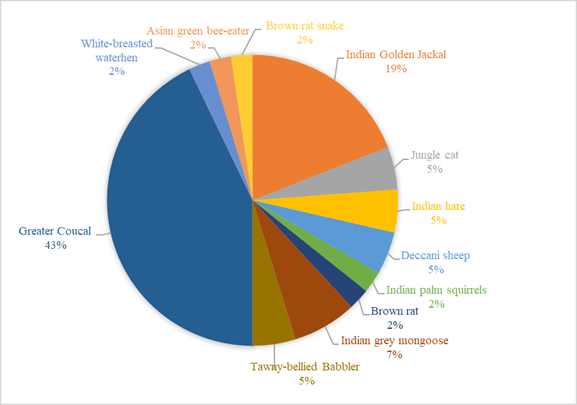
Fig. No.1. Species Wise Distribution of Roadkills Animals Observed during November-2025 to January-2026.
Fig. No.2. Family Wise Distribution of Roadkills of different Animals Observed during November-2025 to January-2026.
 |  |
| Dumetia hyperythra (Indian Golden Jackal ) | Centropus sinensis (Greater Coucal) |
 |  |
| Merops orientalis (Asian green bee-eater) | Amaurornis phoenicurus (White-breasted waterhen) |
 |  |
| Ovis aries (Deccani sheep) | Funambulus palmarum (Indian palm squirrels) |
 |  |
| Urva edwardsii (Indian grey mongoose) | Canis aureus (Indian Golden Jackal) |
Plate No.2. Photograph Some Roadkills of Buldhana District During
November-2025 to January-2026
 |
  |
Plate No.3. News Paper cutting related some Roadkills in Buldhana District.
Results :
A total of 42 road-killed animals belonging to 12 species and 12 families were recorded during the study period. Among mammals, the Indian golden jackal (Canis aureus) was the most frequently recorded species, with 8 road-killed individuals, followed by the Deccani sheep (Ovis aries), jungle cat (Felis chaus), and Indian hare (Lepus nigricollis), each represented by 2 individuals. The Indian grey mongoose (Urva edwardsii) was recorded with 3 individuals, while the Indian palm squirrel (Funambulus palmarum) and brown rat (Rattus norvegicus) were each represented by a single road-killed individual.
Among birds, the greater coucal (Centropus sinensis) was the most affected species, with 18 individuals recorded across Akola, Botha, and Nandura roads. The tawny-bellied babbler (Dumetia hyperythra) was recorded with 2 individuals, whereas the white-breasted waterhen (Amaurornis phoenicurus) and Asian green bee-eater (Merops orientalis) were each represented by 1 individual.
Reptiles were represented by a single species, the brown rat snake (Coelognathus erythrurus manillensis), with 1 road-killed individual recorded during the study period.
Discussion :
The study shows that roads cause the death of different types of animals, including mammals, birds, and reptiles. The Greater Coucal had the highest number of roadkill cases, which may be because it spends a lot of time on the ground and flies slowly. The Indian Golden Jackal also showed higher road mortality, possibly due to frequent movement across roads in search of food.
Most other species were recorded only once or twice, but their presence still shows that roads affect many kinds of wildlife. These results suggest that road traffic is a serious threat to animals in the study area, and simple measures such as reducing vehicle speed and placing warning signs could help in decreasing wildlife deaths.
Conclusion :
The findings of this study demonstrate that road traffic has a significant impact on wildlife, affecting mammals, birds, and reptiles. The higher number of roadkill incidents involving the Greater Coucal and Indian Golden Jackal indicates that species with ground-dwelling habits and frequent road crossings are more vulnerable to vehicle collisions. Although most species were recorded in low numbers, their occurrence highlights the widespread effect of roads on wildlife diversity. The study emphasizes the need for effective mitigation measures, such as speed regulation and warning signage, to reduce wildlife mortality and promote conservation in the study area.
References :
Forman, R. T. T., & Alexander, L. E. (1998). Roads and their major ecological effects, Annual Review of Ecology and Systematics, 29, 207–231.
Grilo, C., Bissonette, J. A., and Santos-Reis, M. (2020). The value of monitoring wildlife Roadkill, European Journal of Wildlife Research.
Hatti, S. S., & Mubeen, H. (2019). Roadkill of Animals on the road passing from Kalaburagi to Chincholi, Karnataka,India, Journal of Threatened Taxa, 11(7).
Pawgi, M., Joshi, Y., Deshmukh, S., Purohit, A., Pawgi, K., and Yosef, P. R. (2024). Monitoring Roadkill in Amravati, India: A citizen science project. European Journal of Ecology,10 (2).
Rawankar, A. S., and Wagh, G. A. (2022). Assessment of Avian Road kill Mortality in the state Highway Passing through Agricultural Landscape (Amravati–Paratwada, Maharashtra), Bioscience Biotechnology Research Communications, 15(2).
Simrin Sirur (2025) Mongabay India article.
Sushanth, S., Praphul, G., and Ganesh, S. R., (2025). Impact of Linear Infrastructure and Landscape Characteristics on Wildlife Roadkill in the Nelliyampathy Hills, Western Ghats, India, Scientific Reports, 15, 25333.
Tayade, S. N. (2022). Wildlife Mortalities on NH-161 Passing through Transit Ecosystem, International Journal of Ecology and Environmental Sciences, 4(2), 100–102.


You must be logged in to post a comment.