



Every American state carries at least one nickname. You see them on license plates, welcome signs, and sports jerseys. But most people have never stopped to ask where these names came from — or whether any government body ever made them official. The symbols usa encyclopedia covers every state designation in depth, and the origins of nicknames alone tell a remarkable story.
The answers are more complicated than you might expect.
Most State Nicknames Were Never Voted On
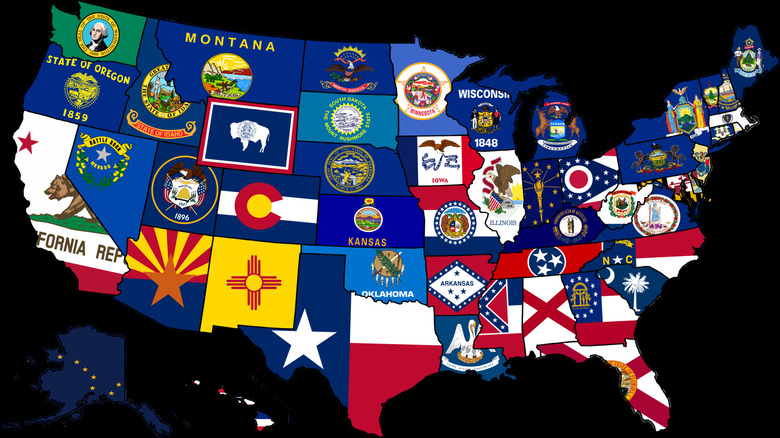
Here is something that surprises people: only about 14 of the 50 states have formally adopted their nicknames through state legislation. The rest exist through popular use, tourism marketing, or tradition — with no legal standing at all.
California’s “The Golden State” was codified by the state legislature in 1968. Florida made “The Sunshine State” official in 1970. Connecticut adopted “The Constitution State” back in 1959. But for the remaining states, nicknames occupy a gray zone: they show up on highway signs and bumper stickers while no law has ever declared them anything.
Washington State is a good example. “The Evergreen State” has been in use for decades, appeared in travel guides and state publications — yet as of early 2025, legislation to formalize it still had not passed. Arizona’s “The Grand Canyon State” had been on license plates since the 1940s but wasn’t legally adopted until 2011, after a California schoolgirl wrote a letter asking why it wasn’t official.
The Three Types of State Nickname
Researchers and educators generally split state nicknames into three categories:
Official — enacted by the state legislature, codified in statute. Examples: Nebraska’s “The Cornhusker State” (1945), New Mexico’s “The Land of Enchantment” (1999), South Dakota’s “The Mount Rushmore State” (1992).
Semi-official — appear on license plates, welcome signs, or official state materials but were never passed into law. Texas’s “The Lone Star State,” New York’s “The Empire State,” and Virginia’s “The Old Dominion” all fall here. They feel official. They are not, legally.
Unofficial — exist only through popular use, with no government recognition at any level. Alabama’s “The Yellowhammer State,” Georgia’s “The Peach State,” and Wisconsin’s “The Badger State” are examples.
The full breakdown of all 50 states with official status and adoption years is in the state nicknames and meanings guide.
Nature-Based Nicknames Are the Largest Group
If you scan all 50 nicknames, the biggest theme is geography and natural landscape. States named their territories after what people saw when they arrived: trees, animals, minerals, terrain.
Maine became “The Pine Tree State” because of its vast forests of Eastern White Pine — the same tree depicted on the state flag. Oregon’s “The Beaver State” honors the animal central to the Pacific Northwest fur trade. Washington’s “The Evergreen State” reflects its forests of Douglas fir and western red cedar.
Mississippi chose “The Magnolia State” after the flowering trees that grow across its landscape. Vermont’s name is itself a French phrase — les Verts Monts, meaning “the green mountains” — and “The Green Mountain State” is simply an English translation of the state’s own name.
Kansas has “The Sunflower State” because wild sunflowers blanket its prairies each summer. Kentucky’s “The Bluegrass State” refers to the blue-green grass in the central part of the state, where most of its famous horse farms sit.
Nicknames Rooted in History
Some nicknames preserve specific moments from American history — moments that would otherwise be forgotten.
Delaware earned “The First State” through a single meeting: on December 7, 1787, it became the first of the original 13 colonies to ratify the U.S. Constitution. Colorado became “The Centennial State” because it entered the union in 1876, the nation’s 100th year.
Tennessee got “The Volunteer State” during the War of 1812. Thousands of Tennesseans stepped forward to fight under Andrew Jackson at the Battle of New Orleans before any official recruitment had even begun. The memory stuck.
Oklahoma’s “The Sooner State” is darker. It remembers the settlers who entered Oklahoma Territory before the official land rush of April 22, 1889 — breaking the rules to claim land ahead of everyone else. The word “sooner” described anyone who jumped the starting signal.
Virginia’s “The Old Dominion” goes back further still. During the English Civil War, King Charles II reportedly gave Virginia the title for remaining loyal to the Crown. It predates American independence by over a century.
The Nicknames Nobody Can Fully Explain
Indiana’s “The Hoosier State” has no agreed-upon origin. The Indiana Historical Bureau lists over a dozen competing theories. One says early settlers called out “Who’s here?” when visitors knocked. Another credits a labor contractor named Samuel Hoosier who preferred hiring Indiana workers. A third traces the word to a dialect term for hill dwellers. No single explanation has ever been confirmed.
Missouri’s “The Show-Me State” is often attributed to Congressman Willard Duncan Vandiver, who reportedly said in 1899 that frothy eloquence did not satisfy him and that people had to “show him.” But the phrase was already circulating before that speech. Its true origin has never been pinned down.
North Carolina’s “The Tar Heel State” started as an insult. The name referenced workers in the tar and turpentine industry, or possibly Civil War soldiers threatened with tar on their heels to stop them retreating. Either way, North Carolinians eventually adopted it as a point of pride.
When States Change Their Nicknames
State nicknames are not always permanent. South Dakota replaced “The Coyote State” with “The Mount Rushmore State” in 1992, judging that a national monument made a stronger identity statement than a native animal. Arkansas dropped “The Land of Opportunity” in favor of “The Natural State” in 1995, shifting the emphasis from economic promise to natural beauty and outdoor tourism.
These changes reflect how states want to be perceived — by residents, by tourists, and in competition with neighboring states for attention and investment.
Why This Matters for Education
For students and teachers, state nicknames are a surprisingly efficient entry point into American history and geography. A single nickname can anchor a discussion of the Gold Rush, Reconstruction, the fur trade, or the Constitutional Convention. The stories behind “The Garden State” (New Jersey’s agricultural heritage feeding colonial cities), “The Beehive State” (Utah’s Mormon settlement patterns), or “The Last Frontier” (Alaska’s purchase from Russia in 1867 for $7.2 million) all connect directly to curriculum content.

 Eduindex
You must be logged in to post a comment.